Kampot Riverside Lodges: How to Choose a Peaceful Stay
Look past the river view and choose the room, setting and daily routine that will let you unwind.
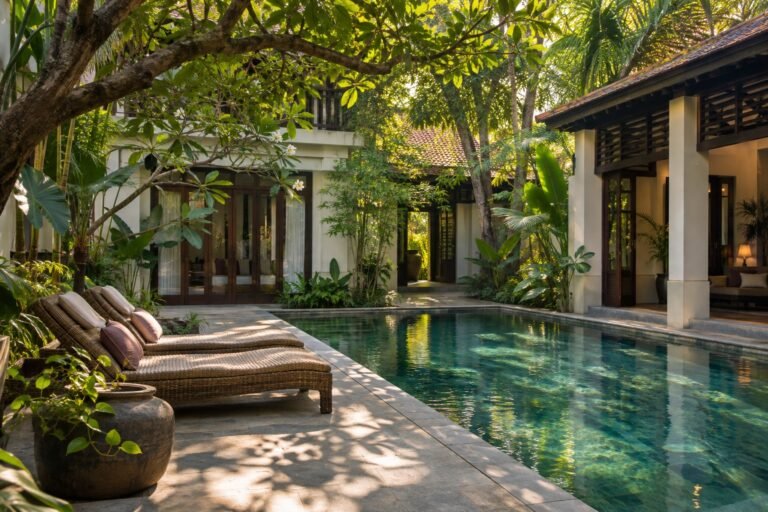
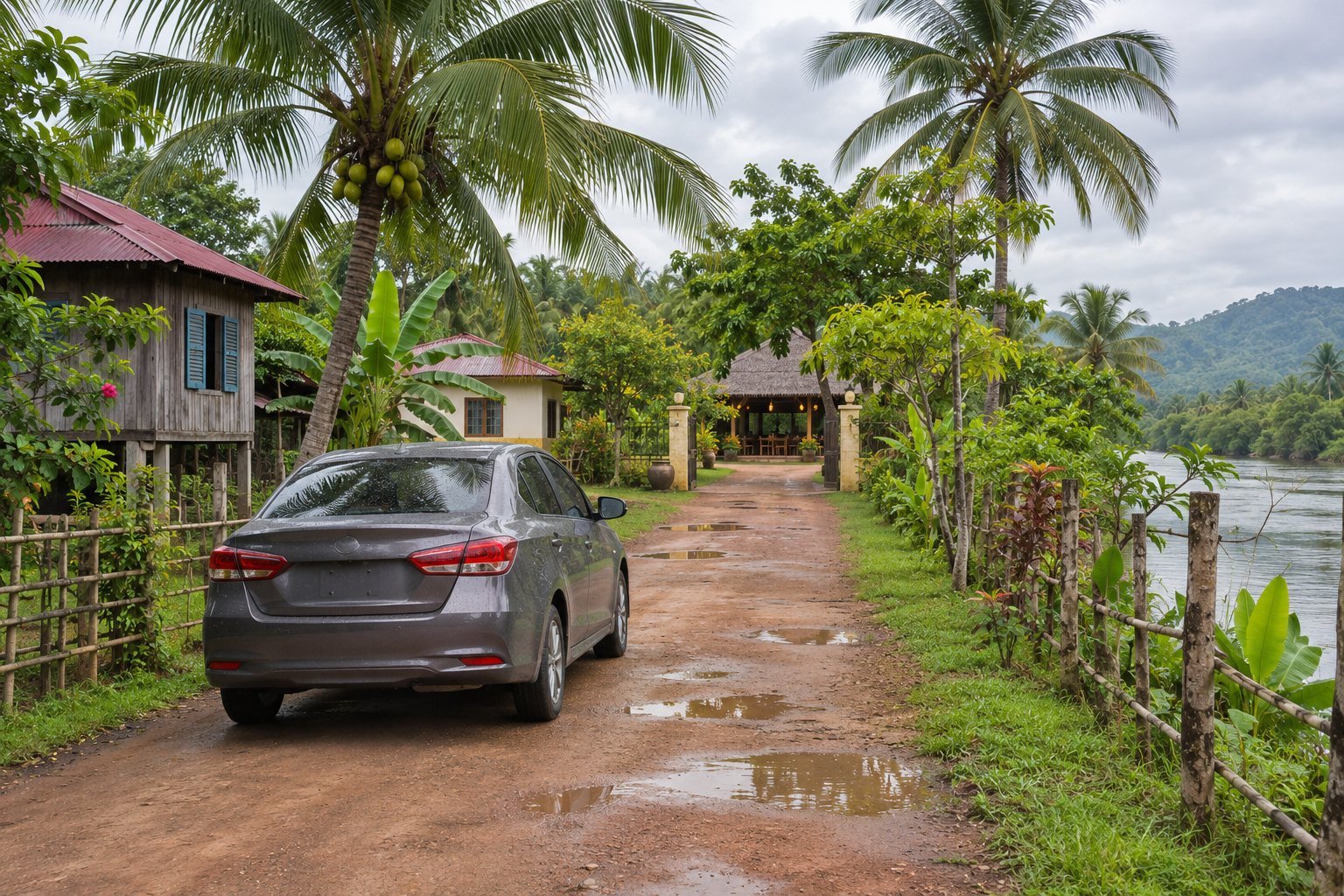
AI-generated illustration of a riverside lodge setting inspired by Kampot; no named property is shown.
Kampot riverside lodges promise an appealing kind of holiday: breakfast facing the water, a shaded seat and time to slow down. The best match depends on details that a sunset photograph cannot show, including the room’s position, cooling, evening noise and the journey back from dinner.
Choose the setting first, then the actual room. This guide compares the trade-offs, uses real properties to show how arrangements differ and gives you a practical way to shortlist a peaceful stay.
Your evening routine: dinner at the lodge or regular trips into town.
The exact room position, cooling and steps.
Room, breakfast, town rides and arrival transfers.
15 November 2026; use current quotes for your dates.
Choose the right kind of Kampot riverside stay
Start with how you want to spend the evening. If you like choosing a restaurant after a stroll, search close to town and check the actual walking route. If dinner at the lodge and a long morning on the terrace sound better, an upstream stay becomes more appealing.
Swipe within the table to see all columns.
| Setting | Best fit | What you give up |
|---|---|---|
| Near town | Meals out, short stays and frequent trips into Kampot. | The room may face a road or share its surroundings with busy businesses. |
| An upstream lodge | Reading, garden time and eating where you stay. | Each town visit needs a transport plan; the cheapest room can bring extra fares. |
| A larger riverside resort | Pools, family space and activities within the grounds. | More facilities create more possible sources of noise; room position matters. |
| A room set back in a riverside garden | Access to a river terrace without sleeping beside the landing. | You may have a garden view and shared waterside seating rather than a private river balcony. |
These are choices of setting, not fixed neighbourhood boundaries. For scale, Champa’s own FAQ places its properties 5 km from central Kampot; Sabay Beach estimates a 20-minute tuk-tuk ride into town.[1][2] Look at the route from the actual entrance to your likely dinner stop, including the bridge you would use. A pin across the river can look deceptively close.
A peaceful stay also depends on what happens around the room. Ask about music, private events, building work and boat activity for your dates. A rural location can still have neighbours and community celebrations; distance from town alone cannot settle the noise question.
Back to top ↑A practical scorecard for a peaceful room
Choose your non-negotiables first: perhaps air-conditioning, a separate bed for a child, no stairs or a room away from amplified music. Discard an option that cannot meet one of those needs before comparing prices.
For the remaining rooms, give each factor 0 if it fails your needs, 1 if it involves a compromise and 2 if it fits. Multiply by the weight below. Leave an unanswered question blank until the property replies; an attractive photograph is not evidence of quiet nights.
Swipe within the table to see all columns.
| Factor | Weight | Useful evidence |
|---|---|---|
| Night-time setting | ×4 | Room position, music finishing time, events during your dates and recent, specific guest comments. |
| Bedroom comfort | ×2 | Cooling in the exact room, screened openings or a usable net, bathroom arrangement and current room photographs. |
| Access and outside space | ×2 | Steps, path lighting, seating privacy and the route between room, restaurant and river. |
| Meals on site | ×1 | A current menu, evening service times and suitable food for your party. |
| Trips into town | ×1 | A clear pickup arrangement, return fare and someone to contact if plans change. |
For example, a room scoring 2, 2, 1, 1 and 1 earns 16 out of 20: 8 + 4 + 2 + 1 + 1. That suggests strong sleep and comfort prospects, with compromises elsewhere. Use the score to compare your own trade-offs, then revisit any compromise that would spoil the stay.
Look beyond the headline room photograph
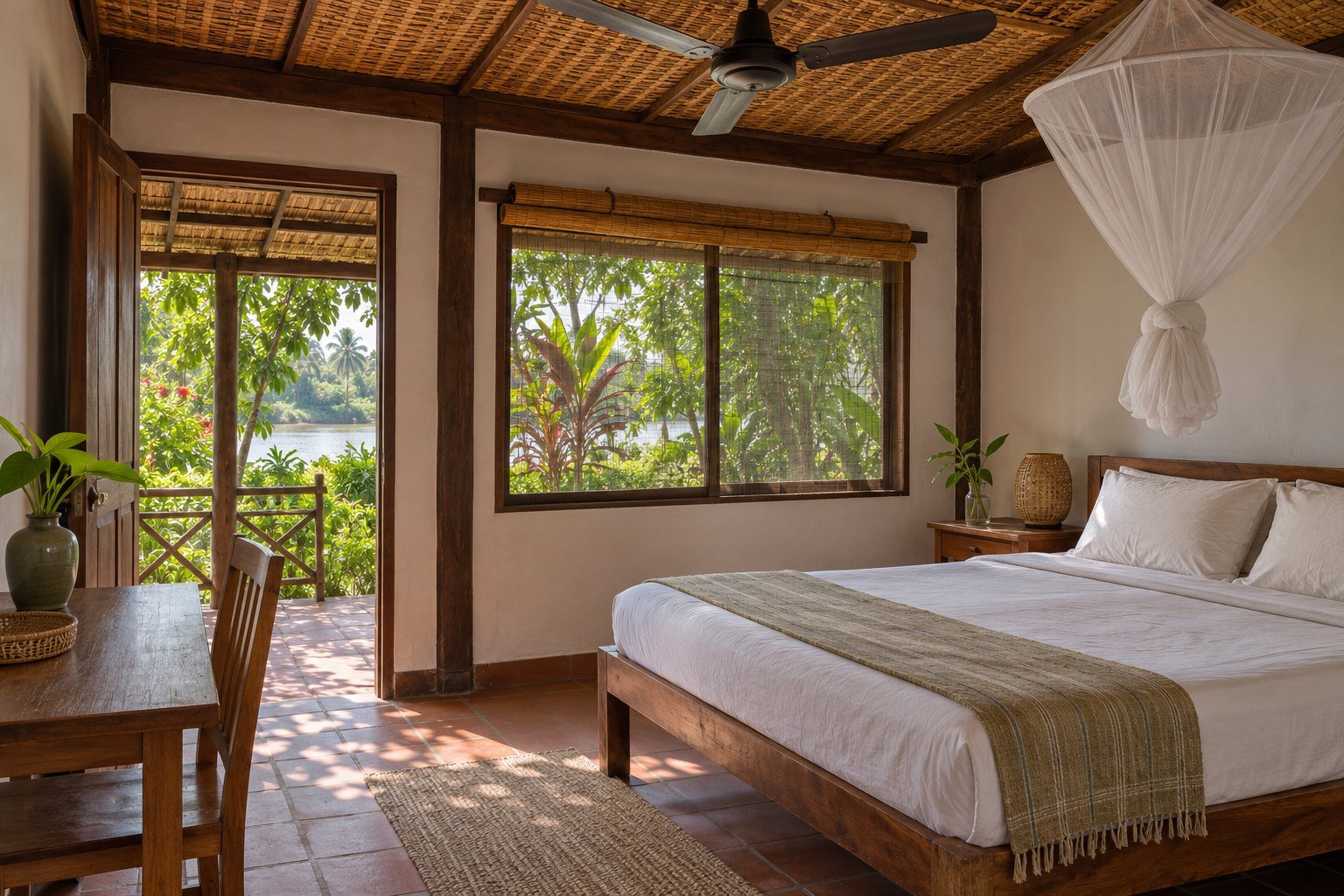
Check whether the pictured terrace belongs to your room, a whole house or everyone using the restaurant. “River view” and “riverfront” can describe quite different arrangements. A ground-floor garden room may suit you better than a photogenic treehouse reached by stairs.
For sleep, ask whether windows close fully, whether the air-conditioning is in the bedroom and whether a fan is also provided. If insects bother you, look for intact screens and ask how beds are protected. For a longer stay, add storage, somewhere to dry clothes and a comfortable chair to your list.
Read recent reviews for repeated details about the same room type. Several descriptions of late music carry more useful information than a high overall score. A single complaint with no room or date attached is harder to interpret.
Three properties that show why room choice matters
These examples were chosen to show different layouts and facilities, using published property information checked on 15 November 2026. Use them to start a shortlist, then compare current room details and prices for your dates.
Sabay Beach: river rooms or a garden setting
Sabay’s own description separates two rooms near the river from seven in its mango garden, including some treehouses. It lists air-conditioning and private bathrooms with hot showers, plus a restaurant and bar.[2] The useful decision is which room gives you the balance of view, stairs and distance from communal areas that you want.
Compare the exact room and cancellation terms for Sabay Beach on Agoda and Sabay Beach on Booking.com. Ask for its position on a simple property plan before paying extra for a river-facing category.
Champa Lodge: book a room or a whole house
Champa Lodge describes three Khmer houses containing five private rooms, bookable individually or as whole houses. Its room descriptions distinguish upstairs accommodation from ground-floor rooms; the FAQ lists air-conditioning, fans and private bathrooms.[3][1] This arrangement is worth considering when a family or group wants more control over who shares the building.
Champa Lodge and Champa Village have separate booking links. Keep the property name consistent when comparing Champa Lodge on Agoda with Champa Lodge on Booking.com; facilities shown for the sister property should not be assumed to belong to your booking.
Villa Vedici: pools and activities, with several room positions
Villa Vedici advertises two swimming pools, a bar and restaurant, and river activities.[4] Its accommodation page distinguishes fan-cooled and air-conditioned rooms, and identifies rooms near the bar, entrance or pool as well as others farther from the main area.[5]
That detail makes it a useful example of why choosing the resort is only half the job. If facilities matter to you, compare Villa Vedici’s room options on Agoda and Villa Vedici on Booking.com, then request a suitable position. If you want very little social activity around you, a smaller property may be a better starting point.
Back to top ↑Decide what you actually want from the river
A view, a place to sit and access for kayaking are three separate features. You can enjoy the river without needing to enter it. If the main attraction is breakfast beside the water, a garden room with a good shared terrace may be enough.
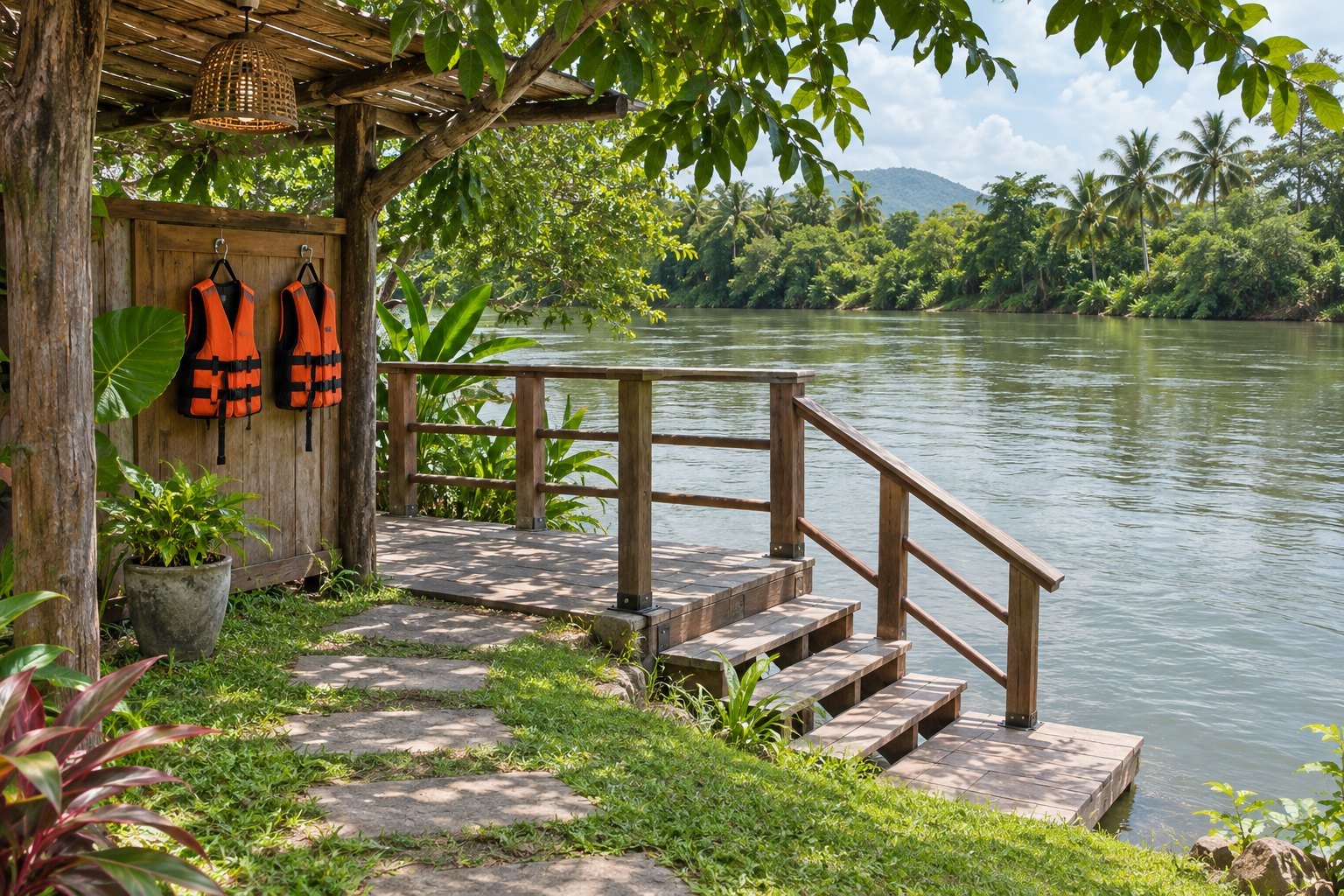
For water access, ask for a current photograph of the landing and the route down to it. Consider steps, handrails, slippery surfaces and how you would get back out. FCDO warns of strong river currents; take current local advice before entering.[6]
Before hiring a kayak, ask about suitable buoyancy aids, a briefing, the intended route and the return arrangements. A lodge offering equipment does not answer all of those questions by itself.
With young children, focus on the everyday layout: can a child move straight from the room or dining table to an unguarded bank? A room farther back, with a clearly separated route to the water, may make the stay easier to manage. Apply the same thinking to a pool.
Arrange the last part of the journey
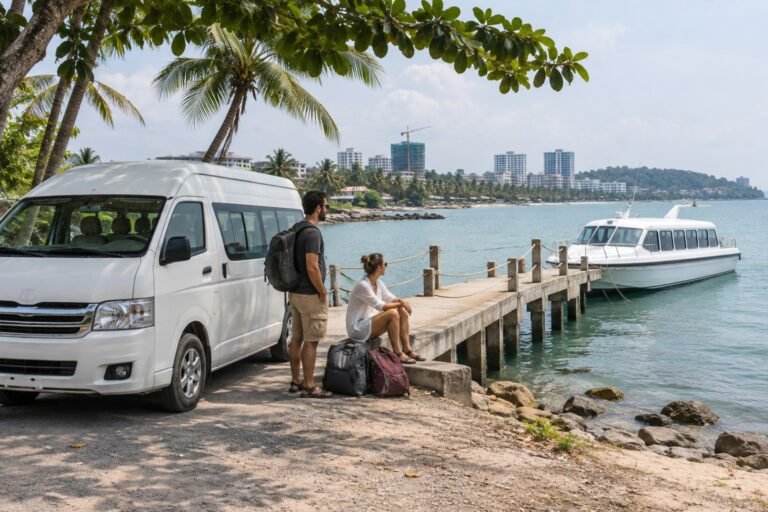
Send the lodge your arrival point and time, then ask for a pickup quote and a contact number. Use its exact map pin, particularly where a name has similar spellings or a sister property nearby. Agree where the driver will wait and what happens if your bus runs late.
For travel from Phnom Penh city, Giant Ibis publishes Kampot services; 12Go’s Phnom Penh–Kampot bus page provides a comparison of operators and departure points.[7][8] The intercity ticket’s arrival point needs checking separately from your lodge transfer. Airport pickups require their own quote.
Before choosing an upstream room, price the journeys you will actually make: arrival, departure and each evening in town. Ask whether the quoted town fare is one way or return, and how you arrange the journey back after dinner. Choosing a lodge should not leave you dependent on hiring a motorbike you would otherwise avoid.
If you expect to work, ask for a recent connection test from the room, not just the reception desk. For messages and maps, Airalo’s store is an optional place to compare Cambodia eSIMs for a compatible phone.[9] Download the arrival details too; a data package cannot promise a signal at every lodge.
Compare the stay, including meals and rides
Use the same dates, occupancy and room requirements for every quote. Include taxes, breakfast, extra beds, arrival transfers and the outings you intend to take. A refundable room can also be worth more to you than a slightly cheaper commitment.
Here is a hypothetical three-night stay for two adults sharing one room. All room prices include taxes; the figures are examples, not offers from the properties above. Both plans include three town outings, with one assumed walkable from the near-town option.
Swipe within the table to see all columns.
| Cost | Near-town option | Upstream option |
|---|---|---|
| Room | 3 × US$58 = US$174 | 3 × US$45 = US$135 |
| Breakfast for two | Included | 3 × US$12 = US$36 |
| Paid town outings | 2 return trips × US$6 = US$12 | 3 return trips × US$12 = US$36 |
| Arrival and departure transfers | 2 × US$5 = US$10 | 2 × US$9 = US$18 |
| Total for the couple | US$196 | US$225 |
The upstream room saves US$39 on accommodation but costs US$29 more overall in this example. It can still be the better holiday if its setting is why you came. If you plan to eat there most evenings, reduce the town journeys and compare the lodge’s menu with your food budget.
Put your own quotes into the Hotel Comparison Calculator, keeping all amounts in one currency.[10] Keep your room score alongside the result so that a small saving does not outweigh a major sleep or access compromise.
The message to send before booking
“We are looking for early, quiet nights on these dates. Which room would you suggest away from your bar, parking and boat landing? Are any events or building works planned? Please confirm its cooling, steps, private outside seating, evening meal times and a return fare into town.”
Adapt that message to your priorities and retain the reply with your booking. Choose the room whose details fit the stay you want, then give yourself enough time at the lodge to enjoy the setting you have paid for.
Frequently asked questions
Is an upstream Kampot lodge always quieter than staying near town?
No. Room position, music, events and nearby activity matter as well as distance. For early nights, ask about your dates and the exact room, then compare recent comments that describe when and where noise occurred.
Does a riverside room have its own terrace beside the water?
Check the room description and plan. A riverside property may have garden bedrooms and a shared river terrace. Sabay Beach, for example, distinguishes river-near rooms from rooms in its mango garden.[2]
Can I stay by the river without renting a motorbike?
Yes, if you arrange transfers and have a workable plan for meals. Ask the lodge to quote arrival, departure and return journeys into town. Staying on site for some evenings reduces both transport costs and the need to organise rides.
Should I choose a fan room or air-conditioning?
Choose according to how you sleep in warm conditions, then confirm the exact room’s cooling. A property can offer both types: Villa Vedici’s accommodation page distinguishes them.[5] A general amenities icon does not establish what your chosen room includes.
How many nights make a riverside lodge worthwhile?
Two nights give you one full day between arrival and departure; three give you two. Choose three if you want time at the lodge as well as outings. For a single night spent mostly in town, a simpler arrival and dinner location may matter more than an upstream setting.
Sources and checks
This guide draws on transport operators, accommodation and activity providers, official advice and destination research. Planning suggestions are editorial recommendations; check time-sensitive details for your travel dates.
- Champa Lodge — frequently asked questions
Checked 15 November 2026. - Sabay Beach — about the property
Checked 15 November 2026. - Champa Lodge — accommodation
Checked 15 November 2026. - Villa Vedici — resort overview
Checked 15 November 2026. - Villa Vedici — accommodation
Checked 15 November 2026. - FCDO — Cambodia safety and security
Checked 15 November 2026. - Giant Ibis — current published schedule
Checked 15 November 2026. - 12Go — Phnom Penh to Kampot buses
Checked 15 November 2026. - Airalo — Cambodia eSIMs
Checked 15 November 2026. - Taylor’s Trailblazing Travels — Hotel Comparison Calculator
Checked 15 November 2026.
Illustrations in this article were created for Taylor’s Trailblazing Travels. Third-party photographs, where used, are credited beside the image or in the source list.