Kampong Thom Travel Guide: Sambor Prei Kuk and Useful Stopovers
Decide whether to pause for a night, take a slower two-night stay or arrange the temples as part of a longer transfer.
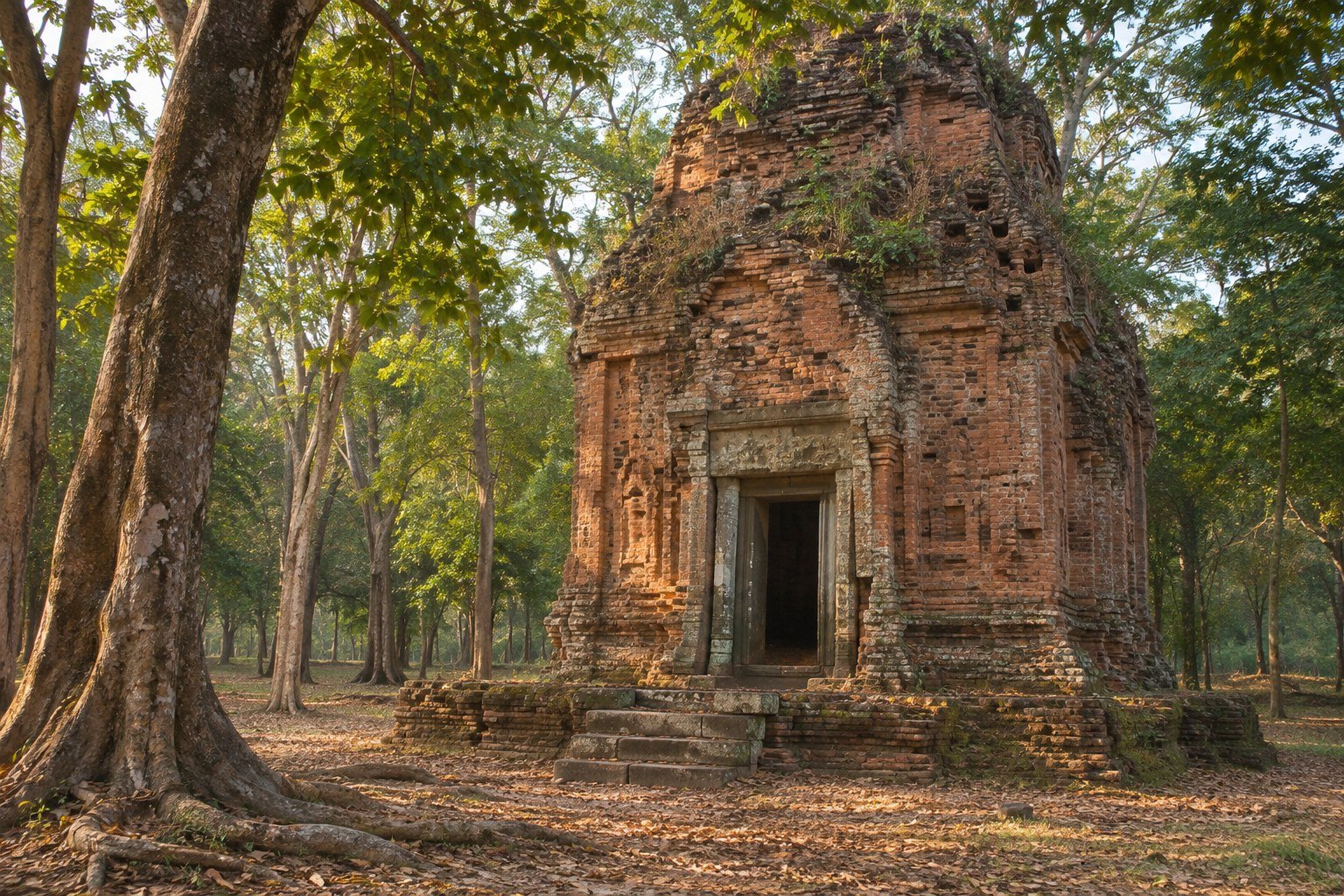
AI-generated illustration inspired by Sambor Prei Kuk’s brick temples and woodland setting.
Kampong Thom makes sense when you want the journey between Phnom Penh and Siem Reap to include more than a meal stop. Sambor Prei Kuk gives you a reason to turn off the main road, while a night or two in town creates time to appreciate it without rushing straight onwards.
The useful decision is how to fit the visit into your route. This guide compares an organised transfer, a one-night stop and a slower two-night stay, then covers admission, local transport, town bases and the small booking details that keep the stop enjoyable.
Some links in this guide are affiliate links. If you book or buy through them, Taylor’s Trailblazing Travels may earn a commission at no extra cost to you.
Best relaxed option
Two nights with the temple morning free of an onward deadline.
Key geographical detail
Sambor Prei Kuk is about 30 km from town, on a separate branch route.
Before paying
Distinguish the driver, site guide and admission charge.
One night, two nights or a transfer-day visit?
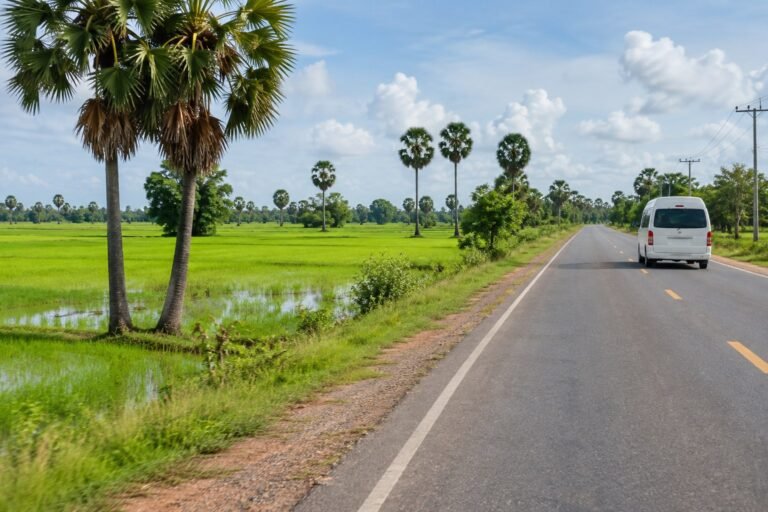
Kampong Thom sits on the National Road 6 corridor between Phnom Penh and Siem Reap. Sambor Prei Kuk is a separate excursion, about 30 kilometres northeast of town. Those two facts explain most of the planning: passing through Kampong Thom does not mean you will automatically pass the temple entrance.[2] [3]
Scroll within the table on a small screen.
| Option | Choose it when | What must be arranged |
|---|---|---|
| No overnight stay | You want to continue between Phnom Penh and Siem Reap in one long day. | A private sightseeing transfer with an agreed temple stop, luggage space and finish time. |
| 1 night | You can arrive in the afternoon and visit the temples next morning. | Local return transport and an onward departure with plenty of room for lunch and delays. |
| 2 nights | You want a full temple day without watching the clock for another bus. | A comfortable town base, a morning outing and an easy afternoon. |
| Longer stay | You have a specific interest in local heritage or a separately arranged countryside activity. | A reason for the extra days; do not assume a packed visitor programme. |
Two nights is the simplest recommendation if Sambor Prei Kuk is the main reason for stopping. One night can work well for organised travellers, especially with flexible onward transport. A through-transfer visit saves a hotel change but produces a substantially longer travel day.
Use the Trip Itinerary Planner to put the temple outing and onward journey on separate lines. That small distinction makes it harder to overlook the journey back from the site.
Back to top ↑Getting to Kampong Thom and finding the right stop
Current route listings offer road services from both Phnom Penh and Siem Reap. Many advertised day vans take about three hours from Phnom Penh, while some Siem Reap services are around two and a half to three hours; other departures take longer. Treat the duration attached to your selected service as an estimate, then add the journey between its stop and your hotel.[4] [5]
Compare Phnom Penh to Kampong Thom services and Siem Reap to Kampong Thom departures on 12Go. Check the arrival map before booking, and send it to your accommodation if you need a pick-up. Confirm the return or onward direction separately rather than assuming the same timetable applies.
Ask whether the ticket is a direct service, where larger bags are carried and how much time to allow at the boarding point. Keep a screenshot of the operator’s address and your booking. Different spellings, including Kampong Thom and Kompong Thom, can appear on accommodation pages; use the map to confirm you have the right town.
If you are travelling in a private car
Specify whether the car is taking you to a hotel, waiting during a temple visit or continuing to another city. These are different jobs. Agree how long you want at Sambor Prei Kuk, whether a separate site guide is included and where your luggage will remain while you walk. A driver who knows the route is not automatically providing a guided archaeological visit.
What makes Sambor Prei Kuk worth the detour?
Sambor Prei Kuk preserves the temple landscape of ancient Ishanapura, associated with the Chenla period in the late sixth and early seventh centuries. UNESCO inscribed it in 2017. Fired-brick towers, sandstone details and distinctive octagonal forms give it a different character from the better-known monuments at Angkor.[1]
The main groups are the northern Prasat Sambor, central Prasat Tao and southern Prasat Yeai, also commonly called Yeay Poan. They sit within a wider archaeological landscape. Rather than trying to identify every ruin, use a visit to understand how the groups fit together and why the brickwork and carved details matter.[1] [2]
A local guide is particularly useful if you have already seen Angkor and want help placing these earlier temples in context. Ask for a few clear comparisons: the materials, the tower shapes and what survives of the original decoration. You do not need to memorise dynasties to enjoy the place.
Give yourself time to look closely at one doorway or section of ornament before moving on. The appeal is often in those smaller observations, so a shorter, attentive visit can work better than covering every possible stop. Ask the guide which areas currently make the best route and where conservation work limits access.

Sambor Prei Kuk admission, hours and the local journey
The provincial tourism page publishes the following visitor details. Reconfirm them shortly before your outing, particularly if you are arranging a late arrival or travelling with children.[2]
Scroll within the table on a small screen.
| Detail | Published information | Planning consequence |
|---|---|---|
| Opening hours | Daily, 07:30–17:00. | Choose a morning start with time for the journey and ticket purchase. |
| International admission | US$10 per person, per day. | Two international adult visitors should allow US$20 for entry, before transport or a guide. |
| Cambodian visitors | Free admission. | Carry any identification needed to establish eligibility. |
| Location | About 30 km northeast of Stung Sen town. | Arrange a dedicated outward and return ride or an agreed onward transfer. |
| Local guide | Recommended by the provincial tourism page. | Ask separately about language, length of visit and the current fee. |
The published route runs along National Road 62 before turning onto Road 219. Leave navigation and the current approach to your driver, and agree the meeting point for the return. A standard intercity bus ticket should not be treated as a temple excursion.[2]
If you are travelling with children, ask which admission rate applies, and agree any guide fee separately. Ask whether payment must be in cash and whether entrance tickets are part of a package. Keep some small notes available rather than relying on a card machine at the moment you arrive.
Wear clothing covering shoulders and knees, observe restricted areas and do not smoke or leave litter at the temples.[2] Keep to established paths: Cambodia’s rural explosive-remnant risks are a reason to avoid shortcuts through unmarked ground.[8]
If step-free access is essential, ask for specific information about parking, paths, thresholds and toilets before booking. “Suitable for most travellers” does not answer those questions. A private vehicle can simplify the journey while leaving the walking conditions unchanged.
Back to top ↑Build a temple morning around your energy
Allow roughly two to three hours at the site as a starting plan, plus travel and a break. This is a suggested allowance, not a required tour length. Keen visitors may want longer; travellers with limited walking tolerance should agree a shorter route before setting out.
Scroll within the table on a small screen.
| Your priority | Suggested approach | What to leave out |
|---|---|---|
| A first introduction | Ask a guide for the main story and a manageable selection across the principal groups. | Small outlying ruins added only to lengthen the itinerary. |
| Architecture and photography | Spend longer with a few towers and details, with pauses to observe the light. | A rigid promise to reach every named group by a fixed minute. |
| Less walking or children | Choose one rewarding area first, then decide whether to continue. | Distant extras when the first part has already used the group’s energy. |
Arrange the vehicle’s waiting time around that plan. Carry water from town, and ask where toilets and a sensible rest stop are available rather than assuming every part of the site has facilities. Start early enough that lunch can remain relaxed.
November to February is a sensible first choice for a visit, drawing on Cambodia’s cooler, drier seasonal pattern; April and May are generally hotter.[10] Forest cover still leaves you exposed to heat or rain. If the ground is wet, slow down and use shoes with grip. A waterproof layer for the journey and a dry bag for a phone are more useful than trying to keep to an ambitious walking circuit in poor conditions.
UNESCO highlights the fragility of the surviving monuments. Respect barriers, leave fallen material where it lies and avoid touching or climbing the masonry for a photograph. A guide can help you understand restricted areas without entering them.[1]
Back to top ↑Where to stay and what to do in town
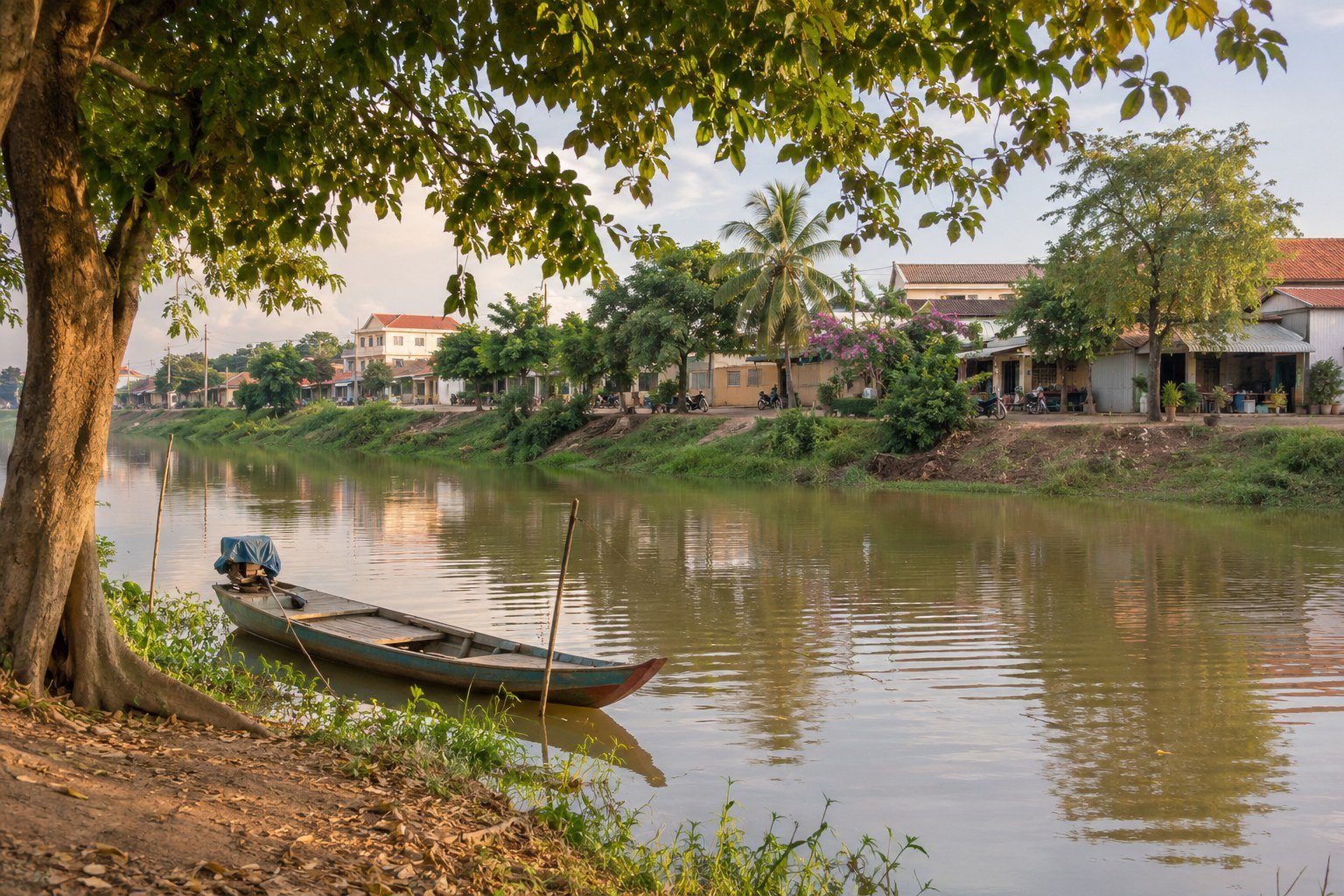
Kampong Thom is useful as a comfortable pause between journeys, with the Stung Sen running through the provincial town. Choose a property that makes your arrival, meals and temple pick-up straightforward. The address on the map is more helpful than a broad claim that a hotel is “central”.[3]
Scroll within the table on a small screen.
| Position | Why choose it? | Check first |
|---|---|---|
| Near the town centre and river | Easy access to everyday town life and a short outing before dinner. | Walking route, road crossings and which side of the river the property is on. |
| Along the National Road 6 corridor | Potentially convenient for your selected intercity service. | The exact boarding point and whether road-facing rooms are noisy. |
| A garden property beyond the centre | A quieter afternoon and more reason to enjoy the accommodation. | Restaurant opening, vehicle access and the cost of repeated rides. |
Compare Kampong Thom accommodation on Agoda and Kampong Thom stays on Booking.com. Check recent comments on the room, meals and transport help, then compare the same cancellation terms. A two-night stay makes a pleasant sitting area more valuable than it is for a late arrival and early departure.
Keep the town afternoon uncomplicated
Make time for lunch, a short look around the centre and a stroll beside an accessible part of the river. Ask your host which walking route works well today and where to eat nearby. Do not reserve a full sightseeing schedule simply because you have an afternoon free; the pause is part of the reason for staying.
If you want another substantial outing, Phnom Santuk offers a hilltop religious setting with a long stair approach. Treat it as a separate choice and check access with a local driver; adding a climb after a hot temple morning will not suit everyone.[7]
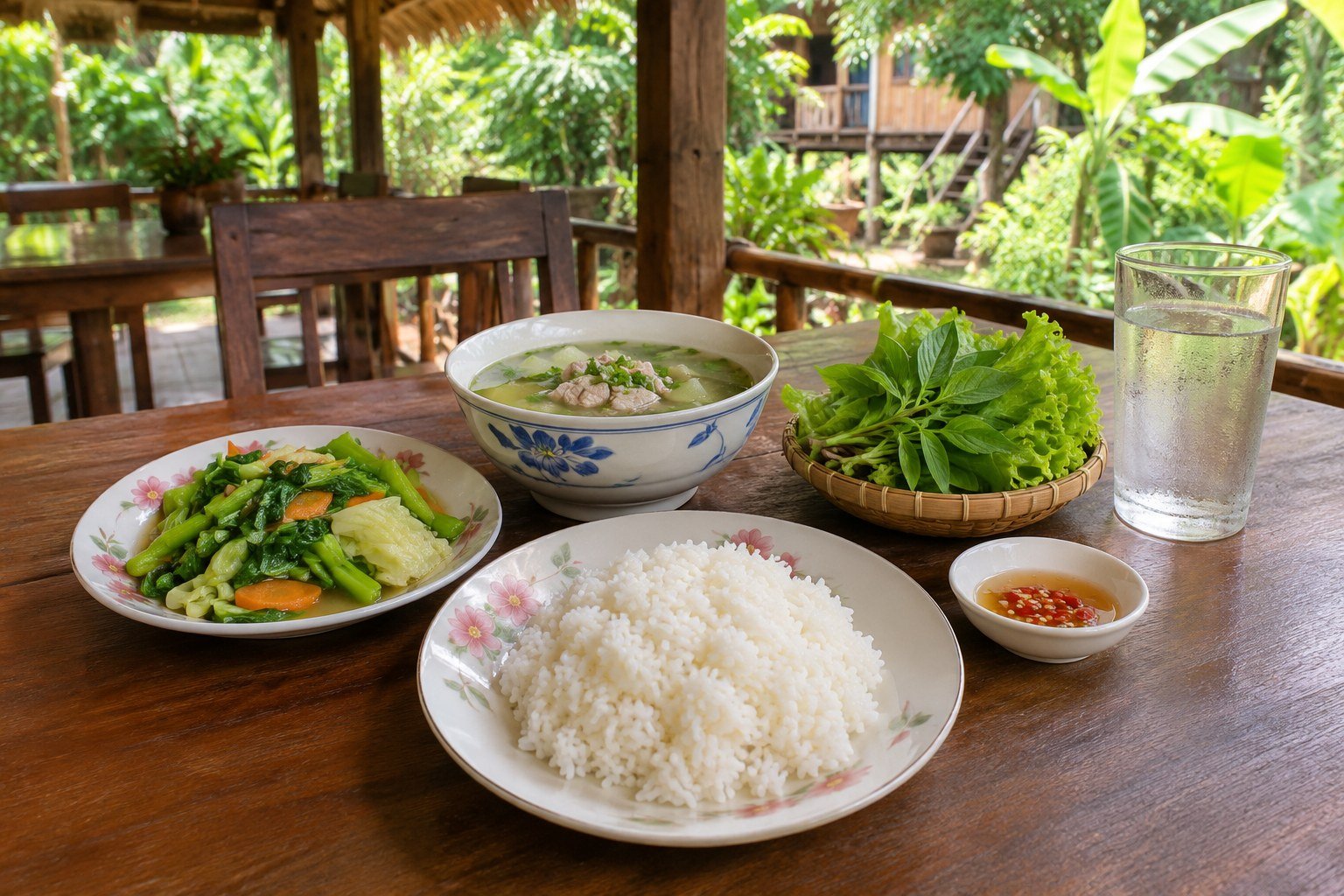
For meals, start with the practical questions: where can you sit comfortably, what is being cooked and can the kitchen meet your needs? If you avoid meat or fish, explain whether that also includes stock, fish sauce and shrimp paste. Ask for a simpler dish when the ingredients are unclear.
Two stopover plans that leave time for lunch
One night: arrive, visit, continue
Arrive in the afternoon, check in and confirm the next morning’s transport. Keep the evening near the hotel. Visit Sambor Prei Kuk in the morning, return for lunch and collect your luggage before continuing on a suitably timed service. Book the outward connection only after the driver confirms the likely return time, with a useful margin for delays.
If the only convenient onward bus leaves too early, change the transport or add a night. Cutting the temple visit to protect a cheap ticket defeats the purpose of stopping. A private onward car may be worth comparing when several people share the cost.
Two nights: give the visit its own day
Arrive and settle in on the first afternoon. Spend the next morning at Sambor Prei Kuk, then have lunch and a quiet town or hotel afternoon. Leave the following morning. This plan removes the same-day connection from the temple visit and is the better fit for anyone who dislikes watching the time.
Only add Phnom Santuk or another arranged outing if your group actively wants it. A second attraction is optional; you have already used the stop well by giving Sambor Prei Kuk an unhurried morning.
Scroll within the table on a small screen.
| Confirm | Leave room for |
|---|---|
| The driver’s return estimate | A slower walk, a wet section or a late start. |
| Hotel luggage arrangements | Collecting bags and using the facilities before departure. |
| The operator’s actual boarding point | A separate ride across town, if needed. |
| The ticket’s reporting time | Arriving before departure rather than at the advertised leaving minute. |
Enter both the local outing and the intercity journey in the Itinerary Pace Checker if you are comparing the one- and two-night versions. Use the transfer hours from your own booking, not a best-case search result.
Back to top ↑Could a sightseeing transfer replace the overnight stop?
A private transfer can work if you want Sambor Prei Kuk but would rather keep the same main hotel stops. It also keeps luggage in one vehicle. The cost buys control over the road day, so agree the part you care about most before accepting a long list of additional stops.
One comparison option is this Phnom Penh–Siem Reap sightseeing transfer on Viator. The listing includes Sambor Prei Kuk among its stops and advertises roughly nine to eleven hours with an English-speaking driver. It also describes the reverse direction by arrangement. Confirm the exact direction, hotel pick-ups, admission costs and whether you want a separate site guide.[6]
The advertised product is not wheelchair accessible and is not recommended for travellers with back problems. It should be assessed as a long sightseeing day, not a normal direct transfer. If it looks too demanding, a night or two in Kampong Thom is the more comfortable solution.[6]
Compare the complete cost
Ask for the extra price of the temple detour over a direct car journey. Compare that with the alternative: a room, local temple transport and the onward ticket. Keep the admission charge on both sides of the comparison, because changing transport does not remove it.
For example, if the extra vehicle cost is £80 for your group, it is £40 each for two people or £20 each for four. Add any separate guiding and meals. Actual quotes depend on the route and dates; sharing a vehicle changes the calculation more than shaving a few pounds off a hotel room.
Use the Travel Budget Calculator for your own accommodation and transport figures. Keep them in one currency, and do not mix a per-person tour price with a per-vehicle quote.

Final questions before you book
Is Sambor Prei Kuk included in an Angkor ticket?
Budget for Sambor Prei Kuk’s own ticket, as shown above. An Angkor pass or a transport booking should not be treated as proof of admission here.[2]
Can I see it without a guide?
The provincial tourism page recommends a local guide; it does not state that every visitor must hire one.[2] A guide adds most value when you want the history explained or a visit adapted to your interests. Ask about the language, fee and duration before agreeing, and follow any current on-site access instructions.
What should I save on my phone?
Keep the hotel address, boarding point, driver contact and ticket available offline. If you need mobile data, the Airalo store offers Cambodia plans; select the country and check that your phone and chosen plan are compatible.[9] Agree a physical meeting point as well, so the return ride does not depend on messages arriving.
What is the most common planning mistake?
Treating the temples as a quick roadside pause. They need their own journey and time on foot. Choose one night only when the onward connection fits comfortably; choose two when you want the main visit free of a departure deadline. Use a private transfer when avoiding another hotel change matters more than keeping the road day short.
Back to top ↑Sources and checks
Official visitor information and operators’ published details were checked for this guide. The suggested number of nights, daily pace and booking priorities are our editorial recommendations; reconfirm access, departures and prices for your dates.
- UNESCO — Temple Zone of Sambor Prei Kuk
World Heritage significance, temple groups and conservation. Checked 14 November 2026. - Visit Kampong Thom — Sambor Prei Kuk
Published visitor hours, admission, route and conduct. Checked 14 November 2026. - Visit Kampong Thom — Province overview
Stung Sen, National Road 6 and town geography. Checked 14 November 2026. - 12Go — Phnom Penh to Kampong Thom
Individual day-service listings. Checked 14 November 2026. - 12Go — Siem Reap to Kampong Thom
Individual service durations and boarding details. Checked 14 November 2026. - Viator — Phnom Penh–Siem Reap transfer with sightseeing stops
Example private transfer via Sambor Prei Kuk; check inclusions. Checked 14 November 2026. - Visit Kampong Thom — Phnom Santuk
An optional hilltop religious outing. Checked 14 November 2026. - FCDO — Cambodia safety and security
Rural paths and explosive-remnant risks. Checked 14 November 2026. - Airalo — Cambodia plans
Cambodia eSIM availability and compatibility. Checked 14 November 2026. - World Bank — Cambodia climate risk country profile
Seasonal climate background for choosing dates. Checked 14 November 2026.
Illustrations in this article were created for Taylor’s Trailblazing Travels. Third-party photographs, where used, are credited beside the image or in the source list.