
Using Cash and Cards in Malaysia: ATMs, Exchange and Everyday Payments
A practical mix of ringgit, cards and digital payments, with enough flexibility for the next stop on your route.
AI-created editorial illustration of a Malaysian market scene.
Using cash and cards in Malaysia works best with a simple division of jobs: a card for payments the business accepts, ringgit for the purchases you have not confirmed, and a second way to pay if your first one fails. The aim is to avoid both a wallet full of unnecessary cash and a trip that depends on one phone.
Malaysia uses the ringgit, written as RM and identified internationally as MYR. Current banknotes include RM1, RM5, RM10, RM20, RM50 and RM100. [1] This guide helps you choose a payment method, understand the costs of obtaining cash and calculate a reserve for your actual route.
Currency choice
Choose MYR for Malaysian purchases when offered MYR or GBP; check the final screen and receipt.
Cash amount
Base it on cash-only spending until the next dependable ATM, plus a reserve.
Card backup
Keep a second physical card separately; a phone wallet alone is a fragile fallback.
QR payments
Confirm your bank or wallet is supported. A QR code is a payment route, not universal acceptance.
Choose a payment mix for your route
Start with where you will sleep and how you will spend your days. A central hotel stay and a remote lodge stay have different cash needs, even when their total holiday budgets are similar. Ask about payment methods before a boat transfer or a long drive, while arranging the stay is still easy.
| Situation | First choice to consider | Useful backup |
|---|---|---|
| Accommodation or a larger planned purchase | A card the business confirms it accepts; check deposit conditions | A second card with enough available funds |
| Food stalls, markets and small purchases | Ask whether cash, card or a compatible QR payment is accepted before ordering | Small ringgit notes |
| Rural, island or lodge stay | Confirm meals, transfers and extras with the host before travelling | Cash covering the gap until your next dependable ATM |
| Merchant displaying DuitNow QR | A supported and working bank or eWallet app | Cash or a separate card terminal, if available |
| Hotel or car-hire security deposit | The precise card type and cardholder required by the booking terms | Available funds kept outside your daily spending allowance |
Do not treat every small business as cash-only, or every modern-looking business as willing to take your particular card. The useful question is specific: “Can I pay this amount with this card or app?” PayNet’s cross-border QR service works through participating banking and wallet apps, so the QR logo alone is not enough. [7]
For a city cash stop, use the bank’s locator rather than a remembered shop name. Penang’s tourism bureau lists banks and licensed exchange services around George Town and other commercial areas, but that does not establish cash access at your next island or rural accommodation. [2]
Back to top ↑Set up a simple arrival routine
Before leaving the airport, make sure you have a workable way to pay for your first transfer and first meal. A small cash withdrawal or exchange can be sensible if those payments are uncertain; converting your entire holiday budget immediately is unnecessary.
- Check the amount and payment method for your first transfer before joining a queue.
- If you need cash, find a bank-operated ATM with a network logo matching your card. Maybank, for example, explicitly accepts several overseas card networks, including Visa and Mastercard, for ringgit withdrawals. [3]
- Read the ATM fee and conversion screens before confirming. If the terms are unattractive, cancel and consider another machine or an authorised exchange counter.
- Count the notes discreetly, put your card away and split your spending money from your backup funds.
- Use an ordinary purchase to obtain some smaller notes where convenient. Avoid expecting a small stall to break a large note for a tiny bill.
Keep a written version of your accommodation address and your bank’s overseas contact number. If your phone is flat or your mobile data has not connected, you can still reach the hotel and deal with a payment problem.
Back to top ↑ATMs: separate the fee layers
There is no single withdrawal limit that applies to every visitor. Maybank states that its withdrawals depend on both the issuing bank’s limit and the ATM’s transaction limit. A card that works at one machine may still be unable to withdraw the amount you request at another. [3]
Check the issuer’s tariff before travelling
Look separately for overseas cash-withdrawal charges, foreign-currency charges and any monthly or daily allowance. MoneyHelper explains that debit-card costs vary by bank and account: a competitive card-network exchange rate can still be followed by an issuer fee. The ATM itself may charge separately. [6]
A credit card is not automatically the cheapest way to obtain cash, even if it is good for purchases. Cash withdrawals can attract fees and interest under different terms from ordinary spending. Check those terms before using one at an ATM. [12]
Read the ATM screen in this order
- Check the amount of ringgit requested.
- Identify any ATM operator charge.
- Identify any offer to convert the withdrawal into pounds.
- Confirm only if you understand the total and the currency being charged.
Choosing MYR deals with the currency-conversion decision; it does not make a disclosed ATM surcharge disappear. Equally, a card advertised as fee-free abroad cannot promise that every independent ATM operator will charge nothing.
If a withdrawal fails, check the bank app for a block or limit, then try a smaller amount or another bank’s machine. Repeatedly entering the same request without understanding the problem is less useful than checking the cause.
MYR or GBP: understand the conversion choice
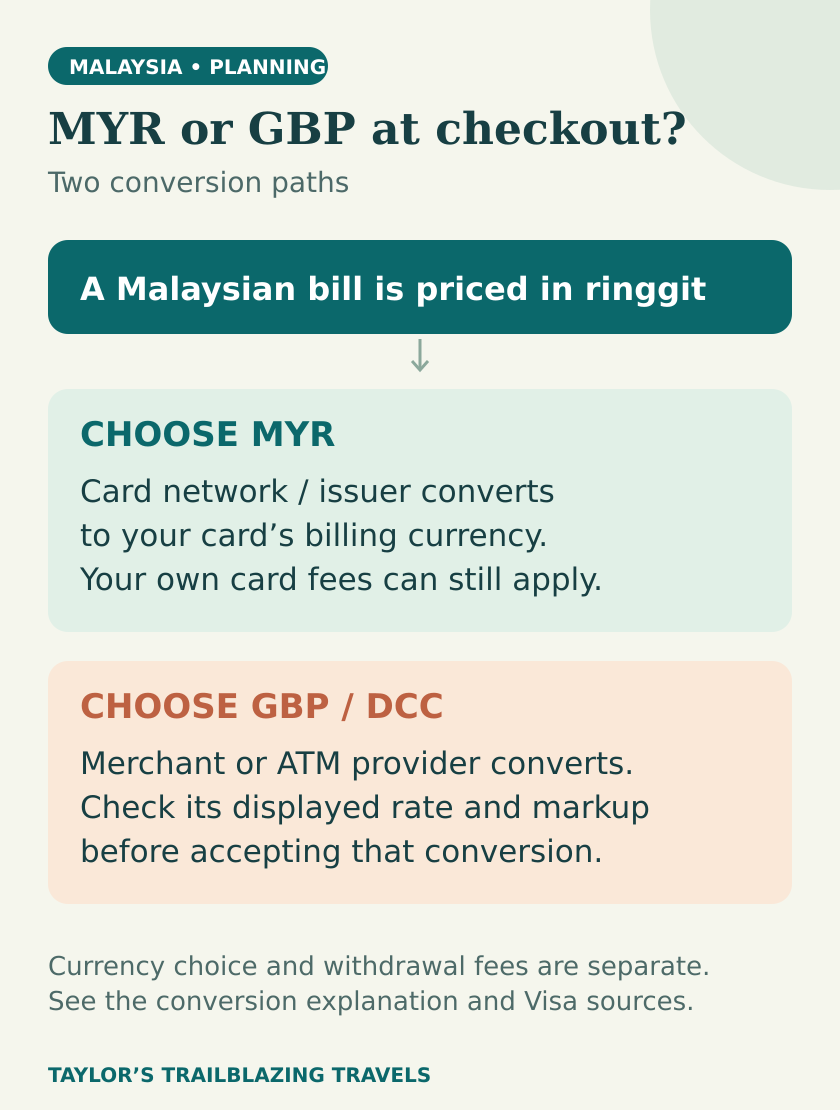
When a Malaysian terminal or ATM offers to charge you in pounds, it is offering dynamic currency conversion, usually shortened to DCC. The merchant or ATM provider supplies that conversion. If you choose ringgit, conversion is instead handled through your card arrangement. Visa advises choosing the local currency to avoid the merchant’s conversion markup. [4]
Read the words, not the colour or size of the buttons. A screen may describe the GBP option as a guaranteed rate or offer it more prominently. Visa says customers should be shown both currency amounts, the exchange rate and any added fees or markup, and should be allowed to accept or decline the conversion themselves. [5]
Declining DCC does not mean declining to take out ringgit. It means declining that provider’s exchange calculation. The card network and your issuer will still apply their own conversion arrangements, including any fees in your contract.
At a shop, ask for the transaction in MYR before tapping or entering a PIN. Check the receipt afterwards. If a merchant converted the bill despite your choice, raise it promptly with the merchant and your card issuer. [4] Keep the receipt; it is more useful than trying to remember the currency selected later.
Calculate cash for the next part of the trip
A useful cash target is based on the time until your next reliable ATM, rather than the total length of the holiday. Write down three inputs: your expected cash-only daily spending, the number of days to cover and a contingency reserve. Add any specific cash-only booking separately.
Cash target = daily cash allowance × days until the next dependable cash stop + contingency + known cash-only bookings.
| Example | Daily cash allowance | Days | Reserve | Cash target |
|---|---|---|---|---|
| City stay with accommodation paid by card | RM80 | 2 | RM40 | RM200 |
| Remote stay with more unconfirmed payments | RM120 | 3 | RM120 | RM480 |
The first calculation is RM80 × 2 + RM40 = RM200. The second is RM120 × 3 + RM120 = RM480. If the remote stay also has a confirmed RM150 cash-only transfer, the second target becomes RM630. Replace every input with your own plans; neither example includes a cash hotel bill, shopping spree or emergency evacuation.
The reserve is an editorial planning choice, not a claim about the probability or cost of a problem. Increase it when a failed payment would leave few alternatives. Reduce the main allowance when the host confirms that meals and transfers are already paid.
Balance withdrawal charges against carrying too much
If an ATM has a fixed fee, repeated small withdrawals repeat that fee. In a purely illustrative example, three RM200 withdrawals with an RM8 charge each cost RM24 in operator fees; one RM600 withdrawal costs RM8. The RM16 difference is arithmetic, not a quoted Malaysian bank tariff. Percentage-based card charges do not shrink in the same way.
That does not justify carrying a large sum you cannot store safely. Plan a sensible cash stop and retain a separate backup card. To fit the cash allowance into the wider holiday, use the Travel Budget Calculator with your own GBP equivalents and booking figures. The tool does not supply a live exchange rate.

Compare money changers by the amount you receive
Use an authorised provider. Bank Negara Malaysia publishes a directory of licensed money-services businesses, including currency-exchange premises; match the business and address rather than relying only on a familiar-looking sign. [8] Penang’s tourism bureau also recommends authorised exchange services, comparing rates and retaining receipts. [2]
Ask a clear question: “How many ringgit will I receive for this amount of pounds, after all charges?” That is easier to compare than an attractive rate displayed without its conditions. Check whether the board quotes per pound or per hundred pounds, and whether the displayed rate is the one at which the counter buys your currency.
Count the cash before leaving, keep the receipt and request a useful mix of denominations if available. If you are exchanging notes, check the provider’s document and banknote-condition requirements beforehand. Taking a passport for identification avoids an unnecessary return journey when it is requested.
There is no permanent “best airport rate” or universally cheapest city counter. Compare the net amount for the transaction you are making, including the time and transport cost of reaching another counter. A small difference is rarely a good reason to miss a booked transfer.
Back to top ↑DuitNow QR and tourist eWallets
A QR sticker is not a card terminal
DuitNow cross-border QR payments require a participating bank or wallet. A foreign card stored on your phone does not by itself give your banking app access to that service. Check the supported-app list and complete a small transaction before treating QR as your main payment method. [7]
Check registration and top-up costs before relying on TNG eWallet
Touch ’n Go’s tourist service is available to visitors from selected countries. Its guidance requires an eligible mobile number, identity verification and an operational account. UK travellers should check the current country selector and verification process rather than assuming that any overseas number will work. [9]
Test a small top-up, read the amount charged and consider what you will do with leftover funds. The provider’s fee table reviewed on 6 November 2026 lists a fee of up to 2.6% for non-Malaysian credit-card reloads. Your card issuer’s own charges may be additional; check the app’s actual confirmation for your chosen funding method. [10]
The standard Touch ’n Go card used at transport and toll touchpoints has its own stored balance, distinct from the eWallet, with particular linked-payment arrangements for eligible uses. Do not assume that adding money to the app has automatically funded every card or toll payment. [11]
For a short trip, the wallet is an optional convenience. If registration fails or its funding costs outweigh the benefit, use the card-and-cash plan you prepared instead.
Back to top ↑If a payment fails, deal with the specific problem
For a card decline, ask the merchant whether the terminal supports your network, then check your available balance, card controls and bank messages. If online payment requires a code or approval, use the bank’s normal app or authentication process. MoneyHelper notes that online card payments may require an additional security step by phone or banking app. [6]
Confirm with your home mobile provider how you will receive any required messages abroad. A data-only travel plan does not replace the mobile number registered with your bank. Keep your bank’s contact details accessible independently of the device you use for payments.
If you are unsure whether an attempt succeeded, ask the merchant to check before paying again. Retain the receipt and transaction time. A pending authorisation and a completed charge need different handling, so ask the bank to explain the entry rather than immediately treating every pending item as a duplicate payment.
For a lost card or an unrecognised transaction, contact the bank promptly through its official channel. Freezing the card in the app may be available, but follow the issuer’s instructions about replacement or cancellation. [6] Keep your second card usable, with enough funds or credit for the next necessary payment.
Before a hotel stay or car collection, ask separately about a security deposit: its amount, the cardholder required, whether debit or prepaid cards are accepted, and how release works. A paid booking and the deposit conditions are different questions.
Back to top ↑Carrying cash across the border and finishing the trip
For unusually large cash sums, check the border rules before travelling. Malaysian Customs’ cash-declaration guidance says cash and bearer negotiable instruments exceeding USD10,000 equivalent must be declared using Customs Form No. 7. Carrying Malaysian ringgit above that equivalent also requires prior written permission from Bank Negara Malaysia. The total includes combined currencies and relevant instruments, not just your ringgit notes. [13]
If you are close to the threshold, consult Customs about the applicable calculation and declaration before crossing; do not rely on a casual currency estimate. Check your departure country’s requirements separately.
Near the end of the trip, reduce new cash withdrawals and wallet top-ups to amounts you expect to use. Keep enough ringgit for any final unconfirmed payment. Check your account after returning home, retain relevant receipts until charges settle and follow up any unreleased deposit directly with the business and bank.
- Save the issuer’s overseas contact number before departure.
- Know each card’s PIN, limits and foreign-use charges.
- Keep a physical backup away from the main wallet.
- Confirm cash needs before remote stops.
- Read MYR/GBP choices before authorising a transaction.
Questions travellers ask
Should I take pounds or withdraw ringgit after arriving?
Either can work. Compare your card’s withdrawal and currency fees with the net ringgit a licensed exchange counter will give you. Take enough accessible payment capacity for arrival, then choose the cheaper practical option for your own card and route. There is no universal advantage to exchanging every pound before departure.
Can I travel around Malaysia with only my phone?
It is a poor fallback plan: a flat battery, a registration problem or an unsupported payment app could affect several payment methods at once. Carry a usable physical card and a cash reserve even if most of your intended spending is digital.
Can I use a credit card to withdraw cash?
Some cards can be used at compatible ATMs, but credit-card cash withdrawals may attract fees and interest. Compare the cash-withdrawal terms, not just the purchase exchange rate, before using this option. [12]
Does a tourist eWallet guarantee I can withdraw my leftover balance?
No. Touch ’n Go’s tourist guidance says its cash-withdrawal facility depends on an eWallet Visa Card, which is not currently available to tourists. Check the permitted ways to use remaining funds before loading a large amount. [9]
Your next decision
For a straightforward Malaysian holiday, start with a low-cost card you already understand, a separately stored physical backup and a cash amount calculated for your next few stops. Add an eWallet only after it works for you. The biggest avoidable mistakes are accepting an unexplained GBP conversion, confusing wallet and transport-card balances, and reaching a remote stay without confirming how to pay.
Sources and editorial checks
This guide draws on Malaysian banking, payments and customs sources, alongside UK consumer guidance. The payment framework and cash examples are editorial planning tools, not measured traveller spending. Provider information was reviewed on 6 November 2026; your card contract, the ATM screen and the merchant’s terms determine your actual costs.
- Bank Negara Malaysia — Current Banknote SeriesChecked 6 November 2026
- Penang Global Tourism — Traveller EssentialsChecked 6 November 2026
- Maybank — Overseas-issued cards at Maybank ATMsChecked 6 November 2026
- Visa — Using Your Visa Card AbroadChecked 6 November 2026
- Visa — Dynamic Currency ConversionChecked 6 November 2026
- MoneyHelper — Using and paying with debit cardsChecked 6 November 2026
- PayNet — DuitNow Cross-Border QR PaymentsChecked 6 November 2026
- Bank Negara Malaysia — Money Services Business LicenseesChecked 6 November 2026
- TNG Digital — International Tourist PaymentsChecked 6 November 2026
- TNG eWallet — Convenience Fee RatesChecked 6 November 2026
- TNG eWallet — Differences between the Visa Card and Touch ’n Go CardChecked 6 November 2026
- MoneyHelper — A simple guide to credit cardsChecked 6 November 2026
- Royal Malaysian Customs — Cash and Bearer Negotiable Instruments DeclarationChecked 6 November 2026
Illustrations in this article were created for Taylor’s Trailblazing Travels. Third-party photographs, where used, are credited beside the image or in the source list.