Hanoi Old Quarter Walking Route: Streets, Markets and Short Stops
A daylight loop from the lake to Đồng Xuân, an old city gate and the trading streets, with time to pause.
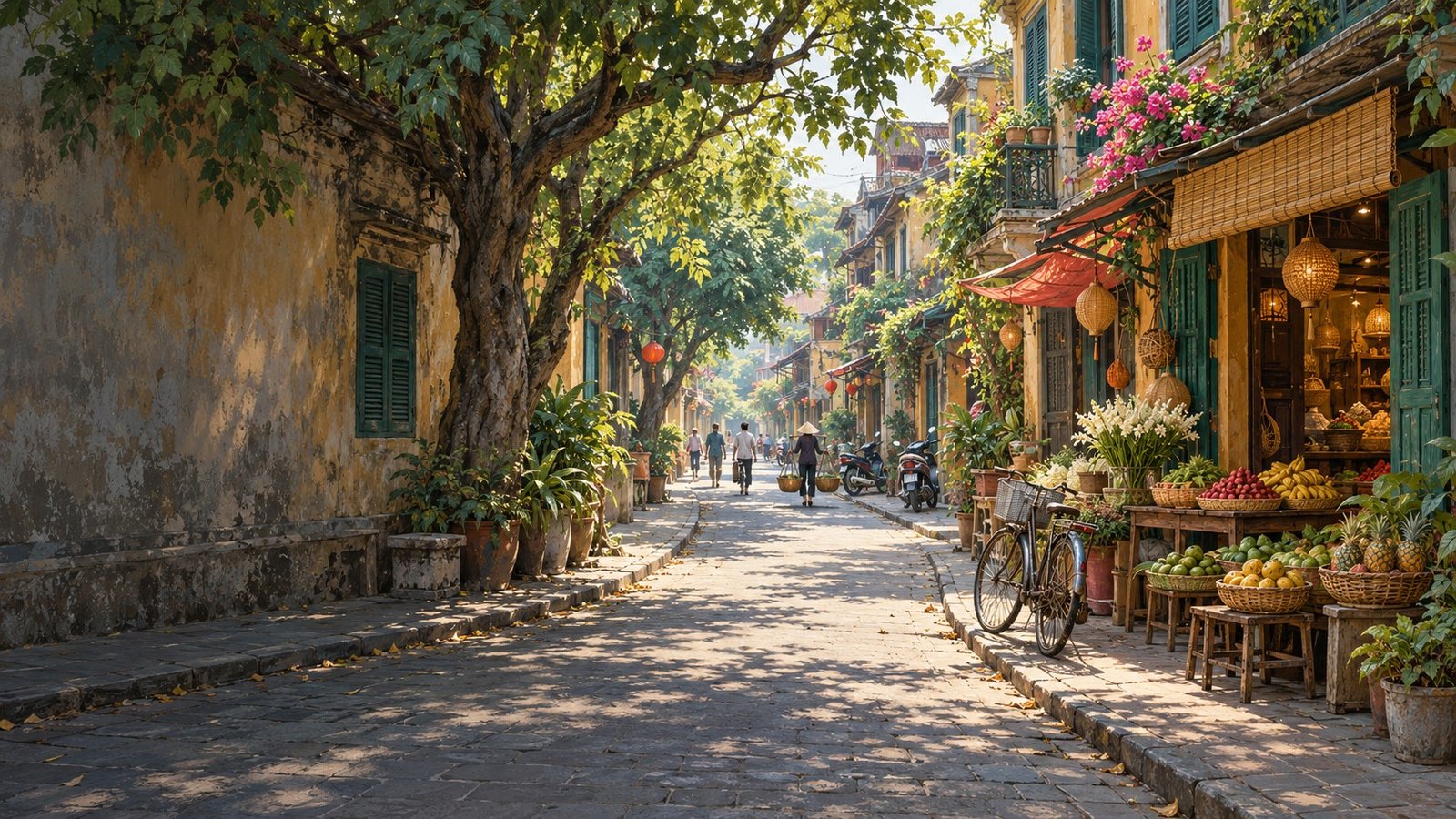
A leafy trading street with shopfronts, bicycles and pedestrians. AI-generated editorial illustration inspired by Hanoi’s Old Quarter; not a photograph of a particular street.
For a first walk through Hanoi’s Old Quarter, give yourself a route with a few clear landmarks and permission to linger. This loop connects the main trading streets with Đồng Xuân Market, Ô Quan Chưởng gate and a restored house on Mã Mây. The point is to understand how the neighbourhood fits together, with enough time to look beyond the next turning.
The route below is a research-led planning proposal. Street connections and visitor information were checked against local tourism, heritage and government sources on 23 October 2026; the distances and time allowances are editorial estimates, not a GPS recording or a claim of a personally tested walk.
Some links in this guide are affiliate links. If you book or buy through them, Taylor’s Trailblazing Travels may earn a commission at no extra cost to you.
One loop, one familiar finish
The lake is both your meeting point and your return point; save its name before you set off.
Pause more than you march
The three-hour example includes browsing, a heritage interior, a café break and a little slack.
Interiors are optional
Keep the street route even if you skip admission; choose one building to explore properly.
Expect traffic
Treat this as an urban walk with crossings and obstacles, rather than a continuous pedestrian precinct.
Your Hanoi Old Quarter walking route at a glance
Meet on the pavement at Đông Kinh Nghĩa Thục Square, away from the junction itself. Save the names of the square, market, gate and 87 Mã Mây in your map app before leaving. The same streets can appear without Vietnamese accents in search results.
Swipe or scroll to see all columns.
| Leg | Follow these streets | Allow |
|---|---|---|
| Lake to Đồng Xuân | Hàng Đào → Hàng Ngang → Hàng Đường → Đồng Xuân; optional short Hàng Mã out-and-back | 35–45 min |
| Market to the old gate | Back south on Đồng Xuân → Hàng Chiếu east → Ô Quan Chưởng | 15–20 min |
| Gate to Bạch Mã | Đào Duy Từ south → Nguyễn Siêu west → Hàng Giầy south → Hàng Buồm | 20–25 min |
| Hàng Buồm to the heritage house | Hàng Buồm east → Mã Mây → number 87 | 35–45 min with the house interior |
| Return to the lake | Mã Mây south → Hàng Bạc west → Hàng Đào south | 20–25 min |
| Seated break | Choose a café when you need the pause | 20–30 min |
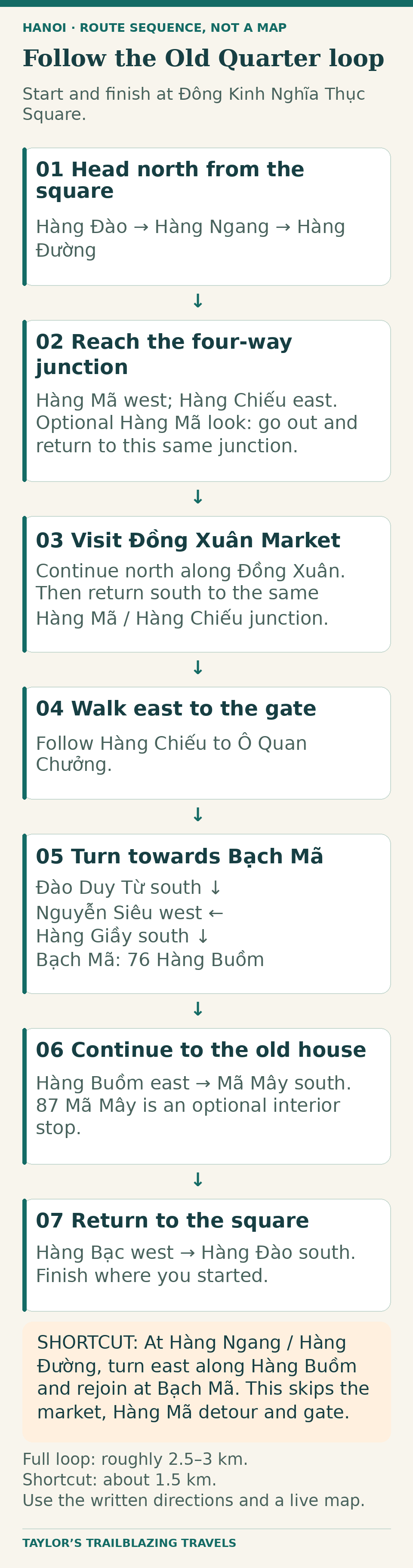
These are planning ranges, not timed walking results. Around three hours is a sensible target; allow longer for shopping, another interior or difficult crossings. The route uses the street connections detailed in the directions and sources below. The schematic is for orientation and is not to scale.
From the lake to the trading streets and Đồng Xuân
Direction: head north along Hàng Đào and keep following the main axis as it becomes Hàng Ngang, then Hàng Đường. Hàng Ngang connects Hàng Đào with Hàng Đường. At the four-way junction, Hàng Mã runs west, Hàng Chiếu east and Đồng Xuân continues north towards the market frontage.[1][2]
If the pavement is comfortable, take a short look west along Hàng Mã, then return to this same junction. About 100 metres each way is enough for this route; there is no need to follow the whole street. Vietnam Tourism identifies Hàng Mã with religious goods and festival decorations, so what is displayed will help explain the shopfronts you are passing.[14] Avoid treating displays as a free photo set: ask before photographing a stallholder or a close-up of their merchandise, and keep doorways clear.
Continue north on Đồng Xuân to Chợ Đồng Xuân. Use the main frontage on Đồng Xuân street as the landmark, rather than a pin for an individual stall. MyHanoi lists the market as free to enter, with hours of 07:00–18:00.[3] Those are the published market hours, not a promise that every stall trades throughout them.
Give the market a bounded visit: choose one entrance, look around the accessible trading area and return to that entrance. You can spend the whole morning shopping, but the loop works better if you leave time for the streets beyond it. Agree a price before buying, take small purchases with you and keep aisles available for people moving stock.
Hàng Chiếu to Ô Quan Chưởng: a short architectural pause
Direction: retrace Đồng Xuân south to the Hàng Mã–Hàng Chiếu junction. Turn east along Hàng Chiếu and continue towards Ô Quan Chưởng, where the approach becomes Ô Quan Chưởng street. The gate stands at the eastern end of this approach.[2][4]
Make this a five- to ten-minute exterior stop. Look at the relationship between the archway, its upper level and the streets feeding into it. A useful photograph does not require you to stand in the carriageway or obstruct an arch.
Stay on the Old Quarter side for the next leg. This route does not require you to continue out to, or cross, the larger Trần Nhật Duật road. Before moving on, locate Đào Duy Từ on your map: it is the southbound street you need.
A small street circuit to Bạch Mã and Hàng Buồm
Direction: from the gate’s Old Quarter side, take Đào Duy Từ south. Turn west into Nguyễn Siêu, then south into Hàng Giầy. Follow Hàng Giầy to Hàng Buồm, beside Bạch Mã. The local street descriptions confirm both crossings; take care to search for Hàng Giầy, not the separate Hàng Giấy street farther north.[5][6]
Bạch Mã Temple is at 76 Hàng Buồm. Decide here whether to make this your interior visit or save that time for the house on Mã Mây. The temple’s standard published admission is 20,000 VND. Its morning and afternoon sessions have a midday break; a closed door at lunchtime does not mean it has ceased admitting visitors.[10]
If you enter, follow the posted dress, photography and worship guidance. If you stay outside, take a short look from a clear section of pavement and continue. Adding every accessible interior makes the route much longer than its modest distance suggests.
Now turn east along Hàng Buồm. Its eastern end meets Đào Duy Từ and Mã Mây; the street’s west end, behind you, joins Hàng Ngang and Hàng Đường. That western connection is the shortcut used by the 90-minute version.[7]
Mã Mây: choose one house and look beyond its frontage
Direction: at the eastern end of Hàng Buồm, take Mã Mây southeast towards Hàng Bạc, looking for number 87 along the way.[8]
The 87 Mã Mây Heritage House is the most useful optional interior for this particular walk: it connects the commercial street outside with the domestic spaces behind it. MyHanoi describes a succession of rooms and courtyards in a narrow, deep building, with trading at the front and family living farther inside.[13] Spend your visit following that sequence. Where does daylight enter? Where does a public shopfront become a more private household? Those questions give the visit a purpose beyond collecting another photograph.
The national tourism authority announced the house’s reopening from 19 January 2026, following restoration; older closure notices are therefore out of date.[11] The published standard admission is 20,000 VND.[12] Confirm the day’s sessions at the entrance and allow roughly 20–30 minutes inside. If it is closed, carry on along the street and use the saved time for a seated break.
Hàng Bạc and the return to Hoàn Kiếm
Direction: continue to the southern end of Mã Mây. Turn west onto Hàng Bạc, crossing the Tạ Hiện–Đinh Liệt junction and continuing to the meeting of Hàng Ngang and Hàng Đào. Turn south down Hàng Đào to your starting square.[8][9]
Hàng Bạc retains jewellery shops, a visible connection with the street’s silver-working history.[14] Pause where you can safely compare the building frontage with the shop activity below it. Walking slowly for one block is more revealing than continually checking off street names.
Optional extra: Kim Ngân communal house at 42–44 Hàng Bạc lies on this return leg. The published standard admission is 20,000 VND, with daytime sessions of 08:00–12:00 and 13:30–17:30.[10] Add 15–25 minutes if you want to enter; that is extra time beyond the three-hour plan, which already allows for one heritage interior.
Finish at the square before deciding whether you want a separate lakeside stroll. A complete circuit of the lake is not included in this walk’s distance or timing.
Choose the three-hour loop or the 90-minute shortcut
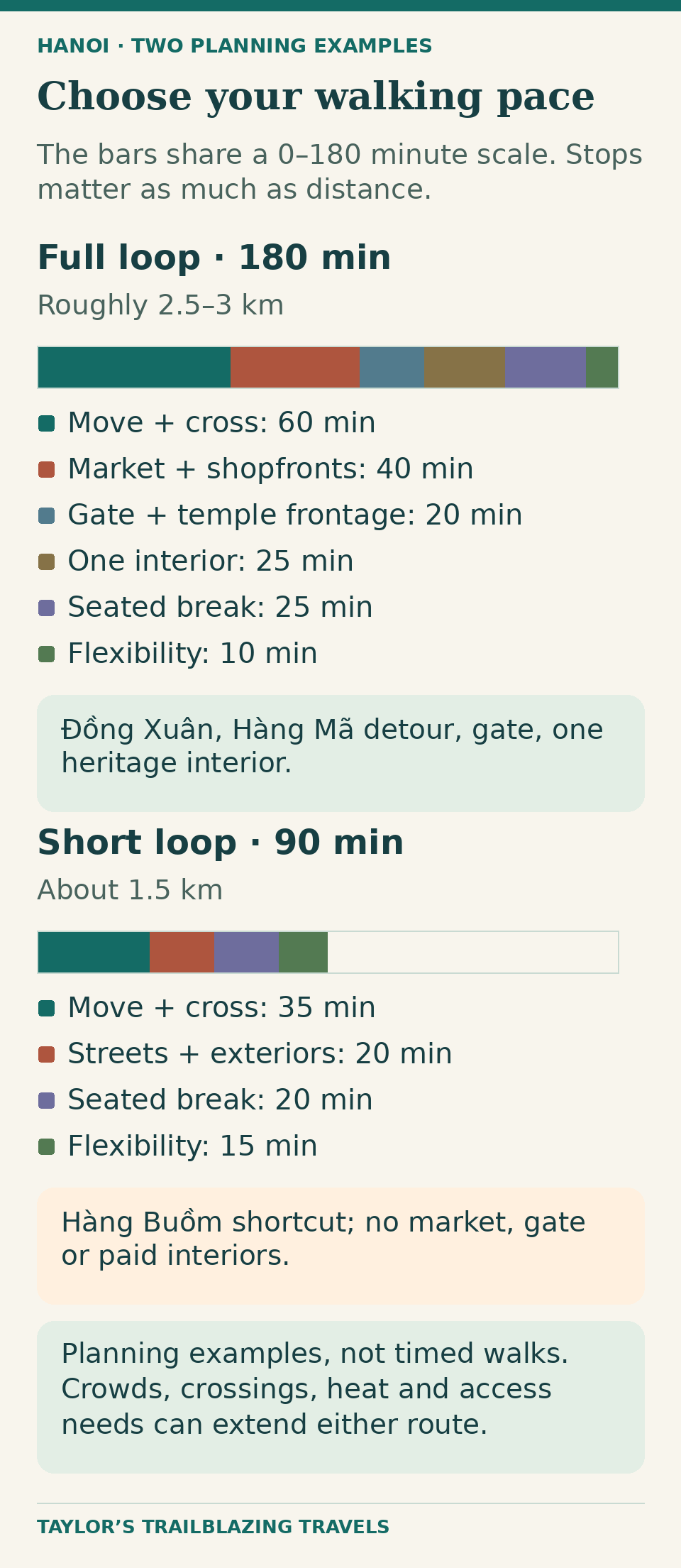
The full loop suits you if you want a market visit, a clear set of neighbourhood landmarks and time for one interior. The roughly 2.5–3 km estimate includes the short Hàng Mã detour and modest movement within stops. It excludes extensive shopping aisles, hotel approaches and a circuit of the lake. Expect approximately 60–75 minutes of moving and crossing streets, spread across the outing.
A sample 180-minute budget is 60 minutes moving and crossing, 40 minutes browsing market and shopfronts, 20 minutes at the gate and temple frontage, 25 minutes in one heritage interior, 25 minutes seated and 10 minutes of flexibility. If crossings take longer, borrow from browsing time or extend the outing. These are allowances chosen for this guide, not measured averages.
For the 90-minute version: take Hàng Đào and Hàng Ngang north, then turn east into Hàng Buồm at the Hàng Đường junction. Continue to Mã Mây, follow it south to Hàng Bạc, then turn west to Hàng Đào and return south to the square.[1][7][8][9] Budget roughly 1.5 km, with street exteriors and a short rest. Leave out the market, gate, Hàng Mã detour and paid interiors; do not try to compress all of them into the shorter time.
In heat or light rain: use the short version and move the rest stop earlier. If you make one interior the main event, allow another 20–30 minutes beyond the 90-minute model. In heavy rain, flooding or a thunderstorm, postpone the street loop and choose an indoor visit you can reach appropriately. A market roof does not make the connecting roads an all-weather walk.
Street access, market hours and what to budget
The outdoor stops are street frontages, not attractions with a shared opening time. They do not guarantee round-the-clock access: temporary barriers, events and local instructions take precedence. This guide is designed for daylight and does not depend on weekend pedestrianisation.
Swipe or scroll to see all columns.
| Stop | Admission | Planning implication |
|---|---|---|
| Đồng Xuân Market | Free | Listed 07:00–18:00; individual stalls can differ.[3] |
| Bạch Mã, 76 Hàng Buồm | 20,000 VND | Daytime 08:00–12:00 and 13:30–17:30.[10] |
| Heritage House, 87 Mã Mây | 20,000 VND | Reopening announced for 19 January 2026; confirm today’s sessions at the door.[11][12] |
| Kim Ngân, 42–44 Hàng Bạc | 20,000 VND | Optional extra; daytime 08:00–12:00 and 13:30–17:30.[10] |
For the recommended one-interior version, set aside 20,000 VND for that admission, then budget separately for refreshments and shopping. Carry small notes and check the current ticket board. There is no need to prebook an ordinary street walk.
The weekend night market is a different outing. MyHanoi describes an evening market on Fridays, Saturdays and Sundays along the Hàng Đào–Đồng Xuân axis.[15] Check that week’s arrangements locally. Do not arrive after dark expecting the indoor market’s daytime trading or assume every connecting street will be traffic-free.
Crossings, comfort and access: what the distance does not tell you
Short distances can still be demanding. Canada’s current Vietnam travel advice notes obstructed or poorly maintained pavements, motorcycles using them and difficult road crossings; it specifically highlights the extra care needed with children, pushchairs and mobility aids.[16] This route has not been surveyed for step-free access, dropped kerbs, accessible toilets or heritage-building entrances.
- At crossings: use marked crossings and signals where available, look both ways and wait for a safe opportunity. Do not assume traffic will stop or flow around you. Stop somewhere clear of the carriageway before reading your phone.
- With a wheelchair, walking aid or pushchair: confirm the specific streets and entrances with someone locally who understands your requirements. A guide can help with planning, but cannot make an obstructed pavement accessible. Start with a small section and retain an easy return option.
- For heat and fatigue: carry drinking water, wear footwear with grip and take the seated break before you feel you have earned it. The short loop is a useful choice even when you have more time.
- For toilets and rest: ask at your chosen café before ordering if facilities are essential. The route does not promise an accessible public toilet at each stop.
- For navigation: download an offline map and save your hotel address. Read street signs as well as the map; do not follow a suggested shortcut into a private passage or through a barrier.
If you need mobile data for changing plans, Airalo offers Vietnam eSIM packages. Check coverage, validity and activation terms, together with its device requirements: eSIM support, an unlocked phone and no rooting or jailbreaking.[18][19] Browse Airalo’s eSIM store and select Vietnam. An offline map remains a useful backup.
When a guided food walk is the better use of your time
Choose this self-guided loop when street layout, shopfronts and heritage are your priorities. A food-focused guide becomes more useful when you want help choosing dishes, communicating with vendors and understanding what you are eating. That is a different afternoon’s plan, so do not squeeze a complete food tour into the café allowance.
A relevant option to compare: GetYourGuide lists Hanoi: Hidden Eats & Full Meal Street Food Tour in the Old Quarter, operated by Host Visor Experiences, as a three-hour guided walk with five to seven tastings. It is a food itinerary rather than a guided version of the route above.[17] Check this Old Quarter food walk’s dates and current inclusions.
Before booking, confirm the meeting point, route, group size and any mobility or dietary requirements directly with the operator. A menu request is not a guarantee against cross-contact. This is a researched option, not a personally tested recommendation.
Frequently asked questions
Can I start at Đồng Xuân instead of the lake?
Yes. Follow the route from the market to the gate, then through Hàng Buồm, Mã Mây and Hàng Bạc to the square. Complete the northbound trading-street leg last to return to the market. Recheck the timing of your chosen interior; changing the start point can move it into a midday closure.
What should I do if one of the streets is temporarily closed?
Follow the barrier or official instruction and pause in a safe place to check an alternative public street. Use the next named landmark as your target, rather than trying to force the exact turn. If the detour is unclear, retrace your route to a familiar junction or end the walk; the estimates here do not account for construction or event diversions.
Choose your walk
For a first visit, choose the morning loop, make 87 Mã Mây your optional interior and protect the time for a proper sit-down. If you are already tired at the Hàng Buồm junction, take the 90-minute shortcut. Seeing fewer streets with enough attention to notice their entrances, courtyards and working shopfronts is a good use of the morning.
When fitting the walk into a longer visit, leave its full time allowance in your trip itinerary planner. Our Vietnam destination finder can help you choose the next stop beyond Hanoi.
Sources and methodology
Researched and editorially reviewed on 23 October 2026. Sources below support the destination and provider facts. Route choices, visit allowances and comparison models are editorial planning judgements; they are not reports of personal visits or live booking quotes. Recheck dated prices, access and operating details before travelling.
- MyHanoi — Hàng Ngang streetConnection between Hàng Đào and Hàng Đường.
- Người Hà Nội — Đồng Xuân streetStreet frontage and Hàng Mã–Hàng Chiếu junction geometry.
- MyHanoi — Đồng Xuân MarketLocation, listed 07:00–18:00 hours and free admission; checked 23 October 2026.
- MyHanoi — Ô Quan ChưởngGate location and approach from Hàng Chiếu.
- MyHanoi — Đào Duy Từ streetGate-to-street connection and Nguyễn Siêu junction.
- MyHanoi — Hàng Giầy streetNguyễn Siêu and Hàng Buồm crossings beside Bạch Mã.
- MyHanoi — Hàng Buồm streetBoth ends of the street and the short-loop connection.
- MyHanoi — Mã Mây streetConnection from Hàng Buồm to Hàng Bạc via Lương Ngọc Quyến.
- Người Hà Nội — Hàng Bạc streetReturn route to the Hàng Ngang–Hàng Đào junction.
- Vietnam National Authority of Tourism / TITC — Bạch Mã and Kim Ngân admission4 December 2025 notice: addresses, 20,000 VND fees and opening sessions effective 8 December 2025; checked 23 October 2026.
- Vietnam National Authority of Tourism / TITC — 87 Mã Mây reopening8 January 2026 notice announces reopening from 19 January 2026.
- Vietnam Government policy portal — 87 Mã Mây admission feePublished standard fee of 20,000 VND from 1 January 2025; checked 23 October 2026.
- MyHanoi — 87 Mã Mây Heritage HouseCommercial and domestic layout, rooms and courtyards.
- Vietnam Tourism — Explore the Old Quarter your wayHàng Mã and Hàng Bạc trading context.
- MyHanoi — Hanoi Old Quarter night marketFriday–Sunday evening market and its Hàng Đào–Đồng Xuân setting; exact current operating hours should be checked locally.
- Government of Canada — Vietnam walking and road safetyAdvice updated 19 October 2026; pavement, crossing and mobility considerations.
- GetYourGuide — Hidden Eats & Full Meal Street Food Tour in the Old QuarterOperator, advertised duration and inclusions checked 23 October 2026; availability and options can change.
- Airalo — Vietnam eSIM packagesCountry offering checked 23 October 2026; no fixed price or coverage guarantee quoted.
- Airalo Help Centre — device requirementsCompatibility, network-lock and device-modification requirements.
Illustrations in this article were created for Taylor’s Trailblazing Travels. Third-party photographs, where used, are credited beside the image or in the source list.