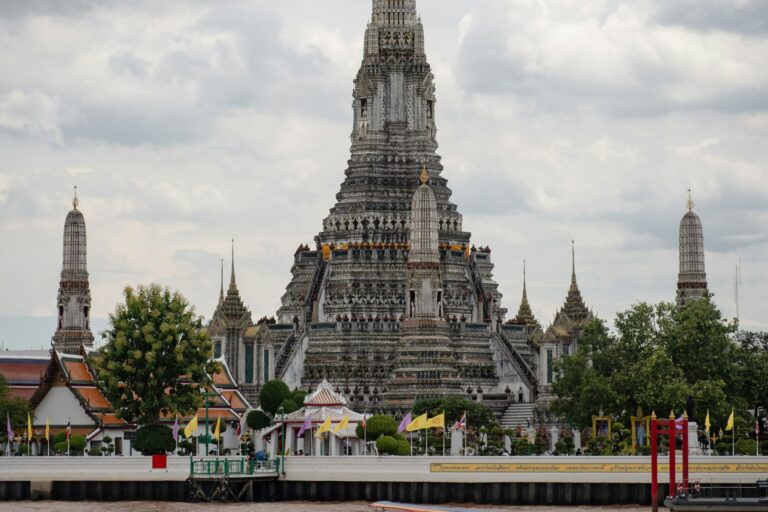
Thailand itineraries
Two cities. Enough time to enjoy both.
Temples, neighbourhood food and northern days, with the travel time left in the plan.
This Bangkok and Chiang Mai 10-Day Itinerary is for travellers who would rather understand two places than collect five hotel keys. It pairs a compact Bangkok introduction with a longer northern stay, then leaves a final night in the departure city. There is room for temples and good meals, but also for a class, a mountain outing and a morning that does not start with a suitcase.
The main version arrives in Bangkok, flies north on day 4 and returns south on day 9. A sleeper adaptation is explained separately because a train night changes the accommodation count. In either version, the calendar includes travel rather than quietly placing it outside the ten days.
The advice is research-led planning judgement, not a report of personal visits. Use the sequence to make the important decisions first: dates, flight or rail arrangements, hotel locations and the conditions for outdoor days. Then add the experiences that match your interests instead of treating every optional stop as compulsory.
Night split
3 + 5 + 1
Bangkok, Chiang Mai, then a Bangkok departure buffer.
Best emphasis
Culture and food
Choose this inland pairing rather than squeezing in a beach.
Northern rhythm
Four full days
An Old City day, Doi Suthep, a class and one countryside choice.
Useful flexibility
Move outdoor days
Keep weather and air-quality checks separate.
How this Bangkok and Chiang Mai 10-Day Itinerary works
Count nine nights before booking anything
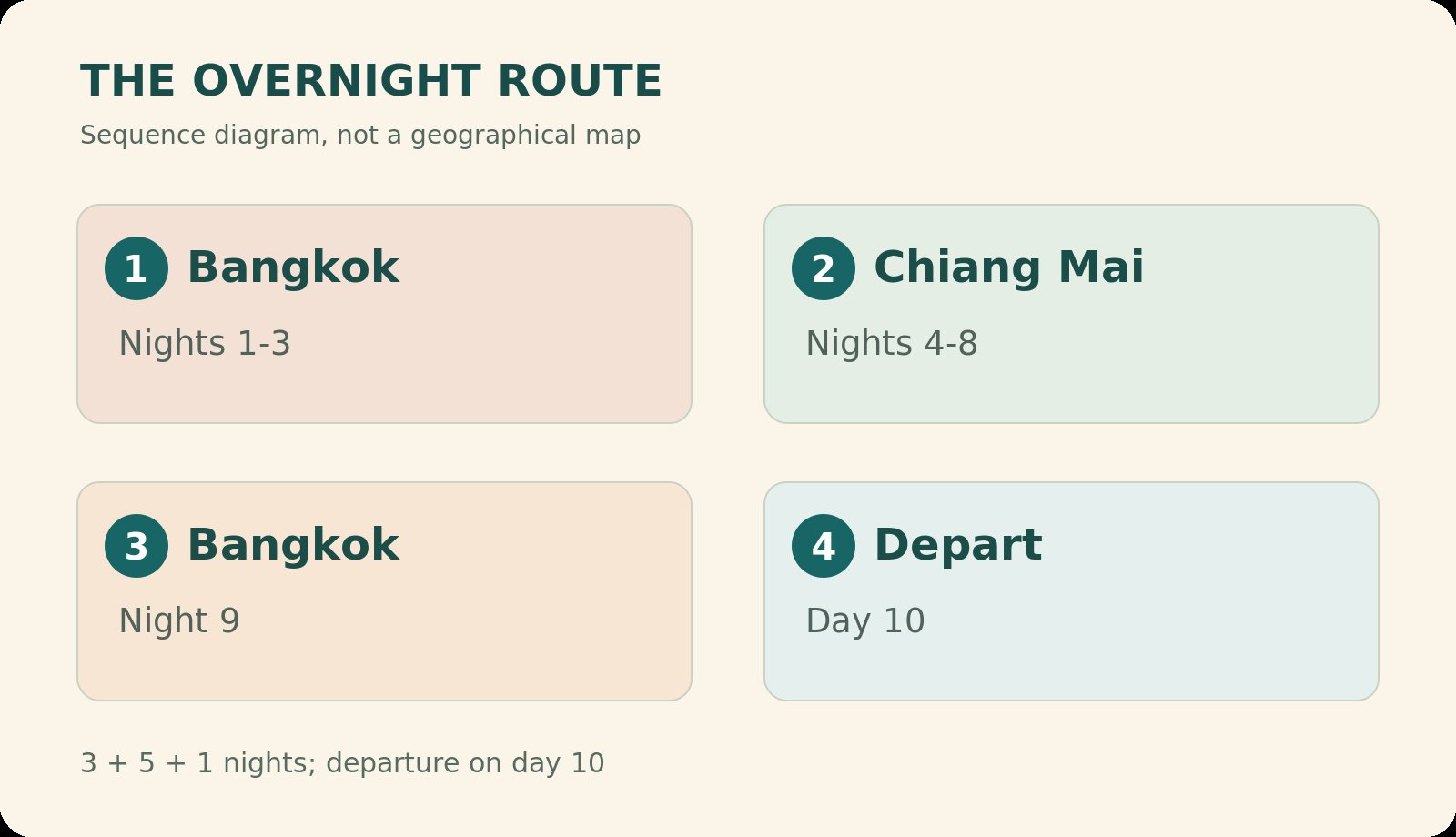
The main plan uses three Bangkok nights, five Chiang Mai nights and one final Bangkok night. Day 1 is your arrival date in Thailand and day 10 is the date you leave. Overnight international flights outside that window are additional travel time. This matters when requesting annual leave: a ten-day holiday allowance does not necessarily buy ten days on the ground.
Bangkok comes first because the route assumes an international arrival there. Chiang Mai then gets the longer stay, allowing an Old City day, a mountain temple, a practical activity and one countryside outing without changing hotels. Finally, returning to Bangkok on day 9 separates the domestic journey from an independently booked international departure. That extra night is a planning choice, not a guarantee against disruption.
| Days | Overnight base | Nights | Purpose |
|---|---|---|---|
| 1-3 | Bangkok | 3 | Arrival; old-city sights; a food- or museum-led day. |
| 4-8 | Chiang Mai | 5 | Travel north, then four full northern days. |
| 9 | Bangkok | 1 | Return before the international departure date. |
| 10 | Departure | 0 | Airport journey and onward flight. |
Who should use this route?
Choose this version when food, temples, neighbourhoods and northern scenery matter more than beaches. It deliberately avoids squeezing an island into the final two nights. The places below are selected for geographical grouping, variety and manageable travel demands; this is not a ranking based on personal visits or paid placement.
An international ticket departing from Chiang Mai can remove the return to Bangkok, provided the airline offers a suitable itinerary. In that case, keep night 9 in Chiang Mai instead. Do not simply add a separate same-day flight to Bangkok and describe it as an open-jaw ticket: those arrangements have different connection risks.
Pick the dates around northern conditions
Start with weather, then examine the air
For the easiest first attempt, I would investigate the cooler end of the year before a hot-season departure. That preference reflects the amount of walking and outdoor time in this route, rather than a promise of clear skies. The Thai Meteorological Department distinguishes northern seasonal cooling from the southern coastal pattern; check its current regional outlook rather than treating Thailand as one weather zone. [1]
Air quality deserves a separate decision. Use the Pollution Control Department's Air4Thai service before committing to northern outdoor plans, and check the reading date rather than accepting an old screenshot. A weather forecast saying sunny does not tell you whether the mountain view will be clear or the air suitable for your planned exertion. Travellers with relevant health concerns should seek individual medical advice. [2]
Leave the mountain days interchangeable
The Doi Suthep visit and countryside day can move within the Chiang Mai stay. In contrast, a non-refundable class or a scarce train berth may be difficult to shift. Put flexible sightseeing around the fixed booking, rather than reserving every day before seeing a forecast.
In wet conditions, choose a city-based cooking session or craft visit instead of a trail. During poor air conditions, a strenuous hike is not automatically the right substitute for a hazy viewpoint. Ask the operator what the replacement day actually includes and whether cancellation is possible. Weather-sensitive travel is easier when there is a clear decision to make, not six prepaid activities competing for the same dry morning.
Choose two useful neighbourhoods, not two famous hotels
Bangkok: make the first three nights walkable
A hotel near a useful rail station or river connection is more valuable here than a distant property with a grand lobby. Check the actual entrance and walking route, including crossings and steps. A pin described as riverside may still require a car to reach the pier you intend to use.
For this itinerary, compare an old-city or riverside location with a rail-connected central base. The first favours the temple day; the second can make varied neighbourhood visits simpler. Neither automatically wins on airport travel, because the last part of the journey depends on your exact address and luggage. Bangkok's airport authority lists both rail and road options from Suvarnabhumi. [4]
Chiang Mai: stay where the evenings work
The Old City or its eastern edge is my starting point for a first visit built around temples and food. However, a quieter room away from a busy frontage may matter more than being directly beside a landmark. Use the map to check the distance to dinner, not just the airport.
Nimman can suit travellers who prioritise contemporary cafes and a different evening atmosphere, while a riverside property may favour downtime. These are neighbourhood trade-offs, not promises about every street. Check recent noise comments, lift access, the room category and whether pickup services include the address. Five nights is long enough for an inconvenient location to become tiring.
For the final Bangkok night, choose according to day 10's flight. A central stay works with a later departure; an airport-area hotel can simplify an early start. Confirm which airport it serves before paying, because Bangkok's two main airports are not interchangeable.
Day 1: arrive with one small evening in mind
Make arrival a landing day
After immigration and baggage collection, go to the hotel before chasing attractions. Keep the booking confirmation, Thai address and contact number available offline. An afternoon landing can easily become an evening arrival at the room, especially when queues, traffic or weather interfere.
Ask about check-in timing before departure from home. An early flight arrival does not oblige the hotel to provide a room at breakfast time. Where immediate access matters, compare a confirmed early-access arrangement with booking the preceding night and notifying the hotel that you will arrive the following morning.
Stay close for dinner
The first evening should establish a comfortable routine: find drinking water, locate breakfast and eat nearby. A short neighbourhood walk is enough. Save the riverfront reservation or lengthy food tour for a date when you are not dependent on the inbound flight running to time.
Before sleeping, check the next morning's attraction information and transport route. Set out clothing suitable for a temple visit and put the hotel address in both travellers' phones. This small preparation removes more friction from day 2 than adding another first-night stop.
Day 2: the old city with room to pause
Give one major sight a proper morning
Start with the Grand Palace and Wat Phra Kaew if they are priorities. Consult the palace's own visitor page for admission arrangements and dress restrictions; this guide does not assume that an old social-media timetable is still valid. Wear a proper sleeved top and suitable long clothing rather than relying on an improvised cover-up at the gate. [5]
Afterwards, stop for a seated lunch before deciding on Wat Pho. The two visits complement each other, but they need not be treated as a compulsory double. Someone who likes architecture may welcome both; someone travelling with young children might enjoy one temple and a quieter afternoon more. Wat Pho's official page provides its current visitor information. [6]
Use the afternoon to absorb, not accumulate
Keep any river journey conditional on normal operating conditions. Choose a clearly identified service and verify where it stops; a public crossing, a sightseeing boat and a private charter are different purchases. In disruptive weather, replace the river element instead of assuming boats will operate because they appear in the itinerary.
Finish with dinner in the same broad part of the city or return to the hotel before going out locally. Avoid a cross-city restaurant booking immediately after a long temple visit. The useful measure is how much of the day you enjoyed, not how many religious buildings appear in the photograph folder.
Day 3: neighbourhood food or a museum-led day
Choose the version that differs from yesterday
After a monument-heavy day, a food-led walk around Chinatown provides a change of focus. Start with a defined meeting point and a manageable loop instead of an ambitious list of stalls. Check the operating day of any specific market or restaurant you are determined to visit, because the itinerary's day number is not a day of the week.
A guided food walk can be worthwhile for ordering confidence, ingredients and context. However, send dietary requirements before booking and obtain a clear answer about substitutions. A vague promise that vegetarian options are available is not enough when cross-contact or a specific ingredient matters.
Keep a weather-resistant alternative
Jim Thompson House offers a different kind of cultural visit. Its official visitor information says that access to the main house is guided and involves stairs without a lift, so assess that before treating it as an accessible fallback. Combine it with a nearby lunch, not another full sightseeing circuit. [7]
Leave part of the afternoon for laundry, packing and tomorrow's transfer checks. Travellers sometimes resist these practical gaps, yet they prevent a useful holiday day becoming an evening of hurried errands. Confirm the Chiang Mai hotel's arrival instructions and arrange transport only once the flight or train details are settled.
Day 4: travel north without pretending it is a free day
The flight-first version
The standard plan flies to Chiang Mai on day 4 and sleeps there that evening. Compare the total purchase, including luggage, seat needs and airport transfers. Record the departure airport code beside the flight number; a ticket labelled Bangkok does not tell you whether it leaves from BKK or DMK.
For diary purposes, block roughly five to seven hours between leaving the Bangkok room and becoming ready to go out in Chiang Mai. This is an editorial allowance, not a published flight duration: it includes road or rail travel, airline procedures, baggage and hotel access. Use the carrier's actual check-in deadline and widen the allowance when conditions require it.
The sleeper alternative changes night 3
A sleeper can suit someone who actively wants a rail journey. Check the State Railway of Thailand timetable and confirmed berth arrangements before changing accommodation. For the cleanest adaptation, take the train on the evening of day 3, replacing that Bangkok hotel night with a rail night, and arrive in Chiang Mai on day 4. Keep the remaining northern nights and the final Bangkok buffer unchanged. [8]
Do not assume the train provides the same rest as a private hotel room. Arrival can precede check-in by several hours, and delays can erase an ambitious morning plan. Reserve day 4 for breakfast, luggage storage and a gentle introduction. Also check the station printed on the ticket rather than travelling to a remembered Bangkok terminal.
Keep the first northern evening uncomplicated
On arrival, locate a nearby place for dinner and walk a small section of the neighbourhood. Avoid booking an out-of-town attraction that depends on landing punctually. There are four substantial northern days ahead; spending the first evening settling in does not waste the stay.
Day 5: Chiang Mai's Old City at walking pace
Build a short loop around your interests
Choose two principal temple stops, such as Wat Phra Singh and Wat Chedi Luang, and allow the streets between them to be part of the visit. Verify local access before setting out. The aim is an introduction to Lanna religious architecture, not a competition to see every temple within the moat. Tourism Authority of Thailand material identifies Chiang Mai's temple landscape as central to the destination. [9]
Make lunch the middle of the route. In warm weather, a long break is more useful than repeatedly ducking into shops while trying to finish an oversized circuit. Carry modest temple clothing even when the morning begins in a cafe, and follow each site's rules on shoes, photography and visitor areas.
Let the evening follow the calendar
Check what actually operates on your date before promising a walking-street market. A normal weekday evening can still be enjoyable: choose a food area, a small restaurant or a quiet return to the hotel. Market access, crowding and road closures may also change the best pickup point.
For souvenirs, buy something you can explain and carry. Ask whether a workshop makes the item locally rather than assuming every object on a stall was produced nearby. Keep fragile purchases small enough to protect during the return journey, especially when travelling with a cabin-only fare.
Day 6: Doi Suthep as a focused half-day
Agree the transport before leaving town
Wat Phra That Doi Suthep sits above Chiang Mai and is approached by road, followed by access to the temple complex. The official tourism listing describes a stairway and a tram alternative; confirm their operation and suitability before relying on them. Arrange the return journey as carefully as the outward one. [10]
A half-day booking can be a sensible starting point, but ask what the operator means by half a day. Hotel pickups, other passengers and additional stops can expand it. Travellers who dislike winding roads may prefer a private vehicle with the option to pause, rather than a large excursion with a rigid sequence.
Do not buy the view in advance
The temple remains the principal reason to go. Haze, cloud and rain can obscure the outlook, so avoid a second viewpoint detour purely because a clear panorama appeared in advertising. Bring a light layer for a cooler or wet visit and keep shoes practical for potentially slippery surfaces.
Back in town, leave the afternoon open for a cafe, rest or a neighbourhood you have not explored. Doi Suthep and Doi Inthanon are different outings; combining both would turn the day into a very different road itinerary. This version keeps the larger mountain excursion for day 8.
Day 7: cook, make or learn something
A cooking class with the right practical details
A cooking session is a useful contrast to sightseeing because it gives the day a clear purpose without another hotel move. Compare the menu, actual cooking time, group size and pickup area. A market visit is attractive only when it adds explanation, rather than functioning as a brief shopping stop before a distant transfer.
Ask whether everyone cooks their own dishes or shares preparation. Also check whether a half-day class includes enough food to replace a meal. Confirm allergies and dietary restrictions directly; a standard menu with fish sauce or shrimp paste may require more than simply omitting meat.
Crafts are an alternative, not an extra obligation
A ceramics, textile or other making session can replace cooking when it better matches your interests. Check how long the activity lasts and whether the finished object can travel immediately or needs later collection. The latter detail matters with departure approaching.
For the rest of the day, repeat something you enjoyed rather than searching for a completely new district. Returning to a favourite lunch spot or browsing an area more slowly is one advantage of five northern nights. Use the evening to confirm tomorrow's road conditions, meeting time and return arrangements, then pack only what the day trip needs.
Day 8: choose one countryside experience
Doi Inthanon for a mountain-focused day
Doi Inthanon National Park combines highland scenery, forest and waterfalls, but its attractions are spread out. TAT's park information is a useful starting point for choosing the type of visit, not evidence that every trail is open on your date. Ask the park or operator about current access, conditions and the exact walking involved. [11]
Compare excursions by the time spent outside the vehicle, not the number of stops. A waterfall viewpoint, a short nature walk and a meal can form a coherent day. A list containing every famous location may leave very little time at any of them. Take suitable footwear, weather protection and a warmer layer than you used in Bangkok.
An animal visit requires a separate welfare decision
An observation-led elephant visit is an alternative, not something to bolt onto the mountain drive. World Animal Protection recommends watching without riding, bathing or touching. Read the programme itself rather than assuming that the word sanctuary guarantees good welfare. [12]
Finally, retain the right to stay in town. Heavy rain, poor air or simple fatigue can make the countryside option the wrong choice that morning. Book terms that allow a sensible response, and do not interpret the final northern day as a reason to ignore local warnings.
Days 9 and 10: close the route calmly
Day 9 returns you to Bangkok
Travel south after breakfast or at another convenient confirmed time, then check into the final hotel. The route gives up one extra northern evening to avoid placing a separate domestic arrival immediately before the international flight. Keep the transfer simple; there is no need to add another Bangkok excursion merely because the city is familiar now.
Check day 10's terminal, luggage allowance and check-in deadline again. Any purchases made during the northern stay may have changed your baggage needs. Make sure both travellers can access the booking and arrange transport according to the actual airport, not the hotel staff's assumption about a typical international departure.
Day 10 belongs to the flight
A later departure may allow breakfast and a nearby walk. However, treat the planned hotel-leaving time as fixed, with sightseeing fitting inside it. If an attraction requires a long queue, timed admission or a cross-city journey, it is probably the wrong last-day choice.
With a genuine international departure from Chiang Mai, the alternative is straightforward: sleep there on night 9 and travel to its airport on day 10. Check the ticketed connection through to your final destination and any baggage transfer instructions. The destination written on the next boarding pass matters more than a generic rule about returning to Bangkok.
Build a ten-day budget from the nights
A model, not a quoted holiday price
The table is a constructed planning example prepared on 5 October 2026 for one adult sharing a twin or double room. Room costs are shown per room per night; the total uses half that amount per person. International flights, insurance, visas where required, alcohol, major shopping and exceptional disruption costs are excluded. Replace the assumptions with your own dates before deciding affordability.
| Cost assumption | Economical example | Comfort example | Upgraded example |
|---|---|---|---|
| Bangkok: room / night (4 nights) | 1,200 | 2,600 | 4,500 |
| Chiang Mai: room / night (5 nights) | 1,000 | 2,200 | 3,800 |
| Accommodation total (one adult sharing a room) | 4,900 | 10,700 | 18,500 |
| Food assumption / person / day | 450 | 900 | 1,500 |
| Food total (10 days; 1 adult) | 4,500 | 9,000 | 15,000 |
| Domestic flight allowance | 2,600 | 4,500 | 7,000 |
| Local / island transport allowance | 1,500 | 2,600 | 4,500 |
| Selected activity allowance | 2,000 | 4,500 | 8,000 |
| MODEL TOTAL before contingency | 15,500 | 31,300 | 53,000 |
| Illustrative 15% contingency, rounded up to THB 100 | 2,400 | 4,700 | 8,000 |
| MODEL + contingency | 17,900 | 36,000 | 61,000 |
The useful comparison is not just the total. Accommodation has nine multipliers, while an organised excursion may occur once. Therefore, paying a little more for a well-located room can make sense when it removes repeated transport costs. Conversely, upgrading every night because the northern hotel seems inexpensive can consume the money intended for the activity you care about most.
Check the small additions at checkout
Compare flights with the same baggage and payment assumptions. For a class or tour, check pickup, admission, lunch, guide language and cancellation conditions. A headline price is not a complete cost when several necessary items are excluded.
Solo travellers should replace the shared room calculation rather than multiplying the whole total mechanically. Families need actual occupancy rules, child ages and extra-bed charges. Use a separate contingency instead of quietly assuming the lowest cost in every category will be available at the same time. The best budget is the one that still works when one decision changes.
Food, luggage and the information to keep offline
Pack for two climates and repeated walking
A compact bag makes the flight or sleeper option easier, but cabin-only travel is a preference rather than a requirement. Choose luggage around what you can handle on steps and during hotel changes. Put the clothing for day 2 near the top, so suitable temple attire is available without unpacking everything on arrival.
Take a light layer for strong air conditioning and northern excursions, plus weather protection that you will actually carry. Keep essential medication and documents in hand luggage, with original packaging and the relevant travel guidance checked before departure. Detailed medication and health questions should be resolved with appropriate professional advice, not a packing checklist. [13]
Make food choices that suit the group
You do not need to book every meal to eat well. Select a few experiences where guidance adds value, then leave other meals open. Where ingredients matter, save a clear explanation in Thai and confirm the kitchen understands it. An attractive menu photograph cannot establish whether stock, sauces or shared utensils meet a dietary requirement.
For connectivity, compare your existing mobile plan with an eSIM on compatibility, data allowance, coverage and activation rules. Download hotel details and tickets regardless of the option chosen: a working data plan can still fail when a battery runs flat.
Adjust the pace without breaking the route
Families and travellers who need shorter days
Keep the hotel sequence but reduce the number of daily stops. One temple followed by lunch and pool time can be a complete Bangkok day. In Chiang Mai, a short private outing may be more suitable than an excursion whose pickup circuit begins well before breakfast.
Ask specific access questions before paying: steps from vehicle to entrance, lift availability, bathroom arrangements and the distance walked on uneven ground. A description such as easy or family-friendly is not a measurement. For the mountain days, request the route and walking requirements in writing so a late substitution does not create a problem.
Swap nights for interests, not for map coverage
Food-focused travellers could move one northern night to Bangkok, producing four initial Bangkok nights, four Chiang Mai nights and the final Bangkok night. However, that removes a full northern activity slot. Choose in advance whether the countryside day or making class matters less.
Adding Chiang Rai or Pai is a different journey, not a harmless extra pin. It introduces substantial road travel and another accommodation decision. With only ten calendar days, I would remove a whole existing component before adding either, rather than reducing each city to a sequence of arrivals and departures.
Keep one practical travel record for the ten days
Write the dates in the order you will use them
Make a single note containing the international arrival, first hotel, northern journey, Chiang Mai hotel, return journey and last Bangkok hotel. Put the check-in and checkout dates beside each property, together with the cancellation deadline. This makes it easier to spot an overlap after changing a flight or substituting a train night.
Keep the final issued documents with that note. A transport search, payment receipt and usable ticket are not always the same thing. Read any collection instructions and confirm whether a requested berth has actually been allocated. For a hotel-arranged driver, save the reply confirming the service rather than only your outgoing request.
Give both travellers access to the essentials
Store the next address, phone number and booking reference in both phones, with an offline copy. Agree a simple meeting plan if you become separated in a busy station or airport. The person who made the reservations should not be the only person able to show a driver where you are staying.
Finally, keep a short list of decision dates: when a hotel becomes non-refundable, when an activity must be cancelled and when an operator will confirm conditions. Reviewing those deadlines once is more useful than repeatedly checking fares after everything has already been purchased.
The strengths and compromises of this two-city plan
What the route does well
Two principal bases keep decisions manageable while giving the cities distinct roles. Bangkok provides the initial urban introduction; Chiang Mai has enough nights for a slower pattern. The final Bangkok stay also gives travellers using separate tickets a clearer division between domestic travel and the flight home.
There is useful flexibility inside the northern block. A class, a city walk and a mountain visit can change order without moving suitcases. That makes the plan easier to adapt to energy and conditions than a route with a new hotel every other day.
What it deliberately leaves out
There is no beach stay and no complete northern circuit. Travellers whose main objective is swimming or island scenery should choose a different ten-day pairing rather than attaching a rushed coastal finish. Likewise, someone who dislikes domestic flights must actively redesign the railway nights instead of pretending the flight-first timetable still applies.
The return to Bangkok costs both time and money. A well-priced, properly ticketed departure from Chiang Mai may be a better arrangement. Compare it at the beginning of planning, before non-refundable hotel dates make the original route difficult to change.
Common mistakes on this particular itinerary
Booking ten hotel nights for a nine-night route
Write each overnight date beside its city before paying. Arrival on day 1 and departure on day 10 normally creates nine accommodation nights, not ten. A very early arrival may justify an additional preceding hotel night, but that is a separate decision that should be clearly marked rather than accidentally built into every reservation.
Treating a train berth as a confirmed room
A request, search result or payment acknowledgement is not necessarily the final travel document. Read the confirmation and collection instructions. Also tell the Chiang Mai hotel when you expect to arrive, particularly when the train reaches the city before standard check-in. Keeping these two arrangements separate avoids assuming that one booking solves the other.
Planning mountains without checking conditions
A fixed countryside excursion can become the most fragile part of the trip. Check weather, air quality and access rather than relying on the season's reputation. Have a named replacement activity and understand the refund rules before the decision becomes urgent.
Spending the last evening too far from the room
After returning to Bangkok, choose a straightforward meal and prepare for departure. A distant reservation is not an essential final flourish. The spare evening earns its place by reducing dependence on perfect transport, not by becoming another ambitious sightseeing day.
Bangkok and Chiang Mai itinerary FAQs
Is ten days too long for only Bangkok and Chiang Mai?
Not when the ten days include international arrival and departure, a domestic transfer and the return to Bangkok. The five-night Chiang Mai block contains four full days, not five. That is enough for distinct experiences without forcing every morning into an early tour pickup. Travellers who prefer a faster pace can add detail within each city before adding another overnight destination.
Should I spend more nights in Bangkok or Chiang Mai?
This version gives Chiang Mai five nights because the northern outings are easier to organise from one stable base. Choose four initial Bangkok nights and four Chiang Mai nights when museums, restaurants and city neighbourhoods are the priority. Keep the final Bangkok night separate in the calculation, since its principal purpose is the onward flight rather than additional sightseeing.
Can I use a sleeper train in just one direction?
Yes. The clearest version replaces Bangkok night 3 with a sleeper journey north, keeps Chiang Mai nights 4 to 8 and flies south on day 9. Confirm the actual service and berth before cancelling accommodation. Arrival morning should remain light, and any hotel room required immediately after the train needs a separate agreement.
Do I need a guide for the whole trip?
No. A guide is most useful where explanation, ordering help or complex transport changes the experience: a temple walk, food tour or mountain day, for example. City meals and ordinary neighbourhood wandering do not need to become organised products. Compare the support you require with the cost and schedule restrictions of each booking.
Can this itinerary work without renting a scooter?
Yes; it is designed around walking where appropriate, urban transport, booked vehicles and optional organised outings. Scooter rental is not part of the route's cost assumptions. Choosing a convenient hotel and agreeing return transport for Doi Suthep are the two most useful steps for keeping it that way.
Is Chiang Rai a reasonable day trip to add?
It would replace a northern day rather than fit into unused time. Long road travel can make a day return a poor match for travellers who want a relaxed pace. Decide whether the specific Chiang Rai sights justify that trade-off; otherwise save the city for a longer northern itinerary with an overnight stay.
What must I check before entering Thailand?
Check the current entry conditions for your own nationality and passport, plus any required arrival formalities. The official Thailand Digital Arrival Card is separate from visa permission. Use the Immigration Bureau's instructions and the relevant embassy or government advice rather than assuming that a ten-day tourist plan automatically settles eligibility. [14] [15]
Should I book every activity before travelling?
Secure the scarce or genuinely important reservations first, then retain flexibility for the outdoor days. Booking everything can leave you paying to ignore a poor forecast or a tired morning. Accommodation cancellation deadlines, transport availability and any special class should determine the fixed framework; the remaining sightseeing can adapt around it.
Give the north time, and keep the final connection simple
Use three initial Bangkok nights, five Chiang Mai nights and one final Bangkok night as the starting point. Book a convenient room in each city, choose one northern countryside experience and let the other days alternate between exploration and ordinary holiday time.
The strongest version is not the one that adds the most places. It is the one in which the sleeper or flight, room access, mountain conditions and departure airport have all been checked before they can cause friction. Spend money on the parts that genuinely improve the trip, while leaving enough uncommitted time to enjoy being in each city.
Before payment, run the route through four questions: does every date have the correct overnight base, are the transport documents confirmed, can the outdoor days move, and is the international departure protected by a sensible plan? Once those answers are clear, the itinerary becomes much easier to personalise.
Sources and fact-checking notes
The route and recommendations are research-led planning judgements. Public sources below were checked for this editorial review on 05 October 2026. Transport availability, admission arrangements, park access and local conditions can change. Budget figures are constructed examples with explicit assumptions, not live quotes or guaranteed costs. The original scene illustrations are conceptual rather than documentary location photographs.
- Thai Meteorological Department: regional weather Current regional forecasts and warning links; not a guarantee for future dates.
- Pollution Control Department: Air4Thai Check the location and timestamp of air-quality observations.
- FCDO: Thailand warnings and insurance Current travel warnings; check again before travel.
- Airports of Thailand: Suvarnabhumi ground transport Official airport transport choices; confirm current services and meeting points.
- Grand Palace: official practical information Visitor arrangements, dress restrictions and direct admission information.
- Wat Pho: official contact and visitor information Check current temple access directly before a visit.
- Jim Thompson House: official visitor information Guided main-house visits and published access limitations.
- State Railway of Thailand: official D-Ticket search Check the dated service, station and final issued ticket; no fixed train schedule is promised here.
- Tourism Authority of Thailand: Wat Phra Singh, Chiang Mai Context for an Old City temple visit.
- Tourism Authority of Thailand: Wat Phra That Doi Suthep Temple setting and access overview; operational details should be reconfirmed.
- Tourism Authority of Thailand: Doi Inthanon National Park Park landscape and attraction types; not proof of current trail opening.
- World Animal Protection: elephant-friendly tourism guidance Observation-led welfare criteria rather than reliance on a sanctuary label.
- FCDO: Thailand health guidance Travel-health preparation and links to specialist advice.
- FCDO: Thailand entry requirements British-passport guidance; other nationalities must check their own applicable conditions.
- Thai Immigration Bureau: Digital Arrival Card instructions Official arrival-form guidance; the form is not visa permission.
Illustrations in this article were created for Taylor’s Trailblazing Travels. Third-party photographs, where used, are credited beside the image or in the source list.