Thailand 4 Week Itinerary 2026: Three Realistic 28-Day Routes
Choose your rhythm first: a varied first visit, a slower Gulf route or a journey built around rail and road.
An original Thailand travel illustration, not a geographically exact map or a photograph of a bookable tour.
A Thailand 4 week itinerary should feel more relaxed than a two-week trip, not simply contain twice as many hotel changes. Twenty-eight days give you room for regional contrasts, laundry, an imperfect-weather day and a place you like enough to revisit. The challenge is choosing what to leave out so that the extra time actually improves the holiday.
The three routes below solve different problems. Route A combines Bangkok, Sukhothai, Chiang Mai and the Andaman coast. With Route B, the north remains but the beach section shifts to Samui and Phangan. Route C avoids domestic flights and counts its two overnight trains properly. Each starts with arrival on day one, ends with departure on day twenty-eight and contains twenty-seven nights.
These are constructed itineraries rather than a bookable package or a claim of first-hand travel. Activities are suggestions, transfer allowances are planning estimates and prices are transparent budgeting assumptions. Confirm dated services, entry permission and current local conditions before committing. Most importantly, do not combine all three routes into one: their value lies in the choices between them.
Route A
Northern history and culture followed by Ao Nang and a longer Lanta stay.
Route B
A slower two-island section, selected for the relevant season rather than assumed year-round.
Route C
Rail and road, with overnight travel counted instead of hidden.
Keep the final buffer
Be back in the departure city before the final full day.
Thailand 4 week itinerary: choose the trip you actually want
Variety, islands or ground travel?
Route A is my default comparison for a first visit when the Andaman section fits the season. It balances two cultural regions with a substantial coastal finish. Route B removes Sukhothai and changes the beach geography, giving you longer blocks on two Gulf islands. Route C is built around ground travel from the beginning rather than replacing flights with exhausting road journeys after the hotels are booked.
| Route | Main sequence | Nights | Best reason to choose it |
|---|---|---|---|
| A: north + Andaman | Bangkok – Sukhothai – Chiang Mai – Ao Nang – Lanta – Bangkok | 27 hotel nights | A varied first visit with a long island finish |
| B: north + Gulf | Bangkok – Chiang Mai – Samui – Phangan – Bangkok | 27 hotel nights | Fewer main bases and a slower Gulf-island section |
| C: no domestic flights | Bangkok – Kanchanaburi – Ayutthaya – Chiang Mai – Hua Hin – Bangkok | 25 hotel + 2 train nights | A coherent rail-and-road trip without pretending long journeys are short |
Make the decision before reserving twenty-seven nights
Ask whether you enjoy moving, whether overnight travel suits you and which part of Thailand is the reason for the trip. Then look at the weather pattern for that region and the actual services on your dates. A route with fewer stops may produce a richer holiday because you have time to understand the places you visit.
The plans use Bangkok as the international gateway. An open-jaw ticket can justify a different ending, but redesign the final buffer around the real departure airport. Do not remove it merely because a direct line on a map looks efficient. The final full day should remain useful even when a previous journey is delayed.
Count every night and check your entry permission
Twenty-eight days do not mean twenty-eight hotel nights
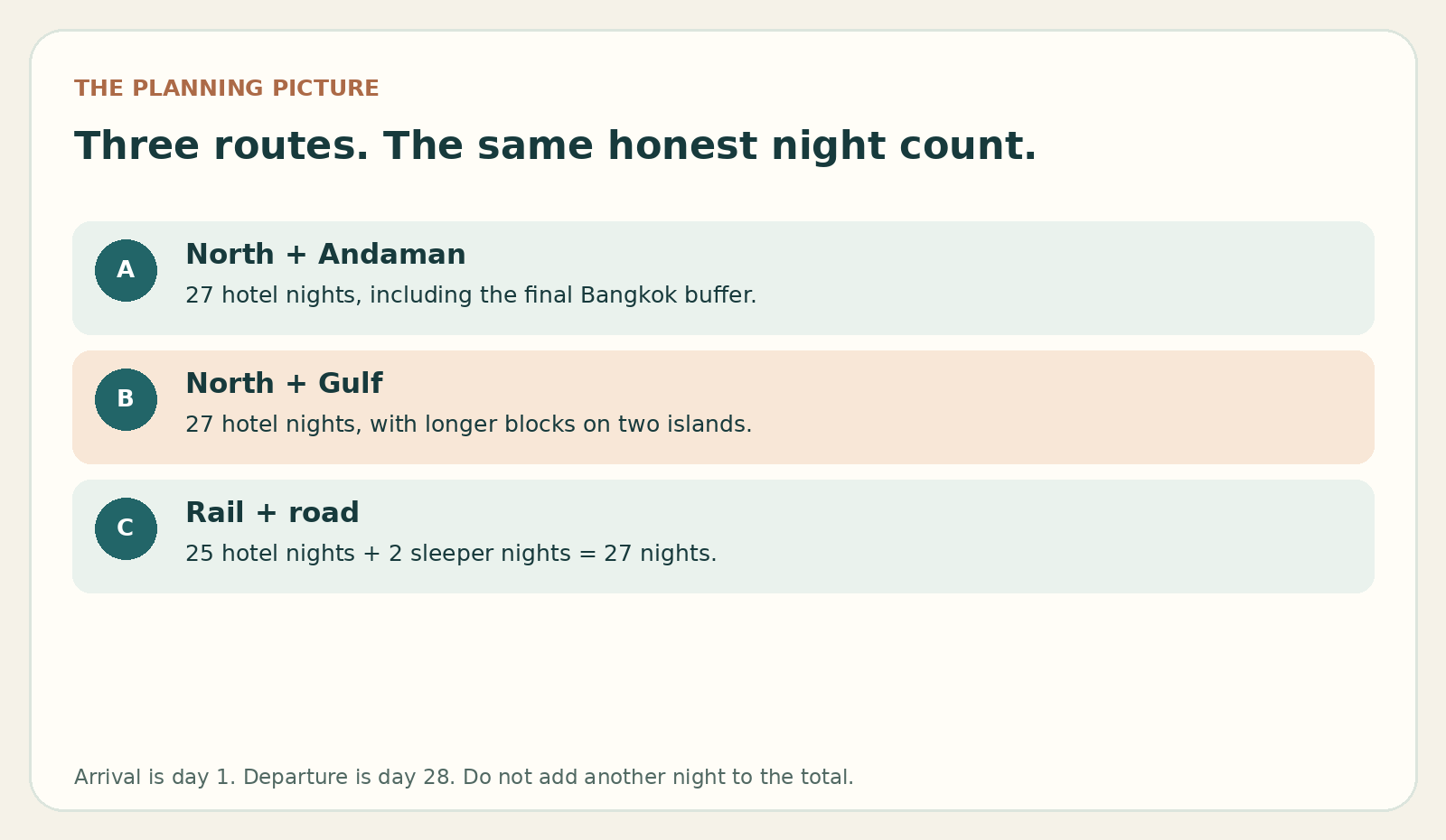
When arrival is day one and departure is day twenty-eight, there are twenty-seven nights between them. The no-flight route contains two nights on trains, leaving twenty-five hotel nights. An overnight flight from home before day one is outside that count. Put your actual calendar dates beside each block before paying a deposit.
Current UK-passport example
FCDO's current guidance says full British-citizen passport holders entering under tourism visa exemption from 15 September 2026 can stay up to thirty days, normally with two such entries per calendar year. Older sixty-day assumptions should not be used without checking. A twenty-eight-day plan leaves little spare time if your dates change; your actual entry stamp and eligibility control the stay. [1]
The Digital Arrival Card is a separate official arrival form rather than a visa or extension. Follow Immigration's current window and instructions for your journey. Other nationalities and people with different travel histories must check their own position, not copy the British-passport example. [2]
Keep the departure date realistic
Do not plan to solve an overstay through a casual border trip. If your holiday needs more time than your permission allows, arrange the appropriate visa or extension through the official process. The route can always be shortened; it should never require you to ignore an immigration deadline.
Route A: the full north-and-Andaman plan
| Days / nights | Base | What the block is for |
|---|---|---|
| 1-4 / 4 nights | Bangkok | Arrival, two substantial city days and one flexible day |
| 5-7 / 3 nights | Sukhothai | Transfer, historical park and a quieter second exploration day |
| 8-13 / 6 nights | Chiang Mai | Transfer, Old City, one mountain outing, class and rest |
| 14-18 / 5 nights | Ao Nang | Flight day, Railay option, one island outing and spare time |
| 19-25 / 7 nights | Koh Lanta | Transfer and an unhurried coastal week |
| 26-27 / 2 nights | Bangkok | Return, buffer day and final errands |
| 28 / 0 nights | Departure | International journey home |
Days 1-4: Bangkok without four overloaded days
Use day one for arrival and a short local walk. Give day two to a temple-and-river area, day three to food and a different neighbourhood, and day four to the interest you most want to pursue. That final day is also the first useful reserve if jet lag or rain changes the opening plans. You do not need four dawn starts to justify four nights.
Choose a location that makes your selected days convenient. A riverside hotel can work well for one pattern, while a rail-connected neighbourhood can suit another. Check the exact address and the last walk to transport. On the final evening, organise tomorrow's journey and leave the first Sukhothai activity unscheduled.
Day 5: travel to Sukhothai
Treat this as a proper transfer day. Compare a flight, a direct road service or a rail journey towards Phitsanulok followed by a road transfer; none should be presented as a train directly into the historical park. The best option depends on the dated service, arrival point and the location of your accommodation. Allow a substantial part of the day rather than planning a full archaeological visit after arrival.
Days 6-7: split the historical area into manageable visits
Use day six for the principal historical-park area, then decide whether day seven should include another temple group, craft interest or a slower return to a favourite spot. UNESCO recognises Sukhothai and associated historic towns as a World Heritage property, while TAT highlights the park and sites such as Wat Si Chum. Those are reasons to give the area time, not a requirement to see everything in one morning. [8] [7]
Base choice matters here. Old Sukhothai can simplify park visits; New Sukhothai serves a different set of practical needs. Check transport and meal access for the exact property. In hot weather, an early visit followed by a substantial break is more enjoyable than trying to cycle continuously until every gate has been reached.
Route A: Chiang Mai and the first coastal base
Days 8-13: use the six northern nights well
Day eight is the Sukhothai-Chiang Mai journey, with only a local dinner planned afterwards. On day nine, explore a manageable part of the Old City. Give day ten to one mountain-area outing if conditions suit, day eleven to a cooking class or craft activity, day twelve to a free day and day thirteen to a final neighbourhood visit or a weather-delayed activity.
The free day is deliberate. This is the point in a month-long trip when laundry, a late breakfast and an afternoon without directions can be valuable. If you feel energetic, choose a short outing locally. Do not turn that flexibility into an unplanned long-distance return trip simply because another place appears tempting on a map.
Day 14: fly to Krabi, with the itinerary checked first
AirAsia's Chiang Mai-Krabi route search is a starting point, not proof of a convenient nonstop flight on every date. Compare the actual itinerary and baggage before fixing the next hotel block. A connection can absorb most of the day. Keep the coastal arrival evening easy and do not make a non-refundable activity depend on landing exactly on time. [12]
Days 15-18: Ao Nang as an excursion base
Use day fifteen for the immediate beach area, day sixteen for a Railay visit when boat conditions permit and day seventeen for one selected island outing. Keep day eighteen as a reserve or a rest day. TAT describes Ao Nang as a departure point for nearby island and Railay boats, which is the practical reason for using it here. [10] [11]
Compare the activities rather than booking every tour with a different island list. One well-chosen boat day and one shorter coastal visit can provide enough variety. Read pickup arrangements, required charges and the weather policy before paying. If the outing is cancelled, use the reserve day only when conditions improve; the presence of a spare slot does not make an unsafe trip appropriate.
Route A: a proper Lanta week and the protected finish
Day 19: move to Koh Lanta
Compare the available road-and-vehicle-ferry transfer with any passenger-boat service running on your date. The useful figure is door-to-door time, including hotel pickup and the final island leg. For planning, allow a substantial half day rather than promising lunch at a precise time. Seasonal services and sea conditions can change the choice.
Arrive, inspect the immediate surroundings and arrange the next morning locally. The purpose of seven nights is to settle, not to begin another rushed sightseeing sequence. Choose a base where ordinary meals and basic supplies are practical without a daily journey you do not enjoy.
Days 20-25: give the island an ordinary rhythm
Make day twenty a beach-and-orientation day. Use day twenty-one for a short island exploration, day twenty-two for a selected sea outing if suitable, and day twenty-three for a completely free day. Day twenty-four can hold a cooking, cultural or gentle nature activity, while day twenty-five remains a reserve and packing day.
These are deliberately interchangeable suggestions. A month-long itinerary should allow you to move the boat day when the operator recommends a safer window or return to a beach you liked. Do not hire a scooter merely because an island guide treats it as automatic; check licensing, insurance and your own experience, or arrange other transport. [6]
Days 26-28: return before the last full day
On day twenty-six, transfer towards Krabi's airport and fly to Bangkok with a generous buffer between ground travel and check-in. Day twenty-seven is available for final shopping, a missed neighbourhood or simple rest. Fly internationally on day twenty-eight. The two Bangkok nights are included in the total, not added after the holiday has already reached twenty-seven nights.
If disruption affects the return, act early and contact the relevant suppliers. The buffer reduces pressure but does not guarantee that every problem can be absorbed. Keep essential documents and medication accessible throughout the final transfer.
Route B: a slower northern-and-Gulf alternative
| Days / nights | Base | Purpose |
|---|---|---|
| 1-4 / 4 nights | Bangkok | A measured start and one flexible day |
| 5-10 / 6 nights | Chiang Mai | Culture, food, one outing and downtime |
| 11-18 / 8 nights | Koh Samui | One base with enough time for weather changes |
| 19-25 / 7 nights | Koh Phangan | A second island without repeated hotel moves |
| 26-27 / 2 nights | Bangkok | Return before the final full day |
| 28 / 0 nights | Departure | Travel home |
Days 1-4: a measured city opening
Arrive on day one, explore a river-and-temple area on day two and a contrasting neighbourhood on day three. Leave day four for your main personal interest and any unfinished practical tasks. Unlike Route A, you will not continue by road towards Sukhothai, so the next important booking is the flight to Chiang Mai.
Days 5-10: stay long enough to enjoy Chiang Mai
Fly north on day five and keep the evening local. Day six introduces the Old City, day seven can be the main mountain outing, and day eight suits a cooking or craft session. On day nine, rest or explore independently; day ten is a flexible final day before the longer journey south.
This version is particularly helpful when you would rather spend more time in fewer bases. The six northern nights do not require six organised tours. Plan around your interests and current conditions, keeping one day available when weather or energy changes the order. A good room and accessible meals are important when you intend to spend genuine downtime in the base.
Day 11: travel to Samui on the service that actually exists
Search the complete Chiang Mai-Samui itinerary through the airline for your date. Bangkok Airways serves Samui, but do not infer a nonstop journey or a specific frequency from an undated route description. A connection via Bangkok may be part of the practical option, and separate tickets can introduce different risks. [13]
Arrive without an activity deadline, collect the information needed for the next few days and start with an easy dinner. The island section is long enough that nothing important needs to happen immediately after the flight.
Route B: eight nights on Samui without filling every morning
Days 12-14: settle before adding excursions
Use day twelve for the chosen beach area and local orientation. On day thirteen, plan a short cultural or island outing with a clear return arrangement. Day fourteen is free time: a pool morning, a nearby meal and space to decide whether the next activity genuinely appeals. Staying eight nights is an opportunity to slow down rather than a reason to book eight different experiences.
Days 15-18: one sea day, one inland interest and a reserve
A marine excursion can fit on day fifteen when the operator and conditions make it appropriate. Use day sixteen for a different interest on land and day seventeen for a reserve or another easy beach day. Day eighteen is intentionally uncomplicated because you move islands next. Confirm the ferry, pier and transfer rather than filling the final afternoon with a distant outing.
For every boat trip, inspect suitability and inclusions. A long day at sea is different from a short coastal crossing, and a generic activity photograph tells you little about the vessel or conditions. Keep the holiday workable even if the marine excursion does not run.
Make the season part of the choice
Route B is an alternative to compare when the Gulf is a better seasonal fit than the Andaman coast, not a year-round good-weather guarantee. The northeast-monsoon pattern can bring substantial rain to the southern east coast later in the year. Use the current regional forecast and plan for changes rather than relying on a Thailand-wide weather summary. [3] [4]
A comfortable indoor room and a practical neighbourhood matter more during wet periods. If a long forecast deterioration would undermine the main reason for the island stay, change the plan while the booking terms still allow it.
Route B: Phangan and the return via a real connection
Day 19: a short-looking crossing still uses travel time
Check the named departure pier on Samui, the arrival pier on Phangan and the road transfers at both ends. Ferry operators publish dated services and conditions; those details matter more than a broad claim that the islands are close. Give the move its own part of the day and avoid a paid afternoon activity that depends on a perfectly punctual crossing. [14]
Days 20-25: choose the island atmosphere you want
Use day twenty to learn the neighbourhood and day twenty-one for an island exploration that suits your transport plan. Day twenty-two can hold a water activity if conditions permit, while day twenty-three is a full rest day. Day twenty-four is available for a different beach or cultural interest, and day twenty-five remains a weather reserve and packing day.
Select the accommodation according to the experience you want. Check the beach at the relevant tide, road access and any event-related noise during your dates. A party-oriented stay and a quiet coastal stay can both be legitimate choices, but neither should be inferred from the words Koh Phangan alone. Ask the property directly about the immediate surroundings.
Days 26-28: do not hide the ferry before the flight
On day twenty-six, return towards an appropriate flight connection to Bangkok, allowing the full ferry-and-road chain. A morning ferry followed by a generously separated domestic flight may be workable, but inspect the actual schedule and consider returning to Samui earlier when forecasts suggest disruption. Do not book an international flight directly behind an unprotected island crossing.
Day twenty-seven is the Bangkok buffer and final full day. Depart on day twenty-eight. If your return uses Surat Thani instead of Samui Airport, rebuild the whole travel day with its longer ground stages rather than changing only the airport name.
Route C: build the no-flight trip around ground travel
| Days / nights | Sleep location | Important detail |
|---|---|---|
| 1-4 / 4 nights | Bangkok hotel | Arrive and settle before moving |
| 5-8 / 4 nights | Kanchanaburi hotel | History and one countryside day |
| 9-11 / 3 nights | Ayutthaya hotel | Transfer and two heritage days |
| 12 / 1 night | Northbound sleeper | Board the booked train at Ayutthaya |
| 13-20 / 8 nights | Chiang Mai hotel | An intentionally longer northern stay |
| 21 / 1 night | Southbound sleeper | Travel overnight towards Bangkok |
| 22-25 / 4 nights | Hua Hin hotel | Continue from Bangkok with a flexible buffer |
| 26-27 / 2 nights | Bangkok hotel | Return and final full day |
| 28 / 0 nights | Departure | International flight |
Days 1-4: Bangkok before the western detour
Keep the opening structure simple: arrival, a river-and-temple day, a second neighbourhood and a flexible day. Use some of the final afternoon to check the next journey and the sleeper reservations needed later in the route. The longest-distance bookings should not remain unresolved while you commit to every hotel.
Days 5-8: Kanchanaburi with time for context
Move to Kanchanaburi on day five and do little more than a short local walk afterwards. Give day six to the historical sites that interest you, approaching war cemeteries and memorial places respectfully rather than treating them merely as scenic photo stops. On day seven, choose one countryside or waterfall outing if local conditions and access are suitable. Day eight is a slower day or an opportunity to complete a missed visit.
The exact hotel location changes the practical trip. A central town stay can simplify independent meals and some visits; a remote river property can be attractive while requiring longer transfers. Choose deliberately and price the journeys that come with the address. Do not assume every property described as Kanchanaburi is near the town's main visitor area.
Why this detour stays realistic
Four nights allow time for arrival, history, one outdoor interest and a spare day. They do not justify attempting every attraction in the province. Check any organised outing's real pickup circuit and driving time. A nominal full-day tour can mean a very long day when your hotel is outside its normal collection area.
Route C: Ayutthaya, one sleeper night and a longer Chiang Mai stay
Days 9-11: do not make the transfer a hidden sightseeing day
Travel from Kanchanaburi to Ayutthaya on day nine using the practical road connection or an appropriate combination via Bangkok. Allow most of the day when using public transport with changes. Keep day ten for the main heritage interest and day eleven for another area or a slower revisit.
UNESCO identifies Ayutthaya as a World Heritage city with surviving archaeological remains. Give the sites space and do not climb or pose on structures where access is restricted. In hot weather, split visits with a proper break rather than trying to complete an entire list continuously. [9]
Day 12: the overnight train is tonight's accommodation
Check out, store luggage if the property agrees and plan a gentle final day before boarding the confirmed northbound train at Ayutthaya. Verify that your actual service stops there, note the boarding time and retain the ticket details offline. A request awaiting confirmation is not the same as a booked sleeper berth. Use the State Railway's official system to inspect dated options. [15]
Count this as one train night and no hotel night. Arrange a practical place to wait, use toilets and obtain food before boarding rather than assuming every need can be met at the last minute. Check the carriage and berth arrangement so that the journey fits your comfort requirements.
Days 13-20: eight northern hotel nights
Arrive on day thirteen and make it a recovery day. Use day fourteen for the Old City, day fifteen for one mountain outing, day sixteen for a class or workshop and day seventeen for rest. Day eighteen can be a short day trip chosen for your interests, day nineteen a neighbourhood day and day twenty a flexible final day.
This longer stay is one of Route C's rewards. You can use the same cafe twice, do laundry and avoid treating every meal as research for the next attraction. Check health and air-quality advice for the season, and change outdoor plans when conditions are unsuitable rather than forcing the programme. [5]
Route C: the southbound sleeper and a mainland beach finish
Day 21: leave Chiang Mai in the evening
Keep the day light and board the booked southbound overnight service. This is the second train night, not the first Hua Hin hotel night. Check the Bangkok arrival station and onward transport independently. Do not assume a familiar city name guarantees that the next departure leaves from the same building.
Day 22: make the Hua Hin continuation flexible
After reaching Bangkok, continue to Hua Hin with enough time for delay, breakfast and the station or terminal change. This is the route's most demanding connection day. Avoid a non-refundable departure that leaves only a narrow margin after the sleeper's scheduled arrival. When the connection is awkward, take an extra Bangkok night and shorten Hua Hin by one night instead.
That fallback preserves the twenty-seven-night total: it changes where you sleep rather than inventing an extra day. Check the change terms before travel so the decision remains practical. Reaching the beach slightly later is preferable to turning a delayed train into a frantic cross-city dash.
Days 23-25: three genuinely easy coastal days
Use day twenty-three for the nearby beach and town, day twenty-four for one short outing and day twenty-five for rest or a favourite local spot. Choose a hotel whose ordinary meal access suits you. After the train sequence, the appeal is a simple routine rather than a new set of long transfers.
Days 26-28: back to Bangkok with a full day spare
Travel back on day twenty-six, keep day twenty-seven for rest and final errands, then depart internationally on day twenty-eight. Route C avoids domestic flights, but it is not a claim of lower emissions calculated here or a guarantee of lower cost. Its distinctive value is the ground-travel experience and the longer stays that make that choice workable.
Transfer planning: compare complete journeys
Use door-to-door estimates
A flight time excludes checkout, road travel, check-in and the final hotel transfer. Ferry timings also leave out the journey to the pier, waiting and the next island's road leg. A sleeper arriving in the morning does not guarantee that you will feel ready for a full day. Build the route using these complete journeys rather than the smallest number on a booking page.
For budgeting time, allow half a day for many domestic relocations and a full day for complicated connections. These are planning allowances, not published schedules. Replace them with the actual itinerary and increase the buffer when the next booking is expensive or difficult to change.
Separate tickets create separate responsibilities
Read what is protected when booking a combined journey and what happens when you assemble it yourself. A transfer sold as one product may still have conditions and check-in requirements. Keep each operator's contact details and do not assume an unrelated airline will accept responsibility for a delayed ferry.
Know the important names
Record the airport code, station or pier rather than only the city or island. Confirm the hotel pickup address, meeting point and check-in deadline. These small details prevent avoidable mistakes, particularly in Bangkok and on islands with more than one passenger pier. Save the information offline before travelling.
A realistic transfer-day example
Imagine that a domestic flight is only two hours long. You may still need to leave the hotel well before it, reach the correct terminal, complete check-in, collect luggage at the destination and travel to the next base. Rather than count the morning as sightseeing and the afternoon as a beach day, mark the whole central part of the day unavailable. Any enjoyable evening then becomes a bonus instead of a missed promise.
Apply the same discipline to Route C's sleeper arrival. Book a flexible onward arrangement and allow time to wash, eat and deal with a delay. If a comfortable connection requires an extra city night, take it from the next base explicitly. That is a sensible redesign, not a failure to follow the itinerary.
A four-week budget with the assumptions visible
Price the route you choose
The model below was constructed on 7 October 2026 for two adults sharing accommodation. It uses twenty-seven hotel nights as a comparison baseline for Routes A and B. For Route C, replace two hotel nights with the actual sleeper costs and reprice the long-distance allowance rather than counting both.
| Category | Assumption | Total |
|---|---|---|
| Accommodation | 27 nights x THB 2,000 | THB 54,000 |
| Meals and ordinary drinks | 28 days x THB 1,200 per couple | THB 33,600 |
| Long-distance travel | Chosen allowance for two | THB 18,000 |
| Local transport | 28 days x THB 300 per couple | THB 8,400 |
| Activities / entry fees | Selected activities, not an excursion every day | THB 12,000 |
| Laundry / connectivity / incidentals | Whole-trip allowance | THB 4,000 |
| Subtotal | Before contingency | THB 130,000 |
| 15% reserve | For variation and disruption | THB 19,500 |
| Working total | Excludes international flights, insurance and visa costs | THB 149,500 |
What changes the total most?
Within this 7 October 2026 model, changing the room assumption by THB 500 per night changes the twenty-seven-night accommodation total by THB 13,500. That is why room standard and location deserve attention before small daily economies. Flight dates and baggage can also move the transport total considerably, particularly when the Gulf route uses Samui flights.
Meals, activities and local transport depend on how you travel. Someone taking organised excursions daily needs a different model from someone enjoying independent neighbourhood days. A solo traveller cannot simply halve the shared-room total. A family needs a real occupancy quote rather than two adult prices multiplied by the number of people.
Keep the reserve available
The contingency should remain money you can use, not a line added after every available pound has already been allocated. A changed flight, cancelled boat day or extra hotel night can require immediate payment even when a refund is expected later. Keep international flights, insurance and any visa costs visible outside the model so they are not mistakenly treated as included.
Seasonal changes that may justify a different route
Swap the coast, not just the order
When the Andaman section is a poor fit for your month, compare the Gulf route rather than merely visiting Krabi earlier in the same wet period. Conversely, later-year Gulf rain can make Samui and Phangan less attractive as the main reason for the trip. Use regional information and the current forecast rather than the phrase Thailand dry season. [4]
Be flexible about northern outdoor days
A northern stay can include food, craft and cultural interests when mountain visibility or weather is disappointing. However, if the season creates conditions that do not suit your health or main interests, reconsider the length of the stay. It is better to change a flexible booking than to spend six days waiting for a photograph you may never get.
Do not make safety subordinate to the night count
A correct twenty-seven-night table does not oblige you to board a boat or visit an outdoor area against local warnings. The count is a planning tool, not a reason to ignore conditions. Contact suppliers early, move the activity or reallocate a night when the situation requires it. A realistic itinerary remains adjustable.
Packing and everyday organisation for a month
Pack around laundry
Bring a practical rotation of clothing, respectful temple wear, comfortable footwear and rain protection suited to the route. Arrange laundry during the longer stays rather than carrying twenty-eight separate outfits. Keep a small transfer-day bag with documents, medication, water and a change of clothes so that ordinary travel does not require opening the main case repeatedly.
For sleeper trains, place overnight essentials somewhere accessible without unpacking everything in a narrow space. For boats, protect important electronics and check how luggage is handled. A month gives you time to replace small items locally, but essential medication and critical documents need a more deliberate plan.
Keep information available when the signal is not
Check eSIM compatibility, validity and data allowance for the full trip, and save tickets and hotel addresses offline. A long stay may outlast a short travel-data package. Keep a separate record of the next connection and the final international flight so that a lost or flat phone does not remove every detail at once. [16]
Share the practical information
When travelling with someone else, ensure both people can find the next booking, the accommodation address and the emergency contact information. One person can manage the itinerary without becoming the only person who knows it. Keep passport copies protected and carry the originals as required; do not leave sensitive documents in an openly shared folder.
Review the next two days each evening rather than repeatedly reorganising the entire month. Check whether tomorrow requires a checkout, a ticket collection, a particular dress code or a weather decision. That small routine catches practical issues while leaving most of the holiday free from constant administration.
Use a mid-trip reset
During the longest base stay, spend a short period reviewing laundry, remaining medication, data allowance and the next important connection. Replace or repair a failing bag strap before another transfer. A planned reset is more efficient than several emergency shopping trips, and it gives you a chance to remove activities that no longer appeal rather than continuing out of habit.
How to adapt a route without breaking it
Travelling with children
Reduce the number of demanding excursions before reducing rest days. Recheck room occupancy, child seats and the suitability of boat trips or overnight berths. A month with children can work well in fewer bases, but a long stay in an inconvenient hotel can create daily friction. Prioritise sleep, food access and practical transfers over a larger sightseeing list.
Travelling solo
Choose accommodation and arrival times that make independent orientation straightforward. A shared activity can add company without requiring a constantly changing route. Keep an evening return plan and avoid using a long overnight journey solely because it appears to remove a hotel charge; your comfort and next-day energy still matter.
Travelling more slowly
Take two or three days from the least important stop and give them to the place you most want to understand. Recalculate the hotel nights and transfer dates before changing reservations. The route should still total twenty-seven nights, and the departure buffer should remain unless a different gateway has been designed properly.
Shortening the holiday
Remove a whole destination rather than shaving every stay down to two nights. For example, dropping Sukhothai from Route A simplifies the northern sequence more effectively than trying to preserve all bases in a much shorter trip. A coherent shorter route is better than a compressed copy that leaves only arrival afternoons everywhere.
A traveller who dislikes repeated packing
Start with Route B's fewer main bases, but consider replacing the second island with a longer stay on the first. Use some of the saved transfer effort for short local outings or a better-positioned room. Repetition can be an advantage when it produces a favourite breakfast place and a familiar route back after dinner.
A traveller whose priority is history
Use Route A as the foundation and consider moving two coastal nights into Sukhothai or Chiang Mai. Alternatively, Route C offers Ayutthaya and Kanchanaburi with a long northern block. Choose according to the kind of history that interests you, then build a respectful and manageable visiting pace. Adding every historical town would undo the advantage of the longer trip.
A traveller who wants a single special experience
Reserve space for that priority first, but inspect its location and seasonal requirements. A diving course, a specific festival or a demanding hike can shape several days around it. Remove an equivalent block elsewhere instead of layering the experience onto already busy transfer days. Keep the booking's cancellation conditions visible when the activity depends on weather or minimum participation.
Pros and cons of these three approaches
Advantages
- Every day and overnight stay has a place in the plan.
- Longer base stays allow laundry, rest and weather flexibility.
- Three different travel styles rather than one route with cosmetic variations.
Trade-offs
- Some long-distance journeys still consume substantial holiday time.
- The coastal versions require seasonal and ferry checks.
- The no-flight version depends on suitable confirmed sleeper arrangements.
Route A offers the broadest contrast, Route B gives more room to settle into island life, and Route C makes ground travel an intentional part of the experience. None wins on every measure. Choose according to the kind of days you want and the compromises you find least irritating.
The common advantage is honest time allocation. Each route includes transfer days, spare time and a protected ending. The common limitation is that actual conditions and services can still require changes. A well-structured route makes those changes easier to manage; it does not remove them.
Common mistakes on a four-week Thailand trip
Expanding the map faster than the time available
An extra island may add only one name but two transfers and a hotel move. Before adding a stop, identify exactly which existing nights it replaces. If the answer is to remove every reserve day, the route is becoming less realistic rather than more complete.
Counting sleep twice
Do not count a sleeper night as accommodation in two cities. Likewise, check whether an early-morning international departure requires a room on the previous date. These errors often appear only when hotel confirmations are lined up, which is why the night count should be done before booking.
Leaving the hardest connection until last
For these routes, the north-to-coast flight, the island return chain or the sleeper berth can constrain the plan. Inspect that connection before reserving every room around it. A beautiful hotel with inflexible dates cannot fix a service that does not operate when you need it.
Trying to recover every missed activity
A cancelled boat day does not create a debt that must be repaid by squeezing another outing into the airport-transfer morning. Decide what still fits comfortably and let the rest go. Four weeks should provide the freedom to enjoy Thailand, not a longer checklist to complete under pressure.
Frequently asked questions
Which route would you choose for a first visit?
Route A is the broadest starting point when its Andaman section fits the season and the north-to-coast connection is workable. It includes history, city culture and a long island stay without changing hotels every second night. Choose Route B instead when the Gulf better suits the timing or you prefer fewer main bases. Route C is for travellers who actively want the rail-and-road experience.
Are twenty-eight days enough to see both Thai coasts?
They can be, but these plans deliberately avoid treating both coasts as compulsory. Crossing between them uses time that could otherwise become an unhurried day in a place you already like. Add a second coast only when it is a central priority and you are willing to remove another block, not by quietly deleting all the reserve time.
Why return to Bangkok for two nights at the end?
The first night follows the domestic return journey and the second protects a final full day before the international flight. This provides more flexibility than arriving from an island just before flying home. It does not guarantee protection against every disruption, but it makes the ending less dependent on several unrelated services operating perfectly on one day.
Does Route C really avoid domestic flights?
Yes. Its structure uses road transfers and two overnight train journeys, including an Ayutthaya-Chiang Mai sleeper and a southbound return towards Bangkok. Those services and berths must be confirmed for your dates. The Hua Hin continuation after the second sleeper needs a generous buffer, with an extra Bangkok night as a practical fallback if the connection is awkward.
Should every hotel be booked before arrival?
Reserve the essential dates, the initial stay, the final return and any particularly important property once the route-defining transport is understood. Flexible middle sections can be useful, but availability and peak periods vary. The right balance is not universal. Know which bookings can change and do not assume a last-minute room will match the standard or location you require.
Can I replace an island with a longer mainland stay?
Yes. That can simplify transport and may suit travellers who dislike boat journeys or are visiting in less favourable sea conditions. Replace the whole island block with a coherent base rather than scattering the nights between several new stops. Then recalculate the route, budget and final return so the twenty-seven-night total remains clear.
How should I handle a weather cancellation?
Follow the operator and local safety advice, contact the relevant suppliers and use the reserve time where it genuinely helps. Keep the next important connection protected. If the cancelled experience no longer fits comfortably, choose something different instead of forcing it into the last available morning. A flexible route is successful even when not every original activity happens.
The recommendation: let the extra weeks create better days
Choose Route A for contrast, Route B for a slower Gulf section or Route C for a deliberate ground-travel journey. Then resist adding destinations simply because four weeks sounds generous. The longer stays are what give these routes room to work.
Before booking, check the night total, the hardest connection, the appropriate season and the final departure buffer. After that, leave space to enjoy the places rather than continually researching the next one. A good month in Thailand should leave you remembering days you enjoyed, not only the journeys between them.
Sources and fact-checking notes
Sources and route assumptions reviewed on 7 October 2026. All three itineraries are original constructed plans, not live package offers. Hotel-night and train-night totals have been checked. Transfer allowances are not timetables; dated airline, rail and ferry information must be confirmed. The cost model is illustrative and excludes international flights, insurance and visa costs.
- 01FCDO: Thailand entry requirementsReviewed 7 October 2026.
- 02Immigration Bureau: official Thailand Digital Arrival Card manualReviewed 7 October 2026.
- 03Thai Meteorological Department: seasons of ThailandReviewed 7 October 2026.
- 04Thai Meteorological Department: current forecastsReviewed 7 October 2026.
- 05FCDO: Thailand health adviceReviewed 7 October 2026.
- 06FCDO: Thailand safety and securityReviewed 7 October 2026.
- 07Tourism Authority of Thailand: SukhothaiReviewed 7 October 2026.
- 08UNESCO: Historic Town of Sukhothai and Associated Historic TownsReviewed 7 October 2026.
- 09UNESCO: Historic City of AyutthayaReviewed 7 October 2026.
- 10Tourism Authority of Thailand: KrabiReviewed 7 October 2026.
- 11Tourism Authority of Thailand: Railay BeachReviewed 7 October 2026.
- 12AirAsia MOVE: Chiang Mai to Krabi route searchReviewed 7 October 2026.
- 13Bangkok Airways: dated flight search and route informationReviewed 7 October 2026.
- 14Lomprayah: official ferry booking and service informationReviewed 7 October 2026.
- 15State Railway of Thailand: official D-Ticket bookingReviewed 7 October 2026.
- 16Airalo: Thailand eSIM specificationsReviewed 7 October 2026.
Illustrations in this article were created for Taylor’s Trailblazing Travels. Third-party photographs, where used, are credited beside the image or in the source list.