Thailand travel planning
A practical Northern Thailand route-planning guide covering Chiang Mai, Chiang Rai, Pai, Mae Hong Son, Sukhothai and quieter northern stops, with realistic transport, seasonal smoke advice, costs and where-to-stay decisions.
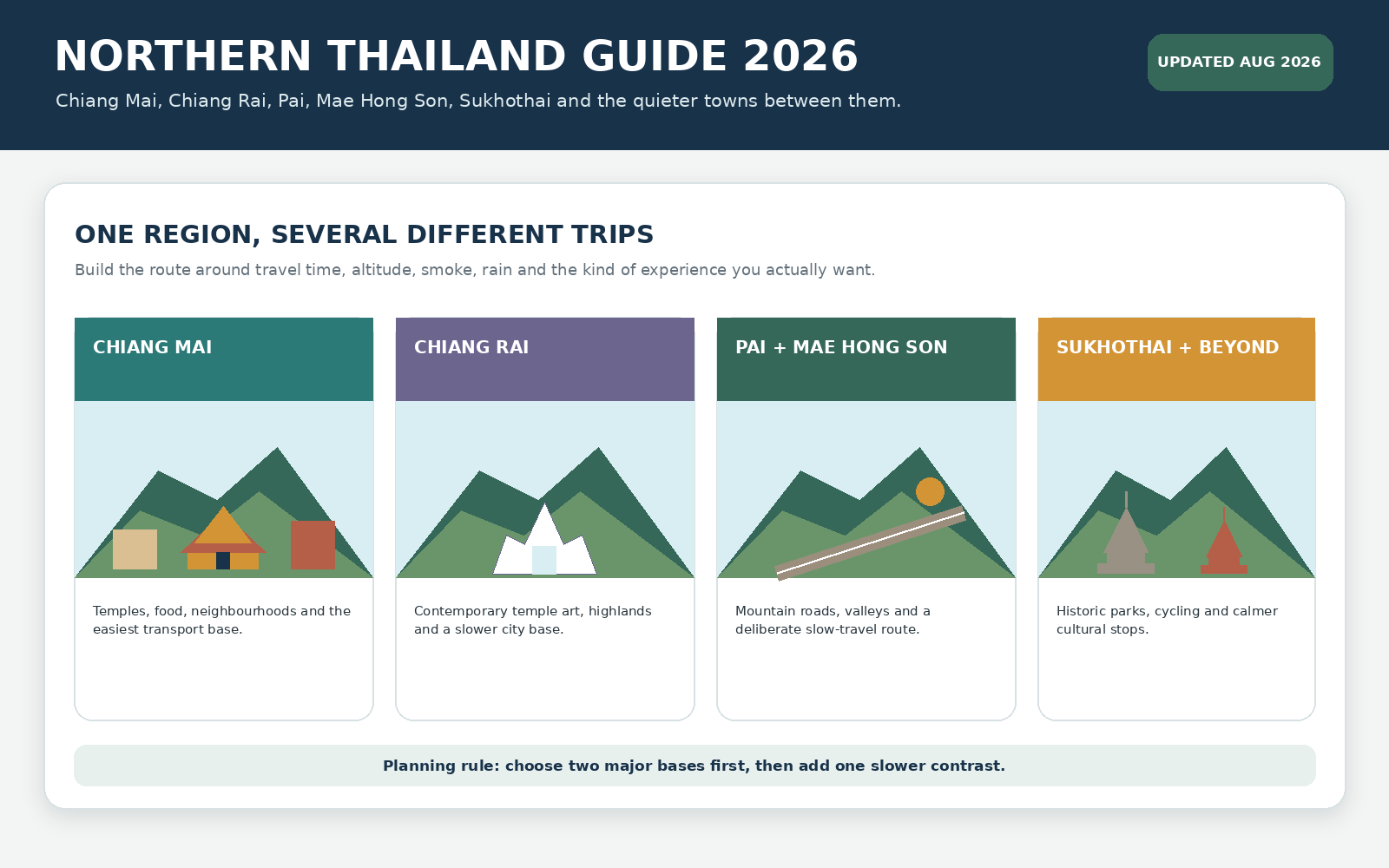
Northern Thailand looks compact on a map, yet a good route depends on more than distance. Chiang Mai, Chiang Rai, Pai, Mae Hong Son, Lampang and Sukhothai sit within the same broad region, but they involve different road conditions, climates, transport networks and reasons for visiting.
The most satisfying trips usually choose two major bases and one slower contrast. Chiang Mai provides the easiest starting point; Chiang Rai adds contemporary temple art and highland excursions; Pai and Mae Hong Son make the road part of the experience; Sukhothai and Lampang create a calmer cultural route. Trying to collect all of them in one week often replaces evenings and neighbourhood time with terminal queues.
This Northern Thailand guide 2026 uses current official transport and safety sources, including the State Railway of Thailand, Airports of Thailand, GreenBus, Air4Thai and the Department of National Parks. Prices and local road times are still planning ranges rather than promises, so the article explains what to verify close to travel and where flexibility matters most.
Northern Thailand: quick answers
Best first base
Chiang Mai for four or five nights, because it has the widest choice of flights, trains, food, hotels and day trips.
Best second stop
Chiang Rai for art and highlands, Pai for a social mountain town, or Sukhothai for cycling and history.
Easiest season
November to January, although popular mountain rooms and festival dates should be booked early.
Smoke-season rule
From February into April, check Air4Thai every day and keep a route-change option rather than relying on averages.
Useful trip length
Seven nights for Chiang Mai plus one contrast; ten to fourteen nights for a mountain loop or several provinces.
About 1,200-2,500 baht budget, 2,800-5,500 mid-range, or 6,000+ comfort per person.
Treating Chiang Rai, Pai, Doi Inthanon and Sukhothai as short day trips from one hotel.
In this guide
- How to use this Northern Thailand guide
- Northern Thailand destinations compared
- Choose Northern Thailand by travel style
- Best time to visit Northern Thailand: weather, smoke and rain
- Chiang Mai: the practical Northern Thailand base
- Chiang Rai: temple art, highlands and a slower city
- Pai and Mae Hong Son: mountain roads need time
- Sukhothai, Lampang, Lamphun and quieter northern stops
- Best day trips from Chiang Mai and Chiang Rai
- Transport in Northern Thailand: realistic timings and choices
- Northern Thailand costs and booking strategy
- Northern Thailand food and markets worth planning around
- Trekking, elephants and community tourism
- Useful gear for Northern Thailand compared
- Northern Thailand itinerary examples
- Northern Thailand: pros and cons
- Before you travel: entry, safety and booking checks
- Common Northern Thailand planning mistakes
- Northern Thailand guide FAQs
How to use this Northern Thailand guide
Choose the trip type before choosing the towns
Think in clusters rather than a single loop
Chiang Mai and Chiang Rai form the easiest two-city cluster. Pai and Mae Hong Son create a separate mountain-road journey. Meanwhile, Lampang, Lamphun and Sukhothai work as a cultural corridor south of Chiang Mai. Joining all three clusters is possible, although it needs more time than most first itineraries allow.
Do not turn every place into a Chiang Mai day trip
Doi Suthep and nearby countryside fit naturally from Chiang Mai. By contrast, Chiang Rai, Pai and Sukhothai become poor day trips for many travellers because the return journey dominates. Therefore, spend two nights where the route would otherwise involve six or more road hours.
Northern Thailand destinations compared
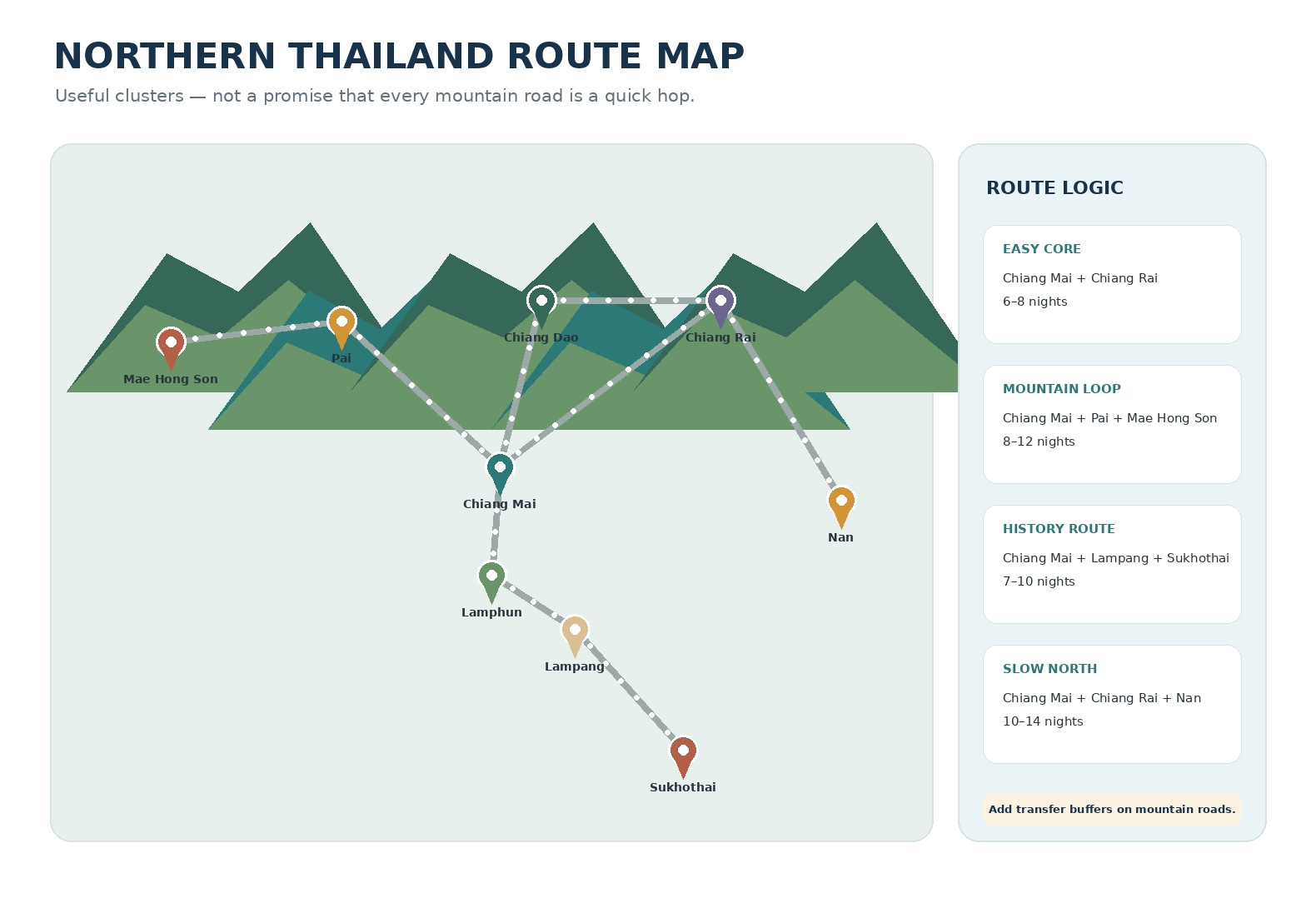
Northern Thailand destination comparison
| Place | Best for | Suggested stay | Access logic | Main trade-off |
|---|---|---|---|---|
| Chiang Mai | First trips, food, temples, day trips | 3-5 nights | Flights, overnight trains, buses | Busy centre and spread-out attractions |
| Chiang Rai | Temple art, highlands, quieter city | 2-3 nights | Flight or GreenBus from Chiang Mai | Sights need road transport |
| Pai | Cafés, valley scenery, social slow travel | 2-4 nights | Winding van or car from Chiang Mai | Motion-heavy road and peak crowds |
| Mae Hong Son | Road trips, mist, Shan/Lanna culture | 2-3 nights | Mountain road or limited flight options | Long distances and few quick exits |
| Sukhothai | History, cycling, archaeology | 2 nights | Road from Bangkok/Chiang Mai; regional air | Separate from upper-north cluster |
| Lampang | Temples, architecture, slower city | 1-2 nights | Rail/road south of Chiang Mai | Less evening choice |
| Lamphun | Short cultural stop, temples | Half day-1 night | Easy road/rail from Chiang Mai | Usually a short stop rather than full base |
| Chiang Dao | Mountains, nature, slower countryside | 1-3 nights | Road north of Chiang Mai | Car/driver useful; seasonal access |
| Mae Kampong | Community stay and mountain village | Day trip-1 night | Road east of Chiang Mai | Weekend crowds and limited inventory |
| Nan | Slow travel, temples, remote north | 3-4 nights | Flight or long road journey | Adds distance to a first itinerary |
Best for a first visit
Chiang Mai plus Chiang Rai is the cleanest first route. Together they cover Lanna temples, contemporary art, food, markets and mountains without committing to the Mae Hong Son road. In addition, both cities have airports and established intercity transport.
Best for a mountain road trip
Pai, Pang Mapha and Mae Hong Son work when the road itself is part of the trip. TAT describes Lod Cave, Pai Canyon and the province’s forested mountains as core attractions. However, travellers susceptible to motion sickness should plan the drive carefully and avoid a rushed out-and-back. [3]
Best for history and cycling
Sukhothai is the strongest history-led stop. UNESCO identifies Sukhothai, Si Satchanalai and Kamphaeng Phet as a connected World Heritage property, while TAT highlights Wat Si Chum and Wat Mahathat. Consequently, two nights gives far more value than a brief transit stop. [4][5]
Best for a quieter return trip
Lampang, Nan, Chiang Dao and Mae Kampong suit travellers who have already seen the headline route. They also reward slower mornings and local transport planning. TAT’s own sample itinerary links Lampang, Lamphun and Chiang Mai over four days, which is a useful reminder that the smaller cities still need time. [8]
Choose Northern Thailand by travel style
The region becomes easier to plan once the purpose of the trip is clear. A food-led city break needs a different route from a mountain road trip, while a history-focused itinerary may not need Pai at all. The table below turns those priorities into a first practical choice.
Which northern route fits you?
| Traveller priority | Best starting route | Useful length | What to leave out first |
|---|---|---|---|
| First visit, food and temples | Chiang Mai + Chiang Rai | 7-10 nights | Mae Hong Son loop |
| Mountain roads and small towns | Chiang Mai + Pai + Pang Mapha + Mae Hong Son | 11-14 nights | Sukhothai |
| History and slower cities | Chiang Mai + Lamphun + Lampang + Sukhothai | 9-12 nights | Pai |
| Nature without a long loop | Chiang Mai + Chiang Dao + Chiang Rai | 8-11 nights | Mae Hong Son |
| Returning visitor | Nan + Chiang Rai or Lampang + Phrae | 8-12 nights | Headline checklist stops |
The route I would choose for a first trip
Four nights in Chiang Mai and three in Chiang Rai is the cleanest short route. With ten nights, I would add Lampang and Sukhothai for a calmer cultural journey, or Pai only when the mountain road and social town atmosphere are part of the appeal. That decision is more useful than asking which place is “best” in isolation.
Best time to visit Northern Thailand: weather, smoke and rain
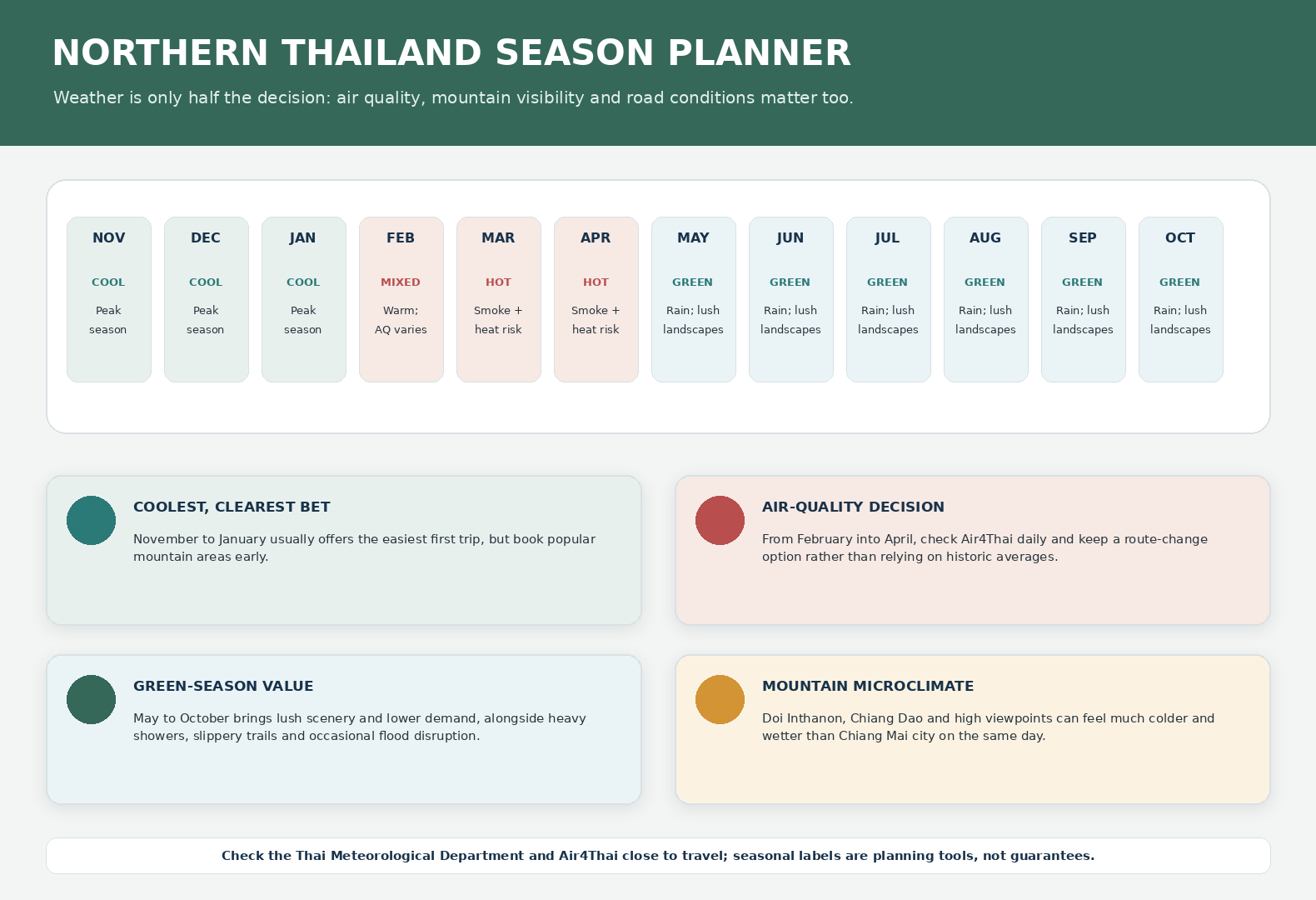
November to January: the easiest broad window
Cooler mornings, lower humidity and clearer mountain views usually make November to January the easiest first-trip period. TMD’s January 2026 summary recorded cool to cold conditions across upper Thailand, with colder weather on mountain tops. Even so, daytime sun can remain strong in the cities. [9]
Peak demand is the trade-off. Popular Pai rooms, Doi Inthanon sunrise tours and small mountain stays can sell out, especially around Christmas, New Year and Thai holidays. Therefore, book the scarce overnight first and leave ordinary city activities more flexible.
February: a transition month, not a guarantee
Early February can still deliver pleasant conditions, yet air quality becomes less predictable as the dry season progresses. Historical averages do not tell you what the valley will look like on a specific week. For this reason, use Air4Thai and current provincial updates before committing to long outdoor days. [12]
March and April: heat and smoke can reshape the trip
March and early April carry the highest planning risk for heat, haze and reduced mountain visibility. Chiang Mai provincial authorities reported orange-level PM2.5 conditions beginning to affect health on 26 March 2026, while FCDO health guidance continues to warn that Chiang Mai can be affected by seasonal regional smoke haze. Treat the timing as variable rather than assuming every year follows the same dates.[13] [33]
May to October: green scenery with rain risk
The green season brings fuller waterfalls, rice fields and fewer peak-season crowds. On the other hand, mountain roads and trails can become slippery, viewpoints may sit in cloud and intense rain can disrupt travel. A TMD warning in August 2025 included flash-flood and runoff risk across Mae Hong Son, Chiang Mai and Chiang Rai. [11]
High mountains have their own weather
Doi Inthanon, Chiang Dao and other elevated areas can feel much colder and wetter than Chiang Mai city on the same day. TAT describes the Ang Ka cloud forest as cool and misty, while its mountain guide places Chiang Dao roughly two hours north of the city. Pack layers and verify park access close to departure. [6][7]
Chiang Mai: the practical Northern Thailand base
How many nights to stay
Three nights is the minimum useful stay, four is better and five allows one substantial mountain day without losing the city. TAT highlights Doi Suthep, Tha Phae Walking Street, Nimman, Doi Inthanon, Mae Kampong and Doi Pui, which is far more than a two-night stop can cover comfortably. [1]
Choose the neighbourhood for the trip you want
Where to stay in Chiang Mai
| Area | Best for | Walkability | Transport reality | Main caution |
|---|---|---|---|---|
| Old City | Temples, first visits, atmosphere | Good within the moat | Songthaews, Grab, walking | Tourist-heavy around main gates |
| Nimman | Cafés, dining, modern stays | Strong local radius | Airport side; road traffic | Aircraft noise and busy roads in parts |
| Night Bazaar / Chang Klan | Markets and evening convenience | Good for central nights | Easy taxis and airport access | Less residential feel |
| Riverside | Couples, calmer hotels | Variable by property | Taxi/ride app often needed | Not always convenient for old-city walking |
| Santitham | Value, local food, longer stays | Mixed but practical | Songthaew/ride app useful | Fewer polished resort options |
The Old City is easiest for a temple-led first visit, while Nimman works for cafés and modern dining. Riverside hotels suit slower evenings, and Santitham can offer better value. Jing Jai also adds a creative market district close to central Chiang Mai, although opening patterns should be checked before building a day around it. [28]
A balanced four-day Chiang Mai plan
Chiang Mai four-day starter plan
| Day | Morning | Afternoon | Evening |
|---|---|---|---|
| 1 | Arrival and neighbourhood walk | Temple or café close to hotel | Simple dinner and early night |
| 2 | Old City temples | Doi Suthep or craft district | Night market / local food |
| 3 | Doi Inthanon, Mae Kampong or Chiang Dao | Continue full-day trip | Quiet dinner |
| 4 | Market or cooking activity | Massage, museum or free time | Departure or final meal |
Doi Inthanon needs a full-day mindset
Thailand’s highest mountain is not a quick viewpoint beside the Old City. The road, park entry, stops and weather create a full excursion. DNP has also piloted e-ticket and QueQ access at Doi Inthanon, so check the current system and what a tour price includes before booking. [15]
Chiang Rai: temple art, highlands and a slower city
Stay two or three nights rather than racing from Chiang Mai
Chiang Rai deserves more than a same-day White Temple photograph. TAT’s official guide includes Wat Rong Khun, Wat Rong Suea Ten, Baan Dam, Doi Pha Tang, Doi Tung, Tham Luang and the Golden Triangle. Since those places spread across the province, two nights is the practical minimum. [2]
Best areas to stay in Chiang Rai
| Area | Best for | Transport reality | Main trade-off |
|---|---|---|---|
| Clock Tower and Night Bazaar | First visits, food and evening walking | Easy songthaew and ride-app access | Busy streets and more tour groups |
| Mae Kok riverside | Quieter hotels and relaxed evenings | Short taxi ride to central sights | Fewer restaurants directly outside some hotels |
| Airport and northern city edge | Early flights and road trips | Convenient for the airport and Highway 1 | Less atmosphere on foot |
| Countryside resort | Pool time, views and retreat-style stays | Driver or hotel shuttle usually needed | Low room rate can be offset by daily car costs |
Compare location before room style
Compare Chiang Rai accommodation with the map open. A central room is usually better for a two-night visit, while a countryside resort makes more sense when the property itself is part of the holiday.
Build one city day and one highland day
Use the city day for Wat Rong Khun, the Blue Temple, Baan Dam and the night bazaar, while understanding that a driver or organised route reduces backtracking. Next, choose Doi Tung, the Golden Triangle or a highland viewpoint for the second day. Trying to include all of them produces more windscreen time than travel.
Bus from Chiang Mai or direct flight
GreenBus’s official timetable page, latest updated 15 July 2026, listed multiple daily Chiang Mai-Chiang Rai departures from morning into early evening. The road journey is commonly planned at roughly three to four and a half hours, although traffic and service type vary. Check the operator timetable and boarding terminal before travel. [16][17]
Chiang Rai is better for deliberate quiet
Evenings are calmer than central Chiang Mai, and that is part of the appeal. Choose a central hotel if you want markets and restaurants on foot; choose a countryside resort only when you are comfortable paying for cars. Otherwise, a cheap rural room can create an expensive daily transport problem.
Pai and Mae Hong Son: mountain roads need time
Pai is a lifestyle stop as much as a sightseeing stop
Pai combines a walking street, cafés, countryside, hot springs and Pai Canyon. TAT describes the evening market and canyon as major draws. However, the town is no longer a hidden village, so visit for the valley pace rather than an expectation of isolation. [3]
Where to stay in Pai and Mae Hong Son
| Base | Best for | Without a scooter | What to check |
|---|---|---|---|
| Pai Walking Street area | Short first stay, restaurants and evening atmosphere | Easiest option | Night noise and parking |
| Pai river or quiet edge | Calmer mornings within reach of town | Walkability varies by bridge and road | After-dark route and luggage transfer |
| Pai countryside | Views, pool time and retreat-style stays | Hotel shuttle or driver often needed | Distance from food and weather access |
| Mae Hong Son town | Lake, temples and loop recovery | Central area is manageable | Limited late transport compared with Chiang Mai |
Do not let a cheap room create an expensive commute
Compare Pai hotels by location and check the route after dark. A countryside property can be excellent, but only when its transfer arrangements match the way you plan to move around.
The Chiang Mai-Pai road is the deciding factor
Vans usually take around three to four hours, but the winding route can feel much longer. Motion-sensitive travellers should sit where they feel most comfortable, eat lightly and avoid treating the arrival day as a full sightseeing day. By comparison, a private car offers stops and space but costs more.
Mae Hong Son works as part of a loop, not a hurried extension
Mae Hong Son town adds Shan and Lanna temples, misty mornings and access to Pang Mapha, Lod Cave and communities around the province. The official TAT profile emphasises the long mountain roads and even advises motion-sickness preparation. Therefore, two or three nights is more sensible than one late arrival and early departure. [3]
Driving and scooter reality
The loop is not a beginner scooter lesson. Long descents, sharp bends, rain, low cloud and tiredness all matter. Rent only when the licence, insurance and experience genuinely match the vehicle. Otherwise, use vans, buses or a driver and accept that the route will move more slowly.
Sukhothai, Lampang, Lamphun and quieter northern stops
Sukhothai is the best historical contrast
Sukhothai Historical Park gives the route open space, cycling and archaeology rather than another mountain city. UNESCO describes the linked historic towns as foundational to the Sukhothai architectural style, while TAT highlights Wat Si Chum and Wat Mahathat. Stay near the old city when sunrise and cycling matter. [4][5]
Lampang adds architecture without a major detour
Lampang sits south of Chiang Mai on the rail and road corridor, which makes it easier to combine than Nan or Mae Hong Son. One or two nights supports temples, old neighbourhoods and a slower city rhythm. In addition, Lamphun can be included as a half-day or overnight between Lampang and Chiang Mai. [8]
Chiang Dao and Mae Kampong suit a one-night pause
Both places are often sold as day trips, yet an overnight changes the experience. Chiang Dao becomes calmer after day visitors leave, while Mae Kampong offers a community-stay atmosphere. Nevertheless, small inventories and weekend demand mean that a flexible last-minute plan may not secure the room you want. [7]
Nan belongs to a slower second trip
Nan rewards travellers who value temples, local art, mountain roads and unhurried evenings. It also sits far enough east to complicate a short first itinerary. For this reason, combine it with Chiang Rai or give it a dedicated three- or four-night stay rather than forcing it between Pai and Sukhothai.
Old Sukhothai or New Sukhothai?
Old Sukhothai is usually the practical choice for early cycling and short access to the historical park. New Sukhothai offers more ordinary city services but needs a transfer to the ruins. Compare Sukhothai accommodation by area before assuming the cheapest room is beside the park.
Best day trips from Chiang Mai and Chiang Rai
A northern day trip works when the route has one clear purpose and the return journey leaves enough time at the destination. It works poorly when several distant attractions are bundled together simply because they fit on a map. Compare the travel hours, walking level and fees before looking at the number of stops.
Northern Thailand day trips compared
| Trip | Best from | Typical day | Best for | Main caution |
|---|---|---|---|---|
| Doi Suthep + Wat Pha Lat | Chiang Mai | Half day | Temples, views and an easy first excursion | Dress rules, heat and weekend traffic |
| Doi Inthanon | Chiang Mai | Full day | Cloud forest, waterfalls and high viewpoints | Cold summit weather, fees and long road time |
| Mae Kampong | Chiang Mai | Full day | Village setting and green scenery | Crowding, narrow roads and over-commercial stops |
| Chiang Dao | Chiang Mai | Full day or overnight | Mountain scenery and slower nature time | Trail permits, seasonal access and driver planning |
| Lampang | Chiang Mai | Long day or two nights | Lanna architecture and a quieter city | Less value when squeezed around transport |
| Doi Tung and Mae Fah Luang | Chiang Rai | Full day | Gardens, mountain roads and cultural history | Spread-out sites and variable visibility |
| Golden Triangle and Chiang Saen | Chiang Rai | Full day | Mekong views and regional history | Long road day if combined with too many temples |
Doi Inthanon: check the inclusion list, not just the photographs
Doi Inthanon reaches 2,565 metres and has a different microclimate from Chiang Mai city. The Department of National Parks lists it as Thailand’s highest point and advises visitors through current park channels. A responsible booking comparison should state whether park entry, pagoda access, lunch, hotel pickup and a nature trail are included, because these details change the real cost and physical demand.[29] [30]
Two useful comparison pages
Compare Doi Inthanon tours on GetYourGuide when the mountain is your priority. For a broader mix of city, temple, private-driver and countryside options, compare Chiang Mai tours on Viator. Check the live itinerary rather than relying on an article summary.
Chiang Rai from Chiang Mai: possible, but rarely relaxed
A same-day Chiang Rai tour can suit a traveller with no spare night, yet the return road makes it a long outing. It also encourages a photograph-led sequence of White Temple, Blue Temple and one additional stop. Staying in Chiang Rai gives the city an evening and makes Doi Tung or Chiang Saen a separate decision rather than another item in a fourteen-hour day.
Compare Chiang Rai tours from the right starting point
Compare Chiang Rai tours on Viator and confirm whether the listing starts in Chiang Rai or Chiang Mai. The same headline destination can involve very different road time.
Transport in Northern Thailand: realistic timings and choices
Bangkok to Chiang Mai: flight or overnight train
Bangkok-Chiang Mai transport comparison
| Option | Planning time | Best for | Main advantage | Main drawback |
|---|---|---|---|---|
| Flight | About 1h10-1h30 airborne; 4-6h door to door | Short trips and onward connections | Fastest practical option | Airport time and fare variation |
| Overnight train | Roughly 11-14h | Experience and saving a hotel night | Central arrival and sleeper option | Sleep quality and availability vary |
| Day train | Most of a day | Scenery and slow travel | Ground-level journey | Uses a full daylight day |
| Coach | Roughly 9-12h | Budget and late booking | Many service levels | Road comfort and terminal logistics |
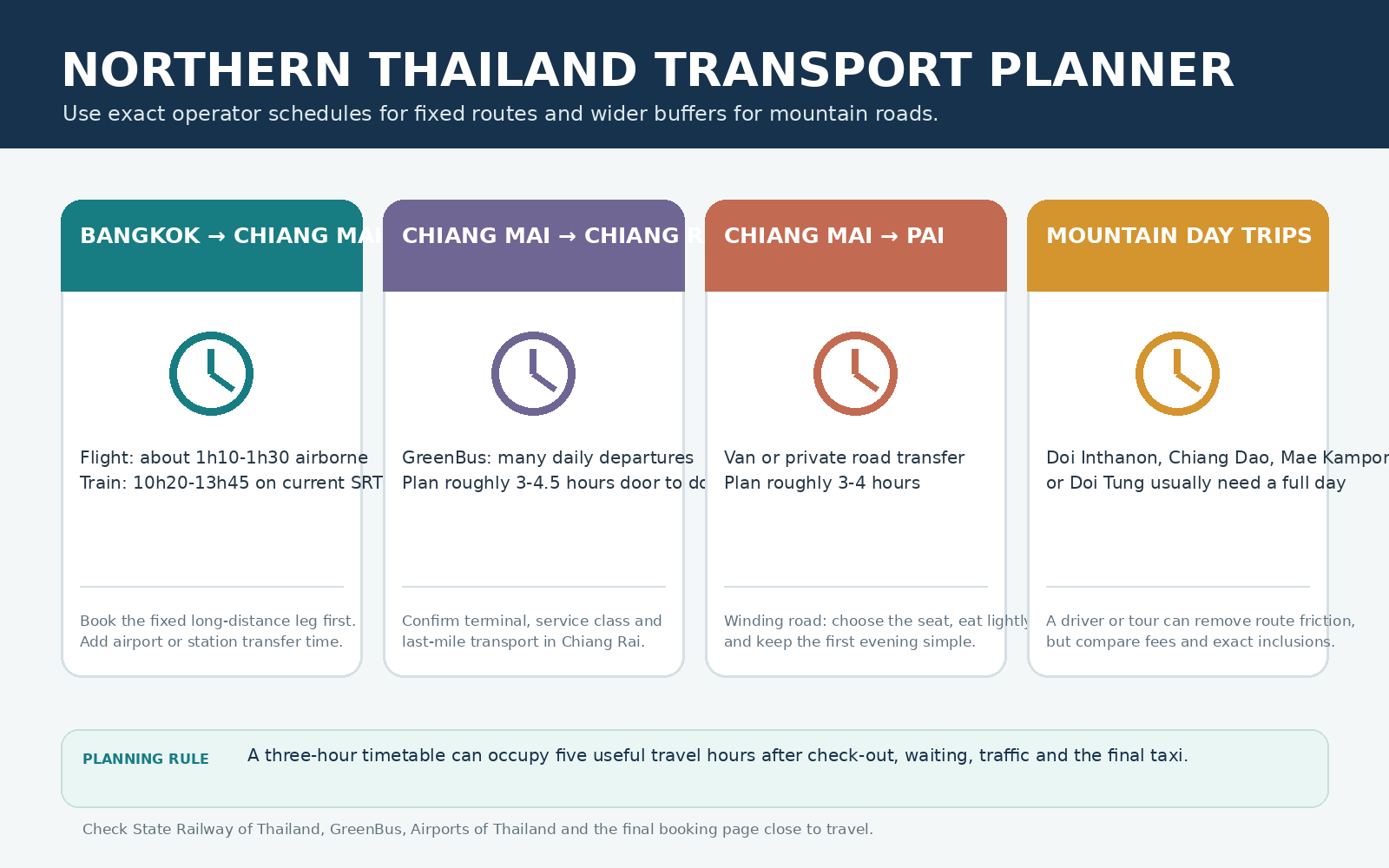
The official 2026 State Railway of Thailand page listed daytime Train 7 from Bangkok Krung Thep Aphiwat at 07:30, arriving Chiang Mai at 17:50, and sleeper Train 9 at 18:40, arriving at 07:15. Other services took longer, and fares varied substantially by train and class. Use the live SRT timetable and D-Ticket for the exact date rather than copying a schedule from an older article.[20] [32]
Airport to Chiang Mai city
Airports of Thailand lists shuttle routes A1 and A2 at 40 baht and A3 at 60 baht, with the current service page advising passengers to verify routes and fares again before travel. AOT also publishes airport transport information and city-bus operating context. Compare the hotel location with the actual drop-off rather than choosing the cheapest headline fare.[18] [19]
Intercity planning ranges
Northern Thailand transfer planning ranges
| Route | Typical planning range | Usual mode | What can slow it down |
|---|---|---|---|
| Chiang Mai-Chiang Rai | 3-4.5 hours | Coach / private car | Traffic, service class, terminal transfer |
| Chiang Mai-Pai | 3-4 hours | Van / private car | Bends, stops, weather, motion sickness |
| Pai-Mae Hong Son | 2.5-4 hours | Van / car | Mountain road and local stops |
| Chiang Mai-Lampang | 1.5-2.5 hours | Train / bus / car | Schedule and station transfer |
| Chiang Mai-Sukhothai | 4.5-6 hours | Bus / car | Connection pattern and road traffic |
| Chiang Rai-Nan | 4-6 hours | Bus / car | Limited direct choices and mountain roads |
These are editorial door-to-door planning ranges rather than guaranteed schedules. Always verify the specific operator. More importantly, add time for hotel pickup, terminal waiting, food and the last taxi; that margin is what keeps a transfer day realistic.
A private driver is valuable on the right day
Doi Inthanon, Doi Tung, Chiang Dao and multi-temple Chiang Rai routes often work better with a driver because sights are spread out. By contrast, paying for a car inside the Old City is unnecessary for many days. Use private transport where it removes genuine route friction, not as a default for the whole trip.
Compare the fixed transport legs first
Compare Bangkok to Chiang Mai trains, coaches and flights before committing to non-refundable hotels. For the next leg, compare Chiang Mai to Chiang Rai transport or compare Chiang Mai to Pai transport. Always verify the operating company and terminal on the final booking page.
Connectivity is most useful on transfer days
An eSIM is not essential, although mobile data can help with maps, driver messages and last-minute platform changes. Check Airalo Thailand eSIM options only after confirming that the phone is unlocked and compatible. Keep screenshots of hotel addresses and tickets in case coverage drops on mountain roads.
Northern Thailand costs and booking strategy
Daily planning ranges per person
Northern Thailand daily budget ranges
| Travel style | Room share | Food/local travel | Activities | Typical daily total |
|---|---|---|---|---|
| Budget | 450-1,000 baht | 500-900 baht | 200-700 baht | 1,200-2,500 baht |
| Mid-range | 1,300-2,800 baht | 900-1,600 baht | 600-1,800 baht | 2,800-5,500 baht |
| Comfort | 3,500-8,000+ baht | 1,400-2,500 baht | 1,000-3,500 baht | 6,000-14,000+ baht |
These are editorial planning ranges for two people sharing a room, not guaranteed market averages. Chiang Mai supports every budget, whereas small mountain stays can become expensive on peak weekends. Private cars and full-day tours also raise the total faster than food or city transport.
Tour and transfer examples
Common northern booking ranges
| Item | Editorial range | Check before paying |
|---|---|---|
| Doi Inthanon shared day tour | 1,300-2,500 baht | Park fee, lunch, guide, trail length and pickup zone |
| Chiang Rai day tour from Chiang Mai | 1,200-2,200 baht | Road time, temple fees, exact stops and return hour |
| Chiang Mai private driver day | 2,500-5,000+ baht per car | Hours, fuel, tolls, overtime and driver language |
| Chiang Mai-Pai shared van | A few hundred baht | Terminal, luggage, seat, stops and cancellation |
| Mountain homestay / small lodge | 1,000-4,000+ baht per room | Meals, road access, heating and transfer |
Ranges shift by season, group size and inclusions. Accordingly, compare the total cost rather than the cheapest headline. A 1,200-baht tour that excludes a large park fee, distant pickup and lunch may not beat a clearer 1,700-baht option.
Book scarce nights before flexible activities
Secure Pai, Mae Hong Son, Doi Inthanon-area or small community stays first, especially from November through January. Next, book the intercity leg that controls the route. City markets, massages and ordinary temple days can remain flexible.
Northern Thailand food and markets worth planning around
Northern food is one of the strongest reasons to slow the route down. A city with an evening is more useful than a stop reached after dark and left at breakfast, because markets, family-run kitchens and neighbourhood restaurants rarely fit a tightly controlled sightseeing timetable.
Start with dishes that explain the region
| Dish or food | What it is | Where it fits best | Ordering note |
|---|---|---|---|
| Khao soi | Coconut curry noodle soup with crisp noodles and condiments | Chiang Mai and Chiang Rai lunches | Spice and richness vary widely; add condiments gradually |
| Sai ua | Herb-forward northern sausage | Markets and shared plates | Check heat level and portion before ordering several sides |
| Nam prik noom | Green chilli dip, usually served with vegetables and pork crackling | Market meals and northern restaurants | Can be much hotter than its colour suggests |
| Gaeng hang lay | Slow-cooked northern curry with Burmese influence | Sit-down meals | Often rich and better shared with rice and vegetables |
| Khanom jeen nam ngiao | Rice noodles with a tomato-based northern broth | Morning markets and casual lunch | Ask about blood cake or pork ingredients if that matters to you |
| Local coffee and tea | Beans and tea from northern growing areas | Chiang Mai, Chiang Rai and highland stops | Look for named origin and producer information |
Markets work best when you know their role
Chiang Mai’s Sunday Walking Street and Saturday Wua Lai market are easy introductions, but they can be crowded and should not replace ordinary neighbourhood food. Warorot Market is more useful for ingredients, snacks and a sense of daily trade. Jing Jai suits a slower morning when its current opening pattern matches the trip. In Chiang Rai, the Night Bazaar is convenient for a first evening, while morning markets reveal a different side of the city.
How to choose a restaurant without chasing one viral list
- Pick the neighbourhood first, then search within a realistic walking or taxi radius.
- Check recent opening days because small restaurants may close unpredictably or sell out.
- Use a queue as one signal, not proof that the food suits your taste or dietary needs.
- Order one regional dish and one simpler plate when testing an unfamiliar spice level.
- Ask clearly about fish sauce, shrimp paste, pork stock and nuts when dietary restrictions matter.
A practical food-planning insight
I would leave one lunch and one evening unbooked in each main base. That space is often more valuable than adding another attraction, because it allows a market discovery, a weather change or a recommendation from the hotel without breaking the route.
When a cooking class genuinely adds value
A class can explain curry pastes, local herbs and the difference between central and northern dishes more clearly than another generic restaurant list. Compare Chiang Mai cooking classes by menu, duration, class size, market visit, dietary options and pickup area.
Trekking, elephants and community tourism
A responsible elephant visit should centre the animals
TAT’s eco-conscious wildlife guidance recommends facilities that support ethical care and allow visitors to observe natural behaviour without coercion. Therefore, avoid choosing an elephant activity only because it promises riding, performances or unlimited close-contact photographs. [22]
Questions to ask before booking
- Are riding, tricks or forced bathing part of the programme?
- Can elephants move away from visitors?
- How large is each visitor group?
- What veterinary and long-term care is described?
- Does the operator explain elephant history without marketing every interaction as rescue?
- Is transport, food and insurance stated clearly?
Trekking requires local conditions, not just a trail photo
Rain changes river crossings, mud, leeches and vehicle access. Smoke changes visibility and exertion. In addition, village visits should respect permission, privacy and local control. Choose a guide who can explain the current route and who benefits, rather than one selling a generic “hill tribe trek”.
Community stays need realistic expectations
A homestay may involve simple bedding, shared facilities, early mornings and limited English. That can be rewarding when the traveller wants participation rather than hotel service. However, do not treat a living community as a themed attraction or photograph people without asking.
Elephant and wildlife experience checklist
Look for these signals before booking
- The operator explains animal care, group size and visitor behaviour rather than promising constant touching.
- There is no riding, performance, forced bathing or pressure for close-contact photographs.
- The itinerary allows observation of natural behaviour and gives animals space to move away.
- Reviews describe guide quality and welfare practices, not only the number of photos.
- The cancellation and transport arrangements are clear enough to compare with other operators.
TAT’s responsible-wildlife guidance favours experiences that avoid coercion and allow observation of natural behaviour. Even a well-designed sales page cannot prove daily practice, so read recent reviews critically and be prepared to leave an activity that does not match the description.[22]
Useful gear for Northern Thailand compared
Northern Thailand packing decisions
| Item | When it earns its place | Buying priority | Main limitation |
|---|---|---|---|
| Light fleece or warm mid-layer | December-January mornings and high viewpoints | Breathable, compact and easy to remove | Usually too warm for city afternoons |
| Packable rain shell | Green season and exposed mountain days | Sealed seams, usable hood and enough room for a layer | A thin shell is not a substitute for changing plans in severe weather |
| Genuine FFP2 respirator | Possible haze periods when official guidance supports use | Recognised certification, secure fit and trusted seller | Does not make strenuous outdoor activity safe in poor air |
| Light walking shoes | Temple days, markets and easy trails | Comfort, grip and quick drying | New shoes should not be broken in during the trip |
| Motion-sickness plan | Chiang Mai-Pai and Mae Hong Son roads | Seat choice, light meal, breaks and professional advice where needed | Accessories do not work equally for everyone |
| Small dry bag or document pouch | Rainy transfers and open vehicles | Simple closure and practical size | Check actual waterproof rating before trusting electronics to it |
Smoke-season packing needs a route decision too
FCDO health advice warns that Chiang Mai can experience seasonal regional smoke haze and that particulate levels can become dangerous, especially for people with respiratory conditions. A genuine well-fitting FFP2 may be useful as one precaution, but the stronger response to poor conditions is to reduce exposure, move strenuous activities or change region. Check Air4Thai rather than treating a packed mask as permission to ignore the forecast.[12] [33] [25]
Optional product comparisons
Compare genuine FFP2 travel respirators, a lightweight packable rain jacket, lightweight walking shoes and motion-sickness travel accessories by specification and fit. Avoid manually typed live prices because sizes, stock and promotions change.
Monsoon-season packing without carrying a second wardrobe
Use quick-drying clothes, one compact shell, a small umbrella and a separate bag for wet items. Waterproofing the phone and documents matters more than carrying several heavy jackets. In mountain areas, add a warm layer because rain and altitude can make the same day feel much colder than Chiang Mai city.
Northern Thailand itinerary examples
Seven nights: Chiang Mai and Chiang Rai
Seven-night northern route
| Nights | Base | Plan |
|---|---|---|
| 4 | Chiang Mai | Arrival, Old City, one mountain day and one flexible food/market day |
| 3 | Chiang Rai | City art-and-temple day plus Doi Tung, Golden Triangle or countryside day |
This is the strongest short first route. It avoids the Pai road, gives both cities proper evenings and leaves one full day for a highland excursion. Fly into Chiang Mai and out of Chiang Rai when fares work, or return by bus with a buffer.
Ten nights: choose one contrast
Ten-night route choices
| Route | Suggested split | Best for | Main caution |
|---|---|---|---|
| Chiang Mai + Pai + Chiang Rai | 4 + 3 + 3 | First trip with mountain-town time | Long road chain; avoid one-night Pai |
| Chiang Mai + Lampang + Sukhothai | 5 + 2 + 3 | History, food and slower cities | Less dramatic mountain scenery |
| Chiang Mai + Chiang Dao + Chiang Rai | 4 + 2 + 4 | Nature without full Mae Hong Son loop | Car/driver useful for rural stays |
Fourteen nights: a Mae Hong Son loop
Fourteen-night mountain-loop example
| Nights | Base | Planning note |
|---|---|---|
| 4 | Chiang Mai | Settle in, city sights and one mountain day |
| 3 | Pai | Arrival recovery, countryside and walking street |
| 2 | Pang Mapha / Soppong | Lod Cave and a quieter mountain stop |
| 3 | Mae Hong Son | Town, viewpoints and local excursions |
| 2 | Chiang Mai | Return buffer, shopping and onward travel |
The second Chiang Mai stay is deliberate. It absorbs weather, road fatigue and any transport change before the next flight or train. Alternatively, confident drivers can continue toward Doi Inthanon, but the route should not end with a fragile same-day international connection.
Smoke-season alternative
When air quality deteriorates, shorten outdoor mountain days and consider moving south rather than waiting for a perfect clearing. Bangkok, the Gulf or the Andaman coast may provide a better use of limited holiday time. A flexible hotel rate earns its value when the environmental conditions are the problem.
Northern Thailand: pros and cons
| Advantages | Trade-offs |
|---|---|
| Strong food culture, temples, crafts and distinct neighbourhoods | No beaches and less simple point-to-point travel beyond the main cities |
| Good-value city stays across several budget levels | Peak winter weekends can make small mountain rooms expensive |
| Excellent mix of trains, flights, buses and private-day options | Mountain roads turn short map distances into long transfer days |
| Cooler mornings and high-altitude scenery in the dry season | February-April air quality can damage visibility and health |
| Easy to build a culture-led trip without constant resort changes | Some rural attractions need a driver, tour or confident legal driving |
Who should prioritise the north?
The north is especially strong for travellers interested in food, markets, architecture, crafts, mountain scenery and a route with several city bases. It also works well for first-time visitors who want a substantial Thailand experience before adding a beach. By contrast, travellers seeking mostly sea time, effortless island transfers or consistently clear March skies may be happier allocating fewer days here.
Should you combine Northern Thailand with the islands?
Yes, but separate the regions with a flight or an overnight Bangkok stop rather than stacking fragile connections. A common two-week structure is six or seven nights in the north followed by six or seven nights at one beach base. The exact island should follow the seasonal weather pattern, not a generic “best island” list.
Before you travel: entry, safety and booking checks
For British citizens travelling on a full passport, current FCDO guidance states that the passport should expire at least six months after arrival and have a blank page. It also describes a 60-day visa-exempt visit for common tourism purposes and requires foreign arrivals to complete the Thailand Digital Arrival Card within the three days before arrival. Rules can change, so check the official entry page for the passport actually being used.[32]
Final northern Thailand booking checklist
- Check FCDO advice for Thailand and transit countries.
- Complete the official Thailand Digital Arrival Card in the permitted window.
- Confirm travel insurance covers the full route and planned activities.
- Book the scarce mountain stay before flexible city activities.
- Verify SRT, GreenBus or flight times on the operator’s current page.
- Check Air4Thai before outdoor-heavy days from February to April.
- Confirm park access, fees and trail closures close to the visit.
- Download offline maps and save hotel addresses in Thai and English.
- Carry the driving licence and accepted permit required for any vehicle.[34] [35]
- Keep the last night before an international flight in a robust transport hub.
FCDO advice current on the research date did not place Northern Thailand inside the specifically advised-against southern or Cambodia-border areas. However, no route is automatically risk-free, and travel insurance can be affected by official advice. Recheck the guidance before paying non-refundable costs and again shortly before departure.[31]
Common Northern Thailand planning mistakes
Mistake 1: counting late arrivals as full days
A 4 p.m. arrival in Pai or Mae Hong Son is not a sightseeing day after a winding journey. Keep that evening local, then start properly the next morning.
Mistake 2: trusting a season label instead of current conditions
“Dry season” does not guarantee clear air, and “rainy season” does not mean constant rain. Therefore, check TMD, Air4Thai and park notices near travel rather than copying a climate chart.
Mistake 3: booking remote hotels without transport prices
A countryside room may look cheap until every meal, temple and bus station requires a private car. Ask for airport, town and day-trip transfer prices before paying.
Mistake 4: placing a mountain road before a flight
Rain, traffic, road works and vehicle issues can all delay the return. Consequently, sleep in the departure city before a long-haul flight or important connection.
Mistake 5: buying the cheapest tour without checking inclusions
Park fees, pickup zones, lunch, guide quality and overtime can reverse the apparent saving. Compare the complete day, not the first price shown.
Mistake 6: treating cultural communities as photo sets
Ask permission, use local guides where appropriate and spend money in ways the community controls. A respectful visit is not measured by how many portraits you collect.
Northern Thailand guide FAQs
How many days do you need in Northern Thailand?
Seven nights is the useful minimum for Chiang Mai plus one additional base. Ten nights supports Chiang Mai, Chiang Rai and either Pai or Sukhothai. A Mae Hong Son loop or slower multi-province trip deserves roughly two weeks.
Is Chiang Mai or Chiang Rai better for first-time visitors?
Chiang Mai is the easier first base because it has more flights, hotels, neighbourhoods and day trips. Chiang Rai is the better second stop for contemporary temple art, quieter evenings and access to Doi Tung or the Golden Triangle region.
Is Pai worth visiting?
Pai is worth visiting when the mountain-town atmosphere, cafés, countryside and slow pace justify a winding three-to-four-hour road journey. It is less suitable when you dislike motion-heavy roads, have only one spare night or expect an untouched village.
Can Chiang Rai be a day trip from Chiang Mai?
It can be done, but the road time creates a very long day and reduces the experience to a few headline stops. Two nights in Chiang Rai is usually better, especially when Doi Tung, the Golden Triangle or rural areas matter.
When is smoke season in Northern Thailand?
Air quality can deteriorate from February into April, although the start, severity and end vary each year. March and early April need the greatest caution. Check Air4Thai daily, review health guidance and keep the route flexible.
Is Northern Thailand cold?
Cities are generally warm by day, but December and January mornings can feel cool. High mountains such as Doi Inthanon can be genuinely cold, misty and windy, so carry a light warm layer even when Chiang Mai city feels comfortable.
What is the best way to travel from Bangkok to Chiang Mai?
Flying is fastest door to door. The overnight train is slower but saves a hotel night and is part of the experience. Official SRT timetables and D-Ticket should be checked because train numbers, rolling stock and times can change.
Do you need a car in Northern Thailand?
Not for central Chiang Mai or Chiang Rai. A car or driver becomes useful for Doi Inthanon, Doi Tung, Chiang Dao, Mae Kampong and multi-stop provincial routes. Mountain driving requires confidence, legal documents and careful weather checks.
Is it safe to drive the Mae Hong Son Loop?
The loop is demanding rather than automatically unsafe. It has long, winding mountain sections, variable weather and limited margin for rushed driving. Use a suitable vehicle, avoid night driving, allow recovery time and do not ride a scooter without the correct licence and experience.
Is Sukhothai part of Northern Thailand?
Sukhothai sits in lower northern Thailand and fits naturally between Bangkok and Chiang Mai. It is especially valuable for travellers who want cycling, archaeology and a calmer historical stop rather than another mountain base.
How much does Northern Thailand cost per day?
A practical editorial range is 1,200-2,500 baht per person for budget travel, 2,800-5,500 baht for mid-range travel and 6,000 baht or more for comfort. Private drivers, peak mountain rooms and long day tours raise the total.
What should I pack for Northern Thailand?
Bring breathable clothing, one temple-appropriate outfit, comfortable shoes, sun protection and a small rain layer. In cool months add a fleece. During possible haze periods, monitor conditions and carry a genuine well-fitting particulate respirator rather than a loose fashion mask.
My first-trip recommendation
Start with four nights in Chiang Mai and three in Chiang Rai. With ten nights, add Pai only when the road and social mountain-town atmosphere genuinely appeal; otherwise, add Lampang and Sukhothai for a calmer cultural route. This approach gives each stop an evening and reduces fragile same-day returns.
Northern Thailand rewards restraint. Choose one major city base, one contrasting region and one carefully selected mountain day. That approach leaves enough space for markets, weather changes, neighbourhood meals and the slower details that make the north distinct.
Sources and methodology
Checked 25 August 2026. Official tourism, heritage, weather, pollution, park, transport and UK travel-advice sources are prioritised. Daily budgets, road durations and tour-price ranges are editorial planning tools rather than guarantees.
- Chiang Mai destination guide – Tourism Authority of Thailand. Official destination context for Doi Suthep, walking streets, Nimman, Doi Inthanon, Mae Kampong and other Chiang Mai highlights.
- Chiang Rai destination guide – Tourism Authority of Thailand. Official destination context for Wat Rong Khun, Baan Dam, Doi Tung, Doi Pha Tang and the Golden Triangle area.
- Mae Hong Son guide – Tourism Authority of Thailand. Official context for Pai, Lod Cave, mountain roads, Pai Canyon and Mae Hong Son attractions.
- Sukhothai destination guide – Tourism Authority of Thailand. Official guide to Sukhothai Historical Park, Wat Si Chum, Wat Mahathat and Si Satchanalai.
- Historic Town of Sukhothai and Associated Historic Towns – UNESCO World Heritage Centre. World Heritage description of Sukhothai, Si Satchanalai and Kamphaeng Phet.
- Mountain: Savouring the Greens at Doi Inthanon – Tourism Authority of Thailand. Official Doi Inthanon and Ang Ka cloud-forest context.
- Chiang Mai’s Lovely Mountains – Tourism Authority of Thailand. Official planning context for Chiang Dao, Mae Kampong and Doi Inthanon.
- Lampang, Lamphun and Chiang Mai: 4 Days – Tourism Authority of Thailand. Official sample itinerary linking three northern cultural centres.
- Monthly Weather Summary: January 2026 – Thai Meteorological Department. Official cool- and cold-weather summary for upper Thailand and mountain areas.
- Monthly Weather Summary: March 2024 – Thai Meteorological Department. Official example of above-normal heat in Chiang Mai, Chiang Rai and Northern Thailand.
- Storm Kajiki and Heavy to Very Heavy Rain in Thailand, No. 20 – Thai Meteorological Department. Official northern heavy-rain, flash-flood and runoff warning example.
- Air4Thai – Pollution Control Department. Official real-time Thai air-quality reporting and mobile-app service.
- Chiang Mai PM2.5 situation, 26 March 2026 – Chiang Mai Provincial Government. Official example of orange-level health-impact conditions during the 2026 smoke season.
- Northern Thailand air-quality travel advisory – Tourism Authority of Thailand Newsroom. Official advice to monitor Air4Thai and consider particulate respirators and flight disruption during haze.
- Doi Inthanon e-ticket pilot – Department of National Parks, Wildlife and Plant Conservation. Official national-park e-ticket and QueQ pilot information including Doi Inthanon.
- GreenBus timetable, latest update July 2026 – GreenBus Thailand. Official timetable page updated 15 July 2026, including multiple daily Chiang Mai-Chiang Rai departures.
- GreenBus ticket sales points and agents – GreenBus Thailand. Official Chiang Mai, Chiang Rai and Pai ticket-counter information.
- Chiang Mai Airport shuttle bus – Airports of Thailand. Official A1, A2 and A3 shuttle routes and listed 40-60 baht fares, with a reminder to verify before travel.
- GRAB TAXI at Chiang Mai Airport – Airports of Thailand. Official airport pick-up information and licensed Grab service types.
- SRT Timetable Matrix 2026 – State Railway of Thailand. Official current timetable for Bangkok-Chiang Mai and other northern trains.
- D-Ticket booking system – State Railway of Thailand. Official online rail booking service.
- Eco-conscious wildlife tourism – Tourism Authority of Thailand. Official guidance favouring observation of natural animal behaviour without coercion.
- MH100 full-zip hiking fleece – Decathlon. Dated product specification and price example retained for traceability from the original article.
- Raincut full-zip hiking jacket – Decathlon. Dated product specification and price example retained for traceability from the original article.
- 3M Aura 9320+ FFP2 respirator – 3M United Kingdom. Manufacturer specifications for an unvalved FFP2 flat-fold respirator.
- 3M Aura 9320+ FFP2 respirator price – Medisave UK. Dated retail price example retained for traceability; live prices are not used in the rebuilt buying guidance.
- San Pa Kia and Doi Mae Taman – Tourism Authority of Thailand. Official highland-accommodation and seasonal mountain-view context.
- Jing Jai Market Chiang Mai – Tourism Authority of Thailand. Official market and creative-district context near central Chiang Mai.
- Doi Inthanon National Park – Department of National Parks, Wildlife and Plant Conservation. Official park area, elevation, highest-point and contact information.
- National park opening and closure information – Department of National Parks, Wildlife and Plant Conservation. Official national-park information used to recommend checking current access and closures.
- Thailand warnings and insurance – UK Foreign, Commonwealth & Development Office. Current travel-advice status and reminder that insurance should cover the itinerary and planned activities.
- Thailand entry requirements – UK Foreign, Commonwealth & Development Office. Current passport, visa-exemption and Thailand Digital Arrival Card information for British travellers.
- Thailand health advice – UK Foreign, Commonwealth & Development Office. Official warning that Chiang Mai can experience seasonal smoke haze and advice on insurance and health.
- Thailand safety and security – UK Foreign, Commonwealth & Development Office. Official road, activity, wildlife and legal-safety context.
- Thailand driving requirements – Thailand.go.th. Official visitor guidance on accepted driving documents and temporary licences.
- Chiang Dao trekking – Tourism Authority of Thailand. Current 2026 official Chiang Dao trekking and biosphere-reserve context.
- GetYourGuide Doi Inthanon inventory – GetYourGuide. Commercial inventory checked to confirm that Doi Inthanon tour comparison is relevant.
- GetYourGuide Chiang Mai cooking classes – GetYourGuide. Commercial inventory checked to confirm that cooking-class comparison is relevant.
- Viator affiliate-link guidance – Viator Partner Resource Center. Official affiliate guidance on link creation, PID, MCID, medium and sponsored attributes.
- 12Go affiliate programme – 12Go Asia. Official affiliate-programme context; dashboard validation is still required for generated deep links.
Image credits
Illustrations in this article were created for Taylor’s Trailblazing Travels. Third-party photographs, where used, are credited beside the image or in the source list.