Sukhumvit vs Silom: Where Should You Stay?
Two useful Bangkok bases, compared through the station, street and evenings you will actually use.
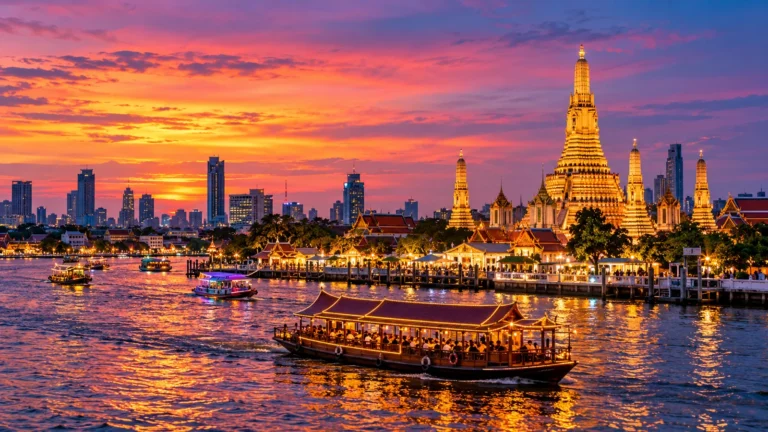
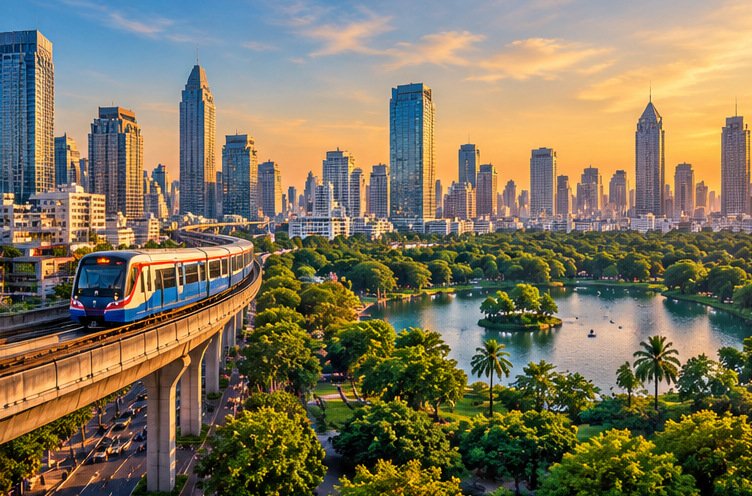
Conceptual Bangkok illustration contrasting rail access and a park-side city setting; not an exact view from a named hotel.
Sukhumvit vs Silom is a choice between two useful Bangkok bases, not between a convenient area and an inconvenient one. Both can work extremely well when the hotel is near the right station. Both can also disappoint when a broad district label disguises a long walk down a side street or a room facing late-night noise.
The most useful comparison is Asok or Phrom Phong against Sala Daeng or another clearly identified part of Silom. Sukhumvit stretches far beyond the small central section most first-time visitors picture. Likewise, a hotel advertised as Silom or Sathorn may not sit beside the BTS-MRT interchange that makes the area attractive.
This guide compares the daily experience: reaching sightseeing areas, finding dinner, returning after dark, taking breaks and getting to the airport. It also shows how to evaluate actual hotel listings without pretending that one district is always cheaper or quieter. The recommendations are based on current transport and venue information combined with practical planning judgement, not first-hand claims about staying in every neighbourhood.
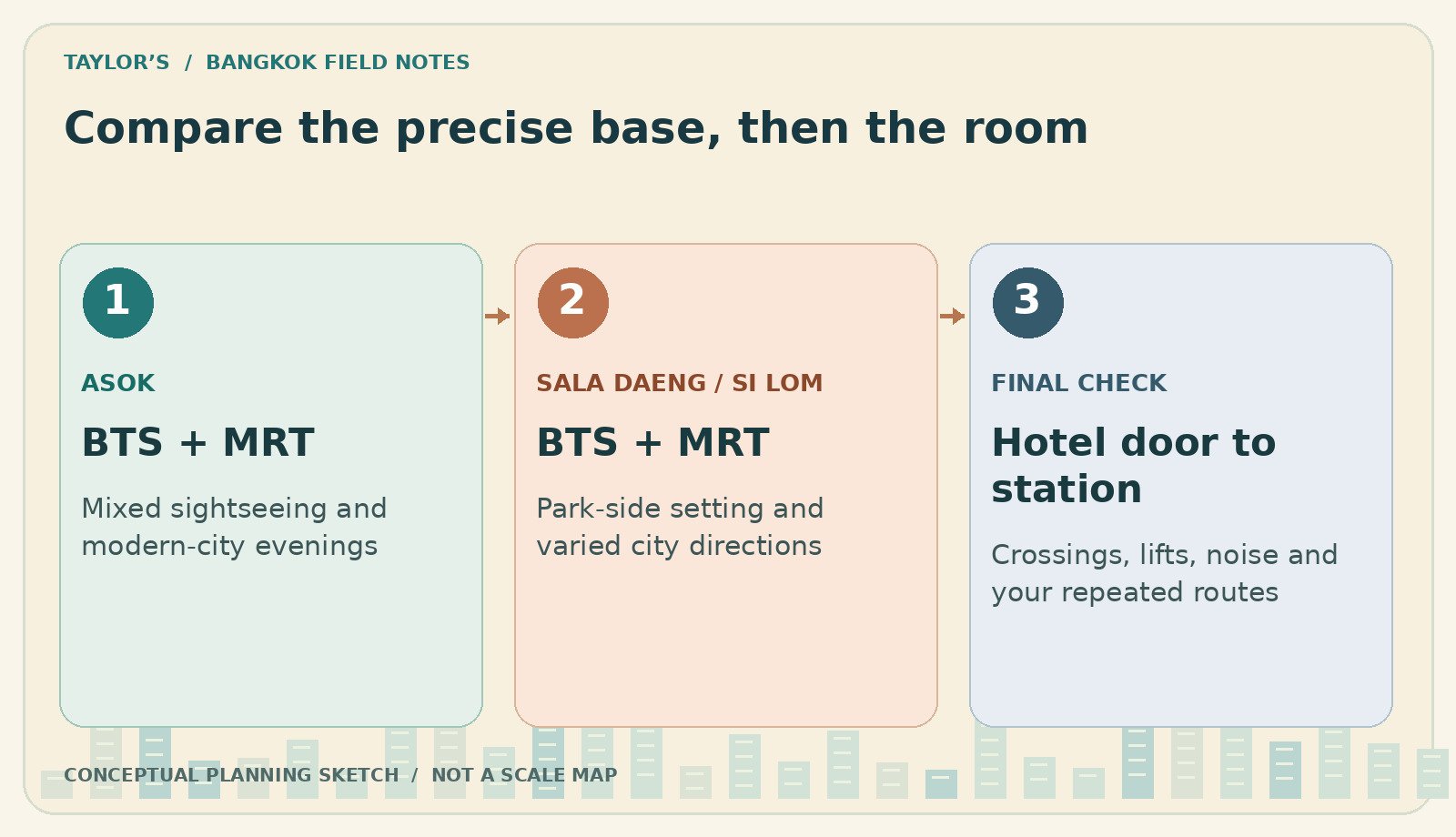
Asok
BTS and MRT access, provided the hotel walk is genuinely short.
Sala Daeng / Si Lom
A useful interchange with park-side and westward sightseeing options.
Phrom Phong
Consider it when nearby restaurants and room comfort dominate.
The actual entrance
Check the crossing, lift route and last evening walk.
Sukhumvit vs Silom: the decision in practical terms
Where each option is strongest
Choose central Sukhumvit when the main attraction is having varied restaurants, shopping and modern-city activities spread along a familiar BTS corridor. Asok is especially useful when you want both BTS and MRT access. Phrom Phong can suit a stay built around shopping, meals and a comfortable hotel routine, provided the actual walk to the station is sensible. [1] [2]
Choose Silom when you want a balanced base for the old city, Chinatown, Lumpini Park and river-oriented outings, with a strong interchange option around Sala Daeng and MRT Si Lom. However, that advantage belongs to particular streets and stations rather than every address carrying the name Silom. A hotel near Chong Nonsi or farther towards the river has a different daily pattern. [3] [4]
| Priority | Central Sukhumvit | Silom micro-areas |
|---|---|---|
| Two rail networks | Asok combines BTS with MRT Sukhumvit | Sala Daeng links with MRT Si Lom |
| Restaurant-led evenings | Choose the exact Asok / Phrom Phong / other pocket | Consider Silom, Bang Rak or Charoen Krung according to the venue |
| Park access | Check the route towards Benjakitti | Check the hotel-to-Lumpini entrance |
| River outings | Possible by rail connection and final pier walk | Stronger from the correct western or interchange location |
| Quieter sleep | Depends on the street and room orientation | Also depends on the street and room orientation |
| Hotel prices | Compare like-for-like live bookings | No district-wide cheaper claim is justified here |
Research-led comparison reviewed 3 October 2026. These are location trade-offs, not district-wide ratings.
How this comparison was made
The judgement uses transport connections, the position of established visitor areas and the likely effort of a normal sightseeing day. It does not score safety by neighbourhood, claim measured average hotel prices or award points for affiliate availability. Hotel examples later in the guide illustrate location differences; they are not a tested best-hotel ranking.
Start by selecting your two most frequent destinations and your expected dinner area. Then compare real hotel entrances against those places. A slightly less fashionable district can be the better base when it removes a repeated journey, while the highest-rated room can be awkward if its location fights the rest of your plan.
Back to the guide ↑What Sukhumvit actually means when you book a hotel
Asok: the most flexible transport starting point
Asok combines BTS Asok with MRT Sukhumvit, giving you a choice of networks. The station names differ, and changing systems involves following the interchange route rather than assuming one ticket covers everything. BEM's station information identifies the MRT stop and local exits; use the exact entrance nearest your hotel when checking the walk. [2]
For a first stay, a hotel close to this interchange is a strong all-round choice. You can use BTS for the shopping corridor and MRT for Chinatown or the old-city station area. Yet the road junction is busy, so check which side of the crossing your accommodation occupies and whether the comfortable pedestrian route matches the short distance advertised.
Phrom Phong: useful when the hotel is part of the holiday
Phrom Phong suits travellers who expect to spend time around restaurants, shopping and their hotel rather than travel to the old city every morning. The BTS provides access along the corridor, but reaching the MRT generally introduces another step. That is a modest trade-off when most of your plans are nearby, and a repeated nuisance when they are not.
Inspect the side street carefully. Two properties described as near Phrom Phong can offer very different walks, especially when one sits close to the main road and another is much deeper into a soi. Ask whether a hotel shuttle is scheduled, on request or limited to certain hours; do not treat it as permanent rail access.
Nana, Thong Lo and farther along the road
Nana can suit visitors prioritising a particular restaurant or nightlife area, but the street and room orientation deserve extra attention. Do not assume the entire neighbourhood shares one atmosphere. A quiet-facing room and a short station walk matter more than a broad reputation.
Thong Lo and Ekkamai can be attractive for return visitors with specific dining plans. However, the restaurants that motivate the stay may sit well away from the BTS entrance. Farther-out Sukhumvit stations can offer appealing properties, but add the repeated rail time before deciding that a lower room rate is a saving. For a short first visit, convenience usually needs a tighter geographic definition.
Back to the guide ↑What Silom means, and where Sathorn enters the picture
Sala Daeng and MRT Si Lom
The area around Sala Daeng BTS and MRT Si Lom is the clearest comparison with Asok. It offers both systems, although they are separate stations with a walking connection. This is useful for travellers who want several different sightseeing directions without making every journey by road. [3]
Do not judge a hotel only by whether the listing mentions the interchange. Plot the walk from the actual front door, including road crossings and the correct side of the station. With luggage or mobility needs, the location of lifts can matter more than the nearest stair entrance.
Chong Nonsi and the Sathorn edge
Chong Nonsi can suit visitors who prefer a hotel-centred routine or have a specific restaurant or business address nearby. Nevertheless, a BTS station in the broader Silom-Sathorn area is not the same as direct access to the Blue Line. Check whether your regular journeys require a BTS-MRT transfer or a separate road trip.
Sathorn is a separate neighbouring area, not simply another spelling of Silom. Hotel search platforms sometimes use broad location labels, which can make two listings appear more directly comparable than their map positions justify. Keep the actual station and street in your shortlist, not just the marketing district.
Towards Bang Rak and the river
The western end of the wider area becomes useful for Charoen Krung, Bang Rak and river access. That can be a good fit for a food-and-boat itinerary, but it does not mean every hotel is close to both the river and the Sala Daeng interchange. Choose which connection matters most.
A riverside plan needs a named pier and a current service, not merely a river view. Walking to the water is different from walking to a useful boarding point. If a hotel advertises a boat shuttle, check its destination and timetable before treating it as part of your everyday transport.
Back to the guide ↑Getting around: the station matters more than the district
BTS and MRT solve different journeys
Sukhumvit and Silom both appear in rail terminology, which can make descriptions confusing. BTS operates a Sukhumvit Line and a Silom Line, with interchange at Siam. MRT Sukhumvit and MRT Si Lom are stations on the Blue Line. Match the network and station name before following a route from a hotel listing. [1] [2] [3]
For a day around Siam, a direct BTS journey can be the obvious choice from either side. For Chinatown, the Blue Line offers access to Wat Mangkon. For the southern part of the old city, Sanam Chai is useful, but the station is not directly at every palace or temple entrance. Add the walking section rather than describing the rail ride as the full journey. [5]
Compare the same starting conditions
A hotel beside Sala Daeng should not be compared with a Sukhumvit property far down a soi and then used to declare all Silom faster. Reverse the hotel locations and the result can change. A fair comparison begins with the same walking tolerance, luggage and likely time of travel.
Use live route planning for your date, then allow margin. The ranges in the table are broad editorial allowances for a visitor moving between representative station areas, not measured averages or promised journey times. Crowds, walking speed and transfers can change them.
| Task | From a central Asok hotel | From a Sala Daeng-area hotel | Allow for |
|---|---|---|---|
| Siam shopping area | BTS; roughly 25-45 minutes door to door | BTS; roughly 20-40 minutes door to door | Hotel and shopping-centre entrance walks |
| Chinatown / Wat Mangkon | MRT; roughly 40-60 minutes door to door | MRT; roughly 25-45 minutes door to door | Current service and the final restaurant location |
| Sanam Chai-area sightseeing | MRT; roughly 45-70 minutes door to door | MRT; roughly 30-55 minutes door to door | Attraction entrance may be farther than the station |
| Sathorn Pier | BTS via Siam; roughly 40-65 minutes door to door | BTS towards Saphan Taksin; roughly 25-45 minutes door to door | Pier access and the next boat departure |
Editorial planning ranges prepared 3 October 2026, not official running times or measured averages. Compare your actual hotel and route.
Do not overvalue a short taxi estimate
A road estimate checked at a quiet hour can be misleading for a busy evening or a wet afternoon. Compare a rail route as well, especially when an attraction sits near a station. Taxis remain useful for luggage, awkward final sections and late returns, but they are not a reason to ignore the hotel's walking location.
Save the hotel's Thai address and a map pin. A brand name alone can be ambiguous when several properties share similar names. For pickup, use the designated driveway or entrance rather than asking a driver to stop wherever the map icon happens to land.
Sightseeing: which base matches your Bangkok plans?
Old-city temples and Chinatown
For repeated trips towards the old city or Chinatown, begin by comparing hotels near the Blue Line at Asok and Si Lom. Both are workable. The difference is often the walk at your hotel end and what you want to do after sightseeing, not a dramatic gap between the two districts. [2] [3]
A temple day should remain a geographic cluster. Visit the sights that belong together, take a proper lunch break and return when the group is ready. Staying in Silom does not make it sensible to combine every riverside attraction with a Sukhumvit shopping trip before dinner.
Parks and gentler mornings
Silom's park-side end is useful for Lumpini Park, while the Asok side of Sukhumvit gives access towards Benjakitti. These are distinct parks with different entrances and routes. Check the gate nearest your hotel rather than assuming a green area visible on the map is accessible from every edge. [4] [6]
A park matters most when you will actually use it: an early walk, a slower afternoon or a break with children. Do not pay a large room premium for a nearby amenity that never fits your itinerary. Conversely, regular access to outdoor space can be worth more than shaving a few minutes off one sightseeing journey.
River outings
Silom and the broader Bang Rak area can work well for a day beginning around Sathorn Pier. However, the river advantage becomes stronger or weaker according to the exact hotel position. From central Sukhumvit, travelling by BTS via Siam towards Saphan Taksin is also possible. Compare the complete route rather than treating the river as inaccessible from one side. [1] [7]
When choosing a paid boat experience, distinguish transport from a guided cruise. A sightseeing pass, dinner cruise and private canal trip serve different purposes. Check the departure pier and return location, because neither may be the one nearest your hotel.
Back to the guide ↑Eating and evenings: what will you do after sightseeing?
Sukhumvit for variety along the corridor
Central Sukhumvit is useful when the group wants different cuisines or plans several evenings around particular restaurants. It also gives you indoor fallback options around the major shopping areas. Terminal 21's Pier 21 is one example near Asok, with its current counter directory available from the shopping centre. [8]
Nevertheless, a restaurant in a Sukhumvit district can still be a substantial trip from your hotel. Before choosing accommodation for dining, save the actual places you expect to visit. Three dinners around Phrom Phong may justify staying there; one dinner in Thong Lo does not necessarily justify moving the whole trip east.
Silom for a mixed food-and-city routine
Silom's wider surroundings make it useful for combining a modern hotel base with Bang Rak and Charoen Krung food exploration. Those areas have their own geography, so select a specific stretch rather than promising yourself every notable meal in one walk. TAT's Charoen Krung guide provides context for its food, architecture and creative spaces. [9]
A food tour can help when you want interpretation and a structured sequence of tastings. Check where it starts and ends; a tour described as Silom or Bang Rak may still require transport from your hotel. Dietary restrictions need direct confirmation rather than an assumption based on the district's variety.
Nightlife is a street-level decision
Both wider areas contain lively evening pockets and quieter streets. Decide whether you want to walk home from nightlife or simply avoid it. Then read recent reviews for the exact room category and look at nearby businesses, rather than applying one label to an entire district.
A high floor is not a guaranteed solution to noise, and a courtyard-facing room is not automatically quiet if plant equipment or another venue faces it. Ask the hotel what quieter room options mean in practice. For a light sleeper, that answer may be more important than choosing Sukhumvit or Silom.
Back to the guide ↑Hotel examples that make the map comparison concrete
A direct-station example in Asok
Solaria Nishitetsu Hotel Bangkok's official location page describes a direct connection to BTS Asok Exit 4 and proximity to MRT Sukhumvit Exit 3. It is a useful example of why an actual connection can be more valuable than a vague near-BTS description. This is a location reference, not a claim that every room or rate is the best choice for your stay. [10]
Check your dates, room size, bedding, cancellation conditions and breakfast separately. The station connection does not answer those questions. Also confirm the route with luggage or a wheelchair if relevant, because the most convenient pedestrian connection may not be the step-free one you need.
A park-side example in Silom
Dusit Thani Bangkok's official information places the hotel beside Lumpini Park and describes connections with Sala Daeng and MRT Si Lom. It illustrates a different proposition: the hotel experience and park-side setting form a substantial part of the choice, rather than simply finding the cheapest room near a station. [11]
Compare the exact booked room and the whole stay cost before drawing a conclusion about the district. A luxury property in Silom and a modest property in Sukhumvit cannot establish which neighbourhood is generally cheaper. Use these examples to understand location, then compare like-for-like accommodation within your own budget.
Back to the guide ↑Costs: compare a complete stay rather than a headline rate
A fair room comparison
Use the same dates, number of guests, bed arrangement, cancellation policy and breakfast requirement. Then check whether taxes and service charges appear in the displayed total. Room names can conceal meaningful differences, including windowless categories, extra-bed charges or occupancy limits that matter for families.
There is no reliable blanket rule that Sukhumvit or Silom always costs less. Hotel category, demand, exact location and the booking conditions can outweigh the district. The table below therefore uses hypothetical examples calculated on 3 October 2026, not live offers or neighbourhood averages.
| Cost component | Hotel A: close to rail | Hotel B: cheaper room, extra rides |
|---|---|---|
| Illustrative nightly room | 3,000 baht | 2,600 baht |
| Three nights | 9,000 baht | 7,800 baht |
| Added short road rides | 0 assumed in this example | 2 per day x 3 days x 200 baht = 1,200 baht |
| Room plus those added rides | 9,000 baht | 9,000 baht |
| What the example leaves out | Shared baseline travel, food and airport transfer | The same baseline costs; actual rides could differ |
Hypothetical arithmetic prepared 3 October 2026. Neither column is a quoted hotel or a measured Sukhumvit/Silom average; the 200-baht ride is an assumption.
Price the journeys you will repeat
Suppose a more remote hotel saves a modest amount each night but requires two road transfers every day. Add those journeys for the entire stay, including the occasions when rain or tiredness makes walking unattractive. The saving may remain worthwhile, but it should be visible rather than assumed.
Time is part of the calculation too. An extra twenty minutes in each direction becomes forty minutes every day before you have reached a single attraction. That is simple planning arithmetic, not a traffic forecast. Decide whether the better room or lower price genuinely compensates for that repeated effort.
Breakfast and cancellation can change the answer
A breakfast package has value when you will use it; it has less value when several early tours leave before service. Likewise, a flexible booking may be sensible while flight plans remain uncertain. Compare the total you are likely to use rather than the largest list of included amenities.
Keep a record of the cancellation deadline in the property's local time and check the payment currency. A refundable rate is only useful when you know when it stops being refundable. Screenshot or save the exact conditions at booking rather than relying on a general badge in search results.
Back to the guide ↑Families, couples, solo travellers and longer stays
Families: reduce daily friction
For families, a comfortable route to rail, enough room space and a reliable meal nearby can matter more than the district's overall reputation. Asok and the Sala Daeng area both deserve consideration. Phrom Phong can also work when hotel facilities and a slower local routine are priorities.
Confirm children's ages in the search and ask about actual bedding. Two children being permitted in a room does not necessarily mean two suitable beds are included. Check the pool, lift access, laundry and late-arrival arrangements against the specific booking rather than a photograph of a different room type.
Couples: choose the evening you want
A couple planning restaurant-led evenings may prefer a particular Sukhumvit micro-area. A couple interested in river visits, old-city sightseeing and a park-side hotel may find Silom more natural. Neither choice prevents visiting the other; it simply determines which journey you make most often.
For a short romantic stay, a quieter room and a pleasant immediate street can be more valuable than squeezing the hotel between every possible attraction. Choose the surroundings you will enjoy at breakfast and after dinner, then let rail handle the occasional cross-city trip.
Solo travellers: make the return simple
A solo traveller benefits from a clear, well-used route between transport and accommodation, especially when returning tired. Avoid selecting a property solely because its district is popular. Inspect the actual entrance, reception hours and the last walking section at the times you expect to use it.
Choose a dinner area where you feel comfortable eating alone and have an easy alternative. A hotel near several food options reduces the need to improvise a long return after an exhausting day. These are practical checks for either district, not a comparative safety score.
Longer stays: test the ordinary routine
For a week or more, laundry, workspace, storage and meal variety become more important. A slightly less central property can be sensible when you are not crossing the city daily. However, check whether the facilities belong to your booked room and whether a kitchenette provides what you actually need.
Choose based on a representative weekday: breakfast, an outing, a rest and dinner. A hotel that works for that routine is more useful than one selected entirely for a single special evening. Review repeated transport costs over the full stay before committing to an apparently economical location.
Back to the guide ↑Airport transfers and the first night
Arrival time changes the best method
Suvarnabhumi offers rail and road options, while Don Mueang has a different set of connections. Check the airport code on the booking before choosing the hotel transfer. AOT's current transport guidance is the starting point for airport pickup arrangements and operating information. [12] [13]
For a daytime arrival with manageable bags, rail can be sensible. For a late arrival, several passengers, children or cumbersome luggage, a booked vehicle or official taxi may remove unnecessary complexity. Do not choose the entire hotel area purely to save one transfer if it makes every sightseeing day less convenient.
Give the first evening a smaller plan
Keep the first dinner close to the hotel and avoid a non-refundable activity soon after landing. Immigration, baggage and the transfer make touchdown time a poor guide to when you will feel ready to go out. A comfortable room, nearby food and a straightforward check-in are often the most valuable arrival-day features.
Send the hotel your arrival details, particularly for an overnight flight reaching Bangkok after midnight. The night you need to book may begin on the previous calendar date. Clarify late check-in directly rather than assuming the reservation system will interpret an early-morning arrival as you intend.
Back to the guide ↑A three-day stay from either base
A plan from central Sukhumvit
Use the first full day for a single old-city cluster reached by MRT where appropriate, then return for dinner near the hotel. Keep the second day around the modern shopping corridor or a chosen neighbourhood. On the third day, add a river outing, market or day trip according to your interests.
This approach avoids treating Sukhumvit as a compulsory evening destination after every distant activity. A dinner in Chinatown can remain attached to the old-city day, provided you have a sensible return route. The hotel base should simplify the trip, not force you to retrace your steps for every meal.
A plan from Silom
Start with Lumpini Park or a gentle local morning when that suits the hotel location, then use the Blue Line for Chinatown or the old-city station area. Make a separate day for the river and Bang Rak. Keep Siam or a selected Sukhumvit restaurant for a day when that part of the city is already your destination.
The aim is not to prove that Silom can reach more attractions. It is to keep each day coherent. A hotel near Sala Daeng can be an excellent starting point, but a property nearer the river may suggest reversing the order and beginning with the boat-based day instead.
Do you need to split the stay?
Usually not for a short visit. Moving between Sukhumvit and Silom costs packing time, a transfer and another check-in, while both are connected to the wider city. Stay in one place unless there is a specific reason, such as combining a special hotel stay with a longer practical base.
For a longer holiday with Bangkok at both ends, trying different areas can make sense without an extra mid-stay move. Keep the arrival stay simple and choose the second location around whatever you most want to revisit. That offers variety without sacrificing a useful sightseeing morning to changing rooms.
Back to the guide ↑A five-minute test for two shortlisted hotels
Put the same six destinations on both maps
Choose the airport you are using, one old-city attraction, your main shopping stop, two likely dinners and a practical place near the hotel for an easy meal. Trace each journey from both properties. This is more revealing than counting the number of attractions mentioned in the hotel description, because it uses the places you will actually visit.
Now mark which journeys happen once and which repeat. An airport transfer occurs at the ends of the stay, while the trip to a favourite dinner area might happen on three nights. A route that is slightly worse once but much better repeatedly can be the more useful choice. Avoid letting one impressive connection outweigh the whole pattern.
Test the least convenient moment
Imagine returning after dinner with a low phone battery, or reaching the hotel with luggage during rain. Is the entrance obvious? Does the walking route rely on a building that may be closed? Is there a straightforward place for a car to stop? These questions can expose a weakness that is invisible in a sunny daytime map view.
Ask the same practical questions of both properties and record the answers beside the prices. That keeps the comparison fair. A helpful reply from one hotel may also clarify a feature that was ambiguous in the listing, such as the accessible route or whether a station shuttle operates after dinner.
Set a reason to stop searching
Once a hotel fits the budget, provides the required room and passes the route checks, decide whether another hour of comparison is likely to improve the trip meaningfully. There will always be another property with a slightly different advantage. A clear booking with suitable conditions is usually more useful than an endless search for a district that has no drawbacks at all.
Back to the guide ↑Check the final hotel shortlist before booking
Read the map as a walking route
Start at the hotel entrance and trace the walk to the station you will actually use. Note major crossings, steps, exposed sections and whether the route depends on a shopping centre being open. A measured straight-line distance cannot tell you those things.
Ask the property for its preferred walking directions and accessible route where needed. Then compare them with recent guest comments. When the answers conflict, resolve the detail before booking rather than hoping it will be obvious on arrival with a suitcase.
Read reviews for the room you are buying
Search for recurring comments about noise, air conditioning, construction, cleaning and the exact room category. A praise-filled review of a suite may say little about an entry-level room facing a service area. Give specific, recent observations more weight than vague enthusiasm or one unexplained complaint.
Use the hotel's direct information to confirm facilities and the booking platform to compare current terms. Neither source alone answers everything. Save the reservation, hotel pin and contact details offline so that a lost mobile connection does not make the first transfer harder.
Back to the guide ↑Pros and cons of each base
Sukhumvit: strengths and trade-offs
Central Sukhumvit provides a useful range of restaurants, shopping and accommodation, with Asok offering particularly flexible rail access. It suits visitors who want modern-city evenings and a clear BTS corridor to organise their plans around. A well-positioned hotel can make everyday choices pleasantly simple.
The trade-off is the size of the area. A broad Sukhumvit label can hide a remote station, a deep side street or a location poorly matched to repeated old-city visits. Some evening pockets also need careful room selection for noise. Buy the address, not the label.
Silom: strengths and trade-offs
Silom can balance park access, Blue Line sightseeing and river-oriented outings, especially when the exact hotel location supports those plans. It is a strong alternative for travellers who want more than shopping and restaurant evenings without giving up central-city convenience.
Its weakness is similar: the label stretches across different daily experiences. Sala Daeng, Chong Nonsi and the river end are not interchangeable. A quieter or more spacious property farther from the interchange may still be a good choice, but its transport pattern should be priced honestly.
Common mistakes when choosing between them
Comparing district names instead of two hotels
Reduce the search to actual properties with the same requirements. Then compare the routes and total cost. A general preference for Silom or Sukhumvit is only a starting filter, not the final booking decision.
Assuming every station connection is step-free
Identify the lift route and any barriers between the station and hotel. A direct pedestrian link may include stairs or restricted opening hours. Ask for specifics when mobility, a buggy or heavy luggage makes the distinction important.
Booking nightlife proximity without checking sleep
Walking distance to bars can be useful, but it can also create a room-noise issue. Ask about orientation and recent construction nearby. Do not rely on a high floor or a reassuring district description to solve an address-specific problem.
Making one airport journey dominate the whole stay
Choose the base for the repeated daily pattern, then arrange the arrival and departure around it. A slightly easier airport transfer is rarely worth several inconvenient sightseeing days. Conversely, a one-night transit stay may justify a completely different location from either district.
Back to the guide ↑Frequently asked questions
Is Sukhumvit or Silom better for a first trip?
Asok in central Sukhumvit is a strong default for visitors wanting varied restaurants, shopping and two rail systems. The Sala Daeng-Si Lom area is equally worth considering for a trip focused on old-city sightseeing, the park and river-oriented days. Compare a real hotel in each area. The quality of the final walk can matter more than the district preference.
Is Silom quieter than Sukhumvit?
Not as a blanket rule. Both wider areas contain lively streets and quieter hotel settings. Noise depends on the immediate businesses, road exposure, construction and room orientation. Read recent comments for the room category and ask the property what a quieter room means before paying for a non-refundable stay.
Which area is cheaper?
There is no dependable district-wide answer for a particular booking. Dates, hotel category, cancellation terms and proximity to transport all affect the total. Compare equivalent rooms and add the journeys you expect to repeat. A cheaper nightly rate can remain good value, but only after its extra walking or transport has been counted.
Can I reach the old city from Sukhumvit?
Yes. MRT Sukhumvit connects with the Blue Line, including the station areas used for Chinatown and Sanam Chai. You still need to allow for the walk from your hotel and from the arrival station to the attraction. Staying near Asok makes that pattern easier than staying at a distant property with only a broad Sukhumvit address. [2]
Should families avoid either area?
No district-wide avoidance rule is useful here. Families should prioritise the actual street, room space, bedding, food options and a manageable transport route. Confirm child policies and practical facilities directly. A suitable hotel in either area can work better than an unsuitable hotel in a district described generically as family friendly.
Is it worth changing hotels halfway through a short stay?
Usually not. The transfer and second check-in often cost more useful time than the location change saves. Use one well-positioned base and visit the other area by rail or road. A split can make sense for a special hotel experience or separate Bangkok stays at the beginning and end of a longer Thailand trip.
Back to the guide ↑The better choice is the one that fits your evenings
My planning preference is Asok for a varied first visit built around restaurants, shopping and flexible rail travel. I would look closely at Sala Daeng or the park-side end of Silom for a stay with repeated old-city outings, gentler mornings and more interest in the river side of Bangkok. Those are starting points, not universal winners.
Choose the actual hotel only after checking its entrance, room conditions and the two journeys you will make most often. Once those details work, either district can become an excellent base. The difference between a comfortable stay and a frustrating one is usually much smaller and more specific than the name Sukhumvit or Silom suggests.
Back to the guide ↑Sources and fact-checking notes
Transport comparisons use operator maps. Micro-area preferences are editorial judgements, not safety scores or claims of universal superiority. Hotel examples use official location information only; rates, room suitability and service quality have not been personally reviewed.
Editorial review: 3 October 2026. Search and comparison links do not guarantee a particular product, room, departure or price. Confirm the final details with the operator before paying.
- BTS Skytrain: routes and station structure
Used for line structure and interchange relationships, not individual journey guarantees.
- BEM: MRT Sukhumvit station and connections
Official or first-party information checked 3 October 2026; confirm operating details for your date.
- BEM: MRT Si Lom station and connections
Official or first-party information checked 3 October 2026; confirm operating details for your date.
- Tourism Authority of Thailand: Lumpini Park
Park location and context; confirm access and current activity availability separately.
- BEM: MRT Sanam Chai station and exits
Official or first-party information checked 3 October 2026; confirm operating details for your date.
- Tourism Authority of Thailand: Benchakiti / Benjakitti Park
Official or first-party information checked 3 October 2026; confirm operating details for your date.
- Chao Phraya Tourist Boat: official operator
Use the operator for current piers and operating times. This is not the same ticketing system as commuter express boats.
- Terminal 21 Asok: Pier 21 directory
Official or first-party information checked 3 October 2026; confirm operating details for your date.
- Tourism Authority of Thailand: Charoen Krung street art and neighbourhood
Official or first-party information checked 3 October 2026; confirm operating details for your date.
- Solaria Nishitetsu Hotel Bangkok: official location
Location example only, not a first-hand hotel review. Confirm room, rate and step-free access for your booking.
- Dusit Thani Bangkok: official hotel and location information
Location and connection example only. Rates and room suitability are not independently assessed.
- Airports of Thailand: Suvarnabhumi transport guide
Consult the airport for current boarding arrangements; no guaranteed road journey time is assumed.
- Airports of Thailand: Don Mueang transport connections
Consult current airport and operator notices for connections and operating hours.
Illustrations in this article were created for Taylor’s Trailblazing Travels. Third-party photographs, where used, are credited beside the image or in the source list.