Sabah vs Sarawak: Which Part of Malaysian Borneo Should You Visit?
Choose your essential experience first, then compare the time and cost of reaching it.
- Wildlife and culture
- Trip pace
- Total-cost choices
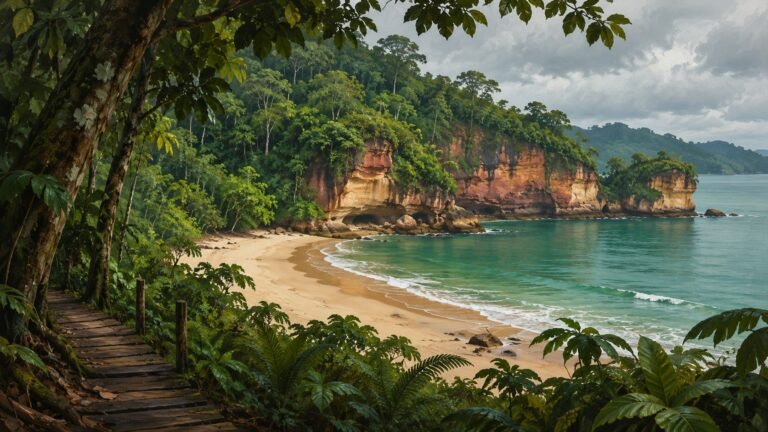
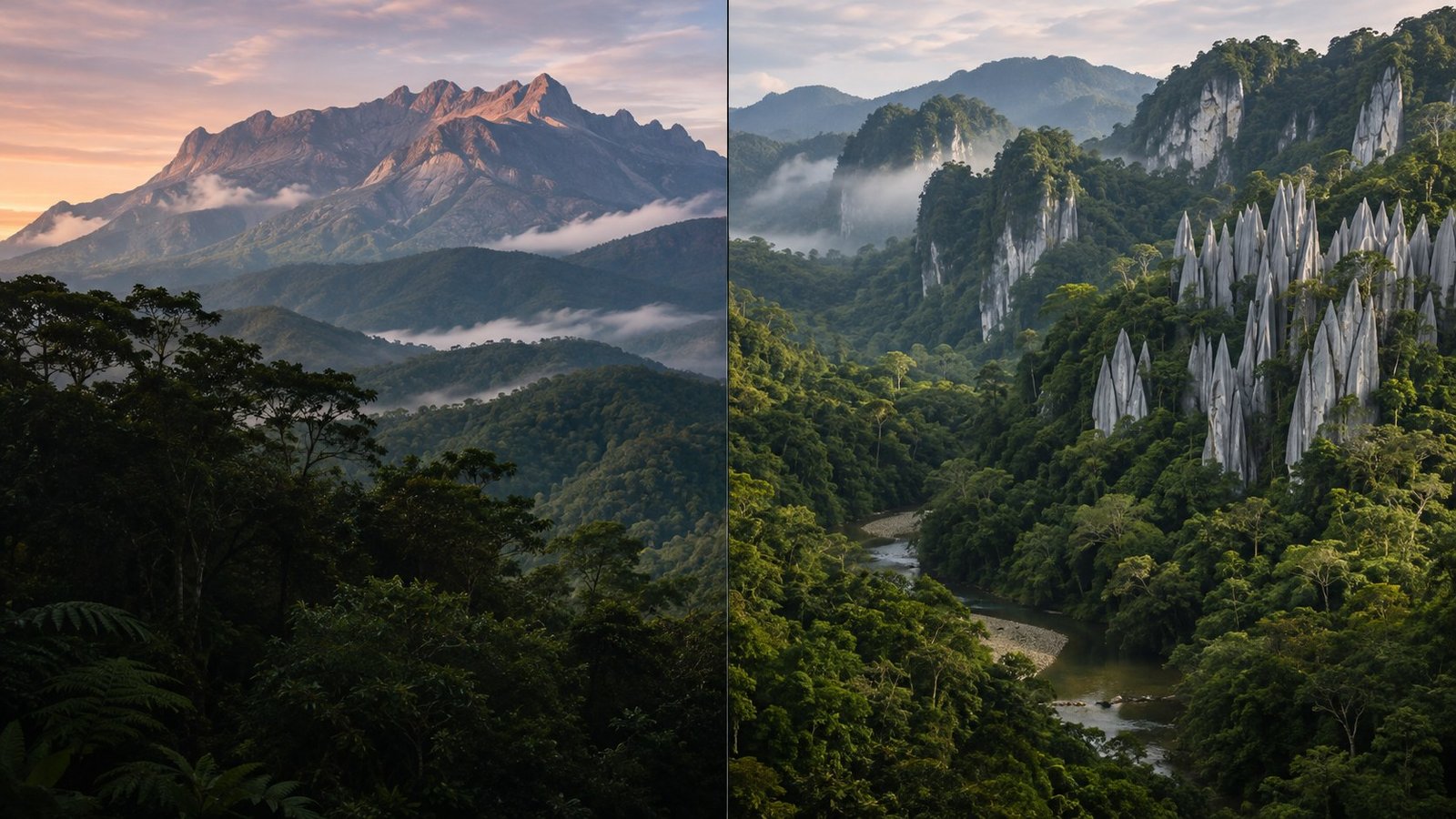
AI-generated comparison illustration of separate Sabah- and Sarawak-inspired landscapes. These are not documentary photographs or continuous geography.
Sabah and Sarawak are both large, varied parts of Malaysian Borneo. The useful question is not which one has more famous sights, but which combination you can enjoy within your available nights. This comparison looks at whole-trip choices, with separate attention to gateway cities, wildlife areas, mountains and caves.
Choose the experience that would justify the trip
Choose Sabah if Mount Kinabalu or a Kinabatangan lodge stay is the experience you would be disappointed to miss. Choose Sarawak if your ideal balance starts with Kuching’s cultural sights and nearby nature, or if Mulu’s caves are the main attraction. Both states offer wildlife, culture and demanding outdoor trips; the useful distinction is which places you will actually connect.
| Decision | Sabah | Sarawak |
|---|---|---|
| Main reason to choose it | Kinabalu mountain landscapes or an east-coast river-wildlife stay. | Kuching-based culture and nature, or a separate Mulu cave trip. |
| A shorter first visit | Choose one cluster: Kota Kinabalu and nearby outings, or Sandakan and the river. | Kuching with selected nearby outings; add Mulu only when the extra move earns its time. |
| Orangutan interest | Sepilok near Sandakan; river wildlife is a separate, less predictable experience. | Semenggoh near Kuching; semi-wild orangutans may not appear. |
| Specialist ambition | A Kinabalu summit climb needs its own permits, accommodation and guiding. | Mulu show caves and the demanding Pinnacles trek are different commitments. |
| Main planning trap | Treating all of Sabah as day-trip territory from Kota Kinabalu. | Treating Mulu as an easy outing from a Kuching hotel. |
| Who should reconsider | Travellers who want several distant highlights in a very short stay. | Travellers choosing it only because they assume culture means little outdoor activity. |
The destination examples above are grounded in the official park, tourism and museum information. The recommendations about pace and fit are editorial judgements, not a ranking of either state. Kinabalu climbing, the Kinabatangan, Mulu, Semenggoh and the Borneo Cultures Museum each require different arrangements. [1] [2] [3] [4] [6]
Write down one essential experience and two optional ones before looking for flights. If your essential experience is absent from a proposed itinerary, a cheaper arrival fare has not solved the right problem. If you cannot name an essential experience, start with a city and a small number of nearby outings.

Sabah works best when you choose a coherent cluster
Kota Kinabalu and the mountain area
Kota Kinabalu is Sabah’s main air gateway, while Sandakan, Lahad Datu and Tawau also have airports. That geography matters: an itinerary built around the west coast is a different proposition from an eastern wildlife itinerary. Price and time the actual onward journey before treating a flight into Kota Kinabalu as the start of every Sabah trip. [7]
For a mountain-focused visit, separate seeing the Kinabalu landscape and visiting the park from attempting the summit. A climb brings distinct permit, guide, accommodation and insurance requirements. A spare day in a city itinerary is not a substitute for securing those arrangements. Check the park’s current conditions and the operator’s cancellation rules before making the climb the fixed centre of a trip. [1]
Sandakan, Sepilok and the Kinabatangan
Sepilok is an orangutan rehabilitation centre, with controlled visitor access. A Kinabatangan stay is a river-based wildlife experience, commonly organised around lodge areas such as Sukau, Bilit or Abai. They answer different interests: learning about rehabilitation and watching for animals in a wider habitat. Neither should be sold as a guaranteed orangutan encounter. [8] [2]
Choose the eastern cluster when wildlife is the priority and you are willing to spend nights outside the city. Compare the lodge’s actual location, pickup point, boat programme, room type and meal coverage. Two offers described as a river safari may leave you with very different amounts of time on the water. A night in transit and a night at the lodge should not be treated as interchangeable.
Sarawak can be a city-and-nature trip or a remote cave journey
Kuching and nearby visits
Kuching offers an urban cultural anchor through the Borneo Cultures Museum, whose galleries explore the region’s people, history and natural environment. Semenggoh provides a separate visit to a reserve with semi-wild orangutans. The animals forage naturally, and fruit availability can affect whether they return for supplementary feeding. Build a day that remains worthwhile if none appear. [6] [4]
Bako adds a different kind of outing. Reaching the park involves a journey to Bako village and a boat connection; tides, weather and the chosen trail matter. Confirm current boat, guide and trail arrangements before booking your day. A city hotel does not make every nature visit independent of conditions. [5]
This combination suits someone who wants varied days without changing hotels continually. It is less suitable if your main ambition is remote wilderness and the city is merely filling nights. Equally, avoid treating a cultural stop as a quick photograph: choose a museum, neighbourhood walk or community-led visit with enough time to understand its context.
Mulu is a separate commitment
Mulu’s limestone scenery and cave systems are a strong reason to choose Sarawak, but they need their own overnight and transport planning. The tourism board distinguishes the show caves from the strenuous, multi-day Pinnacles trek. Do not assume that booking a general Mulu package includes the particular activity you want. Check guiding, fitness requirements, reserve arrangements and the exact number of nights. [3]
Treat Kuching plus Mulu as a two-base proposal to price and schedule, not a promise that every flight combination will work. Protect the return journey from a remote stay before attaching a non-refundable international departure. The sensible buffer depends on your actual flights, ticket protection and tolerance for disruption.
Count moves before deciding whether to visit both states
One state is a useful starting point for a short visit, but the state boundary is not the real cost. Changing bases consumes time. A two-base itinerary across Sabah and Sarawak can be calmer than a four-base itinerary inside either one. Count hotel departures, airport journeys, luggage handling and check-in, not just the flight’s advertised duration.
A transparent ten-night example
Suppose two travellers have ten nights across eleven calendar days. For this planning model, allow half a day on arrival and half a day on departure: one day in total. Also reserve one whole day-equivalent for every change of base. These are chosen allowances, not observed journey times or a claim that nothing enjoyable can happen on a moving day.
| Illustrative plan | Calculation | Usable day-equivalents |
|---|---|---|
| Two bases, one move | 11 − 1 arrival/departure − 1 move | 9 |
| Four bases, three moves | 11 − 1 arrival/departure − 3 moves | 7 |
| Difference | Two extra move-days | 2 fewer |
The second plan spends the same ten nights away but gives up two day-equivalents under these assumptions. That can be the difference between a second wildlife opportunity and a single rushed outing. If an actual transfer takes only a morning, replace the whole-day allowance; if it requires a connection and an overnight, increase it.
For roughly a week, my editorial recommendation is one coherent cluster, with any second base earning its place. For ten nights, compare a two-base single-state plan against a two-base cross-state plan using the same assumptions. With a longer holiday, add places because they contribute something distinct, rather than treating the extra nights as permission to include every famous name.
Use the Itinerary Pace Checker to enter your proposed stops, nights and researched door-to-door transfer hours. Its output helps expose the pace you have chosen; it does not look up transport, validate connections or confirm entry rules.

Compare what the trip includes, not a state’s reputation for value
There is no defensible universal answer to “Is Sabah or Sarawak cheaper?” without dates, room standards, activities and transport. A city stay and a lodge package buy different things. The useful comparison is the full cost for the same travellers and the same number of nights, with included meals, boats and transfers counted once.
An illustrative two-person budget
The following is a worksheet for ten nights and eleven days, in Malaysian ringgit (RM), for two adults sharing. Every price is an invented planning input, not a current quote or an estimate of typical Sabah or Sarawak prices. The package option assumes three lodge nights at RM900 per couple per night and meals covering three complete days; its remaining food allowance covers eight days.
| Cost input | Ten city-hotel nights | Seven city nights + three package nights |
|---|---|---|
| City room: RM240/night | 10 × 240 = RM2,400 | 7 × 240 = RM1,680 |
| Lodge package for the couple | RM0 | 3 × 900 = RM2,700 |
| Food: RM70/adult/day outside package | 11 × 2 × 70 = RM1,540 | 8 × 2 × 70 = RM1,120 |
| Transfers not already included | RM500 | RM750 |
| Activities not already included | RM1,200 | RM700 |
| Subtotal | RM5,640 | RM6,950 |
| 15% contingency | RM846 | RM1,042.50 |
| Illustrative total for two | RM6,486 | RM7,992.50 |
The RM1,506.50 difference comes from this chosen mix of accommodation, package inclusions, food and outings. It does not establish that one state costs more. Flights to and from the region, any internal flights, insurance, specialist climbing or diving, entry-related costs, shopping and drinks beyond the food allowance are excluded. Add applicable costs before calling either figure your holiday budget.
The model is sensitive to the package rate: another RM200 per couple per night for three nights adds RM600, or RM690 after the same 15% contingency. Ask what a real quote includes before comparing it with the city column. A three-day, two-night tour is also a different unit from the three-night illustration here.
Use the Travel Budget Calculator to rebuild your own total from current quotes. The calculator currently asks for GBP inputs, so convert your RM quotes consistently using a current exchange rate before entering them. It does not provide automatic currency conversion or live Borneo prices. Enter a package once, then remove the room, food and activity costs it already covers.
Weather, access and current advice can change the choice
Do not choose a state from a single “Borneo dry season” label. Malaysia’s meteorological service identifies the north-east monsoon, generally November to March, with particularly heavy rain affecting western Sarawak and eastern Sabah. Conditions vary within both states, and other seasonal weather can also bring rain. Use this regional pattern to plan flexibility, then check the forecast and operator advice for the specific place and date. [9]
A flexible day can absorb a rearranged boat trip or improve the chance of enjoying an outdoor visit. It cannot guarantee a summit, a cave activity or wildlife. Give a weather-sensitive highlight more than one possible slot where the booking rules allow; put a museum or other suitable indoor visit on the less promising day.
For British passport holders, the FCDO says to carry your passport when travelling between Peninsular Malaysia and East Malaysia and to obtain the appropriate entry and exit stamps. Check the current passport, entry and arrival-card requirements for your nationality and itinerary. Do not assume that an internal flight starts a new permitted stay, or infer an arrival-card requirement for a state transfer from the rule for entering Malaysia. [11]
Accessibility needs a trip-specific conversation. Ask about boat boarding, steps, uneven ground, toilet access, room position and the length of each walking section. “Suitable for families” is not a precise mobility assessment. For a demanding climb or trek, use the operator’s requirements and appropriate personal medical advice when deciding whether it suits you.
Book the scarce experience first, then build around it
- Confirm the essential experience: the exact climb, lodge programme, cave visit or guided outing, with its dates and restrictions.
- Check the real transport connection, including pickup windows and a workable onward journey.
- Compare accommodation and package terms, then align cancellation deadlines before committing.
- Fill remaining city days with flexible visits, and keep practical addresses and confirmations available offline.
Day trip or overnight river stay?
If you are deciding how much time to give the Kinabatangan, compare genuinely different formats: a Sandakan-based Kinabatangan day cruise with lunch on GetYourGuide and a three-day, two-night Kinabatangan package on Viator. The first returns from a day outing; the second includes overnight time. Read the current itinerary and inclusions, confirm the actual lodge and transfers, and compare the amount of wildlife-viewing time with the driving involved. Neither listing establishes availability for your dates or guarantees sightings. [12] [13]
City accommodation
For a Kota Kinabalu gateway stay, compare Kota Kinabalu hotels on Booking.com with Kota Kinabalu stays on Agoda. For a Kuching base, compare Kuching hotels on Booking.com with Kuching stays on Agoda. These are city-wide search pages, not selected-property endorsements. Use the same dates, room occupancy, cancellation terms and final taxes, then check the location against your pickup arrangements. [15] [16] [17] [18]
Connectivity
If an eSIM fits your device and travel style, check Airalo’s Malaysia plans for current validity, data allowance, activation rules and compatible unlocked devices. Verify the plan’s stated network coverage for the places you will visit. A national data plan is no promise of reception in a forest, on a river or in the mountains, so download essential bookings and maps before leaving town. [14]
Questions that often settle the decision
Which is better for a first visit to Borneo?
Choose the state containing your essential experience, then keep the first route small. If you mainly want a city with varied outings, a Kuching-based Sarawak visit is a reasonable starting point. If your trip is organised around Kinabalu or a Kinabatangan wildlife stay, choose the relevant Sabah cluster. This is a recommendation about fit, not a claim that either state is easier for every traveller.
Can I see orangutans in either state?
Both offer opportunities: Sepilok in Sabah and Semenggoh in Sarawak are distinct conservation settings. Treat natural animal behaviour as part of the visit, not a failure of the attraction. Do not build a tight itinerary around a promised sighting, and follow the centre’s visitor rules. [8] [4]
Can I visit both in seven nights?
A specific flight combination may make it possible, but check what you give up. With two cities and several distant wildlife ambitions, the trip can become a sequence of transfers. I would usually choose one cluster for that length unless the cross-state plan has only two bases, confirmed connections and a clear reason for each stop.
Is Sarawak only for culture and Sabah only for adventure?
That shorthand is too crude to plan with. Sarawak’s Mulu visit can be a specialist outdoor commitment; a Sabah visit can be built around a city and less demanding outings. Compare the actual day’s walking, transport and conditions instead of letting a state-wide label decide your holiday.
Which should I choose for a beach-led holiday?
Check the exact beach or island before choosing a state. In Sabah especially, west-coast and eastern offshore itineraries should not be treated as equivalent under current UK travel advice. A beach extension needs its own weather, access and insurance assessment rather than being added as a generic “Borneo coast” stop. [10]
Make the choice with three concrete answers
Name the experience you most want, decide how many bases you are willing to use, and compare complete costs for those bases. Sabah is the stronger fit when your chosen mountain or eastern wildlife experience leads the plan. Sarawak is the stronger fit when Kuching’s cultural-and-nature combination or a dedicated Mulu stay leads it.
If both still appeal, draw up two equally long options with the same number of moves and price their real inclusions. Choose the one that protects more time for the experience you care about. You can return for the other state; a first visit does not need to represent all of Malaysian Borneo.
For the wider country plan, use the Malaysia travel hub and the Malaysia comparison hub.
Sources and further checks
Research checked on 7 November 2026. Official destination, government and operator information and other supporting research are identified below. Prices, opening times, access requirements and operating conditions can change; confirm them for your travel dates.
- Sabah Parks — Mount Kinabalu climbing requirements
- Sabah Tourism Board — Kinabatangan River and lodge areas
- Sarawak Tourism Board — Mulu National Park
- Sarawak Forestry Corporation — wildlife centres and national parks
- Sarawak Tourism Board — Bako National Park
- Sarawak Museum Department — Borneo Cultures Museum
- Sabah Tourism Board — getting around Sabah
- Sabah Tourism Board — Sepilok Orangutan Rehabilitation Centre
- Malaysian Meteorological Department — monsoons and weather phenomena
- UK FCDO — Malaysia regional risks
- UK FCDO — Malaysia entry requirements
- GetYourGuide — Sandakan Kinabatangan day cruise listing
- Viator — 3-day, 2-night Kinabatangan River Cruise listing
- Airalo — Malaysia eSIM plans and device guidance
- Booking.com — Kota Kinabalu accommodation search
- Booking.com — Kuching accommodation search
- Agoda — Kota Kinabalu accommodation search
- Agoda — Kuching accommodation search
- 12Go — Kota Kinabalu Airport to Kuching Airport flight comparison
Illustrations in this article were created for Taylor’s Trailblazing Travels. Third-party photographs, where used, are credited beside the image or in the source list.