Kuala Lumpur Travel Guide: Neighbourhoods, Attractions and Trip Planning
Choose a useful base, connect the right neighbourhoods and leave space for the city between the landmarks.
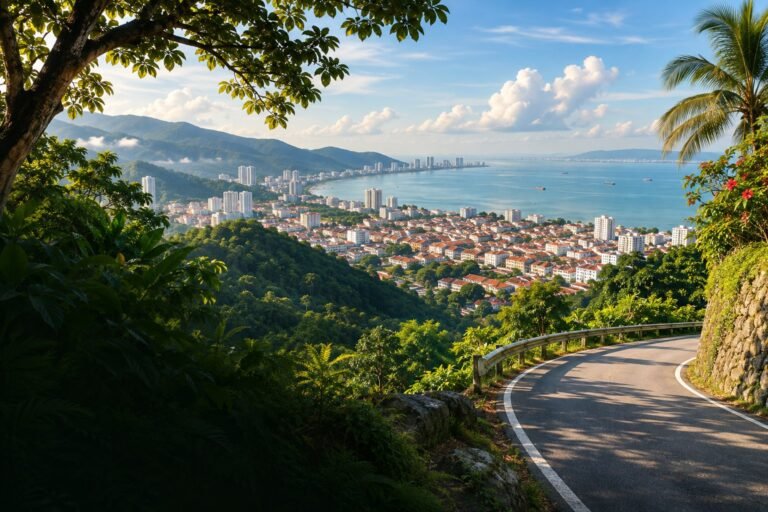
AI-created editorial illustration inspired by Kuala Lumpur’s skyline and tropical parks; it is not a documentary photograph or an exact viewpoint.
A good Kuala Lumpur trip begins with a small decision: which part of the city should feel easy when you step out of your hotel? The answer matters more than collecting every landmark. Build the stay around a convenient base, one main sightseeing cluster at a time and a few unhurried meals.
This Kuala Lumpur travel guide is for a first independent visit, particularly a city stop within a wider Malaysia holiday. It separates places to stay from places to see, and uses a three-night planning model to show what fits without turning arrival and departure days into full sightseeing days.
Some links are affiliate links. Taylor’s Trailblazing Travels may earn a commission if you book or buy through them, at no extra cost to you.
Two full days, with lighter arrival and departure plans.
Stay where dinner and the return to your hotel feel simplest.
Add an indoor pause instead of repeated cross-city journeys.
Keep paid viewpoints and guided activities tied to your interests.
Kuala Lumpur neighbourhoods: choose a base before a hotel
Treat the city as several useful centres. KLCC is the tower-and-park area; Bukit Bintang concentrates shopping and evening activity; Chinatown anchors the older streets around Petaling Street; KL Sentral is the main rail interchange beside Brickfields. These serve different parts of a holiday. [1][4]
| Base | Choose it when… | Check before booking | Useful transport anchor |
|---|---|---|---|
| Bukit Bintang | You want dinner, shops and an active evening close to your room. | Street noise, the exact entrance and a manageable walk with luggage. | Bukit Bintang MRT; the station is at Jalan Bukit Bintang and Jalan Sultan Ismail. [3] |
| KLCC | The towers, park and a comfortable hotel break are central to the trip. | Whether “KLCC” means an easy walk to the park or a much wider marketing area. | Choose the station and entrance that suit the actual address. |
| Chinatown / Pasar Seni | You prefer heritage streets, cafés and smaller-scale exploring. | Stairs, soundproofing and the route back after dinner. | Pasar Seni connects the MRT and Kelana Jaya LRT. [2] |
| KL Sentral / Brickfields | A late arrival, early departure or onward train shapes the stay. | “Near KL Sentral” does not necessarily mean inside or directly connected to the station. | Airport rail and city connections at KL Sentral. [4] |
Use a simple three-test shortlist: a suitable room, a genuinely usable route to transport, and an evening setting you enjoy. If a property fails the second test, price the extra journeys before calling it a bargain. A pool can be valuable after a hot morning, but it should not compensate for a location that complicates every outing.
Compare the same stay
Search the same dates, room occupancy and cancellation terms on both services. These buttons open Kuala Lumpur listings, not a particular hotel or a checked room offer.
Then use the Hotel Comparison Calculator with your own prices, including any extra transport costs. Enter all options in the same currency.

How many nights, and what actually fits?
Count complete days between overnight stays. Two nights usually leave one full day; three nights leave two; four nights leave three. An early flight may add usable time, but it is better treated as a bonus until arrival formalities, luggage storage and your energy level are clear.
| Stay | A sensible scope | What to leave out |
|---|---|---|
| 2 nights | One central walking cluster, the skyline and a good evening meal. | Several outlying sights and a separate full-day excursion. |
| 3 nights | Old-city exploring on one full day; KLCC and another chosen interest on the other. | A promise to cover every museum, tower and temple. |
| 4 nights | Keep the two city days, then give Batu Caves and a slower afternoon their own day. | Unnecessary hotel changes within the city. |
A three-night first-visit plan
Arrival day: reach the hotel, eat locally and take one short walk if you feel like it. Avoid a prepaid attraction that depends on a punctual flight.
Full day one: allocate roughly three hours to Chinatown and the old-city streets, a proper lunch break, then choose an indoor cultural stop or return to the hotel. Put the evening meal in a district you have not already explored.
Full day two: make KLCC the anchor, with a tower slot if wanted. Leave part of the afternoon flexible. If Batu Caves is your main priority, visit it earlier and reduce the rest of this day to the park, one booked attraction and dinner; do not also add several museums.
Departure day: plan around checkout, luggage and the booked onward journey. A nearby breakfast is easier to protect than a distant final attraction. These groupings are editorial choices designed to reduce backtracking, with no claim that every connection has been timed in person.
Back to top ↑Main attractions: build a day around an interest
KLCC and the PETRONAS Twin Towers
Seeing the towers from outside and buying admission to the Skybridge and observation experience are different choices. Pay for the visit if the view and architecture matter to you; a skyline photograph alone does not require a tower ticket. The official booking page is the place to choose the exact session and admission category. [7]
Checked on 6 November 2026, standard general-admission adult tickets are advertised at RM127 on weekdays and RM137 at weekends. Evening and premium options have separate prices and inclusions. The published calendar includes Monday closures and exceptions, so avoid repeating the old rule that every Monday is closed. Confirm your actual date before building the day around it. [7]
Chinatown, Central Market and the older city
Petaling Street provides a starting point for the area’s shops, temples and shophouses. Let a few streets, a market browse and a café break form a coherent outing instead of treating every stop as a separate attraction. REXKL, the former cinema turned cultural venue, is on Jalan Sultan and fits this part of the city. Its events and individual businesses have their own schedules. [1][10]
Keep the walk adaptable. If the weather turns, choosing a nearby indoor stop is usually more rewarding than trying to complete a fixed checklist in heavy rain. Ask before photographing worshippers or entering religious spaces; the fact that a building appears on a visitor map does not make every part freely accessible.
Food as a reason to explore another neighbourhood
Jalan Alor, Kampung Baru and Brickfields offer different settings for eating. Tourism Malaysia identifies these respectively with Chinese food, Malay food and Little India’s Indian cooking; each area contains more variety than that shorthand suggests. [1]
Choose the evening by what you want to do: a busy food street, a focused meal or a guided introduction to unfamiliar dishes. Keep small cash available, ask about ingredients directly and avoid assuming that a dish name establishes its contents.
When a food walk adds value
A guide can provide useful food and cultural context. The Sambal Streets listing describes a four-hour walk with tastings, so it should replace an evening’s eating plan rather than be squeezed between two meals. Confirm meeting point, walking demands and any dietary requirements with the operator. [20]
Batu Caves: allow for the climb and the journey
Batu Caves is in Gombak, Selangor, outside the central sightseeing clusters. The principal cave temple involves 272 steps; Tourism Malaysia identifies KTM Komuter access via Batu Caves station. Treat it as a separate half-day allocation rather than a quick addition between city appointments. [8]
Check the current Komuter timetable for your date: KTMB publishes separate weekday and weekend information, with changes due during November 2026. [9] Cover shoulders and knees for worship areas, carry water, keep food away from monkeys and respect local instructions. If the staircase is unsuitable for your mobility or energy, choose another activity rather than assuming the main cave has step-free access.
A museum that suits your interests
The Islamic Arts Museum Malaysia is useful when you want a substantial indoor cultural visit. Its published adult admission is RM20; usual gallery hours are 09:30–18:00, with shorter Ramadan hours and Eid closures. The National Museum advertises RM5 admission for foreign adults. Checked 6 November 2026; review current notices before travelling. [11][12]
Choose one for a short stay. An hour or two spent paying attention is a better use of a museum ticket than rushing through several collections to complete a route.
Back to top ↑Getting around without making every journey a project
For most first visits, combine rail with short walks and occasional licensed taxis or ride-hailing. Book a hotel around the station you will actually use, then group nearby sights. MRT Corp confirms the useful Pasar Seni interchange and Bukit Bintang’s MRT/Monorail connections. [2][3]
Walking makes sense within a cluster. It becomes less appealing when an apparently short straight-line distance involves a major road, an inconvenient crossing or an exposed stretch in the heat. Check the pedestrian route, not just the map pin. With luggage, a modestly priced last leg can be worth more than an extra interchange.
Should you buy a travel pass?
Rapid Kembara is available to all users. The published pass-only prices are RM25 for one day and RM55 for three days; the new-card bundles are RM45 and RM75. A compatible Touch ’n Go NFC card and at least RM5 remaining purse balance are required. The pass covers the listed Rapid KL services; it is not an airport-rail or KTM ticket. Validity uses service days ending at 23:59, not a rolling 24-hour period. Checked 6 November 2026. [13]
Do not buy automatically. Compare the fares for the trips you have actually planned. Three days spent mostly walking, with one longer excursion, can have a very different transport pattern from three days of repeated rail journeys. A pass bought late in the evening is also a different proposition from one started in the morning.
For a more comfortable visit
Limit each half-day to one main walking area, keep a seated indoor break and confirm step-free access directly where it matters. Bukit Bintang MRT lists lifts and other access facilities, but that does not establish an uninterrupted accessible route from a particular hotel entrance. [3]
A private vehicle or guided city outing can help when the group needs fewer transfers. Compare the actual stops, pickup area, admission inclusions and time spent in the vehicle; a long attraction count can conceal mostly drive-past stops.
Back to top ↑Airport arrivals and onward travel: budget the whole transfer
First establish your airport and terminal. This airport-rail advice concerns Kuala Lumpur International Airport’s Terminal 1 and Terminal 2. Do not apply it automatically to a flight arriving at Subang.
For the regular non-stop service, KLIA Ekspres publishes a 28-minute journey between Terminal 1 and KL Sentral, and 33 minutes from Terminal 2. KL Sentral is the interchange, not necessarily the end of your hotel transfer. [4]
The operator says services after 23:00 stop at all stations. Late arrivals should check the current late-night timetable rather than applying the non-stop timing below. [5]
The useful door-to-door calculation
After reaching the airport rail area, allocate 15–30 minutes for walking, waiting and boarding; add the published 28–33-minute train ride; then allow an illustrative 20–40 minutes for the city connection and hotel approach. That totals 63–103 minutes. The walking, waiting and last-leg inputs are planning assumptions, and immigration, baggage reclaim, delays and check-in come on top.
A road transfer may be simpler with children, several bags or a hotel awkwardly placed for rail. Compare the final quoted vehicle total, terminal pickup arrangements and luggage capacity. Road time depends on traffic; a convenient pickup does not guarantee a faster arrival.
The announced fare change
The currently advertised standard adult KLIA Ekspres single fare is RM55 and return fare RM100. The operator has announced RM65 single and RM118 return from 1 January 2027. These are standard headline fares, not a promise of the price offered when you book. Checked 6 November 2026. [5][6]
Continuing north
For an onward west-coast rail trip, check KTMB’s dated ETS timetable and booking system. Keep Kuala Lumpur station and KL Sentral distinct when reading a ticket. Avoid committing to a tight separate onward departure immediately after an international arrival. [9]
If Ipoh is your next stop, compare departure and arrival points as well as headline fare; a bus and a train do not necessarily deliver you to the same part of the destination. Check the official operator alongside the comparison service. [19]
Use the Trip Itinerary Planner to allocate Kuala Lumpur and your next stops. It organises nights and dates; check actual transport feasibility separately.

A transparent three-night Kuala Lumpur budget
This worked example is for two adults sharing one room, three nights and four spending days. It combines deliberately chosen spending allowances with specified advertised admission and rail prices. It is a planning exercise, not an average, a hotel quote or a promise that your preferred room is available.
| Item | Calculation | Group total |
|---|---|---|
| One room: assumed allowance | RM250 × 3 nights | RM750 |
| Food and drinks: assumed allowance | RM70 × 2 people × 4 days | RM560 |
| Local transport: assumed allowance | RM20 × 2 people × 4 days | RM160 |
| One weekday tower visit + IAMM | (RM127 + RM20) × 2 adults [7][11] | RM294 |
| Airport rail: one arrival journey | RM55 × 2 adults [5] | RM110 |
| Tourism tax, if not collected already | RM10 × 1 room × 3 nights [16] | RM30 |
| Subtotal | Before contingency | RM1,904 |
| Contingency | 10% × RM1,904 | RM190.40 |
| Example total | For both travellers | RM2,094.40 |
The room allowance assumes other compulsory accommodation charges are covered; add any that your quote excludes. The tourism-tax line is included for a taxable foreign-visitor stay and must not be charged twice in your budget if the booking service already collects it. Flights, insurance, onward travel, extra paid tours, shopping and a departure airport journey are excluded.
Change the big inputs first. An extra RM100 per room per night adds RM300 before contingency. Moving both tower visits to weekend standard admission adds RM20. Applying the announced 2027 airport single fare to both travellers adds another RM20; the rest of the example also needs rechecking for a later trip.
Keep local costs in ringgit while comparing offers. For the Travel Budget Calculator, convert your checked amounts into pounds using the rate and fees that apply to your payment method: the tool accepts GBP and does not perform the conversion.
Back to top ↑Weather, connectivity and everyday planning
Keep a rain option in the same area
Kuala Lumpur needs rain flexibility throughout the year. METMalaysia notes more frequent thunderstorms during the inter-monsoon periods around April–May and October–November, including afternoon or evening storms on land. This is a climate pattern, not a forecast for your holiday. [14]
Put an exposed walk earlier in the day when practical, and keep a museum, café or other indoor pause nearby. Check current warnings before leaving. A compact umbrella, drinking water and already-comfortable footwear are more useful than trying to visit every outdoor stop during the hottest part of the day.
Set up navigation before you need it
Save the hotel’s exact address and entrance, download an offline map and keep a copy of important tickets. Compare your home network’s roaming with a local SIM or eSIM. Airalo sells Malaysia data packages, but your device must support eSIMs and be free of carrier restrictions. Check the plan’s validity, activation rules and inclusions. [17][18]
The following link opens Airalo’s general store: select Malaysia and confirm your device before buying.
A final check before flying
British visitors should check the current FCDO entry page and Malaysian immigration instructions, including passport validity and arrival-card requirements. Nationality and travel purpose matter; a hotel or tour booking does not establish permission to enter. [15]
For everyday outings, carry a small cash reserve as well as your card, use designated crossings, keep bags secure and leave yourself a simple route home. At religious sites, follow the site’s dress, shoe-removal and photography instructions rather than assuming every venue applies identical rules.
Back to top ↑What to book first, and the mistakes to avoid
- Fix arrival and departure details, then allocate the actual nights in Kuala Lumpur.
- Choose a neighbourhood and compare the complete accommodation cost for a room that suits your group.
- Book the one or two time-sensitive experiences you care about, checking their current calendar and terms.
- Arrange airport transport around your terminal and hotel, then add flexible sightseeing around those anchors.
A common planning mismatch is a hotel selected only for its skyline photograph followed by repeated journeys to the area where you actually want to spend time. The next is treating a short train ride as the complete airport transfer. Both are avoidable by checking the last part of the route before paying.
A broad guided tour suits travellers who value a ready-made overview and fewer transport decisions. Independent neighbourhood days suit those who prefer longer meals, museum visits and the freedom to stop. Choose according to that trade-off, not simply the longest attraction list.
Keep the Malaysia travel hub as the starting point for the wider route. Plan the city as one worthwhile stop, with enough time to enjoy it, rather than an arrival obstacle before the rest of the holiday.
Back to top ↑Your questions answered
Is a long airport layover enough to visit Kuala Lumpur?
That needs a separate time calculation. Account for immigration, both airport transfers, baggage arrangements and your airline’s return check-in or boarding deadline. The published 28-minute airport train journey is only one part of the trip. A hotel stop with several nights is a different proposition from a short connection.
Should I split a short stay between KLCC and Bukit Bintang?
Usually there is little benefit on a two- or three-night visit. The cost is another checkout, luggage move and check-in. Choose the base that suits your evenings and visit the other district. Split only when a particular accommodation experience is itself a reason for the trip.
Do I need to hire a car for Kuala Lumpur?
The central plan here is designed around rail, walking and occasional vehicle journeys. A hire car can make more sense for the onward countryside part of a holiday. If you keep one in the city, include hotel parking and the extra time involved in collecting and returning it.
Can I enjoy the city without paid tower admission?
Yes. Use the money for a museum, food experience or a better-positioned hotel if those matter more. The reason to buy tower admission is the experience it gives you; it is not a requirement for appreciating the skyline from outside.
Choose your next step
For a first visit, choose one convenient base and allow three nights. Give the older city one main day and the skyline another, with a fourth night if you want a separate Batu Caves outing and more cultural time. Spend on the location and experiences you will actually use, and leave the arrival day light enough to absorb real travel.
Sources and checks
Sources checked for this editorial review on 6 November 2026. Operator information supports the stated facts; suggested day groupings, spending allowances and decision frameworks are editorial planning judgements. Confirm time-sensitive details and actual booking terms before travelling.
- Tourism Malaysia — Kuala Lumpur travel guide
- MRT Corp — Pasar Seni station and interchange
- MRT Corp — Pavilion Bukit Bintang station
- KLIA Ekspres — airport transfer questions
- KLIA Ekspres — standard fares
- KLIA Ekspres — fare adjustment from 1 January 2027
- PETRONAS Twin Towers — admission, ticketing and closure calendar
- Tourism Malaysia — Batu Caves
- KTMB — dated Komuter and ETS timetables
- REXKL — cultural venue and location
- Islamic Arts Museum Malaysia — visiting and admission
- National Museum — admission fees
- Rapid KL — Rapid Kembara Pass FAQ
- METMalaysia — weather phenomena and thunderstorms
- UK FCDO — Malaysia entry requirements
- Royal Malaysian Customs — tourism-tax digital platform guide
- Airalo — Malaysia eSIM packages
- Airalo — device compatibility
- 12Go — Kuala Lumpur to Ipoh route comparison
- GetYourGuide — Sambal Streets food walk details
Illustrations in this article were created for Taylor’s Trailblazing Travels. Third-party photographs, where used, are credited beside the image or in the source list.