What to Pack for Malaysia: City Heat, Highland Rain and Rainforest Visits
Pack for your actual route, with a light core and the right additions.
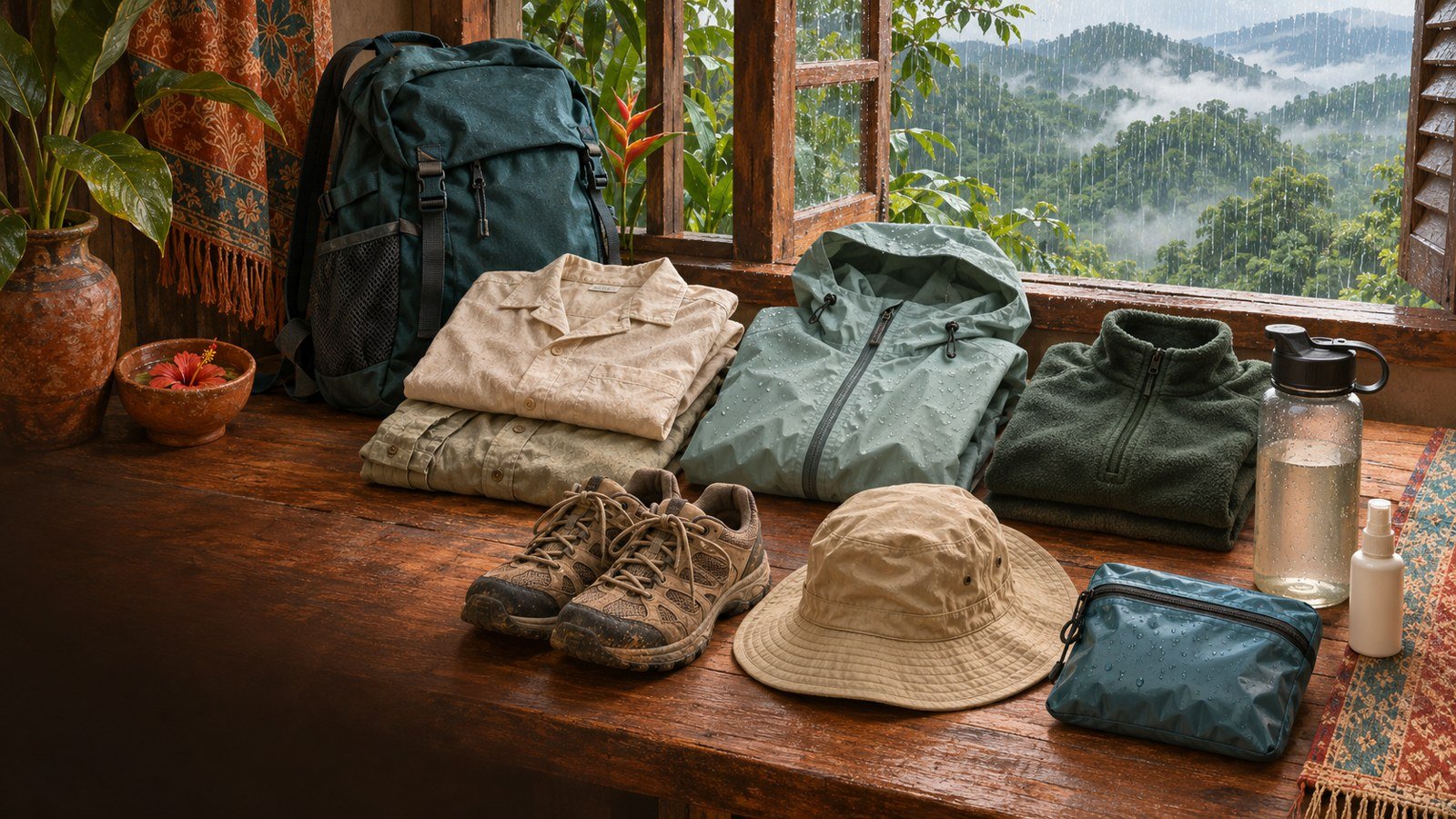
AI-generated editorial packing illustration; unbranded objects are not verified product photographs.
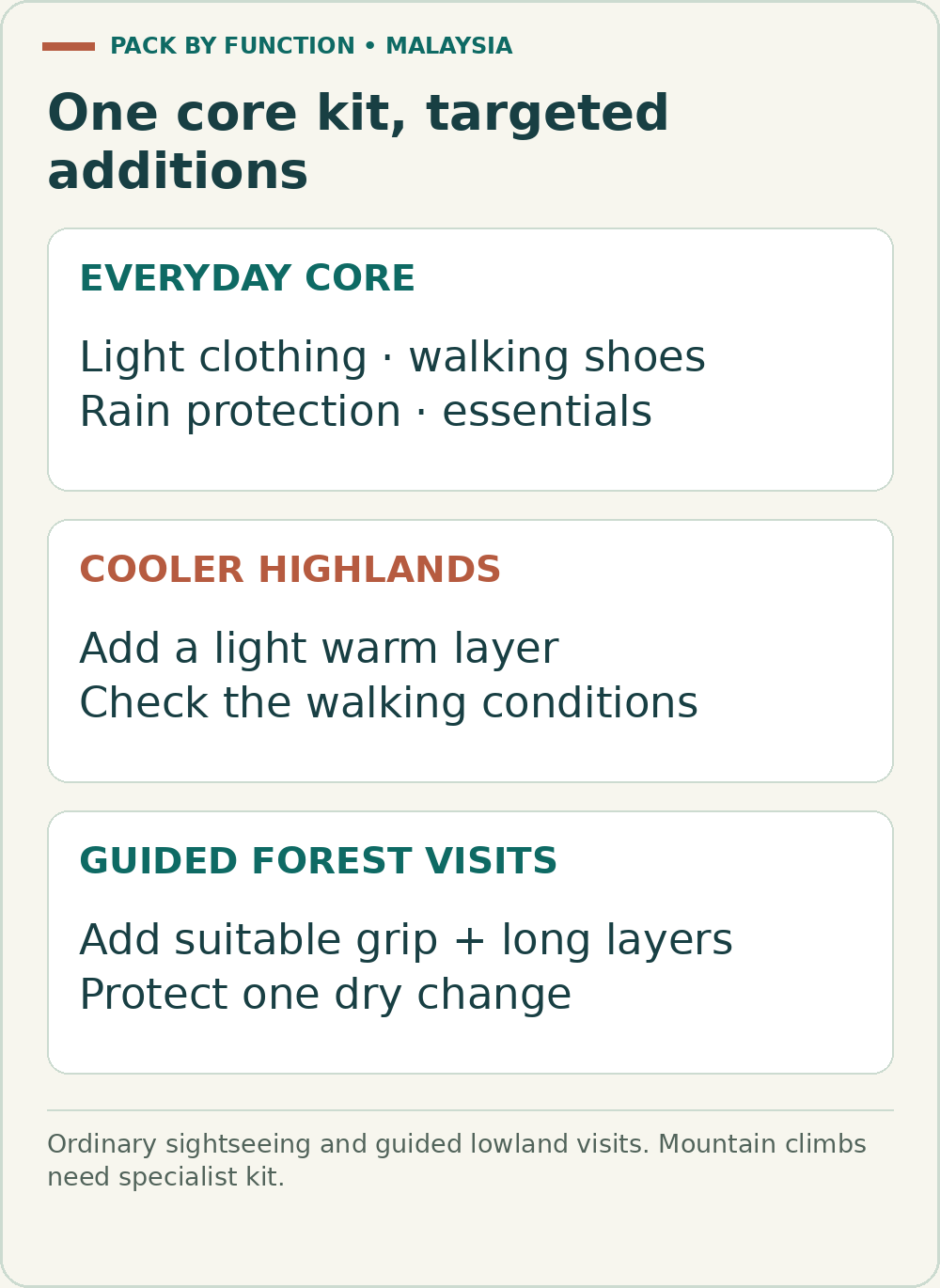
A Malaysia packing list works best when it follows your route. A city hotel, a cool highland evening and a muddy forest walk call for different additions, but they do not require three separate wardrobes.
Start with a small, washable core. Then add only the layers and equipment needed for the activities you have actually booked. The checklist below is designed for ordinary sightseeing, highland stays and guided lowland rainforest visits; a mountain ascent or remote expedition needs its own operator-approved kit list.
Some links in this guide are affiliate links. Taylor’s Trailblazing Travels may earn a commission if you book or buy through them, at no extra cost to you.
Start with the route
City, highlands and forest each add a different layer.
Plan laundry stops
A laundry stop can replace several spare outfits.
Keep a dry set
Separate evening clothing from wet walking kit.
Check every flight
Your smallest baggage allowance governs the whole trip.
What to pack for Malaysia depends on your stops
Malaysia is humid and rainy, while highland areas such as the Cameron Highlands are cooler than the lowlands. That supports a layered approach rather than a heavy all-purpose jacket. [1]
Write your overnight stops into the trip itinerary planner, then mark the days with an unusual clothing or equipment requirement. The tool organises your own choices; check activity conditions and equipment directly with your guide or accommodation.
| Your plans | Add to the everyday core | Check before packing |
|---|---|---|
| Kuala Lumpur, George Town or Melaka | Comfortable walking shoes, small umbrella, light cover-up | Religious-site dress requirements and hotel laundry |
| Cameron Highlands or a cooler upland stay | Light fleece or equivalent layer, long trousers, rain shell | Forecast, walking terrain and whether laundry can dry |
| Guided lowland rainforest walks | Long sleeves, quick-drying trousers, suitable grip, protected dry change | Guide’s footwear, leech-sock and torch requirements |
| Island or river-boat transfers | Securely closed dry storage for documents and electronics | Operator’s bag-size, weight and handling arrangements |
| Mount Kinabalu summit or remote trekking | A separate specialist kit agreed with the operator | Required warm layers, equipment, fitness and insurance |
For specialist activities, ask the operator for its current kit requirements, operating arrangements and the cover your travel insurance needs to provide.
Build a clothing capsule around laundry
Choose pieces that work together and are comfortable in humid conditions. A long-sleeved shirt can serve as a modest city layer and a forest layer, but keep a clean option for dinner if the walking version becomes muddy.
Plan clothing for each religious site’s visitor rules. Tourism Malaysia’s Masjid Jamek guidance asks visitors to dress modestly and remove their shoes on entry. [2]
A starting list for ten nights
This example assumes ordinary sightseeing, one or two guided forest outings, laundry after about four days and no formal dress requirement. Adjust it for your own needs; the quantities are a planning suggestion.
- Four everyday tops, plus one light long-sleeved shirt.
- Two versatile lower garments, including at least one pair of long trousers.
- Five days of underwear and enough socks for the planned walking.
- Sleepwear; swimwear if your accommodation or activities justify it.
- One lightweight warm layer and one rain shell.
- A modest cover-up if your existing clothing does not provide one.
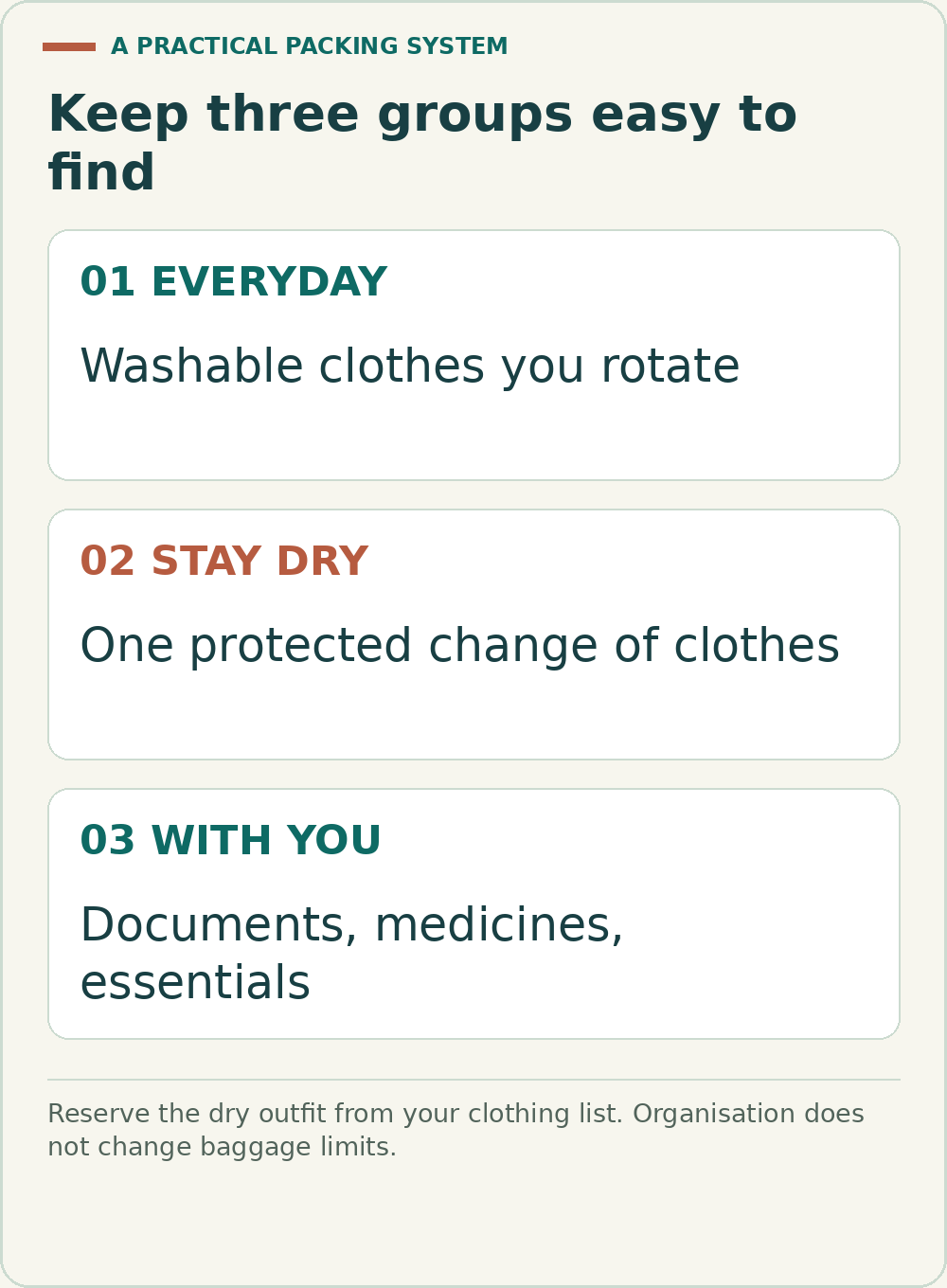
Reserve one outfit from the quantities above as the protected dry change; it is not another outfit on top. For a longer trip with the same laundry rhythm, add wash opportunities before adding outfits. If the next stay is remote or you cannot rely on clothes drying, increase the buffer. Do not assume that a hotel offering laundry returns everything the same day: ask about collection times and turnaround.
Back to top ↑Choose shoes for the surface, not the label
For city walking, use a pair you already know fits over a full day. Check the sole, heel hold and room for your toes, and test any new pair well before departure. Light sandals may be useful around accommodation, but they do not replace shoes suitable for uneven or slippery ground.
For a forest outing, ask the guide about mud, river crossings, steep sections and the expected footwear. For example, Sarawak Tourism Board’s Gunung Serapi guidance calls for hiking shoes, sufficient water, snacks and a light raincoat. [3] A waterproof shoe and a faster-drying non-waterproof shoe solve different problems. Your route and how you handle wet footwear matter more than a universal recommendation.
Replacing everyday walking shoes?
UK readers can explore the Skechers UK Outlet when comparing city footwear. Choose by fit and the demands of your trip. This is a general footwear-shopping option, not a recommendation of a specific model for rainforest trails.
For a mixed trip, a practical approach is one main walking pair and one light second pair, adding specialist footwear only when the activity warrants it. Pack the wet pair separately before a transfer and let it dry whenever conditions allow.
Back to top ↑Protect the contents as well as the bag
Rain protection has two jobs: keep you comfortable outside and keep a usable dry change inside. A jacket alone cannot do both. Put important papers and electronics inside a properly closed protective pouch or dry bag; keep wet clothing away from the clean set.
Sabah Tourism Board’s birding guidance recommends rain protection for both people and camera equipment and identifies leech socks as a useful consideration for relevant forest outings. [4] Ask your own guide what is needed rather than buying a specialist item for every itinerary.
Keep three small groups
- Everyday clothing in the main bag.
- A dry change protected separately for after the outing.
- Travel-day essentials accessible without unpacking everything.
A packing cube organises clothing; it is not automatically waterproof. Nor does compressing a bag change an airline’s weight allowance. Check the finished dimensions and weigh your bag after packing.
Optional organisation for repeated moves
View BAGSMART Blast Packing Cubes if separate clothing groups would help. The manufacturer describes compression zips and mesh panels. [5] They are an organisation option, not a replacement for waterproof inner storage; use pouches you already own if they do the job.
Choose the main luggage around how you will handle it. A wheeled case may suit hotel-to-hotel city stays; a manageable soft bag can be easier when the itinerary involves frequent lifting. Ask the specific boat or lodge about luggage arrangements before assuming it can take a large case.
Make sun, insect and medicine essentials easy to reach
Sun and insects
Bring a hat, sunglasses and sunscreen rather than relying on sunscreen alone. NHS advice recommends sunscreen with at least SPF 30 and four-star UVA protection, alongside suitable clothing and shade. [6]
Pack an appropriate insect repellent and use it according to its label. UKHSA recommends bite precautions during the day as well as at night, including covering exposed skin with suitable clothing. [7] Keep the products you need for arrival accessible, within the applicable airport liquid rules.
The right medical preparation depends on the destinations and activities, not just the country name. Discuss your itinerary with a travel-health professional in good time; the official Malaysia health advice links to current recommendations. [8]
Take a suitable water bottle or reservoir on walks and ask your guide how much drinking water you need and where safe refills are available. Plan the carry around the actual route. [3]
Regular medicines
TravelHealthPro advises carrying medicines in their original labelled packaging, taking prescription documentation, checking legality in every destination and planning for storage requirements and delays. Keep the essential supply with you. [9]
Build a small first-aid pouch around your own needs and the guide’s advice. Blister care is more useful before a walking trip than a bulky assortment of unfamiliar remedies. Ask a pharmacist about suitable products and any interactions rather than treating a general packing article as an individual treatment plan.
Back to top ↑Pack a travel-day bag that can stand alone
Imagine arriving before your main bag. The accessible bag should contain what you need to get through the first evening: documents, payment options, regular medicines, phone and charger, a change of essentials and your first accommodation details.
| Item group | Practical check |
|---|---|
| Passport and travel documents | Keep originals secure and copies separately; retain offline accommodation and transport details |
| Medicines and personal essentials | Check documentation, legal limits and any temperature requirements |
| Power bank and valuable electronics | Follow the operating airline’s cabin-carriage and onboard-use rules |
| Small toiletries and repellent | Check every departure, transfer and return airport’s liquid rules |
| One change and a light layer | Make the first evening manageable if the main bag is delayed |
UK airport liquid allowances vary by airport and screening equipment. GOV.UK says to check the airport’s rules; most still limit individual containers to 100 ml, while some permit larger containers. Also check transfer and return airports. Essential liquid medicines have separate exemptions; check the documentation and screening requirements instead of applying ordinary toiletries limits to them. [10]
Back to top ↑Check charging equipment and prepare the phone
Malaysia uses Type G sockets, the same plug shape used in the UK; Electrical Safety First lists a 240 V, 50 Hz supply. Check that each appliance’s input rating is suitable. A plug adaptor changes the connection, not the voltage. [12] A multi-country trip may still require other adaptors.
Test your charging cable before leaving and put it somewhere accessible. Download useful maps, addresses, booking details and a copy of the itinerary before a journey where connectivity is uncertain. Keep sensitive documents protected rather than in an openly shared travel file.
If you plan to use an eSIM, check device compatibility, network lock, activation timing and the specific plan’s coverage first. Airalo has Malaysia plans, but availability of a data product does not promise coverage on a forest trail or include ordinary voice calls. [13] You can browse Airalo and select Malaysia; this opens the provider’s general store.
Back to top ↑Leave space for the things you will actually use
- Several smart outfits when no evening on your route requires them.
- A heavy warm coat for ordinary lowland sightseeing; choose layers unless your activity calls for specialist insulation.
- Extra shoes without a distinct role.
- Large toiletries that exceed what you need between resupply opportunities.
- A full expedition kit for a short guided walk, before asking what the operator supplies.
- New gadgets that you have not tested or do not know how to use.
Do keep equipment required by your operator, mobility or health needs. Packing lightly should make the trip more manageable, not remove something essential for you. The useful distinction is between a real requirement and an imagined occasion.
Back to top ↑Use a three-stage check before you zip up
- Match the kit to the route: mark city days, cool evenings, wet activities and specialist excursions.
- Match the bag to the journey: confirm all flights and any boat, lodge or guided-trip luggage limits.
- Match access to consequences: put documents, medicines, essential electronics and the first evening’s needs where you can reach them.
Try lifting the packed bag, walking with it and finding the rain shell without emptying everything. Make the same check with the day bag. If you cannot manage the luggage comfortably, remove duplicate items or change the packing arrangement before changing essential kit.
Return to the Malaysia planning hub if you are still deciding which regions belong on your route. Settle that decision first: it is the strongest guide to what should go into the bag.
Back to top ↑Questions that change the packing list
Can I travel with cabin luggage only?
Possibly, but check the allowance on every flight and test your packed bag against the strictest relevant limit. A city itinerary with regular laundry is a different proposition from a remote stay with specialist equipment. The example clothing quantities are not a promise that everything will fit.
Do I need boots everywhere?
No single shoe suits every route. Pick everyday footwear for ordinary sightseeing and follow your guide’s requirements for difficult terrain. Avoid taking heavy boots solely because the itinerary includes the word “rainforest”.
Is a rain cover enough for electronics?
Treat it as one layer of protection. Check the product’s stated protection level and use suitable closed inner storage for valuable items. A loose bag cover and a waterproof pouch serve different purposes.
Back to top ↑Sources and checks
Official guidance and relevant merchant information consulted on 6 November 2026. Packing quantities, grouping methods and luggage trade-offs are editorial planning suggestions. Recheck airline, health and activity requirements before departure.
- MetMalaysia — Malaysia’s Climate: humidity, rainfall and cooler highlands.
- Tourism Malaysia — Masjid Jamek: mosque visitor dress guidance.
- Sarawak Tourism Board — Gunung Serapi: route-specific footwear, water and rain protection.
- Sabah Tourism Board — An Advance Birders Guide to Sabah: forest clothing and equipment considerations.
- BAGSMART UK — Blast Packing Cubes: manufacturer description; not a personal product test.
- NHS — Sunscreen and sun safety.
- UKHSA — Mosquito bite avoidance: advice for travellers.
- FCDO — Malaysia health advice.
- TravelHealthPro — Medicines and travel.
- GOV.UK — Hand luggage restrictions: liquids.
- Malaysia Airlines — Additional baggage restrictions: power banks and other restricted articles.
- Electrical Safety First — Malaysia travel adaptors.
- Airalo — Malaysia eSIM plans: check device and individual plan terms.
Illustrations in this article were created for Taylor’s Trailblazing Travels. Third-party photographs, where used, are credited beside the image or in the source list.