
Domestic Flights in Indonesia: How to Choose Routes and Allow Connections
Choose the right airport, price the whole journey and leave enough room for the connection.
AI-generated airport illustration; not a depiction of a verified terminal or airline.
The cheapest domestic flight in Indonesia can become an expensive choice if it lands at the wrong airport, needs another baggage payment or leaves too little time before your flight home. Start with the journey you need to complete, then compare the tickets that can deliver it. A slightly dearer nonstop can buy a useful afternoon; an overnight connection can protect the part of a holiday you cannot easily replace.
Start with the airport
A city name is not enough. Check the three-letter code on both tickets before comparing prices.
Price every sector
Add baggage, transfer costs, meals and any extra night to the displayed fare.
Separate tickets need slack
A retailer selling two flights together does not itself establish airline connection protection.
Protect the departure home
An overnight in the departure city creates more recovery time than a tight same-day transfer.
Choose the route before the airline
For domestic flights in Indonesia, compare three journey shapes first. The right one depends on how much holiday time you have and what would happen if a flight changed.
| Journey shape | When it earns its place | Main compromise |
|---|---|---|
| Nonstop | A short holiday, a fixed hotel check-in or a simple move between two bases | May cost more or operate at a less convenient hour |
| Airline-protected connection | No suitable nonstop, with the onward journey sold and confirmed as a connection | Another flight and airport wait; protection still follows the ticket conditions |
| Separate tickets with a stopover | You want to visit the connection city, or can absorb an extra night and replacement costs | You organise the transfer and should plan for the consequences of missing the second flight |
Before choosing a cheap routing, count how many hotel nights it consumes. Arriving late, sleeping near an airport and leaving early is a transport stop, not a full day in that destination. If that stop is necessary, include it honestly in your route.
AirAsia describes its Fly-Thru product as a coordinated connection, with route-specific baggage and transfer procedures. Its self-transfer guidance is different. Look for explicit protection on your selected booking rather than inferring it from a single payment or a familiar airline name.[6]
Write down the arrival airport, onward airport, ticket arrangement, final check-in deadline and fallback plan. If one of those is unclear, resolve it before buying the cheaper option.
Back to top ↑Use the airport code as your starting point
These four airports are useful search starting points for different parts of a trip. Their codes and locations come from Indonesia’s Directorate General of Civil Aviation; the suggested roles below are planning judgements, not promises of a flight on your dates.
| Airport | Search role | Question to resolve |
|---|---|---|
| Jakarta — Soekarno-Hatta, CGK [1] | Compare as a gateway when building a wider Indonesian route | Do both tickets use CGK? A result for Jakarta may involve another airport. |
| Bali — I Gusti Ngurah Rai, DPS [2] | Start here when Bali is a substantial part of the holiday | How long is the road transfer to your actual Bali base? |
| Surabaya — Juanda, SUB [3] | Consider when East Java is part of your route | Does using Surabaya remove backtracking through another city? |
| Makassar — Sultan Hasanuddin, UPG [4] | Include when comparing access to Sulawesi and onward options | Does the offered connection leave usable recovery time? |
Search the end-to-end journey first, then compare the individual legs. A route map is a planning aid, not a timetable: confirm your travel date, operating days, stops and whether the ticket is already issued. Recheck airport names if a search uses “all airports”. Treat an airport change as a separate road journey, with its own uncertainty, rather than as a normal terminal connection.
For a Jakarta–Bali comparison, open the Jakarta Airport–Denpasar search on 12Go and compare the result with the operating airline. Select flights, your dates and exact airports; the search may also display other transport. Do not treat its headline duration or lowest price as your confirmed journey.
Use the Trip Itinerary Planner to keep airport nights and destination nights in order. Enter your own stops: the planner organises the route you give it and does not validate airline schedules.
Back to top ↑Calculate the whole travel day
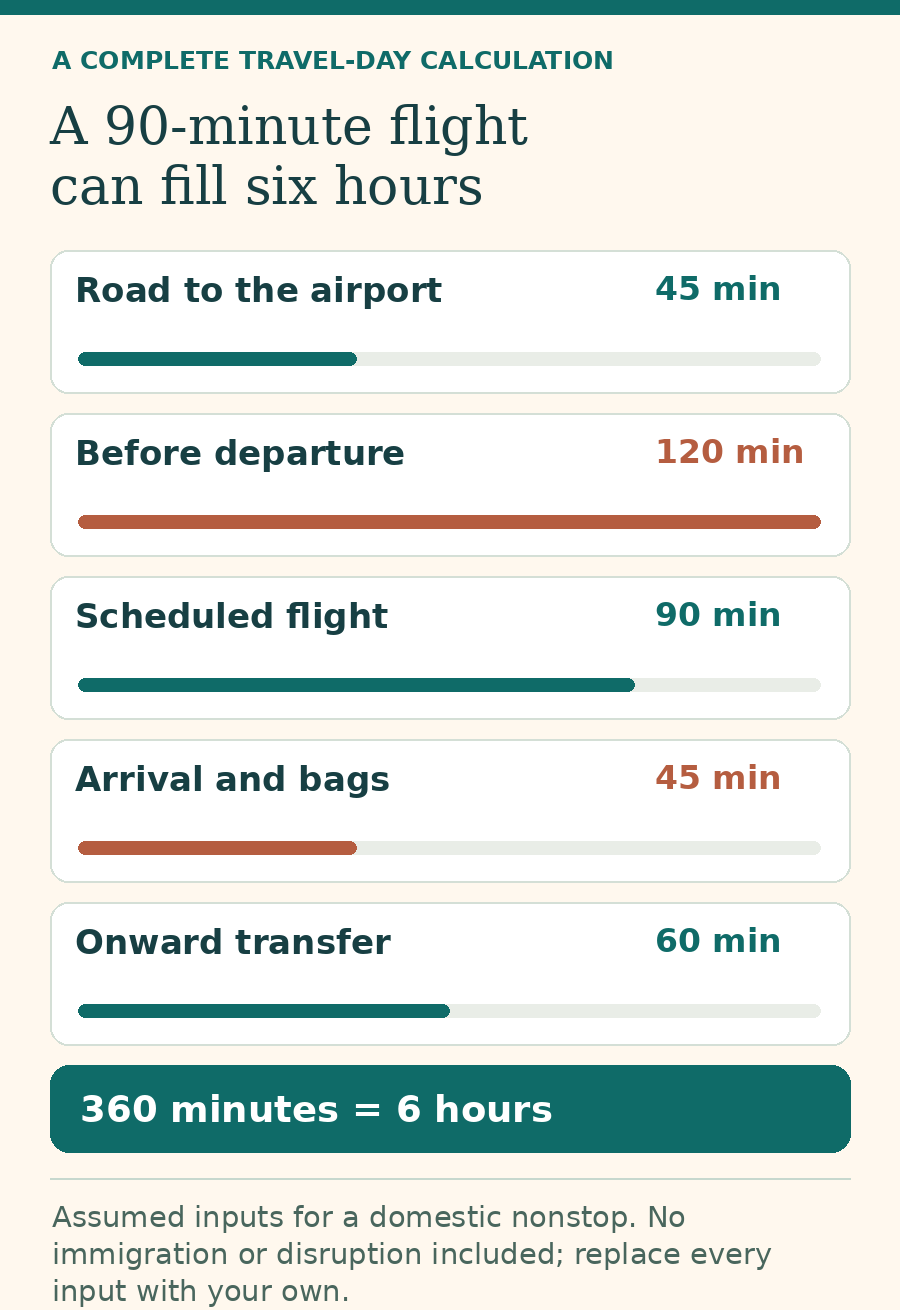
A short flight can occupy most of a day once you add the journeys to and from the airport. Use the following calculation to judge whether an extra destination is worthwhile.
An original planning model
Door-to-door time = road to airport + time before departure + scheduled flight duration + arrival formalities and bags + onward transfer. Add a separate allowance for disruption; do not hide it inside the flight time.
| Part of the journey | Assumed time |
|---|---|
| Hotel to departure airport | 45 minutes |
| Arrival before scheduled departure | 120 minutes |
| Scheduled flight | 90 minutes |
| Disembarking and baggage collection | 45 minutes |
| Arrival airport to next hotel | 60 minutes |
| Total before disruption | 360 minutes — six hours |
These are adjustable inputs, not observed queue times or an airline requirement. Replace each with information for your airports and hotel addresses. Adding a two-hour connection to this example already takes it to eight hours, before allowing for the second flight or a terminal change.
Read departure and arrival times in their local zones
Java, including Jakarta and Surabaya, uses WIB. Bali and Sulawesi, including Makassar, use WITA, one hour ahead. Maluku and Papua use WIT, two hours ahead of WIB.[5] That difference affects your arithmetic.
For example, a hypothetical departure from Jakarta at 10:00 WIB and arrival in Bali at 13:00 WITA lasts two hours, not three. This is a clock example, not a published service. Check the arrival date too when comparing overnight journeys.
Allow connections according to what you stand to lose
There is no single connection time that is suitable for every Indonesian airport and ticket. An airline’s minimum connecting time is an operational limit for a particular itinerary; it is not a comfortable allowance for two tickets you have assembled yourself.
| Your situation | Starting plan | When to add more |
|---|---|---|
| Confirmed airline-protected connection | Use the airline’s valid itinerary and read its disruption terms; favour more slack where you have a choice | Assistance needs, a complex terminal transfer or little onward availability |
| Domestic-to-domestic self-transfer at the same airport | Consider at least 3–4 hours between scheduled flights, then build the actual process backwards | Checked bags, terminal changes or the last useful flight of the day |
| International arrival followed by a separate domestic ticket | Consider 4–6 hours as a starting allowance, or an overnight if the onward trip matters more than speed | Immigration, customs, a long-haul delay or no easy replacement departure |
| Separate domestic ticket before the flight home | Return to the departure city the previous day where practical | A remote origin, infrequent flights, weather disruption or an expensive onward itinerary |
Even these longer allowances can fail. Work backwards from the next airline’s check-in or bag-drop closure, not just the departure time. Include getting off the first plane, collecting baggage if required, reaching the correct terminal, checking in, security and the walk to the gate.
What an international-to-domestic transfer involves
ANA’s Jakarta guidance tells arriving international passengers connecting to domestic flights to complete immigration, collect checked bags and clear customs before domestic check-in. Confirm the process for your own airlines.[7] AirAsia also notes an international-to-domestic baggage collection and recheck exception in Indonesia, including on relevant Fly-Thru journeys.[6]
Ask three concrete questions: is the connection protected, where must the bags be collected, and who will rebook the onward flight if the first is delayed? A through baggage tag alone does not answer all three.
Make the overnight useful
Choose a hotel by its actual terminal access, shuttle hours and check-in policy. “Airport hotel” can still mean a road transfer. For a CGK stop, compare hotels near Soekarno-Hatta on Agoda with CGK-area stays on Booking.com. These are airport-area searches, not promises of airside access, free shuttles or availability.
Back to top ↑Compare the total price, including your time
Price the same baggage, flexibility and airport transfers on every option. A low headline fare is useful only when the final basket still suits your plans.
| Cost | Nonstop example | Connecting example |
|---|---|---|
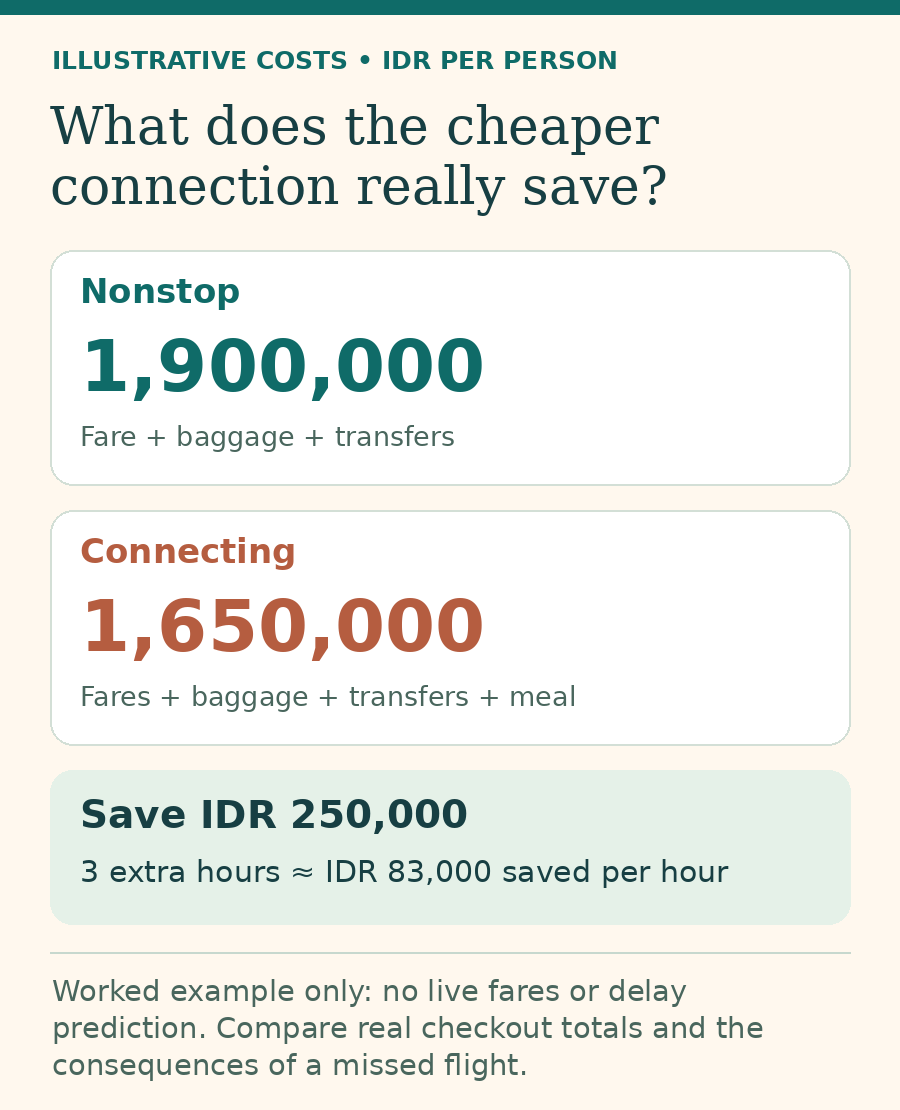
| Flight fare or combined fares | 1,400,000 | 900,000 |
| Required baggage across the journey | 200,000 | 300,000 |
| Departure and arrival transfers | 300,000 | 300,000 |
| Additional connection meal | 0 | 150,000 |
| Total | 1,900,000 | 1,650,000 |
The connecting option saves IDR 250,000 in this example. If it takes three extra hours, the saving is roughly IDR 83,000 per added hour. Decide whether that is worth the longer day before considering any missed-connection risk. A required overnight, another taxi or a paid seat would narrow the saving further.
This model does not predict delay rates, include international flights or price insurance cover. Replace the assumptions with the actual checkout totals. For two travellers, multiply passenger costs by two, but enter a shared taxi or hotel room once.
If you use the Travel Budget Calculator, convert your current quotes to GBP first and account for card charges. The tool expects pounds and does not perform the currency conversion.
Check baggage on the exact ticket
Keep a screenshot or copy of the baggage entitlement displayed during purchase and check it against the issued ticket. Verify the allowance on every flight, including any smaller connecting aircraft, rather than assuming the longest sector governs the whole journey.
Two published policy details that show why this matters
For Garuda-operated flights, tickets purchased or issued from 1 September 2026 follow the airline’s piece concept. Earlier tickets retain the weight concept unless voluntarily reissued or rebooked from that date; airline-disruption changes retain the original weight allowance. Read the number of bags and maximum weight per bag on your ticket rather than an older “kilograms included” summary.[8]
Lion Air Group’s terms list different checked allowances for its airlines: for tickets issued from 17 July 2025, Lion Air and Super Air Jet economy show 10 kg, Wings Air shows no free checked allowance, and Batik Air Indonesia economy shows 20 kg. These are published policy examples checked on 1 November 2026; confirm your own fare and any subsequent changes.[9]
Check cabin dimensions separately from checked weight. A bag that works on one aircraft or airline may not meet another carrier’s cabin limits. Keep essential documents and permitted essentials with you, and ask the carrier about special items before paying.
A luggage purchase is rarely the first solution. Weigh what you already own, compare the cost of adding the correct allowance, and pack for the most restrictive sector you actually intend to fly.
Back to top ↑Book and depart with a usable fallback
Before payment
- Match the passenger name to the travel document and use the correct local dates.
- Check every airport code, operating carrier and stop. Note any self-transfer label.
- Read the fare’s change, cancellation and no-show terms.
- Add the bags you need and check the final currency and payment total.
- Confirm payment is complete and the booking is issued or confirmed for travel, rather than merely held; save the reference and airline contact route.
Before leaving for the airport
Check the airline app or official website for the operating terminal and flight status. Build your hotel departure around traffic and the carrier’s deadlines. Online check-in does not remove bag-drop, document or gate deadlines.
For example, Lion Air’s terms state a domestic check-in closure 30 minutes before departure and a gate closure 15 minutes before departure. Those are cut-offs, not sensible times to arrive at the airport.[9] Use the earlier requirement shown for your particular flight when notices differ.
Save your ticket, hotel address and contact details offline. Mobile data can help with status changes and rebooking: compare Airalo data plans and choose the Indonesia option only after checking your phone and the plan. Airalo requires an unlocked, compatible device; coverage and package terms need checking for the places you will visit.[11]
If the first flight changes
Contact the operating airline or ticket seller through its official channel. For a protected connection, ask how the entire journey will be rebooked. For separate tickets, contact the next carrier before its departure or no-show deadline and assess the cost of changing it. Keep receipts and written notices for any later claim; reimbursement depends on the applicable terms.
FCDO notes that volcanic ash can disrupt flights and regional airport operations in Indonesia. Check the airline and local official advice when an incident affects your route.[10] An extra night is a useful buffer, but a sustained closure can outlast it.
If a delayed flight would strand you away from an essential booking, choose a different routing, earlier arrival or more flexible downstream plan. Do not build a costly boat departure, expedition or flight home around a best-case airport transfer.
Airline check-in cut-offs are not uniform. Garuda Indonesia’s published airport check-in information, for example, lists domestic counter closure 45 minutes before departure at Jakarta (CGK), versus 30 minutes at other airports. These are last cut-offs, not recommended arrival times, and rules may change. Use the operating airline’s instructions and allow separate time for security, bags and the gate. [12]
Back to top ↑Questions before you book
Should I book each Indonesian flight separately?
Separate tickets can work when you deliberately include a stopover and can absorb changes. For a journey that depends on making a same-day connection, compare a confirmed protected itinerary before accepting the saving from self-transfer tickets.
Is a four-hour connection always enough?
No. Four hours is only a planning input. The airport, terminals, bags, immigration, assistance needs and consequences of a delay all change the decision. Check the actual process and consider an overnight if missing the next flight would be difficult to resolve.
Does a boarding pass mean my bag goes through?
No. Ask at check-in where the bag is tagged and whether you must collect it en route. International-to-domestic connections in Indonesia can require collection and customs even when the wider journey is connected.[6]
When should I buy a domestic flight?
Once your route and important downstream bookings are stable, compare the acceptable options and their total cost. There is no universal cheapest booking window established in this guide. Paying early for the wrong airport, baggage allowance or connection is not a saving.
The final decision
Choose the simplest route that serves the places you actually want to visit. Pay for a useful nonstop when the alternative saves little after extras, buy a genuinely protected connection when the journey depends on it, and give a separately booked flight home an overnight buffer where practical. Then check every airport, date, bag and deadline on the final ticket before paying.
Use the Indonesia travel hub to keep this flight decision in the context of the wider route.
Back to top ↑How this guide was prepared
This research-led guide uses official destination information and selected provider references; current service terms must be checked before booking. Route choices, transfer allowances and illustrative budgets are editorial planning judgements. Confirm current services and terms for your dates; no personal visit or booking test is implied.
Sources and research
Sources and references are provided for checking route details, access and provider terms. Timetables, availability, prices and conditions can change; check the relevant official or operator page for your travel dates.
- Directorate General of Civil Aviation — Soekarno Hatta (CGK)
- Directorate General of Civil Aviation — I Gusti Ngurah Rai (DPS)
- Directorate General of Civil Aviation — Juanda (SUB)
- Directorate General of Civil Aviation — Sultan Hasanuddin (UPG)
- Indonesia Ministry of Tourism — time differences
- AirAsia — Fly-Thru connections and baggage procedures
- ANA — Jakarta airport transfer guidance
- Garuda Indonesia — baggage policy transition
- Lion Air — terms and conditions
- FCDO — Indonesia safety and security
- Airalo — Indonesia eSIM and device requirements
- Garuda Indonesia — published check-in cut-offs by departure airport
Illustrations in this article were created for Taylor’s Trailblazing Travels. Third-party photographs, where used, are credited beside the image or in the source list.