Tokyo · Immersive art
teamLab in Tokyo: Which Exhibition and Ticket Plan Makes Sense?
Choose the experience first, then the ticket that fits your day.
The useful question about teamLab in Tokyo is which experience you want to spend time inside. A ticket price, a dramatic photograph and a convenient time slot can each point you towards a different answer.
This guide compares Borderless and Planets as a booking decision: the kind of visit, the physical demands, the cost of flexibility and the space needed in your itinerary. Recommendations and time allowances are research-led editorial judgements; ticket rules come from the venue and seller sources listed below.
Taylor’s Trailblazing Travels may earn a commission when you book or buy through an affiliate link in this guide, at no extra cost to you. This helps fund the research and upkeep of the site.
Choose the experience
Free exploration points towards Borderless; active participation makes Planets a stronger candidate.
Check the venue
Borderless is at Azabudai Hills. Planets is in Toyosu. Save the actual entrance before travelling.
Read the ticket benefit
Flexible arrival and priority admission are different benefits. Check the named pass.
Protect the half-day
Transport, entry, lockers and a meal need time alongside the art itself.
Which teamLab in Tokyo fits your visit?
Use the comparison as a fit test, rather than a ranking of which museum is objectively better. Decide the experience and any access requirements before looking at the remaining ticket times.
Swipe or scroll sideways to read every column.
| Your priority | Borderless · Azabudai Hills | Planets · Toyosu |
|---|---|---|
| How you explore | Wander through connected art spaces without a fixed map. | Distinct zones, including Water, Garden and the expanded Forest. |
| Physical involvement | A shoes-on visit centred on discovering changing works. | Water and movement are a central part of the choice. |
| When it makes sense | You want to revisit spaces and follow your curiosity. | Your party wants an active art experience. |
| Main planning trade-off | Exploration can absorb longer than intended. | Clothing, mobility and sensory preferences need thought. |
Both are immersive art museums; the useful distinction is how you want to explore them.[1][2]
Choose Borderless for exploration
Borderless relocated from Odaiba to Azabudai Hills in 2024. Its connected works encourage wandering instead of working through a checklist.[1]
This is the stronger starting point for a couple or solo traveller who wants to spend time with light and space, then have a relaxed meal nearby. It also avoids making water participation part of the decision. That does not make it a conventional, brightly lit gallery: check the access and sensory notes below.
Choose Planets for a more active visit
The Forest expansion opened in January 2025 and includes Athletics Forest, Catching and Collecting Extinct Forest and Future Park. Old accounts describing only a short sequence of water rooms miss that additional dimension.[2]
Planets is a promising family choice when the children enjoy participating, moving and making things. Treat that as a preference test, not a blanket claim that every child will enjoy it. If one person dislikes wet feet or unpredictable sensory experiences, agree which activities they would be happy to skip before buying.
Standard, flexible or premium: what are you buying?
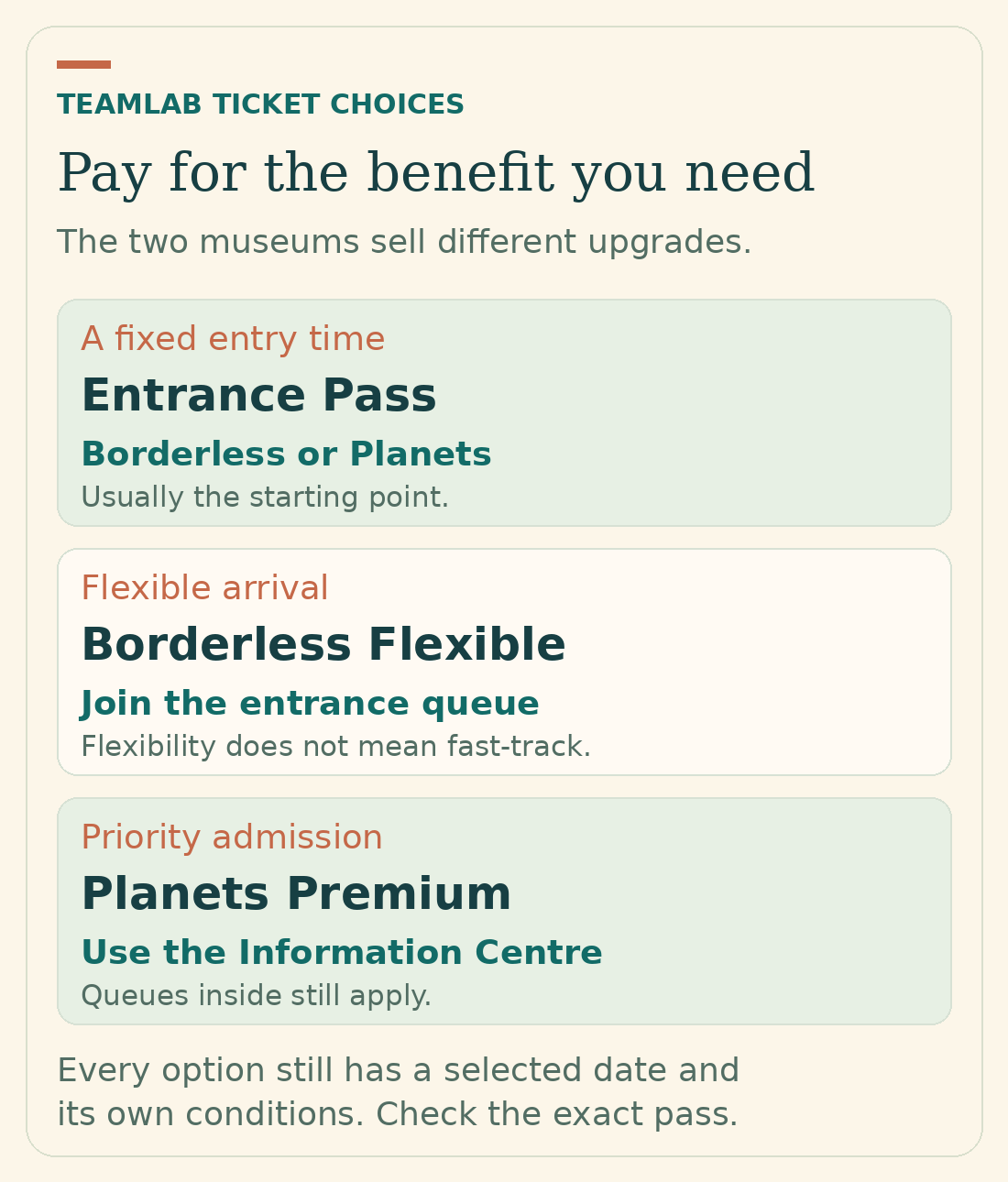
Compare the actual ticket names. Both museums sell a standard Entrance Pass, but the more expensive passes have different benefits.
Swipe or scroll sideways to read every column.
| Ticket | Advertised adult price | What changes |
|---|---|---|
| Borderless Entrance Pass | From ¥3,400 | Reserved admission time. |
| Borderless Flexible Pass | ¥12,000 | Chosen date, arrival by last admission; join the entrance queue. |
| Planets Entrance Pass | From ¥3,800 | Reserved admission time. |
| Planets Premium Pass | ¥12,000 | Chosen date and ticket window; bypass the entrance queue via the Information Centre. No priority inside. |
The higher price is worthwhile only if the benefit matters to you. A Flexible Pass is a poor answer to a queue-avoidance question at Borderless. At Planets, paying for priority at the entrance still leaves the time needed to experience the exhibition.
Put a price on flexibility
At the displayed starting adult rates, the extra cost is ¥8,600 per adult for Borderless Flexible or ¥8,200 for Planets Premium. For two adults, that is ¥17,200 or ¥16,400 above two standard starting-price tickets. These are simple differences, not predictions of the price on a particular date.
Ask what that extra money protects. If your day has a stable start time, a standard booking and a generous travel buffer may solve the problem. If you have a genuinely uncertain commitment, compare the expensive pass with moving the museum visit to another day. It should not become an automatic upgrade because the word “premium” appears.
A family cost check
Children aged 4–12 cost ¥1,500 on standard tickets; the upgraded passes charge ¥12,000 for adults and children in this age band.[3][5]
For two adults and two children in that band, the displayed adult starting rates give a standard-ticket subtotal of ¥9,800 at Borderless or ¥10,600 at Planets. Four ¥12,000 passes would total ¥48,000. The difference is ¥38,200 or ¥37,400 respectively, before travel or food. Use your party’s actual age categories and the checkout prices before deciding.
Book the correct venue and read the change rules
Use the official booking pages as the starting point: Borderless official tickets and Planets official tickets. You are choosing one location, admission date, age band and ticket type; confirm all four before payment.
Direct tickets are generally non-refundable. Eligible standard bookings permit up to three changes, subject to availability, until two hours before reserved entry. For upgraded passes, the deadline is two hours before last admission at Borderless, or 08:30 that day at Planets. Partial changes to a multi-ticket order are excluded; check other restrictions.[3][4]
The practical consequence is that “changeable” does not mean you can move to any sold-out session. Keep the existing reservation until the change is actually confirmed. For a party that may split up, check how the seller handles an order containing several tickets.
Compare Planets ticket sellers when it helps
Check Planets entry tickets on GetYourGuide if you prefer that booking service. This LINKTIVITY listing is non-refundable, requires its official admission voucher and excludes same-day purchase.[7]
Compare the Planets admission listing on Viator if you use that service. TourCraft’s current listing is non-refundable and unchangeable; its separate QR ticket arrives by email or WhatsApp. The Viator voucher alone is not the entrance ticket.[8]
Compare the final charge, the exact entrance time, voucher delivery and change conditions. A lower headline price can be a worse fit if the date is uncertain. Neither a marketplace title nor the phrase “skip the line” is enough to establish the same benefits as the official Premium Pass.
Keep the entrance document ready
For a direct Planets booking, the QR code becomes visible from midnight on the admission date; the official store accepts the displayed QR ticket or a printout.[5]
Check the admission document before leaving Wi-Fi, charge your phone and keep the confirmation reference separately. With a marketplace, follow that seller’s voucher instructions. A payment receipt and the document used to enter may serve different purposes.
Check access, clothing and sensory comfort first
These checks belong before payment, especially when one member of the party needs a particular route. An “accessible” symbol on a booking page does not tell you which individual works they can experience.
Mobility and wheelchairs
Planets allows your own wheelchair with tyre covers. Some water works require a special chair and a companion; other works have viewing-only access or cannot be entered.[4]
Borderless permits wheelchair entry, but some works are inaccessible; staff may limit simultaneous wheelchair admissions.[3]
Send the venue your chair dimensions, whether transferring is possible, the assistance available and the particular experience you want. For a mixed group, agree a meeting point and whether everyone would be content to miss an activity together. The practical question is how the visit works for your party, rather than whether a whole museum can be given a single yes-or-no label.
Dress for the experience you selected
Planets’ water spaces are barefoot and can reach adult knee height. Mirrored floors may reflect beneath skirts or wide hems.[4] Shorts or trousers that roll above the knee simplify the clothing decision.
Choose clothing you can adjust easily and avoid building the rest of the day around a bulky shopping bag. Store large luggage before visiting. With children, a spare lightweight outfit can be more useful than extra camera equipment.
Both venues warn about darkness and strong sensory effects; Borderless also notes flashing lights, loud sound and aromas.[3][4]
If those conditions present a concern, consult the venue’s current guidance before committing. A conventional collection museum may be a better fit for someone seeking a predictable, quieter indoor visit. Explain the experience to children in advance and make leaving an acceptable outcome, rather than treating every room as something they must complete.
Allow a real half-day, including the journey
For Borderless, use Azabudai Hills Garden Plaza B, basement level 1. The complex lists Kamiyacho Station exit 5 on the Hibiya Line and Roppongi-Itchome exit 4 on the Namboku Line as nearby approaches.[9]
For Planets, the official guide gives approximately one minute on foot from Shin-Toyosu on the Yurikamome, or ten minutes from Toyosu on the Yurakucho Line. These are station-to-venue walking figures, not hotel-to-entrance journey times.[6]
Do not use Odaiba as the destination for Borderless or confuse Shin-Toyosu with Toyosu. Save the museum name and entrance, then use a journey planner from your actual starting point. In heavy rain, inspect the final approach as well as the train route.
An original time budget you can adjust
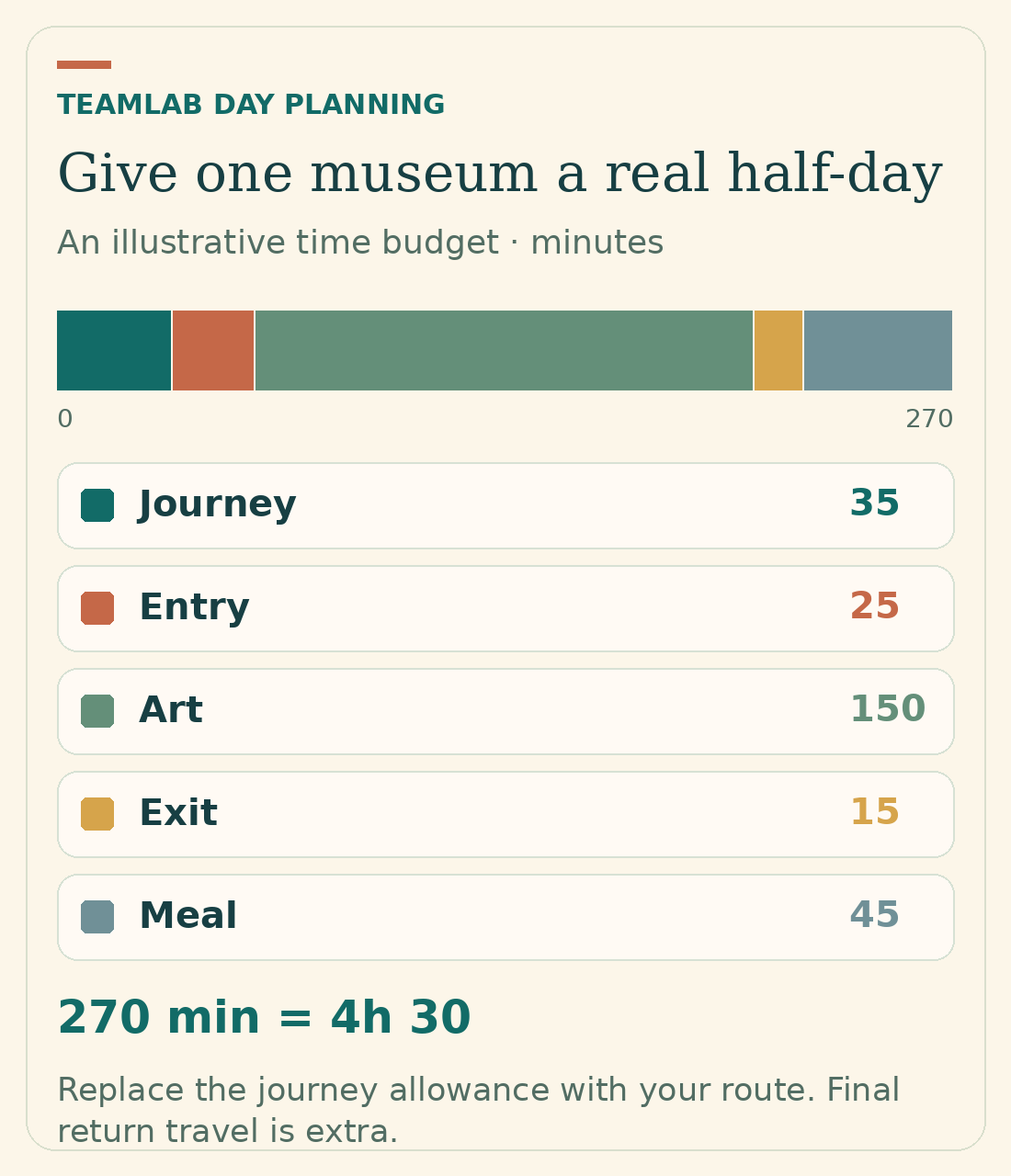
The following is an editorial planning model for one unhurried visit, with 2½ hours inside. It is not a measured queue forecast or an official minimum stay. Replace the journey line with your own route and allow more time if your party wants repeated exploration.
Swipe or scroll sideways to read every column.
| Part of the visit | Allowance | What it covers |
|---|---|---|
| Journey to the venue | 35 minutes | Illustrative city journey; replace with your route. |
| Entry preparation | 25 minutes | Finding the entrance, queuing and arranging belongings. |
| Inside the museum | 150 minutes | A planning allowance, not a promised visit duration. |
| Leaving and regrouping | 15 minutes | Belongings, toilets and deciding the next step. |
| Nearby meal | 45 minutes | A simple lunch or early dinner. |
| Total | 270 minutes | 4 hours 30 minutes. |
On this model, a 10:00 departure from your hotel uses the day until about 14:30. Protect the entry time by working backwards from your actual ticket, rather than treating this example as an appointment schedule. A longer queue or slower meal pushes the end time later.
Pair the visit with its neighbourhood
After Borderless, keep lunch and a short walk in the Azabudai area; after Planets, keep the optional extra in Toyosu. Both locations are established by the venue information above.[6][9]
This grouping leaves you free to extend the gallery visit. For a first trip, it is generally more rewarding than adding a second distant paid attraction and spending the afternoon watching the clock. Use the trip itinerary planner to organise your Tokyo nights within the wider trip, then leave room in your daily plans for this half-day. Check transport and tickets separately.
Should you visit both museums?
Both can make sense for someone whose main Tokyo interest is immersive art. For a short first visit, choose one and give the remaining time to something that changes the texture of the trip: a neighbourhood, food stop, garden or collection museum.
Two visits using the model above take 7 hours 40 minutes before any connecting journey if you retain two entry allowances, two 150-minute gallery visits, two exit allowances, one 45-minute meal and a 35-minute initial journey: 460 minutes. Add an illustrative 60 minutes between venues and the result is 520 minutes, or 8 hours 40 minutes, before returning to your hotel. The transfer allowance is a buffer to replace with your route, not a published timetable.
That arithmetic explains the recommendation to separate the museums across two days when both matter. You gain room for rest and remove the need to rush out of the first venue to protect the second booking. Both museums prohibit re-entry after leaving.[3][4]
Borderless lists closures on 20 October, 24 November and 8 December 2026; check daily hours.[3] For Planets, check the actual date and session in its ticket calendar.[5]
Booking mistakes to avoid
- Choosing a ticket from a photograph without checking the museum and address.
- Buying a flexible pass to solve a problem it does not cover.
- Assuming a marketplace ticket has the venue’s direct-booking change rights.
- Booking a rigid onward activity immediately after the gallery visit.
- Ignoring physical or sensory preferences because someone else wants a particular photograph.
Questions before you go
Is teamLab Biovortex another Tokyo option?
No. teamLab Biovortex is in Kyoto. Include it only when Kyoto is part of your trip; it is not an alternative Tokyo address for a Borderless or Planets reservation.[10]
Will every artwork in an older photograph be available?
Do not plan around that assumption. The Azabudai Hills site, for example, advertised a Borderless special presentation for 8 July–8 October 2026.[9] Check the current programme if one named work is the main reason for your visit.
Make your choice
For a first decision, choose Borderless if you want exploratory art spaces and Planets if active, physical participation is the point of the outing. Settle any access questions, reserve one generous half-day, then compare standard tickets for your actual date.
Upgrade only when you can name the benefit you need and justify its price. A well-timed standard booking, the correct entrance and enough room around the visit are usually the more useful planning improvements.
Sources
Official visitor information and the identified booking listings were consulted for this guide. Prices and dated operating information were checked on 17 October 2026; recheck the relevant venue and your selected ticket before travelling.
- GO TOKYO — teamLab Borderless: experience and relocation
- GO TOKYO — teamLab Planets and the Forest expansion
- teamLab Borderless — current tickets, visitor conditions and calendar
- teamLab Planets official ticket store — help, access and pass conditions
- teamLab Planets official ticket store — ticket types and QR admission
- teamLab Planets — official access and usage guide
- GetYourGuide — Planets admission listing and seller conditions
- Viator — TourCraft Planets admission, voucher and cancellation conditions
- Azabudai Hills — Borderless location, access and programme notices
- teamLab — Biovortex Kyoto venue information
Illustrations in this article were created for Taylor’s Trailblazing Travels. Third-party photographs, where used, are credited beside the image or in the source list.