Kyoto or Osaka: Which Is the Better Base for Kansai?
A practical choice between Kyoto mornings, Osaka evenings and the cost of travelling back and forth.
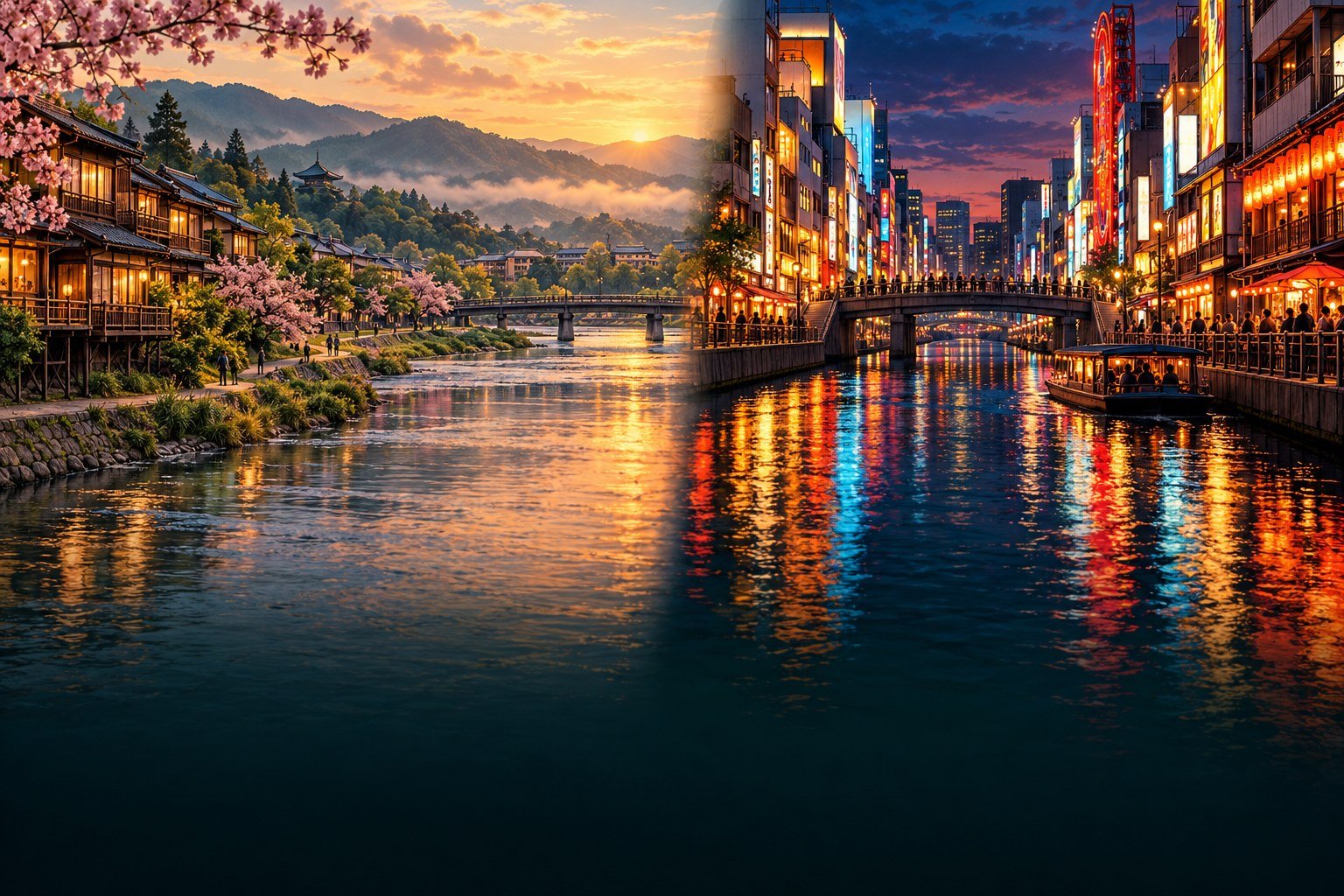
Original AI-assisted editorial illustration of Kyoto and Osaka; a composite, not a photograph.
Choose Kyoto if most of your Kansai sightseeing is in Kyoto, especially when several early starts or relaxed evenings there matter. Choose Osaka if your plans lean towards Osaka and you want to return to its food and nightlife districts after dinner. For a balanced, longer stay, sleeping in both cities can be worth one hotel move.
The useful comparison is between two actual hotels and your intended days. A cheaper room can make sense for one Kyoto excursion and lose much of its advantage over three. This guide helps you count those journeys, compare the complete cost and decide whether to keep one base or divide the stay.
This guide contains affiliate links. Taylor’s Trailblazing Travels may earn a commission when you book or buy through them, at no extra cost to you.
Planning decision 01
Kyoto mornings
Stay closer when several Kyoto days need an early start or a midday hotel break.
Planning decision 02
Osaka evenings
An Osaka base suits repeated dinners and late nights there, with Kyoto as a day trip.
Planning decision 03
Whole journey
Include the hotel walk, waiting, train and travel from the arrival station.
Planning decision 04
Whole price
Compare room totals, accommodation tax and the extra fares for everyone travelling.
Start with your days, then your evenings
Write down your full sightseeing days before searching for a hotel. Give each a Kyoto, Osaka or other-destination label. Then mark any morning you particularly want to start early and any evening you would rather spend near your room. This makes the trade-off visible before a tempting room rate decides it for you.
| Your plan | Stronger starting choice | Why it fits |
|---|---|---|
| Four nights, three full Kyoto days and one Osaka evening | Kyoto | Keep the repeated sightseeing journeys local; make the Osaka evening the excursion. |
| Four nights, one Kyoto day and two Osaka days | Osaka | Accept one longer Kyoto day rather than commuting for most of the stay. |
| Five or six nights or more, with at least two substantial days in each city | Consider both | One hotel move may buy useful mornings and evenings in each place. |
| An even day split, but several late dinners in Osaka | Osaka, or an Osaka portion of a split stay | Your preferred evenings become simpler when the hotel is nearby. |
| Children, limited stamina or a regular midday rest | The city containing most of your activities | The ability to return to your room can matter more than a modest saving. |
Kyoto’s tourism board specifically encourages morning and evening exploration, including quieter walks away from peak visiting periods. That supports staying locally when those hours are a priority; it does not promise empty streets or universal early temple opening. Check each attraction’s hours, and keep noise low in residential areas. [2]
Osaka’s official nightlife guide highlights places such as Dotonbori, Hozenji Yokocho and Uranamba. If several of those evenings are part of the trip, an Osaka room avoids building an intercity return into every night. Kyoto also has evening options, so this is a preference about where you want to finish the day. [2][3]
Back to top ↑The 30-minute train is only one part of the journey
Kyoto’s official access guide lists three useful approaches from Osaka. They serve different parts of Kyoto, which can matter more than the shortest time in the table. [1]
| Train | Station pair | Approximate ride | Useful comparison |
|---|---|---|---|
| JR Special Rapid | Osaka → Kyoto | 30 minutes | Hotels and onward journeys that suit Kyoto Station |
| Hankyu | Osaka-umeda → Kyoto-Kawaramachi | 45 minutes | A downtown Kyoto arrival |
| Keihan Limited Express | Yodoyabashi → Gion-Shijo | 48 minutes | An arrival on the eastern side of the centre |
Choose the arrival station for your first stop. Routing every Kyoto day through Kyoto Station can add travel that a different line avoids. Train type also matters: Keihan’s limited express does not stop at every sightseeing station, including Kiyomizu-Gojo and Fushimi-Inari. [4]
A transparent door-to-door example
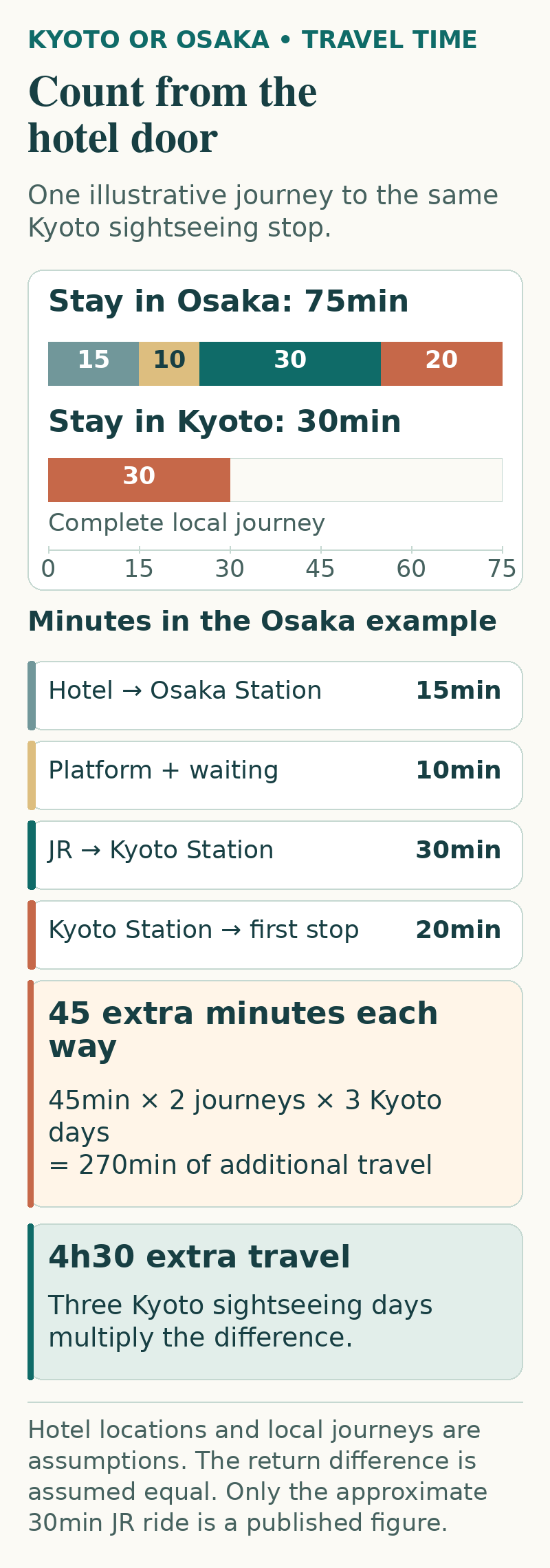
Suppose the Osaka hotel takes 15 minutes to reach Osaka Station, you allow 10 minutes to reach the platform and wait, the JR ride takes the published approximate 30 minutes, and the onward journey from Kyoto Station takes 20 minutes. That is 75 minutes to the first stop.
Now suppose a Kyoto hotel reaches that same stop in 30 minutes. Staying in Osaka adds 45 minutes each way. If the return difference is the same, three Kyoto day trips add 270 minutes: four and a half hours. The hotel walks, waiting, local journeys and equal return difference are illustrative assumptions; only the approximate JR ride is a published figure from Kyoto’s tourism board. [1]
Before booking, check the journey from each hotel to your first and last stop on a representative day. Include station entrances, transfers and walking. Check the final connection for any late return; a convenient daytime service does not establish a workable journey after dinner.
Compare the hotel’s station as carefully as the city
A well-placed Osaka hotel can be more useful than an inconvenient Kyoto one. Equally, a lower room price beside the wrong station can create repeated transfers. Shortlist the right transport area, then compare rooms with the same dates, occupancy, bed arrangement, breakfast and cancellation terms.
If you favour Kyoto
Start with Kyoto Station when JR arrivals and departures fit your plan. Compare downtown locations around Karasuma or Kyoto-Kawaramachi when the Hankyu approach suits your days, and access to Keihan around Gion-Shijo when the eastern side of Kyoto is the priority. These are transport starting points; the best hotel still depends on its actual walk to the station and your intended sights. [1][4]
Use the two Kyoto searches to compare the full stay price and room conditions. They open city results, so select your dates and check each property’s map before deciding.
If you favour Osaka
Compare access to Osaka Station or Osaka-umeda for the JR and Hankyu routes, and Yodoyabashi for Keihan. A hotel near your chosen railway reduces the amount of local travel attached to every Kyoto day. [1]
If the reason for choosing Osaka is evenings around Dotonbori and neighbouring food districts, also compare hotels around Namba. Test their full Kyoto journey before assuming that every Osaka address shares the 30-minute headline. [3]
Compare Osaka rooms against the Kyoto shortlist using the same conditions. A room total is only comparable once you know whether accommodation tax and other mandatory charges are included.
When does the cheaper hotel actually save money?
There is no dependable city-wide answer without dates and equivalent rooms. Calculate the saving for the whole room, then subtract the additional transport for each person. Include accommodation tax in the hotel totals before making this calculation.
Net saving from the cheaper base = total accommodation saving − additional transport cost compared with the other base.
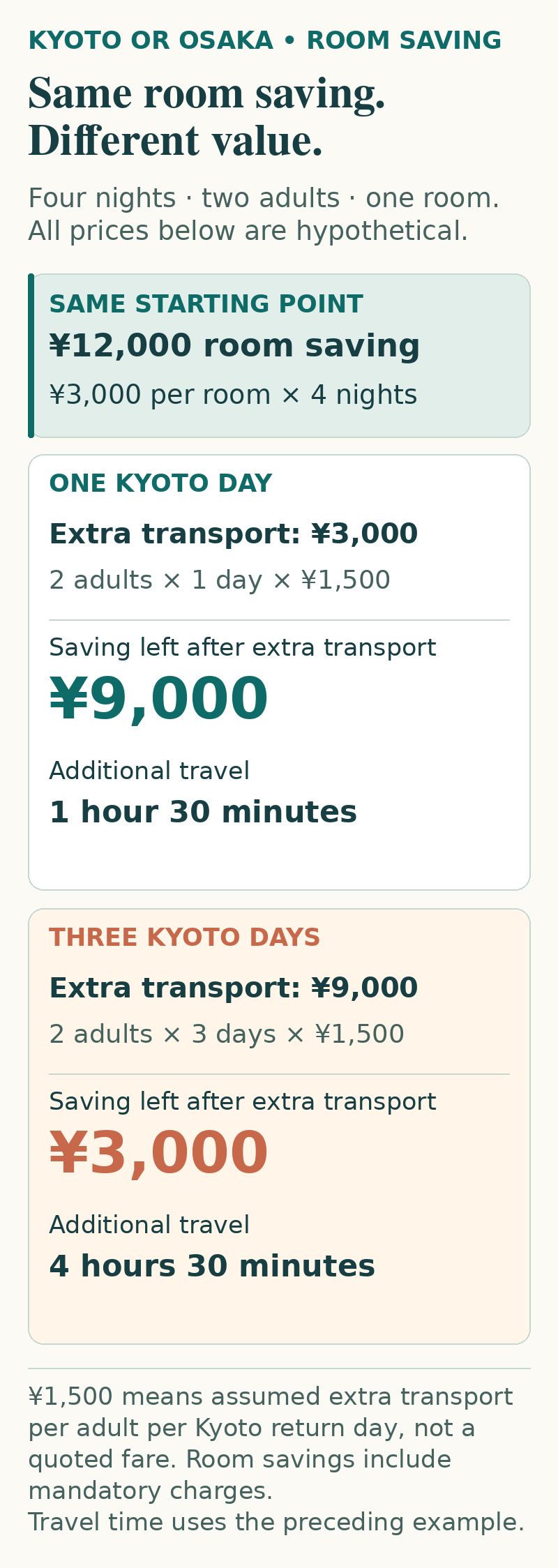
Here is a hypothetical comparison for two adults sharing one room for four nights. The room discount and transport allowance are assumptions, not hotel quotes or current rail fares.
| Assumed item | Calculation | Result |
|---|---|---|
| Osaka room cheaper by ¥3,000 per night, after mandatory charges | 4 × ¥3,000 | ¥12,000 saved per room |
| Three Kyoto days; each adult incurs ¥1,500 extra transport per return day | 2 adults × 3 days × ¥1,500 | ¥9,000 extra transport |
| Remaining saving | ¥12,000 − ¥9,000 | ¥3,000 for the whole stay |
The transport figure must be the difference between the two plans. Subtract local fares you would have paid while staying in Kyoto, and account for any pass you already hold only where its coverage actually applies. Do not treat the illustrative ¥1,500 as a quoted Osaka–Kyoto return fare.
With just one Kyoto day, the same assumptions leave ¥9,000 of the hotel saving. With three, they leave ¥3,000 and, using the earlier journey assumptions, cost four and a half extra hours. That is why the number of Kyoto days can change the answer even when the room discount stays identical.
Allow for the current accommodation taxes
Kyoto’s revised accommodation tax applies to stays from 1 March 2026; Osaka’s revised bands took effect on 1 September 2025. These are amounts per person per night, based on the taxable accommodation charge, rather than a single fee per room. Ask the property which band applies if the booking total combines several elements. [5][6]
| Taxable accommodation charge | Kyoto tax | Osaka tax |
|---|---|---|
| Under ¥5,000 | ¥200 | ¥0 |
| ¥5,000 to under ¥6,000 | ¥200 | ¥200 |
| ¥6,000 to under ¥15,000 | ¥400 | ¥200 |
| ¥15,000 to under ¥20,000 | ¥400 | ¥400 |
| ¥20,000 to under ¥50,000 | ¥1,000 | ¥500 |
| ¥50,000 to under ¥100,000 | ¥4,000 | ¥500 |
| ¥100,000 or more | ¥10,000 | ¥500 |
For example, at a taxable charge of ¥10,000 per person per night, two adults over four nights incur ¥3,200 in Kyoto accommodation tax or ¥1,600 in Osaka. That ¥1,600 difference is arithmetic using the official bands, not an accommodation-price comparison. Add tax only when it is excluded from the displayed total; do not add it again to an inclusive quote. [5][6]
Back to top ↑Keep one base for simplicity; split when both cities deserve it
For two to four nights, one base is usually the practical starting point. Packing, checkout, moving luggage, storage and check-in consume effort even when the cities are close. An isolated early start in the other city may be easier to manage than a hotel change.
For five or six nights or more, consider a split when you have at least two substantial days in each city and want mornings or evenings in both. Group the Kyoto days together and the Osaka days together. This removes repeated intercity returns and makes the move serve the itinerary.
Test the move against the commuting it removes
Use your own estimate for the complete hotel change. If packing, luggage arrangements, travel and settling in take two to three hours, compare that with the four and a half hours of additional commuting in the earlier three-day example. That assumed move could leave more usable time, although luggage arrangements and check-in timing may interrupt the day. A move that removes only one return journey is harder to justify on time alone.
For a six-night trip focused on both cities, three nights in each is a useful first draft. Adjust it around your arrival time, departure and sightseeing priorities: three nights do not automatically provide three full days. On the transfer day, arrange luggage storage before assigning a full programme of activities.
Choose two hotels because each improves a meaningful part of the trip. If one city is only a single excursion, start by testing one well-located base.
Check the day trips and airport journey that could change the choice
Nara alone does not settle the question. Rail links make it a workable excursion from either city: Kyoto’s transport guide describes Kintetsu connections towards Nara, while Kintetsu’s network includes the Osaka-Namba–Kintetsu-Nara route. Compare the connection from your actual hotel, then let the rest of the itinerary decide the base. [4][8]
If another outing has a fixed early entry or meeting time, run that exact journey too. One particularly awkward start can justify changing the order of a split stay, even when the overall city-day count is balanced.
Flying into Kansai International Airport does not by itself require an Osaka base. JR West’s Haruka serves both Osaka and Kyoto. For a very early departure or a late arrival, check services at your actual flight time before deciding where the first or last night belongs; the existence of a direct route does not establish that it runs when you need it. [7]
Back to top ↑Questions that often change the decision
Is Osaka a poor choice for a first Kyoto visit?
No. One focused Kyoto day from a well-connected Osaka hotel is a reasonable plan. The trade-off grows when you repeat the journey over several days or want a midday rest in your room. Use the day count and complete journey rather than a rule that every first-time visitor must sleep in Kyoto.
Should a family or traveller with limited mobility automatically choose Kyoto?
Choose the base closest to most of your activities, then check the property and route in detail. A short map distance does not confirm a step-free station exit, suitable bathroom or easy hotel entrance. Confirm the required access with the hotel and transport operator before paying; city choice alone cannot establish accessibility.
What if suitable Kyoto rooms are too expensive or unavailable?
An Osaka base remains a sensible option if the complete journey works. Compare hotels near the railway that best serves your Kyoto plans, group sights by arrival area, and reduce the number of cross-city returns. A suitable room that leaves enough budget for the trip can be more valuable than a theoretically ideal address.
Does an existing rail pass make Osaka the obvious choice?
Only if it covers the services you would actually use, and even then it changes the money calculation more than the time calculation. Check the exact pass, train operator and validity dates. Include any uncovered local transport, and retain the hotel-to-station and onward travel time in the comparison.
Can you enjoy Kyoto at night while staying in Osaka?
Yes, provided the return works for the evening you want. Kyoto’s official guide includes after-dark exploration. Check the complete last connection to your hotel before making late plans, and consider a Kyoto portion of a split stay if several such evenings are a priority. [2]
Back to top ↑The recommendation: stay where your trip repeatedly starts and ends
Kyoto is the better base when Kyoto supplies most of the sightseeing, several early starts or the evenings you most want to enjoy. Osaka is the better base when Osaka supplies those anchors and Kyoto is one or two planned excursions. A longer trip with substantial time in both deserves a serious look at a split stay.
Make the decision concrete: shortlist one suitable hotel in each city, test a representative day from both doors, and compare the full room and transport totals for everyone travelling. Then decide whether the remaining saving is worth the extra time. That produces a more useful answer than choosing a city by reputation alone.
Back to top ↑Sources and research
Editorial review: 18 October 2026. The official references below support the key planning information; check changing fares, opening arrangements and services for your own travel dates.
- Kyoto City Tourism Association — Getting to KyotoApproximate Osaka–Kyoto train times and the JR, Hankyu and Keihan station pairs.
- Kyoto City Tourism Association — Kyoto in the morning and at nightMorning and evening exploration, opening-time context and consideration for residential areas.
- Osaka Convention & Tourism Bureau — Osaka nightlifeEvening food and nightlife districts, including Dotonbori, Hozenji Yokocho and Uranamba.
- Kyoto City Tourism Association — Getting around Kyoto by subway and trainRailway orientation, Keihan stopping patterns and Kintetsu links towards Nara.
- Kyoto City — Accommodation tax revision FAQs for guestsOfficial per-person, per-night tax bands applying from 1 March 2026, determined by stay date; Japanese-language source checked 18 October 2026.
- Osaka Prefecture — Revised accommodation taxOfficial per-person, per-night tax bands effective 1 September 2025; Japanese-language source checked 18 October 2026.
- JR West — Kansai-Airport Express HarukaHaruka service destinations include Osaka and Kyoto; no discounted fare or eligibility claim is made in this article.
- Kintetsu Railway — Railway network mapNetwork and Osaka-Namba–Kintetsu-Nara route.
Illustrations in this article were created for Taylor’s Trailblazing Travels. Third-party photographs, where used, are credited beside the image or in the source list.