
Flying to Japan from the UK: Arrival-City and Connection Decisions
Choose the flight that fits your first hotel, final city and actual journey from home—not just the lowest fare.
- Airport-code comparison
- Through-ticket vs self-transfer
- Illustrative total-cost model
Original editorial illustration of an imagined airport at dawn. The aircraft, terminal and skyline do not depict a specific airline, airport or scheduled service.
A good flight to Japan is a journey you can use. The price matters, but so do the trip to your UK departure airport, the connection arrangement, the Japanese arrival terminal and the route to your first hotel. A cheap Tokyo return can become less attractive when most of the holiday is in Kansai and the final days must be spent retracing the route.
Compare flight-and-ground-transport combinations before choosing accommodation. This guide provides a decision framework and worked arithmetic, not a live fare search or a guarantee that a particular route operates on your dates.
Right gateway
Match the airport to your first and last overnight bases.
Whole journey
Include the UK airport trip, bags and Japanese ground transport.
Ticket structure
Confirm the connection contract, not just one checkout screen.
Arrival reality
Check the last useful transfer and the hotel’s check-in arrangements.
Choose the arrival region before choosing the fare
Place the first and last overnight bases beside the flight search. A trip mainly in Tokyo has a different useful arrival from a trip mainly in Kyoto, while a route between the two regions is a reason to compare flying into one and out of the other.
| Airport | Useful starting comparison | Question before booking |
|---|---|---|
| Haneda · HND | A Tokyo-first stay or an onward domestic connection. | Which terminal, which hotel route and what operating times? |
| Narita · NRT | A Tokyo-first stay with a suitable fare and arrival time. | What is the complete rail, bus or transfer journey to your actual hotel? |
| Kansai · KIX | An Osaka-, Kyoto- or wider Kansai-first stay. | Which regional base and onward connection fit the arrival? |
Haneda and Narita are different airports, not two terminals of one airport. Likewise, a flight labelled “Osaka” needs its actual airport code checked. Do not compare a domestic connection into one airport with an international departure from another as though the transfer were automatic.
For a Hokkaido- or Kyushu-led trip, put the relevant regional airport into the search from the start rather than assuming a Tokyo arrival followed by a separate ticket is necessary. JNTO’s gateway guide includes New Chitose and Fukuoka among the options to investigate.[1]
The right choice is the gateway that works for your itinerary at an acceptable total cost. A slightly less convenient airport can be reasonable for a meaningful saving or a better arrival time; a familiar name is not itself a reason to select it.
Compare the journey from your UK home
British Airways describes a nonstop Heathrow–Haneda service. JAL’s London–Tokyo flight page is another starting point for comparing dates and products. These are examples to compare, not an exhaustive airline list or evidence of seats on your dates.[3][4]
A nonstop long-haul flight can remove an interchange, but it may not be your shortest door-to-door journey if reaching Heathrow requires a long trip or an overnight hotel. Compare it with a connecting itinerary from a practical UK airport near you.
Include the cost and time of rail, coach, driving, parking or a feeder flight in both directions. A late UK return may create a final overnight stay that the outward search does not reveal. Enter realistic baggage and seat requirements as well: a fare comparison is weak when one option includes the extras you need and another does not.
When a UK feeder flight is involved, establish whether it is part of the long-haul ticket or a separate positioning booking. One of the questions is financial: who is responsible for getting you onwards if the feeder is late? Another is practical: do you need to collect bags and check in again?
Distinguish a through-ticket from a self-transfer
For a connecting itinerary, ask the seller to confirm the ticket arrangement, operating airlines, airport and terminal changes, baggage handling and what happens after a missed connection. A single payment or an attractive itinerary display does not, by itself, answer those questions.
British Airways’ connection guidance distinguishes flights on one booking from separate bookings and warns that a missed connection on separate tickets can require a new ticket at your expense. Its specific transfer advice is not a universal time allowance for every airline or airport.[2]
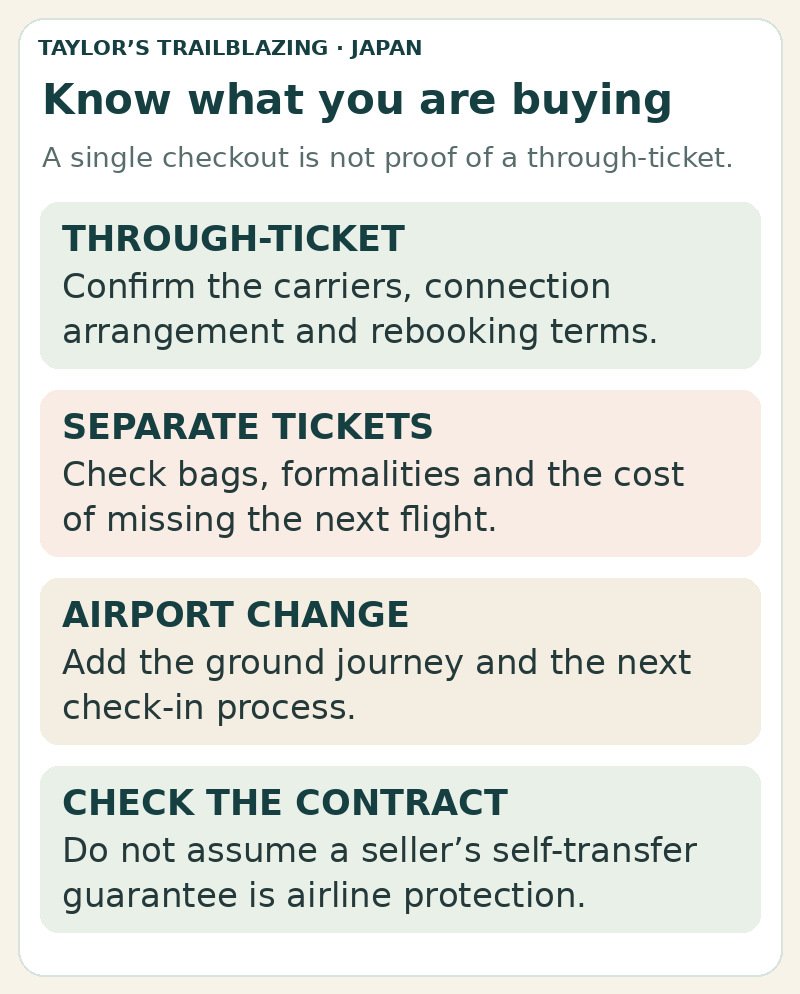
A connection sold by an airline on a through-ticket still deserves scrutiny. A permitted connection time is a minimum used for that itinerary, not a comfort recommendation for every traveller. Consider mobility, travelling with children, terminal complexity and how you would feel if there were little margin.
For separate tickets, allow for the full landside sequence where relevant: arrive, clear formalities, collect baggage, move to the next terminal or airport, check in again and reach the gate. Check whether the transit country requires entry permission for that process. Do not assume travelling with cabin baggage removes every immigration or security step.
Read any self-transfer guarantee as a separate product
Some sellers describe their own connection assistance or guarantee. Read its conditions, exclusions, contact process and remedy before relying on it. It is not automatically the same contract as an airline through-ticket. A low fare can be worth considering, but the risk should be understood rather than hidden by a friendly label.
Check domestic connections and airport changes in Japan
An international arrival followed by a domestic flight is not necessarily a simple airside walk. JAL’s Haneda instructions require arriving international passengers to collect checked baggage and clear customs at Haneda before taking it to the domestic connection counter. Its terminal procedures and deadlines are specific to that connection.[8]
Use the operating airline’s instructions for your ticket, not a general airport blog. Check the international arrival terminal and the domestic departure terminal, including any shuttle and separate bag-drop arrangements. Confirm the process again when the flight information becomes available.
A Haneda–Narita airport change is a ground journey between airports. Add the arrival formalities, transfer, new check-in and security process; do not confuse the drive or train time with the required time between flights. Where a booking includes an airport change, ask what transport is included and who bears the cost and missed-connection risk.
The same logic applies to a rail ticket after landing. The flight’s scheduled arrival is not the moment you are standing on a railway platform. Compare a flexible onward plan with a reserved connection and understand what happens if the flight arrives late.
Make the first evening achievable
Read the arrival date as carefully as the arrival time. Long-haul itineraries can show an arrival on the following local date. Check both the Japan hotel night and the UK return date directly from the itinerary before paying for rooms or leave from work.
Plan from terminal to hotel, not from airport to a generic city centre. Haneda and Narita publish access information, while Kansai’s access guidance distinguishes its railway station, terminal and shuttle arrangements. A route that works from one terminal may require an extra step from another.[5][6][7]
For a late landing, check the last service that completes the whole journey, including the final interchange. Compare a realistic later transfer or an appropriately located first-night hotel rather than assuming that public transport runs whenever the flight arrives. Contact the hotel about late check-in and what to do if you are delayed.
Use a whole-journey cost check
The following figures are invented solely as a transparent arithmetic example—not airline fares, hotel quotes or researched average prices. Imagine that option A has a lower flight fare but needs more UK positioning and Japanese ground travel. Option B costs more in the air but better matches the traveller’s departure point and first/last bases.
| Cost item | Option A | Option B |
|---|---|---|
| Return / multi-city flight fare | £780 | £940 |
| Required baggage and seat extras | £65 | £65 |
| UK airport positioning / access | £120 | £35 |
| Unavoidable transit overnight, allocated per person | £70 | £0 |
| Japan airport access and extra backtracking | £110 | £50 |
| Comparison total | £1,145 | £1,090 |
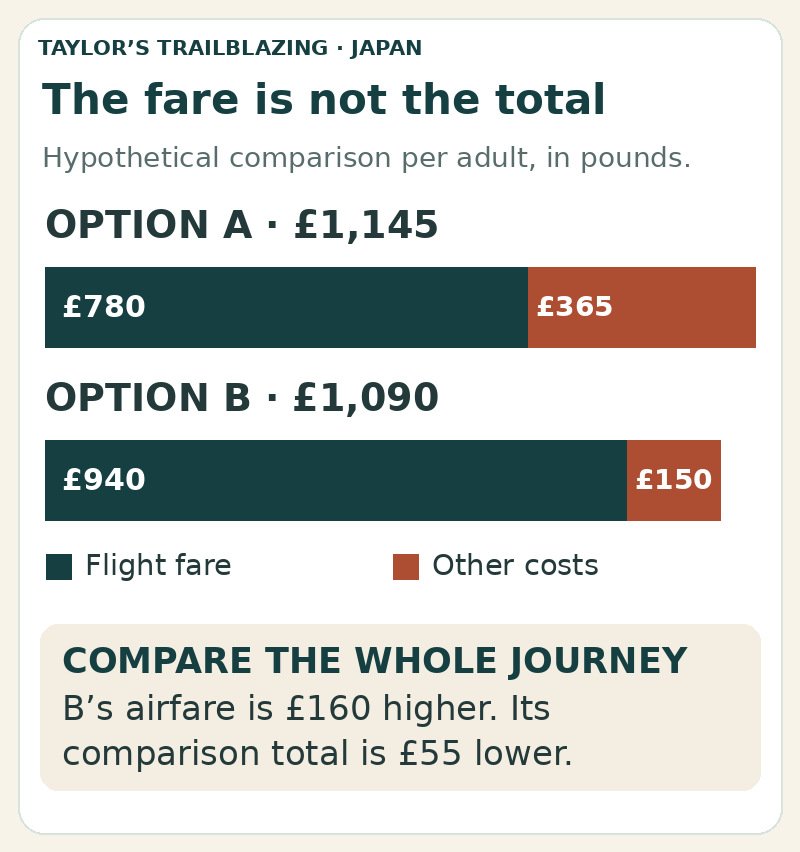
Option A’s fare is £160 lower, but its other listed costs total £365 rather than £150—a £215 difference. Option B is therefore £55 cheaper across these comparison items. The calculation excludes normal holiday accommodation, food and sightseeing common to both plans. It does not put a cash value on comfort or the consequences of a missed flight.
Run the same comparison with your own quotes, then compare time separately. Keep total elapsed journey time, number of changes, sleep opportunity and arrival practicality visible. An itinerary can be the cheaper one and still be the wrong choice for your family.
Check the return journey too. Arriving in Tokyo and leaving from Kansai may reduce retracing on a westbound holiday, but the actual multi-city fare, included luggage and connections determine whether the combination earns its price.
Check the details before clicking pay
- Confirm every airport code, terminal where available, local date and overnight connection.
- Confirm whether the itinerary is a through-ticket, separate tickets or a seller-backed self-transfer.
- Read baggage allowances for the actual operating flights and ask whether bags are checked through.
- Check passport and transit requirements for the traveller and every country involved, using official sources.
- Make sure the first hotel and final airport journey work with the timings.
- Save the fare conditions, confirmation and a practical contact route for the seller and airlines.
Do not make your arrival depend entirely on a working phone or a single online account. Save the hotel’s full address, transport instructions and important booking references somewhere you can still access after a battery or connectivity problem.
Useful questions before you decide
Is Haneda always the better airport than Narita?
No. Compare the fare, arrival time and complete route to your hotel. Haneda’s location can help some itineraries, but the useful airport is the one that fits the whole journey—not the one that wins a general ranking.
Should I buy a separate domestic ticket after landing in Japan?
Compare it with a through-ticket before deciding. A separate ticket can offer flexibility or a lower fare, but its baggage process and missed-connection consequences need to be acceptable. Do not treat the scheduled landing time as the start of an immediate onward ride.
Does one booking reference guarantee every connection is protected?
Do not use the booking reference alone as proof. Ask the seller to explain the ticket and contract structure, baggage handling and rebooking obligations. Carrier guidance can include specific exceptions; read the terms for the actual itinerary.[2]
Is it worth flying into Tokyo and out of Osaka?
It can be for a route ending in Kansai. Compare the complete multi-city fare with the return-fare alternative plus the ground travel, time and any additional hotel night needed to reach the original departure airport.
The practical decision
Choose the flight as part of the route, not as a bargain isolated from it. The strongest option has an understandable ticket, workable arrival and departure days, and a total cost you can compare honestly. A modest premium for a simpler journey can be worthwhile; so can a sensible connection when its savings and conditions are clear.
Research and planning notes
Airline and airport descriptions were checked against the listed primary sources on 17 October 2026. Published service descriptions are not live availability checks. All prices in the worked model are explicitly hypothetical. Flight schedules, terminals and entry/transit requirements must be rechecked for the actual itinerary.
Sources
Source links and selected high-impact claims independently reviewed on 18 October 2026. Booking rules, operating notices and availability can change; use the current source before making a purchase or fixing a journey.
- JNTO — airport access overview Gateway information; not an airline route inventory.
- British Airways — flight connections Separate-ticket and baggage guidance. Advice is carrier- and itinerary-specific.
- British Airways — flights to Tokyo Published London Heathrow–Tokyo Haneda service description.
- Japan Airlines — London to Tokyo flights Official flight-search starting point; no displayed fare is quoted as current availability.
- Haneda Airport — official access information Terminal and ground-transport checks.
- Narita International Airport — official access information Ground-transport options and onward planning.
- Kansai International Airport — access questions Station, terminal and transfer information.
- Japan Airlines — Haneda transfers International-to-domestic baggage, customs and terminal procedures.
- GetYourGuide — Tokyo transfers Commercial transfer listings, not a guarantee of suitability or availability.
- Airalo Help Centre — eSIM package expiry and activation Validity can depend on the selected plan’s activation policy.
Illustrations in this article were created for Taylor’s Trailblazing Travels. Third-party photographs, where used, are credited beside the image or in the source list.