Using Money in Japan: Cash, Cards, ATMs and Payment Tips
Choose the right way to pay, understand the fees and keep a useful backup.
- Cash and card backup
- Choose JPY at checkout
- Transparent fee comparison
AI-generated editorial illustration of travel payment choices; the currency and cards are illustrative and do not depict a particular financial product.
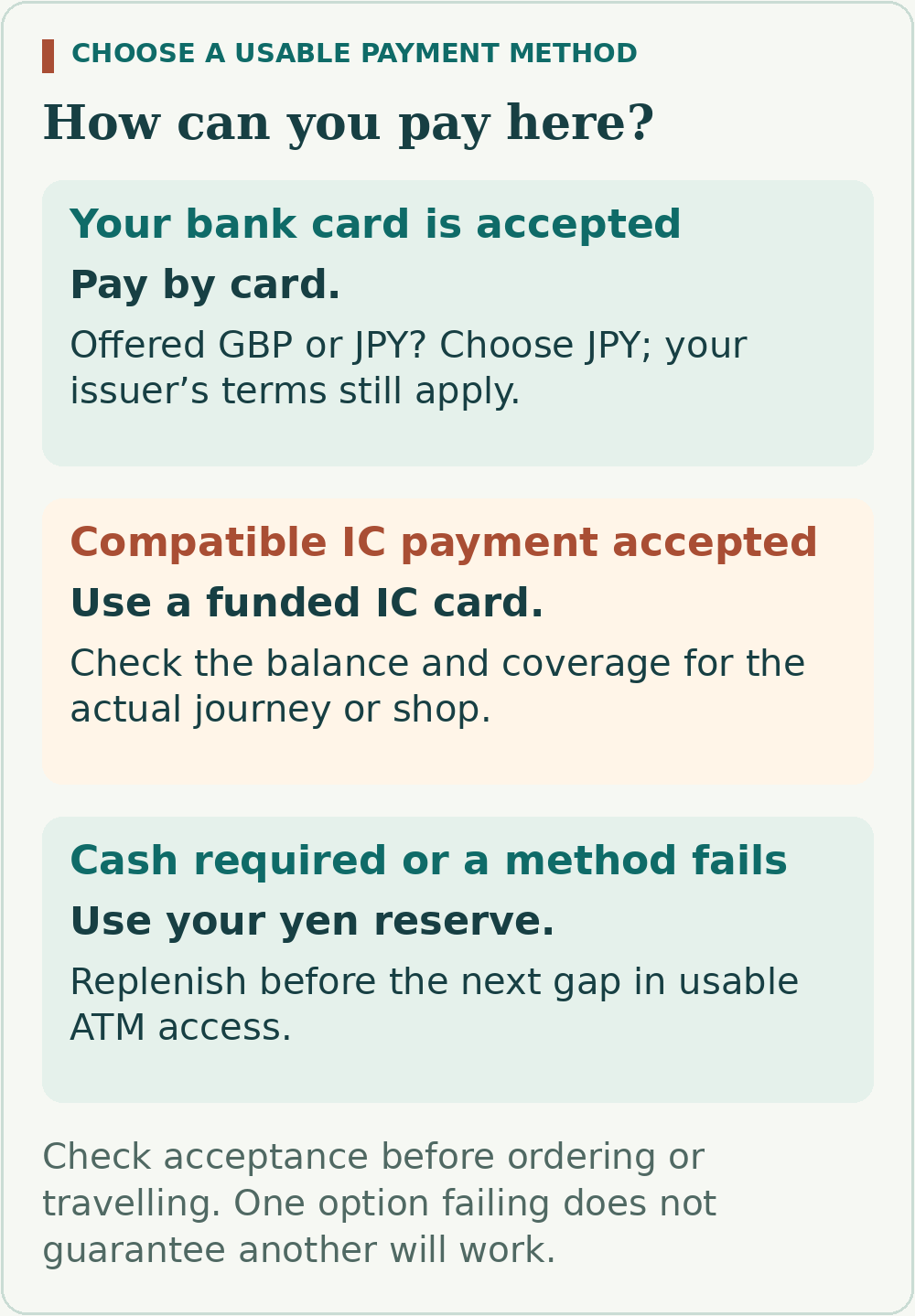
A reliable way to manage money in Japan is to combine a bank card, a manageable reserve of yen and, where useful, a transport IC card. Card payments are widely available at major hotels, shops and many urban restaurants, but cash remains necessary at some businesses, particularly beyond the main cities. Check acceptance before committing to a purchase or stay. [1]
The decisions that matter are which card to use for purchases, how to obtain cash, who converts the currency and how you will pay if your first option fails.
Cash reserve
Cover the period until your next confirmed ATM, including any cash top-ups.
Bank card
Check purchase fees and withdrawal fees separately.
At the ATM
The machine’s charge and your issuer’s charges are different costs.
IC card
Useful prepaid spending for participating transport and shops.
Match the payment method to the purchase
| Method | Useful for | Check first |
|---|---|---|
| Debit or credit card | Accommodation, shopping and other purchases where your card network is accepted. | Acceptance, overseas purchase charges and whether the terminal is offering currency conversion. |
| Japanese yen cash | Cash-only bills, physical IC-card top-ups and a fallback when another payment fails. | How much you need before the next accessible ATM. |
| Transport IC card | Compatible local trains and buses, plus participating shops and vending machines. | Coverage, balance and the specific card’s top-up and refund rules. |
Look for the payment methods displayed at the entrance or counter, and ask whether your intended method is accepted before ordering. [1]
How much cash should you carry?
Set a cash reserve around your next gap in access, rather than withdrawing your whole holiday budget. A useful planning rule is:
Cash needed until the next confirmed ATM = known cash-only payments + planned cash top-ups + an essential fallback.
For example, suppose one traveller expects to spend ¥6,000 in cash over the next two days, including a physical IC-card top-up, and sets aside another ¥4,000 for a fallback meal and journey. The resulting reserve is ¥10,000. These are illustrative choices, not typical daily prices or a universal recommended amount.
A cash-only accommodation bill must be added in full. Before a rural stay, ask the property how you can settle the balance and where the nearest usable ATM is; JNTO specifically recommends checking ahead in remote areas. Keep some smaller notes and coins available for modest purchases. [1]
Should you buy yen before leaving the UK?
Either a small amount bought before departure or a planned withdrawal after arrival can provide your initial cash. Choose the arrangement that covers your first transport, food and check-in needs, including an alternative if the intended ATM is unavailable. For exchange quotes, compare the yen you receive for the same sterling outlay after commission, delivery or collection charges. A headline “no commission” offer alone does not tell you which quote provides more yen.
Use an international ATM and read its charges
Seven Bank and Japan Post Bank publish guidance for foreign-issued cards. Both support major international networks, subject to the particular card being accepted. Their published limits are ceilings, not suggested withdrawal amounts. Your issuer may impose a lower daily or transaction limit. [2] [3] [5]
| ATM operator | Foreign-card withdrawal limit | What the operator says about fees |
|---|---|---|
| Seven Bank | ¥100,000 per withdrawal; ¥30,000 for magnetic-stripe transactions. | Fees vary by card brand. Check the transaction shown on the machine. [2] |
| Japan Post Bank | ¥50,000 per transaction. | Certain foreign-issued cards may incur ¥220, including tax, per withdrawal. Issuer charges may also apply. [3] |
Do not read a bank’s domestic account tariff as a promise of free withdrawals with your UK card. Use the operator’s foreign-card guidance and location information, and check access hours for the actual machine. Maintenance and the opening hours of the premises can affect availability. [2] [3] [4]
- Have your physical card and PIN ready. Select English if offered.
- Choose withdrawal, the appropriate account option and the yen amount you need. Follow your issuer’s guidance if you are unsure which account option applies.
- Read any operator fee and currency-conversion offer before confirming. Choose JPY if you want the transaction passed to your issuer in yen.
- Collect the cash, card and receipt, and check that you have all three before leaving.
Seven Bank’s illustrated process shows the currency choice separately from the withdrawal amount. Screens differ between operators and cards. [4]
Choose yen, then check what your own card charges
If a shop or ATM asks whether to charge you in GBP or JPY, choosing JPY is the practical default. A GBP offer normally uses the merchant’s or ATM provider’s dynamic currency conversion (DCC). Visa explains that this conversion usually includes a markup; declining it allows your issuer’s normal conversion arrangements to apply. This does not remove your issuer’s overseas fees. [5] [7]
Read the wording rather than relying on button colours. Declining conversion is a different choice from cancelling the purchase or cash withdrawal. Visa says a DCC offer should disclose both currency amounts, the exchange rate and additional fees or markup, with a genuine choice for the customer. [6]
Check purchases and cash separately
Look up your exact card’s tariff for overseas purchases, cash withdrawals, any minimum or fixed withdrawal charge, fee-free allowances and the exchange-rate method. Nationwide’s published tables illustrate why the distinction matters: fees differ between its products, and a credit card can have no non-sterling transaction fee while still charging a cash fee. This is an example of how terms differ, not a card recommendation. [7]
Credit-card cash withdrawals can also attract interest from the withdrawal date even when you repay the statement in full; Nationwide explicitly describes that treatment in its terms. Check cash-advance interest as well as the advertised foreign-spending fee before choosing your withdrawal card. [8]
Save the answers for the cards you will actually carry. A debit card with suitable cash terms may serve a different purpose from a credit card used for purchases.
A worked example: the same cash, different fees
This hypothetical comparison gives the traveller ¥30,000 in every case. It assumes an ATM charge of ¥220 per withdrawal and uses a rounded reference of ¥210.72 per £1, derived from the ECB’s 16 October 2026 rates. The reference is for comparison, not a consumer exchange-rate quote. Your bank’s actual conversion rate may differ. [9]
The issuer charges below are hypothetical inputs, not the terms of a named card. The assumed ¥220 operator fee is not universal; replace it with the amount shown by your ATM.
| Scenario | Assumed issuer charges | Total account debit | Cost above the cash’s reference value |
|---|---|---|---|
| A: one ¥30,000 withdrawal | No percentage fee; no fixed fee. | £143.41 | £1.04 |
| B: one ¥30,000 withdrawal | 3% of the yen transaction, including the operator fee; £2 per withdrawal. | £149.72 | £7.35 |
| C: three ¥10,000 withdrawals | The same 3% and £2 terms as B, applied to each withdrawal. | £155.87 | £13.50 |
The cash alone has a reference value of £142.37. The calculation is: ((¥30,000 + number of withdrawals × ¥220) ÷ 210.72) × (1 + issuer percentage fee) + number of withdrawals × issuer fixed fee in pounds. Totals are calculated before rounding.
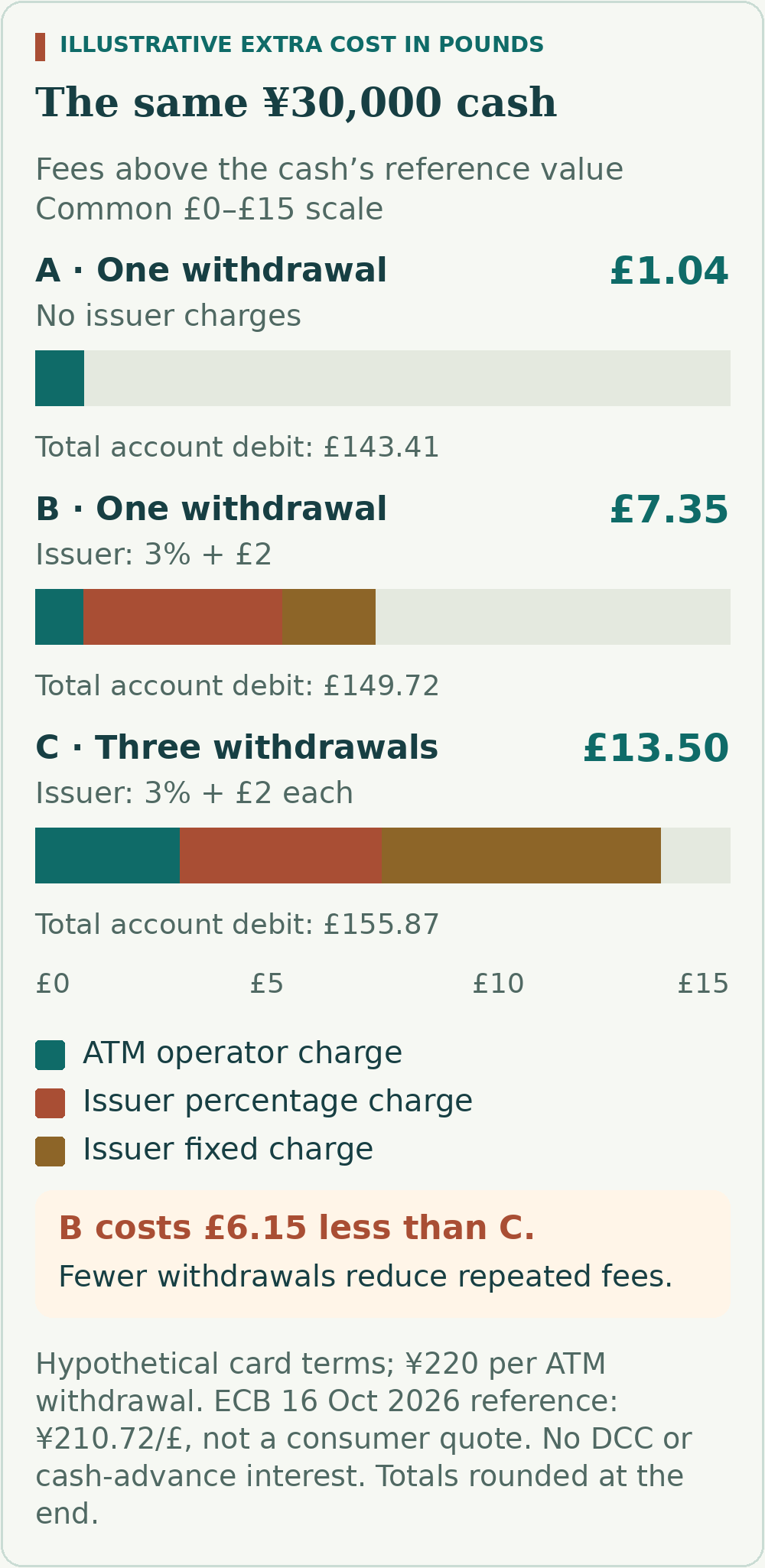
B costs £6.15 less than C because fewer withdrawals reduce repeated charges. A shows that the issuer’s terms also matter. There is no DCC, credit-card interest, account subscription or other charge in this example. Real terms may apply fees differently.
Use the comparison to choose a card and a sensible withdrawal frequency. Only take out cash you expect to need and can comfortably look after; paying repeated small fees and carrying an excessive reserve are both avoidable planning problems.
Keep IC cards and bank-card tapping separate
Physical IC cards
Suica, PASMO and ICOCA belong to Japan’s interoperable transport IC system, but coverage has limits. An IC balance pays individual fares; it is not an unlimited travel pass. For example, JR East says Suica cannot be used for a continuous journey between separate IC areas, and limited-express services can require an additional ticket. Check the journey rather than assuming a funded card covers every train. [10]
For physical Suica cards, plan for cash top-ups. JR East caps the balance at ¥20,000; load only what you expect to use. [10]
| Product | Deposit and unused money |
|---|---|
| Regular Suica issued by JR East | ¥500 refundable deposit. Refunds at JR East; up to ¥220 is deducted from the unused balance. [10] |
| Physical Welcome Suica | No deposit; valid for 28 days including purchase day. Unused balance is normally non-refundable. [11] |
These are examples, not universal rules for every IC product. Check the issuer before buying, especially if you leave Japan through a different region.
Mobile IC cards
Compatible Apple devices can hold Suica, PASMO or ICOCA in Wallet; adding money requires a supported payment card. Google’s PASMO guidance requires an Osaifu-Keitai-compatible device. Do not assume that a UK phone supporting ordinary contactless payments can automatically hold a Japanese IC card. Check device and funding-card support before relying on it. [12] [13] [16]
A separate physical IC card can provide an alternative. If you transfer an existing physical card into Apple Wallet, that plastic card stops working; it cannot then serve as your backup. [16]
Tapping a bank card at the gate
Bank-card travel is available on some networks. Tokyo Metro’s current Tap to Ride service supports eligible cards and transfers with participating Kanto operators, but has coverage exceptions, including no boarding at Nakano. Adult fares apply; check child-ticket options for a family. It does not support transfers to railways outside the scheme. [14]
For that service, enter and exit using the identical physical card or device. A phone containing the same underlying bank card is not interchangeable with the plastic card partway through a journey. Check the whole route and use the reader intended for your chosen payment method. [14]
Prepare a backup that still works if your phone does not
A second version of the same card on the same phone leaves several failures unresolved. The following is a practical preparation checklist, rather than a claim that every traveller needs another account:
- Check your card’s expiry, PIN, available funds and withdrawal limit. Follow your issuer’s instructions on overseas use and travel notifications.
- If you have another suitable physical card, keep it separately. A card from another issuer can reduce reliance on a single account being available.
- Keep the cash reserve accessible without the main wallet, while keeping each amount secure.
- Save your issuer’s official overseas support details somewhere you can reach without a working phone. Plan how to receive authentication messages or recover access to your banking app.
- Before leaving a city or airport, confirm the next cash-only bill and the next usable ATM.
Visa recommends knowing your PIN and limits and keeping loss-reporting details separately from your wallet. The extra separation above is our planning recommendation. [5]
If a payment fails
Check the payment method being requested, your balance and any issuer alert. Try a suitable physical backup if available. For an incorrect-PIN error, stop and contact the issuer rather than repeatedly guessing; Seven Bank directs customers to their card company in that situation. [4]
If cash is not dispensed but a debit appears, keep the receipt or note the location, time and amount, then contact your issuer and the ATM operator. If a card is lost, use the issuer’s official freeze or reporting process. Keep receipts until transactions settle so you can compare the currency and amount with your account records; ask your issuer about an unwanted currency conversion. [5]
Questions that can change your plan
Can two people use one Suica for the same train journey?
No. JR East’s rules make a Suica fare card valid for one person on a journey, with a child card valid for one child. Plan an appropriate card or ticket for each paying traveller rather than a shared travel balance. [15]
Does mobile Suica need an internet connection at every gate?
Apple says a Suica, PASMO or ICOCA used in Express Mode does not need a mobile-data or Wi-Fi connection for the journey. Set it up and fund it beforehand. Battery-related capabilities depend on the device, so retain an accessible fallback. [12]
Make the decision that fits your trip
Before departure, identify your purchase card, your cash-withdrawal card and the cash reserve needed before your next confirmed ATM. Decide whether a physical or compatible mobile IC card suits your transport, and keep a backup that does not depend on the same phone. At checkout, check acceptance and currency; at an ATM, check the combined cost before confirming.
For the amount to set aside for the holiday itself, use our Japan trip budget guide, which separates flights, accommodation, transport and daily spending.
How this guide was researched
This guide was checked against official tourism, bank, card-network, transport and device-support guidance on 17 October 2026. It does not claim firsthand payment testing or universal acceptance. The cash-reserve rule and fee scenarios are original planning examples, not observed customer transactions or product recommendations.
For the fee comparison, the ECB’s 16 October 2026 reference rates were ¥177.82 and £0.84385 per euro. Dividing 177.82 by 0.84385 gives approximately ¥210.72465 per pound; the calculations use ¥210.72. The ECB publishes reference rates for information and discourages their use as transaction rates. All issuer-fee inputs are hypothetical, and the actual rate, operator fee, card terms and transaction processing can change the result. [9]
Sources
Official guidance and operator information reviewed on 17 October 2026. Recheck time-sensitive details for your own travel dates.
- JNTO — Cashless Payments in Japan
- Seven Bank — Overseas Cards Usable at ATMs
- Japan Post Bank — International ATM Service
- Seven Bank — How to Withdraw Cash in Japan Using a Foreign Card
- Visa — Using Your Visa Card Abroad
- Visa — Dynamic Currency Conversion
- Nationwide — Fees for Using Your Card in a Foreign Currency
- Nationwide — Credit Card Interest Rates
- European Central Bank — Euro Foreign Exchange Reference Rates, 16 October 2026
- JR East — Suica
- JR East — Welcome Suica: Purchasing and Using
- Apple Support — Use travel cards on iPhone or Apple Watch in Japan
- Google Wallet Help — Add PASMO to Google Wallet
- Tokyo Metro — Tap to Ride Service
- JR East — IC Card Ticket Handling Rules
- Apple Support — Add a travel card to Apple Wallet in Japan
Illustrations in this article were created for Taylor’s Trailblazing Travels. Third-party photographs, where used, are credited beside the image or in the source list.