
Chiang Mai vs Chiang Rai: Which Should You Visit in 2026?
Two distinct northern stays. Choose by your interests, not the similarity of the names.
A comparative illustration of two northern architectural settings; the scenes are not adjacent in real life.
Chiang Mai vs Chiang Rai is less a contest between two versions of the same city than a choice between two different styles of northern Thailand trip. Chiang Mai is my stronger default for a first visit built around several kinds of activity. Chiang Rai makes more sense when its distinctive art sites and a slower, more selective itinerary are the reason you are travelling north.
The names are similar, but changing between them is a real transfer, not a short taxi ride across one urban area. That matters when you have four nights available. Splitting those nights can leave both destinations feeling rushed, even though the route looks perfectly reasonable on a map.
This comparison uses current tourism-authority descriptions, operator information and practical itinerary modelling. The judgements are editorial recommendations, not measured visitor-satisfaction scores or claims of recent personal stays. I compare what you can reasonably do with your available time, including transport, hotel location, weather and the activities that would actually make the trip worthwhile for you.
Chiang Mai
A broader mix of neighbourhoods, food and excursion choices.
Chiang Rai
Make its distinctive sites the purpose of the journey.
Around one week
Allow complete days in each base and transfer only once.
Usable hours
Arrival and departure timings matter as much as night counts.
Chiang Mai vs Chiang Rai: decide by the trip you want
Chiang Mai is the broader starting point
TAT’s Chiang Mai overview brings together Old City temples, walking streets, Nimman, gardens and mountain outings. That variety is why I give it the first-visit advantage: you can build days with different levels of effort without changing hotels. [1]
A morning of cultural sightseeing can sit beside an afternoon cooking class or a slower neighbourhood visit. Another day can be reserved for Doi Suthep or a longer mountain outing. The benefit is not that every attraction is close; it is that you have more ways to adjust the balance of the stay.
Chiang Rai rewards a more specific interest
Chiang Rai’s official destination overview highlights Wat Rong Khun, Wat Rong Suea Ten, Baan Dam and the wider province’s hill and garden destinations. These give a visit a distinctive artistic and geographical focus. [2]
Choose it because those places appeal, not because it is supposedly a less crowded substitute for everything in Chiang Mai. Major attractions can still be busy, and a quiet hotel does not make a widely dispersed sightseeing circuit walkable.
| Your main priority | My stronger starting choice | The practical reason |
|---|---|---|
| First visit with varied interests | Chiang Mai | Easier to mix city time with one major excursion |
| Contemporary temple art | Chiang Rai | The headline sites are the purpose of the visit |
| A short stay without much driving | Chiang Mai | A central base supports more local exploring |
| A week devoted to the north | Both | Enough time to make a one-way transfer worthwhile |
| A quiet stay at one carefully chosen property | Either | The specific hotel location matters more than the label |
On a small screen, swipe the table sideways. Any cost ranges are dated planning examples unless explicitly identified as a named supplier price.
Temples and art: different strengths, not a single winner
Chiang Mai works well as a walking-and-temple day
The useful approach is to choose a compact section of the Old City and give a few places your attention. A guided walk can add context when names and dates would otherwise blur together. However, hiring a guide is optional; an unhurried independent morning can also be satisfying.
Doi Suthep provides the contrasting mountain temple experience. TAT describes its golden chedi, Lanna architecture and city outlook, but visibility depends on the day. Treat the temple itself as the reason to visit rather than buying a guaranteed panorama. [3]
Chiang Rai is stronger for a concentrated art circuit
The White Temple and Blue Temple have different visual identities, while Baan Dam is an art museum rather than simply a third temple in another colour. That distinction prevents the familiar ‘white, blue and black temples’ shorthand from flattening three different experiences. [2]
The art-focused visitor should reserve time to look beyond the first photograph. Read the site rules, respect restrictions inside religious buildings and avoid treating worshippers as part of the scenery. Some imagery can also be intense or unsettling for children, so look at the actual attraction description before promising a universally child-friendly temple day.
For me, Chiang Mai wins for integrating temples into ordinary city exploration. Chiang Rai wins when dramatic, individual sites are the point of the trip. Those are different criteria, which is why a universal temple winner is not particularly useful.
Food, markets and evenings: where the day continues naturally
Choose Chiang Mai when food is a daily project
My preference is Chiang Mai when the itinerary includes comparing northern dishes, trying a cooking class and exploring different eating areas. Its broader visitor infrastructure gives you more room to organise the stay around food without making every meal a separate excursion. TAT specifically highlights local cuisine and the Nimman area among the city’s attractions. [1]
Do not interpret that as a promise that every famous stall is worth a queue. Pick a small number of things you want to try and keep alternatives nearby. A market tour is most useful when you want help understanding ingredients and ordering, not simply someone to lead you past every stall.
Choose Chiang Rai when a simpler evening is appealing
A stay in Chiang Rai can be arranged around a sightseeing day followed by dinner close to your hotel. That slower structure suits travellers who do not need a large programme after dark. Nevertheless, research the actual neighbourhood: a countryside property and a central hotel deliver very different evenings.
One mistake is to compare Chiang Mai’s busiest visitor streets with a quiet Chiang Rai resort and call that a fair comparison of the cities. Match like with like. Decide whether you want to walk to dinner, use hotel dining or arrange a car, then choose the property accordingly.
The better food destination for you may therefore be the one that makes eating easy after the activities you enjoy. A magnificent day tour followed by a complicated journey to dinner can be less satisfying than a modest day ending somewhere comfortable and convenient.
Nature and day trips: count the time outside the vehicle
Chiang Mai offers several kinds of escape
Around Chiang Mai, you can choose a highland day at Doi Inthanon, a botanic-garden visit, a waterfall outing or a village-focused trip. They are not interchangeable: each has a different driving commitment, walking level and weather sensitivity. Official destination information is a starting point for those differences, not a reason to combine all the options. [4] [5]
For a first stay, select one full excursion and leave the rest of the visit for the city. The advantage of choice is being able to find the right outing, not feeling compelled to book several consecutive early departures.
Chiang Rai’s province needs its own time allowance
Doi Tung’s gardens and wider provincial outings require time beyond the central art sites. The Doi Tung operator’s information is useful for identifying the attractions and checking current arrangements. Do not confuse the garden complex with similarly named attractions elsewhere in the province. [6]
A two-night stay can cover a selective art day, but it is not automatically long enough for every hill destination and border-area excursion. Read current regional travel advice before adding routes near international borders; attractive destination descriptions do not supersede official warnings. [7]
My nature verdict depends on the available days. For one excursion attached to a broader city break, Chiang Mai is easier to recommend. For a deliberately planned province-focused journey, Chiang Rai can be very rewarding. The mistake is expecting the second option to fit into the time budget of the first.
Atmosphere and walkability: smaller does not always mean easier
A compact sightseeing core has practical value
In Chiang Mai, a well-positioned Old City hotel can reduce the effort of a temple morning or an evening meal. You can return to the room when the heat, rain or energy level changes. That is a meaningful advantage for a short stay, even if your chosen day trip still needs transport.
However, the Old City is not a traffic-free park. Check the exact approach to the hotel and do not assume a short map distance guarantees an easy pavement route. A property outside the moat may still be the better choice when its access and surroundings suit you.
Chiang Rai needs a clearer transport plan
A central Chiang Rai base can work well for meals and local exploring, but the headline attractions form a wider circuit. The practical question is whether you are comfortable booking a tour or arranging transport for the day, rather than expecting to walk between everything.
Do not make either city a test of how far you can walk in tropical conditions. Group nearby stops, take breaks and use transport when it improves the day. A slower pace is a planning decision you can make in either destination.
For someone who likes to leave the hotel with no plan and discover several options nearby, I favour a carefully chosen Chiang Mai base. For someone happy to plan a defined daytime route and keep evenings simple, Chiang Rai loses much of its apparent logistical disadvantage.
Getting there: choose the gateway before booking the hotels
Check airport names and codes carefully
Chiang Mai is served by CNX, while Mae Fah Luang-Chiang Rai International Airport uses CEI. The official airport sites distinguish the two and provide current passenger information. A similarly named destination in a booking search is not enough: check the airport code on every flight. [8] [9]
For a north-only trip, arriving at one city and leaving from the other can avoid retracing the road transfer. Nevertheless, compare the complete fare with baggage, any connection and ground transport. A cheaper-looking flight may lose its advantage when it requires a separate hotel night or a difficult connection.
Make a Bangkok connection a real connection
Check whether onward flights use the same Bangkok airport as your arrival. Leave the time recommended by the airline and ticket conditions, especially when travelling on separate bookings. A headline flight duration tells you little about the total travelling day.
A train or bus to Chiang Mai can also be a deliberate part of the trip rather than simply the cheapest alternative. Consider sleep, luggage and the arrival time you can comfortably manage. Do not schedule a demanding tour immediately after a journey that may leave you tired.
For Chiang Rai, compare the onward route with returning through Chiang Mai before you settle on the number of nights. The best itinerary is often the one that eliminates an unnecessary transfer, not the one with the cheapest individual ticket.
The Chiang Mai-Chiang Rai transfer: plan for a substantial half-day
Use the actual operator’s date-specific service
GreenBus is an operator to investigate for the Chiang Mai-Chiang Rai road journey. Use its current route and booking information for your actual travel date and direction rather than copying a departure time from an older itinerary. [10]
Allow roughly four to six hours hotel to hotel as a planning range reviewed on 6 October 2026. That includes getting to the terminal, a sensible arrival margin, the road journey and reaching the next hotel. It is not a guarantee about any individual service.
Compare a coach with a genuinely private transfer
The coach is a sensible starting point for independent travellers who can manage their own luggage and terminals. A private vehicle may be worth the extra cost for a family, a group or someone who needs a specific stop. Ask whether the quoted vehicle has the right seat belts, luggage capacity and child seating.
A private transfer can incorporate one pre-agreed attraction, but do not turn it into an unlimited sightseeing day without discussing the hours and price. Equally, avoid buying a long day tour solely to use it as transport unless the supplier explicitly permits a different final drop-off and carrying your luggage.
Costs: compare the whole stay rather than the cheapest room
Use consistent assumptions
The following are constructed planning allowances for two adults sharing one room, prepared on 6 October 2026. They are not measured city averages, live hotel quotations or a claim that one destination is a fixed percentage cheaper. International flights and major intercity transport are excluded.
| Daily component for two adults | Chiang Mai working allowance | Chiang Rai working allowance |
|---|---|---|
| Comfortable, non-luxury room | THB 1,200-2,500 | THB 1,100-2,400 |
| Meals, snacks and non-alcoholic drinks | THB 800-1,500 | THB 800-1,500 |
| Local transport on a city day | THB 200-600 | THB 250-800 |
| Admission and modest activities | THB 200-800 | THB 300-1,000 |
| Constructed city-day total | THB 2,400-5,400 | THB 2,450-5,700 |
On a small screen, swipe the table sideways. Any cost ranges are dated planning examples unless explicitly identified as a named supplier price.
These overlapping ranges are intentional. Your room choice and paid activities can matter more than the city name. A private sightseeing vehicle or a specialist experience should be added separately rather than hidden inside a misleading low daily estimate.
Count the cost of splitting the stay
Changing cities adds tickets or a vehicle, terminal transfers and time that could otherwise be spent enjoying your accommodation. Sometimes an extra night in one place is cheaper and better than a superficially efficient two-city circuit.
A practical comparison is to price two complete options: four nights in Chiang Mai, and two nights in each city with the transfer included. Then ask what additional experience the second option buys. That question is more useful than arguing over small differences in a plate of noodles or an entry ticket.
Where to stay: choose the route from your door
Chiang Mai: central convenience or a quieter setting
An Old City base is my first place to investigate for a compact cultural stay. Nimman can appeal when cafes and a more contemporary neighbourhood are priorities. A riverside or outlying property may offer the setting you prefer, but include the journeys needed for meals and tour pickups in the comparison.
Check recent room-specific information rather than relying on the hotel’s overall description. Sound insulation, stairs, the position of a family room and access from the main road can change the experience substantially. ‘Central’ is a marketing word until you identify the places you intend to visit.
Chiang Rai: decide whether the hotel is part of the holiday
A central hotel is a sensible choice for a short sightseeing stay. A more secluded property works better when you want time at the hotel and accept pre-arranged transport. Neither is inherently superior; the wrong choice is booking a retreat and then resenting every transfer.
Before booking, map the property against your first and last travel points as well as the attractions. A room that saves a modest amount but adds repeated journeys can be false economy. Conversely, a comfortable resort can be excellent value when relaxation is genuinely part of the plan rather than something you hope to squeeze between tours.
Families, couples and solo travellers: apply the same comparison differently
Families need a usable day, not just suitable attractions
For a first family visit, I normally favour Chiang Mai because it is easier to alternate a local morning with a slower afternoon. Nevertheless, the right hotel, safe transport and age-appropriate activities matter more than the destination label.
Chiang Rai can work very well for children who enjoy visual art and shorter, focused sightseeing visits. Explain that the White Temple may include unsettling imagery, keep the circuit modest and resist turning every stop into a lesson. A private vehicle can help with breaks, but only when the seat and luggage arrangements are confirmed.
Couples should compare the kind of quiet they want
A peaceful hotel evening is not the same as a quiet city centre, and a photogenic temple is not the same as a romantic holiday. Choose Chiang Mai when a variety of meals, classes and neighbourhoods is appealing. Choose Chiang Rai when a more selective art-and-landscape programme fits the way you enjoy travelling together.
Solo travellers should count coordination as well as price
A shared tour can solve a dispersed sightseeing day without the expense of hiring a whole vehicle. However, compare the route and group size rather than buying the first low-priced result. Chiang Mai offers an easier starting point for mixing independent days with one organised outing; Chiang Rai rewards a little more advance structure.
Seasons and conditions: neither city escapes the northern pattern
Cool weather does not guarantee clear air
Both destinations require weather and air-quality checks. FCDO health advice identifies seasonal regional smoke haze as a concern affecting northern travel, including Chiang Mai. A trip to the hills is not a reliable way to escape regional pollution. [11]
For a visit focused on outdoor activity, keep some flexibility in the itinerary and accommodation terms. Check conditions shortly before committing to a strenuous day. Someone with a respiratory condition should seek individual medical guidance rather than relying on a travel article’s general seasonal preference.
Rain changes what a good day looks like
Gardens, wet streets, viewpoints and longer mountain roads respond differently to rain. A short shower may simply change the order of the day; a severe-weather alert or attraction closure requires a more substantial adjustment. Check the actual route rather than making a blanket decision from a provincial forecast.
On 6 October 2026, FCDO travel advice included severe flooding affecting parts of Thailand. That does not establish conditions at every northern attraction, but it is a reason to check onward journeys and official local information closely. [7]
There is no useful rule that Chiang Rai is automatically the safer weather choice because it is farther north. Choose dates and activities using current conditions, not a simple city-versus-city claim.
How many nights: protect at least one complete day in each base
Three nights: usually choose one city
For most first visits, three nights in Chiang Mai is the stronger allocation. You can settle in, enjoy a local day and choose one excursion without immediately packing again. Three nights in Chiang Rai also works when its attractions are your main reason for travelling, especially with convenient flights.
Splitting three nights is usually a poor bargain. An arrival, one transfer and a departure leave little uninterrupted time. The itinerary may contain both names, but the experience can be dominated by transport and checking in.
Four or five nights: two cities are possible, not compulsory
With five nights, three in Chiang Mai and two in Chiang Rai is a workable compact plan when the gateways cooperate. Keep the Chiang Rai programme selective and avoid assuming the transfer day can carry a full set of attractions.
With four nights, I would normally stay in one city unless there is a particular site in the other that would make the extra journey worthwhile. A personal priority is a valid reason to accept a faster pace; vague fear of missing out is less convincing.
Six to eight nights: the two-city route becomes stronger
A split of four nights in Chiang Mai and three in Chiang Rai provides a sensible framework, but it is not a rule. Someone interested mainly in Chiang Rai’s wider province can move a night across. The key is having complete days that are not reduced by arrival, departure or a major road transfer.
Three sample itineraries with different priorities
Four nights: a balanced Chiang Mai first visit
Use arrival day for checking in and a meal close to the hotel. On the first full day, explore a manageable Old City section and leave the afternoon open. The next day can focus on Doi Suthep, a cooking class or another half-day interest, depending on how much activity you enjoy.
Reserve the final complete day for one larger excursion only when it adds something meaningful. Otherwise, another neighbourhood, a garden visit or revisiting a favourite place can be the better use of the time. Departure morning should remain uncomplicated. This itinerary values variety without turning the stay into a sequence of departures before breakfast.
Three nights: Chiang Rai for art and a slower pace
Arrive, settle into a conveniently placed hotel and establish transport for the main sightseeing day. Give the White Temple and two other carefully chosen sites a realistic amount of time, with lunch and a break built in. Avoid adding distant destinations merely because a tour description suggests they can all be combined.
Use the second full day for a separate interest such as the Doi Tung area, or keep it local when the weather or energy level makes that preferable. This is a stronger Chiang Rai stay than a single night after an overlong transfer day. The departure then feels like the end of a visit rather than another interruption.
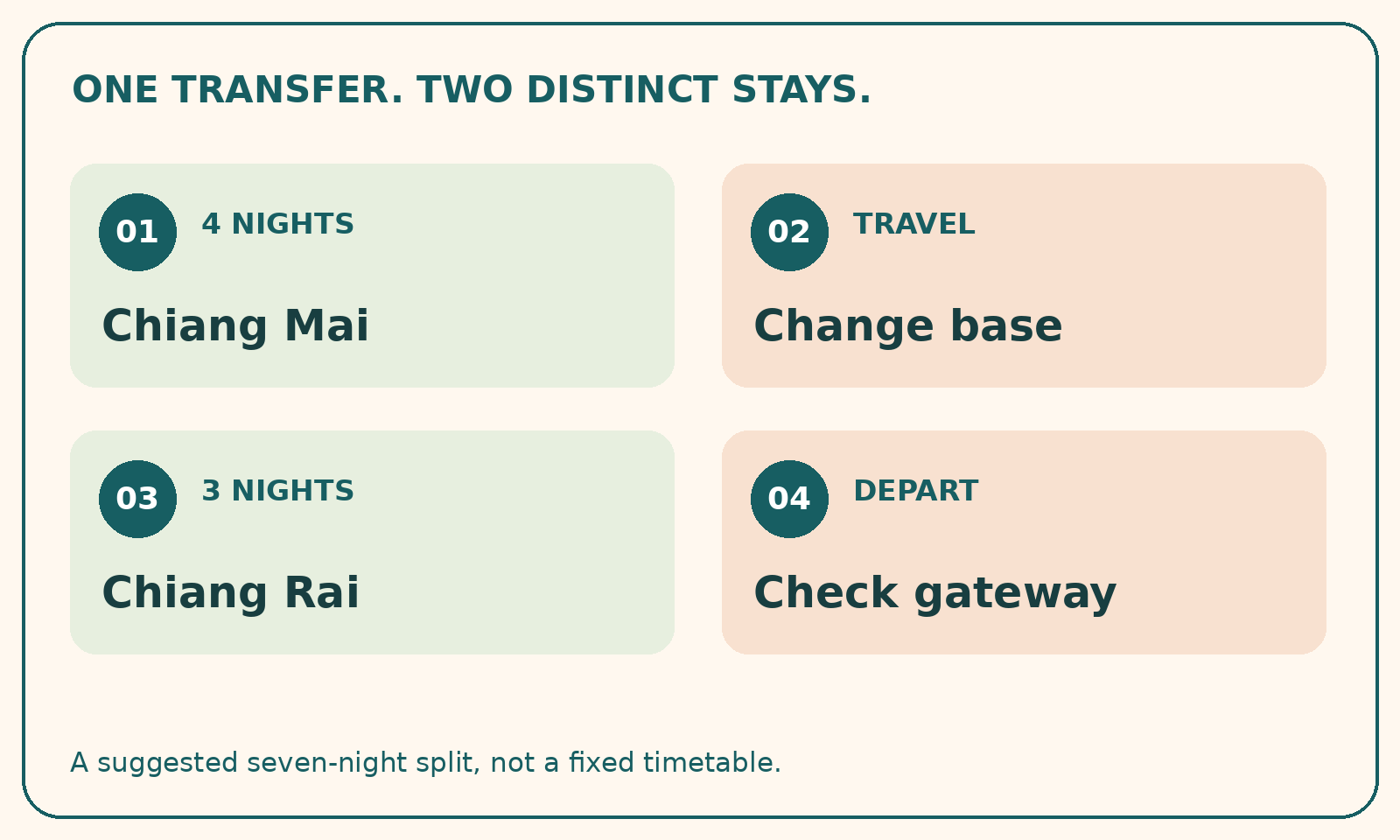
Seven nights: four in Chiang Mai, three in Chiang Rai
Begin with a city day, one distinctive excursion and a flexible day in Chiang Mai. Transfer in daylight without planning an essential attraction immediately after arrival. In Chiang Rai, separate the main art circuit from a wider provincial outing and retain enough room for an unhurried meal or hotel time.
Leave from Chiang Rai when the available onward itinerary makes sense. Otherwise, acknowledge the return journey to Chiang Mai as a separate travel commitment and protect the connection. A two-city route works best when it moves forward rather than repeatedly undoing its own progress.
Is a Chiang Rai day trip from Chiang Mai a sensible compromise?
It can work for a specific, informed priority
A long day tour is reasonable when you strongly want to see the White Temple, cannot change your hotels and understand the road commitment. A reputable organised product can coordinate the day more easily than trying to piece together local transport between dispersed attractions.
However, read the pickup and return expectations before deciding that it saves time. It may save a hotel change while costing a substantial amount of sitting and reducing time at each stop. That is a trade-off, not a free improvement to the itinerary.
An overnight is not automatically the answer either
One night gives more breathing room only when the arrival and departure arrangements leave usable time. Arriving late and leaving early can still produce a rushed visit with the added work of changing hotels.
My preference is either a consciously chosen long day for a particular site or at least two nights for a genuine Chiang Rai visit. Avoid the middle option when it gives you the disadvantages of both: a long transfer, luggage handling and almost no independent time in the destination.
The same principle applies in reverse. Chiang Mai is not well represented by a hurried temple stop on an out-and-back day from Chiang Rai. Visit it when you can enjoy the range of experiences that makes it the broader base.
Pros, cons and the mistakes that distort the choice
Chiang Mai: strengths and limitations
The strength is flexibility: a central stay can combine culture, food and several kinds of excursion. The limitation is that popularity does not make every area restful, every road easy to cross or every day trip close. You still need to choose the neighbourhood and activity level carefully.
Chiang Rai: strengths and limitations
The strength is a distinctive set of art and provincial attractions that rewards a focused visit. The limitation is the transport needed to connect them. A smaller urban centre does not eliminate driving, and a temple circuit alone should not be confused with experiencing the entire province.
Avoid these planning shortcuts
Do not select Chiang Rai solely because someone called it cheaper, or Chiang Mai solely because everyone else goes there. Avoid giving each city equal nights merely for symmetry. Check the airport code and the actual bus terminal on your ticket. Most importantly, do not transfer between cities simply to collect another destination name when your available time would be better spent staying put.
Reliable mobile data can make meeting points and hotel addresses easier to manage, but it is not a substitute for saving key information offline. Check device compatibility and plan coverage before buying an eSIM or a local SIM.
Three travellers who should make different choices
The first-time visitor with four nights and no fixed highlights
I would put all four nights in Chiang Mai. Start with a central hotel, one cultural morning and a shortlist of possible excursions rather than a prepaid activity every day. The spare time lets you respond to the weather and to what you discover you enjoy.
Chiang Rai remains an appealing future visit rather than an omission to repair immediately. The additional city would add packing, a road transfer and another arrival routine before you have exhausted the variety of the first base. For this traveller, the case for staying put is stronger than the case for collecting another famous photograph.
The art enthusiast with a convenient Chiang Rai arrival
Choose Chiang Rai confidently. Allocate one day to the principal art sites, research another specific interest and choose accommodation that makes the evenings convenient. You do not need to spend time in Chiang Mai merely to validate a northern Thailand trip.
A useful test is whether removing the White Temple and Baan Dam would change your excitement about the journey. If the answer is yes, those are meaningful priorities and deserve adequate time. By contrast, someone indifferent to those places should not choose Chiang Rai just because a comparison describes it as quieter.
The couple with a week and an onward flight from Chiang Mai
Both cities can work, but consider the order. Starting in Chiang Rai and finishing in Chiang Mai can remove the need for a last-minute return transfer before the onward flight, provided the initial arrival is practical. The quieter or more focused section does not have to come last.
Keep the same principle when the flights run the other way: make the route fit the confirmed gateways. A beautifully balanced split of nights is less valuable than arriving near the correct departure point with enough time. Arrange the overall route before booking individual excursions, which are usually easier to move than a flight.
Calculate usable hours before deciding to split
Nights are only a rough planning tool
Write down the likely hotel arrival time, the start of the intercity transfer and the time you need to leave for the final airport or station. Then mark the periods genuinely available for sightseeing. A two-night stay can contain a complete day and two useful half-days, or little more than one full day, depending on those timings.
Do not count the entire transfer day as available in both destinations. At most, choose a modest activity at one end, such as dinner or a short local walk. An attraction with a fixed entry session needs a larger margin than an optional cafe stop.
Preserve the activity you care about most
Place the essential experience on a complete day, not after a journey you cannot fully control. Keep a flexible alternative for the remaining time. This makes the comparison more honest: you are choosing between complete experiences rather than totals of attraction names.
For example, an art-focused visitor may get more value from an unhurried Chiang Rai day than from adding a distant viewpoint. A food-focused visitor may prefer an extra Chiang Mai evening to another hotel change. Neither is travelling less successfully. They are using the same limited hours in ways that match their interests.
Accessibility and comfort: compare the actual sequence of a day
Ask about more than a hotel’s lift
A room with lift access is only one part of the journey. Check the vehicle boarding height, the distance from parking to the attraction, toilet access and whether uneven ground or steps separate the main areas. A description such as ‘easy tour’ may refer to the walking distance rather than the practical accessibility of the route.
Chiang Mai’s ability to support shorter local outings can be useful, but do not assume every Old City pavement is suitable. Chiang Rai’s dispersed sites can be manageable with the right vehicle, but repeated boarding may itself be tiring. Choose the arrangement that reduces your particular difficulty rather than applying a general winner.
Give the group a shared definition of a good day
Agree how long you are comfortable travelling, how often you need a break and whether everyone wants to enter each site. A slower traveller should not be left without shade or facilities while the rest of the group completes an uncertain-length visit.
A private itinerary can help when these needs are important, but send the requirements before booking and ask for a specific answer. The useful benefit is control over the pace, not permission to add more stops. Paying for fewer, better-timed visits can be the more comfortable use of the same vehicle.
What to confirm in the final week before travelling
Recheck the parts that can change the decision
Confirm the actual bus or flight booking, the terminal or airport code, and the arrival arrangements at each hotel. Revisit the opening information for your priority attraction rather than assuming a general destination guide remains sufficient. Weather, operational changes and special events can alter what is practical on a particular day.
Keep the supplier’s contact details, the hotel address and the agreed pickup point saved together. You should not need to search several messages while standing beside a road with luggage. A little preparation protects the relaxed atmosphere you were trying to choose in the first place.
Change one component before abandoning the whole route
A closed attraction may justify substituting another local interest, not cancelling a city. Poor regional air quality or serious travel disruption can require a wider change. Distinguish those situations and follow official advice where safety is involved.
The purpose of comparing Chiang Mai and Chiang Rai is to create a holiday that works, not to defend an initial verdict after circumstances change. Keep the essential priorities clear and the less important details flexible. That is often a more useful advantage than choosing a nominal winner months in advance.
Chiang Mai vs Chiang Rai FAQs
Which is better for a first trip to Thailand?
Chiang Mai is my default recommendation because its range of city activities and excursions makes it easier to build a balanced short stay. Chiang Rai is the stronger choice when its particular art sites are a major personal priority. The recommendation changes with your interests; it is not a claim that Chiang Mai is objectively better in every category.
Can I comfortably see both in four days?
You can travel between them, but comfort depends on the gateways and how those four days are counted. Four days including international arrival and departure is very different from four complete days already in the north. For most short first visits, choosing one city creates a better ratio of enjoyment to transport.
Is Chiang Rai just the White Temple?
No. Its official destination information includes the Blue Temple, Baan Dam, gardens and wider provincial landscapes. Nevertheless, those attractions need a realistic route and time allocation. Moving beyond the White Temple does not mean they can all be covered thoughtfully in a single afternoon. [2]
Which destination is better without driving?
Both can be visited without self-driving. I favour a central Chiang Mai base for more independent local exploring, while Chiang Rai benefits from a pre-arranged sightseeing day. A shared tour or private vehicle can solve that practical issue, so the absence of a rental car is not a reason to rule Chiang Rai out.
Is there a train between Chiang Mai and Chiang Rai?
Do not plan the transfer around a direct passenger train. The established option for this comparison is the road journey, with GreenBus publishing services between the cities. Check the operator’s current timetable and the details on your ticket rather than relying on an automated search page’s list of transport modes. [10]
Should I fly between the two cities?
Compare a real available itinerary rather than assuming that two airports imply a convenient nonstop connection. A flight involving another city can take longer door to door than the road transfer. For this route, I would normally investigate the coach or a private vehicle first, then assess any flight that is genuinely available for your dates.
Which city is better for a quiet hotel stay?
Either can work, because the property and its immediate surroundings matter more than the city name. Decide whether you need to walk to restaurants, use hotel dining or arrange transport. A countryside retreat is most rewarding when you actually leave time to enjoy it rather than spend every day away on a tour.
Should I book both hotels before the transport?
Check the important transport options first, particularly your arrival and departure gateways. You can then reserve accommodation with terms that suit the level of flexibility you need. Avoid fixing an awkward split of nights and only afterwards discovering that the convenient onward service operates at a different time or from another airport.
My verdict: Chiang Mai first, Chiang Rai with a clear reason
For a first northern Thailand stay with limited time, I would usually choose Chiang Mai and organise the days around a compact base, varied meals and one well-chosen excursion. That gives you room to discover what you enjoy rather than committing the whole visit to a tightly controlled circuit.
Choose Chiang Rai when the art sites and a more focused provincial visit genuinely appeal, or add it when you have enough nights to transfer once without rushing. A good decision should make the itinerary simpler and more enjoyable. It does not need to prove that one city has defeated the other.
Sources and fact-checking notes
Research and editorial review completed on 6 October 2026. Tourism-authority pages identify places and their published facilities; operator pages describe the named products. Listed prices and opening information are dated snapshots, not guaranteed availability. Travel-time ranges, route choices and spending models are editorial planning judgements, not live quotations. Check current official advice, the attraction and the booking provider before travelling.
- 1.Tourism Authority of Thailand: Chiang Mai destination overview
- 2.Tourism Authority of Thailand: Chiang Rai destination overview
- 3.Tourism Authority of Thailand: Wat Phra That Doi Suthep
- 4.Tourism Authority of Thailand: Doi Inthanon National Park
- 5.Queen Sirikit Botanic Garden: official visitor attractions
- 6.Doi Tung: official tourism and garden information
- 7.FCDO: current Thailand travel advice and alerts
- 8.Airports of Thailand: Chiang Mai International Airport
- 9.Airports of Thailand: Mae Fah Luang-Chiang Rai Airport
- 10.GreenBus Thailand: official routes and booking information
- 11.FCDO: Thailand health advice and air quality
Illustrations in this article were created for Taylor’s Trailblazing Travels. Third-party photographs, where used, are credited beside the image or in the source list.