Top Things to Do in Chiang Mai in 2026
Temples, food, craft and nature, arranged around a stay you can genuinely enjoy.
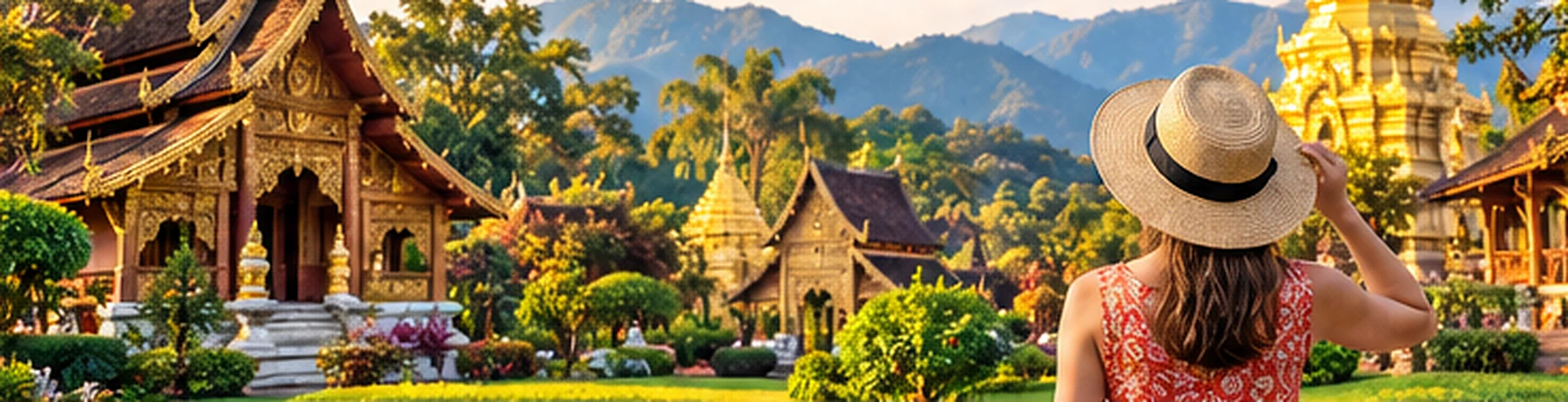
An original temple-scene illustration, not a photograph of the author or evidence of a personal visit.
The best things to do in Chiang Mai are easier to enjoy when you stop trying to give every temple, market and mountain the same amount of attention. A strong first visit usually needs a small cultural core, time to eat well, one activity you actively participate in and a single excursion that changes the setting.
This guide puts the city before the day tours. It includes places worth investigating, but also explains how to use them: when a guided visit adds value, which experiences need advance questions and what to leave out when time or energy is limited. Chiang Mai should feel like somewhere you have stayed, not simply the pickup point for a week of minibus departures.
The selection is based on official attraction information, current operator descriptions and research-led planning judgement. It is not a list of personal visits, and the order balances first-visit usefulness, variety and practical effort rather than claiming an objective ranking. Choose a handful of experiences that appeal to you, then use the suggested groupings to keep the route manageable.
Old City temples
Give a few contrasting places proper attention.
A suitable class
Learn a dish or a craft instead of only looking.
Doi Suthep
Keep the mountain temple outing measured and practical.
A day tour every day
Leave enough time to experience Chiang Mai itself.
Start with Wat Phra Singh rather than a ten-temple checklist
Give the first temple your full attention
Wat Phra Singh is one of the principal temples highlighted by TAT in Chiang Mai’s Old City. Use it as a starting point for understanding the city’s religious architecture, not as the first stop in a race between buildings. [1]
Look at the relationship between the main halls, courtyards and smaller details. A guide can explain what you are seeing, but independent visitors can also slow down, read available information and observe how people use the site. The practical difference is attention, not whether your visit is escorted.
Allow around an hour as an initial personal planning allowance, then adjust to your interest. Wear appropriate temple clothing, remove shoes where requested and avoid blocking worshippers while taking photographs. A small bag is easier to manage than carrying everything you own around the grounds.
Start early enough to leave room for a break before the next major stop. The goal is to leave remembering this temple clearly, rather than discovering at the end of the day that every courtyard has merged into the same image.
Explore Wat Chedi Luang for scale and context
Notice what makes it different
Wat Chedi Luang’s substantial historic chedi and central location make it a useful contrast to Wat Phra Singh. TAT also identifies the city-pillar association, but local access restrictions can apply to individual religious buildings within the complex. Follow the site notices rather than assuming admission means access to every space. [2]
This is a good place to ask a guide about the visible relationship between old structures, restoration and present-day religious life. You do not need to memorise a series of construction dates to appreciate that the site has changed over time.
Pair it with one nearby stop and lunch, not several distant attractions. A short distance on the map can still feel tiring when you are repeatedly walking in the heat and removing footwear at entrances.
For photographs, look for a position that shows the chedi’s scale without obstructing the main paths. Then put the camera away for a few minutes. The quieter details of a functioning temple are part of the visit, even when they do not produce the most dramatic picture.
Take a measured half-day to Doi Suthep
Visit the temple, not just the viewpoint
Doi Suthep adds a mountain setting to a Chiang Mai stay without requiring a full national-park day. Its golden chedi and Lanna architectural details are the lasting attraction; a clear view over the city is an additional benefit when conditions allow. [3]
I would allow four to six hours for a relaxed return outing from a central hotel, including a meal or nearby stop. This is a planning allowance reviewed on 6 October 2026, not a published tour schedule. Traffic, waiting and the chosen transport can change it.
Book or agree the return arrangement before heading uphill. A driver dropping you off is different from a driver waiting, and a shared vehicle may not leave exactly when you are ready.
Ask about stairs, lift operation and the route through the grounds when mobility is a concern. Do not assume a single mechanical lift makes the entire visit accessible. With young children, keep the morning focused and leave enough time for food and a rest afterwards rather than immediately adding another long journey.
Add Wat Pha Lat only when it improves the mountain day
Separate a temple visit from a trail walk
Wat Pha Lat can provide a forest-temple contrast on the Doi Suthep approach. However, there are two distinct ways to think about it: visiting the site by road, or making a walk part of the experience. Check the actual access and trail conditions locally before choosing the latter. [4]
The distinction matters for time and clothing. Temple-appropriate clothing should also allow comfortable movement when you are walking, and footwear needs to suit the surface rather than simply be easy to remove. During unsettled weather, a shorter road-access visit may be the more sensible option.
Treat the setting respectfully. Keep voices low, avoid entering closed areas and do not turn a religious space into a staging area for elaborate photographs. Someone already occupied with religious practice is not an attraction you are entitled to interrupt.
A paired visit with Doi Suthep works when you leave enough time for both. If you are already tired or the return is becoming rushed, remove the extra stop. A shorter, attentive temple visit is better than arriving with only enough time to take a picture and leave.
Use the city museum to make the rest of Chiang Mai more interesting
Choose the correct cultural centre
The Chiang Mai City Arts and Cultural Center on Phra Pokklao Road introduces the city’s development and local identity. It is not the same experience as a similarly named venue offering a northern dinner and performance. Confirm the address when booking transport. [5]
The Thai-language TAT listing gives Wednesday to Sunday, 08:30-16:30, checked on 6 October 2026. Because older English listings differ, confirm current operation directly before making this the centre of a particular day’s plan. [6]
Allow a manageable visit rather than expecting to read every display. A museum works particularly well early in a stay, when it can add context to places you will see later. It is also a useful alternative to another exposed outdoor stop, although you still need to travel between the hotel and the building.
For children, choose one question to investigate rather than requiring them to study every room. Adults with a stronger historical interest can stay longer. That makes the museum useful to different travellers without pretending everyone should spend the same amount of time inside.
Visit Wat Umong for a different temple atmosphere
Let the forest setting change the pace
Wat Umong is known for its wooded setting, tunnel-like structures and meditation association. TAT describes those features as part of a quieter religious environment. It offers a different experience from simply adding another central temple to an already busy walking circuit. [7]
Plan it as a deliberate western-side outing and check the map pin carefully, as temple names can recur. A visit to the grounds does not automatically include a meditation session. Anyone interested in a programme should establish the current schedule, expectations and booking requirements separately.
Keep the experience modest: walk slowly, respect restricted areas and leave space for people who are there for religious practice rather than sightseeing. Low-light spaces can be awkward for visitors who dislike enclosed areas, so there should be no pressure to explore every section.
This is a good choice when you want fewer attractions and more time within one setting. It is a weaker choice when you are merely trying to maximise a temple count. The atmosphere is the reason to go, not an item to complete as quickly as possible.
Make Wat Suan Dok a purposeful western-side stop
Check what you are coming to see
Wat Suan Dok sits on Suthep Road, outside the Old City’s central sightseeing cluster. TAT identifies it as a religious and historic site, which makes it a useful possibility when you are already planning a western-side day. [8]
Rather than attaching it to every itinerary, decide why you want to visit: religious architecture, a quieter pause or a particular programme whose current arrangements you have verified. Meditation and monk-conversation sessions, where offered, should never be assumed to run continuously or accept unannounced visitors.
Combine nearby interests sensibly and use transport when the roads between them are not pleasant to walk. The attraction being relatively close to another on a map does not prove that the connecting route is shaded, accessible or comfortable.
Keep some space around the visit. A meal or a cafe afterwards allows you to discuss what you have seen and breaks up the day. That is especially helpful for travellers who enjoy temples but do not want every hour of their holiday organised around them.
Explore Warorot Market as a place to understand everyday shopping
Look beyond the souvenir purchase
Warorot, also called Kad Luang, is associated with local foods, clothing and everyday shopping; nearby Ton Lam Yai adds another market setting. TAT’s descriptions make it a useful contrast to an evening walking-street visit. [9]
Go with a small set of interests: ingredients, packaged foods, textiles or the way different stalls are arranged. You do not need to buy at every stop. Ask permission before photographing a seller closely, and avoid obstructing people who are there to work or shop.
A food-focused guide can help explain unfamiliar ingredients and practical ordering choices. However, a walking visit is not a guarantee that every sample suits your dietary needs. Discuss allergies in advance and avoid treating translation alone as proof that cross-contact has been controlled.
Take a reusable bag and a realistic view of what you can carry. Before buying food to take home internationally, check the destination country’s import rules; something being sold legally in Chiang Mai does not establish that you can bring it into another country.
Choose the Sunday Walking Street for atmosphere, not solitude
Plan the evening around the market
Chiang Mai’s Tha Phae and Old City walking-street area is highlighted by TAT among the city’s visitor experiences. The main Sunday market is a different outing from visiting an ordinary street or shop on another day, so confirm that week’s arrangements locally. [10]
Give the evening a simple structure: arrive, explore a manageable section, eat when you find something suitable and leave before fatigue turns the crowd into the main memory. You do not have to walk every lane to have experienced the market.
A meeting point is useful for groups, and children need a clear plan for staying together. Keep valuables secure and avoid stopping suddenly in the busiest flow while using a phone. Transport pickups may be easier from an agreed point outside the pedestrianised area.
This is a stronger choice for people who enjoy a lively shared atmosphere than for those seeking a quiet shopping session. For a calmer craft-focused experience, consider a workshop or a market visit at a different time rather than deciding that the city itself is too busy.
Consider Wualai for a separate Saturday evening
Do not treat every market as interchangeable
Wualai’s Saturday walking-street tradition offers another way to organise an evening south of the Old City. Chiang Mai provincial public-relations information describes the Saturday market; confirm the current local arrangements because special events and weather can affect the evening. [11]
Choose it when the day and location fit your stay, not because you must attend both major weekend markets. Repeating a market evening can be enjoyable, but it should reflect genuine interest rather than the assumption that different names guarantee completely different experiences.
Eat at a pace that leaves room to explore. A crowded evening is a poor setting for lengthy decisions about dietary restrictions, so identify a reliable meal alternative before going. Small purchases, a little browsing and a comfortable exit plan can be enough.
When accommodation is nearby, ask about road access during the event. A hotel may be convenient for walking out to the market yet inconvenient for a vehicle pickup at the same time. That trade-off is easy to manage once you know about it and frustrating when discovered with luggage in hand.
Learn to cook something you will actually make again
Compare the class format before its dish count
A worthwhile cooking class should leave you understanding a few techniques rather than merely watching a demonstration. Ask whether you have your own station, which dishes are chosen, whether market time is included and how much of the session involves transport.
Thai Farm Cooking School’s half-day morning listing shows THB 1,200 per person, with a THB 1,000 promotion advertised until 21 October 2026 when checked on 6 October 2026. Its published itinerary includes a market visit, ingredients and individual cooking; confirm the price and inclusions for your date. [12]
The school states that it sells directly, not through GetYourGuide, Viator or similar marketplaces. Book that named school through its own contact page. The comparison link below is for other providers, not a booking route for Thai Farm Cooking School. [13]
State dietary needs before paying
An advertised vegetarian or gluten-free option is not automatically suitable for a serious allergy. Discuss ingredients, shared equipment and what the instructor can realistically accommodate. With children, ask about minimum age, knives, hot surfaces and whether a non-cooking parent needs a separate place.
Do not schedule a large meal immediately before a class that includes eating what you prepare. A smaller programme that you can enjoy comfortably may be better than the longest menu. The lasting value is confidence with ingredients and methods, not the number of bowls in a photograph.
Build a northern-food day around a few clear choices
Make curiosity more useful than a long restaurant list
Northern sausages, chilli relishes and unfamiliar market ingredients can provide a starting point for exploring the region’s food. TAT’s market information identifies several northern specialities, while a cooking school can explain how ingredients and techniques differ. Individual dishes and recipes vary, so ask rather than assuming every version tastes or contains the same things. [9]
Choose one substantial meal and a few small tastes across the day. That gives you space to compare flavours without spending the entire visit full or queueing. A guided food outing is useful when explanation and ordering support matter; otherwise, a carefully researched independent plan can work well.
Keep a fallback meal in mind for a child or companion with a narrow range of comfortable foods. Nobody needs to eat something unfamiliar at every sitting to participate in the holiday.
Do not equate a busy stall with guaranteed hygiene or a mild-looking dish with an absence of allergens. Practical questions and sensible food choices matter more than a confident claim that a particular style of eating is always safe.
Spend a deliberate afternoon in Nimman
Let the neighbourhood be an ordinary part of the stay
Nimmanhaemin is highlighted by TAT for contemporary Chiang Mai, local food and creative shopping. It is a useful contrast to the Old City’s temple-focused experience, but it does not need to become a separate checklist of famous cafes. [10]
Pick a cafe or shop you genuinely want to visit, then allow time to explore the surrounding area. A comfortable afternoon can include reading, writing postcards or planning the following day. Those are legitimate travel activities, not failures to maximise sightseeing.
Check the route between places before deciding to walk. Larger roads, crossings and the weather can make a short vehicle journey more sensible than following the shortest line on a map. If you are choosing accommodation here, consider the exact street and likely noise rather than relying on the neighbourhood’s general reputation.
Nimman works best for travellers who enjoy contemporary urban life alongside historic sights. Someone wanting constant tranquillity may prefer a different setting. The advantage is choice: Chiang Mai can include both a substantial cultural morning and an afternoon that requires very little effort.
Visit Jing Jai with the market calendar in mind
The weekend stalls and the wider complex are different
Jing Jai’s operator distinguishes its food, art, design and craft areas from the wider permanent businesses. The weekend farmers and handmade markets are listed for Saturday and Sunday, 06:30-15:00, checked on 6 October 2026. A weekday visit is therefore not the same product as the weekend market. [14]
Make it the anchor of a morning rather than squeezing it between distant attractions. Go for breakfast, browse the stalls that interest you and leave enough time to talk with makers where conversation is welcome. Do not describe it as a secret locals-only discovery: it is a visitor-friendly destination as well as a place used by residents.
Carry a bag and choose purchases for quality or usefulness rather than because the setting makes everything appealing. Fragile crafts also need a realistic packing plan.
This is a good option for people who enjoy food markets and independent design. However, travellers who dislike browsing may get more from a booked craft workshop, where the activity has a clearer beginning, purpose and outcome.
Try a craft activity instead of making every souvenir a shopping decision
Bo Sang is a practical place to investigate
TAT’s Bo Sang umbrella-making information describes demonstrations of construction and painting. That provides a useful starting point for a hands-on or observation-led craft outing east of the city, but the availability and content of a workshop should be confirmed directly. [15]
Ask what you will make, how long it takes, whether the activity is guided and how the finished item will travel. Drying time can matter when you are leaving soon afterwards. A small, well-made object can be a more practical souvenir than the largest umbrella in the display.
A driver may offer additional craft stops along the route. Choose those deliberately rather than accepting a long showroom circuit by default. Seeing a technique demonstrated is different from browsing a shop, and the trip description should make that difference clear.
For families or a rainy afternoon, a suitable workshop can be particularly rewarding because everyone has something to do. Nevertheless, ask about age suitability and materials; a generic craft label does not guarantee that a toddler can safely participate in the same activity as an adult.
Make the botanic garden your nature choice when plants are the attraction
Choose two or three areas rather than trying to finish it
Queen Sirikit Botanic Garden lists a canopy walkway, glasshouses, a nature museum and several trails on its official site. It is a coherent destination for plant interest and a change of setting, not simply an add-on between more adventurous activities. [16]
Ask about internal transport, gradients and current access to the part you most want to visit. A garden can involve more walking than its name suggests, and glasshouses do not remove the need to move outdoors between areas.
Choose a theme for the visit: contrasting plant habitats, looking closely at leaves or spending more time in one particular collection. That creates a more satisfying experience than rushing through every area to say you have seen it all.
Do not automatically combine the garden with a long circuit of mountain viewpoints, waterfalls and animal venues. A relaxed lunch and a good amount of time at the main attraction can provide a much stronger day. The remaining energy is useful when you return to Chiang Mai and still want to enjoy the evening.
Choose an elephant experience by its practices
Observation matters more than a reassuring name
World Animal Protection advises visitors to favour observation over riding, bathing or touching, and warns that labels such as sanctuary do not establish welfare standards. Apply that test to the exact programme, including anything bundled into a larger tour. [17]
For a named starting point, World Animal Protection’s current guide lists ChangChill View Doi and ChangChill Hillside among venues following its elephant-friendly guidelines, checked on 6 October 2026. Confirm the actual programme, visitor ages, transport and total price directly. An independent listing is useful evidence, but it does not remove the need to check current arrangements for the experience you are about to buy. [17]
Let the day be about learning
Expect observation and explanation, not a guarantee that animals will perform particular behaviours at the moment you arrive. Ask how close visitors are allowed, how guides manage space and whether any part of the itinerary involves direct contact.
Check the walking level and shade for your group, then leave the rest of the day reasonably clear. A wildlife visit should not be squeezed between several unrelated attractions. Choosing fewer activities can support the purpose of the experience as well as your own comfort.
Add one bigger excursion when you have enough time
Doi Inthanon for a full change of landscape
Choose the national-park day when highland scenery and a longer outing are priorities. Check the included trail and admissions, and distinguish a summit-and-waterfall circuit from a walking-focused programme. TAT notes that national-park attractions can close individually for seasonal or safety reasons. [18] [19]
Bua Tong for an active waterfall visit
The limestone waterfall is a different kind of nature day. Ask about the open route and recommended footwear, and keep climbing optional. The unusual rock surface is not a reason to ignore slippery patches or flowing water. [20]
Mae Kampong for a slower village outing
Choose this when a community setting, a walk and time over lunch appeal more than accumulating viewpoints. Confirm transport and the amount of time actually spent in the village; a long list of additional stops can undermine the slower experience you intended to book. [21]
You do not need all three excursions on a first visit. The strongest choice adds something missing from the rest of your stay and leaves enough time to enjoy Chiang Mai itself.
A three-day plan that does not make every day demanding
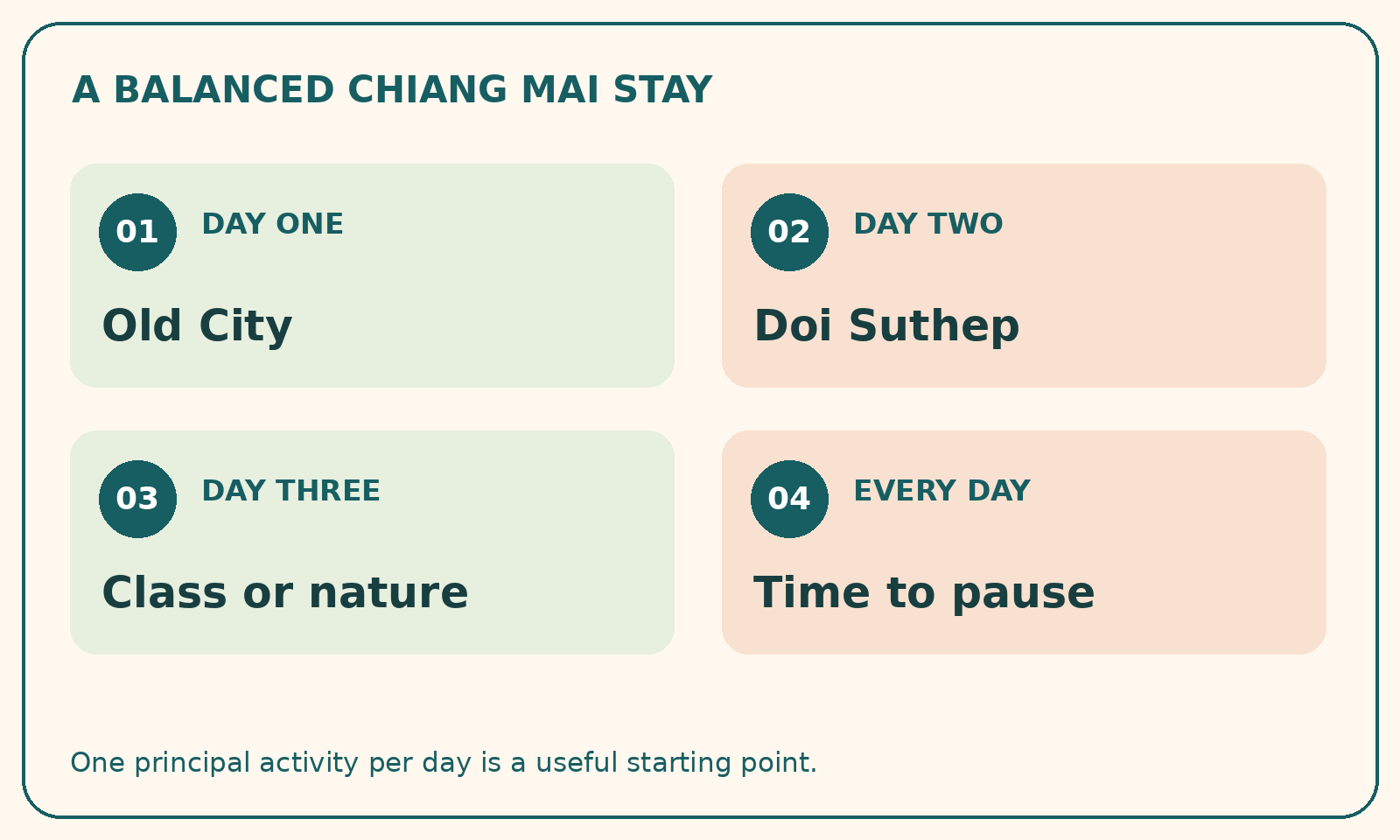
Day one: understand the Old City
Start with Wat Phra Singh and Wat Chedi Luang, allowing a break between them. Add the city museum when it is open and suits your interest; otherwise, keep the afternoon flexible. Choose a meal near the area you are already exploring instead of crossing the city for every restaurant recommendation.
In the evening, visit a suitable market if its schedule aligns. Otherwise, an ordinary dinner is enough. The first day should help you find your bearings and establish a comfortable pace rather than set a punishing standard for the rest of the stay.
Day two: mountain temple and a contrasting afternoon
Reserve the first part of the day for Doi Suthep, with Wat Pha Lat only when the route and energy level suit. Return for lunch or a rest, then choose Nimman, a food interest or another low-effort activity. Do not attach a full cooking programme to the afternoon without checking its actual timing.
Day three: participate or travel, but do not overfill both
Choose a cooking or craft class if you prefer an active city-based experience. Alternatively, use the day for one substantial nature outing. Trying to include a full day trip, a workshop and an evening food tour turns three individually appealing activities into an awkward schedule.
This plan assumes three usable days, not three calendar dates including a late arrival and early departure. Reduce it accordingly. A longer stay can add a garden visit, another neighbourhood or a second outing, but there is no requirement to fill every extra day with another major purchase.
Costs and booking: know which numbers are quotations
Keep daily spending separate from major experiences
These are constructed planning allowances prepared on 6 October 2026, not live quotations or city-wide averages. They exclude accommodation, intercity transport and any expensive specialist experience. Replace them with your selected supplier’s total before paying.
| Day style | Per-adult working allowance | Main reason it varies |
|---|---|---|
| Independent temple-and-market day | THB 600-1,200 | Meals, local transport and admissions |
| Class-focused day | THB 1,200-2,500 | Class length, transport and other spending |
| Shared full-day nature excursion | THB 1,500-3,000 | Park fees, guide, meals and group size |
| Private guided city day | Obtain a party-specific quote | Vehicle, guide, hours and entrance charges |
On a small screen, swipe the table sideways. Any cost ranges are dated planning examples unless explicitly identified as a named supplier price.
A published operator price earlier in this guide applies to that named product and review date. Do not use it to imply that every similar experience has the same cost or inclusions.
Pay for the problem a guide actually solves
A guide can add historical context, explain food or coordinate a dispersed route. An independent walk may be better when you want control over the pace and already know what interests you. The question is not whether tours are good or bad; it is what assistance you need for that particular day.
For a cycling outing, check the road environment, distance, equipment, guide arrangements and your insurance rather than assuming a guided route is automatically easy. Avoid learning to ride confidently in traffic during your holiday.
Getting around and choosing a useful base
Group the day geographically
The Old City, western-side sites, eastern markets and rural excursions are different route groups. Place nearby interests together and avoid returning across the city several times merely to follow a ranked list in order. A lower-ranked activity near your current location may be the better practical choice.
Choose accommodation by the days you expect to have. A central base can support short returns for a rest; an outlying hotel may be ideal for relaxation but add transport to every meal and activity. Read tour pickup-zone wording before booking a resort for a stay dominated by excursions.
Keep arrival day lighter than a full sightseeing day
Check your actual arrival point and leave time for reaching the hotel, eating and settling in. An overnight train or long bus trip does not guarantee useful sleep, even when it saves a hotel night. Avoid a non-refundable early tour immediately after arrival.
Store your hotel address and pickup details offline. Mobile data can help with maps and contacting a provider, but it should support a plan rather than replace one. Confirm that an eSIM works with your device and that the selected package covers Thailand before purchasing.
Weather, air quality and responsible choices
Match the activity to the conditions
FCDO health advice notes that Chiang Mai can be affected by seasonal smoke haze and poor air quality. Check current conditions before strenuous outdoor plans, especially when anyone in the group has a respiratory condition. A mountain viewpoint is not a guaranteed clean-air alternative. [22]
Rain also affects different activities differently. A market or workshop may remain practical when a distant panorama is unappealing; a waterfall closure or serious weather warning requires a change of plan. Current FCDO advice on 6 October 2026 included severe flooding affecting parts of Thailand, so confirm any relevant access and onward transport. [23]
Keep animal welfare and community respect in the itinerary
Decline wildlife experiences built around performances or close-contact photographs. In villages and markets, ask before photographing people, support businesses you genuinely use and avoid blocking working spaces. At temples, follow the rules of the individual site rather than treating a general dress guide as permission to ignore local instructions.
Also check official event arrangements before purchasing a festival package. A lantern image in an advertisement does not establish that an activity is permitted at a particular location or on your date. Book the documented event, not an atmosphere suggested by a promotional picture.
Pros, cons and common mistakes
What Chiang Mai does particularly well
The city supports a varied stay without requiring a new hotel every night. Temples, markets, participatory classes and rural outings can be combined at a pace that suits you. That flexibility is most valuable when you use it to choose fewer, better-matched experiences.
What needs more planning than the photographs suggest
Mountain roads take time, markets operate on different schedules and a calm-looking temple can still involve steps and walking. Air quality and weather can change the value of outdoor plans. None of those issues makes Chiang Mai a poor choice; they make a realistic itinerary important.
Avoid the overfilled version of the city
Do not schedule a different distant excursion every day and then wonder why you have barely seen Chiang Mai. Check whether a cooking class includes a substantial meal before booking dinner. Avoid treating a weekday visit to a market complex as equivalent to its weekend stalls. Finally, leave a margin between rural tour returns and flights, trains or fixed evening events.
Adapt the shortlist to the holiday you actually have
A single day in Chiang Mai
Choose the Old City as the main focus and add one contrasting experience, not three separate excursions. Two temples, a good meal and a market or museum make a coherent day. Doi Suthep can replace part of that plan when the mountain temple is your priority, but it should not be treated as a free addition requiring no time.
Leave the largest day trips for a longer stay. You gain little by visiting Chiang Mai for one day and spending most of it travelling away from the city. A deliberate shortlist gives you a clearer impression than a route organised around hurried photographs.
A weekend with food and craft interests
Place Jing Jai on a morning when its weekend stalls are operating, then keep the afternoon lighter. Choose one evening walking street rather than assuming both are compulsory. A craft activity on another day adds participation to the browsing and gives the stay more variety.
Check workshop timing before arranging transport, particularly when the finished item needs drying or collection later. Keep enough baggage space for anything fragile, and ask about protective packaging before paying. A beautiful purchase is less enjoyable when it becomes a problem for the rest of the journey.
A return visit after you have seen the main temples
Choose depth rather than repeating the standard circuit out of habit. Investigate a particular collection at the botanic garden, book a class that teaches a technique you want to learn, or spend time in a neighbourhood you previously rushed through. Returning to one favourite place can be worthwhile when you give it a different amount of attention.
You can also leave more of the stay unplanned. That does not mean abandoning preparation: know your transport, keep current conditions in mind and identify the essential opening details. The freedom comes from removing unnecessary commitments, not from assuming everything will always be available.
A travelling companion who needs more breaks
Make one activity the shared centre of the day and agree on any optional extra in advance. A cafe or garden bench is a useful pause only when it is comfortable, accessible and close to a clear meeting point. Avoid leaving someone waiting indefinitely while the rest of the group completes an unknown-length visit.
Shorter programmes and a well-positioned hotel can matter more than reducing the total number of nights. Build the itinerary around the slowest comfortable pace, then enjoy the spare time rather than immediately filling it. A holiday that everyone can sustain is more successful than one that looks impressive only on paper.
Things to do in Chiang Mai FAQs
What should I do on my first morning?
Choose a compact Old City route with one or two important temples and a proper break. It is an easier way to find your bearings than beginning with a long pickup circuit. Add the museum when it is open and you enjoy context, then let the afternoon reflect your energy rather than a rigid attraction quota.
How many temples are enough for a first visit?
There is no correct total. Two well-chosen Old City temples and Doi Suthep can provide useful contrast for many visitors. Someone particularly interested in religious architecture can add more, while another traveller may prefer to use the time for food or a craft class. Stop when the visits cease to feel distinct.
Is a cooking class suitable for children?
It can be, but check the particular class’s minimum age, workstation arrangement, supervision and approach to knives and heat. Ask whether a younger child participates, observes or needs a separate booking. A family-friendly description is a starting point for questions, not confirmation that every programme suits every age.
Can I explore Chiang Mai without a scooter?
Yes. Walking within a sensible local area, using pre-arranged transport and choosing organised excursions can cover a first stay. You do not need to learn scooter riding to enjoy the city. Compare the cost of suitable transport with the practical risks and licensing requirements rather than treating a scooter as the default solution.
Which market is best when I only have one visit?
Choose by timing and interest. Warorot is useful for everyday shopping and local foods; Jing Jai’s weekend market suits food and craft browsing; the major evening walking streets offer a livelier atmosphere. Check the current schedule and select the experience you enjoy rather than travelling far to attend every market.
Is Chiang Mai worthwhile during a rainy period?
It can be, particularly when your interests include food, workshops, museums and a flexible pace. However, rain is not always a minor inconvenience: closures, flooding and unsafe road conditions require appropriate changes. Keep a genuine alternative to your main outdoor activity and follow current official information.
Should I include Chiang Rai as a day trip?
Only when you understand the long road commitment and have a specific attraction priority. It is not a relaxed extension of a Chiang Mai city day. With enough nights, a separate Chiang Rai stay offers more flexibility; with limited time, enjoying Chiang Mai properly is often the stronger decision.
What is the most useful thing to book early?
Reserve anything with limited places, a particular instructor or a date that cannot move, while checking cancellation terms. Keep more weather-dependent choices flexible where possible. The best booking order protects the experience you care about most without committing every day to a fixed programme before you arrive.
My recommendation: choose a cultural core and one personal highlight
Build your first Chiang Mai stay around a few places that help you understand the city, then add an activity you actively look forward to. That might be learning a dish, exploring a garden, observing elephants responsibly or spending time with a craftsperson.
Give those choices enough room. A worthwhile visit includes meals, breaks and the freedom to return somewhere you like. The city has more than enough attractions; the skill is selecting the ones that make your own holiday feel coherent rather than trying to prove you completed the longest list.
Sources and fact-checking notes
Research and editorial review completed on 6 October 2026. Tourism-authority pages identify places and their published facilities; operator pages describe the named products. Listed prices and opening information are dated snapshots, not guaranteed availability. Travel-time ranges, route choices and spending models are editorial planning judgements, not live quotations. Check current official advice, the attraction and the booking provider before travelling. Where the museum's language editions disagree, that difference is identified in the article. The named cooking school's direct-booking policy is kept separate from alternative marketplace classes.
- 1.Tourism Authority of Thailand: Wat Phra Singh, Chiang Mai
- 2.Tourism Authority of Thailand: Wat Chedi Luang
- 3.Tourism Authority of Thailand: Wat Phra That Doi Suthep
- 4.Thailand Tourism Directory: Wat Pha Lat (visitor listing)
- 5.Tourism Authority of Thailand: Chiang Mai City Arts and Cultural Center
- 6.Tourism Authority of Thailand: city museum Thai-language opening information
- 7.Tourism Authority of Thailand: Wat Umong
- 8.Tourism Authority of Thailand: Wat Suan Dok
- 9.Tourism Authority of Thailand: Warorot Market
- 10.Tourism Authority of Thailand: Chiang Mai walking-street overview
- 11.Chiang Mai Provincial Public Relations: Wualai Saturday market
- 12.Thai Farm Cooking School: half-day morning programme and published prices
- 13.Thai Farm Cooking School: direct-booking policy and contact
- 14.Central Group: Jing Jai Market zones and weekend schedule
- 15.Tourism Authority of Thailand: Bo Sang Umbrella Making Centre (Thai)
- 16.Queen Sirikit Botanic Garden: official visitor attractions
- 17.World Animal Protection: elephant-friendly visitor guidelines
- 18.Tourism Authority of Thailand: Doi Inthanon National Park
- 19.TAT Newsroom: 2026 seasonal opening and closure of national-park attractions
- 20.Tourism Authority of Thailand: Bua Tong waterfall and mineral spring
- 21.Tourism Authority of Thailand: Mae Kampong community information (Thai)
- 22.FCDO: Thailand health advice and air quality
- 23.FCDO: current Thailand travel advice and alerts
Illustrations in this article were created for Taylor’s Trailblazing Travels. Third-party photographs, where used, are credited beside the image or in the source list.