12 Best Day Trips from Chiang Mai in 2026: Mountains, Waterfalls and Northern Towns
Twelve worthwhile escapes, with enough time left to enjoy the day.
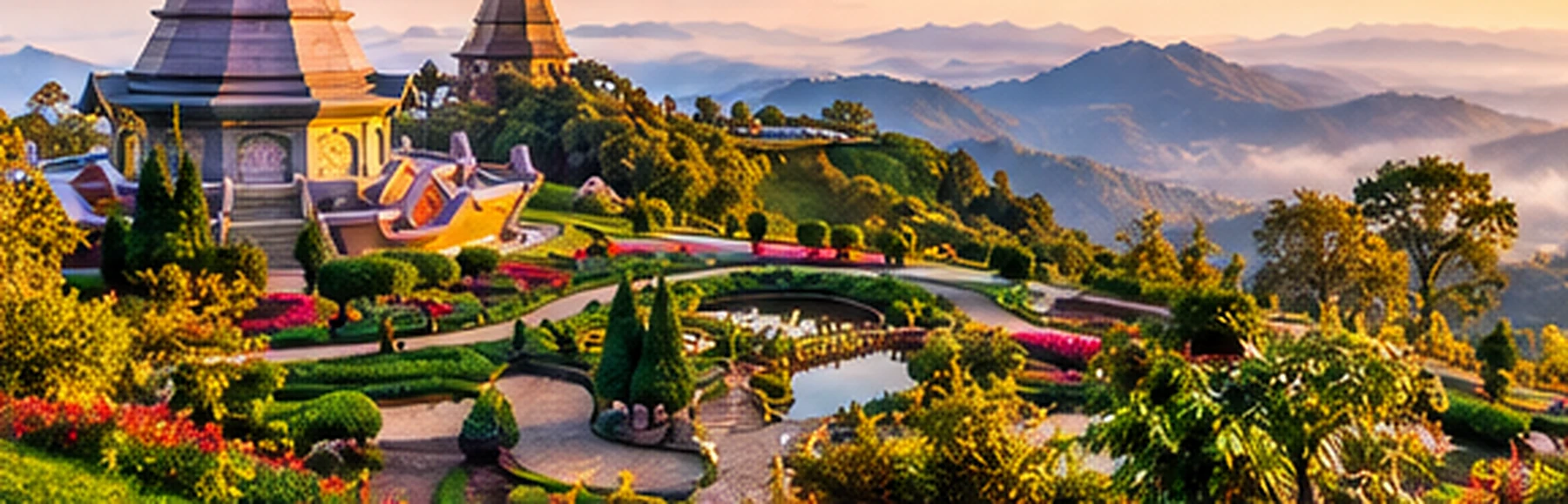
An original highland-garden illustration inspired by northern Thailand, not a route map or a record of a visit.
The best day trips from Chiang Mai are not necessarily the journeys that cover the most ground. A waterfall morning with time for lunch can be more rewarding than a minibus circuit that squeezes five provinces into daylight. The useful question is what you want your day to feel like: mountain air, an active few hours, a slower town, or a properly considered wildlife visit.
This list prioritises a worthwhile experience relative to the travelling involved. Doi Inthanon leads for variety, while nearby Doi Suthep is the simplest mountain-and-temple combination. However, Lamphun is a strong alternative when you would rather explore another northern town than spend the afternoon on twisting roads.
The ranking is research-led editorial judgement, not a survey or a record of personal visits. I compared official destination information, current operator descriptions, geographical groupings and the effort required from a central Chiang Mai base. Travelling times below are deliberately broad planning allowances, not promised pickup-to-drop-off schedules. Choose one main outing, then add a nearby stop only when it improves that outing.
Doi Inthanon
Choose the trail and walking level before the rest of the stops.
Doi Suthep
A shorter outing can leave a useful afternoon back in the city.
Lamphun
A smaller-town visit without the long haul to Chiang Rai.
One clear purpose
Add a nearby stop only when it improves the main outing.
Doi Inthanon: a highlight of day trips from Chiang Mai
Go for the change of landscape
Doi Inthanon combines highland forest, waterfalls and the royal pagoda gardens rather than one single summit view. TAT identifies it as Thailand’s highest mountain destination. The attractions are spread along a climbing road, so reaching the park does not mean you have reached every stop. [1]
Allow roughly two to three hours each way from a central hotel to the upper sightseeing areas, and about nine to eleven hours for the outing. These are planning allowances reviewed on 6 October 2026. A summit-and-waterfall tour and a substantial guided walk are different products, even when both use the same mountain name.
Choose the walking commitment first
For a gentler visit, prioritise a short forest section, the gardens and one waterfall viewpoint. For a walking-focused day, reduce the number of roadside stops. Ask which trail is actually included, whether guiding and admissions are additional, and what replaces the walk during a closure.
Kew Mae Pan is seasonal; do not assume an October booking includes an open ridge trail. National-park closure dates depend on the individual attraction and conditions, so check the current park notice rather than treating an old annual calendar as permission to enter. [2]
A fleece and light waterproof earn their place even when Chiang Mai feels hot. Conversely, a dramatic sunrise departure is poor value for someone who dislikes early starts and mainly wants lunch, gardens and an unhurried walk.
Doi Suthep and Wat Pha Lat: the easiest mountain escape
Keep the temples at the centre of the day
Wat Phra That Doi Suthep offers a golden chedi, temple courtyards and views towards Chiang Mai when visibility cooperates. TAT lists a foreign-adult temple admission of THB 30, checked on 6 October 2026; transport and any lift charge are separate. [3]
My suggested allowance is four to six hours from the city, including both temples and a meal. Wat Pha Lat works as a quieter forest-temple stop on the mountain approach. However, do not confuse visiting it by road with walking the Monk’s Trail: the latter changes the footwear, effort and weather requirements of the excursion.
Book the return, not just the climb
A taxi drop-off is not automatically a return arrangement. Agree whether the driver waits, where you will meet and how much additional waiting costs. Shared transport may involve waiting for other passengers, so leave a little flexibility before any evening reservation.
Wear clothing suitable for a working religious site, carry socks or footwear that can be removed easily, and follow local signs about photography. The accessible option is also worth checking individually: a lift does not establish that every courtyard, toilet or vehicle boarding point is step-free.
Choose this trip over a distant national park when you have only a couple of days in Chiang Mai. You still get a clear change of setting without sacrificing the entire day to travel.
Bua Tong: a waterfall visit with an active element
Understand what makes it different
Bua Tong, often called the Sticky Waterfalls, has mineral-rich water flowing over pale limestone formations. The calcium-carbonate deposits explain its unusual appearance; they do not make every surface safe to climb. The government tourism directory currently lists no admission charge, checked on 6 October 2026. [4] [5]
Allow around one to one and a half hours each way by road as an initial planning allowance. A half-day is usually a better starting point than combining it with several distant attractions. Add time for changing clothes, using the toilets and eating before returning to town.
Treat the climb as optional
Follow the open route and staff instructions. Algae, mud, flowing water and changes in gradient can all make a section unsuitable. Someone in your group should be able to enjoy the forest setting without being pressured into climbing for a photograph.
Check the provider’s footwear guidance before packing water shoes, because the preferred approach can depend on the actual climbing area. Keep a dry change of clothes separate from phones and medication. Children need close supervision rather than confidence borrowed from the word ‘sticky’.
This is my pick for travellers who want to do something physical without committing to a long trek. However, it is not the right substitute for a swimming pool, and a heavy-rain warning is a reason to change plans rather than test the conditions yourself.
Mae Kampong: a village day rather than a photo-stop race
Make room for the village itself
Mae Kampong is a mountain-community destination east of Chiang Mai, in Mae On district. TAT highlights its community and homestay appeal rather than describing it simply as a roadside attraction. [6] [7]
Budget roughly one and a half to two hours each way, allowing more for busy approaches. Once there, a slow walk, lunch and a modest amount of cafe time make a coherent day. A programme that lists the village, several viewpoints, waterfalls, a hot spring and another town may leave surprisingly little time here.
Spend with consideration
Choose somewhere you genuinely wish to eat or drink rather than occupying a small terrace solely for photographs. Ask before photographing residents, private homes or work in progress. If a lane is busy, step aside rather than assuming pedestrians have exclusive use of it.
The village’s slopes and uneven surfaces also matter. A destination can be peaceful in atmosphere while still being demanding for a pushchair or someone with limited walking tolerance. Request practical details from the provider rather than accepting ‘suitable for everyone’.
Mae Kampong is strongest for travellers who enjoy small discoveries and can accept ordinary village activity alongside visitors. For people wanting a large, uninterrupted mountain panorama, a viewpoint-led outing is a more direct match. Keep that distinction clear when choosing between this trip and Mon Cham.
Chiang Dao: limestone scenery without a summit expedition
Keep the cave and the mountain separate
The cave at Chiang Dao sits at the foot of the limestone mountain landscape and includes a temple setting. TAT describes its stalactites and stalagmites, while its separate mountain-trekking guidance makes clear that a summit expedition involves permits and preparation. A cave day is not a shortcut to that trek. [8] [9]
Allow about one and a half to two hours each way from Chiang Mai, then protect several hours for the area itself. The point is to enjoy the landscape and one or two stops, not drive north purely to tick off a cave entrance.
Decide how far underground to go
Ask which sections are open, whether a guide is required and what the ground is like. Dim lighting, low passages and slippery surfaces can change a visit that looked straightforward in a photograph. Nobody needs to continue into an uncomfortable section to justify the journey.
A comfortable alternative is a limited cave visit followed by lunch with a mountain backdrop and time in the surrounding area. Arrange the return transport before leaving the city; passing traffic is not a reliable plan for getting home.
This trip suits independent-minded travellers who prefer a less tightly programmed day. However, a substantial cave exploration and a remote hike should not be improvised during heavy rain. Choose the clearly managed visitor experience, and treat any additional walking as a separate decision.
Lamphun: the best smaller-town cultural outing
Give one temple enough attention
Lamphun provides a change of town without the travel commitment of Chiang Rai. Wat Phra That Hariphunchai is the obvious anchor, with a large golden chedi and a central setting. TAT’s listing shows THB 20 admission, checked on 6 October 2026; treat the on-site notice as the final authority. [10]
Plan roughly forty-five to ninety minutes each way, depending on the route and vehicle. Around the temple visit, leave room for lunch, a short walk and a shop selling something made locally. This is a cultural half-day or easy full day, not an attraction marathon.
Separate the train journey from local transport
A train can make the journey part of the interest, but the station is not the temple gate. Check the actual outward and return departures, the time needed to reach the station, and your last practical alternative home before committing.
For a small group, a driver can simplify the day without requiring a long list of add-ons. Ask for Lamphun itself rather than a combined Lamphun-and-Lampang circuit unless you actively prefer a faster pace.
The strongest reason to choose Lamphun is contrast. After several Chiang Mai temple visits, another city might sound repetitive; a slower rhythm, different layout and attention to one important site can make it feel quite different. Go with curiosity rather than expecting a miniature version of Chiang Mai’s visitor centre.
Queen Sirikit Botanic Garden: plants before adrenaline
Choose a garden day on its own merits
The Queen Sirikit Botanic Garden’s official site lists a canopy walkway, glasshouse complex, nature museum and several plant-focused walking areas. Those offer different experiences within one destination, rather than requiring repeated transfers between unrelated attractions. [11]
Allow roughly an hour to an hour and a half each way as an initial planning allowance, then choose two or three areas to explore. A large garden should not be assumed to be a flat walk: ask how visitors move between sections and whether internal transport is operating.
Build in a weather alternative
The glasshouses provide a different focus when a distant mountain view is unpromising. Nevertheless, access between buildings can still involve outdoor walking, and a canopy attraction can close for operational or weather reasons. Confirm it specifically when it is your main reason for going.
For children, set a simple challenge such as finding contrasting leaf shapes or comparing dry-climate and tropical plants. That often works better than expecting sustained enthusiasm for every botanical label. Adults interested in plants may prefer fewer stops and more time reading.
This is a useful Mae Rim choice when your group wants nature without rafting, animal performances or a strenuous trek. Combine it with a nearby lunch rather than automatically adding a full mountain loop. The value comes from looking closely, not from claiming to have completed the entire site.
Mon Cham: a viewpoint-led day in the Mae Rim hills
Go when the view is worth the climb
Mon Cham sits in the Nong Hoi highland area, with gardens, agricultural scenery and mountain viewpoints. TAT identifies the surrounding community and Royal Project setting. However, its older driving-time wording should not be treated as a reliable hotel-to-viewpoint estimate today. [12]
Allow approximately one and a half to two hours each way, with extra margin around busy periods. The best version is a measured viewpoint-and-lunch outing, not a guarantee of cloud inversions or flower fields looking exactly like a particular social-media picture.
Check what the named stop includes
Businesses and photo areas can have separate entry rules, menus and parking arrangements. Ask where the tour actually stops and how long you have there. A description saying ‘Mon Cham’ may cover quite different locations on the same hillside.
Choose a driver confident on the local roads, and avoid a late descent when the group is already tired. If visibility is poor, the botanic garden may offer a stronger use of the day because its main interest is not dependent on seeing distant hills.
This is a better match for scenery-focused travellers than for those wanting a long, quiet wilderness walk. The distinction matters: pleasant highland tourism can still involve cafes, parked vehicles and other visitors. Treat those as part of the experience, not evidence that your day has somehow failed.
ChangChill: investigate an observation-led elephant day
Choose the programme using current welfare information
World Animal Protection’s current elephant-friendly guide lists ChangChill View Doi and ChangChill Hillside among venues following its observation-led guidelines, checked on 6 October 2026. Use those named listings as a starting point, then confirm the exact programme, location and visitor arrangements directly. [13]
A meaningful elephant day needs time for explanation and observation. It should not be judged by how many photographs you obtain beside an animal. World Animal Protection recommends experiences without riding, bathing or touching, and warns that sanctuary-style names alone do not demonstrate good welfare. [13]
Keep the booking route transparent
Follow the official operator details from the independent listing and ask for the current programme and total price. A marketplace result for ‘elephant sanctuary Chiang Mai’ is not proof that the operator is ChangChill, nor proof of an equivalent welfare approach.
Ask about walking distance, shade, transport, footwear and arrangements for children before paying. A non-participating child may still need a booked place, and reduced admission does not automatically mean a programme suits that child. Confirm the meeting point and whether the hotel is inside the pickup area.
I would leave the rest of the day clear. A rushed wildlife visit followed by another major attraction works against the reason for choosing an observation-led experience. Also accept that natural animal behaviour is not a timetable: river bathing, particular group movements or close views cannot sensibly be promised. Independent welfare information can change, so recheck it before booking rather than treating this shortlist as a permanent endorsement.
San Kamphaeng and Bo Sang: make one coherent eastern loop
Combine different interests along one direction
San Kamphaeng Hot Springs offers designated soaking facilities and gardens, while Bo Sang is associated with umbrella-making demonstrations and painted craftwork. They can complement one another as an eastern outing, but they are separate stops rather than two names for the same place. [14] [15]
TAT lists hot-spring admission at THB 100 for foreign adults and THB 50 for foreign children, checked on 6 October 2026. Baths, activities or products may cost extra. Ask which facilities are included before comparing that admission with an organised tour’s total.
Be selective about workshops
Request one workshop you actually want to see. A driver-led craft circuit can otherwise turn into a sequence of shopping stops, each with an introduction and a showroom. Watching an artisan work is worthwhile; feeling obliged to buy something at every stop is not.
At the hot springs, keep children away from the source water and use only designated visitor facilities. Do not infer a safe bathing temperature from the word ‘spring’, or repeat promotional claims that a soak will treat a medical condition.
This outing works particularly well when your group has mixed interests: one person enjoys craft, another likes gardens, and nobody wants a long hike. However, adding Mae Kampong as well can remove the relaxed character. Choose the village day or the craft-and-springs loop as the main event.
Lampang: worthwhile when you want a full cultural day
Distinguish the city from the outlying temple
Wat Phra That Lampang Luang is in Ko Kha, not a short walk from central Lampang. The Dhanabadee Ceramic Museum is a separate city-area stop with scheduled guided visits. These distinctions matter more than an impressive list of attractions. [16] [17]
Allow approximately two to two and a half hours each way by road, and plan for a full day. Choose the major temple plus either a ceramics visit or time in town. Trying to include everything makes the journey feel like a sequence of parking spaces.
Decide whether an overnight is better
A day trip makes sense when your Chiang Mai accommodation is fixed and you have a clear reason to visit. An overnight is more attractive when you enjoy quieter evenings, want to investigate ceramics properly, or are already continuing south.
For a museum visit, establish the language and start time of the tour, not just the building’s opening hours. Otherwise, you can arrive during the day and still wait for the experience you intended to book.
Lampang ranks below Lamphun here because of travel effort, not because it is less interesting. Travellers particularly drawn to Lanna architecture or ceramic production could reasonably reverse that order. That is the point of a useful shortlist: match the destination to your interest rather than treating the ranking as a competitive league table.
Huay Tung Tao: the uncomplicated lakeside option
Let a quiet afternoon be enough
Huay Tung Tao is a reservoir in the Mae Rim area with a scenic shoreline and places to eat. It is best understood as an easy change of setting rather than a replacement for a mountain expedition or national-park hike. [18]
Plan roughly thirty to sixty minutes each way from central Chiang Mai and leave the precise length of the visit flexible. A lakeside meal and a modest walk can be sufficient. The advantage is that you do not need to manufacture a full day of activities to justify the journey.
Avoid making assumptions about the water
A pleasant shoreline does not establish safe swimming conditions, lifeguard provision or water quality. Treat any water activity as a separate decision requiring current information, suitable equipment and supervision. Families can enjoy the setting without entering the water at all.
Check the menu before settling into a restaurant area, and clarify any charges or minimum order that apply to your chosen seating. Small practical questions prevent an inexpensive-looking outing from becoming awkward later.
This is my recovery-day choice after a demanding tour. It also suits a group whose interests do not align perfectly, because lunch and conversation can be the main activity. Conversely, someone expecting a major attraction may be happier spending the afternoon at the botanic garden or giving another Chiang Mai neighbourhood more time.
How to choose two day trips without repeating yourself
Match the second day to the first
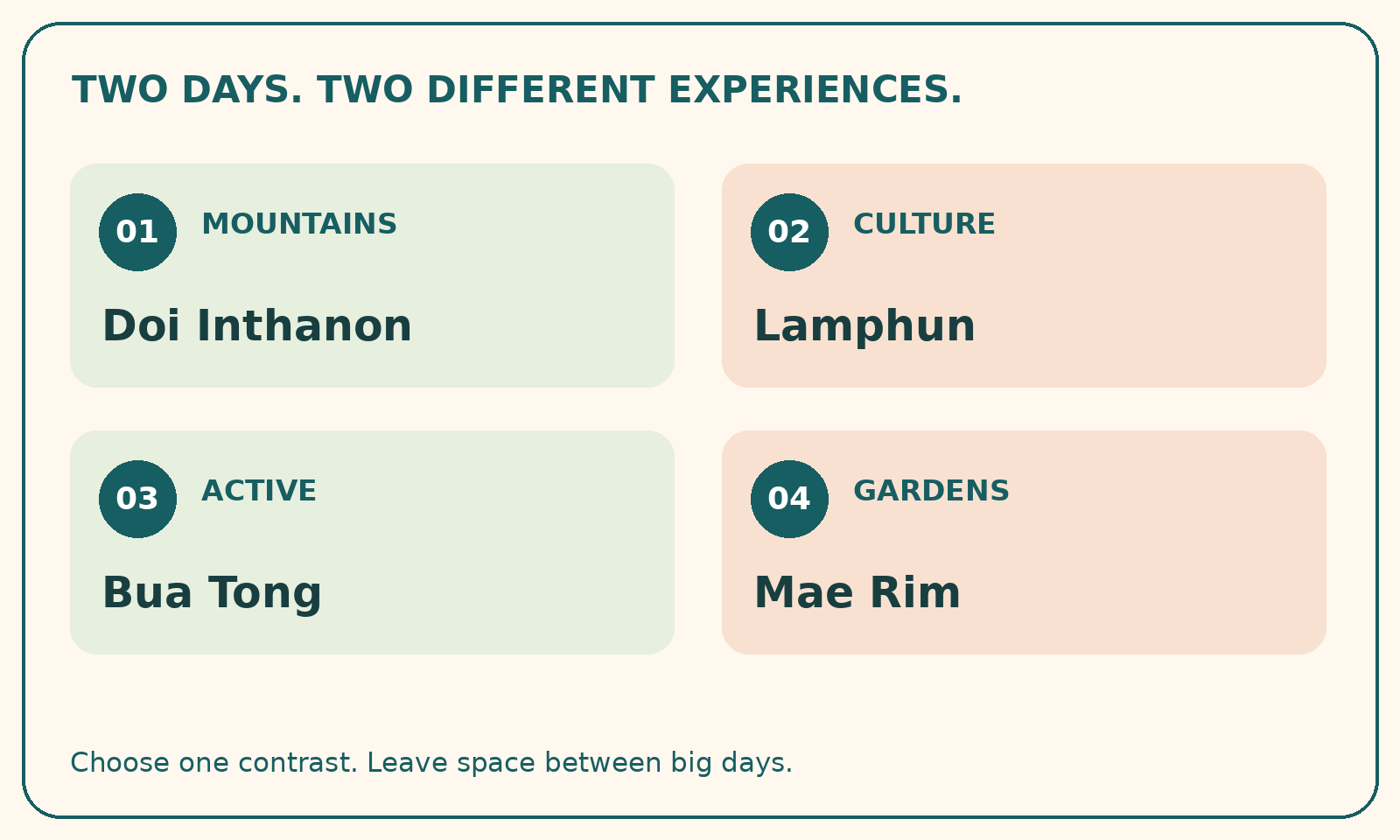
After Doi Inthanon, choose Lamphun or a craft-focused outing rather than another long viewpoint circuit. After Doi Suthep, a waterfall or garden day adds a different texture. A pair of individually good trips can still be a poor combination when both involve similar roads, similar viewpoints and the same early alarm.
For a four-night stay, I would usually reserve one full outing and one shorter escape. Keep a city day between demanding excursions when possible. That spacing leaves room for laundry, changing weather, a longer meal or simply finding somewhere you enjoy returning to.
Why Chiang Rai and Pai are not in the twelve
Both can be sold as day trips, but neither is my default recommendation for a relaxed out-and-back day. Chiang Rai’s major sights are dispersed, while the winding journey towards Pai is a substantial part of the visit. A tight circuit can turn the destination into a collection of brief stops.
An overnight does not automatically solve everything: you still need enough usable time on arrival and before departure. However, two or three nights usually give a much stronger reason to make the transfer than a rushed return merely to avoid changing hotels. Keep the day-trip shortlist for places that genuinely work from Chiang Mai.
Transport, budgets and the booking questions that matter
Compare the complete day cost
Use these as constructed spending allowances, not supplier quotations. They were prepared on 6 October 2026 for planning and should be replaced with date-specific prices before purchase. The per-person result changes significantly when a private vehicle is shared.
| Outing style | Working allowance | What still needs checking |
|---|---|---|
| Nearby independent half-day | THB 500-1,200 per adult | Return transport, entry and lunch |
| Shared guided mountain day | THB 1,200-2,500 per adult | Park fees, trail guide and pickup area |
| Private local day vehicle | THB 2,500-4,500 per vehicle | Hours, fuel, parking and entrance fees |
| Longer private cultural or mountain day | THB 3,500-6,000 per vehicle | Distance limits, overtime and meal stops |
On a small screen, swipe the table sideways. Any cost ranges are dated planning examples unless explicitly identified as a named supplier price.
A useful comparison starts with the route, walking time, group size and included admissions. Only then compare the price. A cheaper tour can be good value, but not when the missing transfer or park fee means you are comparing different products.
Write down the return arrangement
Ask for the hotel pickup window, the latest expected return and the cancellation policy when weather affects the main attraction. State luggage, child-seat or mobility needs before accepting a vehicle description. An ordinary seat count does not tell you whether everyone can travel comfortably with their belongings.
Keep the supplier’s contact details and a saved hotel address accessible offline. Mobile data helps with meeting points, but a connection is not guaranteed on every mountain road. An eSIM is optional; compare it with a local SIM and check your phone’s compatibility first.
Choose accommodation that does not add an extra cross-city transfer to every excursion. Read the pickup-zone wording before deciding that a remote resort is ideal for a tour-heavy stay.
Pros, cons and common mistakes
The advantages of keeping Chiang Mai as your base
One hotel means less packing, easier laundry and familiar places to eat after a long outing. You can also move a nature day when the forecast changes, provided your booking terms allow it. Nearby trips make that flexibility particularly useful.
The limitations of an out-and-back plan
Every excursion includes the return journey, and a distant attraction can consume more road time than time on site. Repeated early departures also reduce the value of evenings in Chiang Mai. Sometimes a second base is the more comfortable choice, even when it looks less convenient on paper.
Four mistakes that weaken an otherwise good plan
Do not book two full mountain days back to back simply because both are highly rated. Avoid treating a listed attraction as confirmation that every trail or facility is open. Ask whether ‘private tour’ means a private vehicle only or also includes an accompanying guide. Finally, do not schedule a non-refundable flight, train or important dinner immediately after a rural excursion.
A rainy forecast does not always require abandoning the countryside, but a closure or severe-weather warning does require a different plan. On 6 October 2026 the FCDO advice included a severe-flooding alert for parts of Thailand. Check your actual destination and access route rather than assuming the national notice means either everywhere or nowhere is affected. [19]
Three practical ways to arrange your spare days
One free day after a short city stay
Keep the decision between a nearby outing and one full excursion. For a shorter day, leave after breakfast for Doi Suthep, visit without rushing, then return for a late lunch. The afternoon remains available for a market, a rest or changing plans. Do not add a distant waterfall just because the morning finishes earlier than expected.
For the full-day alternative, select a Doi Inthanon programme with a clearly stated walking level. Pack the evening before and leave dinner unreserved. The benefit is not merely seeing more places: it is enjoying a landscape that is substantially different from central Chiang Mai. Accept that the travelling is part of the choice rather than planning an ambitious evening afterwards.
Two outing days during a longer stay
Put the more weather-sensitive trip first in your provisional plan, but avoid paying for inflexible extras around it. You might pair Bua Tong with Lamphun: one active nature visit and one smaller-town cultural day. That combination offers contrast without requiring two major mountain drives.
Alternatively, pair an observation-led elephant day with a short Doi Suthep visit on another day. The wildlife programme gets your full attention, while the temple outing leaves room to recover. Check the actual park programme’s return time before assuming the first day has space for another experience. A free evening can be a useful part of the itinerary rather than an unfilled slot.
A mixed-age group with different energy levels
Start by agreeing what everyone can comfortably manage, including the vehicle journey. The botanic garden or a craft-and-lunch outing can offer a clearer shared plan than a climb where half the group is waiting at the bottom. Nevertheless, check gradients, toilets and transport between garden sections rather than assuming a managed attraction is automatically accessible.
Give an optional extra a genuine opt-out: a shaded place to sit, a known meeting point and a realistic time to reunite. Avoid leaving a less mobile traveller alone somewhere without facilities while everyone else disappears for an uncertain-length walk. Paying for a flexible vehicle can be more useful here than paying for additional stops.
Keep the final morning simple
Do not place the trip you most want to do on the morning of departure. A delayed return can turn an otherwise enjoyable outing into a calculation about missed transport. Use that morning for a nearby breakfast, collecting laundry or a short city walk, then leave for the airport or station with the margin your operator recommends.
Read a tour description beyond the headline
Four details that reveal the actual experience
First, look for time at the main attraction rather than the tour’s total duration. A ten-hour product can include extensive pickups and several hours on the road. Secondly, establish the vehicle and maximum group size; the phrase ‘small group’ is not a numerical guarantee.
Thirdly, check whether the person accompanying you is a guide or primarily the driver. A commentary-led temple or history day has a different purpose from transport between stops. Finally, read the exclusions carefully, especially park admission, separate attraction tickets and optional activities. A tour is not poor value merely because these are additional, but you need to know before comparing totals.
Put essential needs in writing
Send a short message stating your date, hotel, party size and any non-negotiable requirement. Examples include a properly fitted child seat, avoiding a strenuous trail, or reaching a particular museum session. Ask for a clear reply rather than relying on a generic accessibility or family-friendly label.
Keep that reply with the confirmation and contact details. If the arrangement changes on the day, you then have a practical starting point for a discussion. A saved promise will not reopen a closed trail, but it can clarify whether the proposed substitute still provides the experience you agreed to buy.
Recognise when to leave an option unbooked
Some decisions improve with better information. A viewpoint trip can wait until you know whether the mountain is visible, while a limited-capacity wildlife programme may need an earlier commitment. Separate those two situations instead of applying the same booking strategy to both.
Keep a simple alternative ready: the garden instead of a distant panorama, Lamphun instead of a demanding walk, or a Chiang Mai city day instead of a waterfall during unsettled weather. This makes changing plans easier because you are choosing another worthwhile experience rather than starting from nothing. Check the substitute’s own opening arrangements, however; an indoor attraction may have a weekly closing day even when the weather is the reason you decided to visit it.
Chiang Mai day-trip FAQs
Which trip should I choose when I have only one spare day?
Choose Doi Inthanon when you actively want a full mountain day and are comfortable with the driving. Otherwise, Doi Suthep offers a stronger balance of scenery, cultural interest and usable time back in the city. Someone more interested in northern towns than viewpoints should choose Lamphun without feeling they have missed the ‘correct’ trip.
Can I do these trips without hiring a scooter?
Yes. Organised tours, a pre-arranged driver and, for some towns, public transport can cover the shortlist. You should not learn mountain-road riding simply to save on one day’s transport. Check the whole return journey before relying on public transport, especially for attractions away from a town centre.
Are the waterfalls suitable for young children?
Suitability depends on the specific area, recent rain and what you intend to do. A short visit to a managed viewpoint is different from climbing wet rock or entering a river. Ask about access and supervision, and have a pleasant non-climbing option ready rather than expecting every child to participate.
Should I book before arriving in Chiang Mai?
Reserve limited-capacity experiences and any trip tied to a particular date early enough to obtain the terms you need. For flexible nearby outings, waiting until you can assess local conditions can be useful. The decision is a balance between availability and weather flexibility, not a rule that every trip must be purchased immediately.
Is February or March automatically ideal for the mountains?
No. Comfortable temperatures or a dry forecast do not guarantee good air quality. Chiang Mai can be affected by seasonal smoke haze, according to FCDO health advice. Check current conditions and consider less strenuous or indoor alternatives when pollution is high. Mountain elevation alone is not a reliable escape strategy. [20]
Can a private driver change the route on the day?
Sometimes, but agree the scope in advance. Additional distance, waiting or overtime may be charged, and a driver is not necessarily a licensed attraction guide. Write down the essential stop, an acceptable substitute and a clear return time so flexibility does not become confusion about what you purchased.
What should I carry for a full day out?
Take water, a small amount of food, sun protection, a light rain layer, suitable footwear and any personal medication. Add a warm layer for higher elevations and a dry change for waterfall visits. Keep payment, tickets and the supplier’s contact information somewhere that remains accessible when your main bag is in the vehicle.
My recommendation: one contrast, not twelve checkmarks
Choose the trip that offers something you will not get by staying in central Chiang Mai. For most first visits, that means Doi Inthanon or Doi Suthep, followed on another day by a different experience such as Lamphun, Bua Tong or the botanic garden.
Then stop adding attractions. The strongest day has a clear purpose, enough time to enjoy its main stop and a sensible journey home. Use this list to remove unsuitable options as confidently as you use it to find appealing ones. You do not need to complete northern Thailand in a week to have travelled it thoughtfully.
Sources and fact-checking notes
Research and editorial review completed on 6 October 2026. Tourism-authority pages identify places and their published facilities; operator pages describe the named products. Listed prices and opening information are dated snapshots, not guaranteed availability. Travel-time ranges, route choices and spending models are editorial planning judgements, not live quotations. Check current official advice, the attraction and the booking provider before travelling.
- 1.Tourism Authority of Thailand: Doi Inthanon National Park
- 2.TAT Newsroom: 2026 seasonal opening and closure of national-park attractions
- 3.Tourism Authority of Thailand: Wat Phra That Doi Suthep
- 4.Tourism Authority of Thailand: Bua Tong waterfall and mineral spring
- 5.Thailand Tourism Directory: Bua Tong admission listing
- 6.Tourism Authority of Thailand: Mae Kampong community information (Thai)
- 7.Tourism Authority of Thailand: Chiang Mai destination overview
- 8.Tourism Authority of Thailand: Tham Chiang Dao
- 9.Tourism Authority of Thailand: Chiang Dao trekking and visitor preparation
- 10.Tourism Authority of Thailand: Wat Phra That Hariphunchai
- 11.Queen Sirikit Botanic Garden: official visitor attractions
- 12.Tourism Authority of Thailand: Mon Cham
- 13.World Animal Protection: current elephant-friendly venue list
- 14.Tourism Authority of Thailand: San Kamphaeng Hot Springs
- 15.Tourism Authority of Thailand: Bo Sang Umbrella Making Centre (Thai)
- 16.Tourism Authority of Thailand: Wat Phra That Lampang Luang
- 17.Dhanabadee Ceramic Museum: official visiting sessions
- 18.Tourism Authority of Thailand: Huay Tung Tao Reservoir
- 19.FCDO: current Thailand travel advice and alerts
- 20.FCDO: Thailand health advice and air quality
Illustrations in this article were created for Taylor’s Trailblazing Travels. Third-party photographs, where used, are credited beside the image or in the source list.