Krabi vs Koh Samui is a useful comparison when you want southern Thailand's beaches but are unsure whether to build the holiday around scenery and excursions or a more settled island routine. The answer changes with your month, your arrival route and what you expect from the beach outside the hotel. A resort photograph cannot answer all three questions.
For this guide, Krabi means the mainland holiday areas around Ao Nang, Klong Muang and Tubkaek, plus boat-access Railay. Koh Samui means the Gulf island itself, not a combined Samui, Phangan and Tao itinerary. Keeping those boundaries clear makes it possible to compare two real stays rather than giving one destination credit for an entire region.
My research-led preference is Krabi for a concentrated coast-and-cliffs trip and Samui for an island holiday where the hotel and neighbourhood provide much of the pleasure. Yet the seasonal fit can outweigh that preference. The following comparison separates official geographical and transport facts from editorial planning choices, and gives you several ways to test which option suits the trip you can actually take.
Krabi
A concentrated purpose: coast, cliffs and selected activities.
Koh Samui
A comfortable neighbourhood can carry much of the holiday.
Coastal season
Do not assume both sides share identical marine conditions.
Allow the whole day
A flight or surface itinerary is more than its shortest segment.
Krabi vs Koh Samui: the practical verdict
Start with the part you would remember
Choose Krabi when the trip you imagine centres on Railay's limestone setting, a coastal excursion and an easy base for organising a few distinctive days out. TAT identifies Ao Nang as a departure point for nearby islands and the Phra Nang peninsula. That gives Krabi a clear role in a short, scenery-focused itinerary. [1]
Choose Samui when the picture in your mind is a comfortable island base, a favourite beach and several evenings in the same neighbourhood. TAT describes a range of Samui beach areas, resort choices and activities rather than one uniform experience. You still need to select the right part of the island, but the holiday can work without leaving your chosen area every day. [2]
| Priority | Krabi option | Samui option |
|---|---|---|
| Scenery-led short visit | A strong editorial starting point | Consider when the island itself is the aim |
| Settled resort holiday | Compare quieter mainland resorts | A strong editorial starting point |
| Everyday base | Ao Nang, resort coast or boat-access Railay | A specific beach neighbourhood or a secluded resort |
| Changing coast | Allow for air or land-and-sea stages | Do not compare only flying or sailing time |
| Deciding evidence | Real dates, flight and property | The same three pieces of evidence |
Planning judgements, not ratings. Scope and geography: [1][2]
Let the most consequential difference lead
Someone travelling in a fixed school-holiday week should give seasonal suitability substantial weight. Somebody with only four nights should give arrival efficiency similar attention. For a honeymoon of ten nights, the property and the pace may dominate instead. The answer becomes clearer when you stop assigning equal importance to every attractive feature.
I would not select a destination just because an itinerary offers more numbered stops. Three memorable outings with comfortable days between them can be a better holiday than seven rushed ones. Decide how much moving around you enjoy before interpreting a busy activity list as a benefit.
Understanding the map before booking
Krabi is bigger than a beachfront address
Krabi is a province containing both mainland areas and islands. In this comparison, an Ao Nang hotel, a Tubkaek resort and a Railay stay are three different versions of the Krabi option. They have different access and daily routines, even if a booking platform groups them under the same destination. [1]
For travellers who want to walk to several meals and arrange outings independently, begin by checking an Ao Nang location. If the resort itself is the purpose of the trip, a quieter mainland coast can be worth examining. For Railay, the transfer and shoreline questions should come before the room category. An attractive room is only part of the stay.
Samui is an island, not one interchangeable beach
Chaweng, Lamai, Bo Phut and Taling Ngam appear in TAT's Samui overview, but they do not promise the same atmosphere or routine. Use them as distinct search areas. A hotel using a broad regional address may be well away from the evening stretch or beach access you intended to use. [2]
Mark three points for each shortlist: the hotel entrance, your ordinary dinner area and the beach access you expect to use. Then ask what the route between them is actually like. This is a much better foundation than estimating convenience from an island map at a zoom level where every road looks short.
Seasons: why your travel month can change the answer
The coasts do not share an identical pattern
The Andaman side and the Gulf side require different seasonal thinking. TMD explains the southwest monsoon's role in Thailand's rainy season and the continuation of substantial southern rain under the northeast monsoon, particularly on the east coast. This is why a single national best-time label is not enough for a Krabi-Samui comparison. [3]
As an editorial starting point, I would investigate Samui early for a mid-year beach holiday and scrutinise late-year Gulf weather carefully. For Krabi, I would be cautious about making several sea outings the non-negotiable centre of a wetter-season stay. These are planning priorities, not statements that either coast is rain-free in any month.
Do not treat transition months as switches
A new month on the calendar does not instantly change the sea. A holiday spanning late October and early November still needs flexible marine arrangements. Similarly, a winter trip requires a more precise look than the claim that all of southern Thailand is in the same dry season.
TMD's outlook issued on 25 September 2026 discusses continued southern rainfall during October-December, with particular east-coast exposure in November and the first half of December. That is current, dated context for near-term travel, not a substitute for the forecast for a particular week or for future years. [4]
| Trip brief | Krabi planning check | Samui planning check |
|---|---|---|
| Fixed mid-year dates | Assess Andaman marine exposure | Investigate the Gulf-side alternative |
| Late-year trip | Check the specific transition period | Give east-coast rainfall proper attention |
| Only one must-do boat day | Leave another day available | Leave another day available |
| Mostly resort time | Choose facilities for a changed afternoon | Choose facilities for a changed afternoon |
No row guarantees dry weather or safe swimming. Guidance checked 3 October 2026; refer to current TMD warnings before travel. [3][4]
Book for the consequences, not just the probability of rain
A resort holiday with a good covered terrace, comfortable room and appealing meals can remain enjoyable during unsettled weather. A three-night trip whose sole purpose is a specific offshore excursion has less room to adapt. Think about what a cancellation would remove before deciding whether a cheaper seasonal rate represents value.
My preference is to schedule the most weather-sensitive outing before the final full day. That creates an opportunity to rearrange without reorganising the entire trip. Also keep a land-based alternative, but verify that it is appropriate in the actual conditions; a flooded path or closed nature site is not a sensible backup merely because it is inland.
Beaches: the view versus the everyday holiday
Krabi's memorable coast may involve a boat
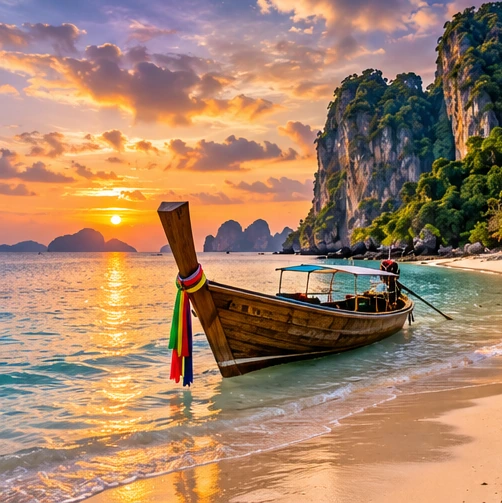
Railay West and Phra Nang provide the limestone setting that draws many travellers to Krabi. TAT describes passenger-boat access from Ao Nang and Noppharat Thara. Therefore, those photographs can represent an excursion from your hotel rather than the view at the end of your garden. [5]
That arrangement can work very well for somebody who enjoys setting out for a beach visit and returning to an easy dinner base. It is less convenient for somebody who wants to alternate sea, room and pool several times each day. Make the distinction explicit rather than assuming a Krabi booking includes direct access to the particular beach in the advertisement.
Samui requires a frontage-level check
For Samui, I would compare the actual beach outside each property and how well it serves your preferred routine. Do you mainly want a long walk, a place to sit, easy room access or opportunities to swim when conditions allow? A highly rated hotel may meet some of those needs and not others.
Ask about seasonal changes, tide effects and any steps or road crossings. Recent photographs can help you understand the setting, but they do not certify water safety or predict the weather. Treat a good pool as useful resilience for a beach holiday, not as evidence that you should ignore a warning at the sea.
Krabi accommodation: three different ways to stay
Ao Nang for a practical base
My first Ao Nang shortlist would favour a location that supports meals and modest local walks without repeated arrangements. That suits a holiday built around a few outings, because returning tired does not create another transport problem. However, being central is not the same as being quiet; inspect what surrounds the exact room and building.
Check whether the hotel is actually within your comfortable walking area. A map pin in Ao Nang can still leave you with a steep approach or an inconvenient road crossing. Prioritise the route you will use every day over an occasional view from a room you will mostly occupy after dark.
Railay for immersion in the peninsula
An overnight Railay stay changes the experience because you are already on the peninsula before and after many day visitors. Nevertheless, TAT distinguishes the west-side beach from Railay East's mangrove shoreline. Do not buy an east-side room expecting the identical beachfront routine shown in a west-side photograph. [6]
Before booking, ask which landing point the hotel uses, whether luggage assistance is provided and how late arrivals are handled. A mobility aid, pushchair or large case can change the practicality of the transfer. The right response is a detailed access conversation, not assuming a more expensive hotel removes all boat-related constraints.
Klong Muang or Tubkaek for a resort-centred stay
These mainland options belong in the comparison when you want more time at the property and fewer independent outings. I would assess restaurant choice, shade, pool comfort and transport arrangements particularly closely. A quieter setting can be an advantage when it is deliberate, but an inconvenience when you expected a central Ao Nang routine.
This version of Krabi may be the most direct competitor to a quieter Samui resort. Compare similar properties and stay lengths rather than contrasting a remote luxury hotel with a central budget room. The destination decision becomes fairer when the underlying holiday brief stays the same.
Samui accommodation: match the area to the evening
A beach-town routine
For a Samui stay with independent meals and some evening variety, I would compare specific properties around Chaweng and Lamai before narrowing the list. The objective is not to find the busiest spot; it is to find enough choice within the distance you actually want to walk. Inspect noise and the return route as carefully as the food options.
A quiet room in a convenient district can be more useful than a remote room chosen simply to avoid bustle. Request information about the room's orientation and neighbouring venues. When a booking site offers several buildings or room categories, confirm which one the rate includes rather than transferring the best photograph to every room.
A north-coast or secluded resort routine
Bo Phut deserves consideration for travellers interested in its historic character and an evening area to return to. However, the wider address can be broader than the particular neighbourhood you have in mind. TAT's description of converted shophouses establishes the area's character, not the walking distance from every hotel carrying the name. [2]
For a more secluded Samui stay, think about how much of the week will happen at the hotel. Compare the comfort of the room, restaurant choice and cost of occasional outings with the mainland Krabi resort option. Neither should be rejected for remoteness when remoteness is part of the attraction.
Getting to your first hotel
Krabi: distinguish mainland arrival from peninsula arrival
An airport-to-mainland-hotel transfer and an airport-to-Railay journey are not the same product. Railay introduces a boat stage, so ask where the road journey ends and who arranges the next part. An apparently small difference in hotel location can therefore change what a late landing means for your first night. [5]
For Ao Nang or another mainland base, compare the available flight and road-transfer combination as a whole. Do not choose an awkward international connection solely because the final road leg looks short. The journey from your home airport to the hotel door is the relevant measure.
Samui: island flight or mainland-plus-ferry
Flying to Samui Airport keeps the final island arrival different from arriving on the mainland and continuing by road and ferry. A surface approach may make financial sense, but its stages need space in the schedule. Treat waiting, boarding and the final transfer from the Samui pier as real parts of the journey.
For a short holiday or after a tiring long-haul flight, I would give a simpler arrival substantial weight. For a longer trip with a tighter budget, a well-organised combined route may be perfectly reasonable. The essential comparison is the actual itinerary offered for your date, not a headline claim that one island is expensive to reach.
Can you combine Krabi and Samui?
Check the flight before building the split stay
Bangkok Airways includes the destinations in its route network and provides Samui-Krabi route information. That makes an airline search a sensible first step, but a network page does not establish a suitable departure on your intended date. Confirm the exact flight, fare conditions and baggage before arranging two non-refundable hotels around it. [7][8]
A short flight does not reduce the hotel-change day to its flying time. Account for checkout, road transfers, airport procedures and settling in at the other end. I would leave that afternoon uncommitted rather than prepay an excursion that depends on everything running to the shortest possible schedule.
Surface routes cross the peninsula
Krabi-to-Samui booking options include combined land-and-sea journeys. They involve travelling towards the Gulf side and using a ferry stage; they are not a simple direct sea crossing from Ao Nang across open water to Samui. Check whether the product ends at a pier or includes the onward hotel transfer. [9]
A surface route can suit travellers with time and a clear understanding of the stages. It is less appealing when the split stay leaves only a couple of nights in each location. I would normally combine the destinations because they provide two different experiences, not because moving between them is possible.
Krabi excursions: build around contrast
Railay plus one different experience
A first Krabi stay does not need three similar island tours. I would start with a Railay visit, then choose one other experience that adds something different. That might be a guided kayaking outing, a climbing lesson or a selected island trip, depending on interest and ability.
TAT describes Ao Thalane as a mangrove-and-limestone kayaking area. It offers a useful contrast to a beach-focused day, although route suitability still depends on tides, weather and the organiser's assessment. Ask about paddling effort and assistance rather than assuming a scenic description makes every itinerary suitable for every participant. [10]
Keep demanding days apart
For an active traveller, a lesson or longer outing may be the holiday highlight. For a mixed group, it may be something only one or two people want to do. Choose a base that lets the others have a pleasant day without joining an unsuitable activity simply to remain together.
Also leave recovery time. Heat, early collections and several hours outside can make back-to-back outings less enjoyable than they look at home. Plan the day after the ambitious experience as generously as the experience itself. This often reveals whether a five-night programme contains too much.
Samui excursions: decide whether Ang Thong belongs in your trip
An offshore day is a separate commitment
Ang Thong's island scenery and viewpoints make it a natural item on a Samui shortlist. TAT describes day trips from Samui and Phangan, but the particular operator determines the route, vessel and activity programme. Do not infer the details of your tour from a generic image of the archipelago. [11]
Read the entire itinerary for boarding, shade, time on the boat and the effort required at viewpoints. Somebody can enjoy the landscape without wanting to climb every available path or join every water activity. Ask how the tour accommodates those preferences before choosing solely by price.
An island day can be enough
A Samui holiday does not need an offshore excursion to count as a successful island trip. TAT lists activities including cooking, yoga and other options on and around the island. A well-chosen land-based activity may suit somebody who dislikes long boat days or wants a different kind of memory. [2]
I would reserve the offshore day only when the experience itself appeals, not because it appears on every suggested itinerary. That leaves more room for the beach area you chose and avoids paying for an outing that is mainly a test of endurance. The best trip is not necessarily the most comprehensive one.
Three traveller examples: how the recommendation changes
A couple with six nights and a strong scenery brief
Imagine a couple who want a memorable coastline, one active outing and several easy meals, but do not need a large resort. I would begin by pricing an Ao Nang base, a Railay day and a contrasting guided activity. The advantage is coherence: the chosen experiences explain why Krabi is the destination, and the hotel supports them without becoming the main attraction.
I would not automatically add a second hotel on Railay. First ask whether staying overnight changes something they value, such as spending more time on the peninsula without another boat outing. If it does, compare the transfer and luggage effort with that benefit. Otherwise, one base keeps six nights from becoming several small arrivals and departures.
A family with a fortnight and little interest in tours
For a family wanting pool time, a beach setting and predictable meals, I would compare a suitable Samui property against a mainland Krabi resort rather than central Ao Nang. The room arrangement, shade, child-friendly routine and arrival process deserve more weight than a destination's activity list. A holiday can be full without a paid excursion every other day.
Here, the coast's seasonal fit becomes especially influential. Two weeks is a substantial commitment to the local routine, so the hotel should remain enjoyable when the sea is unsuitable. I would choose the property and dates together, retaining room in the budget for an occasional outing but not relying on it to rescue a poor base.
Friends who want different things
For friends split between active days and rest, I would look for a location where people can comfortably separate for part of a day. One pair might choose a guided activity while another stays by the pool or visits a local meal spot. This avoids making every decision a negotiation over transport for the entire group.
The best answer may be a more convenient hotel rather than a different destination. Compare how each person would spend a day alone, including the return to the property. A destination that works only when everybody travels together can become tiring even when the scenery and accommodation are excellent.
Cost: a seven-night comparison you can actually use
Price equivalent holidays
Start with comparable room arrangements. A central Ao Nang room and an isolated Samui villa are not substitutes simply because both sleep two people. Match the comfort, occupancy, cancellation terms and style of stay, then compare flight and transfer costs separately before adding them to the hotel total.
For a worked illustration, suppose your own hotel quotes differ by THB 700 per night. Across seven nights, that is THB 4,900 per room. These are hypothetical inputs for a budgeting exercise prepared on 3 October 2026, not a measured destination price gap. Compare that result with the actual difference in arrival cost for everyone travelling.
| Item | Keep this comparable | Include this often-missed cost |
|---|---|---|
| Accommodation | Same room occupancy and flexibility | Breakfast or extra-bed terms |
| Arrival | Complete journey for everyone | Mainland, pier or hotel transfer stages |
| Activities | Only the experiences you want | Per-person fees and optional equipment |
| Illustrative room gap | THB 700 x 7 = THB 4,900 | Compare with the real arrival-cost difference |
The room-gap example is hypothetical arithmetic prepared 3 October 2026, not a quoted destination average.
Remember what is charged per person
A couple may share a room and a private transfer but pay separately for a boat excursion. A family may need a different room category even when a headline search says children are welcome. Build the comparison for the actual party rather than multiplying a solo estimate and assuming it remains accurate.
For an excursion-heavy Krabi trip, allocate a specific activity allowance. For a Samui resort stay, inspect the spending you expect at the hotel and the cost of leaving occasionally. Neither pattern is inherently better value. The important question is whether you are consciously buying the version of the holiday you prefer.
Different travel budgets can still produce the same recommendation
A budget traveller and a luxury traveller may both choose Samui or both choose Krabi, but for different reasons. The budget version might favour a smaller central room and selective outings; the luxury version might prioritise privacy and resort facilities. Avoid assuming that one place belongs to one spending category and the other belongs to another.
For a fair comparison, make a short requirement sheet: bed arrangement, air conditioning, pool if wanted, meal access, cancellation flexibility and acceptable transfer effort. Find a plausible property in each destination that meets those requirements, then compare totals. This reduces the temptation to explain a hotel-level difference as a destination-wide price advantage.
For the resort-led Krabi version, look beyond the first central Ao Nang results. A Klong Muang shortlist may be more relevant to the Samui holiday you are actually considering. Check whether the quieter setting gives you enough everyday choice and whether an occasional return journey can be arranged without difficulty.
Food and evenings: assess the routine after the outing
Krabi: returning to a useful base
An Ao Nang base can suit somebody who wants an uncomplicated choice of food after a day out. When comparing hotels, list several nearby places that could realistically meet your preferences, then check recent opening information closer to departure. The aim is resilience, not constructing a rigid restaurant schedule weeks in advance.
For a quieter mainland resort or Railay stay, ask how much choice is available within the area you can comfortably reach. A beautiful location may be worth that trade-off, provided the food arrangements still work for the whole party. Dietary requirements deserve direct questions rather than assumptions based on a destination's popularity.
Samui: choose the area where you want to spend evenings
For Samui, I would treat dinner and the return walk as central hotel-selection criteria. A beach that looks wonderful at noon does not answer what happens after sunset. Somebody who wants an easy evening stroll has a different brief from somebody content with resort dining and occasional arranged transport.
Be specific about noise tolerance, too. Proximity to restaurants can be useful while proximity to late entertainment may not be. Look for descriptions of the room you will occupy and the neighbouring buildings, not merely a broad claim that the district is lively or peaceful. Both can be true a short distance apart.
Families and travellers who need easier access
Reduce the number of handovers
For a family with young children, I would give considerable weight to the number of times luggage and passengers must change vehicles. Mainland Krabi can be straightforward when the arrival route fits; Samui can be equally comfortable with a suitable island flight and transfer. Railay or a mainland-to-Samui ferry approach requires more detailed consideration.
That is not a reason to rule out boat access. It is a reason to ask the right questions about boarding height, luggage help, waiting areas and what happens in changed conditions. A useful operator answer describes the actual process rather than relying on the label family-friendly.
Check access along the entire chain
A step-free room does not ensure a step-free holiday. Consider reception, breakfast, pool access, transport and the beach route. For wheelchair users or anyone with limited mobility, request current photographs and written information from both property and transport providers. Broad destination recommendations cannot establish individual suitability.
For boat activities, confirm suitable flotation equipment and whether somebody can remain comfortably in a shaded place while others participate. For private vehicles, specify any child restraints or space requirements before accepting a quote. The most useful upgrade is often the one that removes a practical difficulty for a real person in the group.
Couples, solo stays and longer breaks
Couples should compare pace, not just privacy
For couples who want active scenery-focused days, Krabi is my first shortlist. For a more settled resort routine, I would examine Samui alongside quieter mainland Krabi properties. A honeymoon or anniversary does not automatically require a remote villa; it requires accommodation and a pace that both people enjoy.
Discuss how many days you want to spend together on organised activities and how many you would rather keep open. A disagreement about that rhythm will not be fixed by the destination. Choosing a base where either person can enjoy a quiet day independently can be a useful compromise.
Solo and longer stays reward everyday usefulness
For a solo traveller, an easy meal, clear arrival and comfortable local route can be more valuable than a large room. Choose group activities selectively when company appeals, but keep enough independence that you are not committed to a social itinerary every day.
For a longer stay, evaluate laundry, workspace if needed and the comfort of spending an ordinary afternoon at the property. Avoid assuming that a destination-level claim about internet or services applies to every room. Ask the hotel about the specific connection and working arrangement when those features are essential, and keep important travel information available offline as well.
Preparing for two different kinds of outing
A Railay or coastal-activity day
For a day involving a boat and a beach, pack so you can manage the final approach without carrying everything from the hotel room. Keep the return information, essential documents and items that must stay dry protected and accessible. Check what the operator supplies before bringing bulky equipment or buying something you will not use again.
Footwear should suit the actual activity rather than a generic tropical packing list. A guided paddle, a beach walk and a specialist climbing lesson have different requirements. Ask the provider, especially where equipment is included or personal items must be stored during participation. A good preparation question can prevent both overpacking and arriving without something genuinely needed.
A Samui resort day with an optional outing
For a resort-centred day, the more useful preparation may be confirming an activity time, a return vehicle and a meal plan rather than assembling a large day bag. Keep plans light enough that you can decide to stay locally without losing several reservations. The aim is to preserve the reason you chose a settled island routine.
When combining the destinations, pack a separate moving-day bag and keep the rest organised. That avoids opening large cases while changing vehicles or waiting for a room. The site's Thailand packing guide can help with the broader list, but the route and activity provider should determine any specialised requirements. Simpler luggage is helpful only when it still includes what the actual journey needs.
Sample plans for four, seven and twelve nights
Four nights: choose the easier satisfying stay
For four nights in Krabi, I would keep one mainland base, use one day for Railay and one for a chosen contrasting outing, then retain time to rest. For four nights on Samui, I would prioritise the hotel and local beach area, adding only one ambitious excursion. In either case, arrival day should not carry a fixed activity commitment.
This is a planning model, not a list of reservations to copy blindly. Change the order for weather, your energy and the operator's availability. A short trip has little tolerance for losing a day to an unnecessary hotel change, so select the destination that gives you the most usable time for the experiences you actually want.
Seven nights: allow the place to become familiar
In Krabi, seven nights can support two or three purposeful outings with easy days in between. You have time to return to a favourite area rather than merely sample it once. In Samui, the same length supports a settled beach routine, a land outing and an optional offshore day without requiring an island-wide tour every morning.
Twelve nights: a split can be worthwhile
For a twelve-night holiday, I would consider roughly five nights in one destination and six in the other, allowing for how the travel days fall. Start with the more active stay and finish with the calmer one when that matches your preferences. However, protect the final departure: the location of your onward flight should influence where the last night is spent.
Reversing the itinerary can solve more than upgrading transport
Before paying for a complicated connection, try reversing the order of the two stays. A flight available on one day, an early homeward departure or a hotel with a minimum stay may fit more comfortably in the opposite sequence. Evaluate both versions before assuming the original order must be preserved at any cost.
The last base deserves special attention because the consequences of delay are different when travelling home. An inconvenience halfway through the holiday may be absorbed by a flexible afternoon; the same delay before a long-haul flight may be much harder to manage. Position the final night around the confirmed onward route rather than simply ending at the hotel with the most appealing view.
For an itinerary that already includes Bangkok or another region, examine the whole sequence on one page. Count travel days, not just nights in hotels. A coast-to-coast combination can be worthwhile, but it should not leave most of the trip divided into arrivals, one full day and departures. Sometimes dropping the second coast produces a richer holiday on the first.
A final comparison for a ten-night budget
Put the nights and travel stages beside the costs, not on a separate sheet. One itinerary might include ten hotel nights and a straightforward arrival, while another appears similar until an additional mainland night and two local transfers are added. Those extras may be worthwhile, but they should not remain invisible when you decide which coast offers better value.
Use the same approach for a split stay. Mark each day as mainly settled or mainly moving, then look at how many settled days remain in each destination. A five-and-five division sounds balanced, but flight times and transfers can produce a different lived experience. The goal is not mathematical symmetry; it is enough enjoyable time in both places.
Finally, identify the first thing you would remove if the plan became too expensive or tiring. A duplicate excursion, an unnecessary room upgrade or a second hotel may be easier to lose than the convenient arrival or the main experience that attracted you. Deciding this in advance makes the budget more flexible without turning every small purchase during the holiday into a fresh negotiation.
Pros and cons, followed by mistakes to avoid
Krabi's advantage is a concentrated purpose
Krabi works particularly well when the coast, Railay and a few distinct outings explain why you are going. Its weakness is that the iconic image may not describe the daily surroundings of your hotel. Choosing the wrong base can leave you repeatedly travelling to the holiday you thought you had already booked.
Samui's advantage is a settled island routine
Samui works well when the hotel and neighbourhood are a strong match for your pace. Its weakness is that an inconvenient arrival or remote property can make a supposedly effortless beach holiday require more arranging than expected. The seasonal distinction deserves attention, particularly when a late-year trip depends on reliable sea outings.
Three comparisons to reject
Reject the comparison of a budget room with a luxury villa, a flight time with a complete surface journey, and a sunny photograph with a seasonal forecast. Each makes one option look artificially attractive. Replace them with equivalent room conditions, door-to-door timing and current weather information.
Also avoid assuming that an island trip must include another island. Add Ang Thong, Phi Phi or another excursion only when you want that particular day, and confirm current operation. Leave enough time to enjoy the destination named on your hotel booking instead of using it exclusively as a launch point.
Frequently asked questions
Which is better for a first southern Thailand holiday?
Krabi is my starting point for a focused scenery-and-excursions trip; Samui is my starting point for a settled island stay. Your month and actual arrival route can reverse that order. Shortlist a suitable property in each, then compare what a normal day would involve. That is more useful than deciding from destination reputation alone.
Which would you choose with only four nights?
I would usually choose the option with the simpler satisfactory arrival, provided it offers the experience you most want. Keep a single base and avoid an unnecessary inter-coast transfer. Four nights can feel generous with one or two meaningful outings, but very short when split between hotels and transport stages.
Is Krabi an island like Samui?
No. Krabi is a province that includes mainland areas and islands. This comparison concentrates on Ao Nang and the nearby mainland resort coast, plus boat-access Railay. Samui is the island itself. That distinction matters because a hotel listed under Krabi may offer a completely different arrival and daily routine from another property in the province. [1]
Does staying in Krabi mean we can walk to Railay?
Do not plan it that way. TAT describes passenger-boat access to Railay from Ao Nang and Noppharat Thara. Ask your hotel about the actual boat arrangement and return options. A Railay stay and an Ao Nang stay should be compared as different access choices, not neighbouring hotels reached in the same way. [5]
Is Samui a useful alternative during the Andaman wetter season?
It deserves investigation because the Gulf and Andaman seasonal patterns differ. However, alternative does not mean guaranteed dry or calm. Look at current climate guidance and short-range forecasts, then consider what your holiday would lose if a boat excursion changed. A flexible resort stay has different requirements from a brief sea-activity-focused visit. [3]
Can we fly directly between the destinations?
Bangkok Airways lists the destinations in its network and has Samui-Krabi route information. Check the actual search for your date, direction and baggage requirements before relying on a flight. A published route is not a promise that the departure you need will be available or that a particular fare will still exist. [8]
What does the cheaper surface connection involve?
Surface products generally combine a land journey towards the Gulf side with a ferry stage. Confirm the vehicle changes, waiting, luggage handling and the point where the booking ends. A product labelled Krabi to Samui may not include your final hotel transfer. Judge the total journey rather than assuming it is a short direct boat ride. [9]
Which is better for someone who does not swim?
Both can work if you choose the experience deliberately. Krabi can offer coast-and-cliff scenery and suitable guided land or paddling activities where participation requirements fit. Samui can offer a resort routine and selected island outings. Do not reserve a water-activity-heavy tour without confirming how a non-swimmer is accommodated and what alternatives are actually available.
Is one destination definitely better value?
No universal answer follows from the place name. Compare equivalent rooms, arrival routes and the activities you intend to take. In particular, separate costs charged per room or vehicle from those charged per person. A modest hotel saving may be outweighed by the journey, while a pricier convenient base may reduce repeated local transfers.
Can we stay in both without rushing?
Yes, with enough nights and a clear reason for the contrast. I would be more inclined to combine them in a longer holiday than in a one-week break. Give each base enough time to feel like a stay, allow the whole moving day and organise the last night around the important onward departure rather than around an idealised itinerary.
Final recommendation: choose the experience with the best fit
For a first comparison, I would choose Krabi when Railay, limestone scenery and a focused set of activities are the main reasons for travelling. I would choose Samui when a comfortable island base and a repeatable beach-and-evening routine are the priorities. Neither preference overrides the weather pattern, arrival options or an unsuitable hotel location.
The strongest decision uses three pieces of evidence: your actual dates, a real arrival itinerary and a realistic property shortlist. Test each against the needs of the people travelling, including the least flexible member of the group. Then decide which compromises are acceptable rather than searching indefinitely for a destination with none.
Keep the finished holiday lighter than the research. You need enough information to make confident choices, not an obligation to experience every attraction you have read about. A few memorable days, a comfortable base and an uncomplicated departure are a good result on either coast.
Sources and fact-checking notes
Destination and provider information checked on 3 October 2026. Seasonal guidance describes tendencies, not the weather for your stay. Recommendations and illustrative itineraries are research-led planning judgements; hypothetical budgets are labelled separately from published product examples.
- Tourism Authority of Thailand: KrabiProvince scope and the role of Ao Nang as an excursion base.
- Tourism Authority of Thailand: Ko SamuiNamed beach areas, Bo Phut and activity categories; not a hotel-level assessment.
- Thai Meteorological Department: Thailand seasonsGeneral monsoon explanation in Thai; broad seasonal tendencies are not daily forecasts.
- Thai Meteorological Department: October-December 2026 outlookIssued 25 September 2026. The PDF has stray older template labels; this guide uses only the clearly identified October-December discussion, not its unrelated labels or numerical tables.
- Tourism Authority of Thailand: Railay BeachPeninsula setting and passenger-boat access. Local operation must be reconfirmed.
- Tourism Authority of Thailand: Ao RailayThe difference between the west-side beach and east-side mangrove shoreline.
- Bangkok Airways: route networkNetwork context only; a route map is not date-specific flight availability.
- Bangkok Airways: Samui-Krabi flight searchOfficial route search; no daily frequency or fixed fare is asserted.
- 12Go: Krabi-Koh Samui route productsCombined land-and-sea routes and their stated final arrival points.
- Tourism Authority of Thailand: Thalane BayMangrove and limestone paddling setting; route suitability must be checked with the operator.
- Tourism Authority of Thailand: Mu Ko Ang ThongArchipelago setting and excursions from Samui/Phangan. Conflicting entry fees on the page are not adopted as a current tariff.
Live availability, operating conditions and the terms on your confirmed booking take precedence over planning examples. No first-hand visit or independent assessment of a particular hotel, vehicle or tour is claimed.
Illustrations in this article were created for Taylor’s Trailblazing Travels. Third-party photographs, where used, are credited beside the image or in the source list.