Tonle Sap Floating Villages from Siem Reap: How to Choose Responsibly
Choose the village, boat and operator together—and know what your visit supports.
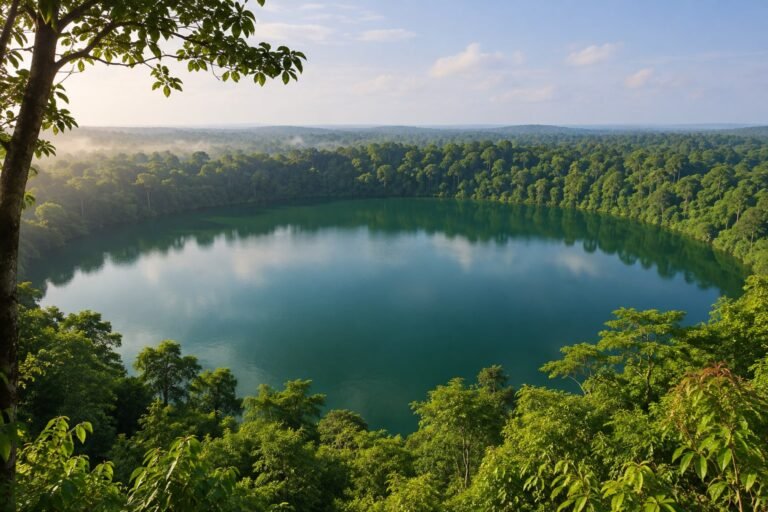
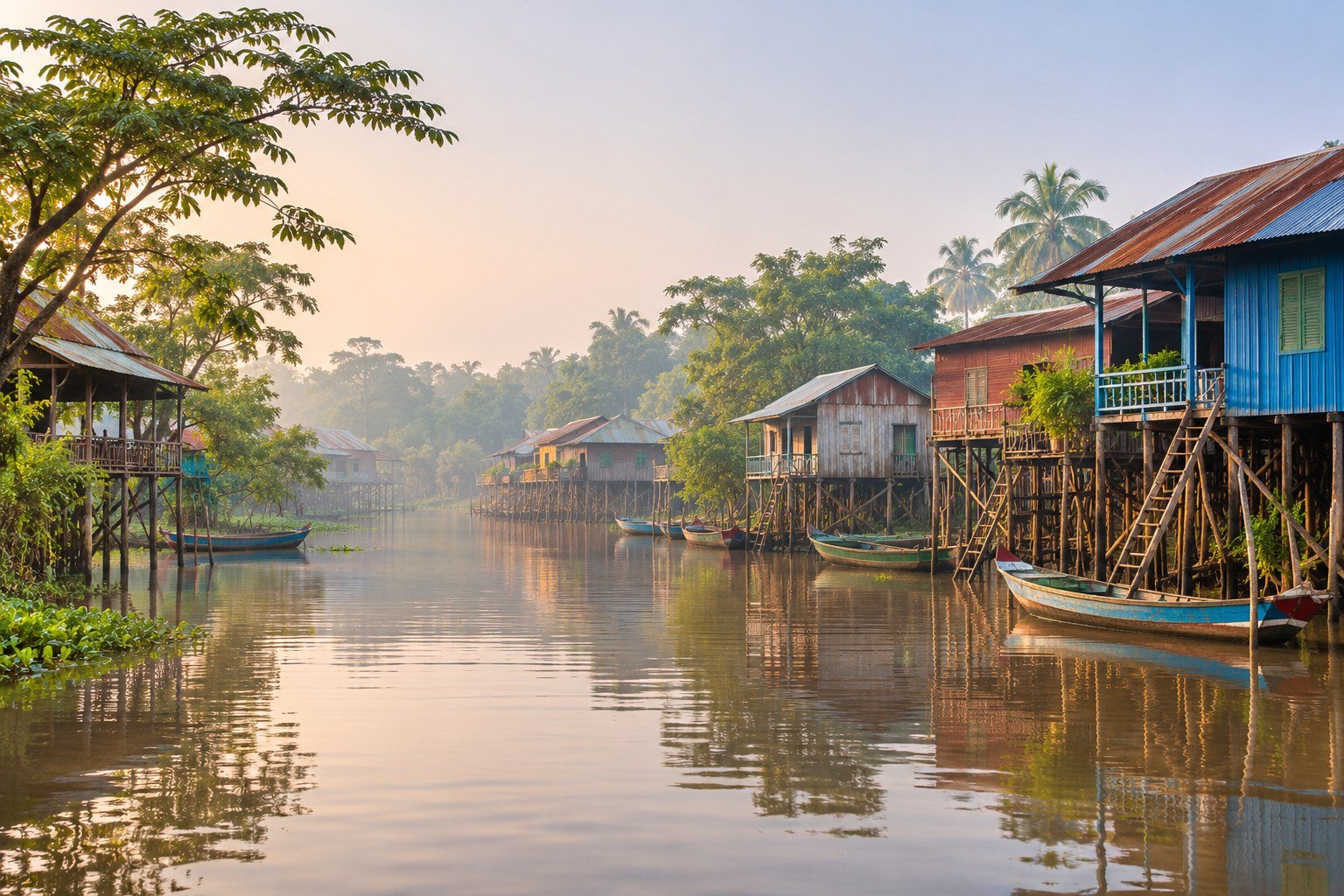
AI-generated illustration of lakeside village scenery; water levels and individual villages vary.
A Tonle Sap floating village day trip can add a thoughtful change of scene to a Siem Reap stay. The best choice begins with a clear account of the route, the boat and the people providing the visit.
A village name alone cannot tell you whether a tour is respectful. Look for a guide who can explain the lake, an operator who names the services residents are paid for, and an itinerary that gives people control over visits to their homes and workplaces.
This guide contains affiliate links. If you book or buy through them, Taylor’s Trailblazing Travels may receive a commission at no extra cost to you.
Which village and departure point will we actually use?
Is the flooded-forest boat section operating this week?
Pay for agreed local services and respect a refusal to be photographed.
Allow a generous half-day; some community outings take most of a day.
Choose a village that fits your time and interests
Kampong Phluk and Kampong Khleang are known for stilted homes; the wider lake also has homes that float. “Floating village” is often used loosely in tour titles, so ask what you will actually see.[1] The distinction matters most at low water, when tall supports can be fully exposed.
Swipe within the table to see all columns.
| Place | Useful starting point | Question that decides the booking |
|---|---|---|
| Kampong Phluk | Stilted village and a manageable outing from Siem Reap | What is the water level, and is a separate forest canoe included? |
| Kampong Khleang | A longer road journey for a broader village-and-lake visit | Which community services are paid for, and can school contact be excluded? |
| Mechrey | An alternative floating-village route | Where are the current boarding point and village, and who operates the boat? |
| Chong Kneas | A comparatively close departure area | What exactly is included beyond the boat ride, and can unwanted stops be removed? |
| Prek Toal | A deliberately planned community or birdwatching outing | Is this a village visit, a sanctuary visit, or both? |
For orientation, Cambodia’s embassy lists Kampong Phluk just over 30km from Siem Reap, Kampong Khleang around 50km away, Mechrey around 25km and Chong Kneas around 16km. These are broad location guides, not driving-time guarantees; water levels can also change the final approach.[1]
If you are mainly interested in village life and the lake landscape, a well-explained half-day route is enough to start with. If birds are the priority, choose a trip explicitly covering the sanctuary and ask about current sightings and access. A generic sunset cruise is a different purchase.
Back to top ↑Match expectations to the water level
Tonle Sap’s seasonal expansion is central to the landscape. UNESCO describes a freshwater lake, floodplains and seasonally flooded habitats; the Mekong’s seasonal flood pulse helps drive the rise and fall.[2][3] A photograph from a high-water month may look very different from the village on your travel date.
Swipe within the table to see all columns.
| Conditions | What may change | Ask before paying |
|---|---|---|
| Higher water | Boats can approach more village areas; some forest routes may open | Which sections are operating, and what happens if storms develop? |
| Lower water | More exposed stilts and walking; the boat may board farther out | How much road and walking time replaces the high-water route? |
| Changing levels or difficult weather | Boarding points, route length and optional canoe trips can change | What will be substituted, and what are the cancellation terms? |
Do not buy an outing solely because a calendar says “wet season”. Ask for a recent description of the exact route. Community First’s Kampong Khleang itinerary, for example, explains that low-water visits use a different combination of driving, walking and boating.[4]
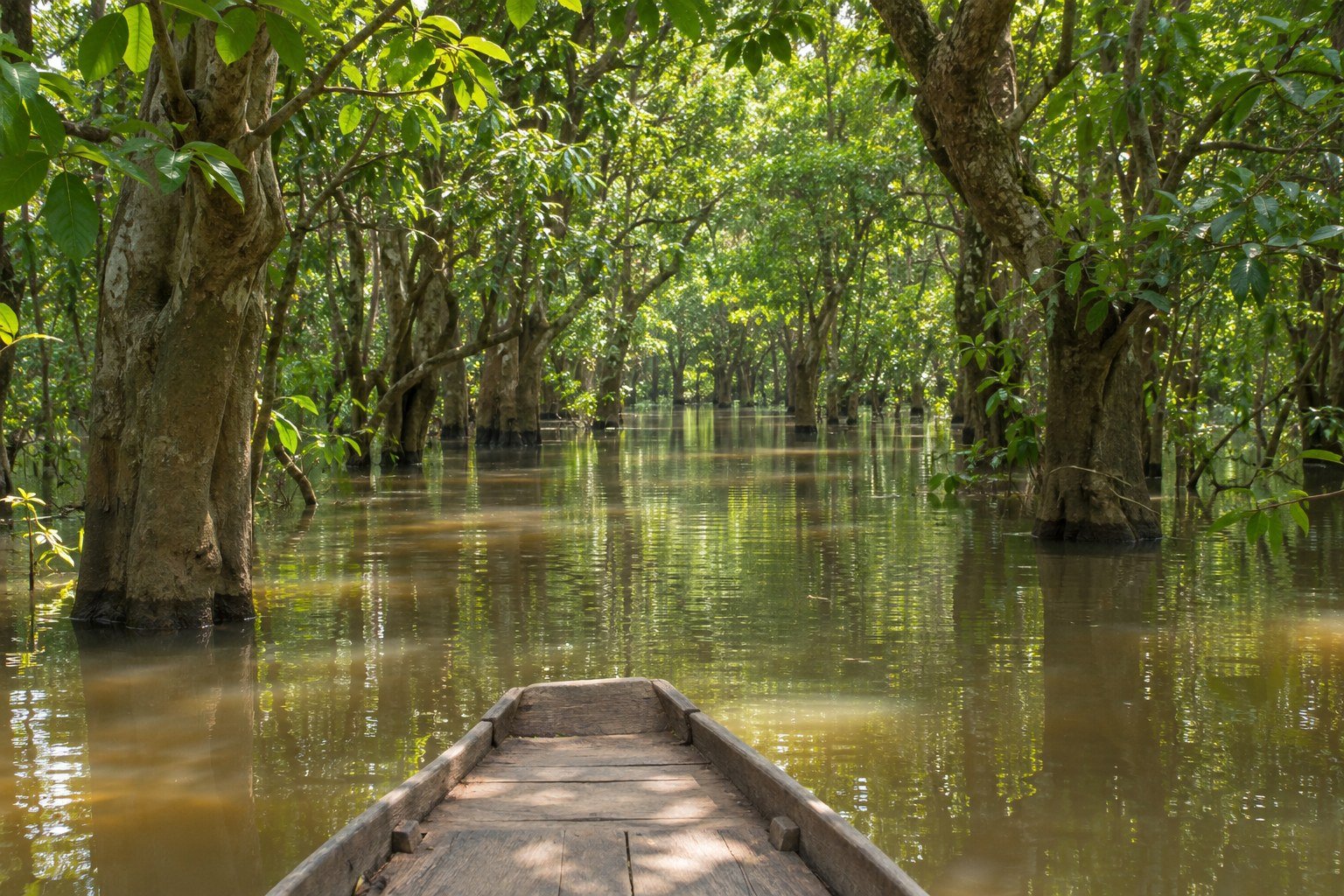
The flooded forest is freshwater habitat; “mangrove” is sometimes used in sales descriptions, but it is clearer to think of a seasonally flooded forest.[2] Avoid a booking that promises the same forest canoe experience every day of the year.

Use this operator scorecard before booking
The following is an editorial checklist for comparing answers, not an accreditation scheme. Give each row a green, amber or red mark. Green means a clear, specific answer; amber means you need clarification; red means an answer or practice you are unwilling to accept.
Swipe within the table to see all columns.
| Check | A convincing answer | Reason to pause |
|---|---|---|
| Local payment | Names the local boat, guide, meal or craft service being paid | Vague claims that “the village benefits” |
| Consent | Home or workshop visits are arranged with hosts, with photography optional | Residents treated as scenery or photographed without asking |
| Children | No orphanage tourism, staged child encounters or interrupted classes | Giving gifts to children is promoted as an activity |
| Costs | Boat, entry, transfers, extras and tips are clearly separated | Pressure to pay for an unexplained stop after boarding |
| Conditions | Explains today’s route and how weather changes it | A fixed promise regardless of water or weather |
| Boat suitability | Confirms lifejackets, capacity, boarding and return arrangements | Dismisses questions or expects you to accept obvious overloading |
Do not balance a red mark on child protection or boat safety against a cheap price. For an amber answer, ask once more in plain language; if it remains vague, compare another operator.
ChildSafe advises travellers against orphanage visits, disrupting schools, and giving money or gifts to begging children. It recommends supporting suitable businesses or organisations instead.[5] Some community-oriented itineraries still mention a school stop.[4] Ask whether pupils will be present and request an alternative that avoids child contact or disrupted lessons; an educational charity’s name is not enough by itself.
A useful message to send: “Please confirm the village, this week’s boat route, all extra charges, lifejackets for our group, and which local services our payment supports. We do not want school, orphanage or child-performance visits. What time should we expect to be back at our hotel?”
Build a realistic half-day around the boat trip
The two current Kampong Phluk listings advertise about five and six hours respectively. Hotel collections, the selected route and seasonal conditions explain why “half-day” should not be read as a quick two-hour gap.[6][7]
Swipe within the table to see all columns.
| Part of the outing | Time allowed | Why it matters |
|---|---|---|
| Hotel collection | 30 minutes | Shared pickups may start before the advertised departure |
| Road journey out | 1 hour | Allow for the actual departure point and traffic |
| Boarding and briefing | 30 minutes | Meet the boat crew and check your equipment |
| Village-and-lake boat route | 1 hour 30 minutes | Agree what the route includes |
| Agreed village stop or walk | 45 minutes | Depends on consent, access and water level |
| Short break | 15 minutes | Water, toilets or a pause out of the sun |
| Road journey back | 1 hour | Include return to your accommodation |
| Spare time | 30 minutes | Protect the rest of your day from small delays |
The rows add up to six hours. Ask the operator to replace them with its plan for your date. A forest canoe ride, a meal or sunset may need extra time; avoid assuming it all fits inside the same allowance.
Choose a morning outing if you want a relaxed evening in town. For sunset, accept that the road return will be later and check it carefully. Keep a flight, fixed bus departure or tightly timed show off the same afternoon plan where possible.
Back to top ↑Check the boat and boarding before you commit
FCDO notes accidents involving overloaded or poorly maintained boats, alongside hazards caused by weather and changing water levels.[8] A booking-platform rating cannot tell you the condition of the boat you will use that day.
Ask for a properly fitting lifejacket for each person, including children, and wear it. Check that access to it is immediate and that the crew explains boarding and what to do if conditions change. Decline a vessel that is visibly overloaded or an operator who refuses a basic safety question.
For anyone with limited mobility, ask about the actual transfer from vehicle to boat: steps, slopes, gaps, handholds and assistance. Request a recent photograph if useful. One of the current listings states that its tour is not wheelchair accessible; other departures need their own checks.[7]
Covered seating, a realistic toilet plan and a shorter route may matter more for a family than adding another stop. If a child is uncomfortable wearing the available lifejacket, the solution is a suitable jacket or a different outing—not taking it off once underway.

Compare the full cost and how money stays locally
Separate a road-only driver quote from a package that includes the boat and guide. Ask whether the charge is per person or per boat, whether the forest canoe is optional, and whether a meal or compulsory stop adds to the bill. An extra charge should be agreed before you board.
For a conventional Kampong Phluk visit, you can compare the boat-and-guide option on GetYourGuide and the Kampong Phluk tour on Viator. Both current descriptions list a separate charge for the optional small-boat forest excursion. Apply the scorecard to the operator and exact option before booking; these links are comparison starting points, not independent ethical certification.[6][7]
For a different focus, Osmose’s Prek Toal tours describe village visits, water-hyacinth weaving and meals, with birdwatching options. Its advertised half-day runs from 06:30 to 13:00, while its full-day is longer. The organisation says tourism payments support local services and its wider work; ask what your chosen departure includes. Its published itinerary also mentions an environmental education class, so request a visit without child contact or disruption to lessons.[9]
Once you have a quote, put the complete amount into the Travel Budget Calculator as an activity cost. Add optional items separately so you can compare the day you actually intend to take.
Buying an adult artisan’s work or an agreed meal can be a straightforward way to spend locally. Ask about the material, maker and price, then buy only if you want the item. A visitor should not feel obliged to make an unplanned donation or purchase to finish a tour.

Leave room for privacy and an ordinary working day
Photograph the wider setting first. Ask before taking a close photograph of an adult, and let people decline without explanation. Avoid looking into homes, blocking doorways or stepping onto private platforms simply because your boat is nearby. Cambodia’s embassy explicitly asks visitors to respect residents’ privacy.[1]
Leave photographs of children out of the visit. Do not hand out sweets, toys or money, and choose a transparent organisation if you wish to support longer-term work.[5] The same respect applies across the lake’s communities; ethnicity and distance from tourists do not make someone’s home more or less “authentic”.
Take drinking water, sun protection, a light rain layer and footwear with grip for the boarding point. Keep a phone and payment method protected from splashes, and bring only what you can carry easily. Ask where rubbish can be disposed of properly, or take it back to town.
A good guide can explain fishing, changing water levels and the places residents have agreed to share. That gives the outing substance without turning daily life into a performance.
Choose the clearest, most respectful offer
The strongest booking is the one that answers your practical and ethical questions clearly: the right route for current water levels, suitable boat arrangements, a transparent total and paid local services.
If the answers remain vague, or the visit depends on unwanted child contact, pressured spending or a boat you are uncomfortable using, choose another operator or another activity. Tonle Sap can be a valuable part of your trip when the experience works for residents as well as visitors.
Back to top ↑Practical questions
Is a low-water visit automatically a poor choice?
No. It can reveal the tall stilt structures and allow a different village route. It is a poor choice if you have been sold a high-water forest cruise that cannot operate. Ask for the current itinerary and decide whether that version interests you.
Is “community-based” enough to make a tour responsible?
It is a starting point for questions. Ask who provides the services, who receives payment, what consent is arranged and how children are protected. Specific answers are more useful than the label alone.
Can I arrange the road transfer and boat separately?
Yes, if you are comfortable confirming both parts. Agree the correct boarding point, the boat price and capacity, waiting time and the return vehicle before leaving town. A guide can add useful interpretation and help with arrangements, so compare the complete experience.
Sources and checks
- Royal Embassy of Cambodia in London — Things to Do in Siem Reap
Village orientation and privacy guidance; distances are approximate. Checked 15 November 2026. - UNESCO — Tonle Sap Biosphere Reserve
Freshwater habitats and seasonal expansion. Checked 15 November 2026. - Mekong River Commission — Geographic Regions
The Tonle Sap system’s seasonal inflow and outflow. Checked 15 November 2026. - Community First: Kampong Khleang — Shared Group Tour
Operator explanation of seasonal changes and itinerary; checked 15 November 2026. - ChildSafe — Seven Tips for Travellers
Child protection, school visits and responsible support. Checked 15 November 2026. - GetYourGuide — Kampong Phluk with Boat and Guide
Advertised five-hour duration and optional canoe supplement; checked 15 November 2026. - Viator — Kampong Phluk Floating Village Tour by Boat
Advertised six-hour duration, optional boat supplement and access information; checked 15 November 2026. - FCDO — Cambodia: Safety and security
Boat and seasonal travel risks; checked 15 November 2026. - Osmose — Prek Toal Eco-Tours
Operator-described community visits, timings and birdwatching options; checked 15 November 2026.
Illustrations in this article were created for Taylor’s Trailblazing Travels. Third-party photographs, where used, are credited beside the image or in the source list.