Chiang Rai Itinerary 2026: A Realistic 3-Day First-Time Plan
A city afternoon, a southern outing and a northern cluster, with time to look rather than just arrive.
Original Chiang Rai-inspired scene illustration, not a photograph or exact architectural record of a named temple.
A Chiang Rai itinerary works best when the famous sights are grouped into sensible journeys. The White Temple, Blue Temple and Baan Dam are not one continuous city walk, and the wider province is much larger than the cluster of photographs often used to advertise a day trip. A little structure creates a more rewarding visit than adding another distant stop.
This three-day plan uses one city base and two hotel nights. It begins with a lighter arrival afternoon, gives the White Temple and Singha Park a dedicated day, then places the northern sights on the final morning only when departure time allows. Doi Tung and the Golden Triangle remain genuine alternatives or reasons to extend, rather than compulsory extras.
Official visitor descriptions underpin the route, while conflicting fee and opening information is kept visible. The recommendations are researched planning judgements, not first-hand visit claims. Use the timing notes to adapt the plan to your actual flight or bus; the right route is the one you can enjoy without borrowing time from the departure.
Central Chiang Rai
Simple evening meals and a clear pickup point for each outing.
White Temple + park
A southern cluster with a landscape break after the art.
The ticket decides
Northern sights fit only when the onward departure leaves margin.
The wider province
Choose Doi Tung or the Golden Triangle instead of bolting both on.
Chiang Rai itinerary: a city base and two sensible clusters
Start with geography rather than a checklist
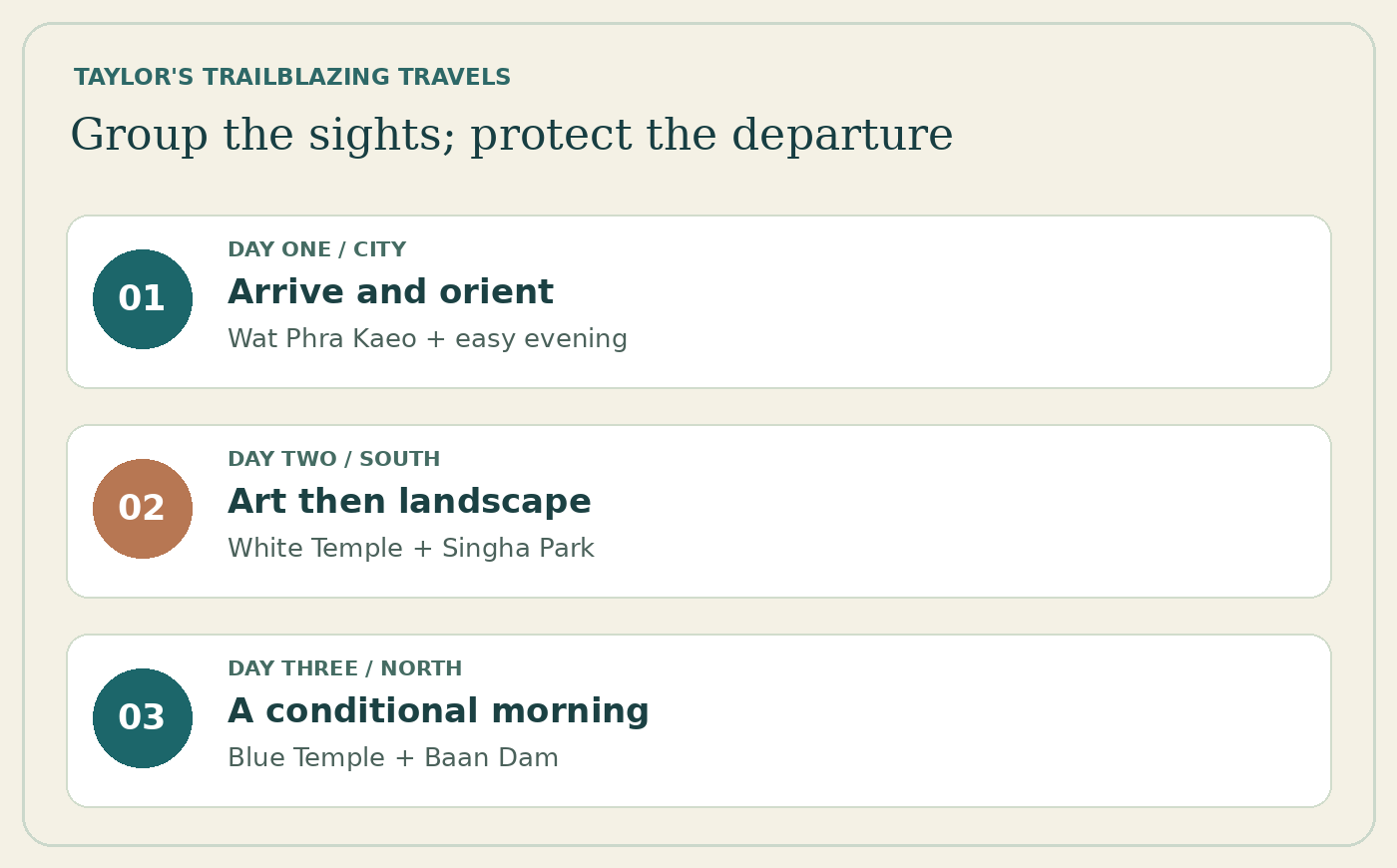
This Chiang Rai itinerary uses the city as a base, then separates the principal sights into a southern outing and a northern outing. Day one stays relatively close to the centre. The second day combines the White Temple with Singha Park. Day three pairs the Blue Temple with Baan Dam before departure, provided your onward transport leaves enough margin. That avoids crossing the city repeatedly just to follow a ranked list of attractions.
The default version assumes arrival by lunchtime on day one, two hotel nights and departure late enough on day three to accommodate a modest morning outing. These are three calendar days, not three completely free sightseeing days. With an evening arrival or an early departure, add a night or remove part of the programme. The missing time cannot be recovered by reducing every visit to a photograph.
How the plan was selected
The route combines official tourism descriptions, current attraction information and realistic sequencing rather than claiming personal guiding experience. It prioritises a historic city temple, contemporary temple art, an art museum and a landscape break. The Golden Triangle and Doi Tung appear as alternatives requiring a different emphasis or extra time, not as automatic additions to an already full day. [1][2][3][4][5][6]
| Day | Geographic group | Suggested programme | Constraint |
|---|---|---|---|
| 1 | Central city | Arrival, lunch, Wat Phra Kaeo, easy evening | Arrive by lunch or shorten the walk |
| 2 | Southern cluster | White Temple, lunch, Singha Park | Confirm opening and exact activity inclusions |
| 3 | Northern cluster | Blue Temple, Baan Dam if time, onward departure | Ticket and check-in requirements determine the finish |
Constructed route, 7 October 2026. Two hotel nights; additional provincial outings need substitutions or more time.
For a first visit, this balance gives Chiang Rai its own identity rather than treating it as a long excursion from Chiang Mai. You can eat dinner locally, adjust the order for weather and avoid making every decision around a return drive to another city. The principal compromise is that the wider province remains largely outside the route.
Arrival, departure and the two-night calculation
Arriving from Chiang Mai
GreenBus is an established option for the Chiang Mai–Chiang Rai corridor, with current services available through its own channels and transport platforms. Verify the terminals on the actual ticket: Chiang Mai Arcade Terminal 3 and Chiang Rai's central Terminal 1 commonly appear, but the city name alone is not a complete boarding instruction. Allow for reaching the station, check-in and the hotel transfer as well as the advertised ride. [7][8]
For planning, I would allow a substantial part of the morning for this move and keep the afternoon light. A departure that reaches Chiang Rai after lunch is still workable, but it should not be paired with a fixed-time visit far outside town. Store luggage, eat and settle in before deciding how much of the city walk feels comfortable.
Affiliate link. Check the exact option, total price, inclusions and cancellation terms before booking.
Arriving by air
A flight into Chiang Rai can fit this itinerary well when it arrives early enough to leave a usable first afternoon. However, the airport arrival time is not the moment you reach the hotel. Include baggage collection, the road transfer and any delay before assuming that a particular attraction can be visited before closing.
Affiliate link. Check the exact option, total price, inclusions and cancellation terms before booking.
Send your hotel the flight number when arranging a pickup and establish how the driver will contact you. A late arrival should lead to dinner and sleep, not a hurried version of the city programme. With only two nights, that changes what the trip can contain; the sensible response is to add a night or prioritise the sights you most want to see.
Choosing the departure time
A late-afternoon or evening flight leaves more room for the northern cluster than an early bus. Nevertheless, set a firm time to return for luggage and begin the airport journey. When leaving by bus in the early afternoon, shorten day three rather than assuming that two attractions, lunch, hotel checkout and the terminal transfer will all fit comfortably.
Affiliate link. Check the exact option, total price, inclusions and cancellation terms before booking.
The central rule is to work backwards from the operator's check-in requirement, not forwards from a list of sights. Keep a separate allowance for collecting bags and traffic. If you cannot build a credible margin, make the final morning a city breakfast and a single nearby visit instead.
Where to stay for two or three nights
Central Chiang Rai: the easiest default
For this route, a central hotel within a practical walk of dinner options is my first choice. It simplifies the first evening and makes it easier to arrange a single pickup for each out-of-town day. The useful question is not whether the listing says 'city centre', but whether its actual entrance connects conveniently with the places you intend to use.
Affiliate link. Check the exact option, total price, inclusions and cancellation terms before booking.
Look at the room's position as well as the hotel location. A street-facing room near evening activity may feel different from a rear room in the same building. Ask about stairs, luggage storage and early breakfast if these affect your departure. For a short stay, dependable basics can matter more than a long list of facilities you will not use.
Riverside hotels: attractive with a transport plan
A riverside stay can provide a calmer, more spacious hotel rhythm, but it may introduce a drive for ordinary dinners. Choose it because you intend to enjoy the property, not simply because a river photograph looks peaceful. Confirm the route into town and how you will return after dark before assuming that a map distance is an easy walk.
Affiliate link. Check the exact option, total price, inclusions and cancellation terms before booking.
This option works especially well when a driver will collect you for both sightseeing days and you are comfortable eating some meals at the hotel. Conversely, a solo traveller wanting spontaneous evening walks may prefer the centre. Neither is inherently better; the difference is how much transport you want built into daily life.
Budget rooms: spend on the right part of the trip
A simpler central room can free money for a properly organised driver day. Before reserving, check air-conditioning, bathroom arrangements and the amount of space needed for luggage. A low room price stops being useful when it creates repeated taxi journeys or an inconvenient departure morning.
Affiliate link. Check the exact option, total price, inclusions and cancellation terms before booking.
Where air quality is a concern, ask about the room's windows and any filtration actually provided rather than assuming an enclosed room solves every problem. Travellers with relevant health conditions should use official air-quality information and appropriate medical advice when deciding whether and how to visit. [9][10]
Day one: the city, Wat Phra Kaeo and an easy evening
A historical counterweight to the famous contemporary temples
Begin with lunch and a manageable walk from your hotel. Wat Phra Kaeo is a useful first temple because it connects the visit with Chiang Rai's historical religious importance rather than only its modern visual landmarks. TAT describes its association with the Emerald Buddha, which is now in Bangkok, and the jade image and museum within the Chiang Rai complex. Do not confuse the two cities' similarly named temples. [2]
Allow time to look at the setting rather than moving straight from entrance to camera position. Follow local instructions about shoes, clothing and photography, especially where worship is taking place. A quiet temple visit sets a different pace from tomorrow's more heavily photographed White Temple and makes the itinerary feel less repetitive.
Leave space between arrival and evening activity
After the temple, take a café or hotel break. This is particularly worthwhile if you travelled by bus that morning or are adjusting to the climate. A first afternoon does not need several additional temples to be useful. Walking a smaller area carefully can help you understand where to eat, where to meet your driver and how long ordinary movements take.
TAT's listing for Wat Phra Kaeo gives daytime visitor hours, but individual museum access can have its own arrangements. Check locally rather than assuming that every building remains open whenever the grounds are accessible. On a late-arrival day, move the visit to a spare city morning instead of racing against closing time. [2]
Dinner and the clock tower
For the evening, choose dinner in the central area and treat the clock tower as a short extra rather than the main event. TAT lists light-and-sound presentations at 19:00, 20:00 and 21:00, with each lasting about ten minutes; those published times were checked on 7 October 2026 and should be reconfirmed locally. Watch from a safe pavement position because the structure sits within an active road junction. [11]
The Night Bazaar area can provide an easy first-night meal, but do not assume that every market advertised online operates every evening. Weekend walking streets and regular evening trading are different things. Ask your hotel what is actually open that night, then choose a meal that leaves you rested for the following morning.
Day two morning: the White Temple without the rush
Give Wat Rong Khun its own attention
Arrange a pickup that reaches the White Temple early in its visitor day, after checking the current opening time. The attraction lies outside the central walking area, so this is the point at which a driver or a well-matched tour becomes useful. Carry suitable clothing and leave enough time to follow the prescribed route rather than treating the site as a quick roadside stop.
Wat Rong Khun is the contemporary project associated with artist Chalermchai Kositpipat. Its white surfaces and mirrored details are the obvious visual draw, but the experience also involves artwork and visitor rules within a functioning sacred setting. Respect signs about photography and movement, and allow other visitors to pass instead of blocking narrow sections for a photograph. [3]
The admission-price discrepancy worth knowing
When researched on 7 October 2026, the TAT attraction page still displayed a THB 100 foreign-visitor fee. However, Thai reporting reproducing the temple's announcement states that the foreign admission rose to THB 200 from 1 January 2026, including the cave-art exhibition. I would budget THB 200 and verify the current ticket at the entrance rather than repeat the older figure as current fact. [3][12]
That is a reported update supported by local coverage, not a claim that this article independently checked the ticket desk. Age or height exemptions and included extras should also be confirmed directly. Keep the fee separate from your transport price unless the tour explicitly includes admission, and avoid paying twice because a booking summary is unclear.
Choose interpretation or independence deliberately
A guide can be valuable when you want context and someone to manage the sequence of visits. A driver-only arrangement gives more control over pace but does not automatically include explanation of the art. Before reserving, ask whether the service provides a licensed guide, transport only, or a combination, and which admission charges remain payable.
Affiliate link. Check the exact option, total price, inclusions and cancellation terms before booking.
For a shared tour, inspect the full stop list. Some products try to combine the White Temple, Blue Temple, Baan Dam and distant provincial sights in one long day. That may suit a visitor with different priorities, but it does not match the slower, geographically grouped route used here. Choose the product for its actual itinerary rather than its thumbnail.
Day two afternoon: Singha Park and a slower finish
A landscape break rather than another temple
After the White Temple, have lunch before moving to Singha Park. TAT places the park close enough to the temple to make the pairing geographically sensible, and the operator describes landscaped grounds, tea-growing scenery and several activities. The purpose in this itinerary is to change the pace, not to collect every paid experience in the park. [4][13]
Choose a tram, a suitable walk or another activity according to the day's heat, weather and your group's interest. Do not assume that a large green area is comfortable to cross entirely on foot at midday. Ask about the route, the return point and the final departure time for any transport within the grounds.
Costs are for specific activities, not a universal pass
TAT's current listing showed a tram price of THB 150 for adults and THB 50 for children under the stated height condition when checked on 7 October 2026. That is an example for the tram, not a statement that all park activities are included. Confirm the applicable child rule, operating day and ticket terms locally. [4]
If animal-related stops are part of an offered route, you can choose not to participate. Equally, there is no need to add a zipline or another activity simply because it is available. The best use of this afternoon may be a landscape break, a drink and an earlier return to town after a detailed temple visit.
Keep the evening local
Return to your hotel with time to rest before dinner. This is a useful evening for trying a different central restaurant or taking a short market walk, provided the relevant market is operating. Avoid adding a remote sunset viewpoint to the end of the southern route unless you have consciously changed the day and agreed the extra driving.
A private arrangement should state the expected finish time and what happens if you extend it. A clear agreement protects both you and the driver from a vague 'one more stop' afternoon. When comparing tours, look for a route that genuinely includes the White Temple and Singha Park together rather than assuming the park can be inserted after booking.
Affiliate link. Check the exact option, total price, inclusions and cancellation terms before booking.
Day three: Blue Temple, Baan Dam and the departure buffer
Begin with Wat Rong Suea Ten
The Blue Temple, Wat Rong Suea Ten, belongs in the northern cluster for this plan. TAT describes its blue-toned contemporary design and identifies its artist connection to the White Temple's creative tradition. That makes it an interesting comparison, but not a reason to approach both places as interchangeable photo backgrounds. [5]
Arrive with enough time to look calmly and follow worshippers' lead about behaviour. Keep shoulders and knees appropriately covered, remove shoes where instructed and avoid interrupting people praying. A shorter, attentive visit can be more rewarding than repeatedly searching for a crowd-free angle while ignoring the temple's purpose.
Baan Dam is an art museum, not another temple
Continue towards Baan Dam only when your onward departure allows it. The Black House collection is associated with artist Thawan Duchanee and includes dark timber architecture, artworks and animal-derived objects. TAT identifies it as a museum, not a Buddhist temple. Some displays may be uncomfortable for children or visitors who dislike animal remains, so describe that honestly when deciding whether to include it. [6]
The TAT listing showed THB 80 admission and a 09:00–17:00 visiting window when checked on 7 October 2026. An older regional tourism listing also mentioned a midday closure. Because those descriptions differ, plan an early visit or confirm the day's opening arrangement rather than arriving at lunchtime on a tight departure schedule. [6][14]
Finish according to your ticket, not your enthusiasm
Set the latest acceptable departure from the museum before the visit begins. Your calculation should include the journey to the hotel if bags are stored there, collecting them, the airport or terminal transfer and the operator's check-in requirement. A direct transfer onwards can simplify the route only when luggage storage and the driver's arrangements are agreed in advance.
For an early bus or flight, drop Baan Dam first or move the Blue Temple to another available slot. Do not assume that a driver can solve a late departure by travelling faster. The route remains worthwhile with fewer stops; missing onward transport rarely improves it.
Doi Tung and the Golden Triangle: alternatives, not compulsory extras
Choose one wider-province day
Chiang Rai province extends far beyond the city attractions in this plan. TAT highlights highland landscapes around Doi Tung and the Mekong scenery associated with the Golden Triangle. Those places can justify a fuller day, but adding them after the southern or northern cluster changes the trip substantially. It is more honest to make them alternatives or extend the stay. [1]
For gardens and highland scenery, consider a Doi Tung-focused day with enough time for the chosen visitor sites and road journey. For Mekong geography and regional context, consider a Golden Triangle-focused route. Neither should be purchased solely because a tour promises the largest number of named destinations.
Affiliate link. Check the exact option, total price, inclusions and cancellation terms before booking.
A three-night version that actually gains something
With a third hotel night, keep days one and two broadly as planned, devote day three to one provincial outing and use day four for the northern cluster or departure, according to your ticket. Alternatively, complete the northern cluster on day three and leave the additional day deliberately open. Both approaches create usable time instead of merely another evening between rushed transfers.
Affiliate link. Check the exact option, total price, inclusions and cancellation terms before booking.
If your chosen tour involves a border crossing, that becomes a separate entry-permission and safety question. This itinerary does not require leaving Thailand, and you should not infer that a river excursion or a marketplace product includes valid entry arrangements for another country. Check current official travel advice and the exact route before paying. [10]
Do not add a dawn mountain trip casually
A sunrise viewpoint can involve very early driving, limited visibility and a long return. Ask about road conditions and the real start and finish times rather than treating it as a brief photo stop. When the forecast is poor, scenery may be hidden and the road journey may be the least comfortable part of the holiday. A city-and-art visit remains a complete trip without a mountain sunrise.
Choosing transport for the sightseeing days
Driver, guided tour or separate journeys?
A private driver is most useful when you want to group nearby sights, control breaks and avoid arranging a new ride after every visit. Alternatively, a guided tour can add interpretation and a clear day structure. Separate journeys offer flexibility in town, but become less convenient when you need a dependable return from an out-of-town attraction.
Ask whether the quoted service includes fuel, waiting, parking, the intended number of hours and the agreed finish point. Admissions and meals may remain separate. Furthermore, a driver who helps with logistics is not necessarily providing a guided cultural interpretation service; clarify the role rather than discovering the difference during the visit.
Send a brief the driver can actually price
A useful enquiry might say: two adults, pickup at the named central hotel, White Temple first, lunch at an agreed type of place, Singha Park afterwards and return to the same hotel. State whether you want a guide or transport only, and ask for the included hours, waiting policy and total vehicle price. This gives the operator a concrete service to quote instead of an undefined request to see the highlights.
For day three, provide the actual flight or bus time and explain where the luggage will be. Ask the driver to work backwards with you, identify the latest departure from the final attraction and confirm whether a direct terminal drop-off is included. Keep the answer in the same conversation as the agreed price. A screenshot of a generic itinerary does not replace that specific arrangement.
If the proposed schedule feels too compressed, remove a stop before confirming. Do not turn a reasonable transport quote into an unplanned longer day through a sequence of additions on the road. A clear brief makes the visit calmer for the travellers and fairer for the person providing the service.
Read a shared tour as a timetable
List the stops in their actual order and identify where lunch fits. Then consider how long remains for each attraction after driving and waiting. An itinerary with many distant stops can be efficient for a traveller who wants a broad introduction, but it is not the same experience as spending time with a smaller group of places.
For the northern cluster, compare whether a product begins in Chiang Rai itself and whether it can finish where you need it to. A tour from Chiang Mai may spend much of the day on the intercity road, so it is not interchangeable with a local departure even if the headline names the same temples.
Affiliate link. Check the exact option, total price, inclusions and cancellation terms before booking.
Avoid solving logistics with an unsuitable scooter rental
This plan does not depend on riding a scooter. Licensing, insurance, road conditions and your actual experience matter more than the apparent simplicity of hiring one. Government travel advice highlights the risks associated with road travel and motorcycles. A driver or suitable organised transport may cost more, but it removes the temptation to learn unfamiliar roads while navigating a busy sightseeing day. [10]
Meals, markets and a food-led alternative
Build meals into the route
Plan lunch between the White Temple and Singha Park rather than hoping everyone remains comfortable until late afternoon. Likewise, allow a proper breakfast before the northern outing and carry drinking water. Eating is part of the day's structure, not an interruption to be squeezed between attractions when the group is already tired.
For dinners, a central base makes it easier to choose according to appetite rather than commit far ahead. Ask what a dish contains and request the heat level you prefer, but recognise that a request is not a guarantee of allergen safety. Anyone with a serious dietary requirement should communicate it directly with the kitchen and choose venues that can provide a clear answer.
A cooking session can replace an attraction block
When temple fatigue sets in, a cooking class can provide a different way to spend a half day. Choose it as a replacement for part of the sightseeing plan, not as another obligation at the end of a long outing. Check whether market time, transfers, ingredients and the meal are included, together with the language and class size.
Affiliate link. Check the exact option, total price, inclusions and cancellation terms before booking.
This option is particularly useful for repeat visitors or families who prefer participating to moving between several buildings. Nevertheless, confirm dietary needs before booking and ask whether everyone cooks individually or shares tasks. The experience you want should determine the class, not simply a photograph of an attractive kitchen.
Budgeting for the three-day visit
Use one consistent unit
For two adults sharing a room, separate the two-night accommodation total from transport priced per vehicle and admissions priced per person. Add meals, arrival and departure transfers, and any optional guided experience. Comparing a per-person tour with a per-car driver price without adjusting for group size can produce a misleading conclusion.
| Item | Simple plan | More private transport | What the figure means |
|---|---|---|---|
| Two hotel nights | THB 2,000 | THB 4,000 | Assumed shared-room totals |
| Sightseeing transport | THB 2,500 | THB 4,500 | Constructed allowance; obtain a vehicle or tour quote |
| Admissions and park activity | THB 1,000 | THB 1,000 | Allowance, not a universal combined ticket |
| Meals and drinks | THB 1,800 | THB 3,000 | Combined spending assumption |
| Arrival/departure local transfers | THB 600 | THB 1,000 | Allowance depends on hotel and terminal |
| Illustrative total | THB 7,900 | THB 13,500 | Excludes intercity buses or flights and wider-province trips |
Constructed 7 October 2026, not live quotes. Two adults sharing; avoid duplicating admissions already included in a tour.
The sample allowances in the table were constructed on 7 October 2026 to demonstrate a two-night budget, not to advertise bookable prices. Replace them with your actual quotes and adjust the programme. Admission examples retain their source qualifications, particularly the reported White Temple update and the different Baan Dam opening descriptions.
Spend where it changes the experience
For a short visit, I would usually prioritise a convenient room and reliable transport over moving into a more distant hotel for a small room-rate saving. A guide may be worthwhile when interpretation is central to your interest in the art. Conversely, expensive room extras add less value when both days are spent out and the evenings are in town.
Keep a reserve for ordinary changes: a taxi after heavy rain, an additional café break or a revised departure arrangement. Budgeting should make those decisions easier rather than lock you into an unsuitable plan. Record which admissions and meals are included in each booking so the same item does not quietly appear twice in your spending estimate.
Season, air quality and a flexible day order
Look beyond a 'cool season' label
A pleasant temperature does not guarantee clear air or a safe road journey. Use the Thai Meteorological Department for current weather and the Pollution Control Department's Air4Thai service for local air-quality information. Check the date, monitoring location and pollutant information rather than relying on a single island-wide or province-wide screenshot shared elsewhere. [9][15]
For the route itself, you can swap the southern and northern clusters if the attraction hours and your transport allow it. However, do not move a long outing onto departure day simply because the previous day was wet. Preserve the departure margin and remove an activity when necessary.
Adapt the kind of activity, not just the order
During heavy rain, a landscaped park or a highland viewpoint may be less worthwhile than a shorter city visit and time indoors. Slippery surfaces can also affect temple approaches and museum grounds. Ask the hotel or driver about current local conditions, then choose what remains comfortable rather than treating the itinerary as a contract that must be completed.
Where air quality is poor, reducing exertion or changing the trip may be appropriate depending on your circumstances. This guide does not provide an individual medical threshold. Follow official health guidance and seek advice relevant to your own condition, especially for children, older travellers and anyone with heart or respiratory concerns. [9][10]
Keep communications simple
Save the hotel address, driver contact and return arrangements offline. A compatible eSIM can support maps and messaging, but check whether it includes voice calls and when validity begins. Keep a copy of your transport confirmation separately from a live booking app so a weak signal does not prevent you finding the terminal or showing your reservation.
Affiliate link. Check the exact option, total price, inclusions and cancellation terms before booking.
Access, temple etiquette and travelling with children
Ask about the physical route through each site
A building that looks accessible from the entrance photograph may still contain steps, uneven paving or a route that is awkward with a pushchair. Describe your needs to the attraction or transport provider and ask about the actual visitor route. Do not assume that assistance at the car door resolves every movement inside a complex.
For someone who tires easily, a shorter visit with a nearby rest stop can be more useful than attempting the complete grounds. Agree meeting points and allow extra time for rejoining the driver. The route's compact clustering helps, but it does not remove heat, walking or the need for comfortable breaks.
Explain the difference between the sights
Children may enjoy the visual contrast between the White and Blue Temples, but Baan Dam's animal-derived objects require a different judgement. Discuss what is displayed before entering rather than treating every attraction as automatically family-friendly. Skipping the museum can be a thoughtful adaptation, not a failure to complete the trip. [3][5][6]
At temples, dress respectfully, follow shoe-removal instructions and keep voices low where people are worshipping. Ask before photographing people closely and respect any restriction inside the buildings. These are working religious places as well as visitor attractions, so the best photograph is not always the most important consideration.
Pros and cons of this first-time route
The strengths of keeping the clusters separate
You get time in Chiang Rai itself, an introduction to different artistic and religious settings and a landscape break without constant cross-city driving. The itinerary also keeps the longest provincial excursions optional. That makes it easier to adapt for a tired arrival day or a group whose enthusiasm for another temple changes after the first two visits.
The limitations to accept
Two nights do not provide a comprehensive view of the province, and the out-of-town sights require transport. The final morning is only useful when the departure time supports it. Travellers mainly interested in highlands, trekking or the Mekong should extend the stay or choose a different route rather than expecting this city-focused introduction to cover everything.
Advantages
Different historical, contemporary and landscape experiences.
One hotel and grouped routes reduce repeated driving.
A wider-province day remains an explicit choice.
Trade-offs
Two nights do not cover the whole province.
Out-of-town sights need organised transport.
Final-morning sightseeing depends on the actual departure.
Common mistakes to avoid
Treating Chiang Rai as a miniature Chiang Mai
Do not assume the same transport options, neighbourhood pattern or concentration of walkable attractions. Build the route around Chiang Rai's actual clusters. A central room helps with evenings, but it does not make the White Temple, Singha Park and Baan Dam one continuous city walk. [1][3][4][6]
Copying an outdated entrance fee
The White Temple discrepancy is a useful reminder that an official-looking page can lag behind a later announcement. Keep the date and source beside a planning figure, carry enough for a reasonable change and check the current ticket terms. The same caution applies to special exhibitions, child concessions and museum lunch closures. [3][12][14]
Booking the final day before choosing onward transport
Choose the flight or bus first, then decide what fits before it. A flexible northern morning is useful; a fixed multi-stop tour ending shortly before check-in is not. Tell the operator about your onward booking before payment, and decline an itinerary whose margin depends on every visit and road section running perfectly.
Frequently asked questions
Is two nights enough for a first visit to Chiang Rai?
Two nights can support this focused route when arrival and departure leave useful time. An evening arrival or morning departure reduces it substantially, so three nights may be the more comfortable choice. The itinerary is designed around what can realistically fit, not around declaring that every traveller needs the same number of days.
Should I visit from Chiang Mai as a day trip instead?
A day trip can suit someone unable to move hotels, but it includes substantial intercity travel and normally gives less control over individual visits. Staying in Chiang Rai allows local evenings and separate attraction clusters. Compare the actual road time and stop list before deciding that a day tour provides the same experience as two nights in the city.
Can I combine the White Temple, Blue Temple and Baan Dam in one day?
Many organised routes do, but this itinerary separates them to reduce rushing and add variety. Combining them may be sensible with less time, provided the transport and visiting hours work. It does not leave unlimited room for Singha Park, the Golden Triangle and Doi Tung as well. A shorter list usually permits a more attentive visit.
How much should I budget for the White Temple in 2026?
Budget THB 200 for a foreign visitor based on reporting of the temple's increase from 1 January 2026, checked for this guide on 7 October 2026. The older TAT page still showed THB 100 during research. Verify the current admission and any exemptions directly rather than treating either an old listing or this guide as the ticket desk. [3][12]
Is Baan Dam suitable for young children?
That depends on the child and the adults' judgement. The collection includes animal-derived objects and a darker artistic presentation than the temples. Explain the content beforehand and be willing to skip the stop. A shorter northern morning or another city activity can be a better fit without undermining the wider itinerary. [6]
Do I need to hire a car or scooter?
No. The plan can be organised with a driver, appropriately chosen tours and local transfers. Clarify waiting time, pickup points and return arrangements before paying. Renting a vehicle introduces licensing, insurance and driving considerations that should not be treated as a casual solution to a short sightseeing itinerary. [10]
Can I add the Golden Triangle without another night?
Only by replacing a substantial part of the default programme and accepting the resulting travel day. It is not a minor detour between the central attractions. Adding a third night gives more room to choose a wider-province outing without squeezing the White Temple, park, northern cluster and departure into an unrealistic sequence. [1]
Final recommendation: let Chiang Rai be more than a photo stop
For a first visit, choose a convenient city base and protect three distinct blocks: a gentle arrival afternoon, a White Temple–Singha Park day, and a northern morning only when the onward ticket allows it. Use a driver or tour that follows that logic rather than adapting yourself to the longest advertised stop list.
The most useful upgrade is a third night when arrival or departure times are awkward, or when Doi Tung or the Golden Triangle genuinely matters to you. More time should create better visits and comfortable breaks, not simply more names in the itinerary. Chiang Rai becomes easier to appreciate when the route leaves enough space to look, eat and move without rushing.
Sources and fact-checking
Official tourism, operator, weather and pollution-control sources form the main evidence base. The White Temple admission update is explicitly attributed to Thai reporting of the temple announcement because the TAT page retained an older figure. Baan Dam opening descriptions differ, so a midday visit is not guaranteed. Budgets are labelled constructed examples.
- 01TAT – Chiang Rai destination overviewCity attractions and the wider Doi Tung and Golden Triangle context.Checked 7 October 2026.
- 02TAT – Wat Phra KaeoChiang Rai temple, Emerald Buddha association, jade image and museum.Checked 7 October 2026.
- 03TAT – Wat Rong KhunWhite Temple background; page retained older foreign admission during research.Checked 7 October 2026.
- 04TAT – Singha Park ChiangraiSouthern pairing and the listed tram-price example.Checked 7 October 2026.
- 05
- 06TAT – Baan Dam MuseumMuseum contents, listed admission and general visiting window.Checked 7 October 2026.
- 07GreenBus – official operatorCurrent bus routes and booking channels; ticket details govern boarding.Checked 7 October 2026.
- 0812Go – Chiang Mai to Chiang RaiTransport comparison; check the actual terminals and operator.Checked 7 October 2026.
- 09Pollution Control Department – Air4ThaiCurrent local air-quality monitoring; not a fixed seasonal guarantee.Checked 7 October 2026.
- 10FCDO – Thailand safety and securityRoad travel, health-related planning and current regional safety guidance.Checked 7 October 2026.
- 11TAT – Chalermphrakiat Clock TowerListed 19:00, 20:00 and 21:00 presentation examples.Checked 7 October 2026.
- 12Chiang Mai News – White Temple announcementThai reporting reproducing the THB 200 foreign admission announcement effective 1 January 2026.Checked 7 October 2026.
- 13Singha Park – official operatorLandscaped park and activity context; inclusions must be checked separately.Checked 7 October 2026.
- 14Regional TAT – Baan Dam MuseumOlder regional description mentions a lunch closure; the discrepancy is flagged.Checked 7 October 2026.
- 15Thai Meteorological Department – current weatherWeather and warning information for the travel dates.Checked 7 October 2026.
Illustrations in this article were created for Taylor’s Trailblazing Travels. Third-party photographs, where used, are credited beside the image or in the source list.