Thailand Island-Hopping 2-Week Itinerary
Phuket, Phi Phi and Koh Lanta, with a mainland Krabi finish and enough time between the boats.
This Thailand island-hopping 2-week itinerary follows one coherent Andaman route: Phuket, Phi Phi, Koh Lanta and a final mainland stay in the Krabi area. It gives you three different island experiences without trying to cross the country halfway through a short holiday. Krabi is the finishing gateway, not an island that has been quietly added to make the route sound more exotic.
The plan uses three nights on Phuket, two on Phi Phi, five on Lanta and three in Ao Nang or another suitable Krabi base. That is thirteen nights across fourteen calendar days. You arrive on day one and leave on day fourteen; international overnight flights outside that window need to be added separately.
I have designed the route around usable days, manageable transfers and a quieter finish before the flight. It is research-led planning judgement, not a personal journey report or a guaranteed operating timetable. Use the main Andaman version when the seasonal setting and current transport suit your dates; a lower-Gulf alternative appears below for a different seasonal choice. [1]
Affiliate disclosure: some links in this guide are affiliate links. If you book or buy through them, Taylor’s Trailblazing Travels may earn a commission at no extra cost to you.
13 nights
Fourteen calendar days include arrival and departure.
5 nights on Lanta
Time to enjoy a base instead of immediately packing again.
Mainland Krabi finish
The last essential sea stage is not beside the flight.
One regional cluster
Use the Gulf alternative as a replacement, not an extra circuit.
The Thailand island-hopping 2-week itinerary at a glance
Three islands, one mainland finish
Phuket provides an easier starting point with several ways to spend the first days. Phi Phi adds a compact scenery-focused stop. Lanta receives the longest stay because constant moving would defeat the purpose of reaching a slower island. The Krabi finish adds a different landscape and separates the last inter-island stage from departure. [2] [3] [4]
This is not the route for somebody determined to see every famous island in southern Thailand. It deliberately omits Koh Lipe, the Trat islands and a cross-country transfer to Samui. Those places deserve their own time. Adding one of them here should mean removing something else, not pretending that a long transfer will fit into a spare afternoon.
| Days | Where you sleep | Nights | Purpose |
|---|---|---|---|
| 1-3 | Phuket | 1-3: 3 nights | Arrival, beach and food/culture |
| 4-5 | Phi Phi | 4-5: 2 nights | One clear scenery-focused full day |
| 6-10 | Koh Lanta | 6-10: 5 nights | A settled stay with optional outings |
| 11-13 | Krabi / Ao Nang | 11-13: 3 nights | Peninsula outing and an easier finish |
| 14 | Depart from Krabi | No hotel night in this plan | Road transfer and departure |
Suggested itinerary, not a transport timetable. Total: 13 nights. Krabi and Railay are mainland settings.
Who this route suits
It works best for travellers comfortable with several hotel changes and boat travel, but who still want proper time in a beach base. A family with very young children, a traveller with significant boarding difficulties or somebody who dislikes boats may prefer Phuket and Lanta with a mainland finish, omitting Phi Phi. The simpler route is an equally valid holiday.
Choose the season before buying the ferries
Use the coast as the first filter
Thailand's beach seasons differ between regions. For this Andaman route, investigate the usual more favourable beach-travel period first, then check the actual operator schedules and national-park access for your dates. Do not assume that every boat or excursion shown in a winter travel account also runs in the same way throughout the year. [1] [5]
During a southwest-monsoon-period holiday, I would compare the lower-Gulf alternative before committing to several Andaman sea stages. That is a planning preference, not a prediction that one coast will have perfect weather. A larger-island stay with fewer crossings may be a better answer than trying to preserve every stop regardless of conditions.
Put the high-consequence connection last
The final flight is usually less flexible than a beach afternoon. Therefore, arrange the itinerary so that the last essential sea crossing is not scheduled immediately before it. The three Krabi nights in this route provide a settled ending and make the final airport transfer a separate, simpler planning task.
Before paying, check the cancellation and amendment rules for the rooms and transport together. A refundable hotel is less useful if the only practical onward connection has restrictive conditions. The route should remain understandable when one stage changes, not depend on every supplier operating at the most optimistic advertised time.
Days 1 to 3: arrive on Phuket and find your rhythm
Day 1: keep the first evening deliberately easy
Arrive on Phuket, take the transfer you have arranged and settle into one accommodation base. Do not book a same-day island excursion after a long flight. Immigration, baggage, the road journey and the time needed to feel human again all belong in the day, even though none appears in the beach photographs.
Choose somewhere with an ordinary meal available nearby. Check tomorrow's plans, save the address offline and stop trying to extract another highlight from the evening. A calm arrival makes the following days more enjoyable and removes the need to solve several transport problems while tired.
Day 2: one beach area and one useful orientation outing
Use the first full day to learn the immediate area. Find the appropriate beach access, a place for lunch and the collection point for any booked activity. Swim only when local conditions and flags allow. A famous beach name is not permission to ignore the advice in front of you. [6]
Keep the rest of the day small. Walk within a manageable area, spend time by the pool or choose a short outing that does not require repacking the day around transport. You will have more opportunities for scenery later; this day is about establishing a comfortable base and recovering from the journey.
Day 3: add Phuket's food or cultural side
Choose a food-focused outing, a cooking session or a visit to Phuket Old Town rather than another compulsory full day afloat. Tourism-authority information highlights the old town's built heritage and visitor setting; a guided walk can be useful when you want context rather than simply a collection of photographs. [7]
If a sea excursion is the main reason for your Phuket stay, use this day for it only when conditions and the operator's plan are suitable. Otherwise, keep the land activity. Pack for tomorrow in the evening and confirm the pier collection, so the first island transfer begins with a clear plan rather than a last-minute search.
Day 4: Phuket to Phi Phi is a transfer day
Read the destination pier carefully
Travel from Phuket to Phi Phi using a service that fits your accommodation. Route information distinguishes the main Ton Sai arrival area from other possible hotel or pier arrangements. The correct choice is not necessarily the first or cheapest departure in a search result; it is the one that makes the whole arrival practical. [8]
As a planning allowance checked against route information on 3 October 2026, reserve roughly half a day for the complete hotel-to-hotel move. The published boat duration is only one component. Add the road transfer, check-in, boarding, unloading and final walk or boat connection to the property. This allowance is not an operator's guaranteed timetable.
Let the arrival afternoon stay light
After checking in, learn the route to meals and the next day's meeting point. A short walk or a suitable nearby beach can be enough. Avoid booking an expensive activity that begins immediately after the ferry's advertised arrival, because a modest delay would turn a manageable travel day into a rushed one.
Choose the Phi Phi room with its surroundings in mind. Convenience near the arrival area and a quieter, more removed resort are different products, with different meal and transfer arrangements. Neither is automatically better. Confirm the practical details before booking rather than discovering that the atmosphere you wanted requires another unplanned journey.
Day 5: make Phi Phi's one full day count
Pick the reason you came
Choose one main activity: a responsible boat excursion, a beach-focused day or a manageable viewpoint outing. The islands' limestone scenery and coastal setting are the reason for this stop, but you do not need to experience every advertised variation in one day. A smaller programme leaves time to enjoy the accommodation and surroundings. [3]
For a boat trip, ask which sites are intended, what happens if conditions change, whether fees are included and how boarding works. Do not assume that a tour described as 'island hopping' offers equal time for swimming, walking and photography. The actual itinerary should match the experience you want.
Treat Maya Bay as a regulated visit
If Maya Bay is included and open, follow the current park instructions. The operator guidance checked for this article states that swimming there is prohibited. A visit should not be sold to yourself as the day's guaranteed swimming highlight, and a restriction is not something to work around by following another visitor into the water. [9]
Keep the evening unhurried. Confirm tomorrow's Lanta connection, check the departure pier and repack so that documents and essentials remain accessible. Two nights on Phi Phi provide one full day, not two; recognising that before arrival is what keeps the stop enjoyable rather than frustratingly overcommitted.
Day 6: Phi Phi to Koh Lanta, then stop moving for a while
Compare direct and combined products
The route search between Phi Phi and Lanta includes different boat and combined-transfer options. Because Phi Phi is an island, a listing with a van or taxi component is not a continuous road-only journey. Open the actual product and identify every stage, the arrival point and whether the final hotel transfer is included. [10]
For a direct boat itinerary, leave several hours around the move rather than planning the day to the shortest advertised crossing. A combined service may take longer and involve a handover. These are reasons to read the ticket, not reasons to assume the most convenient description represents the whole journey.
Choose a Lanta base you can use daily
On arrival, prioritise a comfortable room, meals and a straightforward beach routine. The five-night Lanta stay is the route's deliberate pause. It should not immediately become a new sequence of long daily transfers simply because you have reached a different island.
Khlong Dao, Long Beach and other west-coast areas deserve comparison according to your group's needs. Ask about the exact beach frontage, access and local transport rather than choosing only by a sea-view photograph. A central room can save money and effort over several days, while a secluded property works best when that is the holiday you actually want. [4]
Days 7 and 8: Lanta's beaches and a change of scene
Day 7: make an ordinary beach day a real part of the trip
Spend the day near your base. Walk a manageable stretch of shore, swim where conditions and local advice permit, and return to the room when you feel like it. There is no need to book a trip simply to prove that the itinerary contains an activity on every line. This is the first full day of the longer stay you deliberately chose.
Use the afternoon to decide whether the next days need more structure. A family may value another familiar pool-and-beach day; a couple may want a land outing; a solo traveller may prefer an organised class. The decision should follow your interests and energy, not a generic assumption that a quiet island needs to be escaped every morning.
Day 8: choose a land-based contrast
Lanta's old-town area and other landscapes provide a different perspective from the west-coast beach setting. Arrange a suitable return journey and keep the outing geographically sensible rather than trying to cover every part of the island. The tourism authority identifies the old town, mangroves and beach areas as different aspects of the destination. [4]
Alternatively, choose a cooking session or another activity that genuinely interests the group. Check the meeting point, included transport and accessibility before booking. A meaningful half-day can leave room for a relaxed evening, whereas a full list of scattered stops can turn a slower island into another transport exercise.
Days 9 and 10: one optional sea day, one day left open
Day 9: an excursion only if it fits
Use this as the first-choice day for an offshore activity when the relevant site is open, conditions are suitable and the operator's plan matches your ability. National parks can have seasonal or partial closures, so check the exact attraction rather than assuming that every nearby island follows the same calendar. [5]
Ask about time on the boat, entry into the water and the level of supervision. A trip that looks gentle in photographs may involve a ladder, deep water or a long crossing. The right choice is the one appropriate for the least confident participant, not the one with the largest number of stops.
Day 10: keep a genuinely flexible day
This day can absorb a moved excursion, provide another beach day or simply allow rest. Do not quietly fill it with a second expensive booking before leaving home; that would remove the flexibility it was designed to provide. A buffer only works when it is available to use.
In the evening, confirm the Krabi transfer and the accommodation's collection point. Check whether the vehicle goes directly to your next hotel, what luggage is included and whether any intermediate change is involved. Repacking after five nights should be straightforward because tomorrow's job is to move, not to combine three activities with the journey.
Day 11: Koh Lanta to the Krabi area
Choose the transfer by the final address
Compare a suitable shared vehicle with a private transfer for the whole group. The relevant questions are collection location, luggage space, likely intermediate stops, child-seat availability where needed and the final drop-off. A per-person shared fare and a per-vehicle private quote should not be compared as though they use the same unit. [11]
A Lanta road itinerary can include a short vehicle-ferry element; do not interpret the word 'van' as proof of an entirely uninterrupted road journey. Ask the operator to describe the route. For planning on 3 October 2026, I would keep much of this day clear rather than attach a fixed afternoon excursion to an optimistic arrival estimate.
Why Ao Nang works as a finishing base
A suitable Ao Nang address can support the final days' beach and boat outings while keeping luggage in one place. However, choose the room's actual setting rather than assuming every property with an Ao Nang address is close to the seafront or convenient for your group. Confirm the route to meals and the pickup point for departure.
On arrival, take a short orientation walk and arrange tomorrow's outing only once the local conditions and boarding details are clear. The mainland finish should feel easier than another hurried island stop. Give yourself permission to use the afternoon for a meal, laundry or the pool instead of chasing one more highlight.
Day 12: Railay and Phra Nang, with a clear return plan
A peninsula reached by boat
Railay is a mainland peninsula, not another island on the route. Tourism-authority information highlights Railay West and the Phra Nang setting as key attractions. A visit adds limestone scenery and a different beach environment without requiring another hotel checkout, which is why it fits well near the end of this itinerary. [12]
Before departure, establish where the boat leaves, how boarding works and how the return is arranged. Tides and conditions can affect the practical experience. Travellers who need easy or step-free access should ask for a specific description rather than assume a short crossing is automatically a simple transfer.
Let the place set the pace
Choose a manageable walk and beach time rather than trying to combine every cave, climbing activity and viewpoint into one visit. Some activities require appropriate skills, equipment or a guide; an attractive map label is not enough information to attempt them independently. The day can be rewarding without becoming an adventure checklist.
Stay clear of working boat approaches and follow the local swimming instructions. If the water is unsuitable, enjoy the scenery and return for another activity near your base. A day planned around a flexible outing is more resilient than one that depends on a particular photograph or swim happening at an exact time. [6]
Days 13 and 14: finish without a last-minute sea gamble
Day 13: the final full day belongs to you
Use the day for whatever the trip still needs: a quiet beach visit when suitable, a meal, a short land outing or time to do very little. Avoid making it the only possible day for an expensive offshore excursion. You have already had opportunities for boat-based activities, and the final day is more useful when it remains adaptable.
Check the flight, baggage allowance, pickup time and destination airport. Save the transfer confirmation and ask the hotel where the vehicle will collect you. Pack with the next journey in mind, including a dry layer and access to documents. These ordinary tasks make departure easier without consuming the whole evening.
Day 14: leave the Krabi base for the airport
Arrange a road transfer with enough time for the airport process and the conditions on your day. The exact collection should follow the flight and operator's advice, not a generic minimum quoted for everybody. If you have a separate onward flight, remember that its connection rules may differ from a through-ticket.
The route ends here. A late international flight elsewhere in Thailand may require another domestic connection or an additional night, and that should be booked explicitly. Do not hide a Bangkok hotel or a long airport transfer outside the itinerary merely to preserve the appearance of a fourteen-day plan.
A lower-Gulf alternative for a different seasonal choice
Keep the same principle, change the cluster
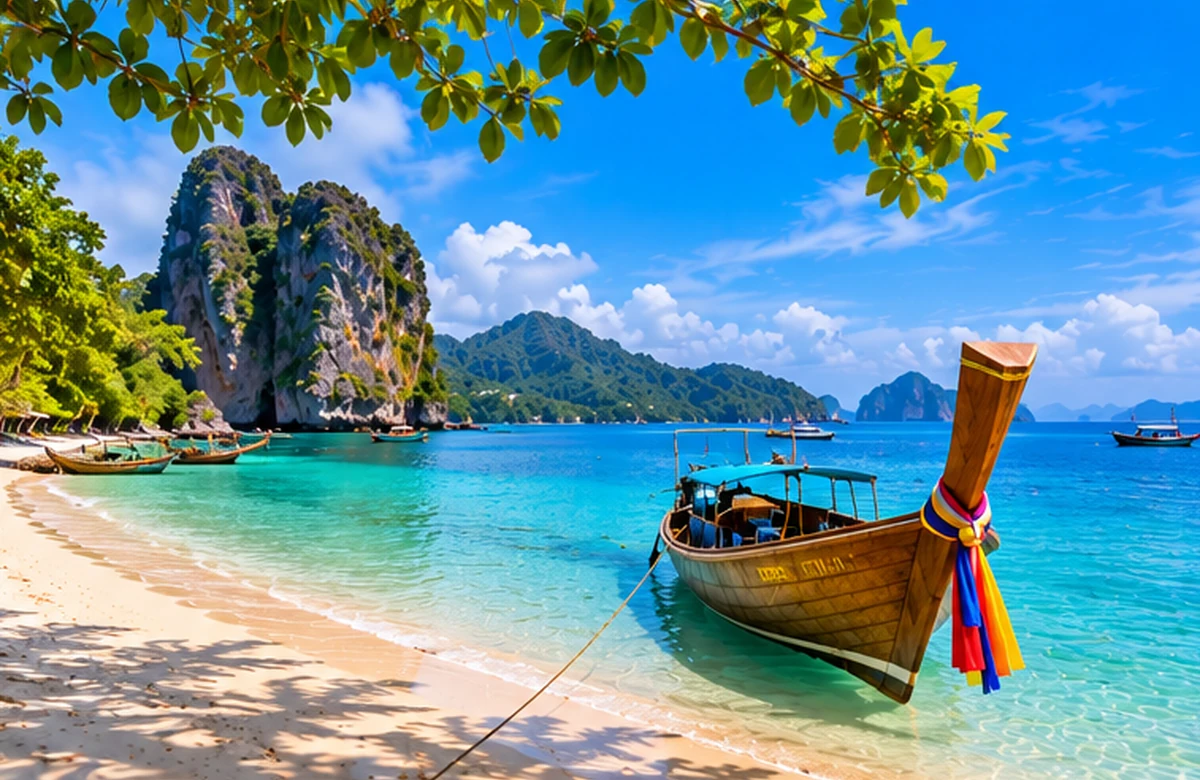
For a lower-Gulf version, use four nights on Samui, four on Phangan, three on Tao and two back on Samui. The total remains thirteen nights. Samui supports the beginning and end, Phangan provides a settled beach stay, and Tao belongs in the route when its water activities or setting are a genuine interest. [13] [14] [15]
This is an alternative route, not an extra circuit to bolt onto the Andaman plan. Crossing between coasts within two weeks can be justified for a particular purpose, but it should not happen simply because both sets of islands appear in a search result. Choose one cluster and give its destinations enough time.
Remove a stop when it improves the holiday
Skip Tao if another sea journey would be tiring or if nobody particularly wants the activities associated with it. Add those nights to Samui and Phangan instead. Conversely, travellers with a strong Tao interest can shorten another stay and spend longer there. The itinerary should follow the reason for travelling, not an obligation to preserve every name.
Check the current piers and sailing products through the actual operator. The last Samui nights separate the return crossing from departure, but they do not make every disruption impossible. Read the terms and retain a reserve for changes, especially when flights and ferries are independently booked. [16]
Booking order that prevents incompatible reservations
Start with the non-negotiable dates
Confirm the arrival and departure airports, then identify any room or activity that genuinely determines the route. Check that the connecting transport works before paying for a chain of accommodation. This is particularly important when a remote hotel includes a specific boat transfer or when a route operates differently by season.
Next, book the principal rooms and the essential inter-island stages with compatible terms. Keep weather-dependent excursions flexible where possible. The aim is not to leave everything undecided; it is to commit first to the parts that make the holiday possible and later to the parts that depend on conditions.
Read the arrival instructions as a set
Save each hotel's address, the transfer pickup point and the operator contact together. A ticket saying 'Phi Phi' does not establish that it serves your particular resort, and a pickup described as 'Phuket' may cover only specified areas. Ask before payment when the wording is not clear. [8]
Finally, check how duplicate names are written. Island names, beach names and piers can have several English spellings, while similar hotel names may refer to different properties. Use the booking address and map pin rather than assuming that a short name in a message is enough to identify the destination.
A stage-by-stage transfer checklist
Phuket hotel to the Phi Phi accommodation
Write down the Phuket collection address, departure pier and arrival pier as three separate fields. Then identify the final route to the Phi Phi room. If the property requires another boat, establish whether it is included, how it is coordinated and what happens when the main service arrives late. A ticket to Ton Sai should not be treated as a universal hotel transfer. [8]
For a beach hotel on Phuket, ask whether collection is available from that exact area and whether the quoted time is a window or a fixed appointment. Keep the first contact number accessible rather than relying on the hotel to identify a driver booked elsewhere. This is especially useful when several companies collect from the same entrance and use similar vehicle descriptions.
Phi Phi accommodation to the Lanta room
Check whether the departure requires a walk from the hotel or a separate resort transfer. Ask where bags must be presented and how early to be there. On the Lanta side, confirm whether the ticket ends at a pier or includes a named hotel zone. A longer combined product may be more convenient than a shorter crossing followed by an unarranged road journey. [10]
Where two operators handle different stages, record who is responsible for the handover. The word 'combined' should lead to a clear explanation of the connection, not an assumption that somebody will recognise you and organise everything automatically. Keep all parts of the confirmation together so you can show the intended final destination without searching through several messages.
Lanta hotel to the Krabi finishing base
For a shared vehicle, confirm the collection window and whether additional hotel pickups are expected. For a private quote, check that the price applies to the whole group, the luggage and the correct final address. Families should request any necessary child-seat arrangement explicitly rather than assume it comes with the vehicle. [11]
Compare two complete options before choosing. The cheaper shared total may be entirely suitable when time is flexible, while a private transfer can make sense for several travellers or a specific mobility requirement. The decision should be based on the actual product, not on the assumption that private always means luxurious or shared always means inconvenient.
Krabi hotel to the departure airport
This final transfer deserves the same care as the more photogenic sea stages. Confirm the airport, terminal information supplied by the airline, collection address and baggage needs. Work backwards from the required airport arrival rather than forwards from the shortest advertised driving time. Leave the hotel with the documents and clothing needed for the flight readily available.
If you have arranged a separate onward connection, keep its details visible too. The end of the island route is not necessarily the end of the travel day. A clear final transfer protects the relaxed finish that the mainland nights were designed to provide, instead of allowing a small administrative mistake to undermine the whole departure.
What to change when a sea stage no longer works
Remove a destination before compressing every other stay
If the Phi Phi stop becomes impractical before travel, one simple revision is three nights on Phuket, seven on Lanta and three in Krabi. The total remains thirteen nights. Check an appropriate Phuket-to-Lanta transfer for the dates and the group, and confirm the revised rooms before cancelling or changing existing reservations. Do not assume every ticket or rate can be amended without a charge.
This revision preserves the route's logic: an accessible beginning, a longer slower island stay and a mainland finish. It is generally more coherent than keeping Phi Phi at all costs while reducing Lanta to a brief stop and moving the final crossing closer to the flight. The omitted island can be a reason for another trip rather than a problem to solve through hurried travel.
Distinguish a pre-trip redesign from an on-the-day disruption
When a change happens during the holiday, follow the operator's current instructions and establish safe accommodation before making new connections. A sensible alternative on paper may not be available immediately. Check the actual options, costs and cancellation rights rather than treating this example as a guaranteed emergency route.
What the two-week budget actually needs to include
Use consistent units
Count thirteen room-nights and fourteen days of food, then add transport and activities for every traveller. A ferry fare is not a per-couple cost, while a private car quote may cover the vehicle rather than each person. Make the units visible before deciding whether the itinerary fits the budget.
Also account for the small connecting pieces: hotel-to-pier transport, final hotel transfers, luggage charges where applicable and airport collection. These are not automatically included in a route search's headline price. Read each offer's inclusions rather than adding a vague allowance and hoping it covers everything.
A worked example for two adults
Using editorial allowances prepared on 3 October 2026, thirteen room-nights at THB 2,800 total THB 36,400. Fourteen days of food at THB 1,100 for two total THB 15,400. Add THB 12,000 jointly for the selected transfers and THB 10,000 jointly for activities: the working total is THB 73,800 before flights, insurance and a separate reserve.
These are chosen planning inputs, not a claim about current average prices or a set of bookable quotations. Replace them with actual offers for your dates. If the total is too high, shorten the list of paid excursions, choose different rooms or remove a hotel change before sacrificing the buffer around the final journey.
| Two-adult budget line | Worked input | Amount |
|---|---|---|
| Rooms | 13 x THB 2,800 | THB 36,400 |
| Food | 14 x THB 1,100 | THB 15,400 |
| Selected transfers | Joint allowance | THB 12,000 |
| Activities | Joint allowance | THB 10,000 |
| Working total | Before flights, insurance and reserve | THB 73,800 |
Editorial allowances prepared 3 October 2026, not a bookable package or market averages.
Luggage, laundry and communication between islands
Pack for repeated handling
Choose luggage that you can manage through the boarding arrangements you have booked. Keep documents, essential medication, a dry change and valuable electronics accessible and protected. Do not assume that every transfer has step-free access, a dry landing or staff available to carry everything for you.
Plan laundry during the longer Lanta stay, but confirm the turnaround before handing over clothing you need for departure. A smaller wardrobe with a realistic washing point can be easier than carrying enough for every day. Leave space for repacking damp items separately so that one wet transfer does not affect the whole bag.
Keep the itinerary available without live internet
Store confirmations and addresses offline, and make sure companions know the next accommodation name. A travel eSIM can support messages and maps, but check the handset, activation rules and whether the plan includes only data. It is a useful tool, not a guarantee of coverage or ordinary voice calling.
On each transfer evening, review only the next stage rather than repeatedly rebuilding the whole holiday. Confirm the pickup, luggage and arrival plan, then stop planning. A clear route should reduce the amount of administration you do on the trip, not become a daily project that competes with enjoying it.
Safety, accessibility and environmental choices
Match the activity to the person
Discuss swimming confidence, mobility and comfort on boats before booking. A short crossing can still involve difficult boarding, while a calm-looking bay may not be suitable for an inexperienced swimmer. Follow local flags and choose appropriate supervision rather than relying on an island's reputation or a tour's broad description. [6]
Children need active supervision around pools and the sea, and suitable equipment should be confirmed with the operator before travel. Do not assume that a general 'family-friendly' label explains lifejacket sizes, vehicle child seats or the practical boarding process. Ask about the exact requirement that matters to your group.
Let responsible restrictions change the plan
National-park closures, no-swimming zones and operator cancellations are part of travelling in a natural environment. Check the relevant rules and accept that some experiences may not be available. Avoid choosing a replacement operator solely because they will promise something that another has declined on safety or access grounds. [5]
Observe marine life without touching or feeding it, and avoid standing on coral. Keep litter with you and use designated access. The aim is to enjoy the island landscape without treating it as a set of facilities that must remain available on demand throughout your holiday. [15]
Pros and cons of this island-hopping route
What the route does well
It provides a clear beginning, a short scenery-focused middle stop, a longer beach stay and an easier mainland finish. The night distribution gives the trip some rhythm rather than repeating the same two-night pattern everywhere. You have time to learn a place instead of spending every second morning finding another departure point.
The route also makes its limitations visible. Krabi is a gateway, not an island; transfer days are not counted as full beach days; and a seasonal alternative is offered instead of pretending that one circuit is equally suitable all year. Those choices make the plan easier to adapt to an actual traveller.
What it asks you to accept
There are still several checkouts and boat stages. Somebody who mainly wants rest may prefer fewer destinations, while a traveller with boarding difficulties should investigate alternatives carefully. The route also leaves out worthwhile places. That is deliberate: two weeks cannot give every island a meaningful visit without spending too much time in transit.
Use the plan as a coherent starting point, not a test to pass. Removing Phi Phi, extending Lanta or spending longer on Phuket can improve the holiday for a particular group. The successful version is the one whose compromises you understand and whose ordinary days you look forward to.
Advantages
- One coherent coast rather than a cross-country race
- A longer slower middle stay
- A mainland finish before departure
Trade-offs
- Several checkouts and boarding stages remain
- Some travellers will prefer fewer stops
- The route intentionally leaves out other islands
Common island-hopping mistakes
Counting nights incorrectly
Fourteen calendar days normally contain thirteen nights when arrival is day one and departure is day fourteen. If you add fourteen hotel nights, the trip extends into another day. International overnight flights can complicate the picture further, so write the actual dates beside each night before booking anything non-refundable.
Another mistake is equating sailing duration with the transfer day. Road collection, check-in, baggage, unloading and the final hotel journey can take a substantial share of the day. A route that looks efficient only when those pieces are omitted will feel much busier in practice. [8]
Booking every optional experience in advance
A full page of prepaid excursions may look organised, but it removes the flexibility needed for weather, energy and changing interests. Book the essential experiences and leave enough room to respond. A day without a ticket is not an unfinished itinerary; it may be the most useful day in the whole plan.
Finally, do not add a final island to avoid feeling that you have missed out. The cost includes another transfer, another check-in and less time in the base you already chose. A good two-week holiday is selective. It does not need to prove that every nearby destination was technically reachable.
Frequently asked questions
Is this itinerary really fourteen days?
Yes: it uses thirteen nights, with arrival on day one and departure on day fourteen. The allocation is Phuket three, Phi Phi two, Lanta five and Krabi three. Add any international travel nights or separate gateway stop outside that window explicitly rather than assuming they fit inside it.
Is Krabi an island in this route?
No. The final Krabi-area stay is a mainland base, chosen for a different setting and a more manageable departure. Railay is also a peninsula, despite its usual boat access. The route contains three principal island stays and a mainland finish; the distinction is intentional. [12]
Can I do the route without staying on Phi Phi?
Yes. Remove those two nights and redistribute them between Phuket and Lanta, checking the direct transfer that fits your dates. This can be a better choice when fewer checkouts, less boat travel or a slower pace matter more than an overnight scenery stop. The holiday does not become incomplete by omitting one island.
Is the Andaman version suitable for July?
Investigate the seasonal setting and current services carefully before committing. For a July beach-led holiday, I would compare the lower-Gulf alternative first and consider fewer crossings. Neither route guarantees weather, and every swimming or boat decision should follow local conditions and the operator's current advice. [1]
Should I book a speedboat because it is faster?
Not automatically. Compare the whole transfer, the vessel, boarding and luggage arrangements, and your comfort with the journey. A faster crossing may not produce the best overall day for a family or somebody who dislikes smaller boats. The ticket's detailed description matters more than the shortest duration in a search result.
Can I catch a flight straight after a final ferry?
I would avoid making an expensive or inflexible flight depend on a separate same-day ferry. This route deliberately finishes with mainland nights. A buffer cannot remove every possible disruption, but it reduces the pressure created by a plan that assumes the shortest crossing and a punctual arrival will always occur.
Is five nights on Lanta too long?
Not for a holiday that values time to settle in. Five nights provide several full days for a beach routine, a land outing and an optional excursion without constant packing. Travellers who prefer a busier setting can redistribute the nights, but the slower middle section is a deliberate strength of this route.
What should I remove if the budget is too high?
Start with a hotel change, a room upgrade or an optional paid excursion. Compare the total savings rather than cutting small useful items at random. Retain enough time and money around the final journey to handle a change; an itinerary that is affordable only when everything runs perfectly is not comfortably budgeted.
My final recommendation for two weeks of island-hopping
Keep one coast, give each island a purpose and count transfer days honestly. Phuket, Phi Phi and Lanta provide enough contrast for a first Andaman circuit, while the Krabi finish makes the departure less dependent on a final sea crossing. The lower-Gulf route follows the same logic when that regional choice better suits the trip.
Book the foundations, not every hour. A comfortable base, an understandable transfer and a few experiences you genuinely want are more valuable than a crowded list of island names. The best version of this itinerary leaves you with time to enjoy the places between the boats.
Sources and fact-checking notes
Research reviewed on 3 October 2026. Official destination, meteorological, safety and provider material informs the factual context. The comparisons, routes and budget allowances are editorial planning judgements, not personal inspection reports, forecasts or guaranteed quotations. Confirm current access, conditions and booking details for your own dates.
- Tourism Authority of Thailand: choosing a beach seasonRegional seasonal context. Climate patterns are not forecasts for a particular date or year. Reviewed 3 October 2026.
- Tourism Authority of Thailand: PhuketDestination setting and variety of visitor activities. Reviewed 3 October 2026.
- Tourism Authority of Thailand: Ko Phi PhiIsland scenery and accommodation-setting context. Reviewed 3 October 2026.
- Tourism Authority of Thailand: Ko LantaBeach variety, old-town and island-setting context. Undated practical absolutes were not adopted. Reviewed 3 October 2026.
- Tourism Authority of Thailand: 2026 national-park closure resourceAnnual and partial closures differ by attraction. Reconfirm the individual park for the year and date of travel. Reviewed 3 October 2026.
- FCDO: Thailand safety and securityCurrent swimming, sea and transport cautions. Follow local warnings; this is not a beach safety certification. Reviewed 3 October 2026.
- Tourism Authority of Thailand: Phuket Old TownBuilt heritage and cultural setting. Historic pandemic-era instructions on the page are not used as current travel rules. Reviewed 3 October 2026.
- 12Go: Phuket to Phi Phi route comparisonUseful for actual product and pier comparisons. Generic route text can mix products or contain dated claims; rely on issued ticket details. Reviewed 3 October 2026.
- Simba Sea Trips: Maya Bay visitor rulesOperator guidance supports the no-swimming restriction. The page contains inconsistent current-open wording, so no live opening claim or specific future timetable is taken from it. Reviewed 3 October 2026.
- 12Go: Phi Phi to Koh Lanta route comparisonIndividual sea and combined-transfer products, not a continuous road-only journey from Phi Phi. Reviewed 3 October 2026.
- 12Go: Krabi and Koh Lanta transfer comparisonShared/private and road/sea product differences. Reverse journeys require their own dated search. Reviewed 3 October 2026.
- Tourism Authority of Thailand: Railay BeachPeninsula beaches and boat-access context. No fixed fare or guaranteed departure is assumed. Reviewed 3 October 2026.
- Tourism Authority of Thailand: Ko SamuiIsland setting and activity variety, not live hotel or flight availability. Reviewed 3 October 2026.
- Tourism Authority of Thailand: Ko Pha-nganBeach names and the distinction between the wider island and its party reputation. Reviewed 3 October 2026.
- Tourism Authority of Thailand: Ko TaoIsland activities and responsible observation of marine life. Promotional or undated practical claims were not adopted. Reviewed 3 October 2026.
- Lomprayah: official ferry informationActual services, piers and issued booking conditions must be checked for the chosen date. Reviewed 3 October 2026.
Illustrations in this article were created for Taylor’s Trailblazing Travels. Third-party photographs, where used, are credited beside the image or in the source list.