Thailand Food Itinerary: 10 Days
Thailand Food Itinerary: 10 Days
Three culinary settings, one meaningful food experience at a time.
A Thailand food itinerary should leave you enough appetite to enjoy the next meal. Ten days of constant market-hopping and oversized tasting menus quickly turns curiosity into fatigue. This route instead gives each destination a different job: Bangkok introduces the variety, Chiang Mai explores northern cooking, and Phuket finishes with the island's distinctive southern and Chinese-influenced food culture.
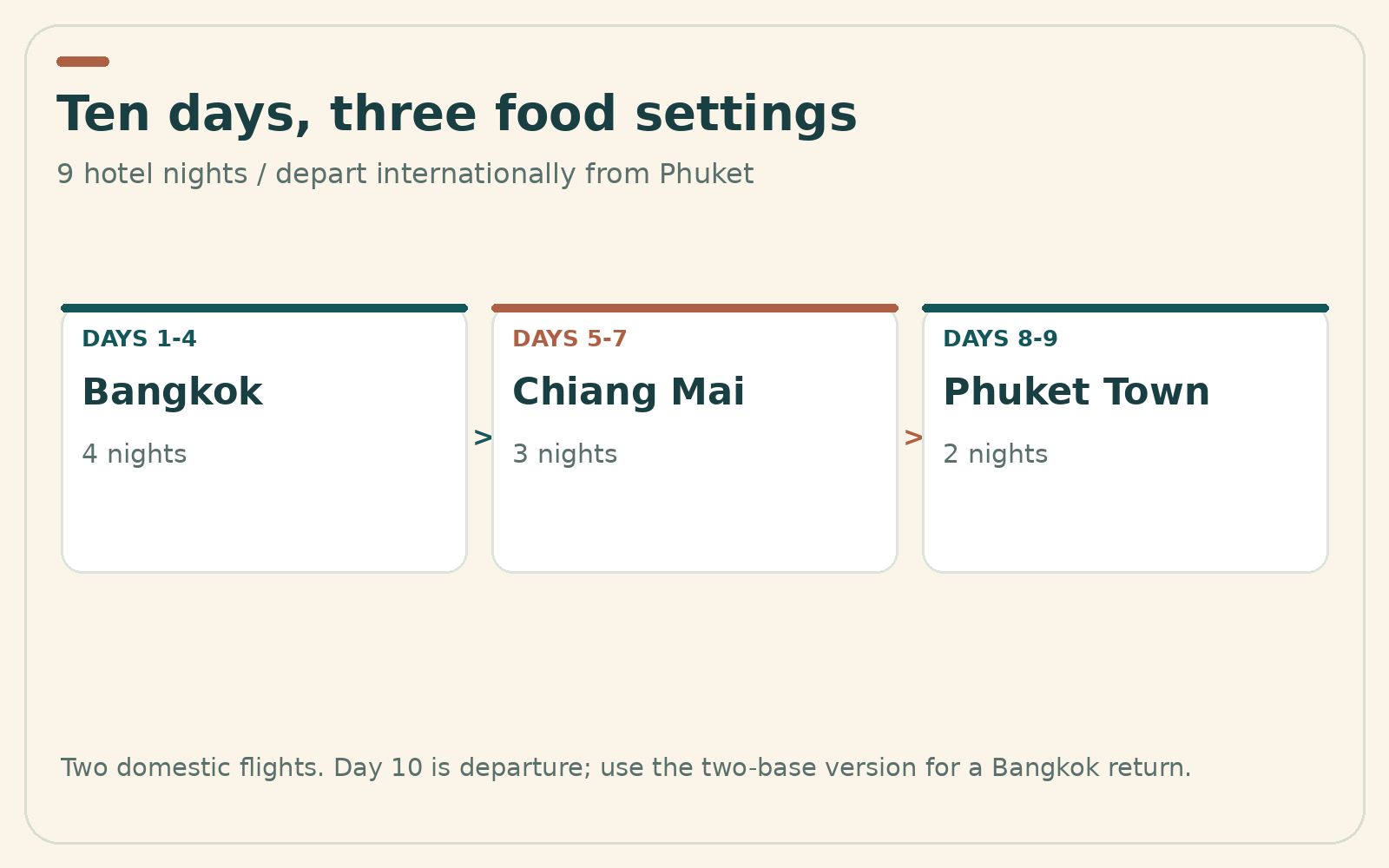
The main version uses four nights in Bangkok, three in Chiang Mai and two in Phuket, departing internationally from Phuket on day ten. It therefore requires two domestic flights and an open-jaw international itinerary, or an equivalent protected onward arrangement. Travellers flying home from Bangkok should use the two-base alternative below rather than squeeze in an extra unprotected flight on the final morning.
This is a research-led eating plan, not a list of restaurants I claim to have personally tested. Dishes and neighbourhoods were selected for regional contrast, practical grouping and the chance to understand ingredients. Restaurant examples come from current primary listings and are starting points to check, not a ranking determined by awards or affiliate commission. [1]
This article contains affiliate links. If you book or buy through them, Taylor’s Trailblazing Travels may earn a commission at no extra cost to you. The route recommendations are based on the planning considerations explained in the guide.
Bangkok neighbourhoods
Compare markets without crossing the city all day.
More than khao soi
Leave room for a regional meal and a class.
Stay around Phuket Town
Keep breakfasts and dinners within useful reach.
One food anchor each day
Protect appetite and leave the rest adaptable.
Thailand food itinerary: the route and the appetite budget
Three destinations, three different purposes
Bangkok is useful for comparing dishes, market formats and neighbourhoods without pretending the capital represents a single regional cuisine. Chiang Mai then gives northern food its own space. Finally, Phuket Town makes sense as a culinary base in its own right, rather than treating food as something fitted between beach transfers. Phuket has belonged to UNESCO's Creative Cities Network in the gastronomy category since 2015. [2]
The order avoids returning to Bangkok between the north and Phuket when a suitable direct flight is available. Nevertheless, book that flight before committing to the three-base plan. A connection that consumes the whole day or arrives late at night leaves very little value in a two-night Phuket finish. [3]
| Days | Base | Nights | Food focus |
|---|---|---|---|
| 1-4 | Bangkok | 4 | Arrival meal, riverside/Chinatown, daytime market and cooking class. |
| 5-7 | Chiang Mai | 3 | Northern dishes, a food walk and a different class or slower market day. |
| 8-9 | Phuket Town | 2 | Southern and Phuket food traditions; one full town-based food day. |
| 10 | Depart Phuket | 0 | A final breakfast only when the flight timing allows it. |
The main route requires suitable Bangkok-Chiang Mai and Chiang Mai-Phuket flights, then departure from Phuket. A Bangkok-return alternative is explained below.
Give each day one anchor
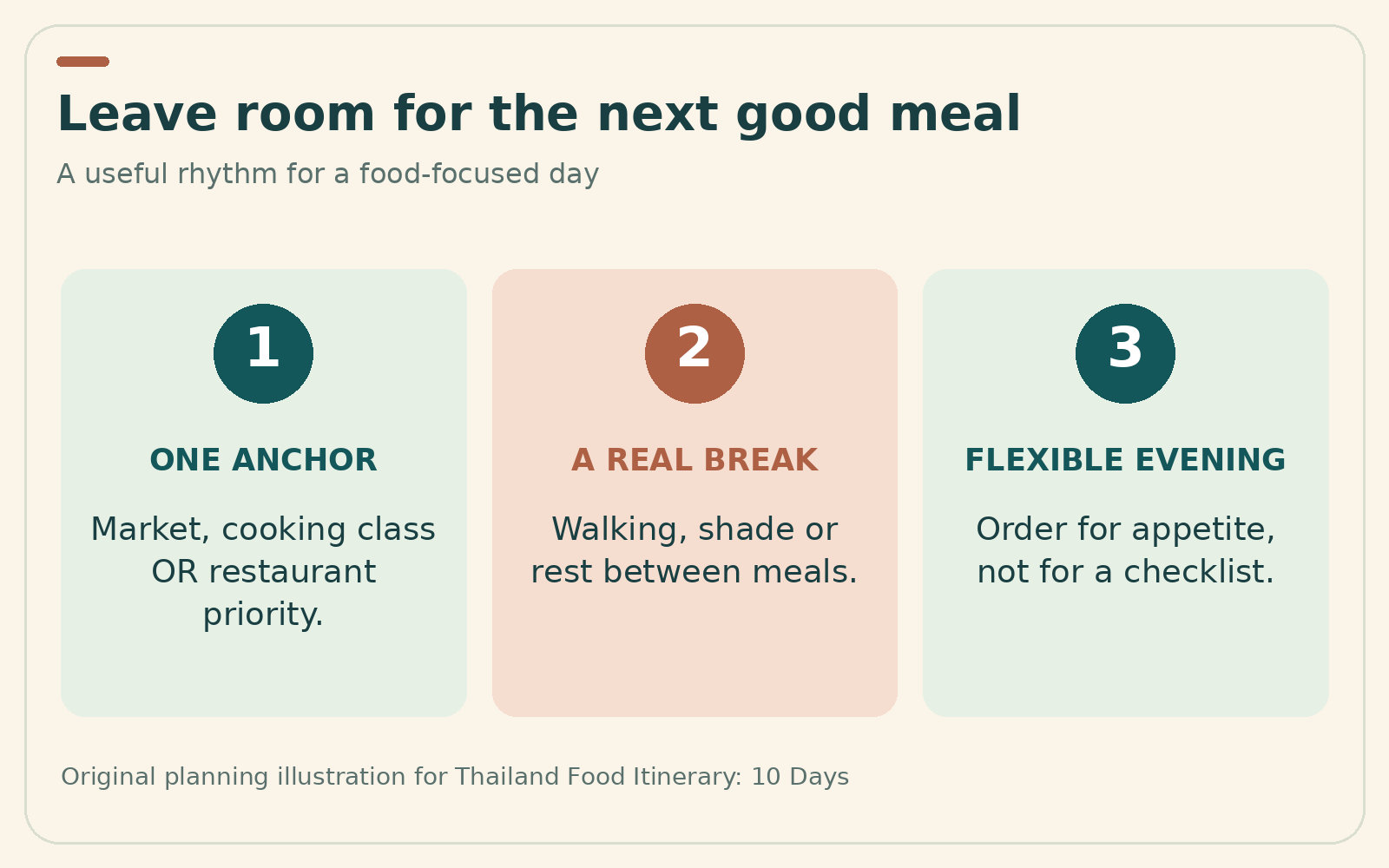
An anchor is the meal or experience worth organising the day around: a breakfast market, a cooking class, a guided walk or a restaurant reservation. Everything else stays adjustable. This is more effective than pre-booking breakfast, lunch, an afternoon tasting and dinner, then discovering that the first outing supplied enough food for several meals.
For two people, sharing a few dishes can create variety without requiring a huge order. However, ask about portion size and the kitchen's sharing arrangements instead of assuming every item can be divided conveniently. A modest first order is easy to supplement; an enormous order cannot restore your appetite for later.
Day 1: arrive in Bangkok and keep dinner simple
The first meal is not a performance
After a long flight, find something satisfying close to your hotel. A freshly prepared rice or noodle dish is a sensible introduction, but choose according to your own dietary needs and appetite. This is not the evening to cross the city for a restaurant that stops taking orders shortly after your scheduled landing.
Check the accommodation's late-arrival procedure and identify a backup meal option before travelling. A nearby seated restaurant can be more useful than an exciting market that is awkward to reach with bags. Meanwhile, avoid promising yourself a long walking tour before you know how tired or delayed you will be.
Choose the hotel for eating, not only sleeping
For this version, prioritise a location with easy access to the riverside, the old city or urban rail, depending on your chosen food stops. A bargain room far from those areas may add transport costs and discourage a second outing after an afternoon rest. The best base is the one that supports the actual plan, not the one with the most impressive lobby.
If breakfast is included, decide whether it genuinely helps. Paying for a large hotel buffet every morning can work against an itinerary built around local breakfasts. On the other hand, familiar food and an early opening time may be valuable for families or travellers managing specific dietary requirements.
Day 2: Bangkok's river neighbourhoods and Chinatown
Start with a compact daytime area
Choose Bang Rak or a nearby Charoen Krung cluster for breakfast and a short walk, rather than hopping between famous dishes scattered across the city. TAT's riverside food guide groups food stops around several piers; use that geographical logic rather than treating every historic shop name as a guaranteed current recommendation. Check your chosen venue directly. [4]
Order one main breakfast, then leave time for a drink and a walk. Notice whether the dish is prepared to order, how the menu is organised and what customers are eating at that time of day. These observations are more informative than trying to complete an arbitrary list of ten foods before lunch.
Give Chinatown a separate evening
Yaowarat and neighbouring Talat Noi have strong Thai-Chinese trading and culinary connections, documented by TAT. However, they are not interchangeable experiences: an evening food outing and a daytime heritage walk answer different interests. Avoid turning both into a single long march through the hottest hours. [5]
A guided Chinatown food walk can be worthwhile when you want help reading menus and understanding unfamiliar dishes. Before booking, ask how much walking is involved, what is included, how dietary requirements are handled and whether the route uses shared dishes. A tour description saying 'local food' is not enough to determine suitability.
Day 3: a daytime market and a properly spaced dinner
Visit Nang Loeng for a different market rhythm
Nang Loeng is a useful contrast with the evening energy of Chinatown. TAT identifies it as a long-established market known for savoury food and traditional desserts. Plan it as a daytime visit, then verify the individual stalls you particularly care about; market opening hours do not guarantee that every vendor trades throughout the whole period. [6]
Arrive hungry enough for lunch, but do not buy everything immediately. Walk the area once, choose a main dish and then decide whether dessert still appeals. This is especially helpful with a group, where everyone spotting a different snack can produce an accidental feast before the planned meal.
Use the afternoon to make dinner better
Take a break rather than filling the gap with another eating attraction. A museum, a short shaded walk or time back at the hotel creates a useful change of pace. Afterwards, choose dinner according to what you have not already eaten: something vegetable-led, a different cooking method or a lighter meal rather than another version of lunch.
Keep restaurant ambitions realistic. A famous name with a long queue may be enjoyable when it is the day's main event, but less appealing when everyone is tired. Decide in advance how long you are willing to wait and save a nearby alternative. That is a practical fallback, not a failure to find the 'best' food.
Day 4: learn to cook rather than just ordering
Choose a class with a clear teaching format
A cooking class works well after several days of tasting, because you have questions to ask. Compare how much time is spent cooking, whether each person has a workstation, the class size and the menu. A market visit can add context, but it should not substitute for the hands-on time you expected.
Ask whether ingredients and recipes are explained in a way you can use at home. For a British kitchen, it is helpful to discuss realistic substitutions without assuming that every specialist ingredient will be available locally. Meanwhile, explain allergies before paying, rather than hoping the instructor can redesign a shared kitchen on arrival.
Count the class meal as a meal
Many cooking experiences finish with eating what you prepared. Therefore, avoid scheduling a large lunch immediately before the class or a fixed tasting menu straight afterwards. Keep the other meal light and leave enough time to pack for Chiang Mai without rushing across town again.
Before bed, check the next day's departure airport, baggage allowance and flight status. Food plans do not cancel the practical demands of travel. A morning flight may provide a useful Chiang Mai afternoon, but only when the early start is compatible with the rest you need.
Day 5: Chiang Mai and the first northern comparison
Arrival deserves a simple lunch
After reaching Chiang Mai, drop the bags and choose one northern dish rather than launching straight into a long tasting circuit. Khao soi is an obvious starting point: TAT describes the northern curry-noodle dish with its contrasting soft and crisp noodles. Think of it as an introduction, not the complete story of northern Thai cooking. [7]
Khao Soi Mae Sai is one research-based option to investigate. Its Michelin listing identifies it as a noodle restaurant on Ratchaphruek Road and currently lists daytime service with a weekly closure. Check those details for your actual date, and have another nearby choice if the shop is closed or the queue is unsuitable. [8]
Set up a base for walking and resting
Stay in or around a part of Chiang Mai that suits your selected restaurants and activities. Being able to return to the hotel between lunch and dinner can be more useful than remaining out all day. However, 'old city' is not a guarantee that every chosen venue is a short walk away; check each actual address.
For the evening, choose a different texture and format from lunch. A shared northern meal can introduce dips, vegetables and a curry rather than another noodle bowl. Ask about ingredients and heat before ordering, and choose enough plain rice or another suitable accompaniment for everyone at the table.
Day 6: explore beyond khao soi
Build contrast into a shared meal
Northern cooking offers more than one familiar signature. TAT's regional overview identifies dishes such as sai ua, chilli dips and northern-style curries. A useful meal might compare a grilled item, a dip and a cooked vegetable dish, rather than ordering several rich dishes that all play the same role. Menus and ingredients differ, so let the kitchen explain what is available. [1]
Huen Muan Jai is a potential starting point for this kind of meal. Michelin's current listing describes its northern Thai menu and a setting with several seating formats. Use that listing to decide whether it fits your needs, then contact the restaurant for a reservation or dietary question rather than assuming the guide itself takes bookings. [9]
A guided walk should add knowledge
Choose a Chiang Mai food walk when you want explanations you would not easily obtain alone: the difference between dishes, the role of particular ingredients or how a market changes through the day. Ask what makes the itinerary northern rather than simply a collection of popular Thai dishes found everywhere.
Leave the afternoon or evening after the tour flexible. Sampling portions can add up, and a guide's final stop may be more substantial than expected. Afterwards, a short stroll and a small meal may make a better evening than forcing another restaurant reservation into the schedule.
Day 7: a northern cooking lesson or a slower market day
Make the second class genuinely different
Taking two cooking classes is worthwhile only when the second adds something distinct. Compare the Chiang Mai menu with the Bangkok class before booking. A regional focus, different ingredients or a deeper look at curry pastes can justify the extra experience; repeating the same menu in another garden is less compelling.
Ask whether the class has indoor or sheltered teaching areas and how transport is arranged. A rural location can be attractive, but it also adds travel time and may leave you dependent on a scheduled return. Factor that into the evening, particularly when you need to prepare for an early flight the following morning.
The alternative is not an inferior day
Skip the class when you would rather revisit a favourite dish, browse ingredients or spend time doing something unrelated to food. Returning to a place you enjoyed can be more revealing than constantly searching for a new discovery. You might order differently, compare a second preparation or simply eat without navigating an unfamiliar menu.
This is also the best point to consider whether three destinations still suit you. When the onward flight is awkward or the weather undermines your intended Phuket plans, extending Chiang Mai and returning to Bangkok may be the better holiday. Flexible bookings preserve that choice.
Day 8: fly to Phuket and stay near the food
Check the direct flight before designing the day
AirAsia MOVE currently displays direct Chiang Mai-Phuket options, but schedules and availability vary. Select a flight that leaves useful arrival time rather than relying on an example departure from a general search page. Include airport transfers, check-in and baggage collection when estimating the day, not just the time in the air. [3]
Once on Phuket, stay in or near Phuket Town for this itinerary. A west-coast beach resort can be a good choice for another holiday, but repeated cross-island journeys work against a short food-focused visit. The relevant question is how easily you can reach your chosen breakfasts and dinners without planning a major transfer each time.
Make the first southern dinner distinctive
Use the first evening for a meal that introduces Phuket's particular food traditions rather than repeating Bangkok favourites. One Chun is a research-based option: its Michelin listing highlights southern Thai cooking and mu hong, a slow-cooked pork dish. Treat that as a menu lead, not a promise that every diner will enjoy the same dish or that availability cannot change. [10]
Order conservatively when you are tired from travel. Ask about portion size, ingredients and heat, then add more if necessary. A comfortable table and time to understand what you are eating can matter more than trying to see the whole old town after dark.
Day 9: a full Phuket food day
Start with a breakfast you have not already repeated
TAT describes several strands of Phuket breakfast culture, including dim sum, roti with curry and khanom chin. Choose one according to your preferences rather than treating them as three consecutive compulsory stops. The point is regional variety over the holiday, not maximum volume in one morning. [11]
After breakfast, walk a compact old-town route and take a proper pause before lunch. A food tour can provide useful interpretation here, particularly when you want context about the island's culinary influences. However, compare its stops with what you have already planned so you do not pay to repeat the same meals.
Give lunch and dinner different jobs
A noodle lunch and a shared evening meal can offer a useful contrast. Phuket food references include Hokkien-style noodles and mu hong, but your choice should also reflect the ingredients you can eat and what the kitchen is making that day. You are not obliged to order a dish simply because it appears in a regional guide. [11]
Leave a short list of possibilities rather than an exact dish-by-dish timetable. That gives room for a closed venue, a full restaurant or an unexpected recommendation from a knowledgeable local cook. Meanwhile, keep tomorrow's departure arrangements settled so the final dinner is not interrupted by transport research.
Day 10: finish without a rushed airport meal
One last breakfast, only when the flight allows it
For a later departure, repeat a favourite breakfast or try one remaining nearby option. For an early flight, arrange something straightforward and leave on time. The final morning is not the place to justify an extra cross-island detour because a restaurant was missed yesterday.
Book the airport transfer for the correct terminal and departure, following the airline's check-in instructions. Confirm how traffic or a changed pickup time will be handled. Phuket Town and the airport are not the same place, so a convenient hotel breakfast does not remove the need for a substantial transfer allowance.
Do not bolt on an unprotected Bangkok connection
The three-base itinerary assumes an international departure from Phuket or a properly planned onward arrangement. If your international ticket instead departs Bangkok, do not casually insert a same-morning domestic flight and call the route finished. Separate-ticket disruption can leave you responsible for the missed long-haul departure.
Use the two-base option below when a Bangkok return is fixed. Alternatively, add an extra night and reach Bangkok the day before flying home. That is an eleven-day version, not the ten-day itinerary with a hidden extra travel day.
The two-base alternative for a Bangkok return
Five Bangkok nights, three Chiang Mai nights, one final Bangkok night
Spend days one to five in Bangkok, fly to Chiang Mai on day six, remain there through day eight and return to Bangkok on day nine. Depart internationally on day ten. The hotel allocation is five plus three plus one, which still totals nine nights. You lose Phuket, but gain a more relaxed route with a protected last night.
Use the extra Bangkok day for a second neighbourhood, a market you missed or a carefully chosen restaurant. Do not simply add another all-day tasting marathon. You can explore southern food in the capital as part of a broader culinary comparison, while acknowledging that this is not the same as experiencing Phuket's local setting.
When this is the better choice
Choose two bases when travelling with young children, managing limited stamina or food allergies, or working with restrictive flight dates. It also suits anyone who enjoys returning to places rather than continually checking into new hotels. Fewer moves create more room to solve a closed-restaurant problem without losing a whole destination.
The three-base version is strongest when regional contrast is the main reason for travelling and the flights line up well. Neither version is inherently more authentic. The appropriate itinerary is the one that lets you eat thoughtfully and travel comfortably, not the one with the longest list of airports.
Three practical ways to pace an eating day
The market-led day
Make the market the main meal rather than an activity inserted between breakfast and lunch. Start with a small breakfast only when you need it, then arrive with enough appetite to choose thoughtfully. Walk the whole area before ordering, identify somewhere comfortable to eat and buy one savoury dish first. Afterwards, decide whether a second small item or dessert would genuinely add something.
For a couple with different preferences, agree one shared item and one individual choice rather than insisting that every dish must suit both people. Keep dietary restrictions separate from this sharing decision: a dish that is unsuitable for one person should not become a casual experiment. A market outing is more enjoyable when everyone knows they will have enough suitable food.
Leave the next few hours free from organised eating. A non-food activity creates contrast and gives you time to notice which flavours or preparations stayed with you. Dinner can then be chosen on the day. That structure works in Bangkok or Chiang Mai without requiring the same dishes or a rigid set of vendors.
The restaurant-led day
When a particular restaurant is the priority, reserve it at a time you can realistically reach without rushing. Read the current menu beforehand and identify two or three suitable possibilities rather than arriving with a single dish that may be unavailable. Ask whether reservations secure a table only or also require a deposit, minimum spend or fixed menu.
Plan the preceding meal accordingly. A late substantial lunch and an early multi-course dinner are rarely a good combination, even when both look appealing on paper. Meanwhile, build enough time after the meal to travel back comfortably rather than scheduling a second distant stop just because it was saved on your map.
For a shared dinner, ask the server to suggest a balanced order with a clear total. Explain that you want variety rather than the largest possible amount. You might choose one main preparation, something lighter and suitable accompaniments, adding another dish only after seeing the portions. This keeps attention on the food instead of turning the table into an endurance challenge.
The class-led day
Read the class itinerary carefully enough to know when you will eat. A morning market visit followed by several hours of cooking may require a small breakfast, while a shorter afternoon class can replace dinner. Carry water and wear comfortable closed footwear when the provider recommends it; an attractive setting does not remove the practical demands of standing and cooking.
Ask questions that make the experience useful afterwards: how to recognise an ingredient, what stage of preparation can be done in advance and which substitutions change the result significantly. Photograph your own finished dishes and notes with permission, but do not let recording each step prevent you from practising the technique.
Later, review the recipes while the lesson is fresh. Note which dish you would actually cook at home and which ingredient you need to research further. That small follow-through often makes a class more valuable than buying extra kitchen souvenirs in a hurry before the next flight.
Ordering, ingredients and dietary requirements
Preference, intolerance and allergy need different explanations
Be clear about whether you dislike an ingredient, avoid it for dietary reasons or have an allergy. Those are not interchangeable requests. A dish described as vegetarian-looking can contain fish sauce, shrimp paste, stock or another ingredient that is not obvious from its appearance. Ask about the preparation rather than removing the visible garnish and assuming the problem is solved.
For serious allergies, arrange professional advice and an individual travel plan before departure. Allergy UK recommends preparation, clear communication and translated allergy information; a card helps explain the issue but does not guarantee a kitchen can manage cross-contact. Decline a meal when staff cannot confirm that your needs can be met. [12]
Build a vegetarian day before you book a general tour
Contact the provider with the exact exclusions and ask which stops remain suitable. A tour that removes most tastings is poor value even when the guide is accommodating. A specialist class or a restaurant with a clearly understood menu may offer a better experience than adapting an itinerary designed around seafood and meat.
Keep a reliable fallback meal near the hotel. That is particularly useful after travel, when hunger and tiredness make detailed questions harder. Likewise, do not make a child or travelling companion wait through several unsuitable stops before finding something they can comfortably eat.
Explain heat before the dish is prepared
Ask whether a dish can genuinely be made less hot. Some preparations use a pre-made base, so reducing fresh chilli at the end may not substantially change the result. Rather than treating mildness as a test of courage, choose a different dish when the kitchen says adjustment is limited.
Taste before adding table condiments. Then adjust gradually, especially with a soup or sauce that becomes difficult to rebalance. A drink and a break between dishes also help you notice differences that disappear when every mouthful is simply much hotter than you enjoy.
Food safety without pretending risk disappears
Choose the preparation, not the queue alone
A busy stall is not a food-safety guarantee. CDC guidance favours food cooked thoroughly and served hot, and warns about raw or undercooked items and unsafe water. Use that principle when choosing a meal rather than assuming a fashionable restaurant or an enthusiastic online review proves safe handling. [13]
Choose sealed or appropriately treated drinking water, wash hands where possible and be cautious about raw garnishes or food sitting warm for long periods. For ice, the water and handling matter; when you cannot establish a safe source, declining it is the cautious option. These precautions reduce some risks but cannot promise an illness-free trip. [13]
Keep the itinerary adjustable when you feel unwell
Do not force yourself through a prepaid food tour when eating is uncomfortable or illness is developing. Contact the provider, check the cancellation terms and seek medical advice when appropriate. The day's priority becomes recovery, not obtaining value from a reservation at the expense of the rest of the holiday.
Keep essential medication and relevant medical information accessible rather than buried in checked luggage. Arrange appropriate travel insurance and consult the current Thailand health advice before departure. General food-tour planning is not a substitute for advice tailored to a medical condition. [14]
Budgeting for food experiences and the whole trip
Separate daily eating from organised experiences
For two adults, an illustrative model allows THB 12,000 for ordinary meals, snacks and non-alcoholic drinks across ten days, plus THB 10,000 for selected food experiences. These are planning allowances prepared on 5 October 2026, not restaurant quotations or a claim about average visitor spending. Accommodation, flights and transfers are additional.
| Budget line | What it covers | Allowance |
|---|---|---|
| Ordinary eating | Meals, snacks and non-alcoholic drinks | THB 12,000 |
| Organised food experiences | Selected classes and guided food outings | THB 10,000 |
| Accommodation | 9 shared-room nights at an assumed THB 2,000 | THB 18,000 |
| Domestic travel | Two flights, airport trips and local transport | THB 16,000 |
| Illustrative total | Before contingency, international flights and insurance | THB 56,000 |
Planning assumptions, not restaurant menus, flight quotes or measured average visitor spending. A class meal can replace an ordinary meal; avoid counting it twice.
Spend for access or understanding, not only reputation
A private guide may be worth paying for when you have a specific culinary interest or need a slower pace. Meanwhile, an inexpensive independent meal may be the most enjoyable one of the trip. Compare what each purchase changes for you: communication, access, comfort, teaching time or simply a more elaborate setting.
Do not assume every restaurant takes the payment method you prefer. Carry a sensible amount of cash and confirm the total before ordering items charged by weight or market price. Where tax or service is additional, read the menu carefully. These details matter more than converting every small purchase into pounds at the table.
Timing, reservations and responsible food travel
Fit weekdays to the places that matter
Markets, restaurants and classes follow their own calendars. Once you know the arrival date, check the specific days for any essential venue and swap outings within each city as needed. There is no reason a market must remain on 'day three' when its best fit in your actual week is day two.
Book the few experiences that genuinely need reservations, leaving the rest flexible. Then reconfirm close to the date, especially during festivals or public holidays. A saved opening time is useful for planning, but direct confirmation is stronger when you would be disappointed to miss a particular meal.
Keep cameras from taking over the meal
Ask before photographing staff, other diners or close-up work in a small kitchen. Avoid blocking a counter while people are ordering, and do not expect a vendor to repeat a preparation solely for your video or photograph. A brief question about a dish usually creates a better interaction than pointing a lens into someone's workspace.
Order what you can eat and add more later. Shopping at several small businesses can spread your spending, but buying food solely for a photograph creates waste. Carry away your own rubbish, respect queues and pay clearly before moving to the next stop.
Pros and cons of this food-first route
Why it works
The destinations provide deliberate contrast, and the nine-night allocation is easy to audit. Bangkok gets enough time for different neighbourhoods; Chiang Mai has room for a regional meal and a class; Phuket Town receives a full day rather than a rushed airport layover. One main food experience per day also protects appetite and energy.
Where it demands compromise
Two domestic flights use time and budget that could otherwise go into eating and exploring. The short Phuket finish depends on suitable flights and an appropriate international departure. In addition, travellers with complex dietary requirements may find a specialist two-base plan more rewarding than trying to adapt every general food experience.
Common mistakes on a culinary holiday
Treating regional dishes as compulsory orders
A regional specialism is an invitation to explore, not an instruction to ignore your preferences or dietary requirements. Ask questions, choose a suitable dish and recognise that menus vary. You can learn about a food tradition without eating every ingredient associated with it.
Booking too many full meals
Tours, classes and tasting menus can each replace a substantial meal. Space them across the trip rather than stacking several into a single day. When an earlier outing runs long, allow the next meal to become smaller instead of treating the itinerary as an obligation to keep eating.
Staying far from every planned food stop
A beautiful beach resort may be the wrong base for two days of Phuket Town breakfasts and dinners. Likewise, a cheap Bangkok hotel can become inconvenient when every meal requires a long journey. Map the actual venues before choosing accommodation, not after the non-refundable booking is complete.
Frequently asked questions
Is ten days enough for three food destinations?
Yes, with the stated four-three-two-night allocation and sensible flights, but it is a focused trip rather than a comprehensive food tour of Thailand. You need to arrive in Bangkok and depart from Phuket for the cleanest version. Choose two bases when extra transfers would reduce the enjoyment.
Should I book every restaurant before travelling?
No. Reserve the experiences or venues that genuinely require it, then leave ordinary meals adaptable. A short list with two options in the same neighbourhood is more useful than a fully prepaid meal schedule. Check current hours and contact essential restaurants directly shortly before the visit.
Can I do the route without domestic flights?
Not comfortably in the same three-base, ten-day shape. Long overland journeys would consume much of the time intended for eating and exploring. A Bangkok-Chiang Mai version can use rail with adjusted days and nights, but it is a different transport plan and needs its own overnight accounting.
Do I need to enjoy very spicy food?
No. Explain your preference and ask which dishes can be adjusted, while recognising that some bases are already prepared. Choose variety in ingredients and cooking methods rather than measuring success by heat. A mild meal that you understand and enjoy is more valuable than an unpleasant challenge.
Is a food tour worthwhile for an experienced traveller?
It can be when the guide adds local knowledge, interpretation or access you would otherwise miss. Compare the actual route, group size and subject matter. An experienced traveller may prefer a specialist walk over a broad introduction that repeats familiar dishes and heavily visited stops.
Can a vegetarian follow this itinerary?
Yes, but adapt the restaurants and experiences before booking. Ask about stock, sauces, pastes and shared preparation, not just the visible protein. A specialist vegetarian class or clearly suitable restaurant may be a better choice than a general tour with most tastings removed.
Does a Michelin listing mean the restaurant is expensive?
No single listing tells you the total bill for your order. Read the current menu, portion information and any additional charges. In this guide, Michelin is used as a research source for specific venue examples, not as a promise of price, dietary suitability or a personally tested recommendation.
What should I do with the last day when my flight is early?
Leave out the final food stop and prioritise the airport journey. Arrange a simple breakfast or suitable travel snack in advance. The itinerary has already provided several days of food experiences, so there is no need to make departure stressful for one more meal.
How much should I carry in cash?
Carry enough for the day's expected meals and small purchases, with a separate reserve, rather than one large amount for the whole holiday. Check payment options for reserved experiences. Keep cash secure and avoid relying on a single card or a phone application working at every small vendor.
Final recommendation: choose variety, then leave room for it
Use the three-base route for a deliberate comparison of Bangkok, northern cooking and Phuket's food culture. Keep one meaningful eating experience per full day, and allow the other meals to respond to appetite, weather and what you discover locally.
However, use the two-base alternative without hesitation when it fits your flights or travel needs better. A memorable food holiday is built from attention, context and meals you genuinely enjoy. It does not require eating the greatest possible number of dishes or boarding the greatest possible number of flights.
Sources and fact-checking notes
- TAT: Discover Thai Cuisine through its famous four regionsRegional food context; not a current restaurant menu or an exhaustive classification. Reviewed 5 October 2026.
- UNESCO Creative Cities Network: PhuketPhuket's gastronomy designation and local culinary context. Reviewed 5 October 2026.
- AirAsia MOVE: Chiang Mai-Phuket flight optionsDirect-service examples checked for route feasibility; no quoted airfare or date-specific availability is promised. Reviewed 5 October 2026.
- TAT: eating around Bangkok's Chao Phraya RiverNeighbourhood and pier-grouping context. Older named venues require a fresh direct check. Reviewed 5 October 2026.
- TAT: Woks and wats – Chinese heritage, culture and cuisineContext for Yaowarat, Talat Noi and Thai-Chinese culinary heritage. Reviewed 5 October 2026.
- TAT: Nang Loeng MarketDaytime market context and food traditions; individual stall hours vary. Reviewed 5 October 2026.
- TAT: regional dishes and northern khao soiDish background and the contrasting noodles in khao soi. Reviewed 5 October 2026.
- MICHELIN Guide: Khao Soi Mae SaiResearch-based restaurant example. Reconfirm opening and dietary suitability directly. Reviewed 5 October 2026.
- MICHELIN Guide: Huen Muan JaiNorthern-menu restaurant example, not a personal restaurant review. Reviewed 5 October 2026.
- MICHELIN Guide: One ChunSouthern-menu and mu hong context; current reservations and availability require direct confirmation. Reviewed 5 October 2026.
- TAT: Phuket Food Culture Poised for Global StardomBackground on breakfast traditions and local dishes; historical award predictions and old business details are not reused. Reviewed 5 October 2026.
- Allergy UK: Travelling Safely with Food AllergyPreparation and communication guidance; individual clinical advice remains necessary. Reviewed 5 October 2026.
- CDC Yellow Book: Food and Water Precautions for TravelersSafer food and drinking-water practices; risk cannot be eliminated. Reviewed 5 October 2026.
- FCDO: Thailand health guidanceTravel-health preparation and environmental health considerations. Reviewed 5 October 2026.
Illustrations in this article were created for Taylor’s Trailblazing Travels. Third-party photographs, where used, are credited beside the image or in the source list.