Islands and beaches / Water safety
Thailand Beach and Boat Safety Guide
Choose the water, the vessel and the conditions carefully, rather than treating a sunny photograph as reassurance.
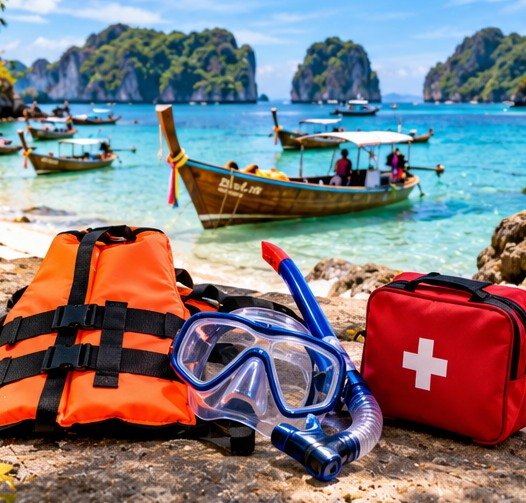
Original conceptual illustration. Equipment in this illustration has not been inspected or certified; check the actual jacket and boat.
Thailand beach and boat safety involves several decisions, not one reassuring label on a destination. A pleasant beach can have an unsafe swimming area, a calm morning can become a rough crossing, and a well-reviewed tour can still be unsuitable for a particular child, swimmer or medical condition. Assess the activity in front of you rather than the holiday photograph that persuaded you to book it.
Start with the local warning, the day’s conditions and your own ability. For a boat, add the vessel, equipment, crew briefing and a realistic return plan. You can enjoy the coast without swimming, and you can decline a departure even after travelling to the pier. Losing an activity is preferable to feeling obliged to proceed when an important question remains unanswered.
This guide is based on official Thai advice, water-safety organisations and specialist references. The checks are arranged around the traveller’s day, not a measured ranking of operators or beaches. No vessel, lifeguard service or item of equipment has been personally inspected for this article, and no booking link is a safety certification.
At the beach
Read the local warning
A red flag is a reason to stay out, not a challenge to stronger swimmers.
On a boat
Wear a suitable life jacket
Find a correct fit before departure, including for every child.
Weather decision
Marine forecast matters
Sunshine on land does not describe waves, wind or conditions at the destination.
Most useful buffer
A mainland night
Avoid making an exposed sea crossing the only way to catch your flight.
Thailand beach and boat safety starts with separate decisions
A beach visit is not automatically a swimming day
Walking, eating by the sea and sitting in shade may remain reasonable options when entering the water is not. Do not let the cost of a beachfront room become a reason to ignore a red flag or local warning. The FCDO specifically advises following beach warnings and taking care with strong currents around Thailand’s coast. [1]
Make the swimming decision again at each beach and on each day. A sheltered-looking corner may have different access, depth, boat traffic or currents from the place used yesterday. Ask the lifeguard or responsible local staff where swimming is currently permitted, then stay within the indicated area.
A boat ticket is not an obligation to board
If the conditions or vessel look unsafe, step back and ask for an explanation. A hurried departure is not the time to let another passenger decide your risk tolerance. Keep records for any later refund discussion, but handle the safety decision first.
Read the local flags and signs
A red flag means stay out
The FCDO highlights the importance of obeying red flags and local swimming warnings. Do not treat them as advice only for weak swimmers. A strong pool swimmer can still be overwhelmed by surf, currents or the distance back to a safe exit. [1]
Other colours and combinations must be read using the beach’s own posted key or lifeguard explanation. Do not assume that an online chart from another country gives every Thai flag the correct meaning. Likewise, the absence of a flag is not evidence that a beach has been assessed as safe.
On a small screen, swipe the table sideways to read every column.
| What you find | Sensible response | What it does not prove |
|---|---|---|
| Red flag or closure notice | Stay out of the water and follow local instructions. | It is not an invitation to judge whether you are strong enough. |
| A marked supervised swimming area | Ask about current conditions and remain within the advised boundaries. | Supervision does not remove the need to watch children. |
| No lifeguard or no clear information | Be conservative and choose an alternative when uncertain. | Quiet water and an empty beach are not a safety assessment. |
| Boat or watersports zone | Keep swimmers away and follow the local separation rules. | A gap between two moving boats is not a swimming lane. |
Ask a question that produces a usable answer
Instead of asking whether the beach is generally “safe”, ask where swimming is allowed now, where the current is strongest and whether conditions are expected to change. For a child or inexperienced swimmer, explain that limitation directly. A vague smile or an old review should not be the basis of the decision.
Understand rip currents without relying on appearance
A calmer-looking gap can be misleading
Rip currents can carry water away from the shore and can be difficult for an inexperienced visitor to recognise. Do not choose a place to swim simply because a gap in the breaking waves looks quieter. The RNLI advises using lifeguarded areas and asking about the conditions rather than trying to identify every hazard yourself. [3]
Know the exit before entering. A beach with rocks, a steep drop or few places to leave the water gives you less room for a mistake. Swim with another person and keep enough energy for the return rather than treating the outward distance as the achievement.
If caught, do not fight directly against the current
The RNLI advises staying calm, floating to conserve energy and signalling for help. If you can swim, move parallel to the shore to get out of the current before heading back towards the beach. Do not exhaust yourself trying to swim straight against it. [3] [4]
If you see someone struggling, alert a lifeguard and emergency help. Keep watching and point out their position. Do not create a second casualty by entering dangerous water without rescue training; use an available reaching or throwing aid from a safe position when practical. [15]
Check the marine forecast, not just the weather icon
Sunshine does not describe the sea
Read the Thai Meteorological Department’s current forecast and warnings for the relevant coast and sea area. Wind, swell, thunderstorms and conditions at the destination matter even when your hotel is dry. A general daily phone icon cannot tell you whether a particular crossing is appropriate. [8]
Check the issue time and geographical area. A warning from last week or another coast is background information, not today’s operating decision. Conversely, an operator saying that it went yesterday does not answer a new warning issued this morning.
Ask how the operator uses the warning
Ask whether the route may change, who makes the cancellation decision and what happens if conditions deteriorate after departure. Do not invent your own universal wave-height threshold for every boat. Vessel design, exposure, crew decisions and official restrictions all matter, and a traveller’s visual inspection has limits.
Leave an alternative activity in the plan. A land-based day, sheltered restaurant or hotel break reduces the pressure to board because there is “nothing else to do”. The alternative does not need to be expensive; it only needs to be acceptable enough that you can use it without feeling the holiday has failed.
Treat the Andaman and Gulf coasts separately
A national season label is too broad
Phuket, Krabi and Koh Lanta face different seasonal influences from Koh Samui, Koh Phangan and Koh Tao. Broad climate patterns can help choose dates, but the TMD’s current marine information is what matters for a departure. Dry-season marketing is not a guarantee of calm water on either coast. [8]
Even within one island, an exposed beach can behave differently from a sheltered one. Ask about the specific bay and activity rather than transferring advice from the opposite side. A hotel may have a pleasant swimming pool while its beach is unsuitable that day; those are separate facts.
Do not chase an apparently better coast at the last minute
A cross-peninsula move adds road travel, another booking and a new set of conditions to check. It may be sensible in a longer itinerary, but is not an automatic response to a cancelled boat trip. Compare the remaining time and the actual forecast before replacing one rushed plan with another.
For a short stay, changing the daily activity is often more practical than changing the entire coast. Keep the holiday centred on a base you can enjoy without needing a boat every morning. This is an itinerary judgement, not a claim that staying put is correct during an official evacuation or closure.
Choose a vessel for the journey, not just the photograph
Different boat types create different practical questions
A small long-tail boat, speedboat and larger ferry can all be appropriate in particular circumstances. None is universally safe simply because of its category. Ask about the actual vessel, passenger capacity, seating, life jackets, boarding arrangement and route rather than accepting a stock photograph as the answer.
On a small screen, swipe the table sideways to read every column.
| Boat style | Questions before booking | Personal suitability to consider |
|---|---|---|
| Long-tail boat | How do we board, where are jackets, and what happens if the weather changes? | Beach boarding, exposure and the ability to step between moving surfaces. |
| Speedboat | What is the seating, route, sea-condition policy and medical advice? | Repeated impacts, mobility, pregnancy or back and neck concerns. |
| Larger passenger ferry | Where are emergency equipment, exits, assembly areas and luggage storage? | Stairs, corridors, motion and the time needed for embarkation. |
| Private charter | Who operates it, what equipment is aboard and what is the return plan? | A private booking does not automatically mean a better-equipped vessel. |
Do not diagnose vessel fitness from decoration
Fresh paint, a luxury label or a high ticket price cannot establish maintenance quality. Look for clear operator identity and willingness to explain safety arrangements. Ask to see the relevant information through the operator’s normal channels, and avoid a departure when basic questions produce evasive or contradictory answers.

Check life jackets before departure
Fit and access are practical requirements
Thai government waterway guidance tells passengers to use a life jacket appropriate for their weight. Find the actual jacket, check that it is accessible and ask the crew to show how it fastens and should be worn. A bag of equipment on the roof is not the same as a usable jacket at your seat. [2]
Check the size range and visible condition: straps, buckles, tears and any instructions. If you cannot secure it properly, ask for another one before the vessel leaves. A loose jacket that rises around the head, or one intended for a very different body size, is not a satisfactory answer to a fit problem.
Follow vessel-specific emergency instructions
On a small open boat, put the suitable jacket on before departure and keep it fastened. On a larger vessel, learn the crew’s instructions for wearing equipment, moving to assembly points and leaving enclosed spaces. Do not improvise with inflatable equipment in a way that conflicts with the briefing.
Personal flotation equipment does not make an unsuitable crossing acceptable. A correct jacket is one part of the decision alongside conditions, vessel and crew. Equally, a good swimmer should not dismiss it as something only children or non-swimmers need.
Children need a separate water plan
Ask for the correct sizes in advance
Give the operator the child’s age and weight, and confirm that a suitable jacket will be available. Check the actual fit on arrival rather than relying solely on a booking note. If an appropriate jacket cannot be provided, do not treat an adult jacket tied more tightly as an equivalent solution.
At the beach or pool, close supervision remains necessary even when lifeguards are present. The Royal Life Saving Society emphasises keeping children within arm’s reach and making clear which adult is supervising. Armbands, floats and a busy group of relatives do not replace that responsibility. [15]
Plan the moments between activities
Boarding, changing clothes, unpacking and buying food are times when attention can drift. Agree who stays with the child before the group starts moving. Keep towels, water and essential items ready so supervision does not depend on somebody briefly leaving to search the bag.
A child becoming frightened or tired is a reason to simplify the day. There is no need to complete every snorkelling stop because it appeared in the itinerary. Ask the operator about shorter or shore-based alternatives before booking a full-day excursion that offers no easy way to finish early.
Boarding safely and managing luggage
Keep your hands available
Wear footwear suitable for the actual boarding surface and follow the crew’s instructions. Avoid balancing a phone, drink and heavy case while stepping across a gap or down a wet ladder. Ask for help with luggage rather than making a risky jump to avoid delaying the queue.
A beach landing may involve wet feet and an uneven seabed, while a pier may involve stairs or a moving gangway. Confirm the arrangement beforehand when mobility, balance or a medical condition is relevant. The phrase “hotel pickup included” tells you nothing about the final step onto the vessel.
Secure belongings without obstructing access
Keep luggage where the crew directs and do not block aisles, exits or safety equipment. A small accessible bag for medication, documents and communication is useful, but it should not become a trip hazard. Protect valuables before boarding so you are not rearranging everything on the moving boat.
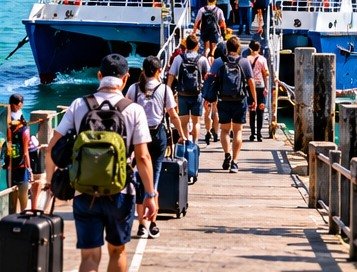
If a companion needs assistance, explain that before the crowd begins moving. Do not assume the crew knows about an invisible condition. Allow enough time for boarding instructions and refuse a hurried arrangement that requires a manoeuvre you cannot perform safely.
Snorkelling is more than floating above a reef
Be honest about ability and confidence
Tell the guide if you are a non-swimmer, have little open-water experience or are uncomfortable putting your face in the water. Ask whether the activity is suitable, what flotation is used and how supervision works. A boat tour listing snorkelling does not mean every passenger should enter the water.
Try the equipment in a controlled setting before swimming away from the boat. Make sure you understand how to stop, signal and return. Do not let the group move on while you are still struggling with a leaking mask or unfamiliar breathing equipment.
Stay aware of the exit and the boat
Listen to the briefing about the permitted area, currents, signals and the route back aboard. Stay with the agreed buddy or guide and do not follow wildlife beyond the group. A reef that looks nearby can be much harder to return from when you are tired or moving against water.
Do not enter near a propeller or climb towards a boat that is manoeuvring unless the crew directs you. Ask about the ladder and assistance needed for reboarding before you jump in. Being comfortable swimming does not automatically mean you can climb a slippery ladder in moving water.
Diving requires its own checks and surface interval
Training and medical suitability are not optional details
Choose a dive centre that can explain training, equipment, supervision and emergency arrangements. Tell the centre about relevant medical conditions and follow its medical-screening process. A tourist booking platform is not qualified to clear you for diving, and a previous uneventful dive does not answer every new health question.
Do not let a tight schedule encourage diving beyond your training or comfort. Ask about the actual dive profile, current, entry and exit before committing. Keep insurance appropriate to the activity, including depth and other conditions in the policy. [11]
Leave time before flying
DAN’s guidance for symptom-free recreational divers recommends at least 12 hours after a single no-decompression dive and at least 18 hours after multiple dives or several days of diving. Decompression dives need a substantially longer interval. These are minimum guidelines for specified circumstances, not a guarantee that flying is risk-free. [6]
Arrange the diving early enough in the stay that the final day does not become a race to the airport. Seek medical advice and do not fly with symptoms that might indicate decompression illness. The ferry or taxi transfer after diving does not itself complete the required preflight interval. [6]
Kayaks, paddleboards and offshore wind
Start with a realistic return journey
Ask the rental operator about the allowed area, wind direction, current and when equipment must return. A gentle push away from shore can make the outward journey feel easy while making the return much harder. Do not rely on an inflatable toy or an improvised paddle to solve that problem.
Use appropriate flotation and follow activity-specific instruction. If the operator cannot explain the conditions or equipment, choose a supervised alternative. Experience on a calm reservoir at home does not automatically transfer to coastal wind, swell and boat traffic.
Keep a communication and supervision plan
Tell someone responsible where you are going and when you expect to return. Keep a suitable way to call for help accessible without assuming mobile coverage exists everywhere. A phone buried inside the bag on the beach is not useful while you are offshore.
Stay within the agreed limits and turn back before fatigue makes the decision for you. When wind or weather changes, the sensible outcome may be ending early. The remaining rental time is not a target that must be used regardless of conditions.
Jellyfish: avoid a one-treatment-fits-all rule
Read the local warning before entering
TAT’s current visitor advice describes potentially dangerous jellyfish in Thai waters and recommends paying attention to signs and local guidance. Do not touch stranded jellyfish or assume that a clear patch of water proves their absence. Covering clothing can reduce exposure but is not a guarantee against stings. [5]
Ask where first aid is located and what the local procedure is. A beach with no visible warning still requires judgement, especially where you have no lifeguard information. Do not choose a swimming spot solely because another group has entered without an immediate problem.
Get help promptly and follow species-specific advice
Thai guidance includes vinegar for at least 30 seconds in its jellyfish advice, particularly relevant to serious box-jellyfish concerns. However, ANZCOR distinguishes potentially lethal jellyfish from bluebottles and advises against vinegar for bluebottles. Its guideline concerns Australian species, so do not apply it as a universal Thai identification tool. Follow trained local advice rather than treating every sting identically. [5] [13]
If the person is unresponsive and not breathing normally, request an ambulance and start CPR with dispatcher guidance. Do not delay resuscitation while searching for vinegar or a photograph of the animal. Unconsciousness alone is not the same as absent normal breathing; tell the operator exactly what you observe. [14]
Heat, alcohol, illness and seasickness
Make the decision before the boat leaves
A long exposed excursion can be unpleasant or unsuitable when you are already unwell, dehydrated or badly sleep-deprived. Tell the operator about relevant concerns and seek medical advice when needed. Do not conceal a condition merely because the booking is non-refundable.
Ask a pharmacist or clinician about personally suitable seasickness options before the trip. Some medicines can cause drowsiness or be unsuitable with other medication, so do not copy a stranger’s dose. Check the operator’s guidance about eating, hydration and seating, while recognising that no preparation guarantees you will feel well.
Keep swimming and drinking separate
The Royal Life Saving Society advises against entering water after drinking alcohol. A shallow-looking swim after a beach bar is still a water activity, and the walk home may pass piers, pools or an unlit shoreline. Plan a route that does not require crossing those hazards. [15]
Build shade and rest into the day rather than treating every hour in the sun as holiday value. Keep drinking water accessible and follow your own medical advice about fluid needs. If someone becomes seriously unwell, use local medical help rather than assuming a nap on the boat will resolve it.
Tsunami awareness without spending the holiday on alert
Learn the exit before there is a warning
At coastal accommodation, identify the local evacuation route and where staff direct guests. A few minutes at arrival are enough to understand the basic direction and assembly instructions. Do not substitute a generic internet map for the signs and current arrangements at the property.
Natural warnings can include strong or long earthquake shaking, an unusual sudden sea change or a loud ocean roar. NOAA advises moving quickly to higher ground or inland when appropriate rather than waiting for an official alert. Follow Thai local evacuation guidance and move safely once shaking permits. [7]
Do not return for the view or the luggage
An exposed seabed is not an attraction, and the first wave may not be the largest. Stay out of the affected area until local authorities say it is safe. Once away from danger, contact a trusted person and conserve phone use for necessary communication. [7]
If you are already on a vessel, follow the captain’s instructions and established marine emergency arrangements. Do not order an improvised return to shore based on a social-media message. The correct action depends on the vessel’s location and the warning being handled.
Compare ferry routes without treating the listing as a safety audit
Know the real operator and departure point
Ask how late arrivals, cancellations and luggage are handled. A combined ticket may be convenient, but it does not automatically guarantee that every connection is protected. Read the actual terms and keep the operator’s contact details separately from the booking confirmation.
Verify the departure again locally
Check the service close to travel and at the pier. A saved departure time can change, and weather disruption may affect later legs. Avoid arriving just before departure with no time to ask about a missing child jacket, an unfamiliar vessel or a changed boarding point.
Where the transfer matters to an international flight, plan the whole chain backwards. The ferry’s advertised arrival is not the same as being checked in at the airport. Allow for disembarkation, baggage, road travel and any deadline imposed by the airline.
Compare tours by the questions they answer
Use marketplaces for information, not certification
Browse Krabi boat excursions and Phuket boat-trip options to compare group size, meeting points, equipment and cancellation terms. Look for clear information about the actual operator rather than choosing solely by the most dramatic cover photograph or number of stops.
Cross-check Krabi tour descriptions and Phuket excursion listings for details missing from the first page. Differences between descriptions are a reason to ask the operator, not to select whichever version sounds more generous. A marketplace listing cannot confirm that the actual boat on the day has been inspected for you.
Ask about the awkward details before paying
For families, ask about jacket sizes and minimum ages. When mobility or medical needs are relevant, explain the boarding method you can manage and ask whether the vessel is suitable. For a nervous swimmer, ask whether remaining aboard or skipping a snorkelling stop is possible without being left without supervision.
Check whether the itinerary can change with conditions and what a weather cancellation means financially. These questions do not make you a difficult customer. They help establish whether the activity fits the people travelling, which is more useful than a generic promise of an unforgettable day.
Pack for water without buying a false sense of security
Protect the essentials and keep them manageable
A roll-top dry bag and waterproof phone pouch can protect belongings when used correctly. Test them with something non-valuable before trusting a passport or phone, and follow the manufacturer’s limits. A bag that handles rain is not necessarily suitable for prolonged immersion.
A long-sleeved rash vest can make sun protection and skin coverage easier, while a sunglasses retainer helps avoid losing glasses overboard. These are optional equipment categories, not independently tested safety products. None replaces sunscreen, local advice or a correctly fitted life jacket.
Keep communication realistic
For maps and routine messages, compare Airalo plans before departure and check whether the plan includes only data. Coverage on land does not guarantee a connection at sea, and a data-only eSIM is not the same as an ordinary calling line. Keep the operator’s contacts and itinerary offline as well. [12]
Leave unnecessary valuables at the accommodation according to its secure-storage arrangements. Carry medication and essentials in a way that remains accessible, but do not attach bulky bags where they interfere with flotation or movement. Ask the crew where they should go before departure.
Build a transfer buffer that removes pressure
A final mainland night is often a useful planning choice
Compare the extra hotel night with the consequence of losing a flight and later bookings. The cheaper itinerary on a search screen may depend on every leg running exactly as scheduled. A buffer buys flexibility, especially when different companies operate unprotected tickets.
Make the cancellation plan before it is needed
Know which contact handles a refund request, whether a later service is offered and where you can stay if the crossing does not run. Keep enough accessible funds for an unexpected night without carrying an unnecessarily large amount of cash. Check the insurer’s cover and exclusions for the actual disruption. [11]
Do not respond to cancellation by accepting the first unofficial boat offer. Ask who operates it, whether authorities permit the departure and how the conditions differ from the cancelled service. A vessel willing to go is not automatically a safer or more reliable alternative.
Agree the emergency plan before the activity
Know the local contacts and the operator’s role
For medical emergencies in Thailand, 1669 is the key ambulance contact; 191 is the police emergency route, and the Marine Department publishes 1199. Save them, but also know how to alert the crew, guide or lifeguard immediately. Staff on scene may be able to communicate the vessel position or beach access more clearly. [9] [10]
Tell a trusted person which tour or crossing you booked, the operator and expected return. Update them if the plan changes. This is a simple communication arrangement, not a reason to broadcast live locations and personal documents publicly.
Help without creating another emergency
If someone falls overboard or struggles in water, raise the alarm, keep them in sight and follow the crew or lifeguard’s instructions. Do not jump in instinctively. A trained rescuer, throwing aid or vessel manoeuvre may be needed, and another person in the water can make the situation much harder. [15]
Once the person is out, seek medical assessment when needed, including after a serious near-drowning incident. If they are unresponsive and not breathing normally, call for emergency help and follow CPR instructions. The booking paperwork and insurance claim can be organised after immediate care is underway. [14]
Three practical choices that make a coastal day easier
A family chooses between a short crossing and a full excursion
A short ferry transfer and a day-long snorkelling tour may both involve boats, but the demands on a child are different. Compare boarding, jacket fit, shade, toilets, meal arrangements and the ability to stop early. The best choice may be a shorter activity followed by a quiet afternoon rather than the longest itinerary at the lowest price.
Before committing, ask how supervision works when adults are in the water. A guide leading a group is not automatically a dedicated babysitter for a child remaining aboard. Agree a parent or guardian’s role and choose an activity compatible with that arrangement.
A confident swimmer arrives at an unguarded beach
Confidence does not supply local knowledge. Walk the beach, identify boat zones and exits, and seek current advice. If the conditions cannot be assessed adequately, enjoy the shore or choose a supervised alternative rather than using other swimmers as evidence that the water is safe.
A calm decision early in the day is easier than reversing a promise to swim after everyone has changed. Present alternatives positively: a pool, another activity or a different beach after checking local advice. The purpose is a good day, not proving that the original plan was correct.
A couple has a ferry and flight on separate tickets
Map the time from leaving the hotel to reaching the airline’s check-in point. Include the road to the pier, check-in, crossing, disembarkation, onward transport and the airport deadline. Then consider what happens if the ferry is cancelled rather than merely late.
If the answer requires accepting an unverified speedboat or rushing a driver, redesign the itinerary before booking. A mainland night can make both the sea journey and the final morning less pressured. It also gives the couple a clear point at which the beach holiday ends and the journey home begins.
Pros and cons of a cautious water-based itinerary
What you gain
Clear checks make it easier to choose suitable activities, ask useful questions and decline an unsafe-looking departure. A buffer protects the final flight, and a land-based alternative means bad conditions do not remove every enjoyable option.
The approach also makes group decisions simpler. Children, less confident swimmers and people with mobility or medical needs can be considered before money and expectations make changing the plan difficult.
What you may give up
You may visit fewer islands, pay for an additional night or skip an activity that other travellers choose to do. Suitable equipment and a slower itinerary can cost more than the cheapest available package.
However, caution is not a promise of zero risk. Forecasts, equipment and judgement all have limits, so keep listening to the people responsible for the actual beach or vessel on the day.
Common mistakes at beaches and piers
Treating calm water as assessed water
An attractive surface does not reveal every current, depth change or marine hazard. Use local warnings and supervised areas, and avoid entering when information is inadequate. Do not assume a popular social-media beach has the same arrangements as a managed resort swimming area.
Inspecting the life jacket after departure
Find the equipment and check fit before the vessel leaves. A missing child size or broken buckle is not something to resolve once the crossing is underway. Ask for the actual jacket, not reassurance that equipment exists somewhere aboard.
Letting sunk costs decide the next action
A prepaid tour, taxi to the pier or non-refundable hotel does not change the sea. Handle any dispute afterwards from a safe place. Likewise, do not turn a cancellation into a race to find a less accountable operator willing to ignore the conditions.
Frequently asked questions
Is it safe to swim in Thailand during the dry season?
There is no universal guarantee. Dry-season dates can offer useful planning conditions, but local currents, wind, marine hazards and swimming restrictions still matter. Read the warnings at the actual beach and ask the lifeguard. Stay out under a red flag and choose an alternative when you cannot assess the conditions properly. [1]
Does a red flag apply to strong swimmers too?
Yes. Treat a red flag as a reason not to enter, rather than a test of swimming ability. Strong swimmers can become exhausted or be carried into a difficult position. A pool-based sense of confidence does not remove surf, currents or the problems of reaching a safe exit in unfamiliar water. [1] [3]
Is a speedboat safer than a ferry or long-tail boat?
Boat category alone does not answer the question. Consider the actual vessel, route, weather, loading, equipment and crew, plus the passenger’s needs. A smaller boat is not automatically unsafe, and a larger one is not automatically suitable. Ask practical questions and decline when essential information or equipment is missing.
Should children wear an adult life jacket if no small one is available?
Do not treat an adult jacket tightened around a child as equivalent to correctly sized equipment. Give the child’s details in advance and check the actual fit before departure. If a suitable jacket is unavailable, choose another service or activity. Flotation also does not replace close adult supervision around water. [2] [15]
What should I do if I am caught in a rip current?
Stay calm, float to conserve energy and signal for help. Do not exhaust yourself swimming directly against the current. If you can swim, move parallel to the shore out of the current before returning towards the beach. A lifeguarded swimming area and current local advice are better protection than relying on escape instructions alone. [3] [4]
Should every jellyfish sting be treated with vinegar?
No universal rule is appropriate. Thai visitor guidance includes vinegar in serious jellyfish advice, while specialist guidance distinguishes bluebottles and advises against vinegar for them. Leave the water safely, seek trained local help and do not rub or rinse with fresh water. Serious symptoms require urgent medical help, not an online identification exercise. [5] [13]
Can I take a ferry on the morning of an international flight?
It may be sold as an itinerary, but that does not make the connection protected or reliable in disruption. Consider all transfer stages and what a cancellation would mean. For an important flight, a mainland or airport-area night beforehand is a useful conservative planning choice rather than relying on a last possible crossing.
How long should I leave between diving and flying?
DAN gives minimum intervals of 12 hours after a single no-decompression dive and 18 hours after repetitive or multi-day diving for symptom-free recreational divers in the stated circumstances. Decompression dives need longer. Follow specialist advice for your actual dive profile and do not fly with symptoms suggesting decompression illness. [6]
Final recommendation: choose a day you can comfortably change
Build the coastal holiday around a base you can enjoy even without entering the sea. Then add swimming, ferry transfers and excursions only when the current conditions, equipment and personal suitability make sense. This makes a cancelled activity an inconvenience rather than a reason to abandon your judgement.
Before each water-based activity, ask three practical questions: do I understand the conditions, can I use the equipment and boarding arrangement, and do I have a workable alternative? When one answer is unclear, pause. The purpose of the trip is time well spent in Thailand, not completing every boat ride or swim that appeared in the original itinerary.
Sources and fact-checking notes
This guide combines Thai official advice with RNLI, NOAA and diving-safety references. UK and US emergency numbers from overseas sources have not been copied into Thai instructions. Species-specific sting treatment and dive fitness require professional advice. No operator or safety equipment was inspected, and the article has not had independent clinical review.
Official pages and provider information were checked on 05 October 2026. Examples, priorities and suggested itineraries are editorial planning judgements, not quotations, guarantees or personal inspection reports.
- FCDO: Safety and security in Thailand – Swimming, transport, crime and activity precautions.
- Thailand government: Waterways and beaches – Life-jacket use, supervised swimming and waterway precautions. Local flag instructions take precedence.
- RNLI: Rip currents – Escape and rescue principles; UK telephone numbers are not carried over into this guide.
- RNLI: Float to Live – Staying afloat and controlling breathing in water.
- TAT: Jellyfish safety advice – Thai public-health advice and the need for prompt emergency help.
- Divers Alert Network: Flying after diving – Minimum intervals for specified recreational dive profiles and warnings about symptoms.
- NOAA / National Weather Service: During a tsunami – Natural warnings and moving inland or to higher ground; follow Thai local evacuation instructions.
- Thai Meteorological Department – Current regional forecasts, marine conditions and warnings.
- Marine Department: Search and rescue – Marine Department hotline 1199.
- FCDO: Getting help in Thailand – Core ambulance, police, fire and Tourist Police contacts.
- FCDO: Foreign travel insurance – Activities, existing conditions, emergency costs and policy exclusions.
- Airalo: Data-only eSIMs, calls and messages – Data access is separate from a normal voice and SMS line.
- ANZCOR: Marine envenomation guideline – Species-specific treatment distinctions, including avoiding vinegar for bluebottles; Australian scope is not silently generalised to Thailand.
- St John Ambulance: CPR – Unresponsive and not breathing normally; local Thai emergency numbers replace UK numbers in this article.
- Royal Life Saving Society UK: Water safety on holiday – Supervision, swimming ability and safer water-based holiday choices.
Illustrations in this article were created for Taylor’s Trailblazing Travels. Third-party photographs, where used, are credited beside the image or in the source list.