A Bangkok stopover that leaves time to catch the next flight.
Two nights, one compact city route and a departure plan made before the sightseeing begins.
A Thailand 3-Day Stopover Itinerary succeeds when it is built backwards from the next flight. Bangkok can give you temples, a river journey, neighbourhood food and a comfortable hotel break without another airport transfer across the country. There is no need to turn a short stopover into a miniature national tour.
This version assumes arrival on day one, two hotel nights and departure on day three. A late arrival followed by an early departure leaves only the middle day for substantial sightseeing. A morning arrival and evening departure create a much larger window, but still not three full twenty-four-hour days.
The plan is research-led rather than a personal trip diary. Timed examples below are suggested working calendars, not airport processing guarantees. Select the version that matches your actual flights, baggage arrangements and entry permission before choosing restaurants or buying a tour.
One city hotel
Do not spend the stopover changing hotels unnecessarily.
Old city and river
Keep the main sightseeing day geographically compact.
Usable hours
Arrival queues and airport travel are not sightseeing time.
The next flight
Fix the hotel-departure time before making other plans.
Start this Thailand 3-Day Stopover Itinerary with usable hours
Fit the first and last city activities around the flights. Reduce optional sightseeing before reducing the margin for the onward journey.
Three dates do not equal seventy-two hours
A Friday-evening arrival and Sunday-morning departure touch three calendar dates but leave only Saturday as a substantial city day. A Friday-morning arrival and Sunday-evening departure provide a much larger opportunity. Both involve two hotel nights, yet they need different sightseeing expectations. Begin with the actual landing and take-off times rather than the phrase three days in Bangkok.
Next remove the time needed for immigration, baggage, airport transport, hotel access and the return journey. These are genuine parts of the stopover, not inconvenient details to hide outside the itinerary. The route below keeps the middle day as the main sightseeing date and treats the first and last dates as flexible around travel.
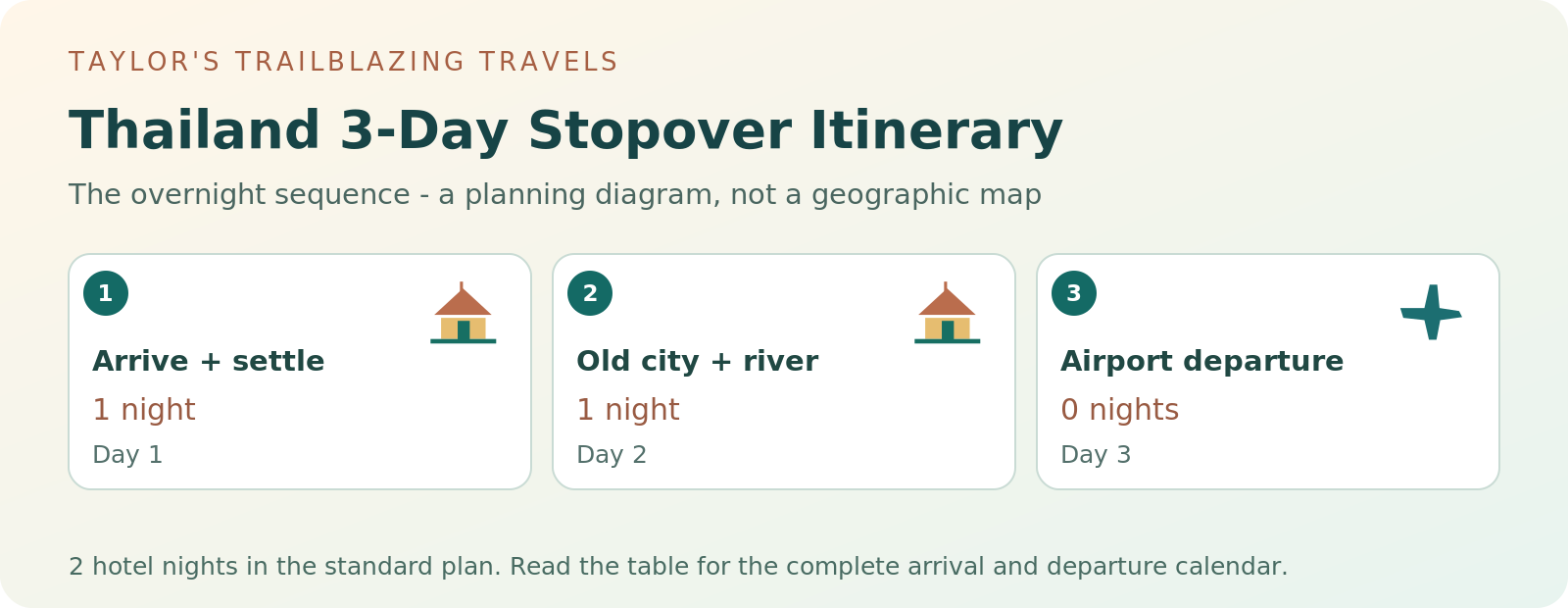
| Day(s) | Overnight base | Nights | Plan |
|---|---|---|---|
| 1 | Bangkok | 1 | Arrival, hotel and a low-pressure local evening |
| 2 | Bangkok | 1 | Old-city sights, river and a relaxed meal |
| 3 | Departure | 0 | One local activity only when the flight permits |
This is a proposed calendar, not a published transport timetable. Scroll within the table on a small screen.
Use a conservative working example
Suppose you arrive around lunchtime on day one and leave at 20:00 on day three. You might plan a local first evening, a full middle day and one nearby activity on the final morning. For the return, an example allowance of ninety minutes for the hotel-to-airport journey plus three hours at the airport would mean leaving the hotel by 15:30. Those are planning assumptions, not guaranteed journey times or a universal airline rule.
Replace the assumptions with your airline's requirement, hotel location and current transport advice. Then make the afternoon plan fit the resulting departure time. Do not decide on a long lunch first and work backwards until the airport margin becomes implausibly small.
Can you leave the airport during the stopover?
A city visit means entering Thailand
Leaving the airport for a Bangkok hotel or sightseeing requires the appropriate permission to enter Thailand. An onward ticket does not itself grant that permission. Check the requirements for the actual passport, any relevant travel history and the airline's documentation checks before booking non-refundable city arrangements. British travellers can begin with the current FCDO and Thai Embassy guidance. [1] [2]
The TDAC is the government's digital arrival form and is separate from a visa. Use the official service and follow its current submission window and instructions. Do not mistake a commercial application service or an emailed confirmation for a guarantee of admission at immigration. [3]
Check whether the booking actually supports a stopover
Confirm that the airline itinerary permits leaving and returning as planned, and establish what happens to checked baggage. A through-ticket, two separate tickets and an airside transit arrangement are not the same travel situation. The airline should confirm whether bags are collected, held through or checked in again; do not infer the answer merely from the length of the connection.
If you cannot establish entry eligibility or the practical ability to return for the onward flight, do not force the city itinerary. Resolve the travel arrangements first. This guide is for a planned Bangkok stay, not a recommendation to leave the terminal during any connection regardless of circumstances.
BKK and DMK: make the airport code the first booking check
Suvarnabhumi and Don Mueang are separate airports
Bangkok's two airport codes matter throughout the stopover. BKK is Suvarnabhumi and DMK is Don Mueang; they are not adjoining terminals. Check the arrival and departure codes independently, then use the correct one for the hotel transfer, final departure plan and any airport-area accommodation. [4]
A transfer between them involves a separate ground journey and the relevant immigration and baggage processes. A shuttle serving flight connections is not a general city sightseeing service. Its eligibility, meeting point and operating details must be checked through the current airport information rather than an old screenshot. [5]
Do not let a booking label hide the journey
A hotel described as Bangkok airport hotel may be useful for only one of the two airports. Similarly, a transfer titled Bangkok arrival can have a specific airport and a limited hotel drop-off zone. Read those fields before payment. The small airport code is often more consequential than the large product title.
With two hotel nights in the city, an airport change can be accommodated deliberately. What you should avoid is discovering it on departure morning after selecting a hotel and pickup around the wrong airport. Put both codes at the top of your saved travel note and check them whenever an itinerary changes.
Getting between the airport and the hotel
From Suvarnabhumi: compare the whole door-to-door plan
The official airport guide lists rail, taxis and other road options; the Airport Rail Link station is in the terminal's B1 level. Rail can be attractive when the hotel connection is straightforward, while a car may simplify the journey with bags or a group. Compare the complete trip, including any interchange and walk from the last station. [5]
Compare Suvarnabhumi-to-Bangkok hotel transfers when a prearranged road journey would help. Confirm whether the rate is for the vehicle or each passenger, how the driver handles a delayed flight, the waiting period and the meeting instructions. A transfer that looks cheap before those details are checked may not be the easiest arrival.
From Don Mueang: use the correct starting point
For DMK, consult the airport's current ground-transport information and compare the options with the hotel's location. Do not reuse a Suvarnabhumi rail plan or assume the same meeting point applies. With substantial luggage, a straightforward road transfer may justify its cost; with lighter bags, public transport may suit the journey better. [6]
Compare Don Mueang-to-Bangkok transfer options and verify the terminal, arrival flight and destination address. Include a contact method that will work on arrival. A saved photograph of the meeting instructions is useful, but also keep the written hotel address and booking reference accessible offline.
Allow the road journey to vary
Traffic, rain and the exact district can change a car journey significantly. The fastest advertised time is not a dependable departure buffer. Ask the hotel or operator for a realistic pickup recommendation for your flight, then add the airline's check-in requirement separately. For a short stopover, keeping one local activity optional is usually a better trade than reducing the return margin.
Choose one Bangkok hotel for both nights
A riverside base for the compact sightseeing route
A river-area hotel can suit a stopover built around the old city and boat journeys, provided its actual pier and road access are practical. Compare Bangkok riverside accommodation around useful transport links. Check the map and recent comments about reaching the property, rather than assuming every riverside hotel has equally convenient public transport.
Ask about luggage storage, reception hours and any early arrival or late departure needs. Two booked nights usually follow standard check-in and checkout times; they do not automatically provide the room from the moment the flight lands until the moment you leave for the airport. A small paid timing adjustment may be more useful than a decorative room upgrade.
A rail-connected base for mixed city plans
Compare hotels near Bangkok's rail connections when shopping, indoor attractions and several neighbourhoods matter more than being beside the river. Read the actual walking route to the station and check whether stairs or road crossings are involved. The term near a station can describe very different practical experiences with luggage.
Stay in the same hotel for both nights unless the flight timings create a clear reason to do otherwise. Changing hotels on a two-night stopover uses time on packing, transport, luggage storage and another check-in. It rarely improves the sightseeing enough to justify the interruption.
When an airport-area hotel is the better answer
Compare accommodation serving Suvarnabhumi Airport when a very late arrival, early departure or need for rest outweighs city access. For a DMK flight, choose a property specifically serving DMK instead. Confirm shuttle hours and the actual transfer time with the hotel; do not assume that airport-area means walking distance or a free ride at every hour.
Day 1: arrive, check in and enjoy one small evening
Keep the first commitment near the hotel
After arrival, go to the accommodation and establish when the room is available. Eat nearby, shower when possible and decide how much energy remains. A late landing should lead to a quiet local evening, not a race across Bangkok to save a restaurant booking made before the airport process was understood.
For an earlier arrival, choose one small outing within a straightforward journey of the base. That might be a riverside walk, a neighbourhood meal or an indoor stop. Keep the return easy enough that you can shorten the evening without losing an expensive tour or a complicated transport booking.
A food walk is optional, not the foundation of arrival day
Compare Chinatown evening food walks when the landing time leaves a comfortable margin and you would value help with dishes and the neighbourhood. Check the start point, finish point, walking distance and dietary limitations. Do not book a departure that depends on clearing the airport unusually quickly.
A food tour can instead be the middle evening, when the arrival uncertainty has passed. Independent eating near the hotel is a perfectly good first-night choice. The stopover does not need to begin with its most ambitious meal; being rested for tomorrow's main sightseeing day is likely to be more useful.
Prepare the essentials before sleeping
Check the next day's opening notices, clothing and transport. Put the room key, a payment method, water and the necessary documents in a manageable day bag. Confirm the final airport pickup now, even though departure is two days away. That separates the hard deadline from the sightseeing decisions and makes the rest of the stopover easier to enjoy.
Day 2 morning: the old city without a temple marathon
Decide between one main sight and two substantial visits
For the standard cultural route, choose the Grand Palace as the main morning visit, with Wat Pho as an optional second stop. Alternatively, make Wat Pho the anchor and leave more time for the river. The decision should reflect interest, heat tolerance and how much of the day you want to spend in busy visitor areas.
As checked on 5 October 2026, the Grand Palace lists 08:30-16:30 opening, with ticket sales ending at 15:30, and THB 500 admission for foreign visitors. Wat Pho's official visitor page lists THB 300 admission. These are distinct attractions and charges; verify current notices before the visit. [7] [8]
Dress for admission before leaving the hotel
Follow the palace's actual clothing guidance, including appropriate sleeves and lower-body coverage. Do not assume that a scarf alone will fix any unsuitable outfit at the gate. Keep belongings light enough to carry comfortably through queues and courtyards, and plan a break rather than trying to complete the full area without stopping. [7]
Compare guided Grand Palace and Wat Pho visits when explanation and a defined route would improve the short stay. Check admissions, language, meeting point and the programme's physical demands. A guide can help with interpretation, but cannot make the day cooler, remove every queue or guarantee access during a closure.
Avoid the false economy of rushing
Buying two admissions and hurrying through both may be less satisfying than enjoying one properly. Select the second visit only when it still appeals after the first. A three-day stopover is not a test of how many Bangkok landmarks can be named afterwards; it is a short opportunity to experience a few of them comfortably.
Day 2 afternoon: the river, lunch and an easy evening
Keep the afternoon in the same broad area
After the morning visit, have lunch before deciding whether to add Wat Arun or a simple river journey. The tourist-boat network connects useful sightseeing piers, but tickets, stopping patterns and service times vary by operator. Confirm the specific journey you need rather than assuming every riverboat is part of one interchangeable network. [9]
Do not treat the river as a way to avoid every weather or access issue. Boarding involves its own practical considerations, and conditions can change. With mobility needs or a group that is tired, a land-based meal and a direct hotel return may be the more comfortable afternoon.
Leave the evening as a choice
You could return to the hotel for a rest, eat near the river or use the previously considered food walk. Avoid a distant evening reservation that turns the end of the day into another transport exercise. The main sightseeing has already happened; the evening can be enjoyable without producing another major highlight.
For travellers who prefer a tailored programme, compare private half-day Bangkok tours and discuss the actual priorities before payment. Use the private format to reduce unnecessary stops and walking, not to request an unrealistic number of attractions. Confirm the vehicle, pickup, admissions and finish location, especially if the tour ends somewhere other than the hotel.

Day 3: one nearby activity, then the airport
Let the departure time choose the morning
For an early flight, the day is simply checkout and airport travel. A later flight may allow a relaxed breakfast and one activity near the base. Do not use the last morning for Ayutthaya, a beach excursion or another airport. The benefit of staying in Bangkok is that the final hours can remain easy to shorten.
Jim Thompson House can suit a city-based morning when its location and guided-tour timing fit the plan. Its visitor information checked on 5 October 2026 lists daily opening from 10:00 to 17:00 and adult admission of THB 250. The main-house visit requires a guide and involves stairs without lifts, so check both availability and suitability before setting out. [10]
Collect luggage before the final transport deadline
Build the return to the hotel and luggage collection into the calculation, even when the activity appears close to the airport route. Bags stored at reception still require time to retrieve, repack and load. If a driver is collecting you, use a pickup time you can meet comfortably without needing the final attraction to finish exactly on schedule.
Keep a meal or snack available in the plan rather than extending lunch until the airport margin disappears. Once the agreed departure time arrives, leave. The decision about whether to add another stop should already have been made before the day began.
Read midnight departures carefully
A flight at 00:30 leaves just after midnight at the start of its printed date. It may require leaving the hotel on the previous evening. Write the hotel pickup date as well as the time, and check the room nights accordingly. This simple calendar issue can matter more than the choice between two sightseeing attractions.
Three alternative stopovers for different interests
Food-first instead of monument-first
Keep the same hotel and airport framework, but replace part of the middle day with a cooking activity or guided food experience. Compare Bangkok half-day cooking classes by location, transfer time, dietary arrangements and the actual finish. The class should replace a temple block, not be added to a day that already has two major sights and a river excursion.
Leave the following meal flexible, since a substantial cooking class may already include plenty of food. Use the remaining time for a neighbourhood walk or an indoor break. The most successful food-led stopover has enough appetite and attention for the chosen experience rather than a long list of tastings squeezed between transport.
Rest-first after demanding flights
Choose a comfortable hotel with straightforward arrival and departure access. Make the middle day one short cultural visit and a meal, then return for rest. This can be the better use of a stopover between long flights, particularly when the group includes children or someone who struggles with jet lag.
Do not judge this version against an idealised traveller who sleeps perfectly on planes. A hotel pool, quiet room and unhurried breakfast can be the purpose of the break. The city experience can remain selective without the stopover feeling wasted.
Indoor-first when weather or comfort calls for it
Use a suitable museum, cultural venue or shopping area as the middle-day anchor, with shorter outdoor stretches between breaks. Check current opening days and access information rather than assuming every indoor attraction is available daily. Keep travel geographically compact so that avoiding rain does not turn into a series of long car journeys.
A rainy period does not mean you must abandon the city, but severe weather warnings deserve attention. Allow the local programme to change around current advice and avoid activities whose safe operation depends on conditions that are deteriorating. [11]
A practical sample day, with the flexible parts marked
The middle day is the one to plan most clearly
An illustrative sequence might be breakfast around 07:30, travel towards the main sight, the first visit in the morning, lunch around midday and an optional river-area activity afterwards. Return to the hotel during the afternoon if needed, then choose a nearby evening meal. These are suggested working times, not official attraction or transport schedules.
The essential parts are the main visit, food, hydration and a workable return. The second temple, extended river journey and distant dinner are optional. Knowing which items can disappear makes the day easier to adjust without feeling that the itinerary has failed.
A delay should remove an option, not create a sprint
If the first attraction takes longer, have lunch later and drop the optional second visit. When the weather changes, shorten the outdoor walk. If the group is tired, return to the hotel. None of those adjustments should threaten the next flight because the airport journey is not attached to the end of this sightseeing day.
On departure day, the rule is stricter: work backwards from the airport deadline and keep the final activity close. A delayed museum tour or a long restaurant queue should lead to abandoning that optional plan, not reducing the transport and check-in allowances that protect the onward journey.
Luggage, room timing and the things a short stay can hide
Know where the main bags will be
Ask the airline about checked baggage before arrival and the hotel about storage before check-in and after checkout. Do not assume that a two-night reservation includes unrestricted storage for every item or that an airport will hold luggage under the conditions you need. Confirm any charge, collection hours and identification requirements directly with the provider.
Pack a small stopover bag when possible, keeping the clothes and personal items needed in Bangkok easy to reach. This avoids unpacking a large suitcase for two nights and makes an early departure simpler. Keep documents and essential items with you rather than in luggage that may remain checked through or stored elsewhere.
Pay for useful hours when necessary
Guaranteed early access or a late checkout can be valuable when flight timings leave a long gap. Compare the actual benefit with an extra room night or a suitable day-use arrangement, but read the exact hours and cancellation terms. A room described as available for the day may cover a different period from the one you need.
For families and access needs, these timing decisions can matter more than the number of attractions. A reliable place to rest and use the bathroom between arrival and sightseeing helps the whole stopover work. Treat it as part of the travel plan rather than a detail to negotiate only when everyone is tired at reception.
What to budget for two nights in Bangkok
A constructed stopover model
The examples were prepared on 5 October 2026 for one adult sharing a room, with two hotel nights and three calendar days. They include local and airport transport allowances but exclude the international flights, insurance and shopping. These are illustrative budgets, not live hotel or taxi quotations, and they do not assume that every listed activity will be purchased.
| Component / assumed allowance | Lean model | More-comfort model |
|---|---|---|
| Accommodation: 2 nights x THB 650 / 1,600 per person | THB 1,300 | THB 3,200 |
| Food: 3 days x THB 500 / 1,000 | THB 1,500 | THB 3,000 |
| Airport and city transport allowance | THB 1,500 | THB 2,500 |
| Admissions and selected activities | THB 1,200 | THB 2,400 |
| Subtotal | THB 5,500 | THB 11,100 |
| 15% contingency | THB 825 | THB 1,665 |
| Illustrative total per adult | THB 6,325 | THB 12,765 |
Planning model dated 5 October 2026. Prices are assumptions, not checked bookable offers. International flights, insurance and shopping are excluded; read the section for route-specific exclusions. Scroll this table horizontally on small screens.
Spend on the parts that protect the short visit
A convenient hotel or well-organised airport transfer may provide more value than an extra paid attraction. Conversely, a traveller with light luggage and a simple rail connection may save on transport without losing useful time. The right choice depends on the complete journey, not a general rule that a private car or a rail ticket is always superior.
Compare room prices on the same basis: occupancy, taxes, breakfast and timing. An inexpensive room with an awkward early arrival can lead to additional spending that was absent from the first comparison. Similarly, a cheap transfer that finishes far from the hotel is not equivalent to a door-to-door service.
Avoid treating the sightseeing allowance as a target
You do not need to spend every planned baht on attractions to make the stopover worthwhile. One carefully chosen visit, good meals and an easy departure can be a successful break. Keep some money accessible for an unexpected transfer or timing change rather than committing the entire budget to non-refundable tours before arrival.
Keep the travel information available, with or without data
Set up connectivity before the first transfer
Compare Thailand eSIM plans through Airalo when your phone is compatible and unlocked. Check activation, coverage and validity for the two-night stay. A large data allowance is less useful than a plan that actually works on your device and remains valid through the airport return.
Save the hotel address, airline confirmations and transfer instructions offline. Include the address in a form you can show a driver, and keep a payment method accessible without needing a long search through bags. The first airport journey should not depend on successfully configuring every app immediately after landing.
Have a simple communication plan
When travelling with someone else, agree where to meet if separated and ensure both people can access the hotel details. For a prebooked transfer, know which contact channel the operator uses and whether it will work without a local telephone number. A clear meeting plan is more useful than assuming the driver will recognise you in a crowded arrivals area.
Families, solo travellers and access requirements
Make the pace fit the people, not the example
With children, choose one substantial middle-day attraction and protect meal and rest times. Ask about car seats, actual room bedding and activity age restrictions directly. A family room label and a transfer advertised for four passengers do not answer every practical question about safely and comfortably travelling with children.
Solo travellers may value a guided walk for company and context, but should still inspect the finish location and return journey. Keep the hotel convenient for an evening meal rather than selecting a remote property on room price alone. A short stay should not require solving a new transport problem every time you want dinner.
Ask about specific access points
Confirm the room, hotel entrance, vehicle and attraction access rather than relying solely on a broad accessibility filter. Boat boarding and historic buildings can present different challenges from a modern hotel lobby. Jim Thompson House, for example, explicitly notes stairs and no lifts in the main house. [10]
When an attraction does not suit, change the attraction rather than trying to force the group through the standard route. A private vehicle, a shorter visit or a comfortable indoor alternative can preserve the purpose of the stopover. The best plan is the one everyone can complete without sacrificing the onward journey or their comfort.
What not to add to a two-night Bangkok stopover
No domestic flight or island hotel
An island or northern city would add another airport sequence and usually another hotel decision. That is a different trip, not a small enhancement to this stopover. Keep Bangkok as the sole base and leave the national itinerary for a visit with enough days to give the second destination meaningful time.
No distant departure-day excursion
Ayutthaya can be a worthwhile destination on a longer trip, but it is not the default use of the final morning before an international flight. The same applies to a distant market or beach outing. A separate road journey with a fixed return deadline introduces uncertainty precisely where the stopover is designed to remove it.
No obligation to attend a late-night highlight
A rooftop, show or nightlife area can be enjoyable when it genuinely suits your interests and timing. It is not required to complete Bangkok. After long flights and a full sightseeing day, a comfortable early evening can be the better decision. Do not let a popular list turn a restorative stopover into another tiring leg of the journey.
The strengths and limits of the Bangkok-only plan
What it does well
One hotel and one compact city route minimise unnecessary movement. The middle day can carry the main cultural experience while arrival and departure remain flexible. The plan also makes the airport distinction, baggage arrangement and room timing visible before they cause problems.
What it leaves out
Two nights cannot represent the whole of Thailand or even every major part of Bangkok. Flight timings may reduce the visit to one complete local day. The route therefore chooses a small number of experiences and protects the onward journey rather than promising a national highlights tour within a stopover window.
Common stopover mistakes
Treating landing time as the start of a city tour
The aircraft's arrival time is not the time you will be ready at a hotel or meeting point. Immigration, baggage and ground transport intervene. Keep the first outing flexible enough that a normal delay changes only an optional plan, not the value of the entire stay.
Forgetting the luggage detour
A final activity may appear convenient until you remember that the bags are at the hotel on the other side of the city. Include collection and loading in the departure plan. Better still, keep the final morning close to the base and leave with everything together.
Reading an after-midnight flight as a late-evening flight
Check the date and hour together, including the pickup date. A 00:30 departure is near the beginning of a day, not the end. Make the hotel nights and airport journey match the actual ticket before buying the final evening's activity.
Thailand stopover itinerary FAQs
Is a three-day stopover enough to see Bangkok?
It is enough for a selective city introduction when the flight times leave useful hours. The standard plan uses two nights and one main sightseeing day, with lighter arrival and departure dates. Choose a few experiences that matter to you rather than trying to include every major district. A longer Bangkok visit would offer more depth, but this can still be a worthwhile break.
Should I stay at the airport or in the city?
Choose the city when you have a substantial middle day and want straightforward access to meals and sightseeing. Choose an airport-area hotel when very late arrival, very early departure or rest is the main priority. Check the exact airport served and the shuttle arrangements. The word airport in a hotel name does not establish that it suits either Bangkok airport equally.
Can I leave checked luggage with the airline?
That depends on the ticket, airline and baggage arrangements. Ask the carrier directly whether bags are checked through, collected during the stopover or checked in again later. Pack the necessary stopover items in accessible luggage, but do not assume the main bag will be available or held automatically just because the connection lasts two nights.
How many temples should I plan for the middle day?
Choose one as the main visit and treat a second as optional. Two can be enjoyable when interest, weather and energy align, but a third is not necessary to make the day worthwhile. Leave time for lunch, the river or a hotel break. The route works better when a longer first visit removes an option rather than creating a rush.
Can I fit a cooking class into the stopover?
Yes, by using it as a main middle-day activity instead of part of the temple programme. Check its location, transport and finish time before payment. Do not attach it to departure day unless the complete timing comfortably fits the airport plan, and do not assume a half-day label means the same number of hours for every provider.
What should I do when the arrival is delayed?
Shorten or remove the first evening's outing and keep the middle day focused. Contact the hotel and any transfer provider through the channel specified on the booking. Do not try to recover lost time by making the final airport journey tighter. The onward flight remains the hard deadline, while sightseeing should stay adjustable around it.
Is a two-night stopover the same as seventy-two hours?
No. Two nights can fit into very different intervals depending on arrival and departure times. A late first-day arrival and early third-day departure leave much less time than morning arrival and evening departure. Count the actual hours, then subtract the airport and hotel logistics before deciding what is realistic.
Should I buy every sightseeing ticket before arrival?
No. Prioritise the experiences that genuinely require an advance reservation and leave the arrival-dependent plans flexible. Read the official admission information or the specific tour conditions rather than assuming that every online ticket offers timed entry, queue avoidance or an open-ended cancellation right. A ticket can secure a product without removing the practical time needed to reach and enter the attraction.
For the final day, pay particular attention to refund and rescheduling terms. A worthwhile nearby activity is optional when the airport journey requires more time; the onward flight is not. Keeping one part of the morning unbooked can therefore be more useful than securing a small advance-purchase saving on a visit you may have to abandon. The purpose of advance booking is to improve the stopover, not make it difficult to respond sensibly when the flights or local conditions change.
Keep the stopover compact and the departure certain
Stay in one Bangkok hotel, give the middle day a clear cultural or food focus and let the first and last dates follow the flights. Decide the return airport, luggage arrangement and hotel-departure time before making optional sightseeing commitments. Those choices have more influence on the success of the stopover than the number of attractions listed.
A few enjoyable hours by the river, one substantial visit, good food and proper rest can be an excellent introduction to Thailand. Leave with time to spare for the next journey rather than turning the final morning into a test of how many extra stops Bangkok can accommodate.
Sources and fact-checking notes
What was checked, and what remains a planning choice
Source pages were reviewed on 5 October 2026. Official entry and attraction information supports the specific visitor details. Night allocations, suggested time margins, route comparisons and budget models are editorial planning judgements, not official itineraries, guaranteed schedules or personally tested bookings. Recheck operational notices and your actual ticket before travel.
- FCDO: Thailand entry requirements. Passport, entry permission and onward-travel requirements for British citizens. Reviewed 5 October 2026.
- Royal Thai Embassy, London: visa exemption. Current exemption conditions; the permission stamped on arrival controls the stay. Reviewed 5 October 2026.
- Thai Immigration: official arrival-card guidance. Official TDAC instructions, eligibility and submission window. Reviewed 5 October 2026.
- Airports of Thailand: airport-transfer information. BKK and DMK are different airports. The page displays conflicting hours, so no exact shuttle timetable is relied on here. Reviewed 5 October 2026.
- Airports of Thailand: transport to and from Suvarnabhumi. Official transport modes, rail-station location and airport-transfer conditions. Recheck operational details before travel. Reviewed 5 October 2026.
- Don Mueang Airport: official airport website. Current passenger information for DMK. Reviewed 5 October 2026.
- Bureau of the Royal Household: Grand Palace visits. Official opening information, admission and clothing rules. Reviewed 5 October 2026.
- Wat Pho: plan a visit. Official visitor information and admission. Reviewed 5 October 2026.
- Chao Phraya Tourist Boat: operator information. River-boat stops and service information; check the dated timetable. Reviewed 5 October 2026.
- Jim Thompson House: visitor information. Guided entry, opening hours, luggage and stair access. Reviewed 5 October 2026.
- Thai Meteorological Department: forecasts and warnings. Check current provincial and marine forecasts close to travel. Reviewed 5 October 2026.
Illustrations in this article were created for Taylor’s Trailblazing Travels. Third-party photographs, where used, are credited beside the image or in the source list.