
Ninh Binh Travel Guide: Tam Coc, Trang An and Rural Bases
Choose your base first, then give the landscape a full day.
AI-generated editorial illustration inspired by Ninh Binh’s limestone landscape; not a photograph of a named boat route.
The main decision in Ninh Binh is where you want to finish each day: somewhere with dinner close by, a rural property where you can settle in for the evening, or a convenient stop before the next train. That choice shapes the whole visit.
This Ninh Binh travel guide helps you choose a base, pick between Tam Coc and Trang An, and leave enough time for the journey between sights. Two nights can cover the essentials; three give you another full day for history, countryside or a change in the weather.
For the wider route, start with the Vietnam travel hub.
Easiest evenings
Look near Tam Coc’s centre and check the actual walk to dinner.
Rural setting
Choose a Trang An-area stay with meals and car access confirmed.
One full day
Book one boat outing; make the climb your optional second anchor.
More breathing room
Stay three nights for a second full day and a movable outdoor plan.
Understand the names before choosing a base
The visitor landscape includes limestone peaks, waterways, villages and temples within the UNESCO-listed Trang An Landscape Complex. Hoa Lu Ancient Capital belongs to that landscape and was Vietnam’s capital in the 10th and 11th centuries. “Trang An” can therefore mean the wider heritage area or the particular boat-tour departure point: save the exact destination pin. [1]
There is also an administrative wrinkle. On 1 July 2025, Ha Nam, Nam Dinh and Ninh Binh merged into the enlarged Ninh Binh province. A property labelled “Ninh Binh” may consequently be far from the familiar Tam Coc–Trang An sightseeing area. In this guide, the city or station area means the urban area around Ninh Binh railway station, not the whole province. [2]
Likewise, ask for Hoa Lu Ancient Capital when booking a history visit; do not rely on “Hoa Lu” alone, which also appears in accommodation addresses and other attraction names. Check the map pin against your intended sight before agreeing a fare.
Where to stay: decide how your evenings will work
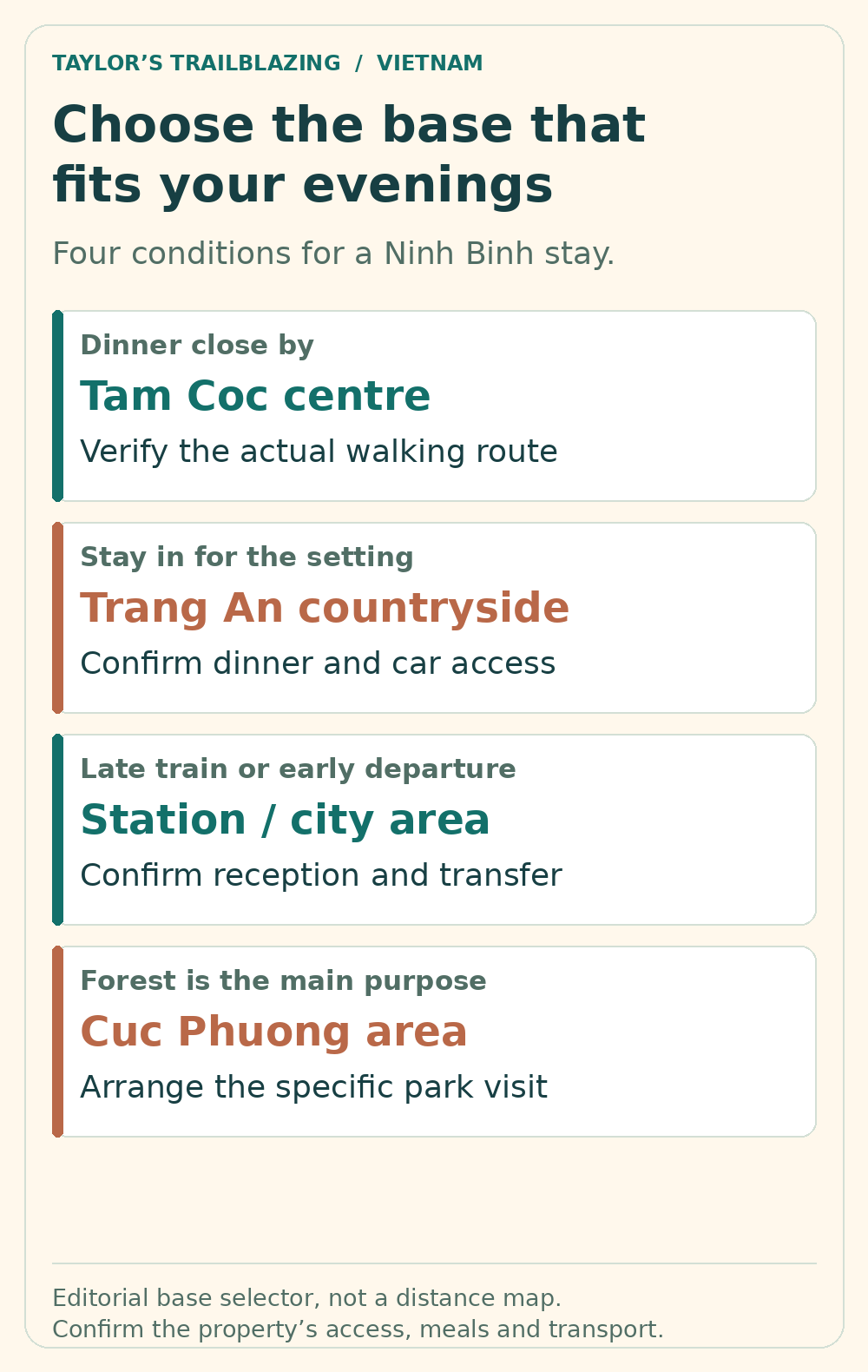
Start with dinner and the final journey home. A room with a mountain view can be a lovely choice if you know how you will reach it, eat there and leave the following morning. Rural stays around Tam Coc and Trang An are an established part of the area’s tourism offer. [3]
| Base | Choose it when… | Check before paying |
|---|---|---|
| Tam Coc centre or a close edge | You want dinner choices within a walk and a straightforward place to meet a driver. | The actual walking route, road lighting and whether your room faces a busy road. |
| Trang An countryside | The setting matters more than going out each evening, and you accept arranged transfers. | On-site dinner hours, car access to the entrance and the price of return journeys. |
| Ninh Binh station/city area | A late train or early departure is the main constraint, particularly for one night. | Distance from the correct station entrance and a confirmed late check-in. |
| Cuc Phuong area | Forest walks are a main purpose of the trip. | Current park access, the specific visit or stay arrangements and onward transport. |
On a small screen, scroll the table sideways to read every column.
Use the last stretch of the journey as a booking test. Can a car reach reception with your luggage? Can you get dinner without a ride you have not arranged? Is someone expecting you at your arrival time? If walking or stairs are difficult, ask about the route from vehicle to room, steps, bathroom access and assistance. A picturesque location or an “accessible” search filter cannot answer those details.
Compare stays in Agoda’s Tam Coc–Bich Dong area if you favour convenient evenings. Use the map to distinguish the centre from more secluded properties. For a wider comparison, browse Ninh Binh accommodation on Booking.com and zoom into the Trang An countryside or station area you actually want. Both searches cover varied locations; neither guarantees easy walks, transfers or luggage storage. [17][18]
Cuc Phuong offers forest hiking, but it changes the focus of this short stay. Give it a separate day if forest time is a priority, or investigate a dedicated stay with the park or accommodation provider. It does not need to become another transfer in a two-night Tam Coc visit. [8]
Trang An or Tam Coc: choose one main boat outing
Choose Trang An for a longer circuit through caves with temple stops. Choose Tam Coc for the Ngo Dong River, the three caves and the rice-field setting close to Tam Coc’s visitor centre. The national tourism guide describes Tam Coc as roughly a two-hour round trip and Trang An options spanning roughly two to four hours. These are planning ranges: ask which routes are running and how long your chosen departure should take. [4]
For a first short stay, either can be the main event. Doing both makes sense if you particularly enjoy slow boat journeys or want to compare the landscapes. It is not necessary to experience Ninh Binh.
Current fees and what they cover
| Visit | Published rate | Scope of the figure |
|---|---|---|
| Trang An | 300,000 | Boat and sightseeing, visitors over 1.3 m; concessions exist. |
| Tam Coc combined route | 250,000 adult | Named Tam Coc–Thai Vi Temple–Dong Tien–Bich Dong route, excluding electric transfers between sites. |
| Tam Coc combined route with electric transfers | 350,000 adult | The same named route with inter-site electric transfers. |
| Hang Mua | 150,000 | Visitors over 1 m. |
| Hoa Lu Ancient Capital | 20,000 adult | Admission. |
On a small screen, scroll the table sideways to read every column.
The provincial table labels the Tam Coc product as a combined sightseeing route without separately explaining its boat component. Confirm the boat trip and all transfers included in the ticket you buy. Check child-height bands, concessions and the current counter price for your party. [5]
For an adult on the standard rates, Trang An, Hang Mua and Hoa Lu total 470,000 VND in these listed entry costs. That is a useful starting line for a budget, before transport, food, accommodation and extras; it is not a recommended single-day schedule. [5]
Before boarding
Wear the life jacket and follow the boat crew’s instructions. Bring drinking water and sun protection, and ask about the seating and boarding assistance if either could be difficult. [4] Check toilets before departure, keep your phone protected from splashes and agree the return meeting point with your driver. A long seated outing, cave passages and getting in and out of a small boat deserve consideration even when the water looks calm.
Add Hang Mua and a heritage stop at your own pace
Hang Mua’s famous view requires a climb. The provincial tourism guide counts 486 stone steps; the national guide rounds this to 500. Treat it as a substantial steep ascent, with time for the descent as well as photographs. [6][12]
Choose a cooler part of the day, carry water and wear shoes with good grip. Wet steps, heat or poor visibility can make postponing sensible. Stop before fatigue makes the descent difficult, and stay on the designated route. The summit is optional: a countryside afternoon can still be worthwhile if the climb does not suit your mobility, fitness or the conditions.
Bich Dong works as a shorter temple visit near the Tam Coc part of the trip. Its pagodas occupy three levels on the mountain, so visiting the upper levels also involves steps. Dress respectfully and allow worshippers space; visit only the parts you can manage comfortably. [7]
Choose Hoa Lu Ancient Capital if you want the historical setting behind the landscape. The surviving heritage area rewards some context about the former capital, so a knowledgeable guide can be more useful than another hurried photo stop. [1] Put it on a second full day or a genuinely free arrival or departure period, rather than assuming it will fit after every boat outing.
Two or three nights: make the full days count
The plans below assume a daytime arrival and a departure that leaves some usable time. If your trains fall late at night or early in the morning, remove the arrival or departure activity. Keep the same accommodation for the whole stay unless a transport constraint makes a change worthwhile.
| Part of the stay | Two nights | Three nights |
|---|---|---|
| Arrival day | Check in, settle your luggage and take a short local walk or Bich Dong visit if time allows. | The same easy arrival; confirm the next day’s weather and transport. |
| First full day | Trang An or Tam Coc, lunch and optional Hang Mua. | One boat outing and an unhurried lunch. Add Hang Mua only if it suits the day. |
| Second full day | Not available. | Hoa Lu and rural time, with Hang Mua movable here. A planned Cuc Phuong day can replace this combination. |
| Departure day | Breakfast and transfer; Hoa Lu only if the departure time comfortably permits it. | Breakfast, an easy local morning if possible, then the onward journey. |
On a small screen, scroll the table sideways to read every column.
The eight-hour day test
This is an editorial planning worksheet, not a tour duration promise. Choose allowances that fit your group and replace the boat time with the operator’s estimate for your selected route.
| Part of the day | Time allowed |
|---|---|
| Boat outing | 180 minutes |
| Tickets and boarding | 30 minutes |
| Local transfers combined | 60 minutes |
| Lunch | 60 minutes |
| Hang Mua visit | 90 minutes |
| Rest and weather buffer | 60 minutes |
| Total | 480 minutes / 8 hours |
On a small screen, scroll the table sideways to read every column.
Adding a 90-minute history stop makes that 9½ hours. Choosing a four-hour boat route instead of the assumed three hours makes the original day nine hours. Those calculations explain why a third night helps: it gives another day on which to place a priority, rather than relying on faster transfers or skipping lunch.

Arrive, move around and keep luggage simple
If you are combining this stay with the capital, use the Hanoi neighbourhood and first-visit guide to plan the Hanoi end of the journey.
Vietnam Railways’ published timetable shows daytime Hanoi–Ninh Binh journeys of about 2¼ hours. This is the station-to-station portion; add your journey to Hanoi station and the transfer to your actual accommodation. Check the dated service before booking, particularly for arrivals after midnight. [9]
You can compare Hanoi–Ninh Binh trains and road transfers on 12Go. Read the exact departure and arrival points: a city office, station and Tam Coc stop are different destinations. Check luggage limits and any final hotel transfer with the selected operator. [10]
Send your accommodation the arrival time, station or drop-off pin and number of people and bags. Ask for a written transfer quote, vehicle size and meeting instructions. For a rural property, confirm that the vehicle can reach reception. Keep the booking, address and telephone number available offline.
Arrange bag storage before an early arrival or late departure; do not assume reception offers it. Keep medication, documents, water and payment methods with you, and collect the main bag before the onward transfer. Where several sights are planned, agree a driver’s waiting time, the final drop-off and any extra charges in advance.
For local cycling, select a route suited to your confidence and daylight, check the brakes and lights, and leave busy roads or wet conditions out of a leisurely ride. If a cycle or scooter does not suit your group, a car can still connect the boat pier, temples and accommodation.
When an organised local outing helps
Check this Ninh Binh Trang An, Bich Dong and Mua Cave outing on GetYourGuide if you want the transport between sights arranged. The listing offers vehicle options, describes a roughly six-hour schedule and states that the driver has basic English, with no separate guide. Trang An boat tickets and Hang Mua admission are extra. Confirm the vehicle, pickup address and pace for your chosen option; it follows a tighter timetable than the independent-day worksheet above. [11]
Plan for the season, then check the actual conditions
For golden rice beside the Ngo Dong River, late May into early June is the period highlighted by Ninh Binh’s tourism authority. Treat it as an aim, with harvest timing and field conditions to check locally. Ask for recent photographs if the colour is a major reason for travelling. [13]
The national tourism guide describes hot, humid summers and cool, drizzly winters, with clearer, cooler autumn weather often appealing for outdoor visits. No month guarantees visibility from Hang Mua or a particular field colour. [12]
Check the forecast and attraction notices shortly before your outing. A provincial advisory in August 2026 documented temporary restrictions during severe rain and flooding: boat routes and forest activities can change when conditions are unsafe. That notice is evidence for keeping plans flexible, not a statement that the attractions are currently closed. Follow current management instructions and never enter a closed route. [14]
Pack repellent and light clothing that covers arms and legs. Bite prevention matters during the day as well as in the evening; follow the product instructions and ask about window screens or mosquito protection at your stay. [15] Carry safe drinking water for the boat and climb; choose sealed bottled water or water reliably treated for drinking, and wash hands before eating. [16]
Book the accommodation and onward journey first, then confirm transfers and one boat outing. Keep the order of outdoor sights adjustable. Rural time is part of the reason to stay here, so protect a little of it from the timetable.
Frequently asked questions
Is Tam Coc or Trang An a better place to stay?
Tam Coc is the practical starting point if you want evenings with dinner close by. Choose a rural Trang An-area property if you prefer settling in at your accommodation and are happy to arrange transport. The exact property location, meals and access matter more than the area label.
Do I need to take both boat trips?
No. Choose one for a short stay and use the remaining time for a viewpoint, history or the countryside. A second boat outing is worthwhile if it is a particular interest, rather than something you need to complete.
Are two nights enough for Ninh Binh?
Two nights usually give one full day, enough for a main boat trip and an optional climb with realistic transfer time. Three nights provide a second full day and make it easier to move outdoor plans around the weather.
Can I enjoy Ninh Binh without climbing Hang Mua?
Yes. Prioritise a suitable boat outing, the accessible parts of your chosen temple visit and countryside time. Confirm boarding assistance, steps and vehicle access directly where needed; the landscape does not require reaching a summit.
Should I stay beside the railway station?
It can be useful for a late arrival or early departure. For a stay centred on the countryside, compare that convenience with the transfers you will need to your chosen sights and evening meals. Confirm reception hours before booking a late arrival.
Choose the base, then protect the best part of each day
Choose a base that makes the end of the day easy, choose the boat outing you most want, and give it enough time. Tam Coc suits a stay with convenient evenings; rural Trang An suits a stay built around the property and landscape. Two nights can work well, while a third makes room for history, forest or a weather change without turning each day into a race between stops.
Sources and research notes
Provider and official information checked on 23 October 2026. The planning models are original editorial examples, with their assumptions stated beside them. Prices, timetables, products and terms can change; check the relevant provider before booking. This guide does not claim a personal visit, product test or live booking.
- UNESCO World Heritage Centre — Trang An Landscape Complex
- Ninh Binh Newspaper — Expanding development space after mergence: a new stature for Ninh Binh
- Ninh Binh Tourism Department — Slow Travel Gains Popularity Among International Visitors in Ninh Binh
- Vietnam National Authority of Tourism — A guide to the boat tours of Ninh Binh
- Ninh Binh Tourism Promotion Centre — Official 2026 attraction fee table (Vietnamese), updated 27 February 2026
- Ninh Binh Tourism Promotion Centre — Hang Mua and its stone stairway (Vietnamese)
- Ninh Binh Tourism Department — Bich Dong Pagoda
- Vietnam National Authority of Tourism — Ninh Binh: an oasis for nature lovers
- Vietnam Railways — Published train timetables
- 12Go — Hanoi to Ninh Binh route comparison
- GetYourGuide — Ninh Binh: Trang An Boat Ride, Bich Dong, Mua Cave Sunset
- Vietnam National Authority of Tourism — Ninh Binh destination guide
- Ninh Binh Tourism Department — Golden Season in Tam Coc, 19 May 2026
- Ninh Binh Tourism Department — Weather and temporary tourism restrictions advisory, 24 August 2026
- NaTHNaC TravelHealthPro — Insect and tick bite avoidance
- NaTHNaC TravelHealthPro — Food and water hygiene
- Booking.com — Ninh Binh accommodation search
- Agoda — Tam Coc–Bich Dong Caves accommodation area
Illustrations in this article were created for Taylor’s Trailblazing Travels. Third-party photographs, where used, are credited beside the image or in the source list.