
Bangkok to Koh Samui: Flight, Train, Bus and Ferry
Compare the complete journey, not a cheap first leg that leaves the important connections out.
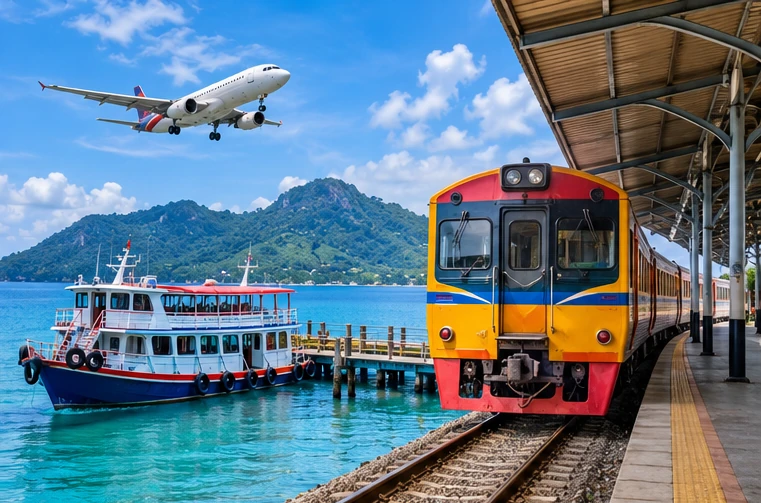
Conceptual illustration of Bangkok and an onward island flight; not a flight-path diagram.
Bangkok to Koh Samui is not one route with four interchangeable vehicles. Flying to Samui puts you on the island; flying to Surat Thani leaves a mainland transfer and a ferry ahead. A train also finishes on the mainland, while a bus-and-boat ticket may use a completely different coastal gateway. Understanding those differences is the quickest way to avoid a misleading comparison between a flight time and an entire day’s journey.
The best choice depends on what you are protecting. A short holiday benefits from direct flying and fewer handovers. A traveller who enjoys rail journeys may value a sleeper even when it is slower. An economical mainland flight can work well when its arrival genuinely connects with a suitable ferry, but a cheap evening landing can require an overnight stop that removes the apparent saving.
This guide compares the complete chain from Bangkok accommodation to a Samui hotel. It separates published operator examples from editorial planning allowances and explains where separate tickets leave you responsible for a missed connection. Routes are compared by elapsed time, coordination and total spend rather than by a claim that one mode suits everyone. Operator schedules and your issued ticket remain the authority for the date you travel. [1] [3] [4] [5]
This article contains affiliate links. If you book or buy through one, Taylor’s Trailblazing Travels may earn a commission at no extra cost to you. Recommendations are based on their practical fit, not the commission available.
Fly to USM
Land on the island, then transfer by road.
Early URT flight
Confirm road, ferry and hotel transport.
Sleeper train
Buy a confirmed berth and station connection.
Through coach and boat
Check the gateway, pier and actual elapsed time.
Start with the whole journey
Bangkok to Koh Samui options compared
Compare the same starting and finishing points
Use your Bangkok hotel as the start and your Samui accommodation as the finish. Otherwise, a ferry-only price can appear beside an all-inclusive transfer, or a short mainland flight can look equivalent to landing on the island. The missing road legs, waiting periods and pier-to-hotel transfer are not minor details; they determine whether you arrive ready to enjoy the day.
The ranges below are broad planning allowances, reviewed on 3 October 2026, rather than a timetable. Add more time for remote hotels, busy Bangkok traffic, disruption or an overnight mainland stay. A specific departure can fall outside the range, so reconstruct its individual legs before purchasing anything.
Whole-journey planning comparison
On a small screen, swipe within the table to see every column.
| Route | Broad door-to-hotel allowance | Best reason to choose it | Main trade-off |
|---|---|---|---|
| Direct flight to USM | About 4-7 hours | Fewer changes; more island time | Direct fares may be higher |
| Flight to URT + road + ferry | About 7-11 hours if connections fit | Potential complete-cost saving | Missed final connection can add a night |
| Train + road + ferry | About 15-22 hours | A deliberate rail experience | Berth availability and connection exposure |
| Through coach + boat | About 14-20 hours | A simple long-distance budget purchase | Long seated journey and sea dependency |
Editorial planning ranges reviewed 3 October 2026, not schedules. Rebuild the timing for your precise tickets and hotels.
My starting recommendation
For a first visit of only a few nights, I would price a direct flight before investigating complicated alternatives. When the difference is substantial and the schedule works, the Surat Thani option becomes a sensible comparison. The train belongs on the shortlist when the journey itself is part of the holiday, while an overnight coach suits travellers comfortable with a long seated journey.
Search results are useful for discovering combinations, not for proving that every component is protected. Read the operator name, departure address, arrival pier and baggage rules. A single payment can still cover separate services with different conditions. [9]
The least complicated route
Direct flights to Samui
Buy an island arrival, not just a flight south
Samui Airport uses the code USM. Bangkok Airways markets direct Samui services from Bangkok, including a Don Mueang route as well as Suvarnabhumi options. Availability and timings should be checked for your dates; do not assume every Bangkok-to-Samui departure leaves from the same airport. The airline’s own route and promotion pages are useful starting points, but a displayed promotion is not a guaranteed available fare. [1] [2]
The practical advantage is the reduced number of handovers. After arriving on Samui, you have a road transfer rather than another mainland journey and a boat. That can be particularly valuable for a family, a traveller with limited mobility or anyone trying to make the most of a short stay.
Allow for the airport parts
A short flight does not create a short hotel-to-hotel transfer by itself. You still need to reach the correct Bangkok terminal, check in, clear security, board and collect any checked luggage after landing. Use the airline’s current guidance for airport arrival rather than working backwards from the scheduled flight time alone.
Choose a departure that fits your last Bangkok night. Saving a small amount on a very early flight may mean losing sleep and paying for a difficult transfer. A slightly later service can be better value when it lets you leave the hotel calmly and reach Samui at a useful check-in time.
Two different Bangkok gateways
BKK and DMK: avoid the airport mistake
Read all three-letter codes
Suvarnabhumi is BKK and Don Mueang is DMK. They are separate airports, not adjoining terminals. Compare the code on your onward ticket with the airport at which you arrive in Bangkok. A booking screen that uses Bangkok as the headline location can conceal a cross-city transfer that changes the feasibility of the whole journey.
If you are connecting from an international flight, check whether your baggage is through-checked and what transfer process applies. A single airline logo does not settle that question when tickets were bought separately. Ask the issuing airline about the actual booking and follow its instructions at the airport.
Changing airports takes real time
Airports of Thailand publishes a shuttle service between the two airports, but its operating arrangements and eligibility need checking before travel. This is still a road journey, with waiting and traffic as well as the drive. It does not turn a tight self-transfer into a protected connection. [8]
For a separate-ticket arrival, calculate immigration, baggage, customs, finding transport, the cross-city drive and the onward check-in deadline individually. When the result only works if every stage goes perfectly, choose a later flight or stay overnight. The apparent inconvenience of a Bangkok hotel can be smaller than the cost of missing a non-refundable departure.
The practical budget alternative
Fly to Surat Thani, then transfer
Mainland arrival means three more tasks
Surat Thani Airport is URT, not USM. From there you need road transport to the relevant pier, the ferry crossing and transport on Samui. A combined airport-to-island booking can simplify those steps, but establish whether it ends at a pier or your hotel. The word Samui in a destination field does not automatically include the east-coast resort you have booked.
Raja’s booking information, for example, offers an airport-and-ferry product to Lipa Noi and separately advertises island shared transfers. This demonstrates why the endpoint matters: a mainland flight and a transfer arriving on the island’s western side are not the same product as a flight into Samui Airport. [4]
Take the arrival time seriously
An early mainland flight gives you more room to recover from ordinary delays. Before buying it, identify a feasible transfer departure after you have collected luggage, not merely after scheduled landing. Ask the transfer supplier how it handles a late flight and whether you are moved to a later departure, charged again or left to arrange a new route.
An evening flight can be perfectly reasonable when an overnight stay is part of your plan. It is less attractive when you discover that necessity after paying. Price the room, meals, extra transfer and lost island time alongside the low airfare. The resulting total is the figure to compare with a direct flight.
Understand the ferry geography
Don Sak, Nathon and Lipa Noi
Match the company to the pier
Don Sak is a mainland gateway area with different operator facilities. On Samui, Seatran Ferry serves Nathon, while Raja’s Don Sak route serves Lipa Noi. The road transfer must deliver you to the right company’s departure point, and your island pickup must meet the correct arrival pier. These names are not interchangeable just because the destination island is the same. [4] [5]
Keep the ferry voucher accessible before reaching the port. It may specify a check-in desk, reporting time and process for boarding. A vehicle transfer that reaches the vicinity of the pier at departure time is too late if check-in has already closed. Use the seller’s reporting instructions rather than relying on the boat time alone.
Vehicle ferries and passenger arrangements
Buying a passenger ticket does not mean your Bangkok coach or mainland van will necessarily accompany you. Some itineraries require passengers and luggage to transfer independently between vehicles and boats. Ask how bags are handled and who identifies the connecting vehicle after arrival.
Travellers taking a hire car need separate permission from the rental company and the appropriate ferry booking. A standard foot-passenger price does not include a vehicle. For most first-time visitors travelling from Bangkok, a passenger transfer is simpler than arranging a long one-way drive and an island vehicle return.
Make the journey part of the trip
The sleeper train via Surat Thani
There is no train onto Koh Samui
The rail option takes you to Surat Thani station on the mainland, followed by road transport and a ferry. Search the State Railway of Thailand’s D-Ticket system for the exact journey and date, selecting the berth or seat type you actually intend to use. A train search result and a confirmed sleeper reservation are not the same thing. [3]
Most relevant long-distance southern services use Krung Thep Aphiwat Central Terminal in Bangkok. The official government explanation records the move of these services from Hua Lamphong, but your issued ticket should settle the departure station. Do not send a taxi to the older station simply because it appears in a familiar guidebook. [7]
Choose comfort deliberately
A sleeper berth can make an overnight journey more manageable than spending the same hours sitting upright. Check whether you are buying an upper or lower berth, air-conditioned accommodation, a seat or a private compartment. The photographs and headline class name should match the confirmation. Availability can be the decisive constraint during busy periods.
Carry an accessible overnight kit rather than opening your main bag in a narrow carriage space. Keep valuables secure, bring a layer for air conditioning and organise an alarm for your stop. Do not assume that a long scheduled journey guarantees a full night’s sleep; noise, movement and an early arrival are part of the trade-off.
Avoid a disconnected booking
Connecting from the railway station
A station arrival is not a pier arrival
Your onward transfer should be booked from Surat Thani railway station when that is where you arrive, not from the airport or an unspecified city meeting point. These are different pickup locations. Confirm where the representative meets the train, how long they wait and whether a delayed service can use a later connection.
A very early arrival needs particular attention. You may have several hours before the next suitable transfer, so check what is open, where you wait and whether the booking includes that period. A journey sold as overnight can still take much of the following morning before you reach the hotel.
Separate tickets versus a coordinated product
Booking independently gives you control over the train class and onward service, but you may bear the risk when one misses the other. A combined product can reduce coordination, although its protection depends on the written terms. Ask specifically what happens when the train is late rather than accepting the vague reassurance that everything is included.
Keep a mainland fallback in mind. If disruption makes the last practical ferry impossible, it is usually better to arrange a safe overnight stay than to chase an uncertain private boat. Contact the Samui hotel early so it understands that the arrival has changed and does not treat silence as an unexplained no-show.
Economical, but read the route
Bus and ferry through-tickets
Not every service goes the same way
A bus-and-ferry booking may use a mainland route towards Don Sak or a bus-and-catamaran combination associated with another gateway such as Chumphon. The number of boat stops and the final Samui pier can differ. Compare the actual itinerary rather than the generic label bus plus ferry.
Lomprayah markets bus-and-catamaran travel to the Gulf islands. Read the complete date-specific itinerary rather than relying on a headline duration in a general guide. As a worked timing example prepared on 3 October 2026, a 21:30 departure reaching its destination at 11:30 the following day would take fourteen hours. Those times illustrate the calculation; they are not a verified available departure. Include any preceding check-in and final hotel transfer as well. [6]
Know the Bangkok pickup
Khao San, Pinklao and a major bus terminal are different departure locations. Some products require check-in at an operator office before boarding elsewhere. Save the address, location pin and reporting time, then allow time to reach that exact place with luggage.
Check the seating category, stops, toilet arrangements and luggage rules before buying. Overnight road travel can be tiring even in an upgraded coach. A budget traveller with a flexible first Samui day may accept that compromise happily; someone planning an immediate dive course or demanding excursion should consider the recovery time as part of the cost.
Use a complete budget
What the journey really costs
Start with the same basket
Record the main ticket, Bangkok transfer, baggage charge, mainland connection, boat, Samui transfer, meals and any overnight room. Add seat or berth supplements only when you actually plan to buy them. Compare like with like for every passenger, then separate shared costs such as a private vehicle from per-person fares.
The dated examples below show how advertised components can differ. They are not a quote for a complete Bangkok-to-hotel journey. Availability, fare class and channel-specific charges can change the result, so request a final total for your travel date before deciding. [1] [4]
Dated component examples, not complete quotes
On a small screen, swipe within the table to see every column.
| Component | Published example | What it does not settle |
|---|---|---|
| Bangkok Airways promotional Bangkok-Samui sector | From THB 2,730 total / person | Limited-seat availability and your travel date |
| Raja Surat Thani Airport + ferry product | THB 540 / person, published example | Your flight connection and any island hotel transfer |
| A train or coach result | Quote the selected service and class | Berth, baggage, endpoints and protection |
Provider examples checked 3 October 2026. Reconfirm payable amounts and conditions before booking. [1] [4]
A transparent worked comparison
As a budgeting exercise reviewed on 3 October 2026, suppose two direct flights total THB 8,000 and the cheaper mainland flights total THB 4,400. The apparent saving is THB 3,600. If the mainland route then needs THB 1,080 for two combined transfers and an additional THB 700 for island transport, the remaining saving is THB 1,820 before any extra food or overnight room. These are explicit illustrative inputs, not current flight quotations.
That smaller saving may still be worthwhile. The useful question is whether it compensates your group for the extra journey and connection exposure. Avoid treating a night’s sleep on a bus as automatically equivalent to a hotel night; the financial saving and the quality of rest are separate considerations.
One bag, several rulebooks
Baggage across flights, trains and ferries
Check the most restrictive leg
A generous allowance on an international ticket does not automatically continue onto a separately booked domestic flight. Bangkok Airways publishes its own baggage rules, including aircraft-dependent cabin-bag dimensions, and other carriers have their own fare conditions. Check the operating airline and the allowance shown on the actual ticket. [10]
A long combined itinerary is easier with luggage you can lift and keep track of. You may need to move it through a terminal, onto a bus and across a gangway. Choose a manageable bag rather than assuming porters or trolleys will be available at every handover. Keep a small pouch for documents, tickets, phone and essential medication.
Label and count at every change
Attach contact details discreetly and photograph your luggage before departure. Count the group’s bags when leaving each vehicle, especially when passengers are being divided among different hotel vans. Similar-looking cases are common, and a missing item is easier to recover before the next service departs.
Ask about oversized equipment in advance. A train berth, budget airline or shared van may have different restrictions from the ferry itself. Do not purchase the whole route first and then discover that the awkward item only fits if you pay for a private vehicle on one leg.
The sea leg changes the risk
Weather and disruption
Choose the correct coast’s forecast
Samui is in the Gulf of Thailand, so an attractive forecast for Phuket does not settle conditions for your crossing. Use the Thai Meteorological Department’s regional and marine information close to travel, alongside the operator’s own service notices. Seasonal descriptions help with broad planning; they cannot certify a particular ferry departure. [11]
In poor conditions, a cancelled or delayed boat is not a problem to solve by persuading someone to ignore the warning. Ask about rebooking, the next authorised service and accommodation if needed. A flexible room and some spare time become valuable when the journey includes the sea.
Check land disruption too
At the 3 October 2026 review, UK travel advice carried a severe-flooding update dated 28 September 2026. Travellers leaving Bangkok should check current road, rail and airline notices rather than assuming that yesterday’s transport plan still works. This is a dated travel-planning alert, not a prediction about the conditions on your future departure date. [12]
Keep important confirmations offline and retain enough flexibility for a changed night on the mainland. A transport company can advise about its own service; it may not manage your independently booked hotel or onward flight. Contact each affected supplier promptly instead of expecting one cancellation message to update the whole itinerary.
Protect the expensive ticket
Connections from international flights
One reservation can matter
When the long-haul flight and Samui connection are on a single protected itinerary, the airline’s connection and baggage arrangements may make direct flying especially attractive. Confirm the terms with the issuing carrier. Do not infer protection merely from two flights appearing in the same email or being bought from one travel website.
With separate tickets, the arriving airline generally has no obligation to make your later independent service work. A delayed arrival, immigration queue or baggage issue can consume the entire connection margin. Choose a genuinely comfortable interval or an overnight stop, especially where changing between BKK and DMK is involved.
The return deserves extra caution
For a separate international flight home, returning to Bangkok before the final day is the lower-stress planning choice. This is particularly useful when your route from Samui includes a ferry and a train or bus. It also gives you a final city evening rather than ending the holiday with several tightly connected vehicles.
A direct Samui flight can reduce the number of stages, but it is not immune to delay. Assess the consequences of missing the long-haul flight rather than applying one universal minimum connection time to every traveller. Insurance conditions and airline ticket rules should be checked against the actual bookings.
The hotel is still one transfer away
Arrival on Samui
Know which side of the island you reach
A USM airport arrival, a Nathon ferry arrival, a Lipa Noi arrival and a Pralarn arrival can imply different final road journeys. Send the correct pier or airport to the hotel and transport supplier. A driver waiting at the wrong terminal is not a small naming error when you arrive tired with luggage.
Before buying a combined ticket, check whether hotel transfer is included, optional or unavailable for your address. If it is included, establish whether the service drops at reception or a nearby road and whether other hotels are visited first. If it is not included, arrange the final stage separately rather than treating the ferry arrival time as your hotel arrival.
Select the base before optimising the last ride
Do not choose a hotel purely because it is close to the arrival pier when it is poorly placed for the holiday you want. A transfer is a one-off task; the location affects every evening. Conversely, someone staying only one night before another boat may reasonably prioritise a practical gateway.
For a first beach stay, compare areas by dining access, beach preference, room access and onward plans. Then price the transfer to the chosen address. The route should serve the holiday rather than turning the easiest arrival point into an accidental accommodation decision.
Travel style, not a universal winner
Which option suits your group?
Couples and short holidays
Direct flying is often the most persuasive choice when only a few island nights are available. It limits handovers and leaves more flexibility for the first day. A couple comfortable with a longer transfer can still find excellent value via the mainland, particularly when the flight and ferry timings align without an overnight stop.
Compare what the saving would buy on the island. It may pay for an extra night or an excursion you value more than the travel time. Equally, spending the whole first day moving between services can be a poor exchange when the holiday is already short. This is a personal value judgement, not a fixed rule about budget travel.
Families and travellers needing assistance
Reduce changes when they create practical strain. A confirmed direct flight and suitable airport transfer can be easier than managing children, luggage and several boarding processes. However, the flight’s own assistance requirements and the final vehicle still need checking; direct does not mean automatically accessible.
For mobility needs, ask about steps, gangways, toilets, lifting assistance and whether a wheelchair can remain in use. Do not rely on the word ferry to imply level boarding. Describe requirements to each operating company and consider a route change when the answers are vague.
Examples you can adapt
Two workable planning patterns
Pattern one: Bangkok breakfast, Samui afternoon
Spend the final Bangkok night within a sensible journey of your departure airport. Take a direct flight with enough time for an unhurried checkout, then arrange a Samui transfer to your selected hotel. Keep the arrival afternoon for settling in rather than a non-refundable activity.
This pattern is not tied to a particular flight number. Its advantage is the small number of dependencies: hotel checkout, airport, flight, island transfer. You can adapt the departure hour to the room rate and airline availability without rebuilding a chain of road and sea reservations.
Pattern two: a deliberate rail journey
Reserve the sleeper you actually want and choose an onward station-to-Samui connection that allows for ordinary delay. Keep a small overnight bag accessible, save both bookings and tell the hotel that the arrival will be after the mainland transfer and crossing rather than immediately after the train.
Allow the first island day to remain light. If the train is punctual and the crossing smooth, enjoy the extra time. If the trip runs late, there is no prepaid activity to lose. The route succeeds because you chose the rail experience and allowed it room, not because it promised to imitate a flight.
A practical sequence
How to book without creating hidden gaps
Secure the limiting component first
For the rail route, the desired berth may be the limiting element. With a mainland flight, the usable onward ferry connection may matter more than the cheapest departure. For direct flying, an acceptable fare and airport choice normally come first. Establish the tightest constraint before making non-refundable bookings around it.
Then reserve the supporting transfers and accommodation with compatible conditions. Use the same passenger details throughout, check the arrival date after an overnight journey and verify whether the final destination is a terminal or hotel. A booking checklist is more useful than a folder full of unrelated confirmations.
Keep the live contact information
Store the operating company’s number beside each ticket, not just the marketplace’s general support page. Note the reporting time, meeting point and policy for late arrival. When the service is sold by a third party, understand whether changes must go through that seller or directly through the operator.
A working data connection helps with driver messages and revised instructions, but keep an offline copy as well. Do not depend entirely on a roaming plan you have not activated or an email account you cannot access without a security code sent to another device.
Change the plan in the right order
When the preferred ticket is unavailable
A sold-out sleeper is not a minor detail
If the berth you want is unavailable, assess the alternative class honestly before buying. A seated overnight journey is not the same experience as a sleeper simply because the departure and arrival stations match. Moving to another date, choosing a daytime train with a planned mainland night or taking a flight may be more sensible than accepting a journey you already expect to dislike.
Check whether a third-party confirmation is immediate or whether a requested rail seat still needs fulfilment. Do not surround a provisional booking with inflexible onward reservations. Keep the train number, accommodation type and confirmed status visible in the final ticket, and seek clarification while there is time to change the supporting arrangements.
A cheap mainland flight is not the only fallback
When direct Samui fares are too high, compare more than one realistic departure day or time where your holiday permits. Then check whether the mainland alternative connects with a suitable transfer. A low-priced flight with no useful onward service is not an equivalent substitute; the overnight stop may still be worthwhile, but it needs to be priced and planned.
Avoid buying the ferry component before establishing how you will reach it. In a disruption, the appealing availability of a boat can distract from an impossible preceding road or flight connection. Start with the constrained leg, build the whole sequence and only then confirm the pieces you can genuinely use.
Keep cancellation terms attached to the option
A flexible ticket can be valuable when travel plans are unsettled, but read what flexibility actually permits. A change may require paying a fare difference, and cancellation may return a credit rather than cash. Compare those conditions with your needs instead of treating the word flexible as an unlimited guarantee.
When several passengers must travel together, verify availability for the whole group before completing individual purchases. A displayed low fare for one seat does not prove the same price or space exists for everyone. Keep the group itinerary coherent rather than solving each ticket independently.
What each route gives up
Pros and cons, honestly compared
Every saving has a counterpart
Direct flights buy simplicity and island time, but fares can be a substantial part of a couple’s budget. Flying to the mainland can lower the airfare while introducing road and sea connections. The sleeper adds a distinctive travel experience, although berth availability and a variable night of rest may limit its appeal.
A bus-and-ferry ticket offers a straightforward purchase and can be economical, but it remains a long journey. One booking does not eliminate physical transfers, luggage handling or weather exposure. For travellers who dislike long seated travel, an upgraded coach may not solve the underlying problem.
The honest trade-offs
On a small screen, swipe within the table to see every column.
| Route | What you gain | What you accept |
|---|---|---|
| Direct flight | Smallest number of handovers | Potentially higher fare |
| Mainland flight | A useful price comparison | Road and sea stages after landing |
| Sleeper train | The journey can be part of the holiday | A long total trip and variable rest |
| Coach and ferry | One straightforward route purchase | Long seated travel and boarding changes |
Decide what matters before opening ten tabs
Choose the main priority: lowest complete cost, fewest changes, a comfortable night’s travel or maximum island time. Then compare two realistic candidates rather than endlessly revisiting every possible route. A more expensive option can still be better value when it protects something you particularly care about.
Do not force the outward and return journeys to match. Enjoying a sleeper on the way south and flying directly back can be a sensible compromise. The final international connection may justify a different decision from the more flexible start of the holiday.
Where the cheap plan goes wrong
Common mistakes
Tickets that end too early
A ticket to Surat Thani may end at the airport, railway station, town office or bus terminal. A ticket to Samui may end at a pier. Treating either label as a door-to-door service is the classic budgeting error. Check the written endpoints, not only the large destination name at the top of the search result.
Another mistake is buying a flight that lands after the useful onward connection, then hoping to resolve the gap on arrival. The correct solution may be an overnight stay, but that should be a deliberate purchase. Add the room and extra journey to the comparison before calling the route cheaper.
Connections that depend on perfection
Avoid booking the last ferry immediately after a mainland flight or scheduling a separate long-haul departure shortly after a sea-and-road journey. A timetable is not a reliability guarantee. Even a journey that runs correctly may involve more baggage handling and reporting time than the headline suggests.
Finally, do not assume a through-ticket means one vehicle throughout. Confirm every change, especially overnight routes. Knowing when you must collect a bag, show another voucher or find another representative makes the long journey much less stressful.
The details that settle the choice
Frequently asked questions
Is there a train from Bangkok directly to Koh Samui?
No. The railway component reaches the mainland, normally Surat Thani for this route, and you then need road transport and a ferry. A listing labelled train to Samui is describing a combination rather than a railway line onto the island. Check the train class and each onward component separately. [3] [4]
Is Surat Thani Airport on Koh Samui?
No. URT is the mainland gateway, whereas USM is Samui Airport. A lower-priced ticket to URT can be useful, but it should be compared after adding the road transfer, ferry and island transport. The distinction matters even when both flights appear in searches for a Samui holiday.
Which Bangkok airport should I use?
Use the airport printed on your selected flight. Direct Samui services are marketed from both Suvarnabhumi and Don Mueang, subject to actual date availability. For a connection, matching the arrival and departure airport can be more valuable than a slightly lower fare requiring a cross-city transfer. [1] [2]
Does a bus-and-ferry ticket include my hotel?
Sometimes, but not automatically. Compare the written endpoint and any optional hotel-transfer addition. Ask whether your particular address is served and whether the van makes other stops. An advertised island arrival time usually should not be interpreted as the moment you walk into reception.
What is the cheapest way for a family?
Calculate the complete group cost, including baggage, seats, child rules and transfers. A low fare per adult may not remain attractive after several connections or an overnight room. The lowest price also needs to describe transport that genuinely accommodates your children and luggage, not merely enough nominal passenger places.
Should I take a ferry before a flight home?
A ferry can be part of the return, but avoid an unprotected chain with little recovery time before an expensive international departure. An earlier mainland or Bangkok arrival is the more cautious planning choice. Confirm the actual ticket protections and insurance conditions rather than relying on a generic connection rule.
Buy the journey you actually want
Final route recommendation
Price the direct USM flight first, then compare an early URT flight with a confirmed complete transfer. Choose the sleeper when the railway experience is a positive part of the trip, and choose the coach when the complete saving justifies the long seated journey. None of these choices should depend on a last-minute dash between an airport and the final ferry.
The winning booking for your holiday is the one that reaches the correct hotel with a manageable number of changes and enough room for ordinary delays. Write down every handover, compare the final total and keep the first Samui afternoon flexible. That is a stronger plan than selecting whichever result displays the shortest flight or the lowest first price.
Research and verification
Sources and fact-checking notes
Prices below are either attributed dated examples or explicitly hypothetical arithmetic. Door-to-hotel durations are editorial planning ranges. Timetables, ticket protections, flight availability and sea conditions require a fresh date-specific check.
- Bangkok Airways: Fly to SamuiDirect route and limited-seat promotional examples, not guaranteed date-specific quotes. Reviewed 03 October 2026.
- Bangkok Airways: Don Mueang-SamuiDon Mueang route information; verify flights on the date required. Reviewed 03 October 2026.
- State Railway of Thailand: D-TicketOfficial rail booking and date-specific seat/berth selection. Reviewed 03 October 2026.
- Raja Ferry: official booking informationDon Sak-Lipa Noi route and combined transfer products; check the final destination. Reviewed 03 October 2026.
- Seatran Ferry: routes and timetableDon Sak-Nathon ferry information. Reviewed 03 October 2026.
- Lomprayah: official routes and bookingBus-and-catamaran service information. Obtain current dates, times and piers from the booking system. Reviewed 03 October 2026.
- Thailand government: Krung Thep AphiwatLong-distance station transition; use the station on the issued ticket. Reviewed 03 October 2026.
- Airports of Thailand: inter-airport shuttleBKK-DMK road shuttle; confirm current operation and eligibility. Reviewed 03 October 2026.
- 12Go: Bangkok-Samui route listingsDate-specific multi-mode route discovery; listings are not a single fixed timetable. Reviewed 03 October 2026.
- Bangkok Airways: baggage allowanceOperating-airline rules and aircraft-dependent cabin dimensions. Reviewed 03 October 2026.
- Thai Meteorological Department: Gulf coastRegional and marine forecast; recheck close to travel. Reviewed 03 October 2026.
- FCDO: Thailand warnings and insuranceSevere-flooding update dated 28 September 2026, checked 3 October 2026. Reviewed 03 October 2026.
Illustrations in this article were created for Taylor’s Trailblazing Travels. Third-party photographs, where used, are credited beside the image or in the source list.