Thailand itineraries · Kanchanaburi
Kanchanaburi Itinerary 2026: A Realistic 3-Day Plan for Erawan Waterfall, Hellfire Pass and the River Kwai
A practical three-day route for railway history, Erawan Waterfall and Hellfire Pass without pretending the province is compact.
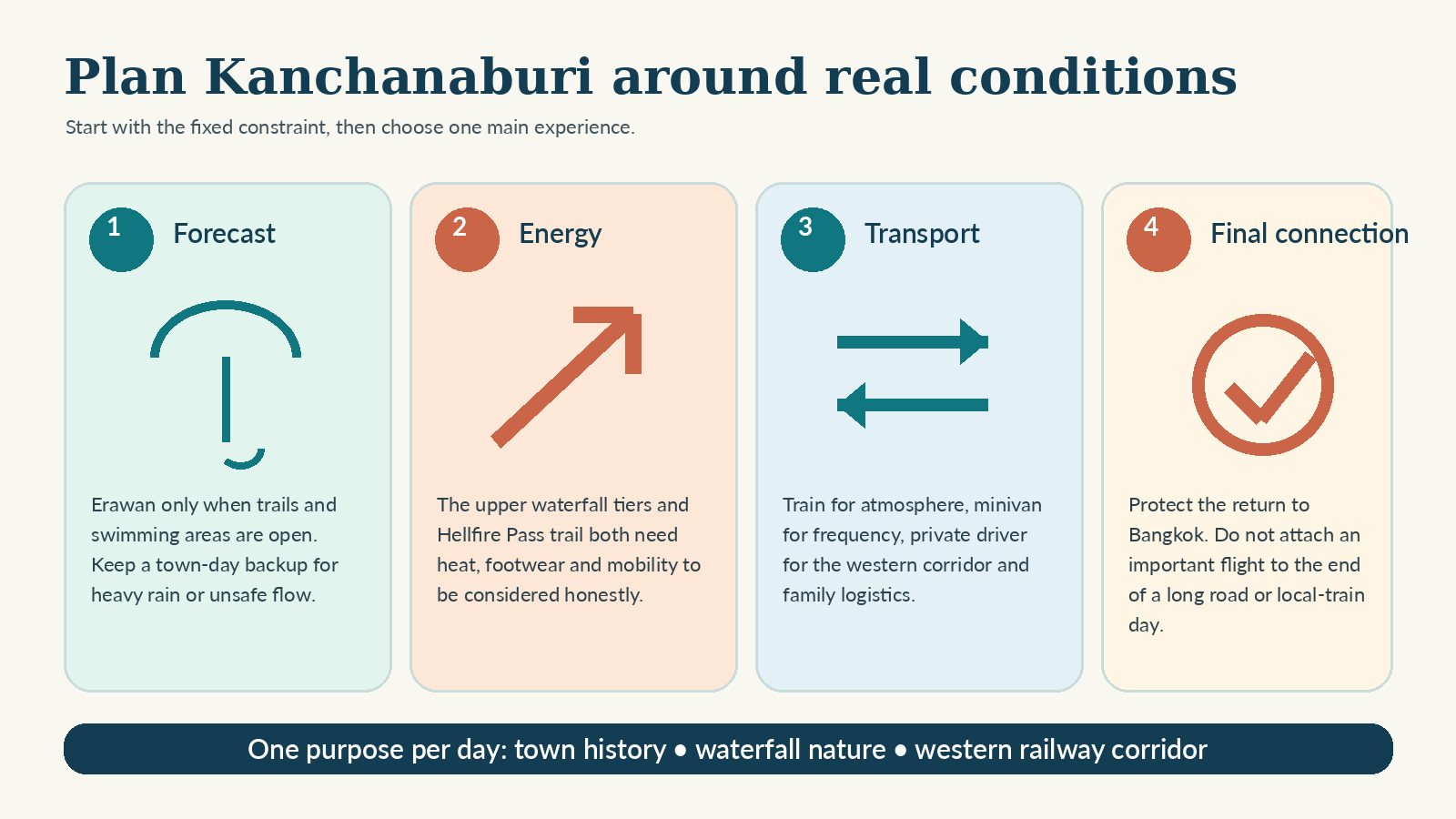
Kanchanaburi works best when town history, waterfall nature and the western railway corridor each receive their own day.
Kanchanaburi is often sold as a quick escape from Bangkok, yet its headline sights sit on three separate routes. The bridge, museums and cemetery belong to the town. Erawan Waterfall is a full nature day to the north-west. Hellfire Pass and the scenic railway corridor stretch much farther towards Sai Yok. A successful Kanchanaburi itinerary begins by accepting those distances.
This guide rebuilds the route around current official information and practical sequencing. It separates fixed opening hours from flexible stops, labels prices as dated references or planning ranges, and explains when a cheap public journey stops being good value. The result is suitable for independent travellers, couples, families and older visitors who want a plan that can survive heat, rain and transport delays.
The official sources were checked on 10 September 2026. Conditions can still change at short notice; in 2026, for example, Erawan briefly closed because of fire, smoke and air quality before reopening. That is why every nature day includes a fallback rather than a promise.
This guide contains carefully selected affiliate links. Taylor’s Trailblazing Travels may earn a commission when a reader books or buys through one of them, at no extra cost to the reader. Links appear only where they solve a transport, accommodation, excursion, connectivity or packing decision.
Three nights in town
Easy museums, food and pickups, with one full day for each distant corridor.
Erawan early
Start before the heat, agree a turn-around time and check live park status.
Centre before bridge
Use serious interpretation before visiting the railway’s most photographed structure.
Distance
Erawan and Hellfire Pass are separate long road days, not nearby town attractions.
Is three days enough for Kanchanaburi?
Three full days is the strongest first-time balance. It gives Kanchanaburi town and the River Kwai history one coherent day, protects a separate nature day for Erawan Waterfall, then leaves a third day for Hellfire Pass and the western railway corridor. The Tourism Authority of Thailand presents the province as a combination of waterfalls, rivers, reservoirs and Second World War history rather than one compact attraction. [1] That geography matters more than the number of places on a wish list.
Two nights is possible, but the edges disappear
A two-night stay normally creates one useful town afternoon and one full excursion day. It works when Kanchanaburi is a side trip within a longer route, although you must choose between Erawan and Hellfire Pass. Trying to keep both usually means a rushed private-car loop, little time on either trail and no margin for rain, traffic or a late local train.
Three nights lets the plan breathe
With three nights, arrival can happen before the first proper afternoon or on the preceding evening. You can then start the waterfall day early, return before dinner and use the third day without worrying that one missed bus destroys the connection to Bangkok. In practical terms, one extra night buys far more than another hotel breakfast: it buys control over the route.
Four or five nights suits a slower river stay
Add time for Wat Tham Suea, Chungkai, a night near Sai Yok, a carefully selected community experience or a genuine rest day. A longer stay also makes a split base realistic. Even then, moving hotel should change the experience substantially; shifting from town to a remote raft property for one night can be worthwhile, whereas moving between two similar town hotels rarely is.
| Stay | What fits comfortably | Main compromise | Best base |
|---|---|---|---|
| 1 night | Town history or one nature trip | Mostly a long day trip with luggage | Town centre |
| 2 nights | Town plus Erawan or Hellfire Pass | One headline day must be removed | Town or bridge corridor |
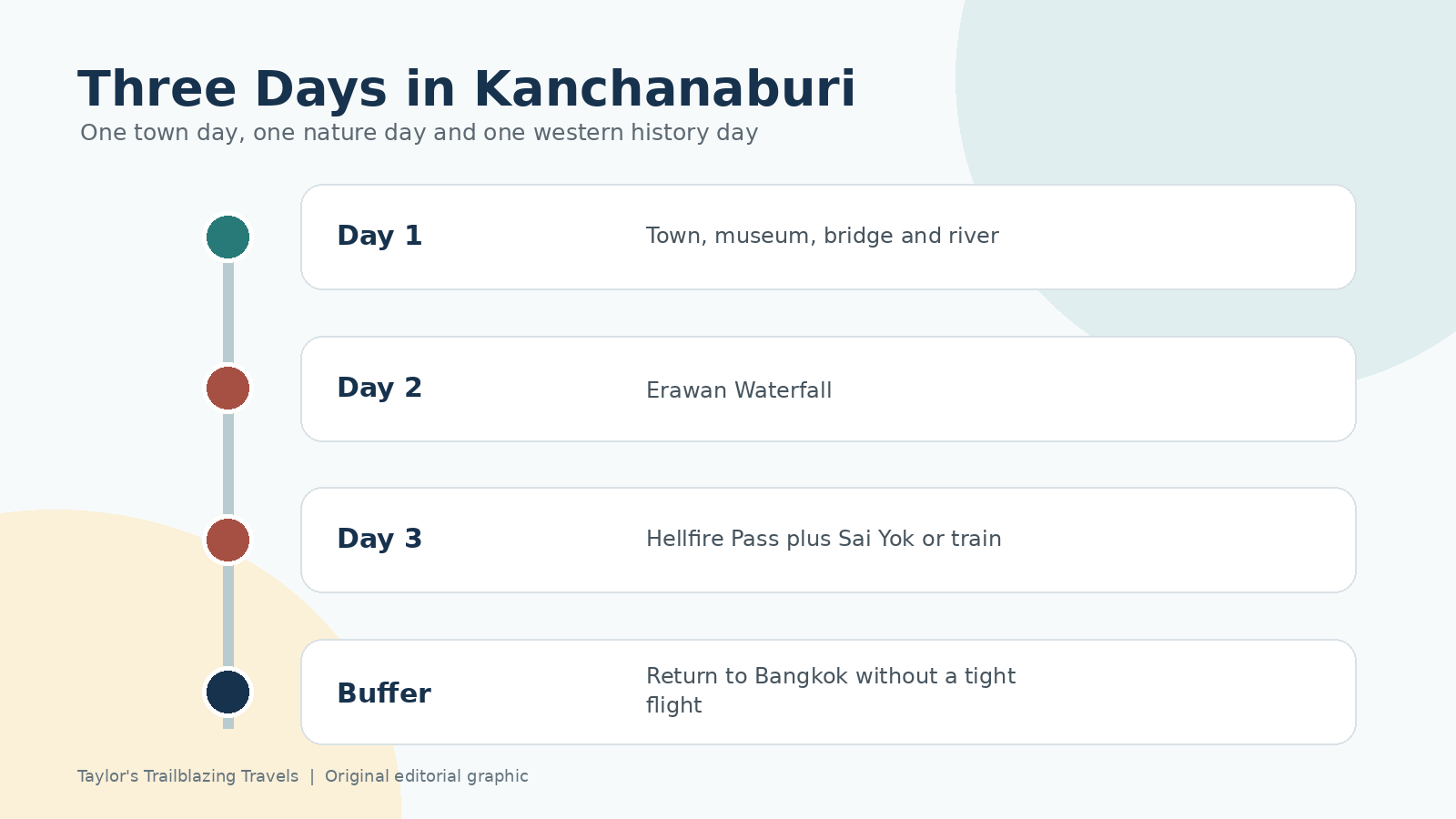
| 3 nights | Town, Erawan, Hellfire Pass/Sai Yok | Little space for a remote resort | Town for simplicity |
| 4–5 nights | Full route plus temple, river or rest day | Higher transport and hotel cost | Town, then optional Sai Yok night |
Kanchanaburi itinerary at a glance
This route assumes three nights in or near Kanchanaburi town. It also assumes that the first day begins after an early Bangkok departure or a previous-evening arrival. If your train or minivan reaches town after lunch, keep the museum and cemetery together, then move the bridge to sunset rather than deleting the context.
| Day | Main area | Core plan | Planning rule |
|---|---|---|---|
| 1 | Kanchanaburi town | Thailand–Burma Railway Centre, War Cemetery, bridge and riverside or Pak Prak | Learn the history before treating the bridge as a photo stop |
| 2 | Erawan corridor | Early waterfall day with time for the climb, swimming and a safe return | Check park status and trail conditions before leaving town |
| 3 | Sai Yok corridor | Hellfire Pass, then Sai Yok Noi or a confirmed scenic train segment | Choose one transport chain before the day begins |
Why the route uses one main purpose per day
Erawan lies roughly 65–70 kilometres from town, while the official Hellfire Pass guidance places the centre about 80 kilometres away. [8] These are not short urban transfers. Once waiting time, road conditions, heat and trail time are counted, a day that looks sparse on a map becomes full. Therefore, the itinerary does not hide a second major corridor after lunch.
What can move
Swap Days 2 and 3 according to weather, scheduled closures and the railway timetable. Keep Day 1 as the fallback because town museums, cafés and heritage streets are easier to adapt during rain. A flexible order is especially valuable from May to October, during severe-weather warnings or when Erawan posts a short-notice restriction.
Where to stay for this Kanchanaburi itinerary
The best first base is not the most photogenic room in the province. It is the place that keeps Day 1 walkable, allows an early pickup on Days 2 and 3, and leaves dinner within a short ride. For most visitors that means Kanchanaburi town, the station and cemetery area, or the River Kwai bridge corridor.
Town centre and station area
Choose this area for the railway museum, War Cemetery, local markets and straightforward road departures. It is practical for travellers arriving by train or bus, and usually offers a broad range of guesthouses and small hotels. The compromise is atmosphere: some streets feel functional, and the river may not be visible from the room.
Bridge and riverfront corridor
This is the easiest balance for restaurants, evening views and access to the bridge. However, check the exact road rather than trusting a “River Kwai” label. A property can be kilometres from the bridge or separated from the main eating area by a dark road. Look at the walking route, not only the map pin.
Riverside resort outside town
A quieter river stay can be excellent for couples and slower trips. Nevertheless, free shuttles may run only at set times, ride-app coverage can be inconsistent and every dinner may become a paid transfer. This choice works best when the hotel itself is part of the holiday and at least one day is deliberately slow.
Sai Yok or floating-raft stay
Use a remote stay to change the experience, not to save a few minutes on one attraction. It can make Hellfire Pass or river scenery easier, but town museums and Erawan may become less convenient. Ask about electricity, air conditioning, luggage transfer, boat-only access, meal arrangements, mobile signal and the last arrival time before paying.
| Area | Best for | Main advantage | Watch for |
|---|---|---|---|
| Town centre | First visits and public transport | Museums, station, food and pickups | Less resort atmosphere |
| Bridge/river road | Evenings and balanced logistics | Restaurants and bridge access | Traffic, noise and variable walking routes |
| Outer river resort | Couples and slower stays | Views and quiet | Shuttle dependence |
| Sai Yok/raft | Nature-led extension | Distinctive setting | Remote meals, transport and power details |
Compare the area before the hotel
Use one broad search to see the location and cancellation terms, then inspect the walking route, pickup access and recent property information. The cheapest river room is poor value when every meal requires a taxi.
How to get from Bangkok to Kanchanaburi in 2026
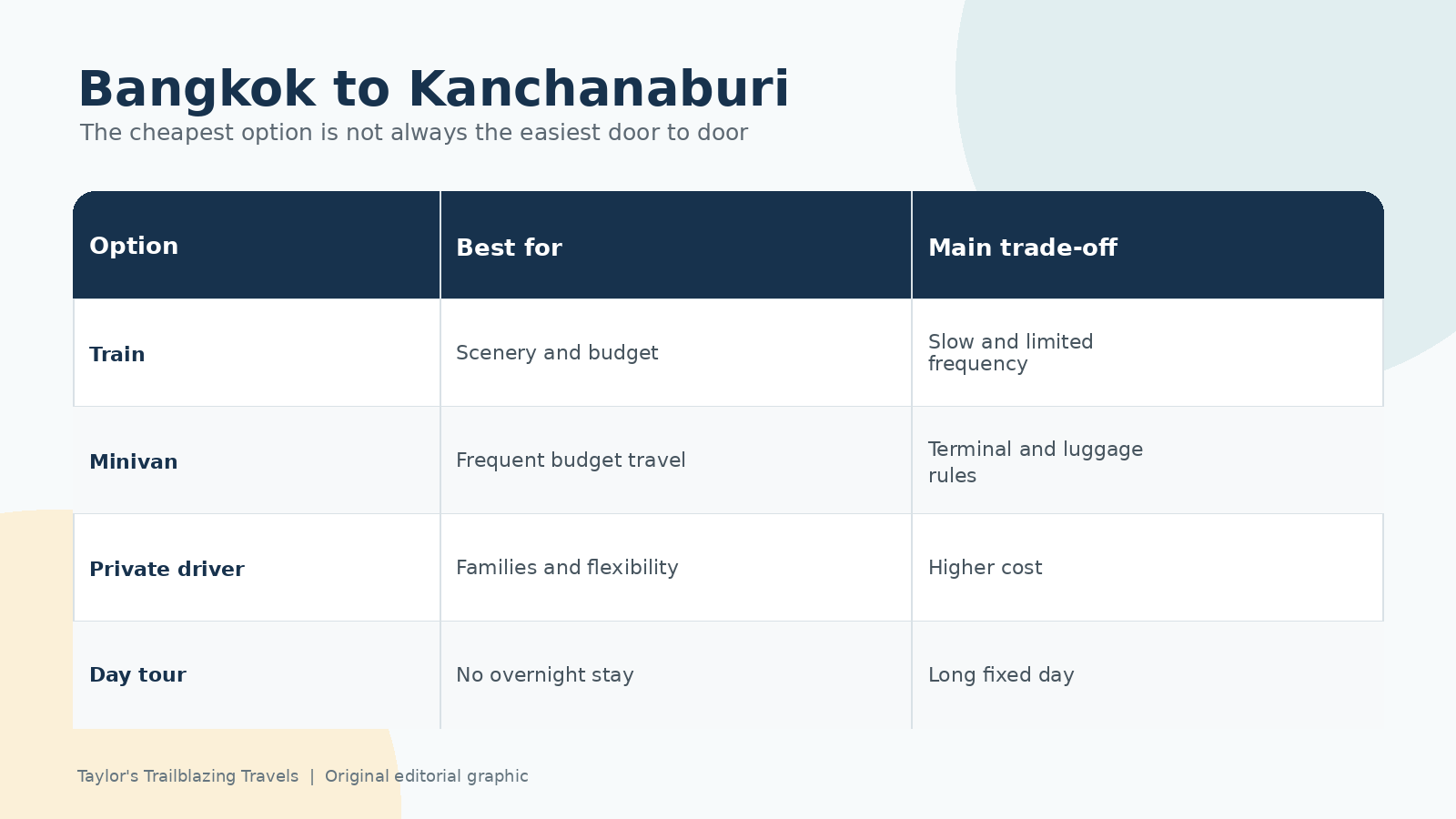
Train, minivan, coach and private transfer all work, although they solve different problems. The ordinary State Railway of Thailand services from Thonburi are the most characterful. The 2026 timetable search shows trains 257 and 259 leaving Thonburi at 07:45 and 13:55 on the Nam Tok line; recheck the exact Kanchanaburi arrival and operating notice for your date. [9]
Ordinary train from Thonburi
Choose the train when the journey itself matters. Expect fan-cooled third class, open windows, basic toilets and a station that is separate from Bangkok’s main Krung Thep Aphiwat terminal. Arrive early enough to find Thonburi station and buy the correct ticket. SRT’s ticket guidance treats ordinary, suburban and local non-reserved services differently from reservable express trains, so do not assume an online seat reservation will appear. [10]
Minivan or coach
Road transport offers more departure times and often a faster point-to-point journey. The weakness is terminal confusion: Bangkok has several bus and minivan departure areas, while Kanchanaburi operators may use the main bus station or a private office. Confirm the exact map pin, baggage allowance and final arrival point before leaving the hotel.
Private transfer
A private car is most useful for families, four adults sharing, bulky luggage, a hotel outside town or a same-day western-corridor stop. Ask whether tolls, waiting time, child seats and hotel access are included. A driver is not automatically a licensed historical guide, so book interpretation separately when that is the reason for paying more.
What about a Bangkok day tour?
A tour can simplify Erawan, the bridge or a combined history route, but read the pickup radius and actual time at each stop. “Kanchanaburi day trip” can describe anything from a museum-led day to a long waterfall drive with a ten-minute bridge photo. Compare the itinerary, group size, entrance-fee treatment and meal rather than the headline attraction list.
Useful transport comparison
12Go can show current rail and road listings together. Use it to identify departure points and operators, then check the operating terms and official SRT timetable before payment.
Day 1: railway history, the bridge and Kanchanaburi town
Use the first day to understand the railway before visiting its most photographed structure. The Thailand–Burma Railway Centre, Kanchanaburi War Cemetery and Kanchanaburi station sit in one compact cluster. The bridge lies farther north-west, while Pak Prak’s heritage buildings sit towards the old town. Grouping them in this order keeps the day coherent.
09:00–11:00: Thailand–Burma Railway Centre
The centre’s visitor page lists daily opening from 09:00 to 16:00 and published admission of 160 THB for adults and 80 THB for children aged 7–12, but the page also states that it was last updated on 31 October 2022. [11] Treat the price as a dated reference and check at the door. Allow 90 minutes to two hours if you want to read rather than simply pass through the rooms.
11:00–11:45: Kanchanaburi War Cemetery
The cemetery is a place of remembrance, not a backdrop. Walk quietly, follow site guidance and use the Commonwealth War Graves Commission search when a particular name or unit matters. [14] The railway’s history also includes huge numbers of Asian forced labourers whose deaths are not represented by the same cemetery record. Hellfire Pass’s official material explicitly commemorates both Allied prisoners of war and Asian labourers. [7]
12:00–13:30: lunch and heat break
Take a proper seated break. The afternoon bridge area has limited shade, and pushing straight through the hottest hours rarely improves the experience. Leave luggage at the accommodation rather than carrying it through museums and along tracks.
14:00–16:30: bridge and riverside
Walk the bridge only when the railway environment is safe and permitted. Trains still use the line, so stay alert, keep children close and do not step into restricted areas for a photograph. A passing train is not a performance arranged for visitors. Afterwards, follow the riverfront or return to the hotel before dinner.
Late afternoon alternative: Pak Prak
Pak Prak is the oldest community area in the town and contains more than 20 heritage buildings with Chinese, European and Thai architectural influences. TAT also records the story of Boonpong Sirivejabhand, who helped carry messages from prisoners of war. [2] The Thai-language TAT page describes a Saturday evening walking street, but current operation should be verified before building the itinerary around it.
Karen’s pacing rule
Do not add Erawan, Wat Tham Suea or a long river cruise to Day 1. The town’s history is already emotionally dense, and a museum deserves more than the time left after a road trip.
Day 2: Erawan Waterfall without turning it into a race
Erawan is the nature day. Leave town early, carry everything needed for heat and water, and decide in advance whether the goal is the full upper trail or a slower lower-tier visit. The park’s official services page describes a large limestone national park and lists official accommodation and contact routes; the page was updated in April 2026. [5]
Before leaving town: check live park status
In April 2026, DNP temporarily closed Erawan because of fire, smoke and PM2.5, then reopened it once conditions improved. [6] That short closure is a useful reminder: an old blog timetable cannot overrule the park. Check the official park page or contact number, current weather, water conditions and any tier restrictions before committing to the road journey.
Working timetable for the day
| Time | Plan |
|---|---|
| 06:45–07:30 | Breakfast, water, weather and park-status check; depart town |
| 08:15–09:00 | Arrive, buy tickets, use toilets and begin before the hottest period |
| 09:00–12:30 | Climb at a pace matched to the group; turn around before fatigue creates a risky descent |
| 12:30–14:30 | Lunch, lower pools or rest; change out of wet clothing |
| 14:30–16:30 | Return to town, allowing for road conditions and rain |
How far should you climb?
The seven-tier label encourages visitors to treat the top as the only successful outcome. It is not. The higher trail becomes steeper and more slippery, especially after rain, while heat and swimming reduce energy. Agree a turn-around time and let the slowest safe walker set the pace. A calm visit to four tiers is better than an anxious rush to seven.
Swimming and belongings
Use only open swimming areas, follow lifeguard or ranger instructions and never enter fast, discoloured or closed water. Keep valuables dry and secure from monkeys. Avoid bringing food onto upper trails when park rules restrict it, and carry litter back to the correct disposal point.
Entrance-fee caveat
The official national fee schedule located for this update is dated 2 June 2023. It lists Erawan at 300 THB for a foreign adult and 150 THB for a foreign child, with Thai adult/child rates of 60/30 THB. [4] Because the dataset is not a live gate notice, label these as dated planning figures and confirm the current price, age definition and vehicle charge.
Shared excursion or private driver?
A shared trip is usually cheaper and simpler for a solo traveller. A private driver becomes more useful for a family, slower walker or group that wants control over departure and return. Compare actual time at Erawan, included fees, lunch and cancellation terms.
Day 3: Hellfire Pass, Sai Yok and the scenic railway
Day 3 follows the western corridor. Hellfire Pass should be the anchor because its 09:00–16:00 hours and scheduled closures are fixed. [7] Then choose either Sai Yok Noi or a carefully confirmed railway segment. Trying to complete the long Hellfire trail, visit several waterfalls and catch a specific train usually leaves no recovery margin.
08:00–09:15: travel to Hellfire Pass
The official FAQ places the centre about 80 kilometres from Kanchanaburi town, roughly one hour by car or 1.5–2 hours by bus. [8] Start earlier by public transport. A private driver should know whether the plan ends at Sai Yok Noi, Nam Tok, Tham Krasae or back in town; these are not interchangeable pickup points.
09:15–12:00: centre and short memorial walk
Admission is free according to the official FAQ. The Blue Walk from the centre to the Hellfire Pass memorial is about 500 metres and takes roughly 45–60 minutes, while the longer route to Hintok Road is 2.6 kilometres one way and can take three hours return. [8] The long route requires better fitness, more water and a free safety radio from staff.
Accessibility support
The centre says a free golf-buggy service is available for elderly visitors and people with physical or health limitations, with one companion. Contact the centre before travel when the service is essential, and allow time for the museum even when the trail is reduced.
Afternoon option A: Sai Yok Noi
Sai Yok Noi is the easier public-transport pairing. Its flow changes by season, and wet rock can be slippery, so treat it as a scenic stop rather than a guaranteed swimming day. It also sits near Nam Tok station, which can make a local train practical when the timetable aligns.
Afternoon option B: short scenic train segment
Use SRT’s live timetable to confirm the exact station, direction and return plan. The ordinary line through Tham Krasae and the river landscape is atmospheric, but trains are limited and delays are possible. Buying a ticket does not solve transport from Hellfire Pass to the station; the official FAQ says no taxi service is based at the centre. [8]
Hellfire Pass closure dates
The current DVA page lists annual closure periods including 1 January, 13–15 April, a three-week maintenance closure in May, 5 December, 24–27 December and 31 December. Exact maintenance dates vary, so confirm before booking a non-refundable driver. [7]
Do not build a flight connection after this day
A local bus, mountain road and ordinary train create too many points of failure. Return to Bangkok on a separate morning or protect several hours beyond the scheduled journey.
Two-day, four-day and five-day alternatives
A realistic two-day version
Day 1: travel from Bangkok, visit the railway centre and cemetery, then see the bridge near late afternoon. Day 2: choose Erawan or Hellfire Pass. Erawan suits a nature-first trip; Hellfire Pass suits travellers for whom the railway history is the main reason to come. Return to Bangkok on the following morning when possible rather than after the full excursion.
A four-day version
Keep the three-day route, then add one of three extensions: Wat Tham Suea and the surrounding countryside; a slower river resort day; or a dedicated Tham Krasae/Sai Yok route that no longer depends on squeezing around Hellfire Pass. This is the easiest way to reduce road fatigue while keeping both history and nature.
A five-day version with one remote night
Use three nights in town and one night around Sai Yok. Move to the remote property only after the town day and Erawan have been completed. On the final morning, return towards Bangkok with a protected connection. Check whether the property is reached by road or boat and whether a late arrival is accepted.
What not to add automatically
Sangkhla Buri, Huai Mae Khamin and Thong Pha Phum are substantial journeys that deserve their own overnight plan. They are not casual add-ons to a three-day Kanchanaburi itinerary. Likewise, an elephant venue should never be inserted simply because it appears on a transport corridor; screen welfare standards and programme details before considering any animal activity.
Getting around Kanchanaburi without losing half the trip
There is no single transport mode that solves every day. The town can be walked in clusters, while Erawan and Hellfire Pass need a bus, shared excursion or driver. A local train can become part of Day 3, but it is not a substitute for the road connection between distant attractions.
| Mode | Best use | Strength | Weakness |
|---|---|---|---|
| Walking | Museum/cemetery and short town clusters | Free and flexible | Heat, road crossings and spread-out riverfront |
| Songthaew/taxi | Town links and station transfers | Useful last kilometre | Price and availability need confirmation |
| Public bus | Erawan or Hellfire Pass for confident planners | Low cost | Loose schedules and roadside returns |
| Ordinary train | Bangkok route or scenic Sai Yok segment | Atmosphere and scenery | Limited frequency and delays |
| Shared tour | Solo travellers and simple logistics | Pickup and packaged route | Fixed pace and variable time at stops |
| Private driver | Families, mobility needs and western corridor | Control and door-to-door travel | Higher cost; guiding may not be included |
Agree the route, not only a daily rate
For a driver, put the sequence, pickup time, final drop, waiting time, overtime, tolls and child-seat requirement in writing. A quote for “Kanchanaburi sightseeing” may not include Hellfire Pass, and a return from Nam Tok is not the same as waiting at the bridge.
Motorbike rental is not the easy answer
Long distances, fast highways, rain and limited lighting make the western corridor demanding. Rent only with the correct licence, suitable insurance, a helmet and real riding experience. A shop willing to provide a scooter does not prove that the rider is legal or covered.
How much does a three-day Kanchanaburi trip cost?
The ranges below are September 2026 planning allowances, not quoted package prices. They assume two people share accommodation and exclude international travel. The largest swing comes from choosing public transport versus a private driver and from staying in town versus a remote river property.
| Category | Budget | Mid-range | Comfortable |
|---|---|---|---|
| Accommodation, 3 nights | 2,100–4,500 THB | 4,500–9,000 THB | 10,500–24,000+ THB |
| Bangkok return transport | 200–700 THB pp | 500–1,500 THB pp | 3,000–6,500 THB per car |
| Local/excursion transport | 500–1,500 THB pp | 1,500–3,500 THB pp | 4,000–8,000 THB per group |
| Food and drinks | 1,200–2,100 THB pp | 2,400–4,500 THB pp | 5,000–9,000+ THB pp |
| Entries and activities | 500–1,200 THB pp | 1,000–2,500 THB pp | 2,500–6,000+ THB pp |
Working total
Two adults sharing a simple town room and using public/shared transport can often plan around 9,000–16,000 THB in total for three nights. A mid-range pair with one organised excursion and one private-driver day may spend 18,000–35,000 THB. Premium river accommodation and private transport can move the total beyond 45,000 THB.
Cash and ticketing
Carry enough cash for local tickets, food and small transport without holding the entire trip budget in one place. Cards are more common at larger hotels, but they are not a safe assumption at a park gate, roadside stop or ordinary station. Keep a smaller reserve separate from the daily wallet.
The false saving to avoid
A remote discounted room can create two paid transfers every day. Likewise, the cheapest shared tour may omit entrance fees or spend far less time at the main attraction. Compare the final route cost rather than the first displayed price.
Best time to visit Kanchanaburi
November to February is usually the easiest period for walking and long road days. March and April can be extremely hot, while the May–October southwest-monsoon period brings greener scenery, fuller waterfalls and a greater chance of heavy rain, slippery paths and local disruption. TMD’s 1991–2020 climate atlas provides the long-term context; a live provincial forecast should decide the actual day. [12] [13]
| Period | Advantages | Main risks | Best adjustment |
|---|---|---|---|
| November–February | More comfortable mornings and trail days | Peak dates and cooler open-air train journeys | Book key rooms earlier; carry a light layer |
| March–April | Long daylight and generally lower rain chance | Heat, dehydration, fire and smoke risk | Start early and keep park plans cancellable |
| May–October | Green landscapes and stronger waterfall flow | Heavy rain, flash flooding and slippery paths | Move the excursion to the best forecast and retain a town backup |
Rain does not make every day unusable
A shower can pass quickly, while a heavy-rain warning can make a waterfall or mountain road inappropriate. Therefore, do not make the decision from one phone icon. Check TMD warnings, park notices and the operator’s local assessment. Museums and Pak Prak are useful alternatives when the nature day is unsafe.
Heat changes the itinerary more than expected
High temperatures slow the Erawan climb and Hellfire Pass trail. Carry more water than a normal city day, use shade and stop before symptoms become serious. An air-conditioned lunch or hotel break is not wasted time; it protects the rest of the route.
Food, evenings and a slower side of Kanchanaburi
Three intense sightseeing days need simple evenings. Use one for the river, one for a local market or town dinner, and one for early sleep before the longest road day. A restaurant does not need a famous bridge view to be worthwhile; proximity, hygiene, allergies and the journey home matter more after dark.
Riverfront dinner
Choose a place within a safe ride or walk of the hotel. Ask whether live music, floating platforms or boat traffic will affect the experience. During high water or severe weather, follow local restrictions rather than insisting on a particular table.
Night market and local dishes
Markets are useful for trying small portions, but pace the meal and choose stalls with active turnover. Kanchanaburi’s location brings central-Thai food alongside freshwater fish, curries, grilled dishes and familiar staples. When allergies matter, use a translated card and choose a kitchen that can explain ingredients rather than guessing from appearance.
Pak Prak at the right time
TAT describes the heritage street and its weekend activity, while the Thai page specifically references a Saturday evening walking street. [2] Check the current day and operating status before travelling across town. Even when no market is running, the historic buildings and interpretation can still make a calm daylight walk.
Alcohol and the next morning
Keep drinking modest before Erawan or Hellfire Pass. Heat, dehydration, slippery trails and an early road departure are a poor combination. Arrange the return from any bar or floating venue before the evening begins.
Families, older travellers and accessibility
Kanchanaburi can work well for mixed-age groups when the itinerary is redesigned around access rather than asking everyone to complete the same trail. Town museums and the cemetery are the easiest. Erawan’s upper path, Hellfire Pass’s long walk, ordinary train boarding and remote raft access require separate decisions.
Erawan with children
Use an adult-to-child plan for water, toilets, snacks and the turn-around time. Lower tiers may be enough. Do not let the seven-tier target overrule tired legs, slippery rock or a ranger instruction. Bring dry clothes and avoid a late, wet road journey back to town.
Hellfire Pass with limited mobility
The official FAQ says the centre offers a free buggy service to and from the cutting for elderly visitors and people with physical or health limitations. [8] Contact the centre when the service is essential. The museum itself still deserves time even if the walking route is shortened.
Ordinary train access
Local rolling stock may have steps, narrow doors, limited luggage space and basic toilets. Ask SRT or station staff about the exact service. A road transfer is often the better choice when step-free access, a wheelchair or a strict medication schedule matters.
Remote accommodation questions
Request precise answers about steps, floating pontoons, railings, room-to-restaurant distance, bathroom layout, emergency access and the ability to leave at night. “Riverside” and “accessible” are not detailed enough for a safe decision.
Safety, respectful history and responsible travel
Waterfall safety
Obey closures, stay within open areas and keep out of fast or discoloured water. Water depth, current and rock grip change after rain. Use a dry bag for valuables, but do not tie yourself to heavy luggage while swimming.
Railway safety
Tracks, bridge walkways and station platforms remain transport infrastructure. Stand behind instructions, move away from the line when a train approaches and never climb on structures. A photograph is not worth delaying a train or creating risk for other visitors.
Respect the human cost
Use museums and official interpretation to understand prisoners of war and Asian labourers rather than repeating only the film title. Avoid staged poses, loud behaviour and intrusive photography in cemeteries and memorial spaces. When discussing casualty figures, use named institutional records and acknowledge that different groups were documented unequally.
Wildlife and animal activities
Do not feed monkeys at parks or viewpoints. Food changes behaviour and can create conflict. For any advertised elephant activity, reject riding, shows, bathing and forced contact, then review the exact programme rather than trusting the word “sanctuary”.
Insurance and emergency planning
Check that the policy covers scooters, hiking, waterfalls and any organised activity you actually intend to do. Save the accommodation, insurer and Tourist Police number 1155. Carry essential medicines and do not leave a same-day international flight dependent on a remote return.
Research-led judgement
The strongest itinerary is not the one with the most stops. It is the one that remains respectful, safe and workable when the weather or transport changes.
What to pack for three days in Kanchanaburi
Pack for a museum, a hot waterfall trail and an exposed memorial walk rather than for one generic city break. A small daypack, grippy footwear, a reusable water bottle, sun protection, insect repellent and a dry layer solve most practical problems. Leave valuable jewellery and an oversized suitcase at the hotel.
Footwear
Choose lightweight trail shoes or closed walking sandals with a sole that grips wet surfaces. Flip-flops are useful around a pool, not as the main Erawan shoe. Break footwear in before the trip and carry blister care.
Water and waterproofing
A five- to ten-litre roll-top dry bag or waterproof liner protects a phone, money and dry clothing. Keep drinking water separate and refill responsibly. A waterproof phone pouch is useful only when the closure is tested before entering water.
Clothing
Use quick-drying layers, a sun hat and a light rain shell. For museums, memorials and local communities, avoid beachwear. A small scarf or overshirt adds coverage without making the trail clothing heavy.
Connectivity
Download maps, addresses and key confirmations before the western-corridor day. Mobile coverage can weaken outside town. An eSIM may simplify arrival, although the handset must be compatible and unlocked.
Specification-led packing comparisons
Check sole grip, weight and actual capacity rather than choosing the first travel-branded product. Amazon links below are broad search pages so the reader can compare specifications and recent availability.
Kanchanaburi itinerary pros and cons
Why this itinerary works
- It combines town history, major nature and the western railway corridor without hiding travel time.
- Three nights are easy to add after Bangkok without a domestic flight.
- Accommodation ranges from inexpensive town rooms to distinctive river stays.
- The route can be rearranged around weather and scheduled closures.
- Independent travel is possible, while a driver can solve the most difficult day.
Where it can frustrate
- The province is larger than first-time visitors expect.
- Public transport is inexpensive but limited and loosely timed.
- Heat, rain, smoke or water conditions can affect the headline sights.
- Some remote accommodation creates meal and transfer dependence.
- The history is emotionally demanding and deserves more than quick photo stops.
Who should choose another destination?
Travellers wanting a compact, walkable break with rail transit and late-night variety may prefer more time in Bangkok. Anyone whose only goal is a resort pool may find the road days unnecessary. Conversely, travellers who enjoy history, rivers, waterfalls and slower transport often find Kanchanaburi more varied than a conventional city side trip.
Ten common Kanchanaburi itinerary mistakes
1. Treating the province as compact
Erawan and Hellfire Pass are different long-distance days from town.
2. Arriving late and counting Day 1 as full
A 13:55 train departure from Thonburi does not create a museum afternoon.
3. Learning no history before the bridge
Use the railway centre or serious interpretation before the photo stop.
4. Forcing all seven Erawan tiers
Turn around for heat, rain, fatigue or a ranger instruction.
5. Ignoring Hellfire Pass closures
Annual holiday and May maintenance closures can change the route.
6. Assuming the train solves every connection
Hellfire Pass, Nam Tok and Tham Krasae still need a road plan.
7. Choosing a remote hotel from one view
Check meal, shuttle, electricity, signal and late-arrival details.
8. Attaching a flight to the final road day
Protect the Bangkok connection with time or another night.
9. Using a commercial “sanctuary” label as evidence
Screen animal welfare and reject riding, shows and forced contact.
10. Publishing undated prices as promises
Label park, museum, tour and transport figures as dated checks or ranges.
Frequently asked questions about a Kanchanaburi itinerary
Is three days enough for Kanchanaburi?
Yes. Three full days are enough for a first trip when Day 1 covers the town and railway history, Day 2 is reserved for Erawan Waterfall, and Day 3 is used for Hellfire Pass with Sai Yok or a carefully confirmed train segment. Add a fourth day when you want a slower river stay, Wat Tham Suea or a full western-corridor day without rushing.
Can Kanchanaburi be visited as a day trip from Bangkok?
It can, but a day trip forces a hard choice. A town-history trip, an Erawan trip and a Hellfire Pass trip are three different journeys. For a first visit, two nights are the minimum that makes the province feel like a destination rather than a long transfer.
What is the best way to travel from Bangkok to Kanchanaburi?
Choose the ordinary train from Thonburi for atmosphere and low cost, a minivan or coach for more road-departure choices, or a private transfer for luggage, children and exact timing. The train is part of the experience, but it is slow, fan-cooled and usually bought as a non-reserved local journey.
Where should a first-time visitor stay?
Stay in Kanchanaburi town or along the bridge and riverfront corridor for the easiest first trip. It keeps museums, restaurants, transport and tour pickups manageable. A remote floating or Sai Yok stay is better as a deliberate nature experience, not as a default base for three days of sightseeing.
How much is Erawan National Park?
The latest national DNP fee dataset located for this research is dated 2 June 2023 and lists Erawan at 300 THB for a foreign adult and 150 THB for a foreign child, with lower Thai-resident rates. Treat those figures as dated planning anchors and confirm the live gate price, park status and any vehicle charge before travel.
Can I combine Erawan Waterfall and Hellfire Pass in one day?
Not comfortably for most first-time visitors. They sit on different branches west of town and both deserve several hours. Combining them usually produces a driver-led sprint, minimal trail time and a late return. Use one as a substitute only when the group knowingly accepts the reduced experience.
Is Hellfire Pass free?
The official Hellfire Pass FAQ states that admission is free. Current visitor information normally gives 09:00–16:00 and scheduled annual closures. A short memorial walk takes roughly 45–60 minutes, while the long route requires more time, suitable footwear and a safety radio from staff.
Do I need a tour for Kanchanaburi?
No. The town, museums, cemetery and bridge can be visited independently. A tour or private driver becomes valuable for Erawan, Hellfire Pass and the western railway corridor because public transport is limited and the order of stops matters.
Can I ride the Death Railway without going all the way from Bangkok?
Yes, when the timetable works. Many travellers arrange a road journey to the Sai Yok or Tham Krasae area and use a shorter local-train segment for the scenic section. Confirm the exact station, direction, ticket rule and return transport before building the day around it.
What should I wear at Erawan Waterfall and Hellfire Pass?
Wear grippy closed sandals or lightweight trail shoes, quick-drying clothing, sun protection and insect repellent. Carry water and a dry layer. The upper Erawan trail can be slippery, while the Hellfire Pass paths are hot and uneven.
Is Kanchanaburi suitable for children or reduced mobility?
The town sights are the easiest. Erawan’s upper tiers are unsuitable for some visitors, and ordinary trains can be awkward to board. Hellfire Pass says a free golf-buggy service is available for elderly visitors and people with physical or health limitations; contact the centre in advance when this support is important.
What is the biggest Kanchanaburi planning mistake?
Treating the province as compact. Erawan and Hellfire Pass are long road days from town, while the bridge and museums need a different route. Give each day one main purpose, keep the final return to Bangkok protected and check weather, park and railway information shortly before travel.
The Kanchanaburi route I would choose
For a first visit, I would stay three nights in or near Kanchanaburi town. I would arrive early enough to use Day 1 for the Thailand–Burma Railway Centre, War Cemetery, bridge and one simple riverside evening. Day 2 would remain an early Erawan day, but only after checking the official park status, weather and trail conditions. Day 3 would begin at Hellfire Pass, then finish with Sai Yok Noi or a confirmed local-train segment rather than trying to force both.
I would spend extra money on a driver for the western corridor before spending it on a room far outside town. That choice protects the most complicated day and keeps the evenings easy. I would also keep the return to Bangkok separate from any important flight, because an ordinary train or public bus is part of the experience precisely because it is not an airport express.
Most importantly, I would allow the history to remain the centre of the first day. Kanchanaburi is beautiful, but the bridge, cemetery and cuttings are not interchangeable attractions. A well-paced itinerary can hold the human story, the river landscape and Erawan’s forest without reducing any of them to a hurried photograph.
Final planning check
Within 48 hours of travel, recheck the official railway timetable, Erawan status, Hellfire Pass closure notice, TMD weather warnings and the exact pickup point for any booked transport.
Sources and fact-checking notes
Research checked 10 September 2026. Prices, timetables, trail access, weather and closure arrangements can change. The national-park fee schedule used here is an official dataset dated 2 June 2023 rather than a live gate notice, while the Thailand–Burma Railway Centre visitor page identifies its own 2022 update date. Both are labelled accordingly in the article.
- Tourism Authority of Thailand: Kanchanaburi province overviewDestination context and major nature and history themes.
- Tourism Authority of Thailand: Pak Prak historic roadOld-town architecture and community history.
- Tourism Authority of Thailand: Kanchanaburi slow travelRiver, waterfall and slow-stay context.
- Department of National Parks: national-park entrance-fee datasetOfficial fee schedule dated 2 June 2023; used only as a dated planning reference.
- Department of National Parks: Erawan National Park services pagePark description, accommodation and official contact route; page updated 22 April 2026.
- Department of National Parks: Erawan reopening notice, 22 April 2026Evidence that fire, smoke and safety conditions can trigger short-notice closures.
- Australian Department of Veterans’ Affairs: Hellfire Pass visitor informationCurrent hours, closures, trail context and contact information.
- Hellfire Pass Interpretive Centre: official FAQFree admission, trail distances, accessibility support, public-transport guidance and audio guide.
- State Railway of Thailand: 2026 timetableCurrent official timetable search; exact times must be rechecked for the travel date.
- State Railway of Thailand: 2026 advance-ticket updateAdvance window reduced to 90 days for reservable trains; ordinary non-reserved services follow separate rules.
- Thailand–Burma Railway Centre: visitor informationMuseum hours, published admission and location; official page itself says last updated 31 October 2022.
- Thai Meteorological Department: 1991–2020 climate atlasLong-term climate context.
- Thai Meteorological Department: Kanchanaburi forecastLive provincial weather and warnings.
- Commonwealth War Graves Commission: Kanchanaburi casualty searchCemetery record context and individual casualty search.
No first-hand visit is claimed. Recommendations are research-led planning judgements based on official attraction, transport, weather and remembrance sources, supported by transparent route analysis.
Illustrations in this article were created for Taylor’s Trailblazing Travels. Third-party photographs, where used, are credited beside the image or in the source list.