KLCC vs Bukit Bintang: Which Kuala Lumpur Neighbourhood Is Better?
Choose the base that fits your repeat journeys, evening plans and actual hotel entrance.
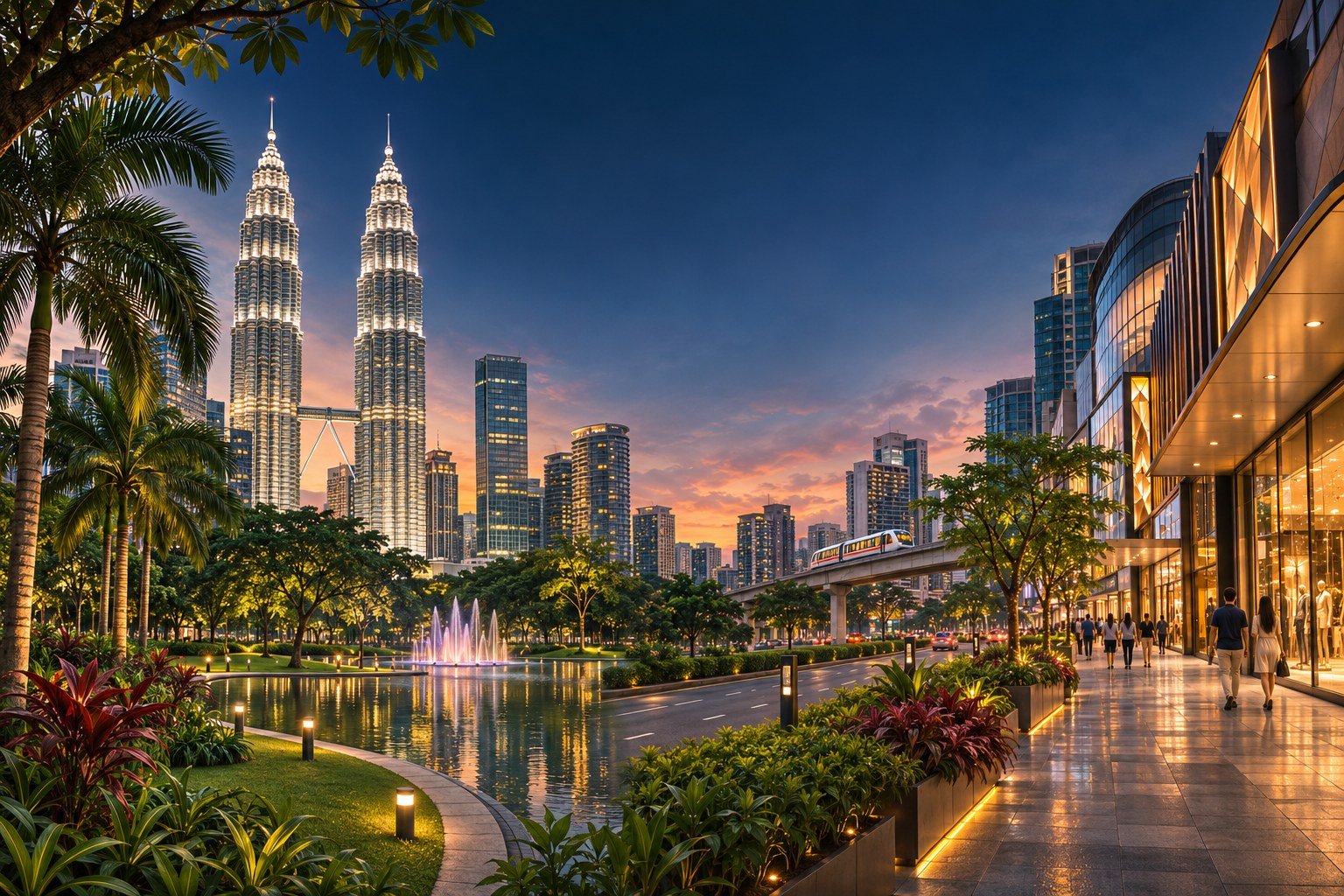
Original editorial composite of two neighbourhood settings. The blended scene is not a shared viewpoint, a geographic map or a depiction of a named hotel.
Affiliate disclosure: Taylor’s Trailblazing Travels may earn a commission if you book or buy through links in this guide, at no extra cost to you. Recommendations are selected for their usefulness to the trip.
KLCC vs Bukit Bintang is most usefully decided by what happens between your sightseeing stops: where you eat, where you return for a rest and which station entrance you use. Both areas can work for a first Kuala Lumpur visit. A good hotel on the right side of either neighbourhood can be more convenient than a supposedly better area with an awkward approach.
This comparison treats the neighbourhoods as everyday bases. It explains the walking connection between them, separates their smaller location choices and uses a transparent model to show how repeated journeys change the result. Four researched hotel examples show how the location trade-offs apply to actual properties.
KLCC advantage
A useful base when the KLCC precinct is where you repeatedly start and finish outings.
Bukit Bintang advantage
A useful base when meals, shopping and your chosen rail journeys cluster here.
The hidden variable
The hotel entrance and station exit matter more than the neighbourhood name alone.
Model result
Six return outings produce an 80-minute difference when four favour one area and two favour the other.
KLCC vs Bukit Bintang: decide by your daily pattern
Start with your likely evenings and rest breaks, then add fixed bookings. A single tower visit need not determine three nights of accommodation. Equally, a shopping afternoon does not outweigh several early starts beside the convention centre. Give recurring plans more weight than attractions you will visit once.
| Your priority | KLCC case | Bukit Bintang case |
|---|---|---|
| Repeat sightseeing or work | Your appointments and return breaks cluster around KLCC. | Your departures and evening returns cluster around Bukit Bintang. |
| Room between outings | Choose a hotel on the same side of the precinct as those outings. | Choose the Pavilion side or rail crossroads according to your actual plans. |
| Meals and shopping | You are content to keep more evenings within your hotel’s immediate surroundings. | You want to organise more evenings around this shopping and dining district. |
| A quiet room | Compare orientation, glazing and the booked room category. | Make the same checks; the whole district cannot predict bedroom noise. |
| Overall value | Worth a premium only if the room or saved journeys matter to you. | The same test applies; do not assume the district guarantees a cheaper stay. |
If you intend to leave after breakfast and stay out until bedtime, the difference may be modest. Returning for a shower, a child’s rest or a change of clothes makes the location work several times a day. Count those returns before comparing hotels.
Back to top ↑Compare smaller locations inside each neighbourhood
KLCC: park and shopping centre, or convention-centre approach?
Mandarin Oriental sits beside the PETRONAS Twin Towers, with KLCC Park at its doorstep and a direct connection to Suria KLCC. Grand Hyatt is at 12 Jalan Pinang, adjacent to Kuala Lumpur Convention Centre. Those are different starting points within the same broad hotel area. [4] [5]
For a park-centred stay, compare the actual entrance you will use for morning and evening walks. For an event, identify your venue entrance before selecting a hotel: a convenient hotel-to-venue approach can matter more than a skyline view. Avoid judging these routes only from a straight line between map pins.
Bukit Bintang: Pavilion, or the rail crossroads?
Pavilion Hotel’s location page describes access to the mall by lift. Farther along the area’s rail approach, PARKROYAL COLLECTION lists Bukit Bintang MRT and Monorail as nearby stations. MRT Corp places Bukit Bintang MRT at the crossroads of Jalan Bukit Bintang and Jalan Sultan Ismail. [6] [7] [2]
Choose the Pavilion end when repeated shopping and a mall-connected hotel are central to the stay. Choose nearer your preferred station entrance when you expect several rail journeys. A hotel described as “Bukit Bintang” still needs its own route check; a district label does not show the crossing, pavement or lift you will actually use.
Jalan Alor adds another evening destination: Pavilion Hotel’s guide identifies its food stalls, coffee shops and restaurants. If that is where you want to eat repeatedly, pin the restaurant and the hotel entrance separately rather than treating every meal in the district as the same walk. [6]
For either area, ask the hotel for its pedestrian entrance as well as its vehicle drop-off. Save both. A driver arriving at the correct building and a walker finding the most useful entrance are separate tasks.
Understand the walking link and station names
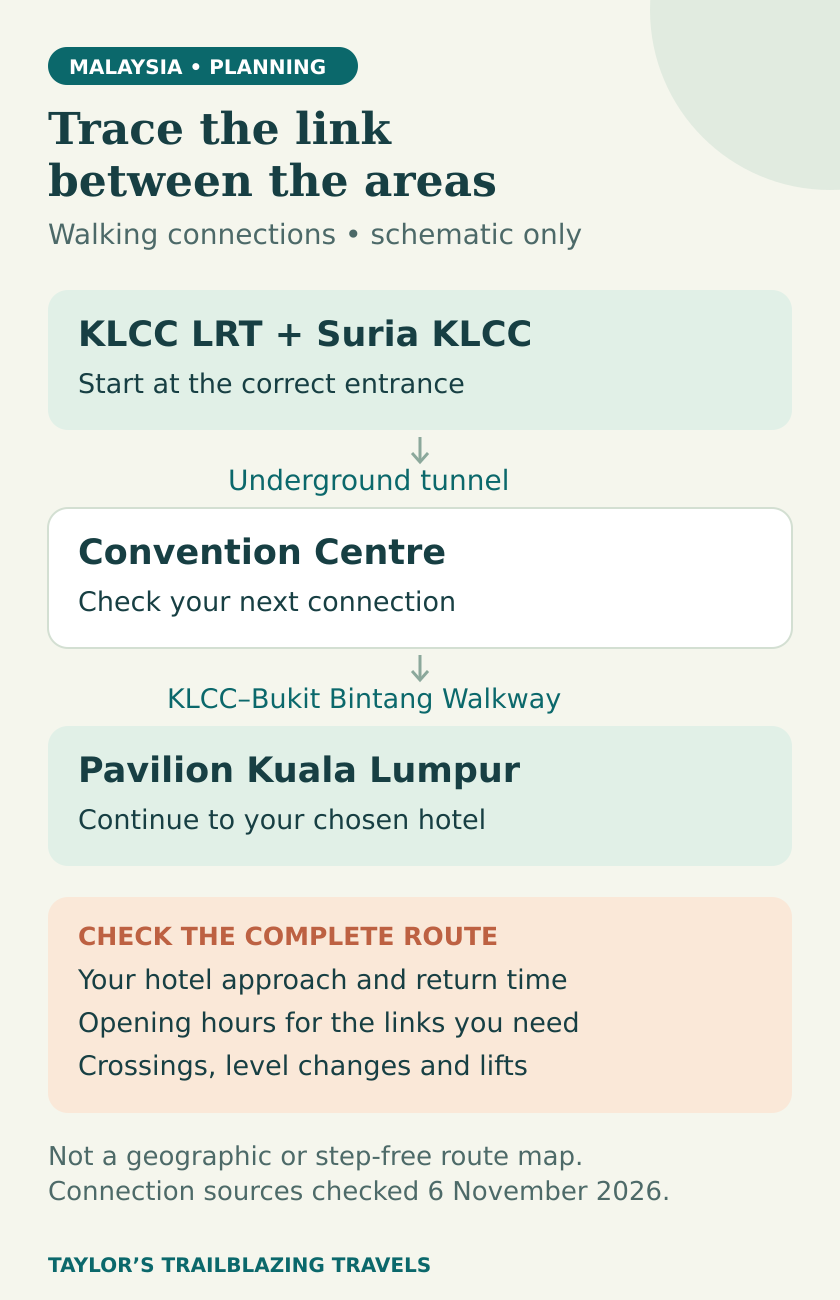
The convention centre’s directions describe a walking connection from Pavilion through the KLCC–Bukit Bintang Walkway, then an underground tunnel between the centre and Suria KLCC. The tunnel is advertised as open 06:00–23:00 daily. KLCC LRT is on the Kelana Jaya Line; Persiaran KLCC MRT is a different station on the Putrajaya Line. Checked 6 November 2026. [1]
This linked core makes it practical to visit both districts from one hotel. It does not establish a continuous sheltered or step-free route from every hotel door, and the published tunnel hours are not a promise about every entrance or the separate elevated walkway. Check the access you need for your return time.
For Pavilion, the mall’s directions specify Bukit Bintang MRT exits D or E, or the signed route from Bukit Bintang Monorail. These are separate rail services, so save the line name with the station name. [3]
When comparing a walk with a train, include the approach, descent or lift, wait, interchange if needed and final walk. For a short journey, a quick train ride can still be a slow hotel-to-destination trip. If you take a car, compare the pickup entrance and traffic allowance as well as the fare.
If steps or prolonged standing are difficult, ask for the complete route in both directions. A station with lifts does not prove that a hotel connection uses them or that every lift will be operating. With a pushchair or large suitcase, crossings and level changes deserve a separate check.
What six return outings do to the comparison
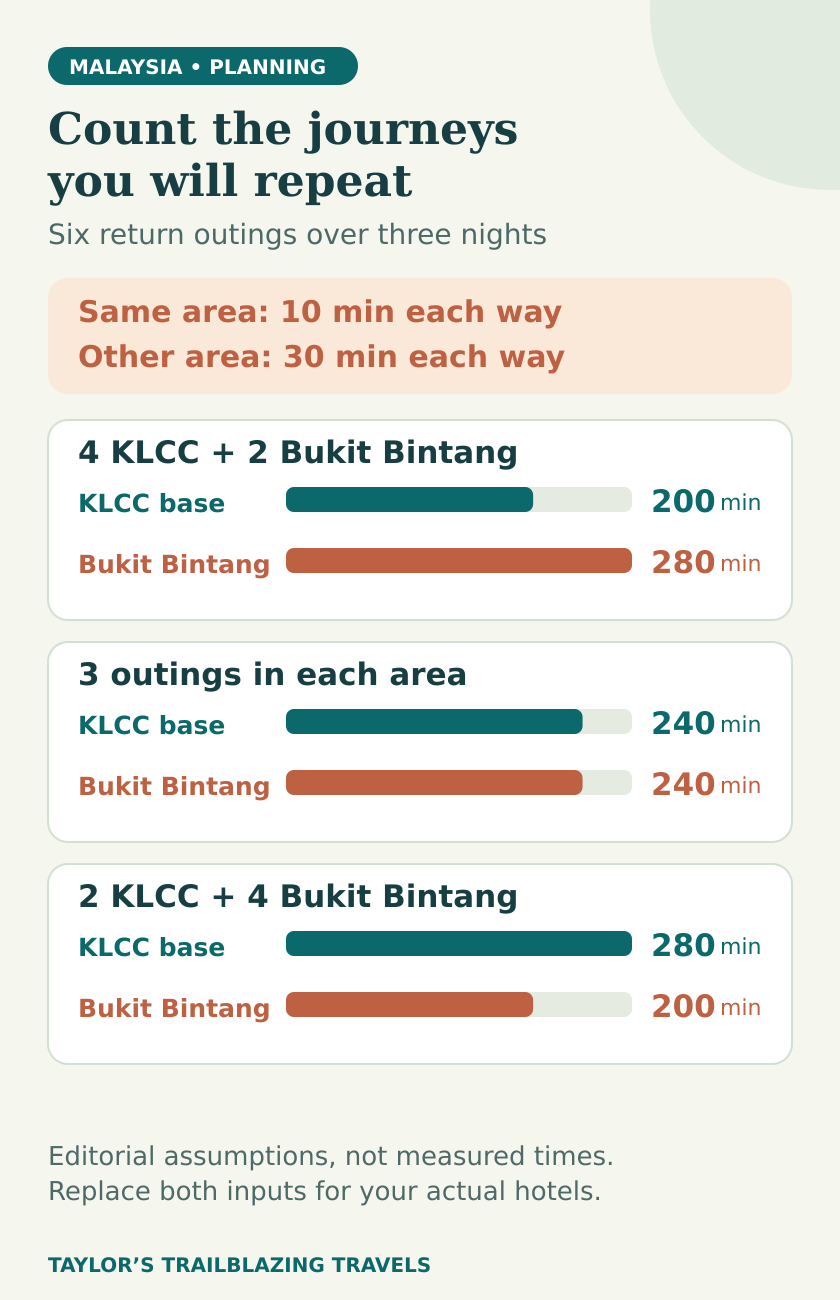
Consider a three-night stay with six outings, each starting and ending at the hotel. To isolate the effect of location, assume a same-area journey takes 10 minutes each way and a journey to the other area takes 30 minutes each way. These are editorial inputs, not measured walking times, rail timings or traffic forecasts.
| Where the outings happen | KLCC hotel | Bukit Bintang hotel | Difference |
|---|---|---|---|
| Four KLCC; two Bukit Bintang | 200 | 280 | KLCC saves 80 |
| Three in each area | 240 | 240 | No difference |
| Two KLCC; four Bukit Bintang | 280 | 200 | Bukit Bintang saves 80 |
The first KLCC total is 4 × 2 × 10 + 2 × 2 × 30 = 200 minutes. The alternative is 4 × 2 × 30 + 2 × 2 × 10 = 280 minutes. Reversing the outing pattern reverses the result; splitting it evenly removes the time advantage.
The useful number is the extra time per crossing. Here it is 20 minutes each way. If your actual hotel routes differ by only 10 minutes, the first scenario’s advantage falls to 40 minutes; if they differ by 30, it rises to 120. A slower walker, an awkward exit or a comfortable direct connection can change those inputs substantially.
Do not apply this model unchanged if you visit both areas on one continuous outing. That removes a return to the hotel and changes the arithmetic. Likewise, add separate journeys to other parts of Kuala Lumpur rather than forcing every trip into one of these two clusters. This is a way to test your plan, not a proposed sightseeing schedule.
Write down the journeys you will repeat, including rest breaks. Replace the two assumed travel times with realistic door-to-door allowances for the hotels you are actually considering. Then compare the result with the total price difference for the stay.
Four real hotels that illustrate the trade-offs
These examples were selected for contrasting locations and independently described property connections, not a cheapest-to-most-expensive ranking. No room rate or available inventory is asserted. The linked listings let you check your dates; compare the same occupancy, room category and cancellation terms with the hotel directly.
| Hotel | Useful starting point | Question before paying |
|---|---|---|
| Mandarin Oriental, Kuala Lumpur | Suria and park side of KLCC | Does the selected room and entrance suit the park or shopping plans? |
| Grand Hyatt Kuala Lumpur | Jalan Pinang and convention-centre side | Which view category and venue approach are you choosing? |
| Pavilion Hotel Kuala Lumpur Managed by Banyan Tree | A hotel with access to Pavilion by lift | Which hotel and mall entrances operate at your return time? |
| PARKROYAL COLLECTION Kuala Lumpur | Jalan Sultan Ismail and the Bukit Bintang station area | Which station exit and street approach work for your luggage? |
Mandarin Oriental: prioritise the park and Suria
The official location description makes this a relevant candidate when repeated trips to the park or Suria are the reason for choosing KLCC. [4] Compare the actual room view and cancellation conditions; being beside a landmark does not mean every category faces it. Check Mandarin Oriental on Agoda or compare the same property on Booking.com.
Grand Hyatt: prioritise Jalan Pinang
The hotel’s position beside the convention centre is its main relevance here. Its official room selection distinguishes city, garden and tower-view categories, so a general skyline photograph should not substitute for the room name on the booking. [5] Compare Grand Hyatt on Booking.com or check matching dates on Agoda.
Pavilion Hotel: prioritise the mall connection
This is Pavilion Hotel Kuala Lumpur Managed by Banyan Tree, the property whose location page describes lift access to Pavilion. [6] Check the full hotel name: a brand name alone is insufficient when choosing a meeting point or booking a room. Check Pavilion Hotel on Agoda or compare Pavilion Hotel on Booking.com.
PARKROYAL COLLECTION: prioritise your rail approach
The property is on Jalan Sultan Ismail and publishes directions from both Bukit Bintang stations. [7] It is a useful comparison when frequent rail departures matter more than direct mall access. Confirm the pedestrian route yourself rather than treating the hotel’s advertised walking estimate as your luggage time. Compare PARKROYAL COLLECTION on Booking.com or check its Agoda property listing.
Back to top ↑Compare the complete stay, not a headline nightly rate
Collect like-for-like quotes for the same nights and everyone travelling. Include mandatory charges, breakfast if you will use it, an extra bed if required, and the cancellation deadline in local time. Check whether payment is due now or later and whether the final charge uses a different currency from the display.
Then add the journeys your location makes necessary. A hotel saving can disappear if you repeatedly pay to get back for a rest. Conversely, a more expensive room does not become good value merely because its address sounds central. Decide what the saved time is worth to your own group; the model does not assign a cash value to an hour.
Compare entered offers with the Hotel Comparison Calculator. It has no MYR option, currency conversion or live prices; use one supported currency consistently. [8]
Check the room as carefully as the district
For noise sensitivity, ask about the room’s direction, nearby event spaces and any current works. For a view, book the named category rather than relying on “subject to availability” requests. For an early arrival or late flight, distinguish luggage storage from having a room available; obtain written confirmation of any extra access you need.
Couples with long days out may accept a less convenient entrance for a room they prefer. A family needing regular rests may value proximity more. Travellers using mobility aids should choose on a confirmed room-and-route combination, even if that reverses the broad neighbourhood recommendation.
A five-minute final decision
- Mark your two or three repeat destinations.
- Pin each shortlisted hotel’s pedestrian entrance and useful station exit.
- Check the return route at the time you expect to use it.
- Compare equivalent total-stay quotes and transport allowances.
- Choose the room and route that remove the most friction from your own days.
Questions travellers ask
Is it worth changing hotels to stay in both areas?
Usually not for a short city stay unless the two hotels are a deliberate part of the holiday or your plans change substantially. Packing, checkout, moving and waiting for the next room consume some of the time a new location might save. Test one well-positioned base first.
Which area is better if I want evening food without a long return?
Choose around the meals you actually intend to eat. Bukit Bintang is the stronger candidate when those evenings repeatedly finish there. If you prefer your hotel restaurant or meals close to a KLCC hotel, that same advantage shifts towards KLCC. Check the final walk, not just the number of restaurants on a map.
Does a covered walking connection make the two areas interchangeable?
It helps you combine both in one stay, but it does not remove the approach from your hotel, the time spent walking or access-hour questions. A connection can be convenient for an occasional visit while still becoming tiring if repeated several times a day.
Should a tower-view room decide the neighbourhood?
Only if that view is an important part of the stay and the exact category confirms it. Treat the view premium separately from the value of the location. If you mainly need a comfortable room for sleeping, put the entrance, room suitability and total price first.
Which base is best when my plans are evenly divided?
In the six-outing model, an even split produces the same assumed travel time. Choose the better individual hotel offer and approach, then check any journeys outside these two areas. There is no need to manufacture a neighbourhood winner when your evidence is balanced.
Your next decision
KLCC is the stronger choice when your days repeatedly return to its precinct. Bukit Bintang is the stronger choice when your rail departures, shopping and evenings repeatedly return there. For a balanced itinerary, shortlist one suitable hotel in each area and compare the room, entrance and total stay cost. The most useful address is the one that makes your own routine easier.
Sources and editorial checks
Researched on 6 November 2026 using official hotel, mall, convention-centre and MRT information. Hotel examples were selected to illustrate different approaches, without a personal-stay or live-availability claim. The six-outing calculation uses stated editorial assumptions; it is not a measured route or accessibility audit. Recheck access hours, the selected room and booking conditions for your dates.
- Kuala Lumpur Convention Centre: official getting-here and walking directionsChecked 6 November 2026
- MRT Corp: Pavilion Bukit Bintang stationChecked 6 November 2026
- Pavilion Kuala Lumpur: official train directionsChecked 6 November 2026
- Mandarin Oriental: current Kuala Lumpur location description, 20 October 2026Checked 6 November 2026
- Grand Hyatt Kuala Lumpur: official property and room categoriesChecked 6 November 2026
- Pavilion Hotel: official location informationChecked 6 November 2026
- PARKROYAL COLLECTION Kuala Lumpur: location and public-transport directionsChecked 6 November 2026
- Taylor’s Trailblazing Travels: Hotel Comparison CalculatorChecked 6 November 2026
Illustrations in this article were created for Taylor’s Trailblazing Travels. Third-party photographs, where used, are credited beside the image or in the source list.