Kek Lok Si Temple in Penang: How to Plan a Respectful Visit
Choose your route through a hillside place of worship, with time to pause and permission to stop short.
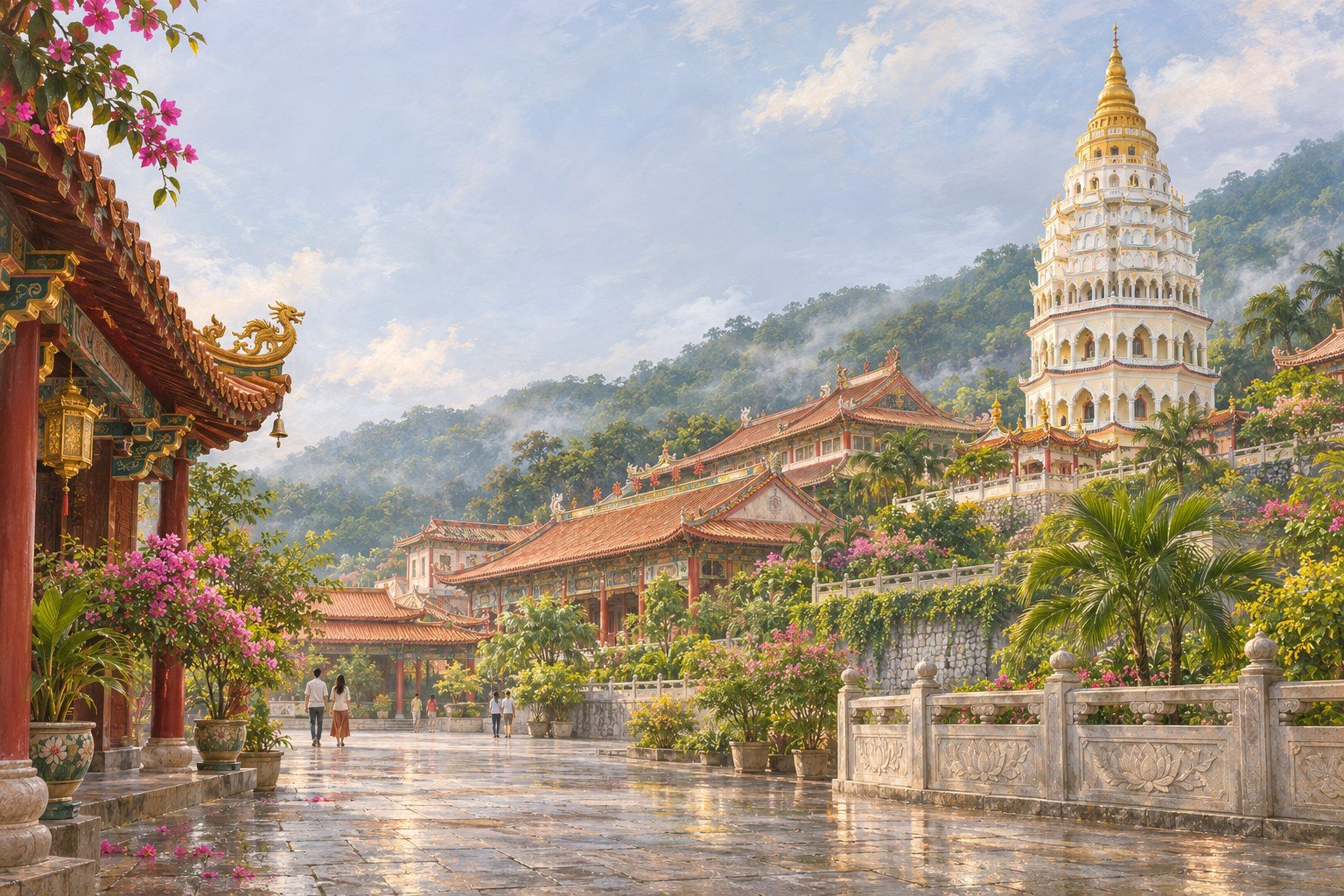
Original architectural impression inspired by Kek Lok Si. It is not a photograph, evidence of current access or a diagram of the temple’s layout.
Affiliate disclosure: Taylor’s Trailblazing Travels may earn a commission if you book or buy through links in this guide, at no extra cost to you. Recommendations are selected for their usefulness to the trip.
Kek Lok Si Temple in Penang rewards a visit with enough time to look carefully. The complex in Air Itam contains prayer halls, pagodas and bell towers, rather than one building reached through a single visitor entrance. [1] Planning the parts you want to see is more useful than treating the whole hillside as a compulsory checklist.
For a respectful visit, make space for worship before photographs and for the least comfortable person in your group before another flight of stairs. The main temple areas, the pagoda and the upper Guanyin area offer different reasons to linger. You can choose a shorter route and still leave with a worthwhile impression.
Start with the purpose
Observe architecture and worship spaces without interrupting the people using them.
Choose optional sections
The pagoda and upper Guanyin area need their own time and access decisions.
Confirm the return
Agree where you will finish and be collected before heading farther uphill.
Keep the pace flexible
A shorter visit is better than rushing a prayer hall or an uncomfortable descent.
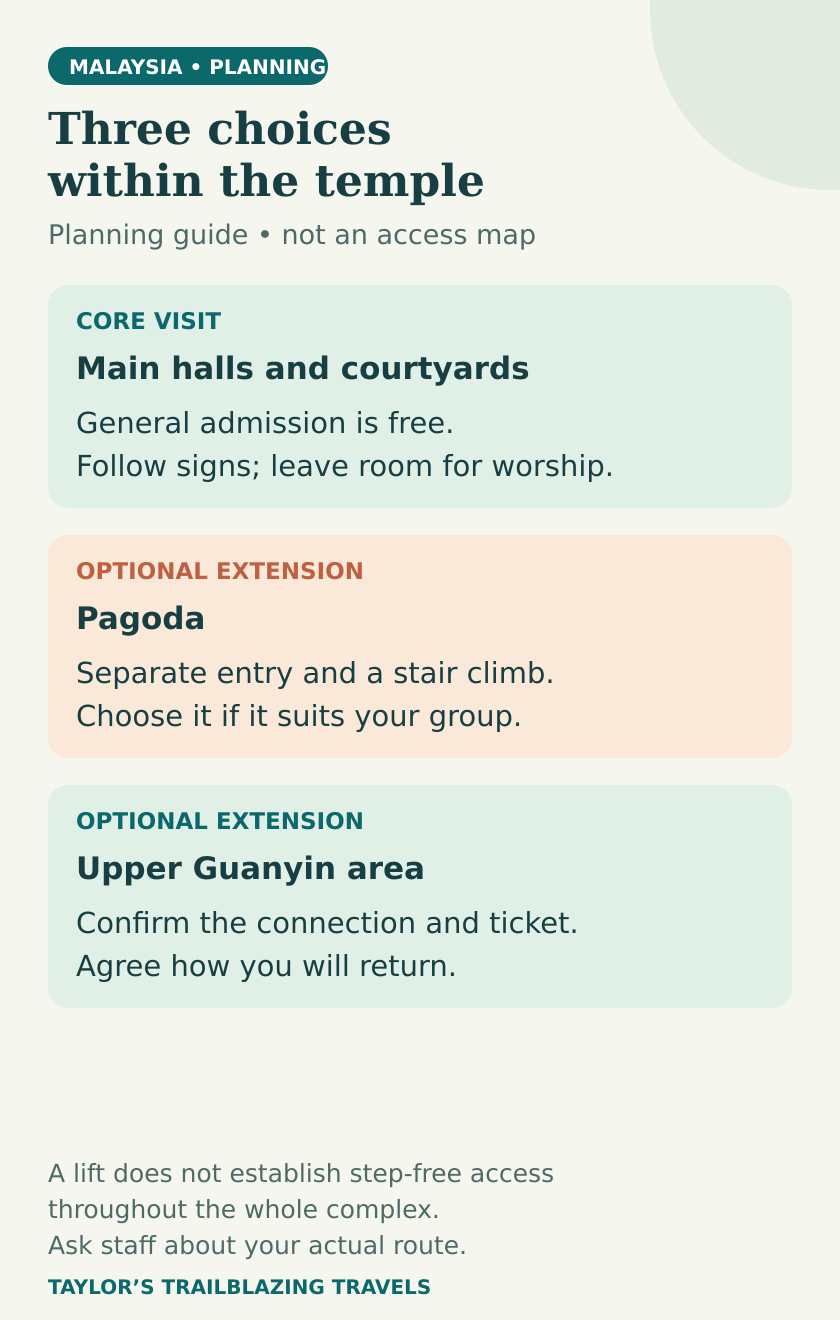
Think in areas, not one continuous attraction
Kek Lok Si is a Buddhist temple complex. Its best-known features include a seven-tiered pagoda combining Chinese, Thai and Burmese architectural elements, and the large bronze Guanyin figure associated with the Goddess of Mercy. [3] These landmarks give the visit structure, but they are not the whole reason to come.
| Area | Why spend time here? | What to decide |
|---|---|---|
| Main halls and courtyards | Architecture, detail and the setting of worship | How long you want to observe without hurrying |
| Pagoda | A closer look at its structure and different perspectives | Whether the optional stair climb suits everyone |
| Upper Guanyin area | The statue, pavilion setting and wider hillside context | How you will get there and return |
Use this as a planning framework, not a navigation map. Your arrival point, the sections open and the route staff recommend can change the best sequence. Ask where the pagoda entrance and upper connection are before committing to a route, particularly if avoiding stairs matters.
A good visit may involve spending several minutes with one carved detail, watching the movement through a courtyard from a respectful distance, or simply sitting quietly. There is no reason to convert every moment into a photograph or a race to the highest point.
When to arrive and what the published hours mean
Penang Global Tourism lists daily opening from 08:30 to 17:30. Treat that as the published general window, not confirmation that every hall, lift or optional section accepts visitors until the final minute. For an access-dependent visit, the directory gives the temple contact as +60 4 828 3317. [1]
An earlier daytime start gives you more room to shorten or extend the visit. It does not guarantee empty courtyards, cooler conditions or unrestricted access. Leave enough margin that a pause for worship, a slower connection or a rest does not turn the final section into a sprint.
If you arrive late in the afternoon, choose the area that matters most and ask about its last admission first. Do not buy an upper connection solely because the overall site appears to be open. The useful deadline is the one that applies to the place you intend to enter and the way you plan to come back.
Back to top ↑What is free, what is optional and what to ask at the counter
The state tourism directory lists general admission as free and pagoda entry at MYR2. It also mentions a small Sky Lift charge, but does not define a complete journey through the upper sections. Confirm the current fare for your exact route, including whether the ticket is one-way or return. [1]
Before paying for uphill transport, ask three practical questions: “Where does this ticket take us?”, “How do we get back?” and “What walking or steps remain at each end?” A lift ticket is a transport purchase; it should not be treated as proof of admission to every building or a step-free route throughout the complex.
For a two-person budget, let T be your total outside transport cost and L the quoted return uphill-transport fare per person. With both people choosing the published MYR2 pagoda entry, the planning formula is T + MYR4 + 2L, before refreshments and any voluntary giving. Keep L blank until you have a route-specific quote; do not substitute a small charge from a general directory for the complete return journey.
Carry small cash as a practical backup and ask which payment methods are accepted where you buy. This is not a claim that every counter is cash-only. Keep donations separate from mandatory fees in your own budget, and use clearly identified temple collection points if you choose to give.
Paid extensions are choices. If someone wants to remain around the main areas while others visit an upper section, agree a precise meeting place and time and make sure everyone is comfortable with the arrangement.
Back to top ↑Choose your arrival and collection points together
Give your driver the temple name and agree the specific drop-off point, especially if reducing uphill walking is important. A general map pin is not enough to explain whether you want to begin near the main halls or another accessible approach. Ask what is practical on the day instead of assuming a vehicle can reach every part of the complex.
For a public-bus approach, check a current journey planner for Air Itam from your actual starting point and include the final approach on foot. Compare the whole journey with a car transfer: waiting, walking, heat and the route home matter alongside the fare. Avoid relying on an old blog’s bus frequency or an optimistic town-centre driving time.
Before exploring, save the agreed pickup point and a recognisable meeting landmark. If your driver will wait, confirm the included waiting period and extra-time charge. If you will request another car afterwards, leave a margin for finding it rather than treating the end of the temple visit as the moment you will already be moving towards your hotel.
Our time model uses 45 minutes each way for outside travel purely to show the calculation. Substitute your own realistic journey allowance. Someone staying close by and someone travelling from a beach hotel should not use the same assumption automatically.
Back to top ↑Dress for worship and read each threshold
Cover shoulders and knees, choose comfortable clothing that stays covered when you bend or climb, and wear secure shoes suited to walking. The FCDO’s general Malaysian guidance warns that places of worship may refuse entry without appropriate coverage or footwear and advises checking entrance signs. It is not a temple-specific dress-code notice. [2]
A lightweight layer can make coverage easier, but bring what you need rather than relying on a loan garment being available. Keep shoes on for outdoor walking; remove them where signs or staff ask you to do so. Different thresholds within one complex can have different requirements.
Keep voices low around prayer spaces. Let people complete their worship without stepping between them and an altar or holding up a passage for a group photograph. If an area is being used for a ceremony, pause or choose another publicly accessible section. A visitor timetable does not take priority over religious use.
For photography, check the local signs before taking out the camera inside a hall. Ask before making an identifiable worshipper or monk the subject of a close photograph. Avoid flash, intrusive posing and repeated takes where they disturb people. A beautiful view of a religious building is still part of someone else’s place of worship.
You do not need to copy a ritual to show respect. If you would like to take part, ask how and whether it is appropriate, then follow the guidance given. Keep hands away from objects used for worship unless invited, and avoid treating religious figures or offerings as props.
Back to top ↑Make the physical plan specific
Assess the visit by the route your group will actually take. The temple tours reviewed for this guide describe walking and stair climbing and do not offer a blanket wheelchair-accessible visit. [5] That does not prove that every part of the temple is inaccessible; it means a generic tour listing is inadequate evidence for your particular requirements.
If steps are difficult, contact the temple or your transport provider with concrete questions: which area can the vehicle reach, what surfaces and gradients remain, whether any lift transfer requires steps, and where an accessible toilet or resting place can be found. Explain the mobility aid you use rather than asking only whether the site is “accessible”.
For children or older relatives, decide on the core visit first and add a section only if energy and conditions allow. A paid connection may reduce one climb while leaving other walking in place. Anyone waiting for the rest of the group needs a comfortable, agreed location and a straightforward way to reunite.
Carry water, allow pauses and keep a simple rain plan. In wet conditions, slow down and reassess optional steps rather than trying to preserve an ambitious schedule. A light bag is usually more useful than carrying equipment for every possible photograph.
Back to top ↑Build the visit from a core and two optional extensions
This original planning model deliberately separates a modest visit from the desire to see everything. It is an allowance for decision-making, not a promise that a particular route or lift queue takes a fixed number of minutes.
The 90-minute core comprises 10 minutes to orient yourself, 45 minutes around main halls and courtyards, 15 minutes for rest, and 20 minutes for movement, return arrangements and contingency. Add 25 minutes if you choose the pagoda, and 45 for an upper-area extension. The extension allowances include their extra movement and waiting; increase them if your route needs more time.
| Your choice | On site | Door to door | Return if leaving at 08:15 |
|---|---|---|---|
| Core only | 90 minutes | 180 minutes | 11:15 |
| Core + pagoda | 115 minutes | 205 minutes | 11:40 |
| Core + upper area | 135 minutes | 225 minutes | 12:00 |
| Core + both extensions | 160 minutes | 250 minutes | 12:25 |
All four versions assume arrival at 09:00. The full version leaves the temple at 11:40 and reaches the starting point at 12:25. Add another 30 minutes for an unexpected delay and that becomes 12:55. Meals and further sightseeing are additional decisions.
The value of the model is permission to change course. If the core takes longer because you are interested in the halls, remove an extension rather than compressing the rest of the visit. If someone is tired after the first hour, the shorter version remains a complete plan.

Choose between independence, interpretation and organised transport
Independent visiting gives you control over pauses and optional sections. A guide can add value when you want help understanding what you are seeing and how to behave, while a driver solves a different problem: getting between places. Read the detailed inclusions rather than assuming the word “tour” guarantees both.
The GetYourGuide hilltop, Kek Lok Si and laksa excursion currently offers 5–8-hour options with an English-speaking guide, Fast Lane funicular tickets and a one-way inclined lift to the Guanyin statue. Its half-day option ends at Armenian Street, and the included assam laksa is non-vegetarian with no ingredient substitutions advertised. [4] Check the chosen option, walking requirements and return logistics; it is a combined itinerary rather than a long temple-only visit.
The Viator combined Penang Hill and Kek Lok Si excursion lists Express funicular and temple lift tickets, but its detailed inclusions explicitly say an English-speaking driver without a guide. [5] It may suit someone who mainly wants transport organised. If religious or architectural interpretation is the reason you are paying extra, obtain a clear answer about who accompanies you inside.
For either option, compare the price for your actual group, pickup area, remaining fees, cancellation deadline and the time allotted at the temple. Do not select on the basis of a fast-lane train inclusion if your main interest is a slow visit to Kek Lok Si.
Back to top ↑Keep festival visits and combined days as separate plans
Penang’s tourism authority places Kek Lok Si and Penang Hill among the same central area’s major attractions. [6] That makes a combined day a reasonable possibility, but it does not establish a short transfer or spare time inside each attraction. Choose which place matters most before letting the second one fill every remaining hour.
If you want The Habitat as well as the public hill, account for that forest visit separately. A temple morning followed by a long hill programme can become a substantial day even when each individual stop sounds manageable. Keep a late lunch, rests and the return journey visible in the plan.
If an advertised festival illumination is your reason for coming, confirm the specific year’s dates, evening access and transport arrangements with the organiser or temple. Do not extrapolate an evening schedule from ordinary daytime opening hours or from a photograph taken in a previous year. Crowds and religious activity may change which kind of visit feels appropriate.
Back to top ↑Questions travellers ask
Do I have to visit every upper section?
No. Build the visit around your interests and comfort. The core plan in this guide deliberately stands on its own; the pagoda and upper area are optional extensions, subject to access on the day.
Can I wear shorts or a sleeveless top?
Arrive with shoulders and knees covered so you are prepared for worship spaces. Do not rely on borrowing clothing. Read each entrance sign and follow staff directions rather than assuming one rule applies uniformly throughout the complex.
Does an inclined lift remove all the stairs?
Do not assume so. Confirm the exact boarding and arrival points, the walking at both ends and how you return. A transport ticket cannot by itself establish a fully step-free visit.
How long should I allow if I mainly want the temple?
Use the 90-minute core as a starting allowance, then choose extensions deliberately. The worked full version totals 160 minutes on site, before outside travel. Increase it if you want slow observation, longer rests or interpretation from a guide.
Your next decision
Plan Kek Lok Si as a place to spend time, not a hillside to complete. Choose a manageable core visit, settle the route and fare before adding upper sections, and let signs, staff and worshippers set the boundaries. The most respectful plan is also often the most enjoyable: enough time to notice the details, with room to stop before the visit becomes a rush.
Sources and editorial checks
Researched and reviewed on 6 November 2026 using Penang Global Tourism, FCDO cultural guidance and opened primary tour listings. The directory’s general hours and pagoda charge are reported as published; a complete current lift tariff and step-free route could not be established. Time allowances and the transport-cost formula are original examples. No first-hand visit, booking, direct temple confirmation or date-specific availability is claimed.
- Penang Global Tourism — Kek Lok Si Temple directoryChecked 6 November 2026
- FCDO — Malaysia safety and cultural guidanceChecked 6 November 2026
- Viator / Asian Overland — Penang Hill and Kek Lok Si descriptionChecked 6 November 2026
- GetYourGuide / Discova — Hilltop Views, Kek Lok Si and LaksaChecked 6 November 2026
- Viator / Asian Trails — combined hill and temple excursionChecked 6 November 2026
- Penang Global Tourism — central-zone attractionsChecked 6 November 2026
Illustrations in this article were created for Taylor’s Trailblazing Travels. Third-party photographs, where used, are credited beside the image or in the source list.