Malaysia • Time well spent
How Long Should You Spend in Malaysia? Choosing 7, 10, 14 or 21 Days
A longer list of stops does not create a longer holiday. Start with the days you can actually enjoy.
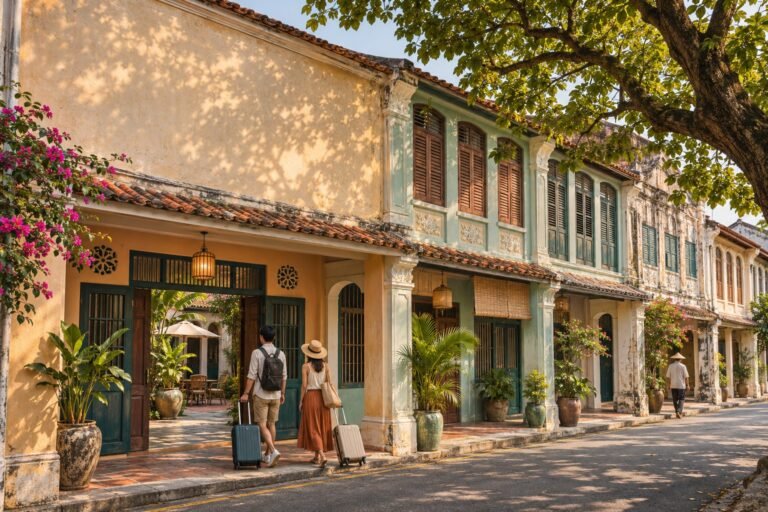
An original island illustration inspired by Langkawi; not a photograph of a named resort.
Ten to fourteen days in Malaysia is a useful starting point for a first holiday that combines cities and a coast. Seven days can work very well for a focused two-base trip. Twenty-one days gives you more room for Borneo or a slower journey, provided the extra time does not simply become more transfers.
The answer to how long to spend in Malaysia depends on the kind of days you want. This comparison uses exact hotel-night totals and an original usable-day model, so you can see what each trip length buys before booking flights.
This article contains affiliate links. Taylor’s Trailblazing Travels may earn a commission on qualifying bookings or purchases through those links, at no extra cost to you.
How long to spend in Malaysia: compare the four choices
| Length in Malaysia | Hotel nights | Good fit | The sacrifice |
|---|---|---|---|
| 7 days | 6 | Two bases, or one region with day trips | Choose city-and-food or beach-and-city; resist a national sampler |
| 10 days | 9 | Three complementary stays, or a focused Borneo holiday | Little slack if every stay needs a connection |
| 14 days | 13 | A first peninsula route with longer stays and a return buffer | Still needs choices; every major region will not fit comfortably |
| 21 days | 20 | Slow travel, deeper nature time or a carefully connected second region | A bigger budget and more booking dependencies |
These are planning recommendations rather than official minimum stays. They assume you prefer time in places to repeated one-night stops. An experienced traveller comfortable with frequent moves may choose differently; a family, a traveller with limited stamina or anyone prioritising rest may want fewer bases.
Malaysia’s peninsula and its Borneo states are separate geographical blocks. [1] That is why adding “a little Borneo” is a larger decision than adding another neighbourhood to a city stay.
Back to guide contents ↑Count the days that remain after moving
First count the nights between your actual Malaysian arrival and departure dates. Then list every separate overnight block, including a final return to Kuala Lumpur. A return stay counts as another block even when you use the same hotel.
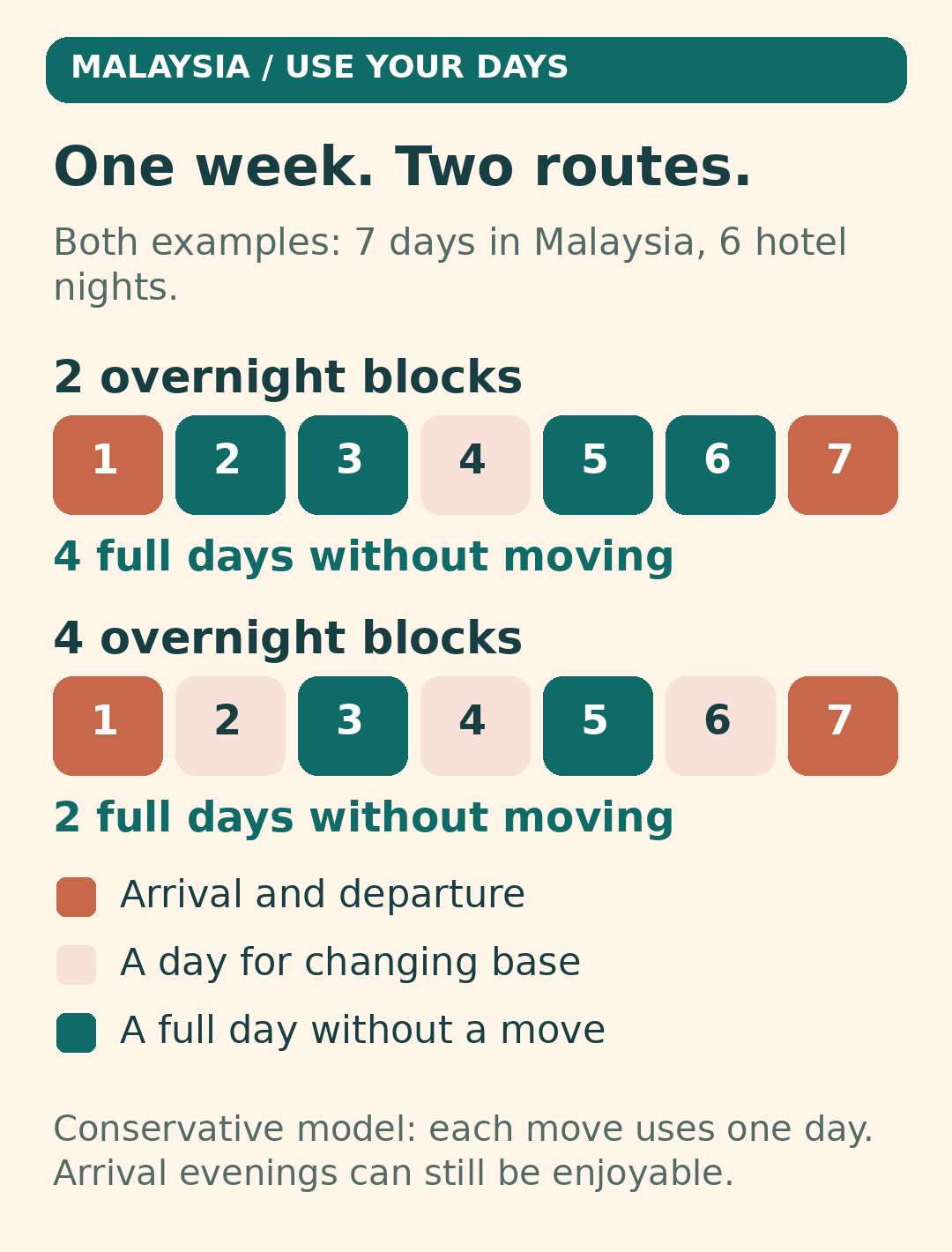
Usable full days without a relocation = days in Malaysia − 2 arrival/departure days − (overnight blocks − 1).
The model conservatively assigns a whole calendar day to each change of base. It does not say that every journey takes 24 hours or that you cannot enjoy an evening after arriving. It protects you from selling the same day twice in your plan. Overnight transport, unusual flight times and same-day stops require a separate calculation.
For example, a seven-day trip with two overnight blocks leaves four full days without a relocation: 7 − 2 − 1 = 4. Put four blocks into that same week and the result falls to two. The flights and the number of hotel nights have not changed; the shape of the holiday has.
Use the nights-minus-one check at each base
Three consecutive nights normally give two full days between check-in and checkout. Two nights give one. One night gives no complete day between those events. Arrival and departure hours may still be useful, but keep that time as a bonus until the transport is fixed.
Open the Itinerary Pace Checker after drafting the route. Enter your actual door-to-door transfer estimates and preferred pace. The result helps spot a crowded plan; it cannot validate a timetable or guarantee a connection.
Back to guide contents ↑Seven days: make the smaller trip deliberate
A week works best when the two main places answer different needs. Kuala Lumpur and George Town combine an urban introduction with a heritage-and-food stay. UNESCO recognises George Town and Melaka for their historic multicultural townscapes. [2] You do not need both heritage cities to have a worthwhile first holiday.
Example: Kuala Lumpur 3 nights + Penang 3 nights
Arrive on day 1, spend days 2 and 3 in Kuala Lumpur, relocate on day 4, spend days 5 and 6 based in Penang, and leave on day 7. That totals six nights and four full days without a relocation. It assumes a suitable departure itinerary from Penang; check the whole ticket, including any connection.
If your international flight is from Kuala Lumpur on a separate ticket, a more cautious shape is Kuala Lumpur 2 + Penang 3 + Kuala Lumpur 1. The total is still six nights, but the extra relocation reduces the model to three clear days. That is the real price of the final buffer.
For a beach priority, replace Penang with an island stay that fits the season and flights. Do not add the island as a third destination. If wildlife is the sole reason for travelling, a focused Borneo week can make more sense than a compulsory capital-city stay, but choose the precise bases and flights first.
This length suits someone who is happy to leave much of Malaysia for another trip. It is a poor fit for a traveller expecting several cities, tea country, an island and rainforest time.
Back to guide contents ↑Ten days: add a third stay without losing the purpose
Example: Kuala Lumpur 3 + Penang 3 + Langkawi 3
Nine nights split equally provide two full days at each base. The model leaves six full days without a relocation and reserves two days for moving. Treat Penang–Langkawi as a dated transport search; do not assume that a direct ferry seen in an older guide is operating.
Penang and Langkawi provide different forms of northern-peninsula travel: the former has heritage-city interest, while the latter offers island and geopark landscapes. [3] The point of combining them is contrast, not collecting two island names.
If a final Kuala Lumpur night is needed, use Kuala Lumpur 3 + Penang 3 + Langkawi 2 + Kuala Lumpur 1. That is still nine nights. The beach block now contains only one full day and the trip has five full days without a relocation. Compare that version with a more relaxed two-base holiday before paying.
Alternative: let one Borneo state be the main holiday
Allocate two nights to the arrival gateway, six to a carefully planned block in one Borneo state and one to the return gateway. Six nights is an envelope, not a claim that every nature site is near the same hotel. Break it down using the actual transfers and the availability of the experience you want.
Ten days is enough to make a third place worthwhile when the connections are straightforward. It is not a good reason to fit both Sabah and Sarawak around several peninsula stops.
Back to guide contents ↑Fourteen days: the strongest general starting point
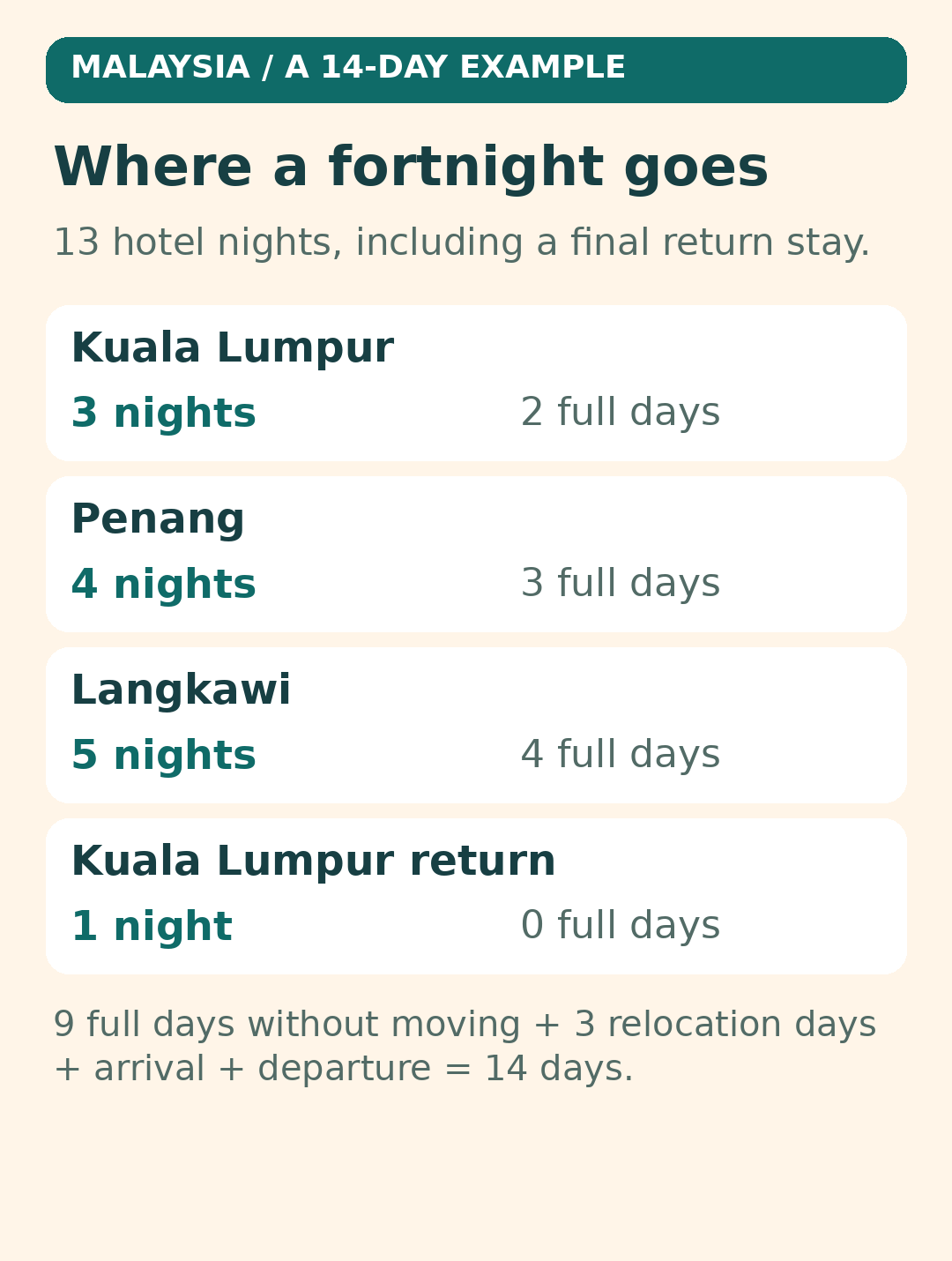
Example: Kuala Lumpur 3 + Penang 4 + Langkawi 5 + Kuala Lumpur 1
This 13-night route has four overnight blocks, including the final return. It provides nine full days without a relocation. The longer Penang and island stays are what make it feel different from the ten-day route; the benefit is not an extra dot on the map.
Use the fourth Penang night for an outing, a slower meal-led day or simply flexibility. Use the fifth island night to reduce pressure to book every day in advance. If you prefer hill scenery, replace the island block with a coherent highland-and-city plan instead of retaining both by shortening everything.
Cameron Highlands is a road-access destination with tea landscapes and cooler conditions. [4] Give that detour a proper block of nights and check the route; do not treat it as a quick station stop on a rail journey.
Could two weeks include the peninsula and Borneo?
Yes, with deliberate omissions. A possible 13-night envelope is Kuala Lumpur 3 + one Borneo state 7 + a final Kuala Lumpur stay 3. That leaves room to divide the Borneo block between suitable bases once logistics are known. Penang, Langkawi and the highlands are not then hidden inside spare afternoons.
Kuching can support a focused Sarawak introduction: Semenggoh is associated with semi-wild orangutans, and Bako offers rainforest and coastal habitats. [5][6] More remote Sarawak experiences need their own transport research. A week around one gateway and selected outings is a different trip from trying to cross the whole state.
Twenty-one days: spend the extra week on depth
Three weeks can support a wider route, but it can also make a simple route much better. Decide whether the extra week is for more regions or longer stays before choosing flights.
Example envelope: Kuala Lumpur 3 + Penang 4 + Langkawi 5 + Kuching 6 + Kuala Lumpur 2
The sum is 20 nights. Five overnight blocks leave 15 full days without a relocation under the same model. The Langkawi–Kuching leg must be checked as a complete itinerary and may need a connection; no direct flight is assumed. If the available connection is awkward, reorder the blocks or remove one rather than accepting a fragile day.
Six Kuching nights create five full base days before allowing for any overnight excursion. Use them to balance city time, selected nature outings and flexibility. An overnight park stay creates another overnight block and changes the model: it can be worthwhile, but count it honestly.
Three other ways to use the extra week
- Keep the peninsula route and extend the beach stay, with fewer packing days.
- Build a Borneo-led holiday around one state, using the time for transfers and weather flexibility.
- Choose food, photography or cultural interests that reward repeated visits to the same neighbourhoods.
A longer trip is not automatically cheaper per day. It reduces the share of fixed international-flight costs, but extra hotel nights, excursions and internal journeys still have to be funded. Price the version you want to live, not an artificially busy itinerary made to justify three weeks away.
Back to guide contents ↑The four factors that should change the recommendation
Your actual leave dates
“Two weeks off work” and “14 days in Malaysia” are different inputs. Put the outbound departure, Malaysian arrival, Malaysian departure and UK arrival in a calendar before calculating the hotel nights. The model already excludes arrival and departure days; your flight times determine whether you gain any useful hours on those days.
The season and the exact coast
METMalaysia describes different regional rainfall patterns; the northeast monsoon particularly affects exposed eastern areas, with east-coast Peninsular rainfall highest around November–January. [7] If a specific island is the reason for the trip, solve that seasonal question before selecting the duration. Extra days cannot make an unsuitable boat season suitable.
Mobility, children and energy
Use longer blocks if packing, heat, stairs or frequent airport procedures take a disproportionate amount of effort. A three-base fortnight can be a more ambitious holiday for one traveller than a five-base trip is for another. Choose a pace you can enjoy repeatedly, not one impressive day multiplied across the whole holiday.
Your main experience and its dependencies
A wildlife lodge, remote park, diving plan or guided trek can determine the route. Check access, availability and the relevant medical or activity advice before counting it as a flexible day trip. Where a Sabah offshore visit is involved, read the current FCDO map: the advice against all but essential travel applies to eastern coastal islands and dive sites from Sandakan to Tawau, including Lankayan, rather than Sabah mainland. [8]
Back to guide contents ↑Test the route before buying the extra nights
Use a three-pass check. First, add the hotel nights and confirm that the total equals the calendar. Second, insert every transfer with its first and last mile. Third, price the stays, journeys and fixed experiences with their actual terms.
For the Kuala Lumpur–Penang leg, consult KTMB’s current timetable and compare the route options on 12Go. Use the operator and date you would actually book; timetable effective dates can differ. [9]
If adding a final Kuala Lumpur buffer, compare the same dates and occupancy on Agoda’s Kuala Lumpur search and Booking.com’s Kuala Lumpur search. A city night and an airport-area night solve different problems: choose for your departure time and the journey needed.
Finally, put the chosen version into the Trip Itinerary Planner. Keep a second version with one fewer base. If the second version preserves your main interests and creates more free time, it is often the better holiday.
A worthwhile extension adds days you want to have. If its only benefit is another place name, shorten the route before lengthening the trip.
Useful questions
Does a fourteen-day holiday always mean thirteen nights?
Only under the convention used here: arrival on day 1, departure on day 14, and no overnight transport. Use the dates on your own bookings. A holiday sold as fourteen nights has a different duration from a fourteen-day itinerary.
Should I fly into one city and out of another?
Compare the complete fares and connection terms. Ending in the final region can remove a return block, but it is useful only if the onward itinerary is practical. Check baggage, any separate tickets and what happens if the first flight is delayed.
Do I need one whole spare day at every stop?
No. The model reserves relocation days; it does not impose an extra empty day at each hotel. Keep flexibility where disruption would matter most, especially before the long-haul departure or around a weather-dependent experience.
Is twenty-one days too long for only the peninsula?
No, if you enjoy longer stays and a slower rhythm. Depth can mean several ordinary mornings and evenings in the same place. Add another region only when it serves a clear interest and its travel time feels worthwhile.
Back to guide contents ↑Choose the length that fits your priorities
Choose seven days when you can happily focus, ten when three stays fit cleanly, and fourteen when you want a fuller first introduction without constant moving. Choose twenty-one for depth or a carefully planned second region. Then judge the route by its usable days, not by its length on a map. The Malaysia travel hub is the next place to organise the details around that decision.
Back to guide contents ↑Sources and checks
Official and primary sources consulted for the factual details below. Route allocations, checklists and worked planning models are editorial analysis. Recheck changing rules, prices and services before booking or travelling.
- Tourism Malaysia — About Malaysia: geography. Checked 6 November 2026.
- UNESCO — Melaka and George Town, Historic Cities of the Straits of Malacca. Checked 6 November 2026.
- Tourism Malaysia — Malaysia Travel Guide: Northern Region. Checked 6 November 2026.
- Tourism Malaysia — Cameron Highlands. Checked 6 November 2026.
- Sarawak Forestry Corporation — Semenggoh Wildlife Centre. Checked 6 November 2026.
- Sarawak Tourism Board — Bako National Park. Checked 6 November 2026.
- METMalaysia — Malaysia's climate. Checked 6 November 2026.
- FCDO — Malaysia: regional risks. Checked 6 November 2026.
- KTMB — Train timetables and effective dates. Checked 6 November 2026.
Illustrations in this article were created for Taylor’s Trailblazing Travels. Third-party photographs, where used, are credited beside the image or in the source list.