Ethical Wildlife Travel in Malaysia: Orangutans, Rainforest and River Cruises
Choose encounters that leave the animal in control—not experiences that promise contact.
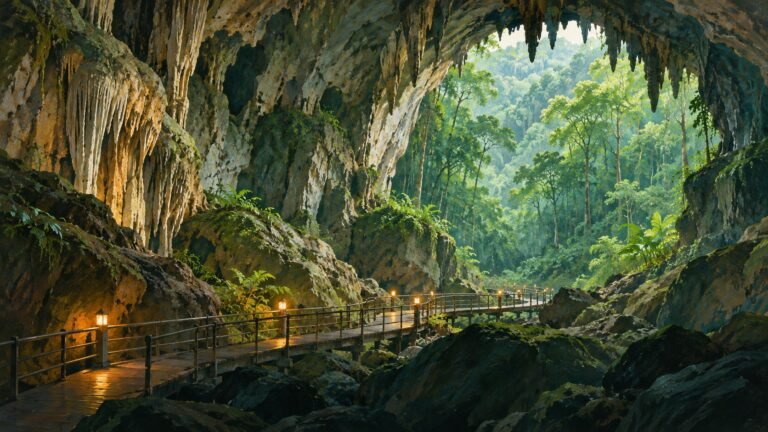
Conceptual Borneo river illustration; no wildlife sighting or specific lodge is represented as verified.
Ethical wildlife travel in Malaysia starts before the booking. The most persuasive wildlife photograph says little about how a boat reached that position, whether an animal was fed, or what the guide did when it tried to move away.
A useful decision combines the kind of encounter with the operator’s behaviour. This guide distinguishes rehabilitation-linked visits, rainforest observation and river cruises, then provides a practical way to assess them without inventing an ethical certification or guaranteeing a sighting.
This article contains affiliate links. If you book or buy through them, Taylor’s Trailblazing Travels may earn a commission at no extra cost to you.
Observation, not contact
No hugging, handling or tourist feeding.
Ask about behaviour
A guide’s response matters more than a green label.
Expect uncertainty
Animals may not appear; that is not a service failure.
Keep the geography clear
Mainland Sabah is not the same as its offshore warning area.
Choose the kind of encounter you actually want
A rehabilitation-linked visit and a search for free-ranging wildlife are not interchangeable. One involves animals whose history includes human intervention; the other involves looking for animals without a visitor timetable. Both need appropriate conduct, but the context should be described honestly.
| Experience | What it offers | What it cannot honestly promise |
|---|---|---|
| Sepilok visit | Observation in a rehabilitation-linked forest setting | An orangutan appearance on every visit or permission for contact |
| Semenggoh visit | A semi-wild orangutan setting near Kuching | A performance or an untouched-wilderness encounter |
| Kinabatangan cruise | Guided observation across river and forest-edge habitats | A checklist of mammals on demand |
| Guided rainforest walk | Attention to habitat, sounds and smaller wildlife | Close views of every large animal advertised |
| Conservation-centre visit | A chance to learn about a specific organisation’s work | Proof that every commercial tour using its name is responsible |
On smaller screens, scroll the table sideways.
Sepilok is run by the Sabah Wildlife Department; its conservation partner explains that orangutans can range freely and sightings vary. Sarawak Forestry describes Semenggoh’s present role as a haven for semi-wild orangutans, with rehabilitation activities having shifted to Matang. Those are important differences to understand before selecting an itinerary. [1][2]
For a first trip, choose one principal wildlife landscape and allow it enough time. A hurried circuit of several centres and river stops can create pressure for a close encounter at each, while leaving little time to understand any of them.
Orangutans: follow the animal’s space and the site’s rules
At Sepilok, Orangutan Appeal UK’s visitor guidance asks for at least ten metres of separation, no touching, no flash and quiet behaviour. It also explains that visitors should back away calmly if an orangutan approaches, leaving a clear route. Follow the current ranger instructions on the day, including any greater separation or access restriction. Do not apply one site’s distance rule automatically to every reserve. [1]
An approach by an animal is not consent to interaction. Put down the urge to get a selfie, do not hold food out, and do not block the path so someone else can take a picture. Before entering, ask staff what to do if an animal appears on a walkway.
Semenggoh should be understood as a managed semi-wild setting, not a zoo performance. Its present purpose includes studying orangutan behaviour and providing a natural haven; the animals are not there to fulfil a tour operator’s promised photograph. [2]
If you are unwell, ask the centre whether you should postpone. Staff instructions intended to reduce disturbance or disease exposure take priority over a prepaid excursion. Ask your organiser beforehand about how a postponement or exclusion is handled.
Feeding is not one single category
Supplementary feeding managed by rehabilitation staff is different from a visitor offering food for a photograph. Ask who controls the activity and why it takes place. Do not assume that being allowed to watch staff feeding animals means that tourist feeding is acceptable.
The Bornean Sun Bear Conservation Centre explicitly prohibits visitors feeding the bears and asks people not to shout at animals or throw objects into enclosures. It also gives specific rules about food, drinks and distance from free-roaming wildlife. Read each site’s own rules rather than expecting one ticket to carry the same conditions everywhere. [4]
River cruises: assess what the guide will do
The Kinabatangan supports river and forest wildlife, and Sabah Tourism identifies lodges and activities around Sukau, Bilit and Abai. River viewing is a distinct experience from a centre visit: even a long stay does not entitle the group to a particular animal. [3]
Ask a prospective operator a behavioural question: “What will your boat do if several boats gather around an animal or elephants start crossing?” A useful answer explains how the guide will avoid crowding and leave a route clear. A reply about getting the closest view misses the point.
Use these editorial standards when comparing answers. They are a screening framework, not a statutory code or a published ranking of operators.
| Topic | A useful explanation | Reason to pause or decline |
|---|---|---|
| Animal distance | How the guide avoids approach, pursuit and blocking movement | A promise to get alongside every sighting |
| River crossings | Space is left for animals to complete the crossing | Following or surrounding animals for photographs |
| Several boats | A plan to wait back or move on | Joining a crowd because other boats are doing it |
| Feeding and sound | No tourist baiting, calling or playback to manufacture an encounter | A staged feeding or guaranteed close encounter |
| Night observation | Clear limits on lights and viewing duration, with a guide who can stop the activity | Repeated bright illumination just to keep an animal visible |
| Safety | Suitable life jackets, a briefing and a weather decision process | Overcrowding or pressure to depart in unsuitable conditions |
On smaller screens, scroll the table sideways.
Ask what is included in a package: boat outings, guide, transfers, meals and any centre admissions. Also ask how many people share the boat and whether the group size can change. None of these answers alone proves an ethical operation, but together they reveal more than a sustainability slogan.

If conduct on the day differs from the agreement, ask calmly for space or to move on. Do not place yourself or others at risk by intervening physically. Raise a factual concern with the organiser and relevant site management afterwards, using a date, location and description rather than an unsupported public accusation.
Rainforest travel: choose habitat and patience
A forest trip becomes more rewarding when the guide can explain what is happening even when the headline animal is absent. Ask whether the walk will focus on habitat, tracks, bird calls and smaller wildlife, and what terrain, gradients and return arrangements it involves. A short distance can still be demanding in heat or on wet ground.
Choose walks that fit your ability and follow the route and access conditions set by the site. Do not leave a path, surround a resting animal or encourage a guide to disturb vegetation to improve a photograph. A respectful guide should be able to say no to a request.
Weather belongs in the plan. METMalaysia describes different monsoon influences across Malaysia, including heavy northeast-monsoon rain in western Sarawak and eastern Sabah. This is background climate information, not a prediction of river levels or trail conditions for your date. Ask the operator about current access and their cancellation decision. [6]
Local benefit needs an explanation
Ask who employs the guide, who owns the accommodation and what local services are bought. A specific account of employment, training or a named conservation contribution is more informative than a broad claim that every booking “saves wildlife”. Avoid treating a donation amount as a substitute for good conduct during the visit.
An operator can support conservation and still need to answer questions about its excursions. Conversely, a small local business does not need a glossy certification page to give clear, credible answers. Evaluate the actual practices and evidence rather than the marketing budget.
A two-stage operator check
First apply non-negotiable exclusions: do not book a product that sells handling, hugging, tourist feeding or harassment as the attraction. A high review score, good room or low price cannot offset that issue.
Then compare the remaining candidates on evidence. Record what is published, what has been confirmed directly, and what remains unknown. Save the current reply and the terms for your own dates. This avoids turning an uncertain answer into a claim of verified practice.
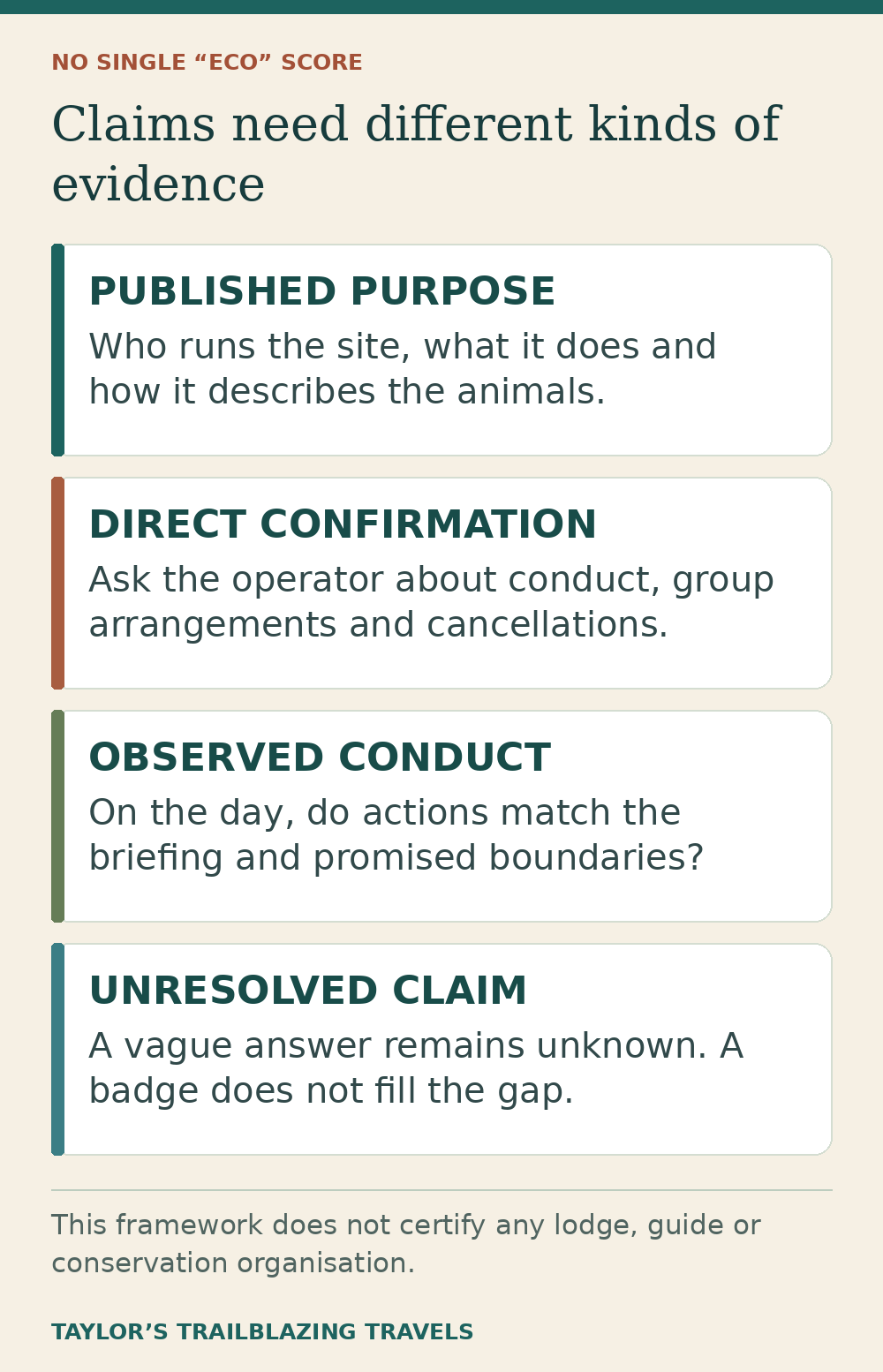
| Question | Record the answer as | What to do next |
|---|---|---|
| Is the site accurately described? | Published context and responsible authority | Check that the itinerary uses the same site |
| How are wildlife encounters managed? | A direct explanation of guide behaviour | Seek clarification on vague answers |
| Who receives a conservation payment? | Named recipient, amount or mechanism | Do not repeat an unsupported donation claim |
| What happens without sightings? | Normal continuation of the visit without staged contact | Reject pressure to manufacture an encounter |
| What happens if weather stops the activity? | A cancellation or alternative plan | Compare with accommodation and transfer terms |
On smaller screens, scroll the table sideways.
For Semenggoh, a verified Viator listing provides a way to investigate a guided transfer from selected Kuching hotels. It lists a guide and admission, but is not wheelchair accessible. The booking listing is not an ethical accreditation; confirm current inclusions and conduct with the operator and follow the reserve’s rules. [7]
Check the Semenggoh guided-transfer option
No operator in this guide is certified by Taylor’s Trailblazing Travels. The purpose of the framework is to help you ask better questions, not to turn website descriptions into a welfare guarantee.
Build a mainland Borneo plan with room for uncertainty
A mainland Sabah model is two nights around Sepilok followed by three at a Kinabatangan base, with transport arranged separately around arrival and departure. That is a five-night planning example, not a fixed tour or a guarantee of daily sightings. It leaves more opportunity to settle than a sequence of single-night stops.
Sabah Tourism identifies lodges and packages in several different river areas. Ask where your actual accommodation sits and whether the transfer is by road, boat or both. Do not substitute a city hotel result for a river-lodge package without checking what you are buying. [3]
Compare Sandakan and Sepilok-area accommodation
That search also includes outlying properties, so confirm the address and transfer before choosing it. [8]
An alternative is a settled Kuching stay with a Semenggoh visit and a separately chosen forest experience. Choose this when you prefer city facilities and less accommodation-changing, rather than trying to combine both states into a short wildlife checklist.
Compare Kuching bases for planned nature outings
The city search covers different neighbourhoods and outlying areas; it does not promise proximity to every excursion. [9]
Do not confuse mainland and offshore risk advice
The UK advisory, checked on 7 November 2026, places the offshore belt between Sandakan and Tawau—including Lankayan—in its category for avoiding non-essential journeys. Kidnapping is the reason given; mainland Sabah is outside that specific offshore warning. Do not add an offshore wildlife stop without checking the exact location and current advice. [5]
For a remote stay, discuss your health needs and the operator’s emergency arrangements before committing. FCDO advises suitable cover for treatment and evacuation, and checking that the destination can provide needed care. A lodge’s isolation is a logistical consideration, not merely part of its appeal. [10]
Questions about responsible wildlife trips
Is no sighting a sign of a poor tour?
Not by itself. Judge whether the operator delivered the agreed guide, access, duration and conduct. An animal’s absence is different from a missing service, and it should not be “fixed” through baiting or pursuit.
Is every rehabilitation-centre visit unethical?
No. The relevant questions include the centre’s actual purpose, visitor boundaries and animal care. Distinguish observing a managed conservation setting from paying for contact. Read the responsible organisation’s own description rather than accepting a reseller’s wording.
Does a small group guarantee good practice?
No. It can help with space and communication, but a small boat can still approach too closely. Ask what the guide does, not only how many guests join.
Can children visit?
Check the specific site and tour requirements. Consider whether the child can remain quiet, follow instructions and keep the required distance, and whether suitable life jackets and transport arrangements are available. Do not treat a generic family-friendly label as a complete answer.
Should we bring food for animals or staff to distribute?
Do not bring food for animals unless the responsible organisation explicitly requests and manages a specific donation. Direct support through an organisation’s own channels is different from feeding during a visit.
What should photographs show?
Aim to record the setting and natural behaviour from the permitted position. A photograph that requires someone to touch, reposition or corner an animal is not worth making.
Choose the trip that can say no
Prefer the operator willing to decline a close approach, cancel an unsuitable outing and explain a day without sightings. Choose one landscape carefully, give it time, and support the organisations whose work you can understand.
The strongest wildlife memory is not the closest possible photograph. It is an encounter that leaves the animal’s choices intact and gives you a clearer understanding of the place it lives.
Sources and editorial approach
Sources checked on 7 November 2026. This is a research-led guide, not a report of personal stays, tours or clinical assessment. Provider descriptions are identified as such; the decision frameworks and worked examples are editorial planning tools. Recheck changing access, operating conditions and travel advice before booking.
- Orangutan Appeal UK — Sepilok Orangutan Rehabilitation Centre: responsible visiting.
- Sarawak Forestry Corporation — Semenggoh Wildlife Centre.
- Sabah Tourism Board — Kinabatangan Wildlife Sanctuary.
- Bornean Sun Bear Conservation Centre — Visit Us: visitor rules.
- FCDO — Malaysia: regional risks.
- METMalaysia — Weather Phenomena.
- Viator / Tour & Incentive Travel — Semenggok Wildlife Centre tour: published inclusions.
- Agoda — Sandakan accommodation search.
- Agoda — Kuching accommodation search.
- FCDO — Malaysia: health.
Illustrations in this article were created for Taylor’s Trailblazing Travels. Third-party photographs, where used, are credited beside the image or in the source list.