Visit Angkor with a Guide, Tuk-Tuk Driver or Independently?
Match the explanation, transport and flexibility you book to the day you want.
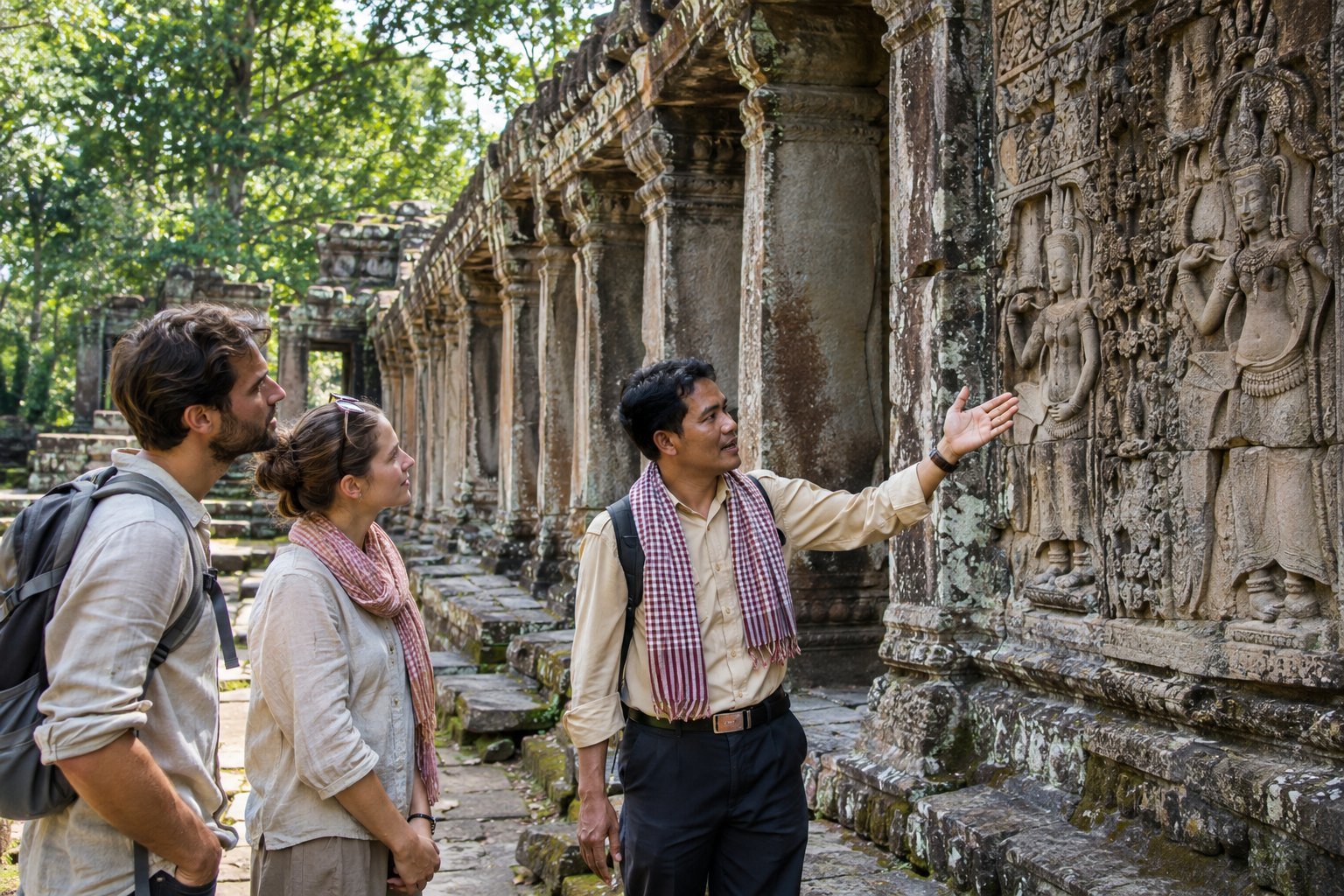
AI-generated illustration of a guided temple visit; no named guide or tour is depicted.
A guide and a tuk-tuk driver solve different problems at Angkor. A guide helps you understand what you are looking at; a driver takes you between places and waits while you explore. You can hire both, use a driver while visiting the temples on your own, or arrange your own transport as well.
For a first visit, a useful middle course is one day with a licensed guide and transport, followed by any extra days at your own pace. If history is only a small part of the appeal, a reliable driver and a short, well-prepared route may suit you better.
This guide contains affiliate links. If you book or buy through them, Taylor’s Trailblazing Travels may receive a commission at no extra cost to you.
A licensed guide can answer questions and connect the details.
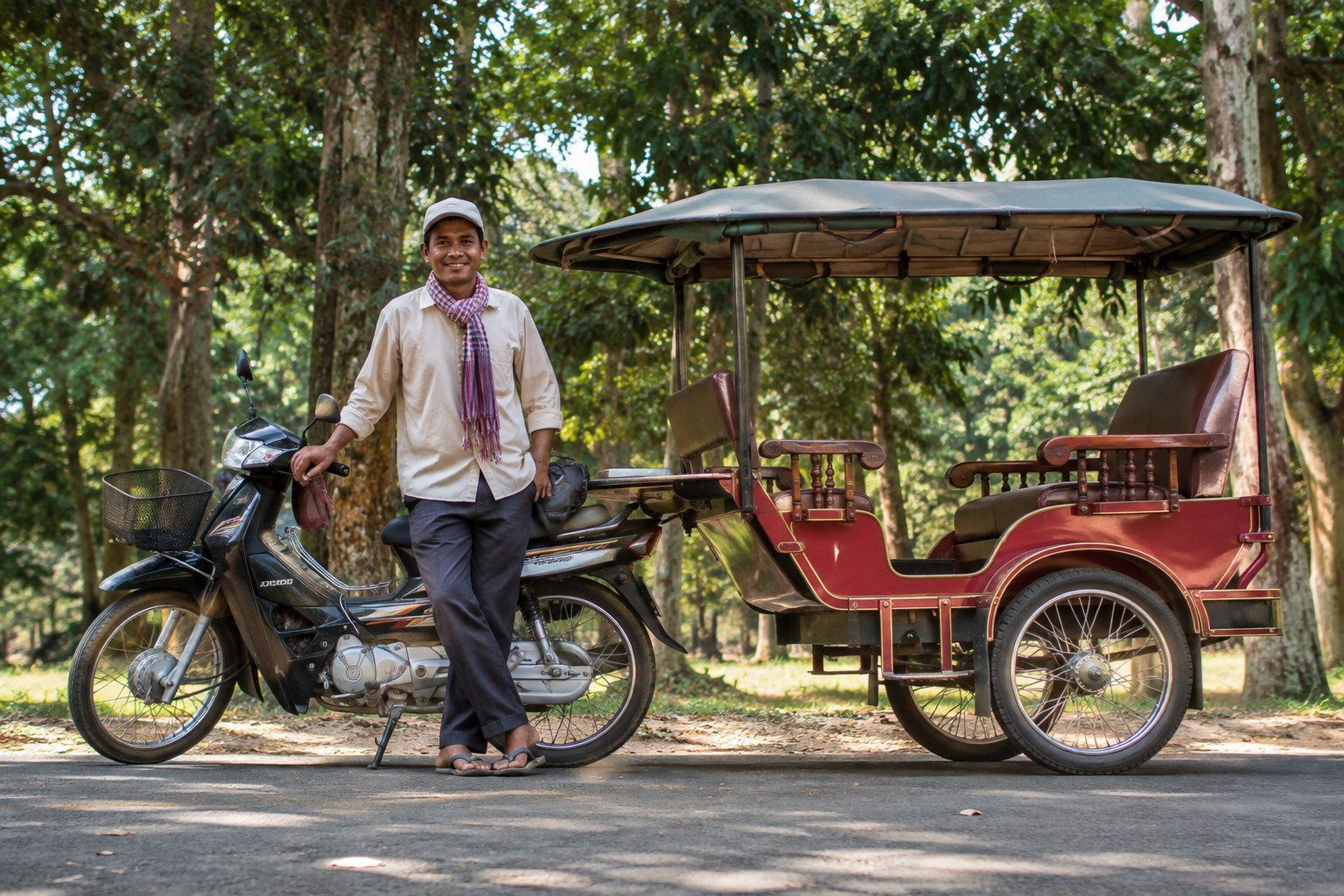
A private driver handles journeys between temple stops.
A small group can share transport and a guided experience.
Plan your own route, transport, breaks and return journey.
Angkor guide vs tuk-tuk: compare the service you get
Swipe or scroll sideways to see the whole table.
| Arrangement | Main benefit | Your responsibility | Main compromise |
|---|---|---|---|
| Private guide with driver | Personal explanation, questions and a route tailored to your interests | Explain your interests and any walking limitations | Higher total cost; guide and transport must both be included in the quote |
| Small-group guided tour | Guiding and organised transport shared with other visitors | Choose a route and pace you can comfortably follow | Less control over stop lengths, meal breaks and departure time |
| Tuk-tuk or car driver only | Flexible journeys and an agreed return | Research the temples and explore inside independently | An English-speaking driver is not necessarily a licensed history guide |
| Own transport and self-guided visits | Maximum control over your schedule | Navigation, equipment, road judgement, parking and return plans | More effort and exposure to weather; help is not automatically on hand |
The distinction is real in operators’ offers. Angkor Tuk Tuk Tours explicitly describes its service as driving, with the driver waiting outside temples; it can help arrange a licensed guide separately.[1] Ask what a listing includes instead of relying on the word “tour”.
Back to top ↑When a licensed guide is worth paying for
Choose a guide when your main questions begin with why: why a temple has a particular layout, what a carving represents, or how different sites relate to each other. Angkor includes successive Khmer capitals, religious monuments and water-management systems across a large archaeological landscape. There is much more to connect than the appearance of individual ruins.[2]
A useful guide should adapt explanation to your interests. Tell them whether you want a broad introduction, more detail on architecture, religious context or a route that works for children. You are paying for someone you can question, so it helps to give them a starting point.
Cambodia’s National Trade Repository states that tourist guides must obtain a Ministry of Tourism licence. Ask for a licensed guide, confirm the language and agree whether they will accompany you inside every temple on your route.[3]
Where a guide may add less
If you mostly want quiet time, photography or a short return to somewhere you already understand, constant commentary may not suit the day. You can book a shorter guided visit or keep later outings self-guided. Being interested in Angkor does not mean you need the same service every morning.
Nor should a guide be treated as a promise of empty temples or special access. Ask how they plan the route, but expect public opening rules, conservation restrictions and other visitors to shape the experience.

When a tuk-tuk driver is the better fit
A driver-only day suits travellers who are happy reading beforehand and exploring at their own pace. You keep the freedom to spend longer at one site while avoiding the work of arranging each journey separately.
Before the first stop, agree where you will be collected afterwards. Some temple visits can finish at a different entrance from the one where you started. Save the driver’s contact details and take a photograph of the vehicle, particularly if you are leaving a busy parking area.
Make the day specific: the temples you want, start time, likely finish, any distant additions and whether returning to your hotel for a break is included. The driver’s flexibility is valuable, but an open-ended “take us everywhere” request makes it harder to compare prices fairly.
Tuk-tuk or air-conditioned car?
A tuk-tuk gives an open ride between stops; a car gives you an enclosed, cooled space if air conditioning is included and working. Choose around the people travelling, the weather and the length of the day. Ask about seating and luggage room instead of assuming every vehicle suits the same party.
A car cannot remove the walking, steps or uneven surfaces inside temple sites. If mobility is a concern, discuss the actual drop-off points and walking route. A vehicle described as comfortable is not enough to establish that the whole excursion is accessible.
Compare the whole day’s price
Private transport is often quoted for the party, while a shared tour is usually priced per person. Add admission before deciding which is cheaper, and check whether the tour already includes it.
As one current example, ACT Cambodia Travel advertises a private driver-only tuk-tuk visit for US$20, a guide with tuk-tuk for US$65, and a guide with SUV for US$80, each of these options for up to three visitors. Its page excludes temple tickets and lunch and notes a sunrise supplement. These are that operator’s advertised options, checked on 15 November 2026; confirm the exact route, supplement and final quote for your date.[4]
Swipe or scroll sideways to see the whole table.
| Paying visitors | Driver and tuk-tuk | Guide and tuk-tuk | Guide and SUV |
|---|---|---|---|
| One | US$57 total | US$102 total | US$117 total |
| Two | US$94 total | US$139 total | US$154 total |
| Three | US$131 total | US$176 total | US$191 total |
For two adults, adding the guide to the tuk-tuk option adds US$45 between you, or US$22.50 each. For three, that same addition is US$15 each. A solo traveller pays the whole difference, which is why a shared guided tour deserves a closer look.
Already holding a valid multi-day pass? Remove the new one-day admission charge from this comparison and compare the services you still need. For a family, calculate only the tickets actually required; do not assume an operator’s child pricing is the same as the park’s admission rules.
Use this method with your own quotes: party transport plus guiding plus required admission, then meals and any agreed extras. A cheap headline loses its advantage quickly if it omits the service you wanted.
If your group shares the guide and driver bill, the Group Holiday Cost Splitter can help allocate the agreed expenses. Enter the amounts you actually pay, and keep each visitor’s admission charge separate where appropriate.
Back to top ↑When a small-group tour makes sense
A shared guided tour can be a practical choice when you are travelling alone, prefer meeting other people or want one booking to cover the day’s organisation. Compare group size, transport, language, hotel collection and admissions before comparing the headline price.
For example, the Viator listing for Angkor Wat Sunrise or Sunset Tour with Guide from Siem Reap advertises an English-speaking guide, air-conditioned transport and a maximum of 13 participants, while its itinerary identifies temple admission as excluded. It also marks the activity as not wheelchair accessible.[6] Those details are useful questions to apply to any alternative, rather than reasons to assume every guided tour works the same way.
The compromise is the shared schedule. If someone wants to spend another hour at a carving, another needs an early finish and another wants a long lunch, a group cannot satisfy all three. Choose a private option if control over the pace is central to enjoying the day.
Read the selected option carefully. Some listings offer both private and shared versions, with different prices and inclusions. A review of one version does not necessarily describe the one you are about to book.
Back to top ↑What fully independent visiting involves
Visiting independently can mean exploring without a guide while a driver handles transport. It can also mean cycling or otherwise arranging your own journeys. Decide which kind of independence you want before accepting the extra work.
For a bicycle outing, plot the ride from your accommodation to the first temple, the links between stops and the journey home. Then add the walking you intend to do. A route that looks pleasant as a ride alone may feel different after several long temple visits.
Check the bicycle’s brakes, tyres, lights and lock, carry water, and have a way to contact help or arrange a lift. Keep the first outing modest enough that you can shorten it. If you want a sunrise visit but are uncomfortable riding unfamiliar roads before daylight, use a driver for that outing.
Renting a scooter should be a separate decision about riding experience, legal requirements and insurance. The availability of a rental does not settle those questions. FCDO warns of serious road risks in Cambodia, greater risk after dark and the need to check insurance; it also advises against leaving your passport as a motorcycle or scooter deposit.[7]
Self-guided does not mean wandering wherever a path appears. Follow site signs and established routes, and give conservation barriers the same respect as you would on a guided visit.

Match the arrangement to your group
First visit with a strong interest in history
Book a licensed guide and transport for the first substantial day. Let that visit help you choose what deserves more time later. It is a stronger use of the budget than paying for several long days before you know which parts interest you.
Two adults who enjoy exploring quietly
Start with a private driver and a short list of temples. Add a guide for one focused visit if you find yourself wanting more context. Agree the meeting point at each stop so that freedom inside does not become uncertainty at the exit.
A family with different energy levels
Prioritise a private schedule, short visits and the ability to finish early. Ask whether the guide is comfortable adapting explanations for the children’s ages. Check vehicle seating and any child restraints directly; a promise that everyone will “fit” is not a useful answer.
A solo traveller watching costs
Compare a small-group guided tour with a private driver using the full cost including admission. The group may offer more explanation and company for your money, provided its duration and pace suit you.
A return visitor or keen photographer
A driver-only arrangement often gives more useful flexibility. Discuss the places and times you care about, then allow room for changing light and weather without making every stop compulsory.

Ask these questions before booking
- Is this a licensed guide, a driver, or both?
- Is the quoted price for each person or for the whole party?
- Which temples and any more distant stops are included?
- What vehicle will be used, and how many passengers can travel comfortably?
- Are admission, hotel collection, water, meals and sunrise included or extra?
- Can we alter the pace, take a hotel break or finish early?
- What are the cancellation terms, and what happens if the operator changes the arrangement?
- Can the actual walking route and vehicle access meet our needs?
For a three-day visit, consider a simple mix: guide and transport on the first day, driver-only on the second, then decide whether the third day needs another guide or just a shorter return. Book anything time-sensitive in advance, but avoid paying for identical full-day services merely because your pass allows three visits.
Whatever you choose, cover shoulders and knees and follow the official rules on fragile structures, carvings and restricted areas. A guide cannot waive these requirements.[8] Take current border advice into account before adding distant excursions: on 15 November 2026, FCDO advised against all but essential travel within 20km of the Thai land border and reported suspended crossings.[9]
Back to top ↑Questions to settle before your temple day
Is an English-speaking tuk-tuk driver also a tour guide?
Not necessarily. Driving and guiding are separate services. Ask whether a licensed guide will enter the temples with you or whether the driver will wait outside.
Can I book a guide without transport?
Some arrangements separate the services. If you book only guiding, agree how you and the guide will move between temples and where the service begins and ends. Do not assume the guide’s fee includes a vehicle.
Do I need a different guide for each temple?
A guided day can cover several agreed temples with the same guide. Confirm that itinerary and the duration when booking. A short, on-site guiding arrangement may cover only one temple.
Should I book sunrise automatically?
Only if it is something you want to see. It means an early start, may carry a supplement and does not guarantee dramatic light. A later start can make more sense if rest and a shorter day matter more.
Is a private car enough to make the visit accessible?
No. Ask about steps, surfaces, walking distances, toilets and the specific drop-off points as well as the vehicle. Have the operator explain which parts of the proposed route you can comfortably manage.
Can a driver arrange the Angkor Pass?
Ask exactly how it will be issued and make sure you receive your own valid ticket. You can also buy directly through Angkor Enterprise. An excursion booking and a park admission ticket are separate items unless your chosen option explicitly combines them.
Choose the help that will improve your day
Spend on a guide if understanding the temples is the priority. Spend on private transport if control over the pace matters most. Combine them when both would make a difference, and use shared tours when their route and economics suit you. The most useful booking is the one that matches how you want to experience Angkor, with every inclusion clear before you set off.
Back to top ↑Sources and further reading
Sources checked on 15 November 2026. Official rules, service details and prices can change; check the linked provider or authority again before booking and departure.
- Angkor Tuk Tuk Tours: frequently asked questions
- UNESCO World Heritage Centre: Angkor
- Cambodia National Trade Repository: licensing for tourist guides
- ACT Cambodia Travel: Angkor temple day tour
- Angkor Enterprise: available tickets
- Viator: Angkor Wat Sunrise or Sunset Tour with Guide from Siem Reap
- FCDO: Cambodia safety and security
- Angkor Enterprise: visitor code of conduct
- FCDO: Cambodia travel advice
Illustrations in this article were created for Taylor’s Trailblazing Travels. Third-party photographs, where used, are credited beside the image or in the source list.