Cardamom Mountains Eco-Lodges: How to Choose a Responsible Stay
Compare the place, the programme and the evidence behind the promise.
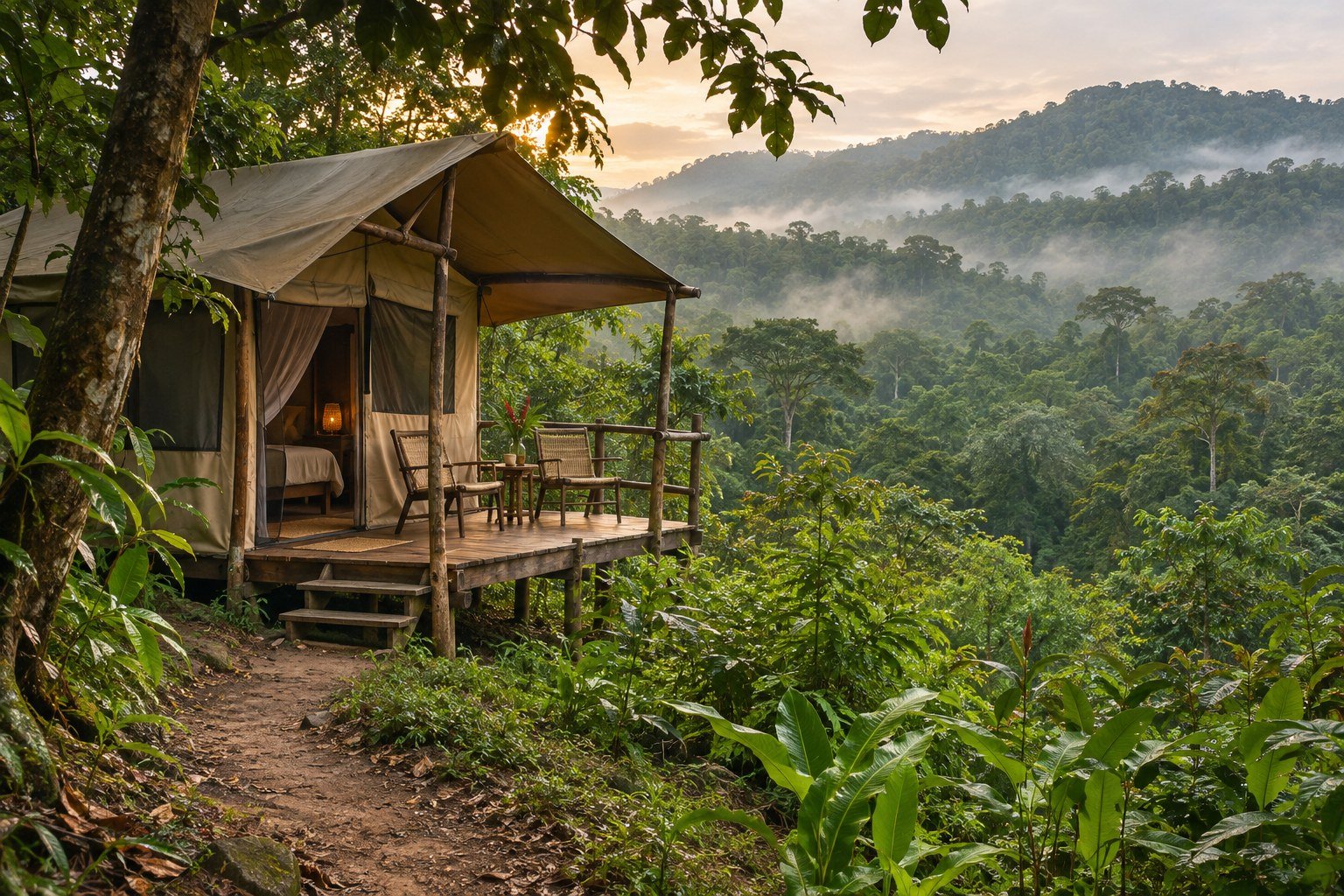
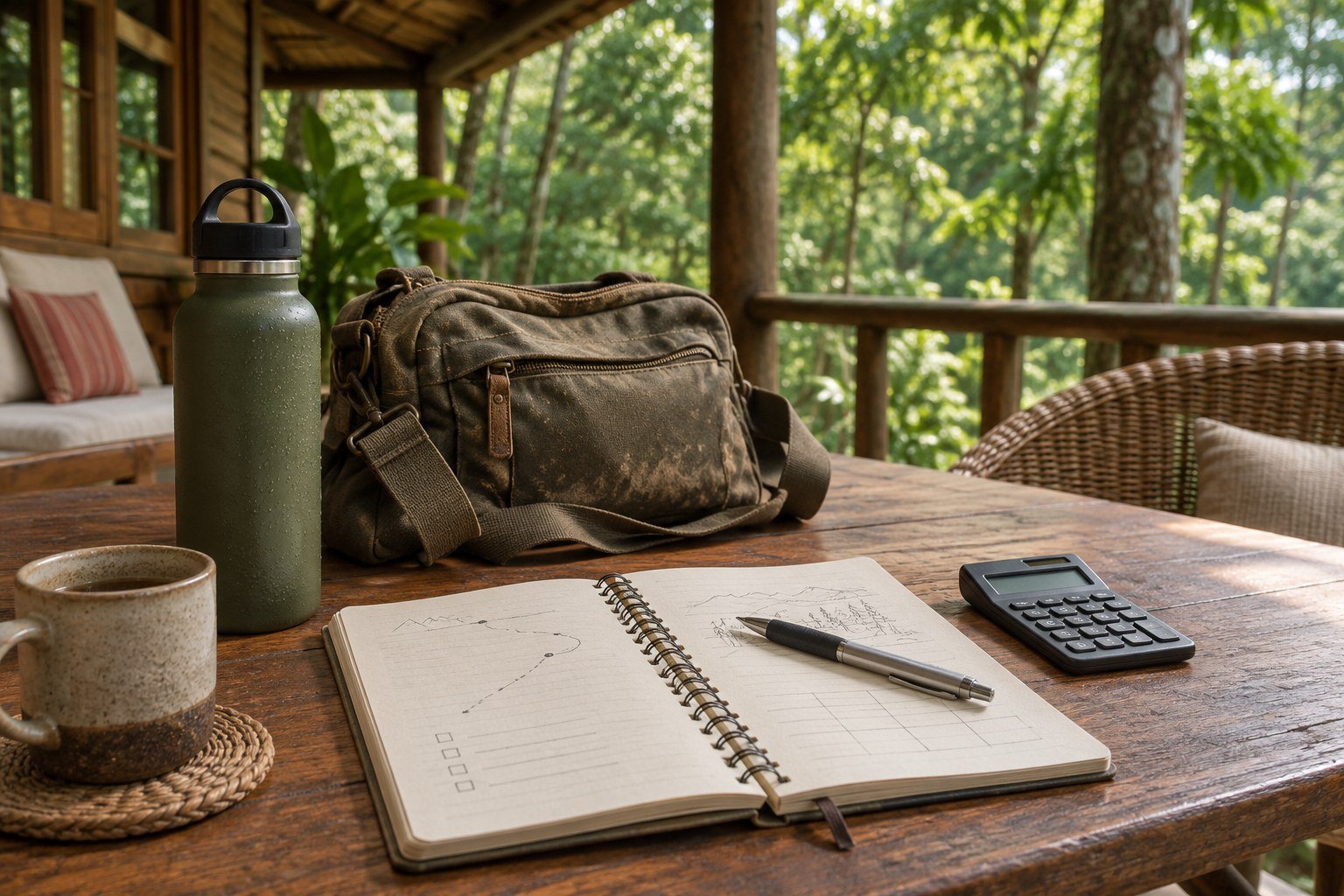
AI-generated illustration of a Cardamom forest stay; no named lodge is depicted.
Choose a Cardamom stay by the experience you want to spend time on, then test its claims about responsibility. A beautiful tent beside a river tells you little about wastewater, employment or who benefits from conservation funding. Equally, a modest guesthouse can still be the wrong choice if its access or facilities do not suit you.
The most useful shortlist combines three distinct properties with a community-stay alternative: Cardamom Tented Camp, Canvas & Orchids Retreat, Shinta Mani Wild and Chi Phat. They offer different locations, comfort levels and booking arrangements. The comparison below explains what is published, what it helps you decide and what deserves a direct answer before you commit.
On 15 November 2026, FCDO advised against all but essential travel within 20km of the Thailand land border; land crossings remained suspended. Check its map against the lodge location and entire proposed transfer.[1]
This guide contains affiliate links. If you book through them, Taylor’s Trailblazing Travels may receive a commission at no extra cost to you.
Choose the right setting
River relaxation, guided forest days and a village stay make different demands on your time.
Ask for specific evidence
Look for named practices, reporting dates and a clear explanation of who benefits.
Price the whole visit
Include the room, transfers, meals, activities, taxes and conditions in one comparison.
Choose the kind of stay first
Swipe within the table to see all columns.
| Stay | Setting and published facilities | Who should investigate it first |
|---|---|---|
| Cardamom Tented Camp | Botum Sakor forest, reached through Trapeang Rung by river. Safari tents have fans and private bathrooms with hot showers.[2][3] | Travellers who want the forest programme to be the centre of the stay and can manage a boat transfer. |
| Canvas & Orchids Retreat | Tatai River; floating tents and land-based island tents, including two-bedroom family layouts. Published room descriptions specify fans.[4] | People drawn to a river retreat, or families wanting a separate sleeping space rather than one shared tent. |
| Shinta Mani Wild | Kampong Seila district in Preah Sihanouk province. Climate-controlled tent bedrooms and a stay sold as all-inclusive, with private road transfers from the named arrival airports.[5] | Travellers seeking a high-service adventure stay who want to compare a complete package. |
| Chi Phat community tourism | A community-based tourism project in the southwestern Cardamoms, supported by Wildlife Alliance.[6] | Travellers who want to discuss village accommodation and locally organised activities directly with the community team. |
These are starting points, not a ranking of environmental performance. Choose two that meet your practical needs and ask both the same questions. Comparing every tent in the region is less useful than finding out whether the two you could realistically book meet your requirements.
Give the place enough time to justify reaching it. My starting plan is three nights: arrival, two full days, then departure. Two nights leave one full day, which can work for a quiet river stay but gives less room to move a guided outing. Check the actual minimum stay and activity days before fixing the surrounding hotels.
Make the final transfer part of the booking
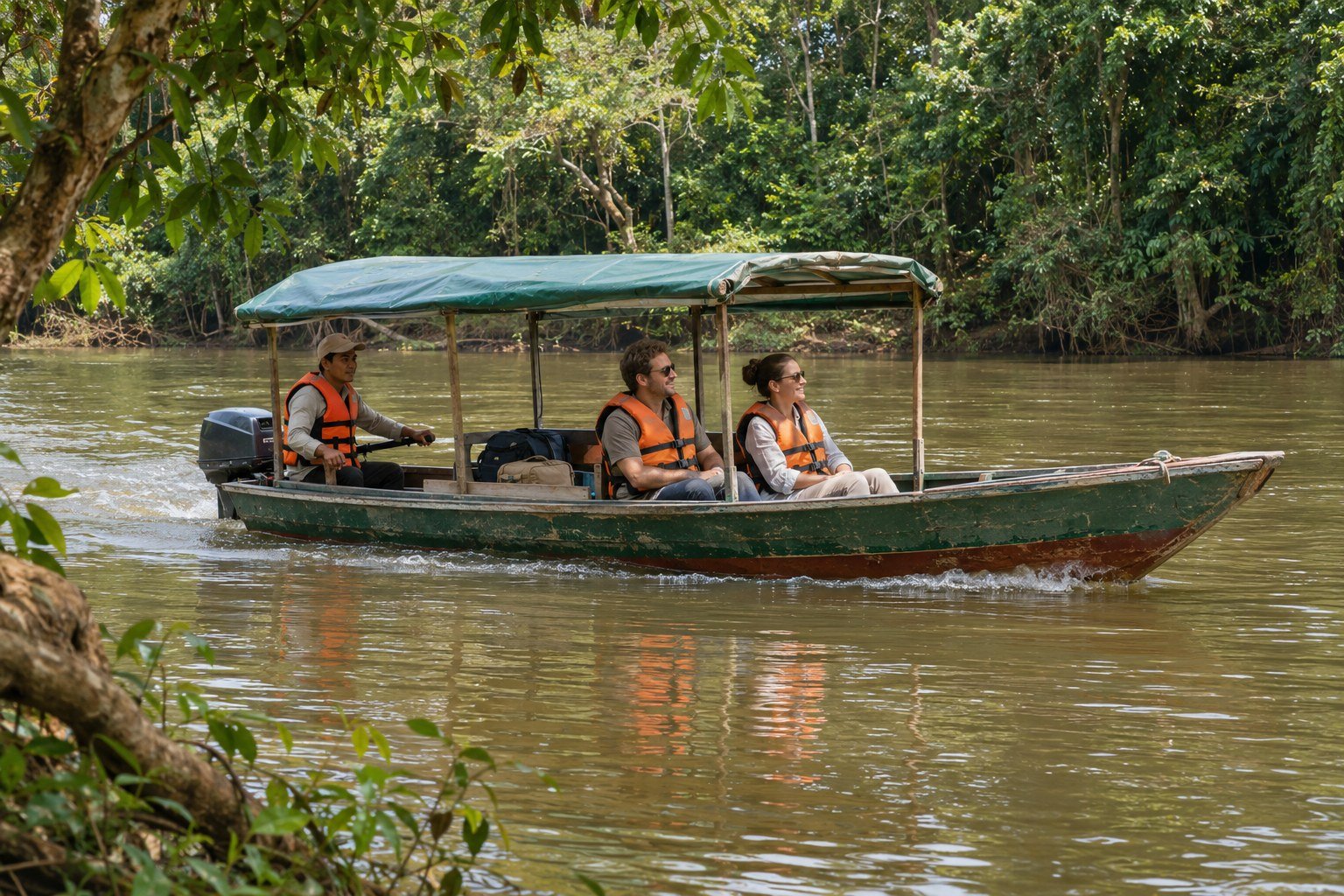
A room confirmation does not finish the journey. Establish the last transfer first, then work backwards to your departure time in Phnom Penh, Sihanoukville or another agreed starting point. Tell the property your precise hotel or airport, party size and luggage; ask for a door-to-door quote and a written meeting point.
Cardamom Tented Camp describes a roughly 30-minute river journey and asks guests to reach its departure lounge by 13:00. It aims to consolidate arrivals into one boat; other departures cost extra and operate in daylight. Anyone arriving by public transport must coordinate the stop and collection with the camp.[2]
Canvas & Orchids lists scheduled check-in boats at 14:00 and 17:00, with private boats charged separately. Its team supplies the precise Tatai meeting pin after booking. Choose your road departure around the confirmed boat, including some room for delay.[4]
Shinta Mani Wild advertises an arrival involving a Jeep and zipline. If that does not suit you, ask for the alternative before paying. Its published airport directions still include the old Phnom Penh airport reference, so request a fresh transfer confirmation for your actual arrival point rather than relying on that page’s driving estimate.[5]
Avoid adding a remote stay immediately before an essential flight. A night back near the departure city gives a delayed road or boat transfer somewhere to land. Ask what the property does if the final transfer cannot run, who arranges the replacement and whether an extra night is covered or charged.
Back to top ↑Match the room and activities to your needs
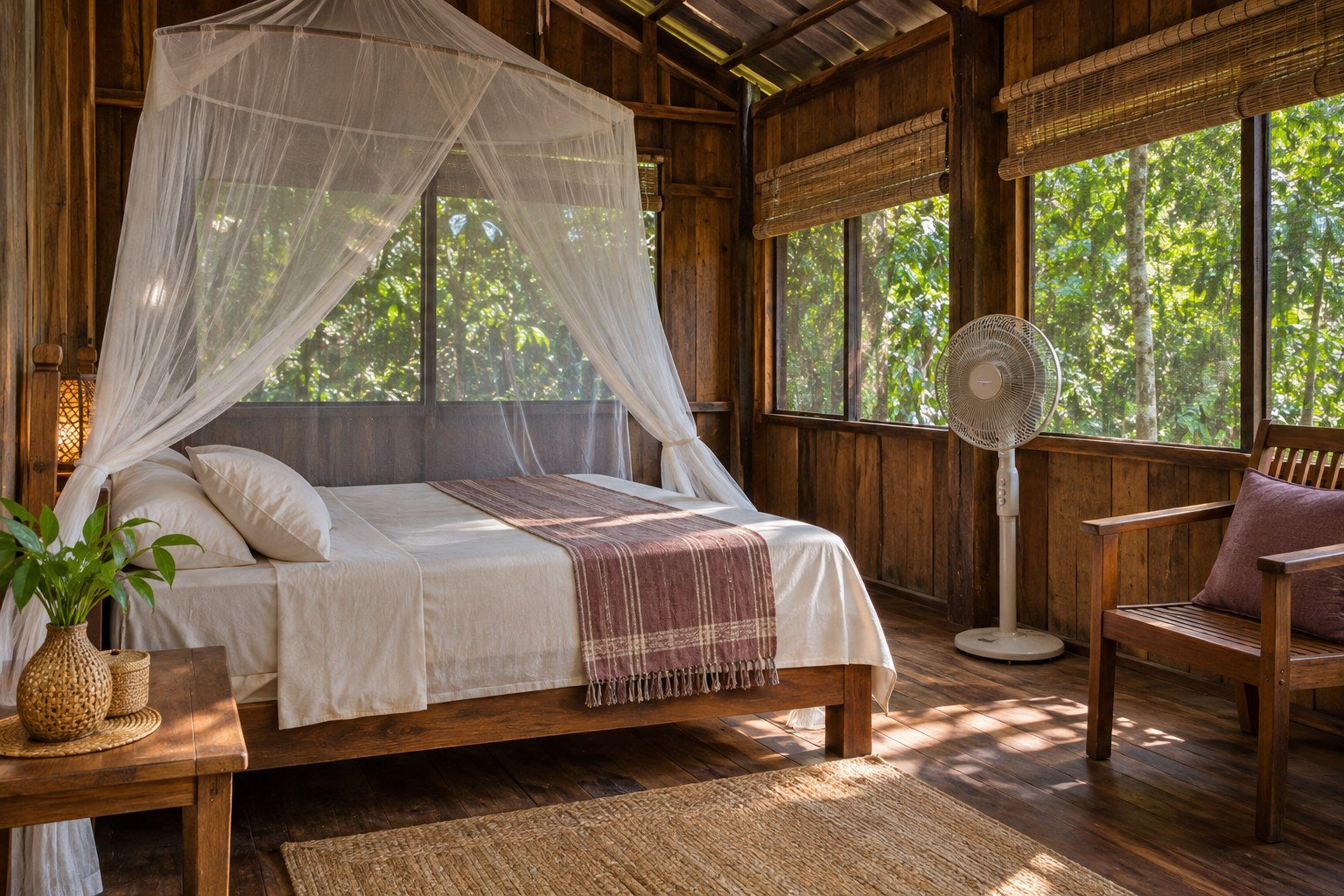
Start with the things you cannot comfortably compromise on: cooling at night, bathroom arrangements, steps, boat boarding, meal requirements and electricity for essential equipment. Send those needs in plain language. “Accessible” or “family-friendly” is too broad to answer them.
Cardamom Tented Camp does not accept children under six; children aged six to fourteen must be accompanied by an adult. Its FAQ also restricts high-power appliances and warns that internet service is limited. Ask about your particular charging or power requirement rather than assuming a socket means unrestricted supply.[7]
Canvas & Orchids welcomes children of all ages and offers island tents with two bedrooms sharing one bathroom. That may be a better family layout, but it still needs a river arrival. Ask about appropriately sized life jackets, the boarding step and the distance from the chosen tent to the restaurant.[4]
- If uneven ground is difficult, request a short video of the route from the landing or vehicle to the room, bathroom and dining area. Ask about handrails, thresholds and help with bags.
- If walking is optional for you, ask what a full day at the property looks like without a trek. A pleasant terrace may be enough; an activity-heavy package may be poor value.
- If you are travelling alone, ask for the single-occupancy total and whether guided activities require other guests. A per-person headline rate may assume two people sharing.
- If staying connected is essential, ask where the connection works and what happens during a power or service interruption. Do not build a working day around an untested remote connection.
For forest activities, ask about the actual walking duration, ground underfoot, water crossings and turnaround options. Cardamom Tented Camp describes muddy terrain and requires closed shoes for trekking.[7] A photograph of a flat boardwalk is not enough to judge the whole visit.
Read the evidence behind the responsibility claim
Useful evidence has a name, a date and a scope. A lodge can describe how its own system works; a membership organisation can confirm a relationship; an independent assessment may examine a defined standard. None should be silently substituted for the others.
Swipe within the table to see all columns.
| Stay | Evidence available to read | Question that follows |
|---|---|---|
| Cardamom Tented Camp | Its impact page describes solar power with a backup generator, staged wastewater treatment and ranger support, and links a 2025 report. The Long Run lists the camp as a member.[8][9] | Which current costs does guest income fund, and can the team explain the reporting period and how those results were checked? |
| Canvas & Orchids Retreat | The operator describes overnight solar supply, a septic treatment system and refillable drinking-water bottles.[10] | How is wastewater performance monitored, where does non-recyclable waste go, and what supplies power outside the stated solar period? |
| Shinta Mani Wild | Its Long Run member profile describes conservation and community commitments.[11] | Which commitments apply to this property now, and what recent reporting can guests read beyond the profile? |
| Chi Phat | Wildlife Alliance identifies a community tourism project and directs visitors to the community booking team.[6][17] | Who provides the room and guide, how is your payment shared, and who decides which visits the community wants to host? |
Those specific operating descriptions are more useful than an “eco” label. They are still published claims, not measurements taken for this guide. The Long Run profiles establish a membership connection; they do not by themselves verify every conservation outcome or prove that each property holds the same certification.
Community rights belong in the comparison too. Human Rights Watch’s 2024 investigation reported harm to Indigenous Chong people associated with the Southern Cardamom REDD+ carbon project. Verra reinstated that project in September 2024 while requiring further human-rights safeguards.[12][13] These findings concern the regional carbon project, not an audit of the lodges listed here. They are a reason to ask how community consent, land access and complaints are handled in the conservation work a stay supports.
A constructive reply should identify who is responsible and how the arrangement works. “We employ local people” is a starting point; ask about training and year-round work. “We support a village” needs the village’s role in deciding the activity. Respectful tourism also means asking before photographing people and accepting when a visit is not welcome.
Compare the cost of the whole stay
Compare the total for your party over the same number of nights. Keep every quote in one currency and separate a room-only rate from a package covering meals and guided outings. Ask whether taxes, service charges and both directions of the final transfer are already included.
A concrete example is Cardamom Tented Camp’s four-day, three-night Explorer package. Its published rates for 1 November 2026–30 April 2027 are US$668 per person in a shared Standard Safari Tent and US$834 in a shared Riverview Safari Tent, excluding 10% VAT. The package lists eight meals, drinking water, guided hikes and pier-to-camp boat transfers.[14]
For two people sharing the standard tent, US$668 × 2 is US$1,336; adding 10% VAT makes US$1,469.60. That is the package total before your road transfers and other excluded spending. A US$668 headline is neither the price for two people nor a nightly room rate.
The same package page gives single-traveller rates separately. Use the correct occupancy and stay period, then obtain a dated quote. Do not compare it with an expired seasonal offer or assume a booking-site room rate includes the same programme.[14]
Swipe within the table to see all columns.
| Part of the quote | What to settle before comparing |
|---|---|
| Room and party | Exact tent or room, nights, adult and child ages, bedding, single supplement and minimum stay. |
| Getting there and back | Vehicle capacity, pick-up location, road tolls, boat fare, scheduled versus private transfer and delay charges. |
| Food and activities | Which meals and drinks, guide fees, equipment, compulsory charges and weather alternatives. |
| Final amount and terms | Taxes, service charges, deposit, balance deadline, cancellation cutoff and the consequence of an access closure. |
Shinta Mani Wild’s practicalities page states that a 10% service charge is added to the bill. Ask for a final amount including applicable taxes and charges, even when the stay is described as all-inclusive.[5]
To compare available room offers, check Cardamom Tented Camp on Agoda and Canvas & Orchids Retreat on Booking.com. Match the room, meals, transfers and cancellation terms to the direct quote; the merchant listing is not evidence of environmental performance.[15][16]
The Hotel Comparison Calculator lets you compare two to four of your own offers in one currency. Add transfers and meals to make the totals comparable.
Make the choice that fits your trip
Choose the stay whose ordinary day you would enjoy, including a day when a planned excursion changes. A longer visit with two outings you want can be better value than an expensive package filled with activities you would decline.
- For an active forest stay, start with Cardamom Tented Camp. Establish whether the guided programme matches everyone’s walking and paddling ability, then settle the transfer.
- For a river setting and separate family sleeping space, start with Canvas & Orchids. Resolve the boat boarding and room layout before comparing prices.
- For comfort and a comprehensive adventure package, investigate Shinta Mani Wild. Ask which experiences suit your party, which transfers are included and what the full bill covers.
- For a community stay, contact Chi Phat’s booking team with your dates and preferred comfort level. Ask for an itemised accommodation-and-activity proposal instead of assuming it works like a resort booking.
Before paying a non-refundable deposit, I would want four answers in writing: the final total, the complete arrival arrangement, the physical demands and the cancellation plan. Then I would read the responsibility evidence alongside those answers. A property that can explain its limits clearly gives you more to work with than one that offers only reassuring adjectives.
Is a floating tent automatically the more responsible choice?
No. Its appearance does not establish how sewage, energy, waste or community relationships are managed. Use the same questions for a floating tent, a forest lodge and a village room.
Should I book extra forest tours separately?
First check what your stay includes and who operates it. A separate tour can duplicate a paid-for activity or introduce another transfer. Ask about group size, wildlife-viewing rules and what happens if the guide changes the route.
Can a short visit still work?
Yes, if the journey is straightforward and your priority is simply time at the property. Count full days after arrival and before departure. If two nights leave only one usable day, choose a stay you would enjoy without completing a long activity list.
Back to top ↑Sources and checks
Sources checked on 15 November 2026. Property facilities and policies are published descriptions; prices, transport listings and booking conditions should be checked for your dates.
- FCDO — Cambodia travel advice and warning map.
- Cardamom Tented Camp — getting to the camp.
- Cardamom Tented Camp — accommodation.
- Canvas & Orchids Retreat — frequently asked questions.
- Shinta Mani Wild — location, arrival and practicalities.
- Wildlife Alliance — Chi Phat community-based ecotourism.
- Cardamom Tented Camp — FAQ and guest requirements.
- Cardamom Tented Camp — impact and operating practices.
- The Long Run — Cardamom Tented Camp member profile.
- Canvas & Orchids Retreat — sustainability practices.
- The Long Run — Shinta Mani Wild member profile.
- Human Rights Watch — Carbon Offsetting’s Casualties, February 2024.
- Verra — Southern Cardamom REDD+ reinstatement and required safeguards, 10 September 2024.
- Cardamom Tented Camp — Explorer package and dated rates.
- Agoda — Cardamom Tented Camp property listing.
- Booking.com — Canvas & Orchids Retreat property listing.
- Chi Phat — community tourism contact.
Illustrations in this article were created for Taylor’s Trailblazing Travels. Third-party photographs, where used, are credited beside the image or in the source list.