Tokyo Disneyland Planning Guide: Park Layout and One-Day Strategy
Two priority rides, seven lands and a day with room to breathe
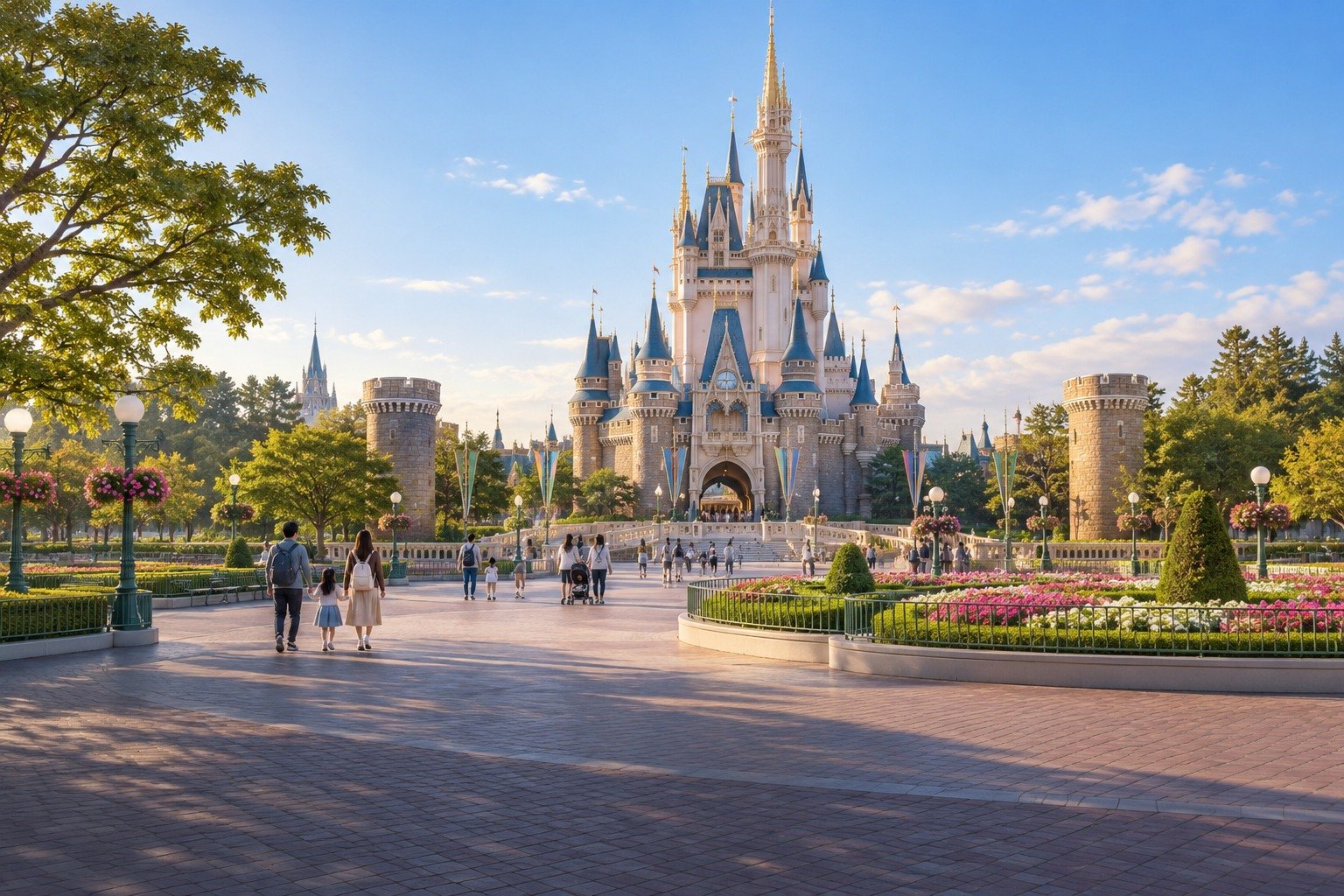
Original AI-created illustration inspired by Tokyo Disneyland; not a documentary photograph.
This Tokyo Disneyland planning guide is for visitors who have one full day and want a plan they can adapt when a queue, a child’s energy or a timed booking changes. It puts the park’s layout to work: fewer unnecessary crossings, deliberate attraction choices and room for the practical parts of a long day.
The route and time model below are original planning estimates based on Disney’s published locations and current rules. They have not been measured on a park visit. Live waits, availability and your party’s pace decide how much fits.
Some links in this guide are affiliate links. Taylor’s Trailblazing Travels may earn a commission if you book or buy through them, at no extra cost to you.
A practical route
Work around the lands
Group nearby attractions and change course for confirmed bookings.
Daily capacity
Protect the essentials
Use the time model to decide what to drop when queues grow.
Ticket choice
Select Disneyland
Check the park, visit date and ticket conditions together.
With children
Build in breaks
Match rides to height, confidence and the pace of the whole group.
Tokyo Disneyland park layout: think in three clusters
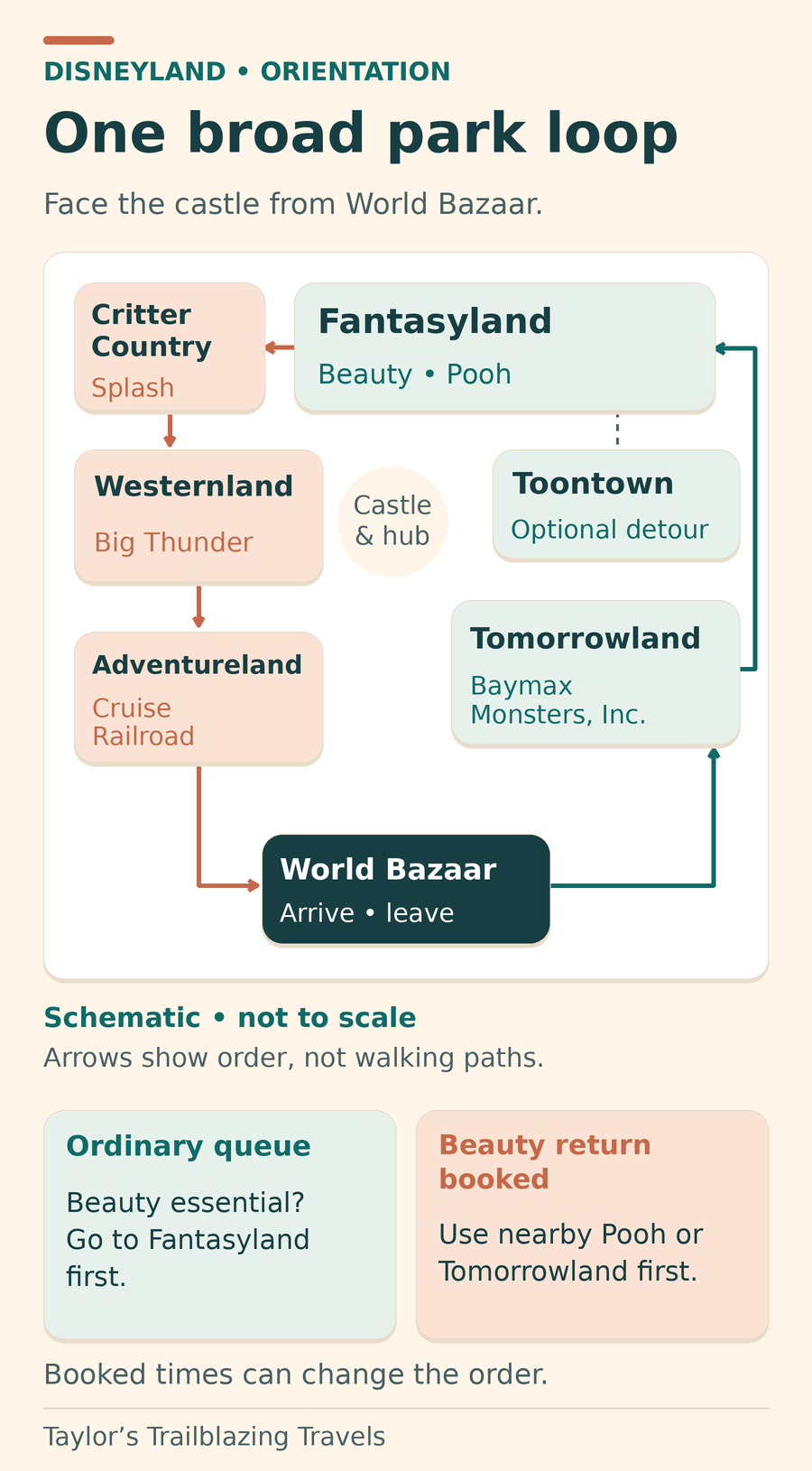
Enter through World Bazaar towards the castle and central hub. Facing into the park, Adventureland and Westernland are on the left, with Critter Country beyond; Fantasyland spreads behind the castle; Toontown and Tomorrowland form the right-hand side. These broad clusters are more useful for a first day than memorising every path. Use the official map for the actual entrances and connections. [1]
Swipe across the table to compare →
| Land | What to use it for |
|---|---|
| World Bazaar | Arrival, orientation and shopping towards departure. |
| Tomorrowland | Baymax, Monsters, Inc. and Star Tours. |
| Toontown | A flexible family detour between nearby bookings. |
| Fantasyland | Beauty and the Beast, Pooh and gentler classics. |
| Critter Country | Splash Mountain, if its drop suits your party. |
| Westernland | Big Thunder Mountain and a change of setting. |
| Adventureland | Jungle Cruise or the railroad before returning towards the hub. |
The attraction groupings follow Disney’s current directory; the recommended uses are this guide’s planning choices. [2]
A one-day route with two possible starts
This route assumes a full-day ticket, an early arrival and a party willing to walk between lands. It prioritises variety across the park over collecting every major ride. The time blocks are editorial allowances, measured from your own entry time; they are not predictions of queues or published opening hours.
Choose the first move before joining a line
If Beauty and the Beast is your essential experience and you will use ordinary queues, make it your first destination. Check the displayed wait before committing. If you secure a paid return for it, use the intervening time for Pooh or a suitable Tomorrowland attraction. Those are alternative starts: trying to complete all three immediately removes the flexibility the route needs.
Once everyone has entered, check any paid return you want and make an Entry Request for a show that matters to you. Reservations cannot include tickets whose holders have not entered yet, even when they share your app group. Move clear of the entrance flow while sorting the bookings. [15]
Swipe across the table to compare →
| Part of the day | Geographic plan | Decision to protect your time |
|---|---|---|
| Before opening | Aim to reach the admission area 45–60 minutes before the posted opening. | This is a planning buffer, not a promised entry time. Allow separately for security and the admission queue. |
| First 90 minutes after entry | Follow your chosen Fantasyland or Tomorrowland start. | Commit to one priority queue; check return windows before adding another. |
| Late morning | Continue through Fantasyland; add Toontown only if useful for your party. | Complete the second anchor if feasible, or substitute a gentler ride. Eat near this part of the park. |
| Early afternoon | Move through Critter Country and Westernland. | Choose Splash or Big Thunder as the thrill stop; make both optional rather than compulsory. |
| Later afternoon | Work towards Adventureland and the central hub. | Allow a rest and the show or parade you have chosen. Its actual time may reverse these two blocks. |
| Evening | Use remaining time near the hub, your final booked ride and World Bazaar. | Set a departure time that fits your train, transfer or children’s energy. |
A fixed show time or paid return can justify one deliberate crossing. Avoid repeatedly chasing a shorter displayed queue on the opposite side of the park: the walk, regrouping and changed queue can consume the apparent saving. At lunch, remove an optional attraction if the morning ran late. Keep the remaining plan coherent instead of carrying every missed ride into the afternoon.
On a narrow screen, swipe the diagram sideways to read the details.
Choose two anchor rides that suit your party
Pick anchors for their experience, not simply because they have the longest queues. Beauty and the Beast plus Pooh makes a story-focused pair; substituting Big Thunder gives more physical thrill. Baymax is a stronger choice for someone who loves its character and lively movement than for someone seeking a long narrative ride.
Swipe across the table to compare →
| Attraction | Why choose it? | Restriction or trade-off |
|---|---|---|
| Enchanted Tale of Beauty and the Beast | Musical scenes experienced in moving, turning teacups; the main story-led anchor. | Riders must sit steadily without support. Darkness, loud sound and spinning matter even without a listed height minimum. [4] |
| Pooh’s Hunny Hunt | Unpredictable hunny-pot movement through the Hundred Acre Wood. | Also requires stable independent sitting; it includes darkness, sound and turning. [5] |
| The Happy Ride with Baymax | A short, energetic ride with swinging and whirling vehicles. | Minimum 81 cm; no riding on an adult’s lap. Its approximately 90-second duration is worth weighing against your queue allowance. [6] |
| Big Thunder Mountain | A runaway mine train with turns and drops. | Minimum 102 cm. Choose it for coaster thrills rather than gentle sightseeing. [7] |
| Splash Mountain | A longer log-flume journey culminating in a substantial drop. | Minimum 90 cm and the restraint must fit. The final drop is 16 metres; the possibility of getting wet changes its appeal on a cold day. [8] |
| Monsters, Inc. Ride & Go Seek! | Search for hidden monsters with a torch while travelling through the scenes. | Stable independent sitting is required; dark areas, loud effects and turning may trouble sensitive riders. [9] |
| Star Tours: The Adventures Continue | A motion-simulator alternative for Star Wars fans in Tomorrowland. | Minimum 102 cm. The motion and 3D effects make it a poor substitute for someone avoiding dizziness. [10] |
For a gentler day, reduce the anchor count to one. Add “it’s a small world”, whose boat ride permits a child on an adult’s lap, then choose nearby activities according to energy. Jungle Cruise and Western River Railroad also permit children on laps under Disney’s published rules. Check the full boarding instructions: a ride without a height minimum is not automatically suitable for every infant. [11] [23]
Book the right ticket and prepare the app
Use a dated Tokyo Disneyland 1-Day Passport for this full-day strategy. As checked on 18 October 2026, the official minimum prices are ¥8,900 for adults aged 18+, ¥7,400 for juniors aged 12–17 and ¥5,300 for children aged 4–11. Children aged three and under enter free. These are starting prices: select your actual date to see its fare and availability. [12]
Check tickets on Tokyo Disney Resort’s official booking site. Standard online sales open at 14:00 Japan time for the same calendar date two months ahead. If that date does not exist in the purchase month, Disney specifies the first day of the following month. Tickets are not sold at the park entrance, and reaching the daily limit can suspend sales. [13]
Before travelling, install the resort app, sign into MyDisney and create a group so one person can select the party’s tickets together. Tickets can be scanned into the group before entry; the group itself does not unlock in-park bookings early. Assign one adult to manage purchases and return times, while making sure another can access the shared plans. [14] [15]
Plan dependable mobile data and enough phone battery for a full day. If your existing roaming is unsuitable, compare data options through Airalo; the link opens Airalo, where you can select Japan and check device compatibility and activation conditions. It is a connectivity option, with no promise that it improves ticket availability. [34]
Understand the current queue and booking services
Swipe across the table to compare →
| Service | What it does | What to do with it |
|---|---|---|
| Disney Premier Access | A paid, timed route into selected attractions or designated entertainment viewing. | Consider one high-value purchase after entry. It is additional to admission and still involves some waiting. [16] |
| Entry Request | A free application for selected entertainment; a successful result is needed when the service applies. | You get one attempt per venue per day. For shows, the published application cut-off is 45 minutes before the performance. A failed request requires a different plan. [18] |
| Standby Pass | Permission to join a designated venue’s queue during a return window. | Check it only where the app requires it. The current eligible list is focused on shops; this is not a replacement free ride-priority scheme. [19] [16] |
| Disney Mobile Order | Order food from participating restaurants and select an arrival window. | Go to the restaurant and tap “I’m Here” at the appropriate time; the food is then prepared. Allow time to collect it. [20] |
| Priority Seating | Advance arrangements at participating table-service restaurants. | Standard advance bookings open at 10:00 Japan time one month ahead. Same-day online requests open at 09:00, subject to availability; a table may still involve a wait. [22] |
Treat a successful show request, meal arrangement or paid attraction time as a fixed appointment in your route. Leave a walking margin between them. None of these systems makes a tight sequence on opposite sides of the park sensible.
Set a queue budget before buying extra access
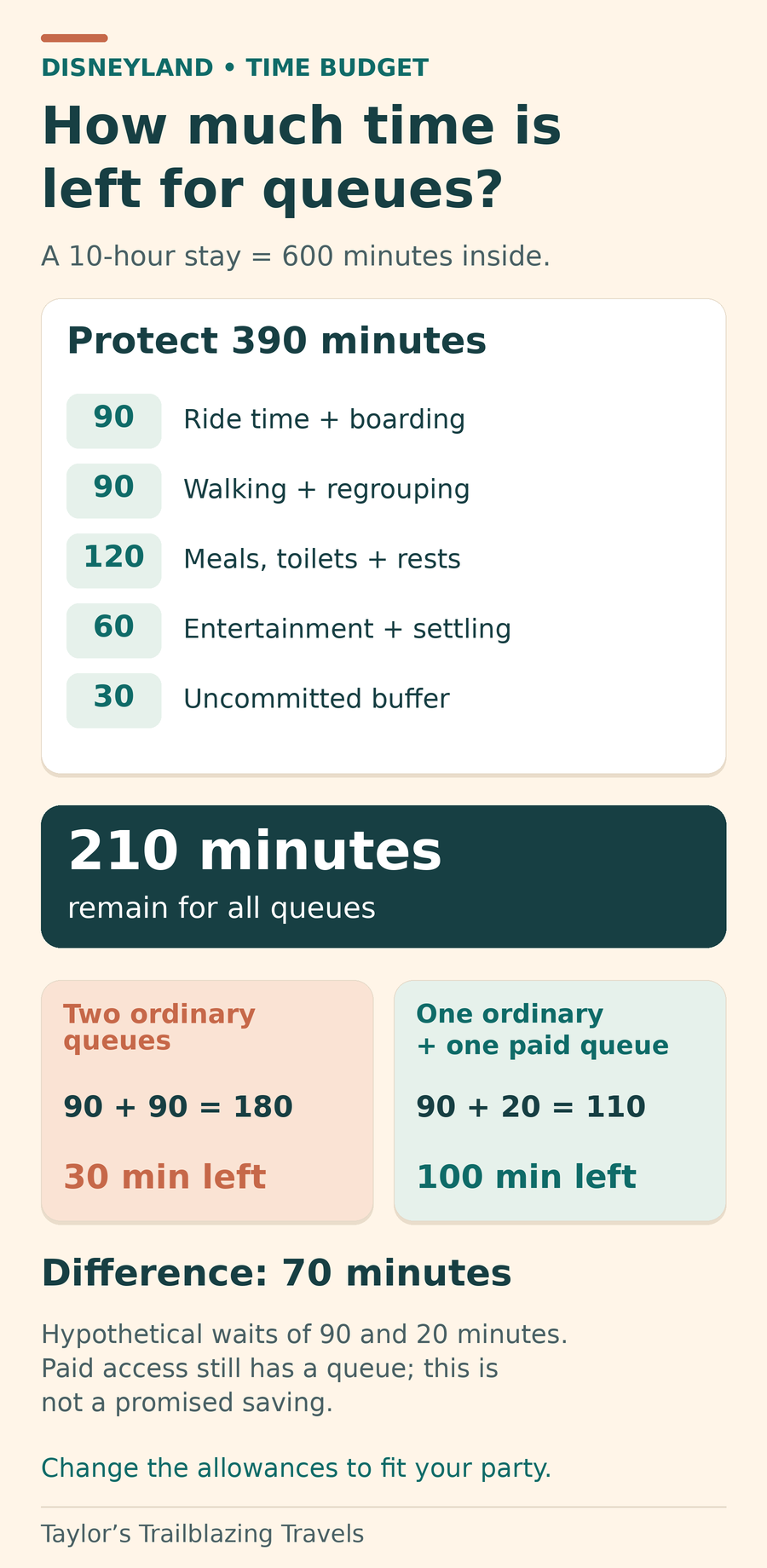
A useful spending decision starts with the day you want to preserve. The following is an illustrative ten-hour stay inside the gates, not a claim about opening hours, average waits or how many rides you will complete.
Swipe across the table to compare →
| Time use | Allowance |
|---|---|
| Ride experiences and boarding, excluding queueing | 90 minutes |
| Walking and regrouping | 90 minutes |
| Meals, toilets and rests | 120 minutes |
| One entertainment choice, including settling in | 60 minutes |
| Uncommitted buffer | 30 minutes |
| Remaining allowance for queues | 210 minutes |
| Total | 600 minutes / 10 hours |
Two hypothetical 90-minute queues use 180 of those 210 minutes, leaving just 30 minutes for every other queue. That is the point to drop an anchor, shorten the entertainment commitment or consider one paid return. Add more rest time for young children and the queue allowance becomes smaller again.
Spend on a bottleneck you actually want to remove
Current attraction Premier Access prices include ¥2,500 for Beauty and the Beast; ¥1,500 each for Baymax, Pooh, Big Thunder and Splash; and ¥1,000 for Monsters, Inc. Prices are per paying guest, per attraction. Four paying guests choosing Beauty therefore add ¥10,000 to the day. Check the live list and available return times before deciding. [17]
Suppose a paid return replaces a 90-minute ordinary queue with 20 minutes in its own access queue: the hypothetical saving is 70 minutes. That could protect lunch and a gentler activity. It is not a predicted saving; paid queues, operational pauses and an inconvenient return window can all reduce the benefit. Ask what your group would actually do with the time, then compare that value with the total party cost.
For different attractions, another purchase is permitted after 60 minutes or when the previous admission time arrives, whichever comes first. A repeat purchase for the same attraction has separate use/time conditions. Attraction and entertainment purchases have separate categories. Tickets are limited; review the selected time carefully because purchases generally cannot be changed or cancelled for personal reasons. [17]
For a low-spend day, choose one essential long queue and let live conditions decide the second anchor. For a family with limited stamina, one useful paid slot can be easier to manage than several timed commitments. Buying every available add-on is unnecessary for this route.
On a narrow screen, swipe the diagram sideways to read the details.
Leave room for meals, rain and a different family pace
Keep lunch in the area you are already visiting
Choose a restaurant that fits the route before adding a cross-park food mission. Mobile Order can organise collection, but it does not reserve a table: you must find seats separately. A booked meal should replace part of the schedule, not sit on top of an already full list. [21]
If rain changes your priorities, favour a nearby indoor experience such as Monsters, Inc. or “it’s a small world”, allowing for its actual wait and your party’s preferences. Indoor attractions can still have exposed queue sections or operational interruptions. Keep a cancelled outdoor entertainment slot flexible rather than building the whole evening around one weather-dependent moment. [9] [11]
Plan around boarding ability and energy
For small children, take the Fantasyland–Toontown portion slowly and consider leaving the two mountains optional. Baby Centers in World Bazaar and Toontown provide feeding and changing facilities; check their current hours, which may differ from park opening. Put a proper rest into the day before anyone reaches exhaustion. [26]
Wheelchair access and boarding requirements vary by attraction. Beauty, Pooh and Monsters, Inc. offer boarding arrangements with additional time, but still require transfer into the ride vehicle. Read the official accessibility guidance before treating a paid slot as usable by everyone in the party. [25]
Disney’s Disability Access Service can allow eligible guests who find queueing difficult to wait elsewhere. Overseas visitors need the relevant disability documentation specified by Disney, and a Cast Member confirms registration. The service does not shorten the wait or waive ride restrictions. Consult the official guidance for the appropriate arrangement before the visit. [24]
Match your journey and hotel to the length of the day
Maihama is the straightforward rail arrival
JR Keiyo and Musashino Line services reach Maihama; Disneyland is about five minutes’ walk from the station. Disney quotes roughly 20 minutes from Tokyo Station on the train, before platform access, waiting and your journey to Tokyo Station. You do not need to ride the resort monorail simply to reach Disneyland from Maihama. [27]
For an airport-to-resort stay, Disney lists indicative bus journeys of 55–60 minutes from Haneda and 65–90 minutes from Narita. Traffic, the departure terminal and the actual stop matter. Treat an international arrival day as a transfer day unless you have deliberately chosen a much shorter park visit. [28]
You can compare bookable route options for Haneda Airport to Tokyo Disneyland on 12Go or Narita Airport to Tokyo Disneyland on 12Go. Select the date, terminal, luggage allowance and exact arrival point before comparing the total with the operator’s own service. These are route searches; availability for your flight has not been checked. [35] [36]
When a ticket-and-transfer package helps
Compare the Disney ticket and shared transfer on GetYourGuide if Asakusa or Shinjuku is a convenient meeting point. Select the Tokyo Disneyland option and the correct one-way or return service. This listing uses shared collection points, not hotel-door pickup. It is non-refundable, and the booking voucher is not the entry ticket: the operator sends the official e-ticket separately before the visit. Confirm collection and return times before committing to the evening route. [29]
Compare Disneyland admission with a private hotel transfer on Viator if avoiding rail changes is worth the extra cost. The current listing covers hotel pickup within Tokyo’s 23 wards, with one-way and return options. Its default return is 20:00; a different time must be requested at least 24 hours ahead. It is listed as unsuitable for wheelchair access. Confirm the final option and cancellation terms. Neither package gives priority access to rides. [30]
Stay near the park when it changes the day you can manage
A resort-area night can make an early start or midday rest more practical; a central Tokyo base can avoid changing hotels for a single park day. Compare the actual door-to-gate journey, including shuttles and walks, rather than the hotel’s straight-line distance.
Search hotels near Tokyo Disneyland on Agoda and compare nearby accommodation on Booking.com. These are landmark searches, not confirmed room offers or a list of hotels with early-entry benefits. [32] [33]
Happy Entry is a separate benefit for eligible Disney hotel stays: qualifying Disneyland admission is generally 15 minutes before other guests, with excluded dates and hotel-specific conditions. It does not apply on check-in day, does apply on check-out day, and requires a separate park ticket. Check Disney’s current eligibility list directly. An ordinary nearby-hotel booking does not establish this benefit or guarantee Premier Access availability. [31]
Useful questions
Can we leave for a hotel rest and return later?
Yes. Tell a Cast Member when leaving that you intend to return, and keep a valid park ticket for re-entry through the admission gates. Allow for both journeys and admission procedures when deciding whether a hotel break is more restful than staying inside the park. [37]
Can this route work with an afternoon or evening ticket?
Only after substantial trimming. Disney offers an After 3 Passport on weekends and holidays and an After 5 Passport on eligible weekdays. For either, choose one compact cluster, one essential experience and a meal; treat entertainment or a second major ride as conditional. Do not expect the full-day sequence or early availability of timed services. Check the ticket calendar for the date’s actual offer. [12]
Make the next planning decision
Before you travel, settle three things: the two experiences your party most wants, the maximum time you are willing to queue and the latest comfortable departure. Buy the correct dated ticket, check closures, then use the app’s actual return times to refine the loop. At lunchtime, make a fresh choice about the afternoon. Removing one optional ride is often the decision that leaves the rest of the day enjoyable.
Sources and checks
Research-led planning guidance, with original itinerary and decision analysis. Sources below were consulted on the dates shown. Recheck operating information, prices, access rules and booking terms for your travel dates.
- Tokyo Disneyland: official park mapChecked 18 October 2026.
- Tokyo Disneyland: attractions and temporary closuresChecked 18 October 2026.
- Tokyo Disney Resort: Tomorrowland 2027Checked 18 October 2026.
- Enchanted Tale of Beauty and the Beast: experience and boarding restrictionsChecked 18 October 2026.
- Pooh’s Hunny Hunt: experience and boarding restrictionsChecked 18 October 2026.
- The Happy Ride with Baymax: experience and boarding restrictionsChecked 18 October 2026.
- Big Thunder Mountain: experience and boarding restrictionsChecked 18 October 2026.
- Splash Mountain: experience and boarding restrictionsChecked 18 October 2026.
- Monsters, Inc. Ride & Go Seek!: experience and boarding restrictionsChecked 18 October 2026.
- Star Tours: The Adventures Continue: experience and boarding restrictionsChecked 18 October 2026.
- “it’s a small world”: experience and boarding restrictionsChecked 18 October 2026.
- Tokyo Disney Resort: current park ticket types and pricesChecked 18 October 2026.
- Official FAQ: when and where park tickets are soldChecked 18 October 2026.
- Tokyo Disney Resort App: creating a groupChecked 18 October 2026.
- Official FAQ: booking experiences for group members who have not enteredChecked 18 October 2026.
- Official FAQ: park experience services and the end of the 40th Anniversary Priority PassChecked 18 October 2026.
- Tokyo Disney Resort: Disney Premier Access, eligible experiences, prices and purchase intervalsChecked 18 October 2026.
- Tokyo Disney Resort: Entry RequestChecked 18 October 2026.
- Tokyo Disney Resort: Standby Pass and current eligible venuesChecked 18 October 2026.
- Tokyo Disney Resort: Disney Mobile OrderChecked 18 October 2026.
- Official FAQ: Mobile Order does not guarantee restaurant seatingChecked 18 October 2026.
- Tokyo Disney Resort: Priority Seating restaurant reservationsChecked 18 October 2026.
- Tokyo Disneyland: guide for guests with young childrenChecked 18 October 2026.
- Tokyo Disney Resort: assistance tools and Disability Access ServiceChecked 18 October 2026.
- Tokyo Disney Resort: wheelchair use and attraction boarding requirementsChecked 18 October 2026.
- Tokyo Disney Resort: Baby CentersChecked 18 October 2026.
- Tokyo Disney Resort: access by trainChecked 18 October 2026.
- Tokyo Disney Resort: access by busChecked 18 October 2026.
- GetYourGuide: Tokyo Disney 1-Day Ticket (Land/Sea) and Shared TransferChecked 18 October 2026.
- Viator: Tokyo Disneyland 1-Day Ticket and Private Hotel TransferChecked 18 October 2026.
- Tokyo Disney Resort: Happy Entry hotel benefits and eligible datesChecked 18 October 2026.
- Agoda: hotels near Tokyo DisneylandChecked 18 October 2026.
- Booking.com: hotels near Tokyo DisneylandChecked 18 October 2026.
- Airalo: Japan eSIM options and compatibility informationChecked 18 October 2026.
- 12Go: Haneda Airport to Tokyo Disneyland route comparisonChecked 18 October 2026.
- 12Go: Narita Airport to Tokyo Disneyland route comparisonChecked 18 October 2026.
- Tokyo Disney Resort: using park tickets and same-day re-entryChecked 18 October 2026.
Illustrations in this article were created for Taylor’s Trailblazing Travels. Third-party photographs, where used, are credited beside the image or in the source list.