Thailand First-Timer Itinerary: North vs South Options

Thailand First-Timer Itinerary: North vs South Options
Choose the ordinary days you will enjoy, not just the best photograph.
The most useful Thailand first-timer itinerary starts with a choice about the holiday you want, not a list of every famous place in the country. Choose the north when you want neighbourhoods, food, temples and a more varied land-based routine. Choose the south when time by the sea is the main reason for travelling, while accepting that the coast, month and transfer arrangements matter as much as the island name.
Neither option needs to exclude Bangkok, and neither region has a monopoly on culture or relaxation. This guide compares two realistic fourteen-day routes, then shows how to simplify them for ten days. The aim is to help you choose the better fit before flights and hotel nights make the decision expensive to change.
The comparison is research-led planning judgement rather than a ranking from personal visits or a claim about what every visitor prefers. Routes are assessed by usable time, transport burden, weather exposure and daily experience. Budget examples are constructed allowances, not measured average spending or a promise that one region will always cost less.
This article contains affiliate links. If you book or buy through them, Taylor’s Trailblazing Travels may earn a commission at no extra cost to you. The route recommendations are based on the planning considerations explained in the guide.
Food, culture and city days
A varied land-based routine with room to slow down.
Beach time comes first
Select the coast and base for your actual month.
Bangkok + one region
More usable days and fewer dependent transfers.
Compare the daily routine
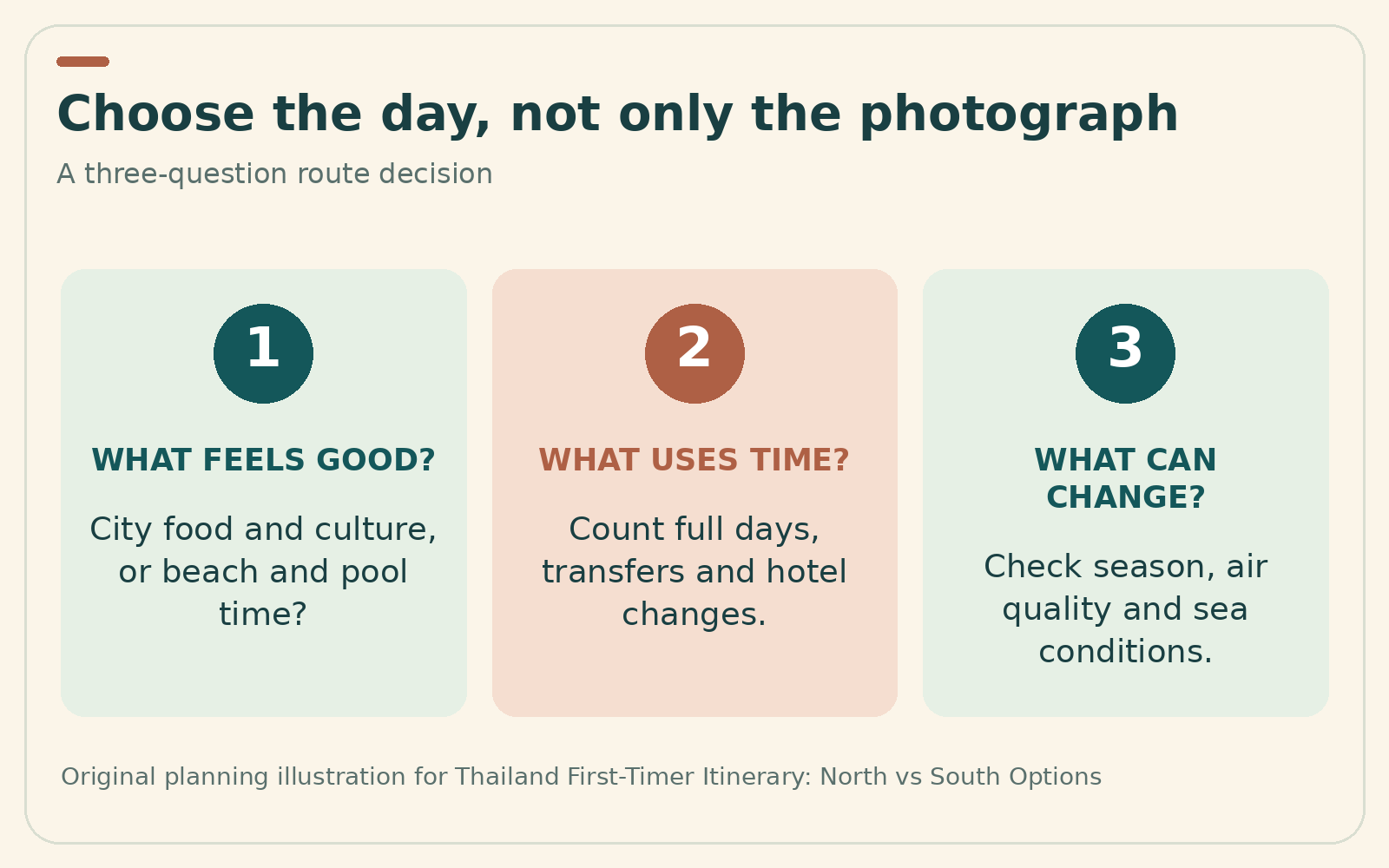
Count full days, hotel moves and the gateway night.
Thailand first-timer itinerary: north or south?
Start with the mornings you would enjoy
Imagine four ordinary mornings, not four promotional photographs. In the north, would you enjoy leaving the hotel for a neighbourhood breakfast, a temple, a museum or a guided outing? In the south, would you prefer breakfast followed by the beach, a pool or a carefully chosen boat trip? The more appealing routine is usually a better guide than the destination with the longest attraction list.
Also consider the least appealing parts. Someone who dislikes sand, boats and repeated sunscreen breaks may not enjoy a beach-led holiday simply because the scenery is beautiful. Equally, a traveller who wants to switch off may find a succession of cultural visits tiring, even when the places are significant.
| Decision | Northern option | Southern option |
|---|---|---|
| Main emphasis | Food, neighbourhoods, temples, museums and land-based outings. | Beach/pool time, coastal scenery and optional marine experiences. |
| Simplest regional base | Chiang Mai, without a compulsory second northern city. | One mainland Krabi base or one suitable island base. |
| Extra-base trade-off | Chiang Rai adds a real intercity journey and hotel stay. | Koh Lanta adds island access and a mainland return buffer. |
| Weather question | Check rain, heat and current northern air quality. | Choose the coast by month; check sea conditions as well as rain. |
| A poor fit when… | Most sightseeing feels like work rather than pleasure. | Sand, boats or weather-dependent swimming are the activities you dislike. |
An editorial comparison of these route designs, not a survey, ranking or claim that every northern or southern holiday feels the same.
Do not confuse the region with one activity
Northern Thailand is not only temples and trekking; a slow city stay can include food, craft and unstructured afternoons. Southern Thailand is not only beach resorts; coastal towns and communities have their own food, history and everyday culture. The difference in this guide is the emphasis of the proposed routes, not a claim that one region lacks the other's qualities. [1] [2]
Choose the option that makes most of your days easy to enjoy. A single must-see attraction can sometimes justify a detour, but it should not force the whole holiday into a region whose ordinary rhythm does not suit you.
The time rule: count nights and protect the gateway
Fourteen days means thirteen nights
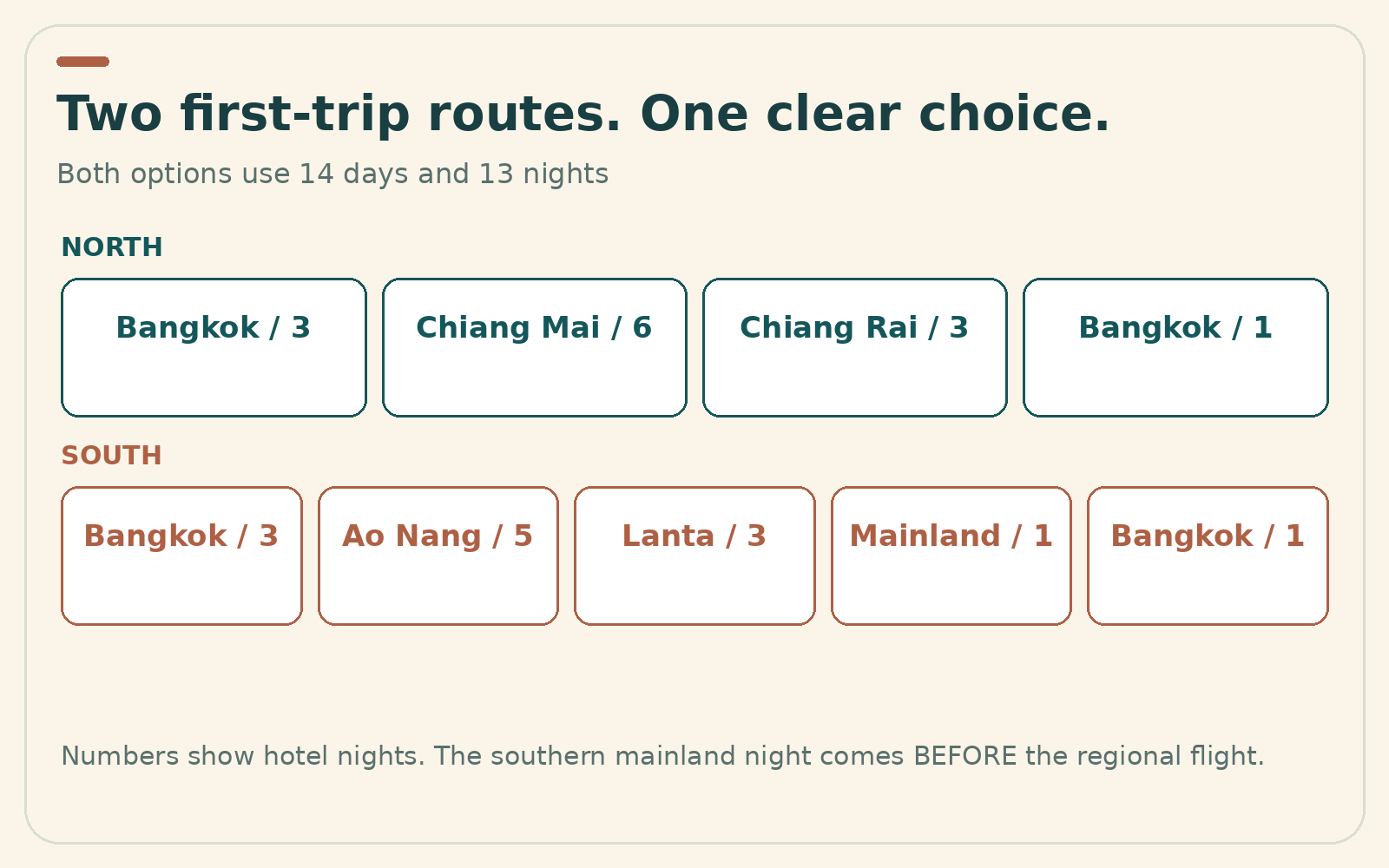
For an arrival on day one and a departure on day fourteen, allocate thirteen nights. The northern plan uses three in Bangkok, six in Chiang Mai, three in Chiang Rai and one final Bangkok night. The southern plan uses three in Bangkok, five in Ao Nang, three on Koh Lanta, one back in Ao Nang and one final Bangkok night.
For the southern version, an extra mainland stay comes before the return flight. That is a genuine hotel move and should not be hidden in the comparison. You can simplify it by remaining around Krabi for all nine coastal nights, or use the longer island version only when its transfers and timing suit you.
| Stage | North option | South option |
|---|---|---|
| Opening Bangkok stay | Days 1-3: 3 nights | Days 1-3: 3 nights |
| Main regional base | Days 4-9: Chiang Mai, 6 nights | Days 4-8: Ao Nang, 5 nights |
| Second regional base | Days 10-12: Chiang Rai, 3 nights | Days 9-11: Koh Lanta, 3 nights |
| Mainland return before flying | Not a separate hotel stop in this route | Day 12: Ao Nang / Krabi mainland, 1 night |
| Final Bangkok night | Day 13: 1 night | Day 13: 1 night |
| International departure | Day 14 | Day 14 |
The southern plan has an additional hotel check-in to separate the island transfer from domestic-flight day. One-base regional alternatives remove that complication.
A buffer is part of the holiday design
The last Bangkok night separates the regional journey from the international departure. It is especially useful when the flights are booked separately or when a ferry or long road transfer precedes the domestic flight. No buffer guarantees against every disruption, but it reduces dependence on several independent services all running exactly to plan.
Do not spend the apparent spare time twice. If day thirteen is needed to return from the region, it is not also a full sightseeing day there. Likewise, a late arrival on day one does not count as a complete Bangkok day simply because the hotel night is booked.
North option, days 1-3: Bangkok as the introduction
Day 1: arrive and keep the first evening local
Choose accommodation with straightforward access to the areas you intend to visit, then leave the evening flexible. A nearby meal and a walk are enough after an international journey. Do not make the success of the first day depend on reaching a paid tour immediately after landing.
The opening Bangkok stay has a practical function as well as a sightseeing one. It gives you time to settle, organise a working phone connection and check the regional transport details. That is preferable to discovering a wrong airport or baggage assumption while rushing to a same-day domestic departure.
Days 2-3: one main area per day
Use one day for a focused old-city or riverside visit and another for a different neighbourhood, food interest or museum. Avoid treating the capital as a list that must be completed before the north begins. A smaller route with time for lunch and rest usually gives a clearer first impression than crossing the city repeatedly.
For a major temple or palace visit, check current access and clothing requirements through the venue. Then leave room for the surroundings rather than adding every nearby landmark. The northern part of the trip will provide further opportunities for cultural visits, so Bangkok does not need to carry the whole historical programme. [3] [4]
Before the third evening ends, confirm the next day's departure airport and hotel transfer. A flight labelled Bangkok-Chiang Mai can involve different Bangkok airports depending on the service. Use the actual ticket rather than assuming the airport you arrived at internationally is also the departure point.
North option, days 4-9: Chiang Mai with breathing room
Day 4: travel, settle and make a short first outing
Fly to Chiang Mai on a service that suits your pace, then keep the arrival day modest. The airport process and hotel transfer make this a travel day even when the flight itself is short. Drop the bags, eat nearby and take a small orientation walk before deciding whether another activity fits.
Choose the accommodation by the streets and activities you expect to use. A room that makes afternoon breaks convenient can improve the whole six-night stay. Check walking distances, road crossings and transport access rather than assuming every property described as central offers the same experience.
Days 5-6: build variety into the city days
Plan one old-city morning with a small selection of temples, followed by a meal and a quieter afternoon. On the next day, choose a different focus: a food walk, a museum or a craft-related visit. The aim is to make the experiences distinguishable, not to find increasingly elaborate versions of yesterday's outing.
A cooking class can be particularly useful when you want more than restaurant visits, but compare the menu and teaching format. Meanwhile, an independent market outing may suit someone who prefers flexibility. Neither requires claiming that every spontaneous encounter is more authentic than an organised activity.
Days 7-8: one excursion, then one flexible day
Choose a single substantial outing rather than several distant stops stitched together. Doi Suthep is one possibility, with road access and an ascent that should be checked for individual mobility needs. TAT provides basic visitor context, but current operation and the complete access route deserve direct confirmation where important. [5]
Keep the following day flexible. Use it for something you missed, a second local interest or simple rest. Six Chiang Mai nights may look generous beside a fast itinerary, but that space is what lets a first-time visitor change plans without sacrificing the next destination.
Day 9: finish the stay rather than starting a new expedition
Use the last full day for a favourite neighbourhood, a practical errand or a modest planned visit. Reconfirm tomorrow's Chiang Rai journey and organise luggage. A distant excursion that returns late adds stress before the next move, particularly when it depends on unfamiliar transport.
This is also a good moment to recognise whether the north's pace suits you. You may enjoy repeated breakfasts in the same area more than another sightseeing circuit. That is useful information for future travel, not evidence that you failed to use the itinerary properly.
North option, days 10-14: Chiang Rai and the return
Day 10: transfer to Chiang Rai
Treat Chiang Mai-Chiang Rai as a proper intercity journey. Current route listings show bus and other transport options, but departure and arrival points vary. Compare the actual terminal, service and hotel connection rather than only the headline travel duration. [6]
Arrive, check in and choose an easy evening. Staying three nights avoids turning Chiang Rai into a very long day trip from Chiang Mai. However, it also creates another hotel stay; travellers who want fewer moves can simply keep all nine northern nights in Chiang Mai and fly back from there.
Days 11-12: select, rather than collect, the sights
Chiang Rai's often-photographed temples and artistic attractions are spread across different locations. Choose a small route and understand what each place represents. Wat Rong Khun, for example, is associated with contemporary artistic creation rather than functioning as an interchangeable substitute for an ancient ruined capital. Read the site's background before treating every elaborate building as the same kind of heritage. [7]
Keep the second day for another interest or a slower outing rather than adding every famous attraction. Agree the route and stops clearly with a driver or guide, including whether shopping visits are optional. Meanwhile, confirm the return flight before letting the last evening become another transport-planning session.
Days 13-14: return to Bangkok, then depart
Fly from Chiang Rai to Bangkok on day thirteen, allowing the night there before the international departure. Check the actual arrival and departure airports when choosing the hotel. A convenient domestic arrival does not guarantee that the next day's international terminal is nearby.
Day fourteen is primarily the departure day. Follow the airline's guidance and use a realistic hotel-to-airport allowance. A late flight may allow a small local outing, but do not create another fragile chain of travel simply because the itinerary includes a buffer.
South option, days 1-3: keep Bangkok, change the emphasis
The opening city stay still has a role
Use the same three-night Bangkok structure, but do not overload it to compensate for choosing beaches afterwards. One main cultural visit, one food-focused area and some unstructured time can provide an enjoyable introduction. The south is not a cultural blank that requires completing every temple in Bangkok first.
Choose comfortable pacing around the arrival flight and the regional departure. The practical tasks remain the same: confirm airports, save hotel details and understand baggage rules. However, packing for a coastal stay may make it particularly tempting to carry too many separate bags; keep the transfer days manageable.
Decide the coast before buying the domestic flights
The main southern example uses Krabi and Koh Lanta on the Andaman side. It is not automatically the best route for every month. Check the seasonal discussion below before fixing the flight to Krabi, and consider a Gulf-based version when that better fits your dates and priorities. [8]
A good-looking airfare is only one part of the decision. The coast needs to support the beach time and activities you actually want, with a level of weather dependence you accept. Otherwise, saving on the domestic flight can lead to a less satisfying holiday overall.
South option, days 4-8: Ao Nang as a practical coastal base
Day 4: fly to Krabi and settle in
Fly to Krabi, transfer to the accommodation and keep the arrival afternoon flexible. Do not book a boat trip to begin shortly after the scheduled landing. Even a punctual flight still leaves baggage collection, the road journey and checking in before you are ready for an outing.
For this version, choose an Ao Nang-area property with the food, transport and beach access that suit you. A more secluded hotel may be attractive, but check whether repeated journeys will be necessary for meals and activities. A practical base is particularly useful on a first visit, when you are still learning local arrangements.
Days 5-6: local beach time and a flexible Railay visit
Begin with a local day, then visit Railay when conditions are suitable. TAT describes Railay's boat access and its different beach areas; this is not an excursion reached by driving along the coast. Ask about the current departure point and return arrangements rather than relying on an old photograph of a ticket booth. [9]
Treat swimming as conditional on the day's flags and local advice. A beach chosen for scenery or convenience is not a guarantee of safe water. A pool, a shaded lunch or a postponed boat trip can be the correct choice without undermining the holiday. [10]
Days 7-8: one optional island trip, one day without a schedule
Compare an organised island outing by the actual boat time, stops, group size, equipment and cancellation terms. More islands in the title do not necessarily mean more usable time at the places that interest you. Choose one well-matched experience instead of automatically booking consecutive full-day tours.
Keep the other day uncommitted. You may want another local beach, a class, a neighbourhood meal or time at the accommodation. Five nights in the opening coastal base allow that choice; constantly moving hotels would remove much of the flexibility you are paying for.
South option, days 9-14: Koh Lanta, mainland, Bangkok
Day 9: transfer to Koh Lanta
Choose a confirmed transfer with clear pickup, luggage and drop-off details. A road-based approach may include a vehicle ferry, while passenger-boat services depend on the route and operating conditions. Read the actual arrangement rather than assuming that every ticket labelled Koh Lanta represents the same journey. [11] [12]
Stay in one beach area for all three nights. The point is a change of atmosphere, not a daily search for a new hotel. Check nearby food, the practical shore access and how additional transport is arranged before selecting a distant property.
Days 10-11: enjoy the island without making boats compulsory
Use one day around the accommodation and the other for an outing only when it interests you and conditions suit it. Marine excursions can be worthwhile, but seasonal access and the operator's safety arrangements matter. A quiet beach holiday does not become incomplete because you stay ashore. [11]
For travellers who dislike boats, need simpler access or prefer fewer moves, replace the Lanta stay with additional Krabi-area nights. This is a stronger adjustment than booking the island and hoping the transfer will somehow feel different on the day.
Days 12-14: separate the island transfer from the flights
Return to Ao Nang or another suitable Krabi mainland base on day twelve. Fly to Bangkok on day thirteen and stay there overnight, then depart internationally on day fourteen. This sequence creates two useful separations: the island move is not on domestic-flight day, and the domestic flight is not on international-departure day.
The price of that resilience is an extra hotel check-in. Travellers who value simplicity above changing scenery can avoid it by choosing one coastal base for all nine nights. The comparison is deliberately honest about this trade-off rather than presenting every southern transfer as effortless.
Weather: the factor that can reverse the decision
The north needs an air-quality check as well as a forecast
A dry-looking forecast is not the complete northern picture. UK health advice discusses air-quality issues, including seasonal pollution in northern Thailand. Check current conditions close to the trip, particularly when the planned days involve long periods outside or someone has a condition affected by poor air quality. [13]
Do not assign a guaranteed smoke-free date from a broad calendar. Instead, keep flexibility where possible and consider how the itinerary would feel with more indoor time. A destination chosen for distant mountain views may be disappointing when visibility is poor, even if it does not rain.
The south is not one weather zone
The Thai Meteorological Department describes differing monsoon effects, with the southern east coast often remaining wetter later in the year. That is why an Andaman choice and a Gulf choice should not be treated as interchangeable bookings with identical seasonal expectations. [8]
For a Gulf-focused first trip, use three Bangkok nights, nine on Koh Samui and one final Bangkok night. This creates a simple one-island version with room for local variety. A second island is optional, not required to make nine nights worthwhile, and any added ferry should earn its place in the route.
Compare what bad weather would actually remove
In the north, heavy rain may disrupt road outings or make outdoor sites less enjoyable, while poor air quality can undermine outdoor plans. On the coast, rough sea conditions can remove swimming or boat excursions even when part of the day is bright. Think about the activities you would lose, not simply the number of forecast rain symbols.
At the 5 October 2026 review, UK travel advice carried a severe-flooding notice. Imminent travellers should check current local warnings, transport operation and insurance conditions. That national notice does not mean every destination in these sample routes is affected in the same way. [14]
Travel effort: which option feels easier?
The north concentrates effort in land journeys and outings
The northern example has a domestic flight in, an intercity move to Chiang Rai and a domestic flight back. After settling into each base, many days can be organised locally. Nevertheless, a mountain excursion or a long multi-stop drive can be tiring; the region is not automatically effortless just because it lacks ferries.
Choose fewer distant outings when motion sickness, limited stamina or a preference for slow mornings matters. Staying longer in Chiang Mai is a legitimate simplification. You can still have a varied northern holiday without treating Chiang Rai or another town as a mandatory box to tick.
The south becomes harder when too many islands are added
A one-base coastal stay can be extremely straightforward. Complexity increases when every scenic place becomes an overnight stop, because each move brings packing, pickup, waiting, a crossing and another check-in. That is a route-design issue, not an unavoidable characteristic of all southern Thailand travel.
For a first visit, choose one coast and no more than two main beach bases unless you actively enjoy moving. Keep the gateway nights visible in the plan. A travel day may leave a pleasant afternoon, but it should not be counted as a full beach day in advance.
The easiest route is often the simplified one
For the north, Bangkok plus Chiang Mai can be enough. For the south, Bangkok plus one Krabi-area base or Koh Samui can be enough. Before adding another location, ask what it supplies that you cannot obtain from the existing base, and whether that difference is worth the actual door-to-door journey.
A simpler itinerary is not a beginner's compromise to be outgrown. It can be the more deliberate choice for experienced travellers as well. The objective is a holiday with days you enjoy, not evidence that you can manage the greatest number of transfers.
Budget comparison without misleading regional averages
Use the same assumptions before comparing totals
A budget room in Chiang Mai and a beachfront resort in Krabi do not measure the inherent cost difference between regions. They measure different accommodation choices. Likewise, a free neighbourhood walk and a private boat outing are different activities. Compare the trip you would genuinely book, while being clear about what changes between the examples.
The illustrative table below assumes two adults sharing, thirteen hotel nights and a mixture of independent time and paid activities. All allowances were prepared on 5 October 2026. They are planning models, not live quotations, and exclude international flights, insurance, shopping and an additional contingency.
| Budget line | North model | South model |
|---|---|---|
| 13 room nights | THB 23,400 (THB 1,800/night) | THB 31,200 (THB 2,400/night) |
| Regional and local transport | THB 14,000 | THB 18,000 |
| Meals and everyday drinks | THB 14,000 | THB 14,000 |
| Selected paid experiences | THB 7,000 | THB 10,000 |
| Total before contingency | THB 58,400 | THB 73,200 |
Constructed planning models, not live prices or measured regional averages. International flights, insurance, shopping and contingency are excluded.
What the example really tells you
The northern model totals THB 58,400 and the southern model THB 73,200 under the stated assumptions, prepared on 5 October 2026. The difference comes from assumed room, transport and activity spending. It is not evidence that every southern holiday costs that much more or that a comfortable north trip cannot exceed both models.
To reduce the coastal total, keep one base, choose fewer paid boat outings and compare properties by practical location rather than resort category. To increase northern comfort, spend on a suitable hotel, a carefully chosen guide or a private transfer where it solves a real problem. In both cases, the spending should follow your priorities.
Solo travellers and families need different arithmetic
A solo traveller should not simply divide the couple's model by two. A private room or vehicle can cost much the same for one passenger as for two. Meanwhile, a family may need a different room configuration, child restraints or separate activity pricing, so a per-person headline can hide the actual booking cost.
Write the budget in units you will purchase: room nights, vehicle journeys, individual tickets and selected experiences. That makes it easier to see which destination changes matter financially. It also prevents a cheap flight from distracting you from a more expensive hotel-and-transfer pattern.
Choosing for couples, families and different interests
Couples with different priorities
Each person should name the three experiences that would make the trip satisfying and one activity they actively dislike. Compare the overlap before selecting the region. A couple who both enjoy food but only one enjoys boats may find the north easier to balance, while a pair who both want long pool afternoons may prefer a coastal base.
Do not use a single compulsory excursion as compensation for a whole holiday that suits only one person. Instead, choose a base with enough independent or low-effort alternatives that both can enjoy the ordinary days. The best compromise is usually in the daily rhythm rather than the number of destinations.
Families: routine can matter more than variety
Ask what makes a day manageable for your particular children: a pool, familiar food, shorter outings, access to shade or a room suitable for early bedtime. Then compare actual properties and journeys. Neither north nor south wins automatically for families because individual ages, interests and needs differ.
A northern stay can offer varied short outings; a coastal stay can offer a simple repetitive routine. However, a long road excursion and a full-day boat trip can both be demanding. Choose fewer headline activities and better everyday arrangements before increasing the number of places visited.
Food, culture and active travel
For a food-led first trip, the north is an easy fit with Bangkok because the regional contrast can be explored without adding a distant southern flight. Nevertheless, Phuket and other southern places have distinct culinary traditions, so a committed food traveller may design a different route around those interests. [1] [2]
For culture, consider what you mean by the word: historical sites, religious life, contemporary art, museums or everyday communities. For active travel, evaluate the actual activity and provider rather than the region's image. A scenic photograph does not establish the suitability, safety or difficulty of a trek, climb or marine excursion.
Four example decisions to make the comparison practical
A couple who want a rest, not an expedition
Suppose both travellers enjoy good food, but their main wish is several quiet days beside a pool and the sea. One dislikes boats. A Bangkok-plus-mainland-Krabi plan is the stronger fit than automatically adding Koh Lanta or a northern circuit. They can take one suitable excursion and leave the rest of the stay simple.
The useful decision is not merely 'south'. It is south with one accessible coastal base, no compulsory marine activities and a room location that supports easy meals and rest. That is a more precise holiday than choosing several islands because their photographs look impressive.
A solo traveller interested in food and everyday city life
For someone who enjoys walking, regional meals and learning how a place works, Bangkok and Chiang Mai can provide a strong first trip without another hotel move. A class or a small guided outing adds social contact, while independent days preserve flexibility. The Chiang Rai extension remains optional.
This traveller should budget for an actual private room or dormitory choice rather than halve a couple's hotel allowance. They should also compare the cost and usefulness of shared activities with private guiding. The northern choice works because of the desired routine, not because solo travel must follow a particular region.
A family with ten days and little enthusiasm for transfers
Use the two-plus-six-plus-one-night structure and choose the regional base after checking the children's needs, the accommodation and the season. The correct answer may be Chiang Mai, Krabi or Samui. What matters is removing the extra transfer that would otherwise consume a large share of the six-night regional stay.
Then select two or three outings, not six consecutive full-day activities. A familiar breakfast place, a suitable pool and reliable rest periods can matter more than a second famous destination. Keeping the gateway night also avoids turning the last day into a test of several independent connections.
A traveller who genuinely wants both culture and beaches
Use the combined thirteen-night example only when the priorities are limited enough to fit: Bangkok, four Chiang Mai nights, one coastal base and the final Bangkok night. Remove Chiang Rai and additional islands rather than squeezing them into the gaps. This is a conscious faster-paced choice, not the relaxed default.
Before booking, mark the arrival and transfer days on a calendar and count the full days left in each region. When that result still contains enough time for the experiences you value, the combination can make sense. Otherwise, choosing one region now is the more useful decision.
Ten-day and seven-day versions
Ten days: keep two main bases
For ten days, use two Bangkok nights, six Chiang Mai nights and a final Bangkok night for the north. For the south, use two Bangkok nights, six nights in one appropriate coastal base and a final Bangkok night. Both allocations total nine nights, and neither requires an extra intercity or inter-island move.
Fly to the region on day three, return on day nine and leave internationally on day ten. Choose local outings from the same base, keeping one or two days flexible. This structure is easier to adapt to a closed attraction, a cancelled activity or simply discovering that you prefer a slower pace.
Seven days: be stricter about the trade-off
With seven days, a two-two-destination ambition can become mostly travel. A workable six-night allocation is two nights in Bangkok, three in one regional base and one final Bangkok night, but it leaves only two full days in the region. Consider whether that is enough for the reason you wanted to go.
Another option is a single-base holiday with a suitable arrival and departure arrangement. A week does not need to imitate a two-week route at double speed. When international travel itself is tiring, reducing domestic moves can provide a more satisfying first experience.
What to cut first
Remove extra bases before removing every rest period. For the north, omit the Chiang Rai stay before compressing Chiang Mai into a single full day. For the south, omit the second island or coastal base before eliminating the final gateway buffer. That preserves the activities and the practical resilience that make the route enjoyable.
Then recheck the actual flights and hotel-night count. Cutting a destination does not automatically make the remaining travel convenient; it changes departure points and available services. Build the revised route from confirmed transport rather than assuming that the old bookings can simply be joined together.
Should a first-timer combine north and south?
Two weeks can accommodate both, but something gives
A three-region trip is possible, especially with flights, but it reduces time in each place and increases dependence on transport. An example is three Bangkok nights, four Chiang Mai nights, five nights in one coastal base and one final Bangkok night. That is thirteen nights, with regional travel on several days rather than a continuous run of sightseeing or beach time.
Choose that version when both regions contain a genuine priority and you accept the faster pace. Do not add Chiang Rai, multiple islands or another historical stop on top and still describe it as relaxed. The space has already been used by the north-south combination.
Ask what you are unwilling to remove
If the important experiences are a cooking class, a few city walks and several beach afternoons, a combination may work. If you also want detailed historical visits, long excursions and multiple islands, fourteen days is likely to force unpleasant choices. Name the priorities before buying the flights that turn those choices into penalties.
For most undecided first-timers, Bangkok plus one region is the clearer default. You get enough time to learn whether you enjoy the pace and enough flexibility to change an outing. A first trip need not prove that you have seen Thailand comprehensively.
Booking the chosen route in a sensible order
Set the gateway, then the regional framework
Avoid booking a non-refundable hotel around an assumed flight that you have not found. Similarly, do not reserve a remote island property before confirming how you will reach it on the arrival day. A good route is built from connections that exist, not from the straight lines a map makes tempting.
Keep the optional experiences flexible
Book a guide or class when its availability is central to the holiday, but do not prepay every ordinary day. On the coast, weather-sensitive outings deserve particular attention to cancellation and alternative-route terms. In the north, leave room to respond to air quality, heat and how much outdoor time you enjoy.
Save tickets, addresses and key contacts offline before moving between bases. A working mobile connection is useful, but it should not be the only place essential travel information exists. Check device compatibility before buying an eSIM, and compare the data allowance and validity with the trip rather than simply choosing the largest package.
Pros and cons of each first-trip option
Northern route: the strengths and limitations
The north supports a varied land-based holiday with substantial time in each city. Food, cultural visits and short local outings can be mixed with quiet afternoons, and the simplified version requires only one regional base. However, longer road excursions still take effort, and air quality or heavy rain can affect outdoor plans.
Choose it because the ordinary days appeal to you, not because you believe a beach holiday would be less meaningful. A traveller who wants little sightseeing may not enjoy a cultural route merely because it looks more educational on paper.
Southern route: the strengths and limitations
The south can provide a straightforward beach-and-pool rhythm, especially with one base. Coastal scenery and selected marine experiences add variety, while the main route protects the flights with mainland and gateway nights. However, sea conditions, island access and repeated hotel moves become significant when the itinerary expands.
Choose it with realistic expectations about weather and swimming. A paid beachfront room does not guarantee suitable sea conditions, and an island tour is not compulsory. The simpler coastal version may be the best one for someone who primarily wants to relax.
Common mistakes when choosing north versus south
Choosing from photographs alone
Photographs show an attractive moment, not the daily transport, weather or routine. Read the itinerary as a series of mornings and afternoons, including the transfers. Then ask whether you would enjoy the ordinary day when the famous viewpoint or boat trip is unavailable.
Treating every day as fully usable
International arrivals, regional flights and hotel changes consume time beyond the advertised journey duration. Count the nights, mark the travel days and identify the genuine full days in each base. This often changes which route looks best before any money is spent.
Trying to insure the decision by choosing everything
Adding both regions can feel like avoiding a difficult choice, but it introduces another trade-off: less time everywhere. Make that choice consciously rather than describing a busy route as the best of all worlds. A holiday can be successful precisely because you left something for another visit.
Frequently asked questions
Which region is better for a very first Thailand trip?
Neither is universally better. The north fits a food, culture and land-based exploration emphasis; the south fits a beach-led holiday. For an undecided traveller, compare the daily routines, month and transport demands rather than choosing the region with the most famous single attraction.
Is northern Thailand always cheaper?
No. Costs depend on rooms, transport, guiding and activities. The illustrative budget in this guide uses different assumptions for the two routes and should not be read as a measured regional price gap. A private-guided northern trip can cost more than a simple one-base coastal stay.
Should I skip Bangkok to gain more regional time?
That can make sense when the flight arrangements support it and the regional stay is the clear priority. However, do not remove a necessary gateway buffer simply to improve the night count on paper. Check the actual arrival airport, onward ticket protection and departure timing before redesigning the route.
Can I see Chiang Rai from Chiang Mai without changing hotels?
An organised day trip may be offered, but it creates a long travel day and a limited visit. The main northern route instead stays three nights in Chiang Rai. Travellers who dislike another hotel move should consider omitting it rather than assuming a long round trip is automatically easier.
Is southern Thailand suitable for someone who dislikes boats?
Yes, with a mainland coastal base and shore-based activities. The Krabi option can be simplified to avoid the Lanta stay and optional marine excursions. Check the access arrangements for the actual hotel; a destination being near the mainland does not prove it can be reached entirely by road.
Which is better during a northern haze period?
A coastal alternative may better suit a trip built around outdoor time, but choose the coast according to the date and current conditions. Do not replace one weather assumption with another. Review air quality, forecasts and transport notices before committing to a revised route.
Are two weeks enough to do Bangkok, north and south?
Yes, as a faster three-region itinerary with fewer nights and fewer extra bases in each region. The example here uses three Bangkok nights, four Chiang Mai nights, five coastal nights and one final Bangkok night. It is a different pace from the main north-only or south-only regional options.
What is the simplest ten-day choice?
Use two Bangkok nights, six nights in one regional base and a final Bangkok night. Choose Chiang Mai for the northern version or a suitable coastal base for the southern version. This keeps the nine-night count clear and removes an extra intercity or island transfer.
How should I choose when travelling with another person?
Compare the experiences each person values and the activities each actively dislikes. Choose a daily rhythm with enough overlap, then add a few individual interests. A single compensating excursion rarely fixes an entire holiday whose ordinary routine suits only one traveller.
Is a final Bangkok night really necessary?
It is a sensible default when a regional flight is separate from the international ticket, especially after island or long road travel. The need depends on the actual ticket protection and timings, but this guide includes the night rather than assuming a tight same-day connection will work. Retain a realistic margin when revising the route.
Final recommendation: choose the holiday, then the region
Choose the north when the idea of varied city days, regional food and cultural visits is what makes you excited to travel. Choose the south when the main pleasure is time beside the sea, with excursions as optional additions rather than the daily purpose.
Then keep the route coherent: Bangkok plus one region, enough full days in the main base and a clear departure buffer. A first Thailand trip does not need to contain everything. It needs to contain enough of the right things, arranged in a way that lets you enjoy them.
Sources and fact-checking notes
- TAT: Discover Thai Cuisine through its famous four regionsRegional food context; not a current restaurant menu or an exhaustive classification. Reviewed 5 October 2026.
- UNESCO Creative Cities Network: PhuketPhuket's gastronomy designation and local culinary context. Reviewed 5 October 2026.
- The Grand Palace: practical informationOfficial foreign-visitor admission, inclusions and clothing restrictions. Reviewed 5 October 2026.
- Wat Pho: visit planPublished admission and temple etiquette. Reviewed 5 October 2026.
- TAT: Wat Phra That Doi SuthepTemple location and approaches. Confirm present access arrangements directly. Reviewed 5 October 2026.
- 12Go: Chiang Mai-Chiang Rai transport listingsIntercity service and terminal comparison. Reviewed 5 October 2026.
- TAT: ancient and modern Lanna in Chiang RaiContemporary artistic context for Wat Rong Khun. Old transport distances and schedules are not reused. Reviewed 5 October 2026.
- Thai Meteorological Department: seasons of ThailandBroad monsoon and seasonal context, not a forecast for an individual holiday. Reviewed 5 October 2026.
- TAT: Railay BeachBoat access and the different waterfront areas. Current sea conditions determine suitability. Reviewed 5 October 2026.
- FCDO: Thailand safety and securityRoad, sea and general safety context. Reviewed 5 October 2026.
- TAT: Koh Lanta destination guideIsland setting, vehicle-ferry access and typical marine-area seasonal closures. Reviewed 5 October 2026.
- 12Go: Krabi-Koh Lanta transport listingsRoute and transport-type comparison; door-to-door allowances in this guide are editorial buffers. Reviewed 5 October 2026.
- FCDO: Thailand health guidanceTravel-health preparation and environmental health considerations. Reviewed 5 October 2026.
- UK Foreign, Commonwealth & Development Office: Thailand travel adviceCurrent travel notices, including the flooding notice visible at editorial review. Recheck before travel. Reviewed 5 October 2026.
Illustrations in this article were created for Taylor’s Trailblazing Travels. Third-party photographs, where used, are credited beside the image or in the source list.