Chiang Mai to Sukhothai: Bus, Train or Private Transfer?
A practical comparison of the direct coach, the railway connection through Phitsanulok and door-to-door private transport.
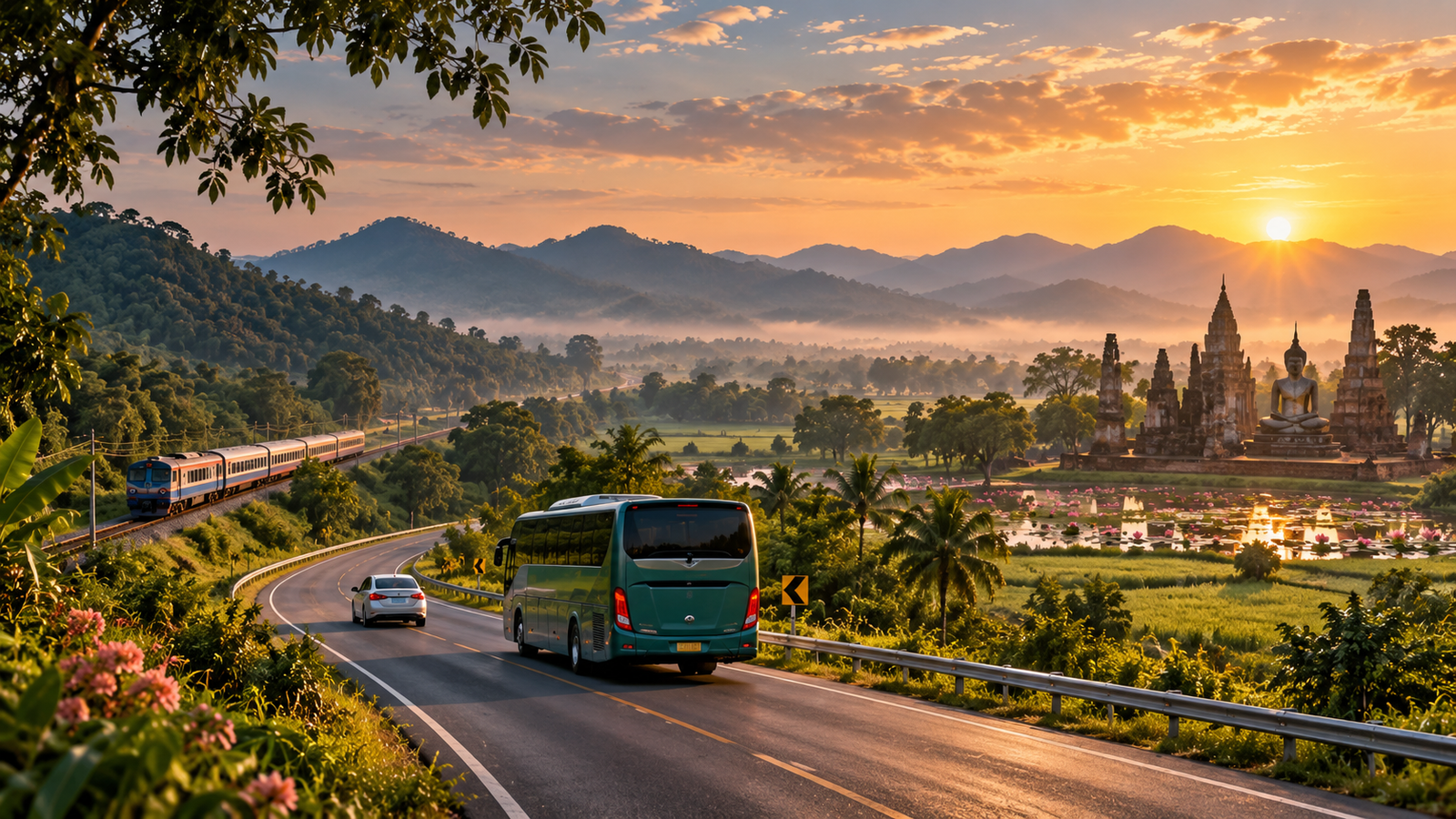
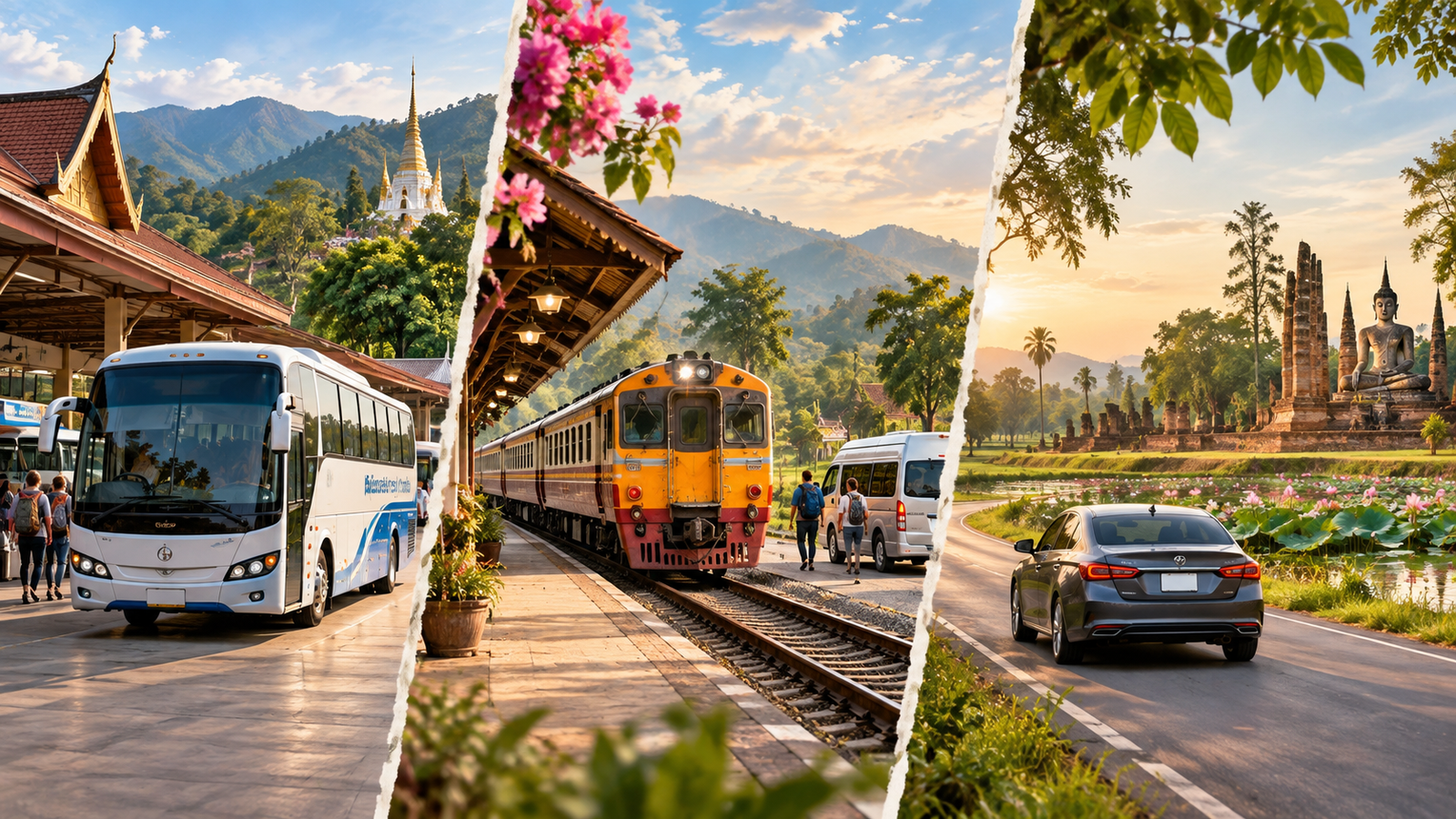
Chiang Mai to Sukhothai is one of those journeys where the simplest-looking line on a map hides three very different travel days. A direct coach follows the road south through Lampang and Tak before turning towards Sukhothai. By contrast, the train feels more relaxed and scenic, yet it cannot take you to Sukhothai itself because the province’s main visitor area has no railway station. Private transport removes the terminal changes, although the price only becomes attractive when several people share it.
For most independent travellers, the direct bus is the practical default. Current Thai booking inventory reviewed on 17 September 2026 showed several daily departures from Chiang Mai Arcade, journey times of roughly five to five hours forty minutes and example fares of ฿340–389 per seat. The train alternative usually needs eight to ten hours once the Phitsanulok transfer is included, while a private vehicle commonly takes around four to five hours door to door.
This guide compares the choices by total travel time, dated cost examples, luggage handling, arrival point and missed-connection risk. Schedules and commercial prices were checked on 17 September 2026; the ticket or written vehicle confirmation issued for your date remains the final authority.
Direct morning bus
One vehicle, clear journey and the lowest transparent cost for most solo travellers and couples.
Train via Phitsanulok
Choose it for railway scenery or an overnight stop, not because it is the quickest route.
Private car or van
Hotel pickup and a direct drop remove terminal transfers and make sense for a group.
Sukhothai has no station
Every rail itinerary ends with a bus, van or taxi from Phitsanulok.
The comparison is ordered by how directly each option solves the journey rather than by a universal “winner”. Planning times include the parts travellers often forget: getting to the departure point, the Phitsanulok change and the final transfer to the chosen Sukhothai area.
| Option | Planning time | Planning cost | Best for | Main trade-off |
|---|---|---|---|---|
| Direct bus | About 5–6h terminal to terminal | About ฿340–389 per seat | Most solo travellers and couples | Fixed departure and possible stop pattern |
| Train via Phitsanulok | About 8–10h including the road connection | About ฿250–650 plus local transfers | Rail enthusiasts and travellers adding Phitsanulok | No train reaches Sukhothai |
| Private car or van | About 4–5h door to door before optional stops | Roughly ฿3,100–6,300 per vehicle; premium quotes can be higher | Families, groups, heavy luggage and tight timing | Highest total price |
| Self-drive rental car | About 5–7h with rest or sightseeing stops | Rental, fuel, insurance and possible one-way fee | Experienced licensed drivers building a road trip | Driving workload and one-way logistics |
Planning examples checked 17 September 2026. Prices and schedules change by date, operator, class, vehicle and booking channel.
The road route is direct; the railway is not
By road, Chiang Mai and Sukhothai are roughly 290–300 kilometres apart. Coaches and cars travel south from Chiang Mai through the Lampang corridor, continue towards Tak and then approach Sukhothai from the west. The exact road and intermediate stops vary, but the result is a coherent same-vehicle journey of roughly five hours before traffic and breaks. Current route inventory listed 297 kilometres for the direct coach. [2]
The Northern Line railway runs from Chiang Mai to Phitsanulok, not to Sukhothai. Phitsanulok is around 60–65 kilometres from Sukhothai by road, so the train creates a second journey rather than replacing the bus. That extra leg is the central fact behind the comparison. [4] [7]
Old Sukhothai and new Sukhothai are different arrival targets
New Sukhothai is the modern town and contains the main long-distance bus terminal. The historical-park area, often called Old Sukhothai, lies roughly 12 kilometres west. A traveller staying beside the ruins may therefore save time by booking a service that explicitly lists the historical park as a stop, whereas somebody staying in the new town should normally use the main terminal.
Current departure examples
Thai booking inventory reviewed on 17 September 2026 showed six direct departures from Chiang Mai Bus Terminal 2 at Arcade: 08:45, 09:30, 11:00, 12:50, 15:00 and 19:00. The listed operators were Sukhothai Thani (Wintour) and Esarn Tour, with journey examples between five hours and five hours forty minutes. Example fares were ฿340–389 per seat at the same check. [1] [2]
| Example departure | Example arrival | Listed duration | Example fare | Planning comment |
|---|---|---|---|---|
| 08:45 | 14:25 | 5h 40m | ฿389 | Strong all-round choice with a daylight arrival |
| 09:30 | 14:30 | 5h | ฿340 | Useful early option; verify the precise Sukhothai stop |
| 11:00 | 16:30 | 5h 30m | ฿367 | Comfortable hotel check-in timing |
| 12:50 | 18:30 | 5h 40m | ฿389 | Arrival approaches evening, especially in wet weather |
| 15:00 | 20:40 | 5h 40m | ฿389 | After-dark arrival; arrange the final transfer |
| 19:00 | 00:00 next day | 5h | ฿340 | Usually poor for a first visit unless accommodation confirms late check-in |
Dated schedule and fare examples checked 17 September 2026; use the issued ticket for the operating terminal, bay, stop pattern and final time.
Where the bus leaves
The current Thai route inventory names Chiang Mai Bus Terminal 2 at the Arcade complex. Several booking platforms label neighbouring buildings differently, and the complex can feel like one large terminal to a first-time visitor. Arrive at least 30 minutes early, show the ticket to the operator counter and confirm the vehicle, bay and luggage procedure rather than following a generic map pin.
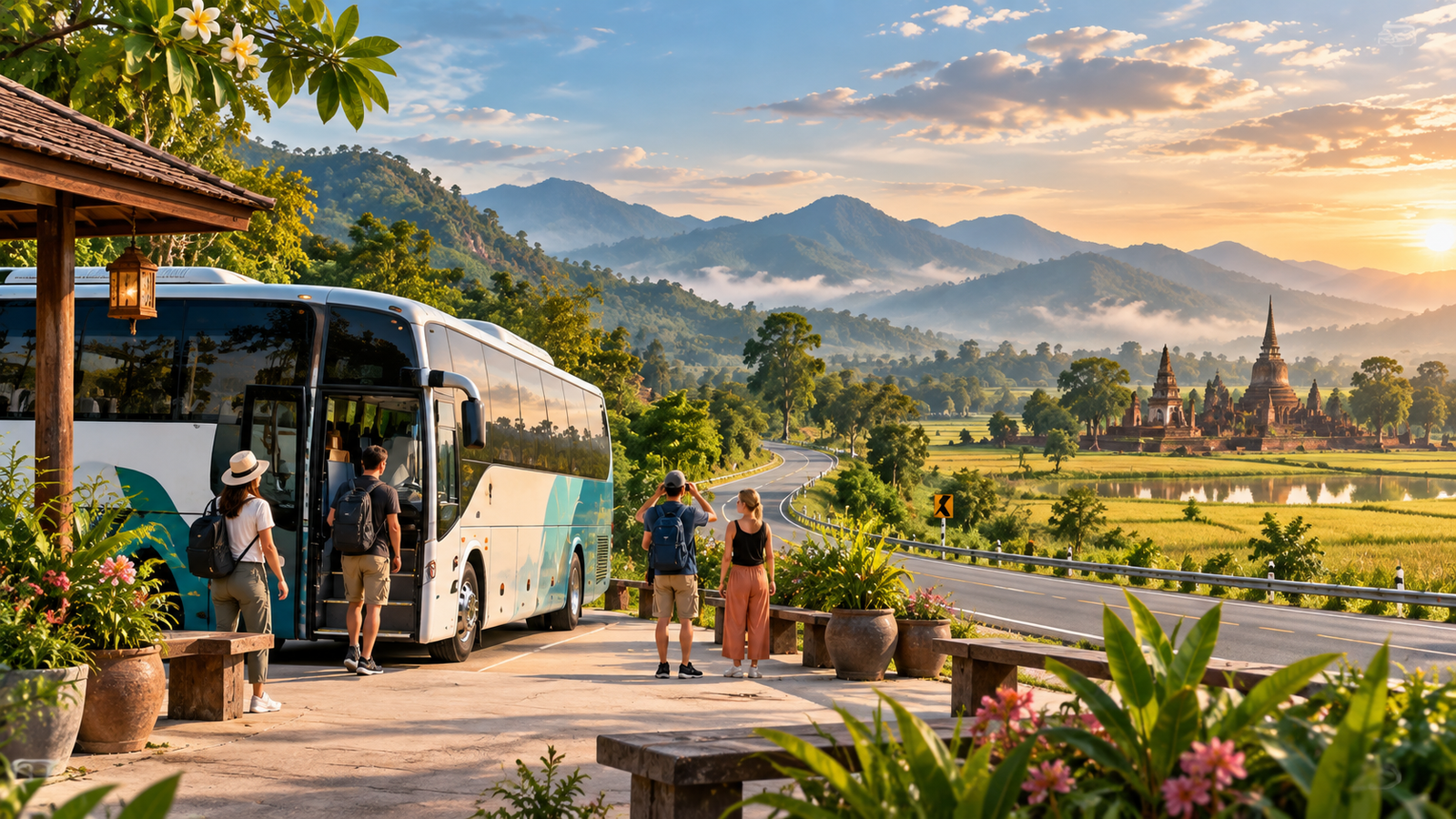
The direct bus wins on logistics, but “direct” does not mean nonstop. Coaches may call at Lamphun, Lampang, Tak, Lan Hoi or other intermediate points, and a longer service may include comfort or meal breaks. The exact sequence varies by operator and departure.
Comfort and onboard expectations
Most services sold on this corridor are air-conditioned intercity coaches rather than small commuter vans. Seat pitch, suspension, toilet availability and USB power vary by vehicle. Air-conditioning can feel cold, while the rear rows often receive more road movement. A light layer, water and an offline copy of the ticket solve more problems than carrying extra gadgets.
Luggage and valuable items
Large cases normally travel in the luggage hold. Keep passports, medicines, electronics, power banks and anything irreplaceable with you. Photograph the suitcase before loading, make the name tag easy to read and watch which compartment is used at intermediate stops. A daypack that fits at the seat is more useful than a rigid second cabin case.
This practical list is grouped by the points most likely to prevent a minor bus delay becoming a larger arrival problem.
- Arrive with the operator name, departure time and destination written in both English and Thai where possible.
- Use the toilet before boarding even when a rest stop is expected.
- Carry a small amount of cash for station food, local transport and unexpected changes.
- Keep the first evening flexible in case the coach runs late.
Main bus terminal in new Sukhothai
The main terminal is useful for hotels in the modern town, onward provincial buses and travellers who have arranged a pickup. It is not beside the central ruins. When the hotel is near the historical park, allow another road transfer and confirm the price before leaving the terminal.
Historical-park stop
Current route inventory showed that some services call at stops labelled Sukhothai Historical Park before reaching the main terminal. That can remove the 12-kilometre backtrack for an Old Sukhothai hotel, but it is not safe to assume every coach stops there. The destination printed on the ticket controls the journey. [2]
Hotel door or private address
A private transfer can deliver directly to a hotel in the new town, a property near the park or another agreed address. Shared booking products that advertise a hotel transfer should be checked carefully for pickup zones, excluded roads and the possibility of a meeting-point handover.
| Arrival label | Best for | What to confirm before travel |
|---|---|---|
| Sukhothai Bus Terminal | New-town hotels and onward buses | Hotel transfer, arrival after dark and exact terminal location |
| Sukhothai Historical Park / Old Town | Hotels near the ruins | That the booked departure really serves the named stop |
| Hotel transfer | Families, groups and awkward luggage | Address, vehicle capacity, waiting policy and contact method |
Arrival labels vary across booking systems. Save the complete voucher and hotel address offline.
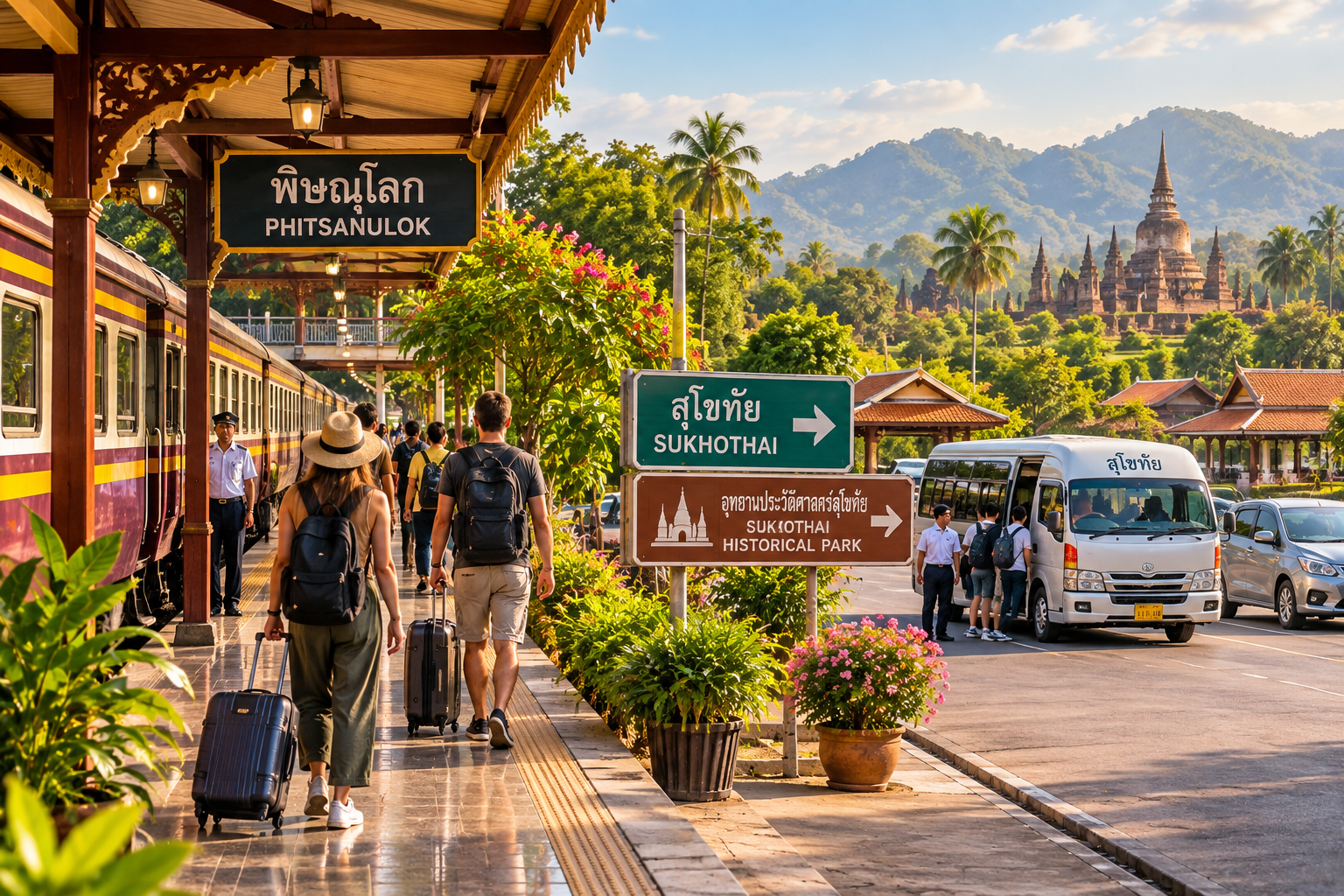
There is no direct Chiang Mai to Sukhothai train. The workable rail plan is Chiang Mai to Phitsanulok, followed by a bus, van or taxi to Sukhothai. It can be enjoyable, but it is a route choice rather than a shortcut.
Useful daytime trains
Current timetable cross-checks showed five daily Chiang Mai–Phitsanulok trains. For a same-day public-transport connection, the two useful morning examples were Rapid 102 at about 06:25, arriving around 13:40, and Special Express 8 at 07:30, arriving at 13:16. Train 8’s published station timetable lists the Chiang Mai departure and Phitsanulok arrival explicitly. [4] [5]
| Train example | Chiang Mai | Phitsanulok | Rail time | Planning fare |
|---|---|---|---|---|
| Rapid 102 | 06:25 | 13:40 | 7h 15m | From about ฿175 |
| Special Express 8 | 07:30 | 13:16 | 5h 46m | About ฿390–450 for 2nd-class AC |
| Express 52 | 15:30 | 23:01 | 7h 31m | From about ฿215 |
| Special Express 14 | 17:05 | 23:59 | 6h 54m | From about ฿255 |
| Special Express 10 | 18:20 | 00:59 next day | 6h 39m | Premium sleeper classes can cost much more |
Example times and fares checked 17 September 2026. Later trains are poor same-day choices because onward public transport is limited after late arrival.
Why anybody would still choose it
The train gives more space to stand, a different view of northern Thailand and a calmer rhythm than an intercity coach. It is strongest when Phitsanulok is an intended overnight stop, when the railway journey is part of the holiday or when a traveller dislikes long coach rides but is comfortable handling a connection.
Train station to onward transport
Phitsanulok Railway Station is in the city, while onward buses may use a bus terminal or a separate operator point. Do not assume the final bus waits outside the railway entrance. Allow time to identify the correct departure location, move luggage and buy or collect the second ticket.
Bus, van or taxi to Sukhothai
Current cross-checks put the Phitsanulok–Sukhothai bus journey at roughly one to one and a half hours, with example fares around ฿60–160. Frequency and the final Sukhothai stop vary, so a same-day rail plan should be built around a confirmed onward departure rather than a general “buses are frequent” assumption. [7]
| Connection style | Likely total after train | Advantages | Main risk |
|---|---|---|---|
| Local/intercity bus | About 2–3h including movement and waiting | Lowest cost | Departure point and late-afternoon frequency |
| Pre-booked taxi | About 1–1½h road time | Direct to hotel or park | Higher cost and driver meeting details |
| Overnight in Phitsanulok | Travel onward next morning | Low stress and adds another city | Uses an extra hotel night |
Planning ranges checked 17 September 2026; confirm the second leg before committing to a non-refundable train.
What the price buys
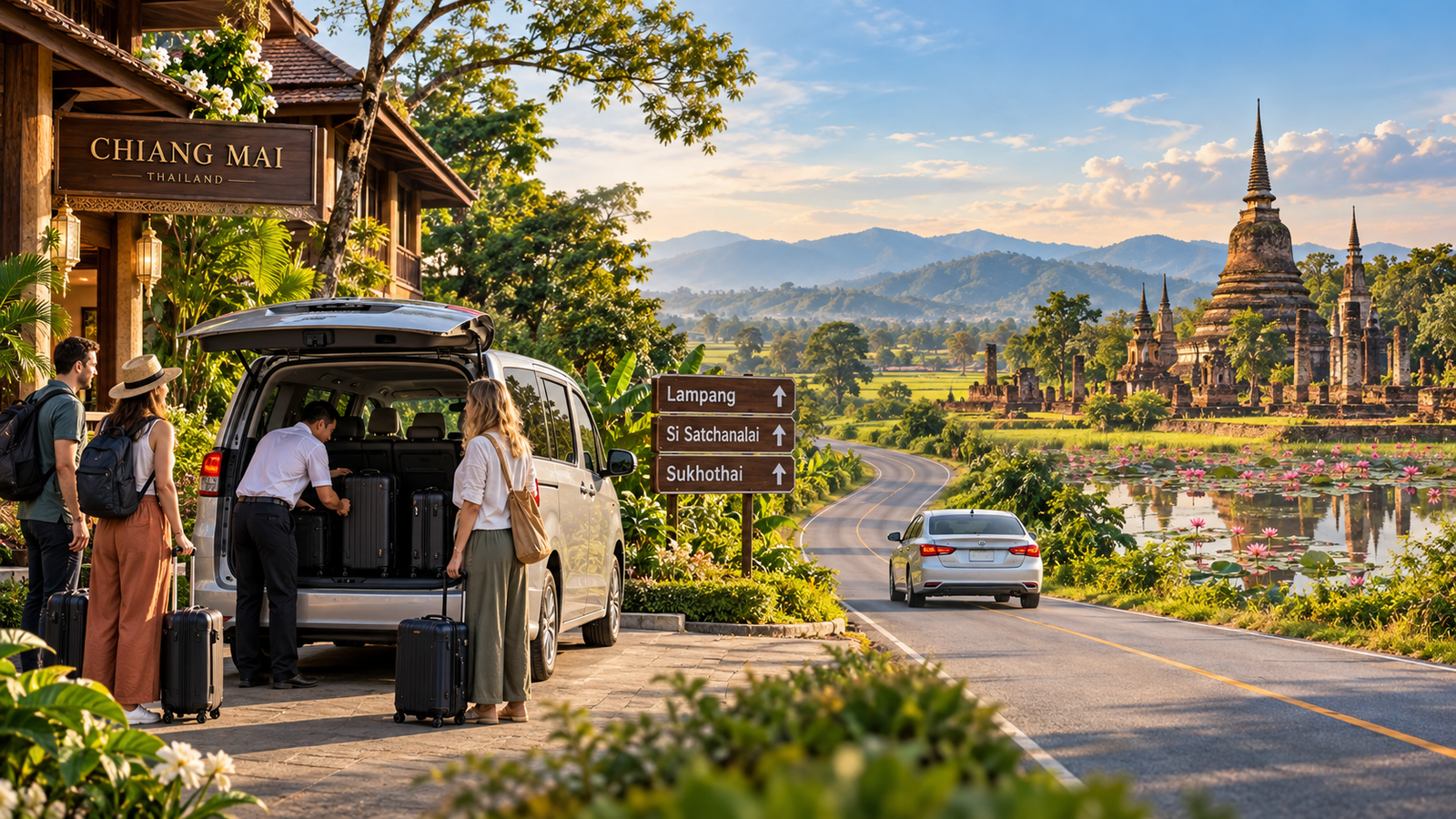
Live commercial examples checked on 17 September 2026 placed ordinary private cars and SUVs at roughly ฿3,100–4,500 per vehicle, with vans and premium vehicles commonly around ฿4,500–6,300 or more. A specialist premium provider listed ฿8,500 for this route. The wide range reflects vehicle type, pickup zone, luggage, inclusions and operator positioning rather than a single regulated fare. [3]
A sensible quote should state the vehicle class, passenger and luggage capacity, pickup address, drop-off address, planned duration, included stops, child-seat arrangement, waiting time, tolls or parking, cancellation terms and emergency contact. A low headline price is not a bargain when it assumes a tiny boot or excludes the historical-park area.
When the arithmetic works
For one traveller, a private car can cost ten times a bus seat. For four people, the per-person gap narrows sharply, while the group also avoids two taxis, terminal waiting and luggage handling. Families, travellers with mobility needs and groups carrying several cases gain more practical value than a solo backpacker.
| Group size | Example vehicle total | Approximate split | Planning judgement |
|---|---|---|---|
| 1 person | ฿3,100–4,500 | Same as total | Convenience purchase, not value travel |
| 2 people | ฿3,100–4,500 | About ฿1,550–2,250 each | Useful for comfort or time pressure |
| 4 people | ฿3,800–5,500 | About ฿950–1,375 each | Often a reasonable upgrade |
| 6–9 people | ฿4,500–6,300+ | About ฿500–1,050 each | Strongest value when the van genuinely fits luggage |
Illustrative group arithmetic using vehicle ranges checked 17 September 2026; obtain a live quote for the actual date and luggage load.
The headline fare is only one component. The fairest comparison includes transport to the departure point, food, terminal-to-hotel travel, the value of a lost sightseeing day and the risk created by separate tickets.
| Cost component | Direct bus | Train via Phitsanulok | Private transfer |
|---|---|---|---|
| Main transport | ฿340–389 per person | Roughly ฿175–450 train + ฿60–160 onward bus | Roughly ฿3,100–6,300+ per vehicle |
| City transfer at start | Old City to Arcade | Hotel to Chiang Mai station | Usually included within pickup zone |
| Connection cost | None if the bus is direct | Station movement and possible taxi | None |
| Sukhothai last kilometre | May be needed from main terminal | Needed unless onward vehicle goes to hotel | Usually included |
| Time exposed to waiting | Low | High | Low |
| Missed-connection risk | Low | Traveller carries the risk | Low after driver confirmation |
Price components are planning examples checked 17 September 2026, not guaranteed quotes.
An example for two travellers
At the 17 September 2026 check, two direct bus seats cost roughly ฿680–778 before local taxis. A private car at ฿3,100–4,500 costs several times more, but the difference buys hotel pickup, a direct drop and roughly one to two hours of saved door-to-door time. The train can appear cheap in third class, yet two local transfers and the final bus can erase part of the saving.
Direct bus booking
These steps are ordered in the sequence that prevents the most common ticketing errors.
- Search Chiang Mai to the exact Sukhothai destination needed: main terminal or historical park.
- Compare operator, departure building, stop pattern, arrival time and refund terms before comparing price.
- Check the passenger name and luggage policy, then save the full voucher offline.
- Ask the hotel whether it recommends the selected stop and how late check-in works.
- Recheck the departure one or two days before travel when the booking channel permits.
Train booking
Start with the onward leg. Verify that a suitable Phitsanulok–Sukhothai bus, van or taxi exists after the train arrives, then buy the train. Rail tickets may open within a limited booking window, and popular air-conditioned seats can sell out before ordinary classes.
Private transfer booking
Send the operator the full pickup and drop-off addresses, passenger count, suitcase count, child-seat needs and desired stops. Keep the driver’s name or dispatch contact and the agreed vehicle description. A screenshot of a generic vehicle category is not the same as a confirmed allocation.
Direct bus
The coach is usually easier than a minivan for a standard suitcase because larger luggage travels underneath. The trade-off is the step into the vehicle, possible walking within Arcade and the need to retrieve the correct case at the final stop. Ask about oversized sports gear, wheelchairs or multiple large cases before paying.
Train plus road transfer
The train provides more room during the long first leg, but every bag must be moved through the Phitsanulok connection. Platforms, kerbs and local vehicles can turn a seemingly comfortable rail choice into the hardest option for somebody with limited mobility or two heavy cases.
Private vehicle
Private transport removes the public-terminal handling but capacity still matters. A nine-seat van does not necessarily hold nine passengers plus nine large cases. Send dimensions or a luggage photograph when the group is close to the vehicle’s limit.
The list is grouped by items that affect comfort or safe handling across all three transport choices.
- Keep medication, identification, electronics and power banks in the day bag.
- Use a soft or medium case when the vehicle category has a small boot.
- Request a forward seat if motion sickness is a concern.
- Carry water and a light layer for strong air-conditioning.
- Confirm assistance rather than assuming a driver can lift a heavy case or mobility device.
Rainy-season roads
Heavy rain can slow the mountain and provincial-road sections, reduce visibility and make terminal movement less pleasant. A bus or private driver still follows the same weather-affected road, so the private option offers convenience rather than immunity. Keep the first Sukhothai evening flexible and avoid scheduling a non-refundable activity immediately after arrival.
Hot-season travel
The transfer itself is air-conditioned, but terminals and roadside stops can be hot. Carry water, use sun protection during outdoor waits and do not leave medicines or electronics in a luggage hold if heat could damage them.
Smoke and air quality
Northern Thailand can experience poor air quality during the burning and haze period. Check current measurements rather than relying on a fixed calendar. Rail does not avoid the regional air, while a private vehicle does not guarantee better filtration. Flexible dates and a well-fitting particulate respirator are more useful than choosing a transport mode on branding alone.
British travellers should also review current FCDO advice and make sure insurance covers the chosen activities and driving arrangements. [11]
A rental car can turn the transfer into a northern Thailand road trip, but it should be chosen for flexibility rather than because the road looks easy on a route planner. The journey includes faster highways, trucks, urban approaches and unfamiliar driving conventions. A one-way rental may also carry a relocation fee or may not be offered between every depot.
When it works well
Self-driving suits an experienced driver who wants to stop around Lampang, Si Satchanalai or rural viewpoints and is comfortable arriving before dark. It works poorly when the driver is jet-lagged, unused to left-side traffic or hoping to learn Thai road conditions while protecting a tight hotel schedule.
The checklist is ordered from legal eligibility through vehicle condition to fatigue management.
- Carry the correct home licence and the international permit required for the driver’s nationality and vehicle class.
- Read the insurance exclusions, excess and tyre or windscreen terms.
- Confirm one-way drop-off before paying for the car.
- Inspect and photograph the vehicle, including tyres and existing damage.
- Plan fuel and a proper rest break, then avoid driving tired after dark.
For a UK licence holder, the current GOV.UK checker lists a 1968 International Driving Permit for Thailand. The permit must be carried with the corresponding valid licence, and the rental company may add its own documentary requirements. [10]
The choices below are matched by the practical constraint each traveller is most likely to face. They are not a quality ranking and assume ordinary weather and availability.
| Traveller | Start with | Why it fits | Check before booking |
|---|---|---|---|
| Solo budget traveller | Direct morning bus | Lowest clear cost and no connection | Exact terminal, stop and luggage rules |
| Couple with normal luggage | Direct bus | Simple and still economical | Whether the historical-park stop is available |
| Rail enthusiast | Train 8 via Phitsanulok | Daylight railway journey and useful scenery | Confirmed onward transport |
| Family with children | Private car or van | Door-to-door timing and controlled breaks | Child restraints and luggage capacity |
| Group of four to eight | Private van | Per-person cost becomes more reasonable | Seats plus cases, not seats alone |
| Traveller with limited mobility | Confirmed private transfer | Least terminal movement | Access and assistance in writing |
| Road-trip planner | Rental car | Flexible stops and route ownership | Licence, IDP, insurance and one-way fee |
| Late-arriving Chiang Mai visitor | Stay overnight, travel next morning | Avoids a tired evening transfer | Hotel and first departure time |
Start with the mode that solves the dominant constraint, then compare live prices within that mode.
Plan A: straightforward bus day
Stay in Chiang Mai the night before, leave the hotel with enough time for Arcade and take the 08:45 or another morning coach. Arrive in mid-afternoon, transfer to the hotel, eat locally and keep the evening light. This is the cleanest plan for most travellers.
Plan B: rail journey with a protected connection
Take Special Express 8 at 07:30, reach Phitsanulok around 13:16 and continue only on a pre-checked bus, van or taxi. A late-afternoon Sukhothai arrival is realistic when the connection works. Choose an overnight in Phitsanulok when the onward service is unclear or when the rail experience matters more than speed.
Plan C: private vehicle with one proper break
Arrange an 08:00 hotel pickup, confirm the luggage load and agree a comfort stop without turning the transfer into a full sightseeing itinerary. A lunchtime or early-afternoon arrival leaves time to settle near the historical park.
| Plan | Suggested start | Likely arrival | Best feature | Main safeguard |
|---|---|---|---|---|
| Morning bus | 08:00–09:30 | 14:00–16:30 | Simple and economical | Confirm the correct Sukhothai stop |
| Train + road | 06:25–07:30 | 16:00–18:00 | Rail experience | Pre-check the Phitsanulok connection |
| Private transfer | Around 08:00 | 12:30–14:00 | Door-to-door control | Confirm vehicle and luggage capacity |
Illustrative plans based on examples checked 17 September 2026; they are not guaranteed operating schedules.
The points are grouped by transport mode and compiled from current timetables, route geometry, transfer handling and booking conditions rather than traveller popularity.
Direct bus — advantages
- Single public-transport vehicle from Chiang Mai to Sukhothai.
- Lowest transparent cost for most travellers.
- Several daytime departure choices.
- Some services list a historical-park stop.
- No self-managed connection.
Direct bus — disadvantages
- Fixed schedule and several intermediate stops.
- Comfort depends on the assigned coach.
- Main terminal may require another local transfer.
- Evening departures can arrive very late.
Train — advantages
- More space to move during the long first leg.
- Scenic daylight sections and a different travel experience.
- Useful when Phitsanulok is part of the itinerary.
- Several seat and sleeper classes exist.
Train — disadvantages
- No railway station in Sukhothai.
- Connection and luggage handling add time.
- Separate-ticket risk rests with the traveller.
- Late trains are poor for same-day onward travel.
Private transfer — advantages
- Fastest door-to-door journey.
- Flexible pickup, breaks and final address.
- Easiest with children, mobility needs or several cases.
- Per-person value improves for a group.
Private transfer — disadvantages
- Highest total cost.
- Vehicle quality and boot capacity vary.
- A driver is not automatically a guide.
- Road and weather delays still apply.
The mistakes are ordered by how severely they can disrupt the transfer, with the most consequential first.
Booking “Sukhothai” without checking the stop
A new-town terminal and a historical-park stop are not interchangeable. Match the ticket to the hotel area.
Treating Phitsanulok as a platform change
The rail-to-road connection may require movement across the city, ticket collection and waiting. Build it as a separate journey.
Choosing the night bus to save usable daytime
A midnight arrival can create a difficult final transfer and late check-in. The saved daytime often becomes a tired next morning.
Comparing only the cheapest advertised price
Add local taxis, luggage charges, connection risk and the value of a lost day before deciding.
Assuming a van fits the stated passenger maximum plus full luggage
Seat count and boot capacity are different. Send the operator the actual luggage count.
Buying the train before checking the final bus
The onward leg creates the deadline. Verify it first, especially for afternoon or evening arrivals.
Planning a major activity on arrival afternoon
Even a good road transfer can lose time to traffic, rain or operating stops. Leave the arrival flexible.
Self-driving without the correct documents
A rental desk handing over keys does not prove the driver is licensed or insured. Check the legal and policy requirements before travel.
Is there a direct bus from Chiang Mai to Sukhothai?
Yes. Current inventories show several direct daily coaches from Chiang Mai Arcade to Sukhothai. Some services may also list a historical-park stop. Confirm the exact destination and terminal on the issued ticket.
Is there a direct train from Chiang Mai to Sukhothai?
No. Sukhothai has no railway station. Take a train to Phitsanulok, then continue by bus, van or taxi.
How long does Chiang Mai to Sukhothai take?
A direct bus usually takes about five to six hours. A private transfer commonly takes around four to five hours door to door. Train plus road transport normally takes about eight to ten hours.
How much is the direct bus?
Examples checked on 17 September 2026 were about ฿340–389 per seat. The live fare can change by operator, class, date and booking channel.
Where does the bus leave in Chiang Mai?
Current Thai route inventory names Chiang Mai Bus Terminal 2 at the Arcade complex. Follow the operator and building printed on your ticket because neighbouring terminals are easy to confuse.
Where does the bus arrive in Sukhothai?
Many coaches finish at Sukhothai Bus Terminal in the new town. Some departures list historical-park stops. Choose the stop that matches the accommodation area.
Can I go straight to Sukhothai Historical Park?
Sometimes. Book a departure that explicitly names the historical park or arrange a private transfer. Do not assume every Sukhothai bus stops beside the ruins.
Which bus departure is best?
A morning departure is usually easiest because it arrives in daylight and leaves time for the final hotel transfer. The exact best service depends on the chosen stop and date.
Should I book the bus in advance?
Advance booking is sensible for weekends, Thai holidays, cool-season dates and travellers who need a particular historical-park stop. Reconfirm close to departure.
Is the train worth it?
Yes when the rail journey or Phitsanulok is part of the itinerary. It is not normally worth choosing simply to reach Sukhothai faster.
How do I get from Phitsanulok to Sukhothai?
Use a bus, van or taxi. Public-road travel is commonly around one to one and a half hours, but add time to move from the railway station to the correct departure point.
Can I do the train route in one day?
Yes with an early train and a confirmed onward connection. A late-afternoon or evening train is usually unsuitable for same-day public transport to Sukhothai.
How much is a private transfer?
Live examples checked on 17 September 2026 were roughly ฿3,100–6,300 per vehicle, with premium quotes higher. Obtain a dated quote for the exact addresses and luggage.
Is a private transfer worth it for two people?
It is a comfort and time upgrade rather than a budget choice. The value improves for four or more passengers or when luggage, children or mobility make terminals difficult.
Can I take a large suitcase on the bus?
Usually, but the operator controls size and quantity. Keep valuables with you and declare unusually large or numerous items before travel.
Is the road likely to cause motion sickness?
The route is less intensely winding than Chiang Mai to Pai, although there are still mountain and highway sections. A forward seat, light meal and suitable medication can help.
Is it better to stay in new Sukhothai or near the historical park?
Stay near the park for early cycling and a quieter historical focus. Stay in the new town for modern services and the main bus terminal. The transport ticket should match that choice.
What is the safest option?
Safety depends on operator standards, weather, seat-belt use, driver behaviour and travel timing. Use a reputable operator, wear the belt where fitted and avoid self-driving when tired or improperly licensed.
For a first trip, book a morning direct bus and choose the Sukhothai stop that matches the hotel. It is the lowest-friction combination of cost, time and reliability, and it avoids turning a straightforward road journey into a self-managed connection.
Choose the train when the railway experience is part of the plan or when an overnight in Phitsanulok improves the itinerary. Choose a private transfer when door-to-door travel solves a real problem: several passengers, young children, limited mobility, heavy luggage or a tight arrival day.
Whichever option you select, make the final check on the live booking screen: operator, departure building, arrival point, luggage terms and cancellation policy. Those five details matter more than a generic promise that the route is direct.
This guide was rebuilt from current operator, railway, government, heritage and commercial booking information checked on 17 September 2026. Timetables, prices, vehicle allocations and stops can change. The issued ticket, operator message and live official advice take precedence over a planning example.
- Sukhothai Thani (Wintour), official timetables — Operator timetable page showing Chiang Mai–Phitsanulok departures and current company contact details.
- Thai bus inventory: Chiang Mai to Sukhothai — Dated route inventory with operators, stops, fares and example departures; checked against current booking listings.
- 12Go: Chiang Mai to Sukhothai comparison — Commercial cross-check for live buses and private vehicles, using the supplied 12Go affiliate ID.
- State Railway of Thailand D-Ticket — Official rail booking and current timetable portal.
- Rail Thailand: Train 8 timetable — Station-by-station timetable cross-check for the useful morning Special Express to Phitsanulok.
- 12Go: Chiang Mai to Phitsanulok trains — Commercial cross-check for classes, fares and the range of daily rail departures.
- Phitsanulok to Sukhothai bus overview — Cross-check for the final road leg, frequency range and typical travel time.
- Fine Arts Department: Sukhothai Historical Park services — Official park opening hours, zones and visitor-service information.
- UNESCO: Historic Town of Sukhothai and Associated Historic Towns — World Heritage inscription and official site context.
- GOV.UK: International Driving Permit checker — Current UK guidance listing a 1968 IDP for Thailand.
- GOV.UK: Thailand travel advice — Current safety, weather and insurance advice for British travellers.
Illustrations in this article were created for Taylor’s Trailblazing Travels. Third-party photographs, where used, are credited beside the image or in the source list.