Getting Around Vietnam: Flights, Trains, Buses and Local Transfers
Build each journey around the time, comfort and connections it really needs.
AI-generated editorial illustration of coastal train travel in Vietnam; not a photograph of a specific service.
Getting around Vietnam works best when you choose transport for each leg, rather than committing your whole trip to flights, trains or buses. A long jump between regions and a short move to the next hotel are different decisions.
Start with your usable holiday time, then compare the complete journey: reaching the terminal, waiting, travelling, collecting luggage and getting to the next address. This guide gives you a method for making that comparison, together with the booking details that deserve a second look.
For the wider route, start with the Vietnam travel hub.
Long regional jumps
Price a flight first if overland travel would remove a day you want at the destination.
Scenic rail
A daytime Hue–Da Nang journey can be an experience as well as a transfer.
Road journeys
Compare the exact pickup, seat type and drop-off; a city name is not an address.
Fragile connections
Add recovery time before a separately booked flight, ferry or important event.
Choose the right way of getting around Vietnam
Vietnam’s tourism authority describes a mix of domestic flights, a north–south railway and intercity buses. These overlap on major corridors, but they do not provide identical access to every destination. [1] Treat the following table as an editorial decision framework, rather than a promise about any particular operator.
| Option | Best fit | What to add | Main trade-off |
|---|---|---|---|
| Domestic flight | A long jump when destination time matters | Airport transfers, check-in, baggage and fare extras | Short flight time can still occupy half a day |
| Daytime train | A railway corridor with a useful arrival time or scenery | Station access and the transfer to your hotel | Fixed departure times; slower than flying on long legs |
| Overnight train | A traveller comfortable with a shared sleeping space | Berth choice, arrival arrangements and recovery time | A bed on a train is not a guarantee of sleep |
| Bus or shared van | A direct road route with convenient stops | Meeting-point travel, pickup rounds and luggage conditions | Comfort and the last stop vary by service |
| Private car with driver | A group, awkward hotel access or a need for fewer changes | Vehicle size, tolls, waiting, stops and luggage space | Higher vehicle cost; road delays still apply |
On a small screen, scroll the table sideways to read every column.
For price, compare the amount you will actually pay: ticket + luggage + first transfer + last transfer + any unavoidable extra room. A higher fare can be worthwhile if it removes two changes or prevents an unusable early-morning arrival. Conversely, flying between nearby stops can add more process than it saves.
Turn a short flight into an honest travel-day plan
Vietnam Airlines describes Hanoi–Da Nang as approximately 1 hour 20 minutes by air. That is a useful starting point, but it does not describe a hotel-to-hotel journey. [2]
| Stage | Minutes | Basis |
|---|---|---|
| Hotel to Noi Bai airport | 60 | Planning allowance; replace with your address and traffic estimate |
| At the airport before departure | 120 | Conservative planning allowance, not the counter-closing deadline |
| Flight | 80 | Airline’s approximate route duration; use your booked schedule |
| Arrival and luggage collection | 40 | Planning allowance |
| Airport to Da Nang hotel | 30 | Planning allowance; not an allowance for an onward Hoi An transfer |
| Total | 330 | 5 hours 30 minutes, before extra disruption |
On a small screen, scroll the table sideways to read every column.
This is an original worked example, not a measured transfer or a guaranteed itinerary. If the first road journey needs another 30 minutes and the flight slips by an hour, the total becomes seven hours. That is why a lunchtime flight should not automatically be paired with an early-afternoon timed activity.
Use the same equation for rail and road: first transfer + reporting time + scheduled journey + arrival tasks + last transfer. For an overnight service, also ask how much of the next morning you would willingly spend recovering. Saving one room night is less attractive if you then need an early-check-in room and miss the activity you travelled for.

Book flights around the day you want to keep
A flight is often the first option to investigate for a large regional jump. It is less compelling when both hotels are convenient for a direct train or road service. Search the same travel date across airlines, then compare the complete fare and timing rather than the headline price.
Check the operating airline and terminal
Confirm the airport codes, operating carrier, departure terminal and baggage allowance on your actual booking. Do this again shortly before travel. A flight sold by one airline may be operated by another, and the operating carrier’s check-in requirements matter.
For Vietnam Airlines domestic services, the published airport-counter window runs from two hours to 40 minutes before departure. The 40-minute figure is a closing deadline, not a sensible airport arrival target. Its guidance also directs passengers on partner-operated flights to the operating airline’s rules. [3]
Protect a separate onward flight
Do not treat two separately purchased tickets as a protected connection. Establish what happens if the first service is late, whether baggage must be collected, and whether terminals or airports change. If missing your international flight would be expensive, an overnight stay in its departure city can be a better use of money than a tighter itinerary. That is a risk-management choice, not a guarantee against disruption.
Keep an important appointment or prepaid excursion away from the arrival edge of a travel day. Choose a morning or midday arrival if the remaining transfer is unfamiliar, rather than buying an inconvenient flight solely because it has the lowest fare.
Use rail where the route and timing earn their place
The main north–south rail corridor connects Hanoi with Ho Chi Minh City through central-coast stops including Hue, Da Nang and Nha Trang. Vietnam’s tourism authority distinguishes seats and sleeper options, including four-berth accommodation. [1] Choose the station and berth for your needs; a destination’s marketing name can cover a much wider area than the station itself.
A useful daytime example: Hue to Da Nang
The official heritage-train page describes a journey of approximately three hours through the Hai Van area. Its published timetable blocks showed conflicting departure times when checked on 23 October 2026, so use the dated booking result and your ticket for the actual schedule. [4]
For a traveller already moving from Hue towards Da Nang, that creates a logical scenic transfer. If your accommodation is in Hoi An, add the separate onward road leg and arrange it around your ticketed arrival. Do not stop calculating at Da Nang station.
Choose an overnight berth deliberately
Ask whether the price buys one berth or exclusive use of a compartment, whether an upper berth requires climbing, and what the exact arrival time means for your next hotel. A lower berth may be more practical for somebody who finds ladders difficult, but it does not establish that the station, carriage or toilet is accessible.
Use the official railway booking site to check dates and conditions. The railway’s current transport-regulations page also warns that appropriate luggage tickets are required where applicable; check large or unusual items before purchase. [5] If booking through an agent, confirm the actual train, carriage, berth and refund conditions.
For a longer regional comparison, 12Go has a Hanoi–Da Nang page covering different transport options. Its results are a place to compare your dates, not proof that every listed product is the same service or that seats are held. [6]
Compare your preferred departure and arrival windows, then check the operator and full payable amount.
Compare Hanoi–Da Nang transport on 12GoRead a bus or van listing beyond the vehicle photo
For a road journey, the most useful listing is the one that makes the whole transfer clear. Before paying, collect six details: exact pickup, reporting time, vehicle or seat type, luggage allowance, exact drop-off and what happens if plans change.
Descriptions such as “limousine”, “VIP” and “sleeper” do not answer those questions on their own. Ask whether you will sit upright, recline or lie in a berth, whether a berth is shared, and whether there is enough usable length for you. If you need a toilet or regular stops, request the arrangements for that specific departure.
Check whether “direct” includes a change
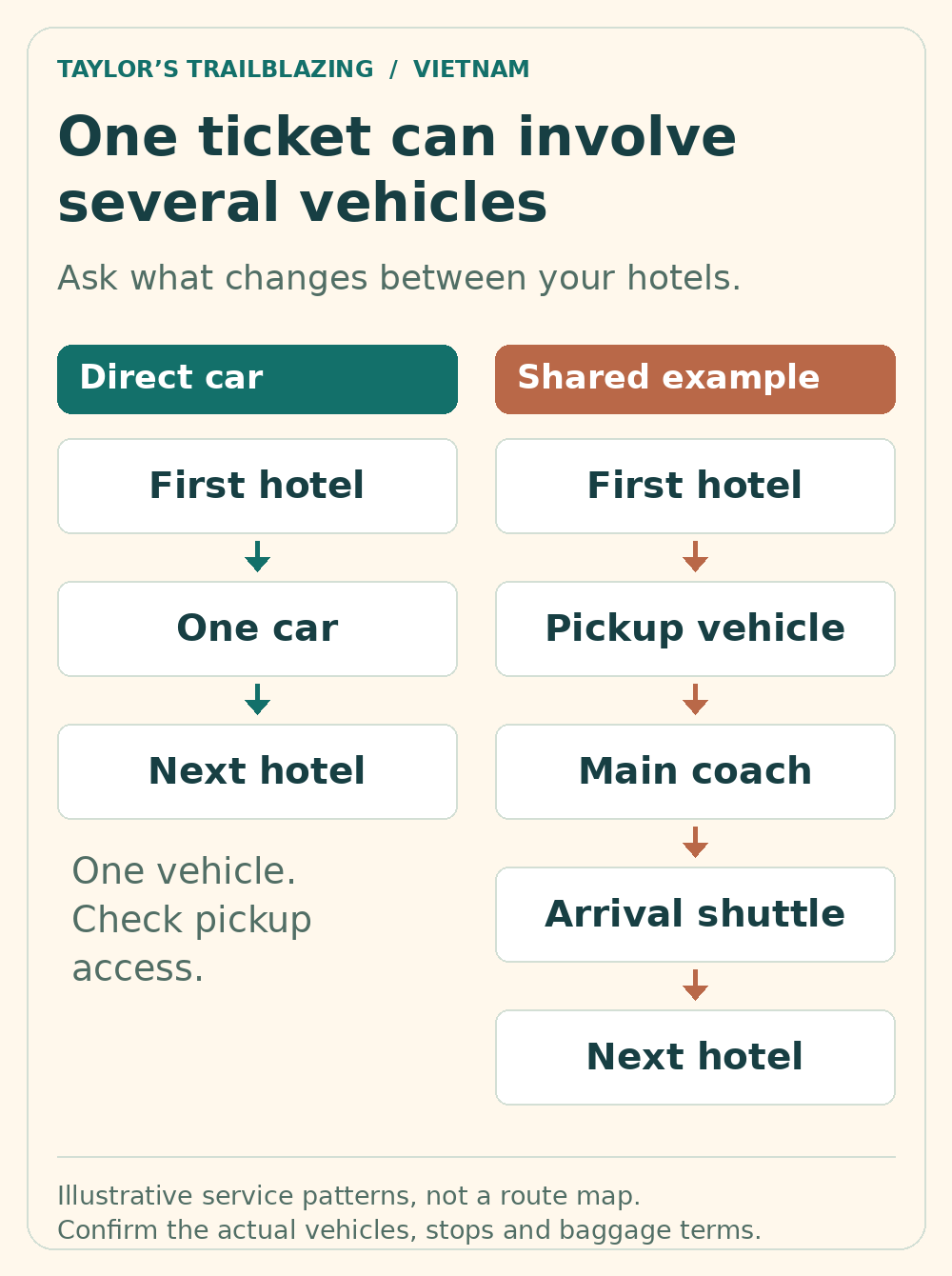
A single booking may still involve a small pickup vehicle, a larger intercity coach and another shuttle at the far end. Ask how many times you and your luggage change vehicles. Also check whether hotel collection applies to your actual address; “Hanoi pickup” is not a promise to collect everywhere in the city.
The FCDO warns that bus and coach crashes are more likely at night. [12] Compare a daytime service, rail or a flight if avoiding overnight road travel is a priority. A daytime seated journey is also an option if sleeping on transport rarely works for you. An overnight service may save daylight, but plan somewhere suitable to wait on arrival and do not make the next morning dependent on excellent sleep.
Use a private vehicle for a concrete reason
A car with driver becomes worth comparing when several people share the cost, you have awkward luggage, or a direct hotel-to-hotel move removes multiple changes. Obtain a written total covering the agreed route, stops, tolls, waiting time and number of passengers and bags. Extra seats do not automatically mean extra luggage capacity. Ask about a child restraint or wheelchair arrangement before paying, if needed.
Make the final kilometre as clear as the main journey
Save the destination’s full address, a map pin and its contact number before leaving. With similarly named hotels, the street address matters more than the English name. Keep an offline copy of the booking and enough battery to find it.
For a daytime city journey, compare a local bus or an urban rail route where it serves both ends. Check the walk between the stop and your destination, operating hours and how to buy the ticket. With luggage or a late arrival, the extra changes may outweigh the saving.
For app-booked airport rides, Grab instructs passengers to check the pickup location and follow the directions in the app. Match the car and driver to the booking, and choose a vehicle that fits the passengers and bags. [7] Follow current airport signs and in-app instructions rather than an old screenshot of a pickup lane.
Check the service type as well as the number displayed. GrabTaxi describes its in-app fare as an estimate, with the final amount based on the taxi’s meter. That differs from an upfront fixed-fare ride. [8] Read the fare details for tolls, airport charges and other extras before confirming.
When pre-booking an airport transfer helps
A named meet-and-greet arrangement is worth comparing for a late first arrival, a group or a traveller who wants pickup agreed before landing. One researched option is the Noi Bai private transfer listed on GetYourGuide for Hanoi city-centre or Old Quarter accommodation. It states one suitcase and one carry-on per passenger and is not wheelchair accessible. Confirm your direction, hotel coverage, luggage and flight-delay arrangements before purchase. [9]
Connectivity is useful for contacting a driver and recovering from a missed meeting point. If you need an eSIM, browse Airalo and choose Vietnam, checking device compatibility and the plan terms before purchase. Its Vietnam page currently offers data packages; that does not by itself promise a local phone number or reception on every part of a route. [10] Keep your hotel address and ticket accessible offline as well.
Resolve access needs and disruption before the travel day
Ask concrete access questions: are there steps between the entrance and seat, can you use the toilet, is a wheelchair transferred or stored, and who provides assistance at each end? A booking category described as comfortable or premium does not answer those questions.
Vietnam Airlines publishes wheelchair-assistance arrangements and asks travellers bringing a wheelchair to provide its dimensions, weight and relevant battery details. Contact the operating carrier early and obtain confirmation for your specific flight and airports; an airline service does not establish accessibility of the road transfer at either end. [11]
For weather disruption, check the operator’s latest notice and the current FCDO Vietnam travel advice. Heavy rain, flooding and landslides can affect travel. [12] Reconfirm a mountain or coastal journey when conditions deteriorate, and be prepared to keep an extra night rather than force a departure.
Self-riding a motorbike deserves a separate decision about competence, licensing and insurance. The FCDO warns that motorbike travel is significantly riskier than in the UK and advises inexperienced riders against hiring one. It also warns about theft on buses and trains, especially while passengers sleep. [12] Keep essential documents and valuables under your control, and do not use a rental bike as the automatic solution to an awkward transfer.
Book in the order that protects your route
- Place the fixed commitment first: your international flight, cruise departure or genuinely immovable booking.
- Identify the longest move and decide whether it deserves a flight, an overnight journey or fewer destinations.
- Check exact arrival points and whether the next hotel can receive you at that time.
- Reserve the dated seat, berth or flight you actually need, with suitable change conditions.
- Arrange the first and last transfers, then save the confirmations offline.
- Reconfirm times, terminals, addresses and disruption notices shortly before departure.
For a simple route with three bases, compare two substantial moves before adding a fourth base. If the extra stop requires a day of travel for one short evening, removing it may improve the trip more than finding a slightly faster bus.
Three mistakes worth preventing
- Buying on journey duration alone: an inconvenient terminal can erase the apparent saving.
- Comparing incomplete fares: add bags, transfer charges and any necessary early-arrival room.
- Building a chain with no recovery: a delayed overnight arrival should not immediately threaten a separately booked flight.
Frequently asked questions
Can I travel through Vietnam without taking domestic flights?
Yes, provided your route, available time and transport preferences support it. Use the actual rail or road schedule for each leg and reduce the number of regions if the long journeys consume too much of your holiday. An overland trip works best when the journey itself is part of the plan.
Is a sleeper train always better than a sleeper bus?
No. Compare berth comfort, departure and arrival times, how many changes are involved and access to both terminals. The better option is the one that fits your needs for that route; neither guarantees a good night’s sleep.
Should I reserve every transfer before arriving?
Reserve the commitments that hold the itinerary together, especially a required flight or berth. Leave flexible local journeys flexible where that suits you, but arrange an unfamiliar late arrival in advance if it will make the journey easier. Check availability before assuming you can buy the preferred departure later.
Does one transport booking mean a protected connection?
Not necessarily. Read who operates each leg, whether vehicles change and what assistance or refund is offered if a connection is missed. Do not infer protection from a combined search result or a single payment.
What if I arrive before my hotel room is ready?
Ask the hotel before travel about luggage storage, reception hours and paid early check-in. If immediate room access is essential, obtain a confirmed arrangement rather than assuming a free early room. Include any extra cost when comparing an overnight journey with daytime travel.
Choose the journey you can comfortably complete
Choose a transport mix that protects the part of Vietnam you want to enjoy. Start with a flight for a large time-sensitive jump, consider rail where its scenery or overnight timing adds value, and assess road services by their actual pickup and drop-off. Once the main ticket is chosen, finish the plan all the way to the hotel door.
Method: this research-led guide combines official transport and travel-advice sources with an original planning framework. The worked time model uses stated assumptions; no journey or booking was personally tested. Operator details were reviewed on 23 October 2026 and should be checked again for your travel date.
Sources and research notes
Provider and official information checked on 23 October 2026. The planning models are original editorial examples, with their assumptions stated beside them. Prices, timetables, products and terms can change; check the relevant provider before booking. This guide does not claim a personal visit, product test or live booking.
- Vietnam National Authority of Tourism — Transport within Vietnam
- Vietnam Airlines — Hanoi to Da Nang flights and approximate duration
- Vietnam Airlines — Airport check-in
- Vietnam Railways — Hue–Da Nang heritage train
- Vietnam Railways — Transport regulations
- 12Go — Hanoi to Da Nang transport comparison
- Grab — Noi Bai airport rides and pickup instructions
- Grab Vietnam — GrabTaxi fare estimates
- GetYourGuide — Noi Bai International Airport Private Transfer
- Airalo — Vietnam eSIM packages
- Vietnam Airlines — Passengers with wheelchairs
- FCDO — Vietnam safety and security, transport risks and extreme weather
Illustrations in this article were created for Taylor’s Trailblazing Travels. Third-party photographs, where used, are credited beside the image or in the source list.