Thailand Honeymoon Itinerary 2026: A Romantic 14-Day Route
Three memorable stops, a generous beach stay and enough breathing space to enjoy being newly married.
An original romantic coastal illustration, not a photograph of a named hotel or a promise of private beach access.
A Thailand honeymoon itinerary should leave room for the holiday you actually want: an unhurried breakfast, an evening you do not have to organise and enough time in a lovely room to justify booking it. Bangkok, Chiang Mai and Krabi make a satisfying fourteen-day combination, provided you resist turning every spare afternoon into another excursion.
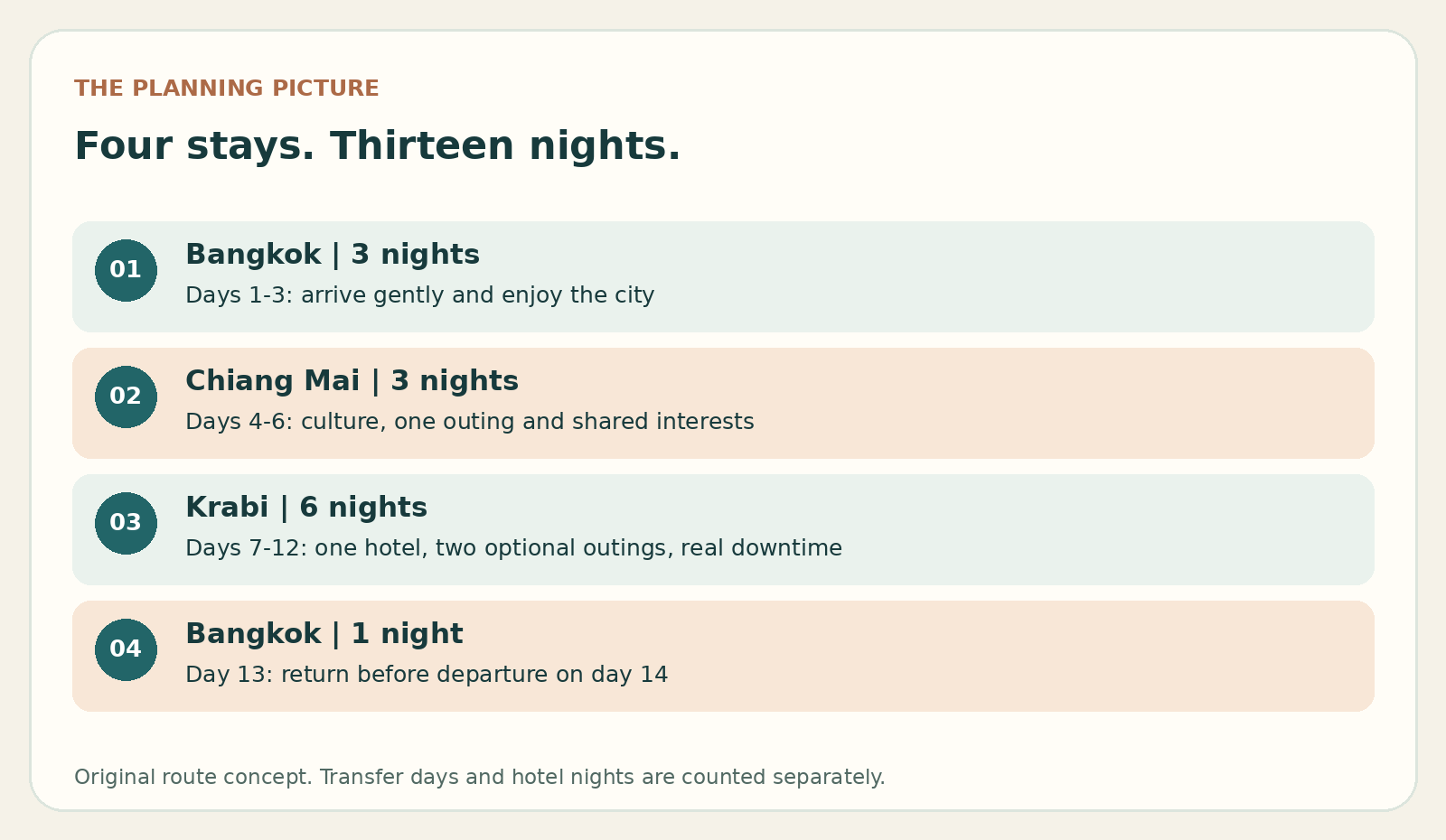
This route gives you three nights in Bangkok, three in Chiang Mai, six at one Krabi beach base and one final Bangkok night. You finish with a protected journey home rather than a ferry, a flight and an international departure balanced on the same day. There are three domestic flight legs, so couples who dislike airports should use the two-base alternative later in the guide.
The itinerary is an original planning proposal, not a report of a personal honeymoon or a package currently on sale. Hotel areas are compared for convenience, atmosphere and transfer effort. Costs are a dated model for two adults, not live hotel quotations. Select the beach coast for your month first; then choose the room, the special meal and the activities that matter to both of you.
Three main stops
City food, northern culture and a long beach finish without changing islands repeatedly.
The right room
Pay for quiet, shade and a useful terrace before paying for a hotel’s impressive entrance.
Skip the northern flight
Bangkok plus nine Krabi nights removes one domestic flight and one hotel move.
A final city night
Return to the international departure city before the flight-home day.
Thailand honeymoon itinerary: why this route works
Three contrasting places, not thirteen check-ins
Bangkok supplies the energetic opening, Chiang Mai changes the scale and the beach section deliberately lasts longest. That sequence suits couples who want more than a resort holiday but do not want to spend their honeymoon continuously repacking. Most importantly, the six beach nights are in one hotel. A day trip can change the scenery without adding a new checkout time.
Count nights before choosing flights. A fourteen-day trip usually provides thirteen nights when arrival is day one and departure is day fourteen. An overnight international flight before arrival does not create an extra Thai hotel night. Likewise, an early-morning flight home may require a different final-night arrangement. Write the actual dates beside the rows below before booking anything.
| Days | Sleep here | Nights | Main purpose |
|---|---|---|---|
| 1-3 | Bangkok | 3 | Arrive gently, explore the river and enjoy one organised evening |
| 4-6 | Chiang Mai | 3 | Old City, one mountain outing and cooking or craft time |
| 7-12 | One Krabi beach base | 6 | Beach mornings, two optional outings and generous downtime |
| 13 | Bangkok | 1 | Return before the international departure day |
| 14 | Departure | 0 | Travel home; no extra hotel night included |
Decide what you are willing to leave out
This plan does not include Chiang Rai, Pai, Koh Tao or an overnight stay on Phi Phi. Their absence is intentional rather than a judgement about their appeal. Adding any of them means taking time from the northern stay or the six-night beach finish. Discuss which part of the honeymoon you would willingly shorten before introducing another destination.
For a couple arriving exhausted after a wedding, I would make the first evening optional and the first morning late. Conversely, a well-rested couple with an afternoon arrival can enjoy a short neighbourhood walk without committing to an organised excursion. The route has space for both approaches because its first day is not sold as a complete sightseeing day.
Choose the coast for your wedding month
A season is a planning clue, not a forecast
Thailand does not have one uniform beach season. The Thai Meteorological Department describes the broad southwest-monsoon rainy period and the later wet conditions that can affect the southern east coast under the northeast monsoon. That is why a mainland calendar saying the rains are ending should not automatically settle a Samui booking. [1]
For this Bangkok-Chiang Mai-Krabi combination, the cooler part of the year is the simplest starting point for research. Nevertheless, a sunny promotional photograph cannot establish sea conditions for your dates. Look at the current forecast, choose a hotel you would enjoy during a wet afternoon and keep at least one interchangeable excursion day. [2]
Summer weddings and a Gulf alternative
For a July or August honeymoon, compare Samui with Krabi before choosing the beach block. My planning preference would be a convenient Samui base when the available forecast and seasonal information favour the Gulf, rather than forcing the Andaman route. This is a relative judgement, not a promise that the Gulf will be dry. Rebuild the domestic flight connections as well as changing the hotel.
Late-season Gulf rain can be significant, so the reverse assumption is equally unhelpful: Samui is not the automatic good-weather substitute in every month. If your wedding date falls in a transition period, flexible booking terms are part of the honeymoon budget, not a needless extra.
Northern heat, rain and visibility
Ask whether your ideal Chiang Mai days involve mountain views or food and culture. Poor visibility can undermine the first but still leave meaningful indoor alternatives for the second. Before a hiking or viewpoint day, check local conditions and any official warnings. If conditions would make the northern stop disappointing, move those three nights to the coast rather than treating the itinerary as a compulsory checklist.
Days 1-3: a gentle Bangkok opening
Day 1: arrive, unpack and do very little
Book the first hotel for the previous night only when a very early arrival makes guaranteed immediate access worth the extra expense. Otherwise, ask what early check-in means in practice; an informal request is not the same as a room held for you. Carry the hotel address in Thai or a saved map pin, then keep the first dinner close enough to abandon if you are tired.
A riverside room creates an attractive introduction, while a hotel near useful rail connections may simplify the rest of the stay. Neither is universally more romantic. Choose the location that removes the kind of friction you dislike most: traffic, long walks in the heat or dependence on a hotel shuttle. Budget the actual airport transfer separately.
Day 2: one temple area and an easy river afternoon
Make Wat Pho the main cultural visit rather than attempting every famous temple before lunch. Check its own visitor information close to travel, dress respectfully and leave room for a proper break. Then choose either another riverside stop or a relaxed meal with a view. You do not have to cross the city repeatedly to make the day feel substantial. [5]
Keep a light cover-up in your day bag even when the rest of the day is casual. It saves returning to the hotel because your sightseeing clothes do not suit a religious site. If either of you finds heat tiring, move the longer walk into the morning and reserve an indoor lunch. A good honeymoon day should still work when one person needs to stop early.
Day 3: follow a shared interest
Use the final full Bangkok day for something you both enjoy: a market and food neighbourhood, a design district, a museum or a long lunch followed by a pool afternoon. Avoid choosing activities merely because an itinerary says that day three needs another landmark. Discuss your evening plans before booking daytime transport; crossing Bangkok twice to collect forgotten dinner clothes is easily avoided.
An organised food walk can be useful when you would otherwise spend the evening negotiating where to eat. However, dietary needs and walking distances matter more than the number of tastings. A private river dinner is another option, but inspect the seating plan and entertainment style before calling it intimate. The atmosphere on a large entertainment cruise may be very different from a quiet restaurant.
Days 4-6: northern Thailand at a manageable pace
Day 4: travel to Chiang Mai, then stay local
Treat the flight day as a transfer day even when the airborne journey looks short. Checkout, the airport journey, check-in, baggage and the next hotel still use a substantial part of the day. Choose a flight that lets you arrive comfortably rather than the one with the lowest headline price and the most awkward start.
Once checked in, explore a small part of the Old City or the neighbourhood around your hotel. A modest first walk tells you where to find breakfast, water and a convenient dinner. It also gives you time to decide whether the next day should be active or slow. There is no need to travel straight from the airport to a major excursion.
Day 5: choose one mountain outing
Plan a Doi Suthep-area visit as the main outing, subject to local access and weather, rather than coupling it with an ambitious day trip to another province. Book transport with an agreed return arrangement and ask about walking, steps and waiting time. A temple visit is still a religious visit: keep noise and photography considerate and follow the site's instructions.
After lunch, leave the afternoon open. Couples who want more can explore another small neighbourhood; couples who want less can use the hotel. This flexibility matters because the most enjoyable honeymoon rhythm is not necessarily the same for both people. Agree on one shared anchor activity and allow individual reading, shopping or rest around it.
Day 6: cooking, crafts or an unhurried city day
A cooking class provides a shared experience that is not dependent on clear mountain views. Compare a city-based session with a countryside programme: an attractive garden setting may also mean a longer pickup circuit. Ask how much of the class is practical, whether you cook separately and how dietary substitutions are handled. A craft workshop can fill the same role if food is not your main interest.
Keep the evening simple because tomorrow involves another hotel move. Pack before dinner, check the flight again and leave enough charge on both phones for airport messages. This is also a useful moment to do a small laundry load rather than carrying a week's clothes to the beach. The benefit is practical, but so is not spending the next morning searching for a missing charging lead.
Day 7: move south without sacrificing the evening
Check the full journey before booking the beach hotel
AirAsia's route search includes Chiang Mai-Krabi, but route availability is not a guarantee of a suitable nonstop departure on your date. Check the live itinerary, not merely the origin and destination shown at the top of a search page. A connection changes the time available after arrival and may make a different coastal gateway more sensible. [6]
For planning, set aside roughly half a day or more door to door. This is an editorial allowance, not a flight timetable. An itinerary with a long connection can take most of the day. Avoid paying for a non-refundable sunset activity on the arrival evening, and tell the hotel if your expected arrival is later than its normal reception pattern.
Make the final transfer straightforward
For the main route, I would choose an airport-to-hotel road transfer and a beach base with land access. Railay is visually appealing but adds a boat stage; that difference deserves attention when you are carrying luggage or arriving after dark. TAT identifies Ao Nang as a departure point for boats to Railay, rather than presenting Railay as a normal drive-up resort strip. [4]
Have water and a change of light clothing accessible without unpacking both cases. Once at the hotel, inspect the room before fully settling in: noise, air conditioning and any promised terrace privacy are easier to discuss promptly. Then make dinner an easy option, not an appointment that turns a delayed flight into a ruined evening.
Days 8-12: five days that should feel like a honeymoon
Day 8: make the first full beach day deliberately empty
Take breakfast slowly, learn the hotel's layout and explore the immediate beach surroundings. Check where you can safely swim that day rather than assuming that clear-looking water is harmless. Follow lifeguard instructions and warning flags. A hotel swimming pool is a useful fallback, but it is not a reason to ignore a warning on the beach. [10]
This is also the right day to discuss the week's activities with a local operator. Ask which days currently look most suitable and what happens if conditions deteriorate. Do not book several different boat tours simply because each includes different island names. You will get more contrast from one boat day, one land or paddling outing and several genuinely free mornings.
Day 9: a scenery day on the water
Choose one island outing with clear inclusions, adequate lifejackets and a sensible cancellation policy. A private long-tail boat can give you more control over the pace, but it does not make public beaches private or remove weather limitations. Ask whether lunch, hotel pickup and any required park charges are included, and keep the return time clear.
Bring only the valuables you need and protect essential electronics. A dry pouch should be tested before relying on it; a low-cost accessory is not a guarantee against immersion. Once back at the hotel, do not stack another paid activity onto the same afternoon. Salt, heat and several hours outside can make a quiet meal more appealing than an elaborate evening plan.
Day 10: a shared treat and no compulsory sightseeing
Use this day for the room or hotel experience you chose carefully. That might mean a long breakfast, a shaded terrace, a couples' treatment after checking suitability, or a meal you have selected in advance. Ask about dress requirements and cancellation terms without assuming the word honeymoon automatically brings complimentary upgrades.
Give the hotel any dietary information directly rather than relying on a booking-platform message sent months earlier. For a special dinner, check the wet-weather arrangement and whether a beachfront setup remains available at the relevant tide. The practical backup is what protects the romance when the photograph and the actual evening do not match.
Day 11: kayaking or a coastal change of scene
A guided Ao Thalane-area kayaking outing offers a different kind of landscape from another speedboat excursion. Before committing, ask about paddling effort, tides, time on the water and what happens if one person struggles. This is an activity choice, not a fitness test. Couples who would rather stay dry can substitute a short coastal outing or a relaxed town visit.
Day 12: keep the final beach day free
The last full coastal day is not the place to put your most weather-sensitive booking. Use it as a reserve for an earlier cancelled outing, or leave it entirely empty. Take any photographs you still want while there is good light, settle incidental charges and confirm tomorrow's transfer. Small administrative tasks are less irritating when they are handled before the final dinner.
Protect a little time for the two of you to do nothing together. This may sound obvious until every attractive activity has claimed a slot. A six-night beach stay is valuable precisely because it can accommodate a disappointing-weather day, a tired day and a favourite place you want to revisit.
Days 13-14: finish without a last-minute gamble
Day 13: return to Bangkok
Leave the beach for Bangkok the day before the international flight. The final hotel need not be expensive; it needs to fit the departure airport and give you a reliable night. When the international departure is later in the day, a city hotel may work well. For a very early departure, investigate an airport-area option and its actual shuttle timetable.
Check whether each flight uses Suvarnabhumi or Don Mueang. Airport names are more useful than the word Bangkok on a booking summary. If you must move between them, allow a generous road-transfer buffer instead of assuming that a domestic arrival and international departure are in the same building. The final night is insurance against logistical stress, not a promise that disruption cannot happen.
Day 14: keep the journey home simple
Have passports, tickets and essential medicines in hand luggage. Leave enough time for checkout, airport transport and the airline's check-in deadline. A late flight does not automatically mean a free hotel day: confirm luggage storage, shower access or a late-checkout charge before planning a final afternoon out.
Couples flying internationally from Phuket can redesign the final part as an open-jaw itinerary, but do not simply delete the Bangkok night without replacing its protective function. Stay near your actual departure gateway on the final evening. The best ending is the one that lets you enjoy the previous night rather than repeatedly checking whether tomorrow's connection still works.
Pick a beach area before choosing a hotel brand
Ao Nang, Klong Muang or Railay?
TAT describes Ao Nang as a busy accommodation and excursion base, with access to boats serving nearby islands and Railay. That makes it useful when independent restaurants and convenient outings matter. My planning preference for couples seeking a quieter hotel-led stay would be to compare Klong Muang and Tubkaek as well, while checking the extra dependence on road transport. [3]
Railay works differently because of its boat access. It can be a lovely choice when the setting is central to the honeymoon, but the arrival arrangements need more attention. Ask which landing point the property uses, how luggage is handled and what happens after dark or in poor sea conditions. Do not choose it solely because a room photograph looks more secluded.
What to ask about the actual room
Request the room category, not a general statement about the resort. Ask whether the terrace is overlooked, whether the pool is private or shared and how far the room is from reception and breakfast. A hillside villa can offer a view while adding steps or reliance on a buggy. Meanwhile, a ground-floor room can simplify access but reduce privacy.
Check for construction and large scheduled events directly with the property. Look for recent guest comments about the issues you personally find difficult: music, early-morning deliveries, noisy corridors or thin connecting doors. A room that suits your habits is a better honeymoon purchase than a nominal upgrade with features you will barely use.
A useful room-request message
Send a short message explaining the dates, booked room category and the two features that matter most. For example, ask for a quieter position away from evening music and confirmation of whether the terrace is overlooked. Avoid a long list of contradictory requests, such as the most private room, no steps and the closest possible position to every facility.
Ask which requests can be guaranteed and which are preferences only. Keep the reply with the booking confirmation and check the arrangement again before arrival. That gives you a clear basis for a polite discussion if the room differs from what was agreed, without assuming that the word honeymoon overrides the room type you actually purchased.
A transparent budget for two adults
Build the total from nights and choices
The model below was prepared on 7 October 2026. It is not a claim that a particular hotel, flight or tour can be bought at these prices. Its purpose is to show how a comfortable honeymoon total develops when you pay for thirteen hotel nights, three domestic flight legs and a mixture of everyday meals and selected experiences.
| Category | Calculation for two adults | Model total |
|---|---|---|
| Accommodation | Bangkok 3 x 4,500 + Chiang Mai 3 x 3,500 + Krabi 6 x 6,000 + final Bangkok 4,500 | THB 64,500 |
| Food and ordinary drinks | 14 days x THB 1,800 per couple | THB 25,200 |
| Domestic flights | 3 legs x 2 adults x THB 2,500 allowance | THB 15,000 |
| Ground transport | Airport journeys and local travel allowance | THB 8,000 |
| Activities | Selected outings, entries and one shared treat | THB 10,000 |
| Small extras | Laundry, connectivity, tips and incidental purchases | THB 5,000 |
| Subtotal | Sum of the six categories | THB 127,700 |
| Contingency | 15% of subtotal, rounded to the nearest THB 100 | THB 19,200 |
| Working total | Subtotal plus rounded contingency | THB 146,900 |
Which line should you change first?
Within this 7 October 2026 planning model, reducing the six Krabi nights from THB 6,000 to THB 4,000 per room saves THB 12,000 before contingency. That is a much larger effect than removing one modest meal. Conversely, increasing only two beach nights to a special room creates another checkout and transfer unless the hotel can move you internally. Ask whether a shorter upgrade is worth the disruption.
The domestic-flight allowance is particularly date-sensitive. Replace it with the total including the bags and seats you intend to buy, then recalculate the reserve. Keep international flights, insurance and any unusual medical or accessibility arrangements outside the table until you have actual quotations; otherwise the apparent all-in figure becomes misleading.
Save on friction, not just on the headline price
A less expensive room far from anywhere you want to eat can create repeated taxi costs. Equally, breakfast included is only useful when you expect to use it. Compare the complete stay with the same cancellation terms, room occupancy and meal basis. Paying a little more for a cancellable rate can be rational while flights or wedding plans remain uncertain.
Set aside a small amount that neither person has to justify line by line. The aim is to avoid turning every coffee, souvenir or spontaneous dessert into a budget discussion. Agree the big spending decisions beforehand; let the minor pleasures remain minor.
Book transport and experiences in the right order
Start with the route-defining bookings
Confirm your international dates first, then the domestic connection that constrains the route most. Here, that is usually the Chiang Mai-to-coast journey. Next book the preferred beach hotel and the initial and final city nights. Leave weather-dependent activities until you understand their cancellation terms and the practical local conditions.
An overnight train can replace the Bangkok-Chiang Mai flight, but it changes the experience rather than simply saving time. Use the official State Railway of Thailand system to inspect the actual service and berth. Some couples enjoy the novelty; others would rather protect a comfortable night's sleep. Do not count the train night as both a hotel night and a free extra day. [7]
Use a short shared booking sheet
Keep one record with dates, airports, hotel addresses, cancellation deadlines and who has paid each deposit. Add the currency and whether the amount is per person, per room or per vehicle. A private-transfer quote can look expensive beside a per-person bus fare until the units are compared properly.
Save confirmations offline and give both partners access. A honeymoon should not leave one person carrying every password and every logistical decision. Divide the planning in a way that suits you, but make sure either person can find the next hotel's address if a phone fails or a bag is temporarily unavailable.
Two alternatives for different honeymoon styles
More rest: Bangkok and one beach base
Keep the opening three Bangkok nights, replace Chiang Mai with three additional Krabi nights and retain the final Bangkok night. The thirteen-night total remains unchanged: three plus nine plus one. This removes one hotel stay and one domestic flight leg while giving the beach section enough time for a deliberately slow rhythm.
That version is especially appealing after a large wedding or for couples who already know northern Thailand. It also allows you to select a hotel for a substantial stay instead of compromising on room quality to fund several transfers. However, nine nights in an inconvenient location can feel restrictive, so access to independent meals becomes more important, not less.
More culture: keep the north and shorten the resort emphasis
Couples who prefer temples, cooking and neighbourhood walks can move two beach nights into Chiang Mai. The total then becomes three Bangkok nights, five Chiang Mai nights, four Krabi nights and one final Bangkok night. You still have a beach finish, but the northern section no longer feels like a brief introduction.
For a Gulf-season version, replace Krabi with a single Samui base and rebuild the flight sequence around the dated services available. Avoid adding Phangan merely because it appears close on the map. Another island means a ferry, another hotel and another weather-dependent transfer, which may be worthwhile but is not a free addition.
Practical preparation that makes the trip easier
Documents before decorative details
For full British-citizen passport holders, current FCDO advice describes a tourism visa-exempt stay of up to thirty days from 15 September 2026, normally limited to two such entries in a calendar year. This is different from older sixty-day advice. Recheck your nationality, travel history and permission before departure; the honeymoon label does not alter immigration requirements. [8]
The official Thailand Digital Arrival Card is a separate arrival form, not a visa. Use Immigration's own service within its stated arrival window and retain the confirmation. A paid third-party form is unnecessary for the official submission. [9]
Pack for the itinerary you have chosen
Bring respectful temple clothing, something suitable for a special dinner, comfortable footwear and swimwear that can dry between uses. A small laundry plan is more useful than packing a separate outfit for every possible activity. Keep swimwear and one change of clothing accessible on the coastal transfer day in case the main luggage arrives later than you do.
Before travel, discuss health needs with an appropriate professional and check what your insurance actually covers. For connectivity, test both phones, preserve a second method of accessing bookings and keep important addresses offline. An eSIM can help on arrival, but inspect activation timing and device compatibility instead of assuming it works like every previous SIM purchase. [11]
Pros and cons of this fourteen-day route
Advantages
- Three different settings with six consecutive nights at the beach.
- A final Bangkok night reduces dependence on a same-day domestic connection.
- The daily plan contains reserve time rather than a paid activity in every slot.
Trade-offs
- Three domestic flight legs and four hotel stays still require organisation.
- The Krabi section is not equally suitable for every season or sea condition.
- Choosing isolated hotels can add dinner and transfer costs.
Who should choose it?
Choose this plan when you both want cultural variety and a substantial beach stay, and three domestic flight legs feel acceptable. Its strongest feature is not that it includes the most places; it is that the second week becomes progressively less demanding. The final buffer night then protects the journey home without swallowing several coastal days.
Choose the two-base alternative when airports, frequent unpacking or ambitious mornings are likely to diminish the holiday. A honeymoon that suits your energy is not a lesser trip. Likewise, couples whose main dream is diving or a particular island should build the route around that priority rather than trying to bolt it onto this already complete plan.
Common mistakes that make a honeymoon feel like work
Overbooking the romantic moments
A sunrise excursion, afternoon treatment and sunset dinner can each sound gentle while creating a surprisingly rigid day. Put your most important experience into the diary first, then leave space around it. A special meal feels less special when you are calculating how quickly you must leave the previous activity.
Paying for a name rather than a location
Check the distance between the room, the beach and the places you expect to use. Do the same for arrival transfers. A resort marketed under a broad destination name may be far from the neighbourhood you pictured. Use maps and the hotel's direct answers, not a destination label alone.
Assuming every honeymoon benefit is guaranteed
Request any celebration arrangements, but treat flowers, upgrades and late checkout as confirmed only when the property agrees in writing. Explain dietary needs and privacy preferences clearly. Meanwhile, avoid spending the final day arguing for an upgrade that was never included; the right base room should already meet your needs.
Forgetting that the trip belongs to two people
Agree on the balance of organised outings and free time before booking. If one person loves boats and the other gets uneasy at sea, find an experience that both will enjoy instead of relying on honeymoon enthusiasm to solve the mismatch. Good planning makes room for different preferences without keeping a score.
Frequently asked questions
Is fourteen days enough for a Thailand honeymoon?
Yes, for three main destinations at a sensible pace. This plan uses thirteen hotel nights and keeps the beach stay longest. It is not enough to add every famous island without changing the character of the holiday. Start with the main experience you both want, then remove any stop that exists only because another itinerary included it.
Should we fly straight to the beach after landing internationally?
A protected through-ticket can make that workable, but this route assumes a Bangkok arrival and a gentle city opening. With separate tickets, the risks and baggage arrangements differ. After a demanding wedding and overnight journey, I would usually prefer a reliable first hotel over another uncertain connection. Rebuild day one around the actual international arrival rather than an imagined full sightseeing day.
Is a private pool villa worth the upgrade?
Only when you will use it and the exact room delivers the privacy, shade and access you expect. Ask whether neighbouring terraces overlook the pool and whether reaching the room involves steps. A well-positioned ordinary room with a pleasant balcony can be a better choice than a villa whose headline feature is less useful in practice.
Can we do the whole trip without domestic flights?
Yes, but not with the same effortless timing. You would need to redesign the route around rail and road rather than exchange each flight for a long ground journey. A Bangkok-Chiang Mai-and-Hua Hin variation is a more coherent starting point than trying to preserve every Krabi day. Inspect dated train availability before arranging hotels around a sleeper berth.
Would you stay in Ao Nang or Railay for the honeymoon?
For a first visit prioritising easy transfers and independent meals, I would generally investigate a road-accessible Krabi base first. Railay becomes the stronger choice when its setting is a central reason for the trip and you are happy with the boat-arrival arrangements. Neither choice guarantees quiet; the room position and immediate surroundings still matter.
Should we prebook every boat trip?
No. Reserve a particularly important experience only after checking the cancellation policy, and leave another coastal day available if weather changes the plan. A six-night stay offers flexibility, but the operator and local safety advice must still determine whether an outing runs. Do not move a cancelled excursion onto your airport-transfer morning.
How do we keep the honeymoon special without overspending?
Choose one or two upgrades that genuinely improve your experience, such as a quieter room, a private transfer after a tiring flight or a carefully selected dinner. Then keep everyday spending simple. The transparent budget is intended to show those trade-offs, not to suggest that spending more automatically produces a more romantic trip.
The recommendation: protect the time you came to share
Use Bangkok for an enjoyable arrival, Chiang Mai for a change of rhythm and Krabi for a beach stay long enough to stop planning every hour. Keep the final Bangkok night unless you have rebuilt the route around a different international gateway. Most importantly, choose the coastal hotel and the season together rather than treating them as separate decisions.
Before paying, ask each other which three moments you most want from the honeymoon. They might be a meal, a shared activity and a genuinely lazy morning. Make room for those first. Everything else should support them rather than compete with them. The best version of this itinerary is not the one that follows every suggestion; it is the one in which you both have time to enjoy the choices you made.
Sources and fact-checking notes
Research checked on 7 October 2026. Official tourism pages establish destination and access context; operator searches must be rerun for dated services. The itinerary, transfer buffers and budget arithmetic are original planning judgements. No hotel, weather outcome, fare or special honeymoon benefit is guaranteed.
- 01Thai Meteorological Department: seasons of ThailandReviewed 7 October 2026.
- 02Thai Meteorological Department: current forecastsReviewed 7 October 2026.
- 03Tourism Authority of Thailand: KrabiReviewed 7 October 2026.
- 04Tourism Authority of Thailand: Railay BeachReviewed 7 October 2026.
- 05Wat Pho: official visitor informationReviewed 7 October 2026.
- 06AirAsia MOVE: Chiang Mai to Krabi route searchReviewed 7 October 2026.
- 07State Railway of Thailand: official D-Ticket bookingReviewed 7 October 2026.
- 08FCDO: Thailand entry requirementsReviewed 7 October 2026.
- 09Immigration Bureau: official Thailand Digital Arrival Card manualReviewed 7 October 2026.
- 10FCDO: Thailand safety and securityReviewed 7 October 2026.
- 11Airalo: Thailand eSIM specificationsReviewed 7 October 2026.
Illustrations in this article were created for Taylor’s Trailblazing Travels. Third-party photographs, where used, are credited beside the image or in the source list.