Thailand with Kids 2026: Family Routes, Costs and Practical Tips
A calmer family route, transparent costs and the practical details that make the holiday work.
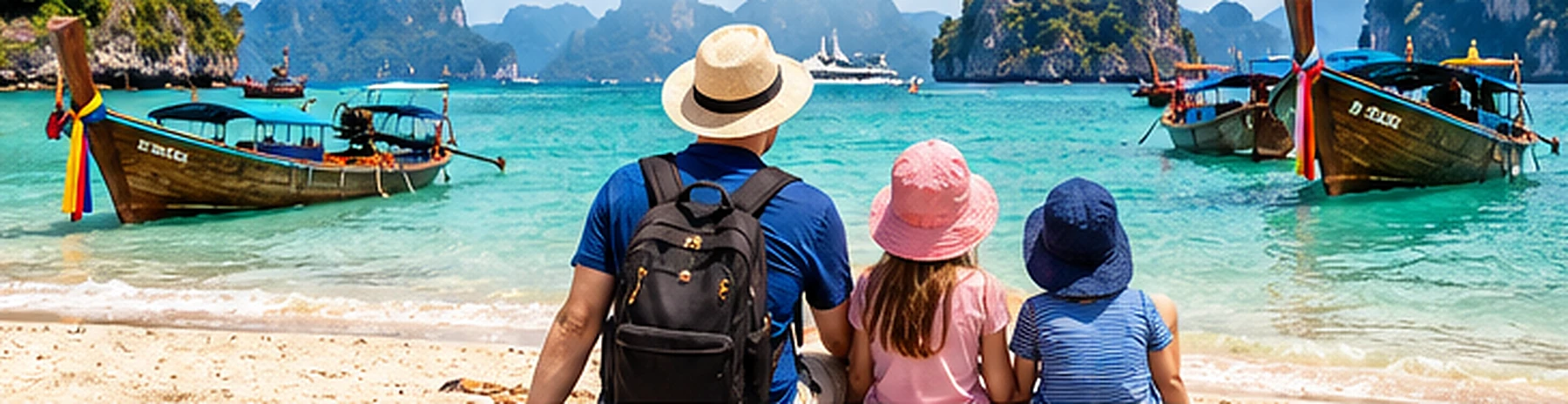
An original family-beach illustration; swimming and boat suitability always depend on current local conditions.
Thailand with kids works best when the route is designed around ordinary family needs before the exciting photographs. Easy meals, sensible transfers, a room everyone can actually sleep in and time to recover from the journey often matter more than adding another island or famous temple.
For a first visit, I would normally choose Bangkok plus one main holiday base, or Bangkok, Chiang Mai and one beach area when you have a full two weeks and children who travel comfortably. You do not need a new destination every two or three nights. A longer stay somewhere convenient gives the family time to find a favourite breakfast, use the pool and enjoy an outing without packing again immediately afterwards.
This is a research-led planning guide, not a claim of personal family travel or individual medical advice. The routes are constructed examples, and the cost models are transparent spending assumptions rather than live quotes. Recommendations prioritise transfer simplicity, rest, age suitability and access to practical services. Current official advice and the particular supplier’s rules take priority over any general suggestion here.
Two main bases
A simpler route can improve both cost and comfort.
City, north and beach
Add the third region only when the transfers suit the family.
Real family occupancy
Price the correct ages, bedding, baggage and seats.
Time to recover
Keep arrival days and some afternoons deliberately light.
Thailand with kids: choose the easiest route that still excites you
Start with your family’s travel tolerance
The best route is not necessarily the shortest on a map. It is the one whose transfers, meals and sleeping arrangements your family can manage without every day becoming a negotiation. A child who enjoys a train journey may tolerate it well, while another may find several hours of waiting and changing vehicles much harder than one straightforward flight.
Choose the experiences you most want first, then identify the smallest number of bases that can support them. Beaches, temples, food and wildlife do not all need separate destinations. The spare days created by a simpler route are useful for weather changes and ordinary rest.
Treat arrival and departure as part of the holiday
A late international arrival is not the beginning of a full sightseeing day. Arrange a clear airport-to-hotel plan and decide what the family will eat if everyone is hungry at an awkward hour. Keep essential medication, a change of clothes and immediate supplies accessible rather than buried in checked luggage.
At the other end, avoid placing a remote boat transfer directly before an important international flight. The appropriate margin depends on the actual route and ticket arrangements, but the general objective is simple: do not make the final day depend on every separate connection working perfectly.
Match the itinerary to the children's ages
Babies and toddlers: prioritise the room and the routine
For very young children, choose accommodation and transfers before ambitious sightseeing. A quiet sleeping space, safe cot arrangement, convenient food preparation and easy access to supplies can shape the entire stay. Ask the hotel what is actually provided rather than assuming a cot request is confirmed merely because it appears in the booking notes.
Fewer bases are usually helpful. Keep outings short enough that returning to the room is practical, and do not rely on a child sleeping on demand in a vehicle. A pushchair and carrier can serve different purposes; choose according to the surfaces, stairs, heat and your own comfort rather than expecting either to solve every situation.
Primary-school children: give each day a clear highlight
A manageable temple visit, a suitable cooking class or a beach morning can each be the main event. Add a simple choice the child can control, such as which snack to try or which craft to make. That helps participation without making them responsible for the whole itinerary.
Keep physical expectations realistic. A short walk at home may feel different in heat, on uneven ground or after poor sleep. Build in breaks before they become urgent rather than waiting until everyone is exhausted.
Teenagers: involve them before the bookings are fixed
Discuss the activities, hotel location and amount of independent time that will make the trip enjoyable. A teenager interested in food, photography or a particular sport may value a focused experience more than another generic family attraction.
Agree boundaries and meeting arrangements in advance. Giving older children a meaningful say is different from assuming they need no supervision or safety planning. The aim is a route that works for the whole family, including the adults, rather than a compromise nobody actively enjoys.
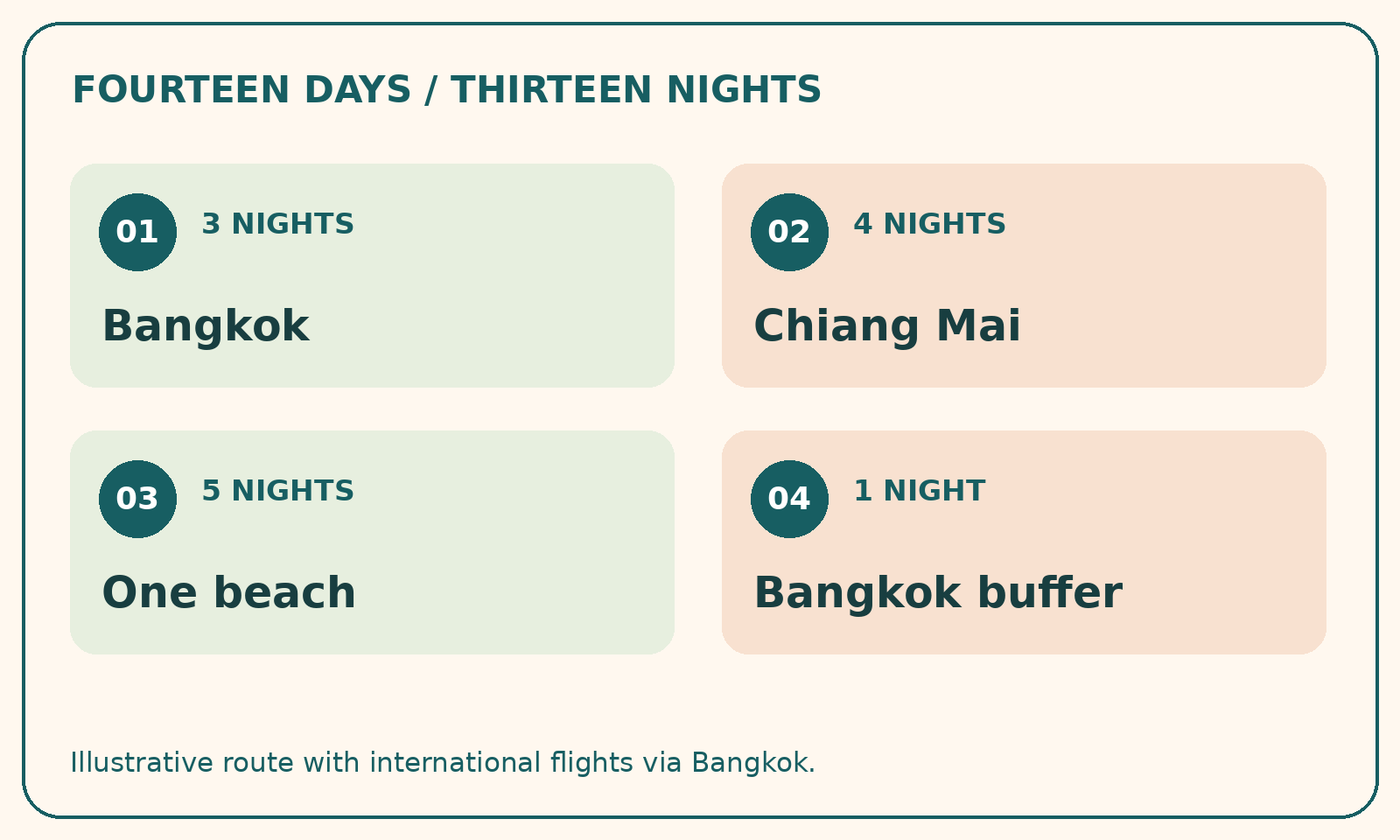
Route one: fourteen days with city, north and beach
Nights one to three: Bangkok without the full sightseeing marathon
Use the first day for settling in. On the next two days, choose one cultural or river-related activity and one child-led outing, with rest around them. A short, appropriately equipped boat trip can be interesting, but check boarding, life jackets and the route before booking.
A well-positioned hotel can reduce repeated cross-city journeys. Decide whether rail access, riverside access or proximity to your chosen activities is the priority, then inspect the actual walking route rather than relying on the neighbourhood name.
Nights four to seven: Chiang Mai at a sustainable pace
Travel north, then allow a light arrival afternoon. Use the complete days for an Old City visit, a suitable class and one nature or wildlife experience. Do not make every morning an early tour departure; the family still needs time to enjoy the hotel and eat without a timetable.
Confirm a cooking class’s minimum ages and practical arrangements before promising it to younger children. A hands-on activity is valuable only when the supervision and equipment suit the participants.
Nights eight to twelve: one beach base, not an island circuit
Choose a beach area with a practical airport connection and accommodation that makes ordinary days easy. Use the same base for swimming when conditions allow, a carefully chosen outing and unstructured time. A pool can be useful, but it requires close supervision just as the sea does.
Night thirteen: return towards the international gateway
This example assumes international flights through Bangkok, with day fourteen reserved for departure. A different gateway or a protected connection can justify a different shape. The final night is a planning buffer, not a universal guarantee against disruption.
Route two: ten days with Bangkok and Hua Hin
A straightforward mainland alternative
For families who prefer to avoid domestic flights and ferry combinations, Bangkok plus Hua Hin is a useful route to investigate. TAT describes Hua Hin as a family-friendly beach destination within a few hours’ drive of the capital. The exact journey depends on your departure point, traffic and stops. [1]
A constructed nine-night plan is two nights in Bangkok, six in Hua Hin and one final night back near your international departure arrangements. This gives the beach stay time to settle into a rhythm instead of becoming a brief pause between transfers.
Choose the transfer for the family, not just the lowest fare
Compare a properly arranged private vehicle with a date-specific train or coach option. Include getting to the station, waiting, luggage and the onward journey at the destination. A cheap ticket can still be good value, but the complete process is what the children experience.
For a private transfer, request the correct child seats in writing and make the party size and luggage clear. Agree a sensible break rather than assuming a direct transfer means nobody can stop. The beach hotel should also be chosen for its actual shoreline and local facilities, not merely because its address includes Hua Hin.
Route three: two weeks with one main beach holiday
Bangkok plus a longer Krabi, Phuket or Samui stay
A family that primarily wants rest does not need to include the north. Two Bangkok nights, ten nights at one beach base and one final gateway night can be a more satisfying thirteen-night plan than trying to fit three very different regions into the same time.
Choose the area after comparing the season, airport transfer and hotel. An island is not automatically more peaceful, and a mainland resort is not automatically less scenic. The practical question is whether you can enjoy ordinary days without repeatedly arranging transport.
Use the long stay to become less scheduled
Plan a few possible outings rather than purchasing activities for every day. You then have room to choose the calmer-weather day for a boat trip, respond to a child’s energy and enjoy the accommodation you have paid for.
A longer stay also exposes weak hotel choices, so check room size, pool access, nearby food and any construction or access concerns carefully. A property that looks appealing for two nights may be frustrating for ten when every meal needs a vehicle. Conversely, somewhere genuinely comfortable and convenient can make the simpler route feel richer rather than less adventurous.
Choosing the beach region without promising perfect weather
Krabi and Phuket: inspect the exact base
The region’s scenery is not the same as the conditions on every beach. Compare the distance from the airport, the particular bay, the walking route to meals and the need for boat travel. A hotel described as near a famous beach may still require steps, a vehicle or a boat to reach it.
For a young family, I would normally prioritise a convenient base over a remote-looking photograph. A shorter arrival journey and ordinary facilities can be worth more than an additional viewpoint. Check the current forecast and sea advice rather than using a regional reputation as a swimming forecast.
Samui: convenient flights may justify the fare
Samui can be worth investigating when the available flights and selected beach area produce a simple arrival. However, compare the total family cost with alternatives, and do not assume that all islands share the same seasonal weather pattern.
The Thai Meteorological Department’s outlook issued on 25 September 2026 highlights continuing southern rainfall into late 2026, particularly along the east coast in November and early December. That is a broad outlook, not a forecast for a particular hotel or a guarantee that every day will be wet. [2]
More remote islands: add them for a reason
A ferry transfer can be perfectly manageable, but it adds equipment, luggage and weather questions. Before choosing an island, establish the route from the airport, the actual pier, the boat type and how you reach the hotel at the other end. Then decide whether the extra effort buys something your family genuinely values.
The season should shape the activities, not just the destination
School-holiday dates require a regional comparison
When your dates are fixed, compare possible regions rather than looking for one national ‘best month’. A route built around outdoor mountain activity needs a different weather assessment from a beach-and-pool stay with flexible outings.
Late-year travel also needs current information. The 2026 TMD outlook distinguishes reducing rain in upper Thailand from wetter conditions on parts of the southern east coast. Do not apply a broad ‘winter is dry’ slogan to every region. [2]
Keep one meaningful alternative to the main outdoor activity
A workshop, suitable museum or a comfortable hotel day is a better backup than another equally weather-dependent outing. Check that the alternative is open and appropriate for the children’s ages; a museum name alone does not tell you whether it has practical activities or long galleries of text.
Chiang Mai also needs air-quality checks, particularly when the planned visit is built around outdoor exertion. Use current health and local information and seek individual advice where respiratory conditions are relevant. A general travel guide cannot establish the right pollution threshold for a particular child. [3]
Read current warnings before paying for the route
On 6 October 2026, FCDO advice included severe flooding affecting parts of Thailand. Check your hotels, access routes and transport directly when relevant. Separate regional border warnings also apply; a family itinerary should not be designed around crossing an affected border merely because an older guide describes it as convenient. [4] [5]
Family costs: a transparent model instead of an optimistic headline
Start with real occupancy
The examples here assume two adults and two children aged six and ten, sharing accommodation explicitly approved for four people. These are planning assumptions prepared on 6 October 2026, not a claim about your family or live market prices. International flights, insurance, visas where required and shopping are excluded.
Never multiply a double-room search result without checking the children’s ages, bedding, breakfast and maximum occupancy. A property may require a larger room, an extra bed or two rooms. That change can matter more than small differences in local food prices.
A constructed ordinary-day budget
| Component for a family of four | Working allowance per day | What it assumes |
|---|---|---|
| Family accommodation | THB 2,000-3,500 | One confirmed room or suitable unit, not a luxury villa |
| Food, drinks and snacks | THB 1,400-2,200 | A mix of simple meals and convenient family dining |
| Local transport | THB 500-1,000 | Some walking plus appropriate local journeys |
| Modest admissions and activities | THB 500-1,200 | Not a major private tour or four expensive tickets |
| Constructed daily total | THB 4,400-7,900 | Excludes flights and major intercity transfers |
On a small screen, swipe the table sideways. Any cost ranges are dated planning examples unless explicitly identified as a named supplier price.
A pool day may cost less in activities, while a paid excursion can exceed this model substantially. The point is to keep the assumptions visible, not to present one number as the price of a family holiday.
A fourteen-day, thirteen-night worked example
Using the three-region route, suppose accommodation averages THB 2,800 for thirteen nights, food averages THB 1,800 for fourteen days and local transport averages THB 700 for fourteen days. Add THB 9,000 for selected paid activities and a constructed THB 24,000-36,000 allowance for three domestic flight legs for four people, including whatever baggage your final quotes require.
Prepared on 6 October 2026, that arithmetic gives THB 104,400-116,400 before contingency, or about THB 115,000-129,000 with ten per cent added. It is not a flight quotation or a cheapest-possible target. Replace each assumption with the actual family booking total; the route and room requirements may move the result considerably.
Adjust the example for a different family
For teenagers, replace every child allowance with the actual supplier’s age category rather than assuming the same discounts remain available. Two rooms, larger meal portions and adult-priced activities can change the total substantially. For a baby, ticket costs may be lower in some circumstances, but suitable sleeping arrangements, feeding supplies and appropriate transport can create different expenses.
A single adult travelling with children should compare whole-room and whole-vehicle costs rather than simply dividing the four-person example. Some costs remain almost unchanged when the party becomes smaller. Likewise, a larger family may need a different vehicle or accommodation category, so adding one more child’s food budget is not enough. Rebuild the model around the booking you actually need instead of applying a flat percentage to someone else’s total.
Where families can save without making every day harder
Remove a transfer before cutting comfort everywhere
Dropping one destination can remove tickets, airport journeys and another round of packing. That saving may be larger than repeatedly choosing the cheapest meal or a room in an inconvenient location. A simpler route can therefore improve comfort and lower costs at the same time.
Compare breakfast-inclusive rates with what your family would realistically spend and use. A breakfast you enjoy before an easy morning has value; one you repeatedly miss for early pickups may not. The same reasoning applies to pools, kitchens and hotel activity facilities.
Use a few paid highlights well
A carefully chosen class or private outing can be a worthwhile family expense. It does not require buying an organised activity every day. Interleave paid experiences with ordinary beach time, a short market visit, a garden or simply enjoying the hotel.
Be cautious about child discounts that depend on height, age or a passport category. Confirm the actual rule and carry whatever evidence the supplier requires. A ‘children go free’ headline can still involve charges for transport, meals or a separate seat.
Keep a contingency that can actually be used
A reserve is useful for an unplanned hotel night, a more suitable transfer or replacing a cancelled activity. Do not assign every part of the budget in advance and then call the remaining flexibility unnecessary. The best saving is not always the lowest initial price; it can be the ability to change a poor arrangement before it spoils several days.
Transport with children: make the whole chain work
Flights: count bags, seats and ground journeys
Compare the total payable for the entire family, not four copies of the first fare displayed. Check each airline’s age categories, seat-selection rules, baggage, pushchair or car-seat handling and any charges that matter to you. A route with a connection may involve different rules on separate sectors.
Keep a small arrival kit in hand luggage: essential documents, medication, a change of clothes and immediate food or feeding supplies appropriate to the children. Confirm security and airline rules for liquids and special supplies rather than assuming every airport handles them identically.
Road transfers: specify the restraint, not just the passenger count
Ask for the type of child restraint, suitability for the child’s size and how it will be installed. A message saying ‘baby seat available’ is not a complete answer. Request enough space for both passengers and luggage and check the arrangement before leaving the pickup point.
Do not use a motorbike ride as the default solution to a family transport problem. Road travel is a significant concern in FCDO safety advice, and appropriate vehicles and restraints deserve a place in the budget. [6]
Trains and coaches: understand the arrival as well as the journey
A train can be enjoyable when the timing, sleeping arrangement and luggage work for the family. Nevertheless, a tired arrival still needs food and a practical hotel transfer. Check the actual berth or seat allocation rather than assuming adjacent bookings produce the arrangement you need.
Boats: suitable equipment is non-negotiable
Ask about correctly fitting child life jackets, boarding, shade, toilets, luggage and the cancellation policy for poor conditions. Do not accept an adult jacket as a substitute simply because the boat journey is short. When the conditions or equipment are unsuitable, decline the trip and choose something else; an attractive itinerary does not justify ignoring those problems.
Book the family room you need, not the hotel name
Confirm sleeping and safety details directly
Enter the correct ages and number of guests, then confirm bed configuration, cot provision and maximum occupancy. A sofa in a room photograph is not proof it becomes an approved extra bed. Connecting rooms should be confirmed as a requirement rather than left as an unguaranteed request when the children cannot sleep separately.
Look closely at balconies, stairs, pool access and the route from the room to public areas. A swim-up room can create supervision demands rather than simply adding convenience. Ask about practical safety features without treating a marketing label such as family resort as a substitute for checking.
Think about the ordinary evening
Can you get a suitable meal nearby when everyone is tired? Is there a place to sit after the children go to sleep? Can the room be kept comfortable without an awkward arrangement of air-conditioning and bedding? These details often matter more than the number of attractions listed on a hotel website.
A kitchenette or laundry access can be helpful for a longer stay, but verify the actual equipment and any extra charges. A minibar-style fridge is not necessarily suitable for every food-storage or medical requirement; ask specifically when temperature control is essential.
Food, feeding and allergies: prepare a reliable fallback
Familiar meals are a tool, not a defeat
Introduce new food when the family is rested and nobody is desperately hungry. Keep a few reliable options for difficult moments. A child who eats a familiar breakfast can still enjoy discovering a new fruit, soup or snack later in the day.
Ask about spice separately from ingredients. A dish can be mild and still contain fish sauce, shrimp paste, nuts, egg, dairy or another ingredient you need to avoid. For a serious allergy, obtain individual advice and discuss what the restaurant can actually control; a translated card helps communication but does not guarantee safety.
Make feeding logistics concrete
For babies, establish access to suitable feeding supplies and follow professional advice on preparation and cleaning. Do not assume a particular formula brand or specialised product will be available in every small destination. Carry enough for the immediate journey and a realistic delay margin rather than placing all essential supplies in one checked bag.
Keep food decisions separate from sightseeing pressure
A hungry child is not a good reason to ignore concerns about food handling, and a famous market is not compulsory for every meal. Choose freshly prepared food you are comfortable with and safe drinking water. NaTHNaC’s Thailand and children guidance provides a more appropriate basis for health precautions than anecdotes that a particular style of eating is always harmless. [3] [7]
Health, heat and water: use professional advice where it matters
Arrange a pre-travel health conversation
Discuss the route, duration, children’s ages, medical conditions and planned activities with a qualified travel-health professional. Vaccination and malaria advice can depend on the itinerary; one family’s recommendation should not be copied automatically by another. NaTHNaC advises checking destination-specific guidance and preparing for children’s particular needs. [7]
Carry prescribed medication with the relevant documentation and check Thai entry rules for the actual medicine. Insurance should cover every family member, declared medical conditions and intended activities, including any arrangements for treatment or evacuation that your itinerary could require. [3]
Plan heat protection into the day
Use shade, suitable clothing, regular drinks and breaks, and reduce activity when the conditions are demanding. Do not wait until a child looks unwell before offering a rest. Mosquito-bite prevention also needs age-appropriate products used according to their instructions; ask a clinician or pharmacist when uncertain. [8]
The NHS identifies reduced urination, unusual drowsiness, few tears and other symptoms as possible signs of serious dehydration requiring urgent assessment. Breathing difficulty or difficulty waking a child warrants emergency help. In Thailand, use local medical services rather than UK-only telephone services; the local emergency medical number listed by FCDO is 1669. [9] [10]
Pools and beaches need active supervision
Assign a specific adult to supervise children near water, even when several adults are present. Recheck supervision when people change places or go for food. Inflatable toys and a hotel’s family-friendly description are not substitutes for safe conditions or suitable protective equipment.
At the beach, follow flags and local advice and stay out when conditions are unsuitable. Do not promise swimming every day merely because the hotel is beside the sea. A comfortable alternative is part of a sensible beach holiday, not an admission that the trip has failed.
Family activities that offer more than another ticket
Bangkok: keep the outing short and age-appropriate
A modest cultural visit or a carefully arranged river outing can give children a strong sense of place without filling the whole day. For a child-focused option, investigate Bangkok Children’s Discovery Museum at Chatuchak. Its operator publishes age and entry rules as well as opening arrangements, so check these before travelling across the city. [11]
A private guided family outing can be useful when you need to control the pace, but specify the children’s ages and maximum comfortable duration. Do not assume a standard adult itinerary becomes suitable simply by changing the product title.
Chiang Mai: participation often beats passive sightseeing
Choose a class or workshop where the child can do something appropriate to their age. A short temple visit can work better when paired with a simple observation challenge than with a long sequence of dates and names. Ask about actual supervision and equipment, not only whether children are admitted.
Wildlife: look for freedom from direct-contact activities
World Animal Protection recommends elephant experiences based on observation rather than riding, bathing or touching. That makes a useful family discussion as well as a booking criterion: enjoying animals does not require handling them. Check the particular venue and programme before making a promise to the children. [12]
Beach areas: one suitable boat day is enough
A short, well-equipped excursion can be a highlight, but long sea days are not automatically better value. Check the route, stops, shade and toilets, and keep the decision flexible around conditions. Other days can simply involve sand, an ordinary meal and time at the accommodation.
Documents and entry rules for a UK family in 2026
Check every passport and the current permission to stay
For travellers using full British-citizen passports, FCDO guidance checked on 6 October 2026 states that passports need at least six months’ validity on arrival and a blank page. It also describes a tourism visa-exemption stay of up to thirty days from 15 September 2026. Check the Thai authorities and current FCDO page for your circumstances before travelling; rules and eligibility can change. [13]
Other nationalities, travel histories or purposes may have different requirements. Do not treat a child’s age as removing the need for their own appropriate travel documents. Keep the permission granted on entry in mind rather than assuming the duration you hoped for is the one you received.
Complete the arrival-card process for the family
Thailand’s official Digital Arrival Card guidance provides individual and group submission, with each traveller’s details included. Use the official service within the three days before arrival, include the children as travellers, check each passport number and save the confirmations. The arrival card is not a visa. [14]
Prepare consent and relationship documents where relevant
When a child travels with one parent, another relative or someone whose surname differs, check the documents appropriate to the circumstances. UK government guidance explains permission to take a child abroad and the role of parental responsibility. Requirements are not identical for every family arrangement. [15]
Keep copies separate from the originals and make sure the accompanying adult can access essential contact and insurance information. A phone containing everything is useful until it is lost, flat or unavailable.
Packing and connectivity without taking the whole house
Divide essentials from conveniences
Put documents, necessary medication, a change of clothes and immediate feeding or snack supplies in accessible hand luggage. Keep some essentials split between adults where practical so one missing bag does not remove everything the family needs.
Pack for the actual route. A warm layer can be useful in air-conditioned transport or northern highlands, while a beach stay needs clothing that dries and practical sun protection. Specialised items deserve more attention than ordinary clothes that can be washed or replaced.
Choose equipment you can move through a transfer
Before taking a large pushchair, several hard cases and a child seat, imagine moving them from airport to vehicle, through a station and into the hotel. The equipment may be necessary, but the transfer must be chosen to accommodate it. Reducing bags should never mean dropping an essential safety item merely to fit a cheaper vehicle.
Make communication reliable but not dependent on one phone
Save hotel addresses, provider contacts and an offline copy of the route. An eSIM or local SIM can help with maps and messages, but check device compatibility, coverage and whether the plan includes calls or only data. Keep a way for both adults to access essential information.
Make the first twenty-four hours deliberately easy
Before leaving the arrival airport
Have the hotel address, transfer confirmation and the provider’s contact details accessible without searching through an inbox. Check the vehicle and child restraints before loading everything, and make sure essential bags remain reachable. A change of clothes, water and the next feeding or snack requirement should not be beneath the largest suitcase.
Agree which adult is handling documents and which is supervising the children while the other speaks to the driver or hotel. This is a simple practical arrangement, not a permanent division of responsibility. It reduces the chance that everyone assumes someone else is watching a child during a busy transition.
At the hotel
Inspect the sleeping arrangement, balcony access and any immediate water hazards before relaxing. Resolve a missing cot or an unsuitable bed configuration straight away rather than waiting until bedtime. Ask where you can obtain a straightforward meal and essential supplies nearby, and establish how to contact reception from the room.
Keep the rest of the day modest. A short walk, a meal and time to settle in may be more useful than trying to recover the cost of the flight through immediate sightseeing. The next morning’s plans should remain flexible until you know how the family has slept.
On the first full day
Choose a nearby activity with a clear exit option. You should be able to return to the hotel without abandoning a long prepaid programme. Keep a familiar meal available and allow extra time for everything, because you are learning the local transport and the family’s response to the new setting simultaneously.
A gentle start does not waste the holiday. It gives you information that improves the remaining days: who needs an earlier meal, how much walking is comfortable and whether the original activity level is realistic. Adjusting early is easier than repeatedly trying to force the first plan to work.
The questions to send before confirming a family booking
Ask the hotel for a specific answer
State the number of adults, each child’s age and the intended dates. Ask the property to confirm the exact room type, approved occupancy, bed arrangement and whether breakfast includes everyone. Include any non-negotiable requirement, such as a confirmed cot or connecting rooms, rather than listing it as a casual preference.
Then ask about the details that affect your particular family. Examples include lift access, distance from the room to the pool, kitchenette equipment or a late-arrival meal. You do not need a long generic questionnaire; you need clear answers to the few points that could make the stay unsuitable.
Ask the transport provider about the actual vehicle
Give the number and approximate size of bags, whether you have a pushchair and the type of restraint each child needs. Request confirmation of the vehicle and seating arrangement, not simply an assurance that the family will fit. For a longer journey, ask about a reasonable toilet or meal break.
Save the written reply with the booking. On arrival, check that the arrangement matches it before starting the journey. A clear conversation before payment is usually more effective than trying to negotiate a safety-critical requirement at the kerb while the children are tired.
Ask activity providers about participation, not admission alone
A child being allowed to enter does not mean they can use the equipment, follow the whole programme or safely take part. Ask which elements are suitable, who supervises them, whether an adult must participate and what happens when a child cannot continue.
Confirm the refund or rescheduling terms where weather matters. A description saying ‘weather dependent’ is incomplete until you know who decides, when the decision is made and what alternative or refund applies. Keep the family comfortable with saying no when the actual conditions do not match the expected experience.
When siblings want different holidays
Build one shared highlight and one flexible period
A teenager may want a longer food walk while a younger child needs an early dinner and a pool break. You do not have to force both into the same full-day programme every day. Choose one shared activity, then leave a period when the adults can divide responsibilities where that is practical and safe.
Agree meeting points, transport and contact arrangements before separating. Avoid a plan that leaves one adult with impossible luggage or supervision demands. A convenient hotel base makes these choices easier because returning does not require another complicated journey.
Do not make the quieter child the default compromise
Ask each child what they would like to do and notice when someone is repeatedly accepting the other’s preferences. A small choice, such as a craft activity or a particular meal, can make the itinerary feel more balanced without creating another major excursion.
The same applies to adults. A sustainable family holiday leaves everyone something to enjoy rather than making one person the permanent organiser and another the permanent supervisor. Simpler days create room for that balance, which is another reason not to judge the route only by how many destinations it contains.
Pros, cons and the mistakes that make family travel harder
What makes Thailand a strong family option
You can combine cultural interest with a longer holiday base, choose different levels of activity and build a route around your family’s particular interests. A small number of well-chosen destinations can offer plenty of variety without requiring constant movement.
What deserves realistic preparation
Heat, road travel, water safety, room occupancy and the logistics of feeding or medication all need attention. Some attractive locations involve several transfer stages. None of this means every family needs an escorted holiday; it means the practical plan should be as carefully considered as the sightseeing list.
Avoid the common planning traps
Do not price only two adults and assume the children add little. Avoid booking a connecting room as a mere preference when it is essential. Keep major activities away from uncertain arrival times. Confirm child seats and life jackets rather than trusting generic reassurance. Most importantly, do not turn every spare afternoon into another paid outing when the family would enjoy a rest.
Thailand with kids FAQs
Is Thailand suitable for a first long-haul family holiday?
It can be, especially with a simple route, convenient accommodation and properly arranged transport. The key is matching the trip to your children’s ages, health needs and travel tolerance. Start with a manageable number of bases rather than copying an adult itinerary and assuming everyone will adapt to its pace.
How many destinations should we choose in two weeks?
Two main bases is my default for a relaxed first trip. Three regions can work when transfers are straightforward and the children travel comfortably, but each move needs usable time. Count the international arrival, departure and any final gateway night honestly rather than treating all fourteen dates as complete sightseeing days.
Is a family room always cheaper than two rooms?
No. Compare the actual total for the correct ages and approved occupancy, including extra beds and breakfast. A family room may be better value or more convenient, but its name does not guarantee enough space. Two rooms only solve the sleeping problem when the arrangement and supervision are suitable for the children’s ages.
Can we rely on taxis to have child seats?
Do not assume that a vehicle arriving on demand will carry the restraint you need. Arrange suitable seats in advance, specify the child’s size and check the installation at pickup. A vague promise of a baby seat is not enough when the type, fit and number of seats determine whether the journey is appropriate.
Do we need to take a pushchair and a carrier?
Not every family needs both. Consider the child’s age, your planned routes and how comfortably you can carry them in heat. A compact pushchair can be useful in airports and suitable hotel areas, while a carrier may help where there are steps. Check the actual surfaces rather than assuming either option will work everywhere.
Which is easier: a beach resort or island hopping?
A single well-chosen beach base is normally easier because it removes repeated boat journeys, packing and new arrival arrangements. Island hopping can work for a family that enjoys the travel itself, but it needs suitable equipment and conditions. Do not add it merely because an adult route presents moving every few days as essential.
Should we book activities before leaving home?
Reserve limited places and anything central to the trip, while reading cancellation terms carefully. Keep weather-sensitive boat or mountain days flexible where possible. A useful middle ground is to research suitable providers in advance without paying for every available day before you know how the family feels after arrival.
How much extra money should we keep for changes?
The worked example uses ten per cent as a constructed contingency, not a guarantee that it will cover every disruption. Your needs depend on insurance, ticket flexibility, medical requirements and the remoteness of the route. Keep access to emergency funds separate from the ordinary spending plan and understand what your insurer requires when a problem occurs.
Are elephant experiences appropriate for children?
An observation-led programme with suitable walking, shade and supervision can be worth investigating. Avoid activities requiring riding, bathing or touching, and check the exact venue’s practices rather than trusting the word sanctuary. Also confirm age limits and the child’s interest; an ethical programme still needs to be a practical fit for the family.
What should we do when a child becomes unwell?
Reduce activity and seek appropriate medical advice rather than trying to preserve the itinerary at all costs. Know the local medical options and your insurer’s contact arrangements before you need them. Serious symptoms need urgent local assessment; a travel article, hotel opinion or another traveller’s experience cannot diagnose your child.
My recommendation: spend your flexibility on a better family holiday
Choose the route that leaves the family comfortable enough to enjoy what makes Thailand interesting. For many first visits, that means Bangkok plus one beach base, with Chiang Mai added only when there is enough time and genuine interest to justify the extra movement.
Spend deliberately on the room configuration, suitable transport and a few experiences that matter. Then protect the ordinary moments between them. A successful family holiday does not need every day to be exceptional; it needs the practical details to work well enough that the good experiences can happen without constant exhaustion.
Sources and fact-checking notes
Research and editorial review completed on 6 October 2026. Tourism-authority pages identify places and their published facilities; operator pages describe the named products. Listed prices and opening information are dated snapshots, not guaranteed availability. Travel-time ranges, route choices and spending models are editorial planning judgements, not live quotations. Check current official advice, the attraction and the booking provider before travelling. The worked family budget uses explicitly stated ages, occupancy and quantities. Entry and medical guidance should be checked for every traveller's actual circumstances; the article does not replace professional advice.
- 1.Tourism Authority of Thailand: Hua Hin destination brochure
- 2.Thai Meteorological Department: October-December 2026 outlook, issued 25 September
- 3.NaTHNaC TravelHealthPro: Thailand country health advice
- 4.FCDO: current Thailand travel advice and alerts
- 5.FCDO: Thailand regional risks and border warnings
- 6.FCDO: Thailand safety and road travel
- 7.NaTHNaC TravelHealthPro: children travelling abroad
- 8.NaTHNaC TravelHealthPro: insect and tick bite avoidance
- 9.NHS: dehydration and urgent warning signs in children
- 10.FCDO: Thailand medical assistance and emergency number
- 11.Bangkok Children's Discovery Museum: official visitor information
- 12.World Animal Protection: choosing an observation-led elephant experience
- 13.FCDO: Thailand entry requirements for British citizens
- 14.Thai Immigration: official Digital Arrival Card manual
- 15.GOV.UK: permission to take a child abroad
Illustrations in this article were created for Taylor’s Trailblazing Travels. Third-party photographs, where used, are credited beside the image or in the source list.