Best Things to Do in Hanoi: First-Visit Sights Worth Your Time
Choose the sights that match your interests, then give them enough time to be worthwhile.
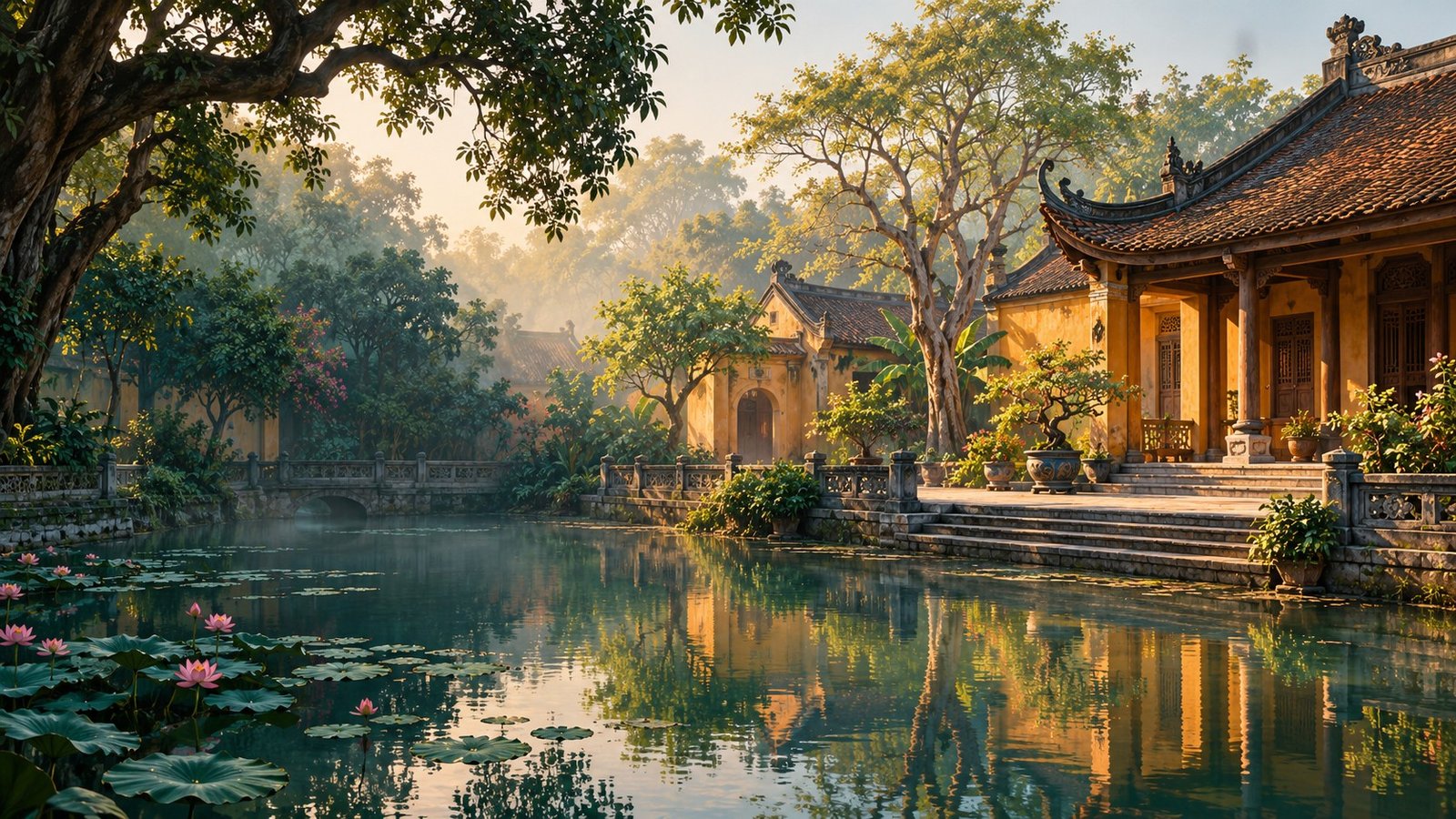
A traditional courtyard, tiled roofs and a reflective pond. AI-generated editorial illustration inspired by Hanoi’s heritage architecture; not a photograph of a specific attraction.
The best things to do in Hanoi depend on the kind of visit you want. A courtyard, a prison museum and a water-puppet performance ask different things of your attention. Choosing among them is more useful than trying to collect every famous name.
This research-led shortlist weighs interest, time on site, location and booking constraints. The visit allowances and combinations are editorial planning models. Use them to decide what earns a place in your day, then check the current arrangements for your travel date.
Some links in this guide are affiliate links. If you book or buy through them, Taylor’s Trailblazing Travels may earn a commission at no extra cost to you.
Choose a subject
Pick the museum whose questions interest you; three different museums do not have to share one day.
Count the whole visit
A short exhibition still needs a journey, an entrance queue and a place in the rest of your day.
Fix the performance first
Build the evening around the showtime you actually book, with ticket collection time included.
Keep a useful fallback
Choose one nearby alternative before you travel, then leave enough flexibility to use it.
The best things to do in Hanoi, matched to your interests
There is no universal ranking here. The strongest choice is the one that answers your question about Hanoi without absorbing more time than you want to give it. For a first visit, combine one substantial interior or heritage site with an experience that changes the pace.
Swipe or scroll to see all columns.
| Sight or experience | Choose it for | Protect this time | The main trade-off |
|---|---|---|---|
| Temple of Literature · west of the lake | Courtyards, learning and examination history.[1] | 90 minutes | A focused heritage visit; less suitable if you want a large indoor museum. |
| Vietnamese Women’s Museum · south of the lake | Women’s lives, cultural traditions and historical roles.[2] | 75–90 minutes | Best when you want time to read and reflect. |
| Hoa Lo Prison · south-west of the lake | Colonial imprisonment and wartime history.[3] | 75–90 minutes | A demanding subject; consider your appetite for distressing material. |
| Thang Long Imperial Citadel · western central Hanoi | Archaeology and successive centres of political power.[5] | 120–150 minutes | Give the remains and exhibitions time to explain the site. |
| Museum of Ethnology · farther west | Vietnam’s communities and domestic architecture.[2] | 120–150 minutes on site; reserve a half-day with travel | Its location makes a quick detour a poor use of time. |
| Hoan Kiem Lake and a small Old Quarter sample | Street life, a flexible walk and a pause between interiors.[7] | 60–90 minutes | This is a taste of the area, not a complete neighbourhood walk. |
| Thang Long water puppets · beside the lake | A seated performance and an evening with a fixed focus.[7] | 75 minutes including an arrival buffer | Choose the actual performance and ticket collection arrangements first. |
| A Hanoi meal and café stop | Food as part of the visit, with time to order and linger. | 60–90 minutes | A cross-city restaurant chase can consume the time you meant to enjoy eating. |
Use the shortest allowance only when you are happy to make a selective visit. Keen readers, photographers and anyone who needs frequent rests should lengthen the block and remove another stop. Opening hours describe the available window; they do not tell you how late you can arrive and still enjoy the place.
For ideas beyond the capital, browse the Vietnam things-to-do collection.
Temple of Literature or Imperial Citadel?
Choose the Temple of Literature for a focused architectural visit
Văn Miếu–Quốc Tử Giám brings together temple courtyards, the history of education and the doctoral stelae that record scholarly achievement. The official visitor entrance is at 58 Quoc Tu Giam Street.[1]
It is the more manageable choice when you want one heritage site within a varied day. Give the courtyards and inscriptions enough attention to connect the architecture with its purpose. If your interest is mainly visual, a selective 90-minute allowance is a reasonable starting point; add time for exhibitions or detailed interpretation.
Plan this as an outdoor heritage block with sheltered spaces, rather than your main answer to persistent rain. The daytime admission figure below also should not be used to budget for a separate evening programme.
Choose the citadel for layers of political history
The Imperial Citadel’s value lies in its surviving monuments, excavated remains and long sequence of government and royal use. Its central sector includes the archaeological area at 18 Hoang Dieu and the historic citadel axis.[5] House and Bunker D67 add a twentieth-century military command story to that much longer history.[14]
Choose it if you enjoy reconstructing a place through evidence. Expect to interpret foundations and exhibitions as well as look at buildings; a grand, fully furnished palace is the wrong expectation. A two-hour block gives this approach room to work. If archaeology leaves you cold and you have one day, put the temple first.
The operator announced the start of Kinh Thien Palace reconstruction on 29 September 2026. Check which areas and entrances are available during the works; the centre’s published address is 19C Hoang Dieu.[16]
Both can earn a place on a history-focused second day. Combining them makes less sense if it means losing the only time you have for food, street life or a subject you care about more.
Choose the museum that answers your question
Women’s Museum: how have women shaped Vietnamese life?
At 36 Ly Thuong Kiet, the Vietnamese Women’s Museum covers women’s cultural and historical roles, including clothing traditions and wartime stories.[2] It is a useful first choice if you want human stories to sit alongside the city’s monuments. Allow yourself to follow a theme rather than rushing between floors to say you have seen everything.
Hoa Lo: what can a prison tell you about colonialism and war?
Hoa Lo is at 1 Hoa Lo Street.[4] The French built the prison in 1896 to imprison Vietnamese people; part of its later history concerns American prisoners of war. The surviving site presents these histories through preserved spaces, objects and commemorative interpretation.[3]
Read it as a museum with a particular national perspective, and distinguish the account being presented from a complete history of the conflicts. Its subject makes it a deliberate choice. If distressing material would dominate the rest of your day, choose another museum and leave Hoa Lo for a visit when you want to engage with it.
Ethnology: how do Vietnam’s communities live, build and express identity?
Find the Museum of Ethnology on Nguyen Van Huyen Street, Nghia Do.[10] It combines objects and cultural displays with full-size examples of domestic architecture outdoors.[2] That mixture rewards a longer visit, particularly if buildings and everyday life interest you more than political chronology.
Give it a half-day including the journeys, with 120–150 minutes on site as a starting allowance. Its western location makes it a substitute for a substantial central sightseeing block. The outdoor component also means that a wet-weather visit changes what you can comfortably explore; it is not an entirely indoor fallback.
A guide may help when you want to ask questions across two different collections. The linked Women’s Museum and Hoa Lo walking tour is advertised as four hours. Treat it as the main activity for that half-day, and check the selected language, meeting point and whether admissions are included before paying.[12]

Give the lake, food and a performance their own time
Hoan Kiem and a manageable piece of the Old Quarter
The Old Quarter lies north of Hoan Kiem Lake, making the lake a useful anchor for a short outdoor block.[7] Spend your hour on the lake edge and a handful of nearby streets, with room to stop. Trying to turn that hour into a comprehensive market-and-monument circuit changes the experience completely.
This is the flexible part of the shortlist. It can become a longer wander when you have energy, or a short lakeside pause when the museum held your attention. Use a separate neighbourhood walk if the streets themselves are your main interest.
Eat one meal with curiosity
Bún chả pairs grilled pork with rice noodles and herbs; chả cá brings fish together with dill and other seasonings. For a café stop, cà phê trứng combines coffee with a sweet egg topping.[11]
Choose a dish you want to understand, then find a suitable place within the day’s area. Protect an hour for lunch instead of treating eating as spare minutes between admissions. Ask about ingredients, portions and prices before ordering; dietary requirements need a direct conversation.
Water puppets: book the evening you actually want
Thang Long Water Puppet Theatre is at 57B Dinh Tien Hoang, beside the lake.[7] It gives the evening a seated focus after a day of walking. Listed ticket products commonly allow around 45–50 minutes for the performance; the 75-minute planning allowance here adds an arrival buffer.[8]
Compare the selected date, showtime, seat category and method of receiving the ticket. A voucher that requires collection needs a different arrival plan from a ticket that admits you directly. Avoid attaching a non-refundable performance to the end of a tightly packed day of uncertain journeys.
The link is a comparison page for Thang Long theatre tickets. Read the chosen provider’s collection and cancellation conditions; no particular performance availability has been assumed.
Check admissions and the closure that changes the plan
Ho Chi Minh Mausoleum: a dated exception
Checked on 23 October 2026: the Government’s notice sets annual maintenance from 4 September to 2 November 2026, with visits expected to resume on 3 November. An interior visit does not belong in an October plan.[9]
For later travel, confirm reopening, admission days and current rules for dress, bags, photography and security before going. Treat the Mausoleum, nearby museum and residence visits as separate choices; check each one’s access. An exterior look at Ba Dinh is an option only where local access permits, not a guaranteed substitute for admission.
Swipe or scroll to see all columns.
| Place | Adult admission | Published opening | Planning consequence |
|---|---|---|---|
| Temple of Literature | 70,000 VND | 08:00–17:00 daily[1] | Evening programmes are separate from this daytime comparison. |
| Vietnamese Women’s Museum | 40,000 VND | 08:00–17:00 daily; national tourism authority listing[2] | Confirm current arrangements before fixing a late-afternoon visit. |
| Hoa Lo Prison | 50,000 VND | 08:00–17:00 daily, including holidays; no lunchtime closure[4] | The official notice directs daytime visitors to buy at the entrance. |
| Imperial Citadel | 100,000 VND | 08:00–17:00 every day[6] | Allow a substantial daytime block rather than arriving close to closing. |
| Museum of Ethnology | 40,000 VND | 08:30–17:30; closed Mondays and the Lunar New Year holiday[10] | Check the holiday notice and move this visit off Monday. |
The basic one-day selection below has 110,000 VND in adult admissions: 70,000 for the temple plus 40,000 for the Women’s Museum.[1][2] The four paid sights across the two-day version total 260,000 VND.[4][6] These are calculations from the listed fees, not complete day budgets; food, transport, optional interpretation and the performance come on top.
Use official attraction information for ordinary entry, then compare guided or timed products only when they solve a real need. Check any student, child or other concession against the venue’s actual eligibility rules rather than assuming a UK card or age category qualifies.
Make the choices fit one or two days
One day: one heritage site, one museum and room for Hanoi
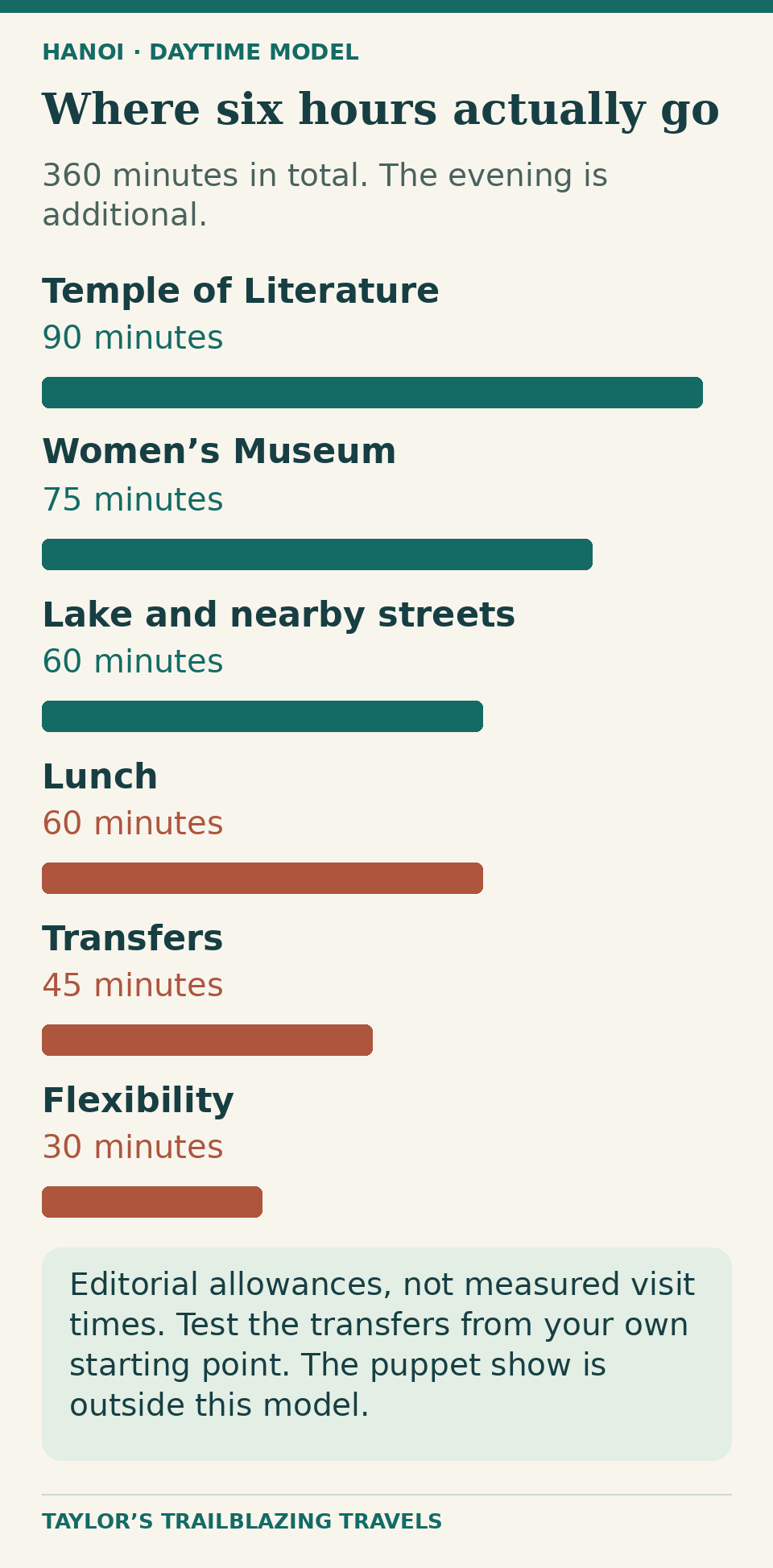
The useful constraint is six daytime hours, not a target number of attractions. Start with the temple in the western part of central Hanoi, move to the Women’s Museum south of the lake, then finish around Hoan Kiem. This order limits repeated movement across the centre.
Swipe or scroll to see all columns.
| Part of the day | Minutes | What the allowance protects |
|---|---|---|
| Temple of Literature | 90 | A considered first visit. |
| Vietnamese Women’s Museum | 75 | A selected set of exhibitions, rather than every label. |
| Hoan Kiem and nearby streets | 60 | An unhurried taste of outdoor Hanoi. |
| Lunch | 60 | A proper meal. |
| Transfers | 45 | Movement between the selected places. |
| Flexibility | 30 | A queue, slower journey or extra pause. |
| Total | 360 | Six daytime hours; the evening is separate. |
For a later start, preserve the meal and remove a whole sightseeing block. If travel takes 30 minutes longer, the flexibility allowance absorbs it; a larger delay should trigger a shorter lake visit or a dropped stop. The transfer allowance is a budget to test, not a traffic prediction.
Swap Hoa Lo into the museum slot if that is the subject you want. Swap the citadel for the temple only if you also release another 30–60 minutes; otherwise you have changed the name without making room for the visit. Ethnology needs a more substantial redesign: give it the morning and choose one easy central activity afterwards.
Two days: keep the central and western choices together
Swipe or scroll to see all columns.
| Day | Main choices | Supporting time | Adult admission subtotal |
|---|---|---|---|
| Central day | Women’s Museum 90 min → Hoa Lo 75 min → lake and nearby streets 75 min | Lunch 60 + transfers 30 + flexibility 30 = 120 min | 90,000 VND[2][4] |
| Western heritage day | Imperial Citadel 120 min → Temple of Literature 90 min | Lunch 60 + transfers 45 + flexibility 45 = 150 min | 170,000 VND[1][6] |
This version suits visitors who actually want both central museums. If you prefer variety, remove Hoa Lo and use that block for a longer meal or neighbourhood exploration. If Ethnology is your priority, replace the western heritage day’s two major visits with that half-day and a flexible afternoon. Do not add it to an already full programme.
Keep the puppet show outside these daytime totals. Book its actual time first, then allow for dinner and the journey to the theatre. A six-hour daytime plan is not a promise that every traveller will want another scheduled activity that evening.
Choose your fallback before you book
In persistent rain, shorten the lake block and favour the Women’s Museum or a performance with a confirmed ticket. In hot weather, keep the more exposed heritage visit early and protect a long lunch. These are pacing choices: check the forecast and same-day venue notices before setting out.
If a venue is closed unexpectedly, use the alternative in the same part of the city. The central museum pair provides a useful choice; the western sites work better with a reassessment of the whole half-day. Avoid racing across Hanoi just to preserve the original number of stops.
- Choose the subject you most want to understand.
- Check the date against opening days and closure notices.
- Pin the actual entrances and test journeys from your starting point.
- Reserve timed experiences and keep ordinary sightseeing flexible.
Save your pins and ticket information offline. Mobile data can help with changed pickup points or booking messages. Airalo has Vietnam eSIM options; check your phone’s compatibility, network-unlock status and the chosen plan’s terms before buying. Its general store link requires you to select Vietnam.[13][15]
Frequently asked questions
What should I choose if I have only two free hours?
Choose one nearby priority. The Women’s Museum can work with a brief lake pause if you are already in that part of town; the Temple of Literature can fill the available block if you start west of the lake. Include the return journey before deciding you have time for a second stop.
Which choices work best with children?
Start with your children’s interests and attention span. A water-puppet performance offers a seated activity; Ethnology offers a mixture of buildings and displays if you can give it enough time. Consider the prison subject at Hoa Lo carefully. Confirm the selected venue’s child ticket rules and practical facilities rather than assuming every museum has the same arrangements.
Is Train Street essential on a first visit?
No. There is enough variety in the lake, food, museums and performances to build a strong visit without entering a railway corridor. Keep café and photography stops away from active tracks, obey barriers and local instructions, and never treat an invitation from a café as permission to bypass a restriction.
Can I use these combinations with a wheelchair or pushchair?
Use them to choose interests, then check access with each venue. The time model does not establish step-free entrances, lift access, accessible toilets or a continuous usable pavement between sights. Ask about the exact entrance and the sections you want to see; allow for a vehicle transfer when a walking connection will not meet your needs.
Choose the sights that earn your time
Choose your first museum before adding another famous sight. Then give one heritage visit, one meal and the lake enough space around it. If a second day is available, use it for the interest that needs more time: archaeology, another historical perspective or Ethnology. Record those choices in the trip itinerary planner, then check opening dates and book any fixed performance separately.
Sources and methodology
Researched and editorially reviewed on 23 October 2026. Sources below support the destination and provider facts. Route choices, visit allowances and comparison models are editorial planning judgements; they are not reports of personal visits or live booking quotes. Recheck dated prices, access and operating details before travelling.
- Van Mieu–Quoc Tu Giam — official visitor informationOfficial centre website: entrance, heritage, daytime hours and fees; checked 23 October 2026.
- Vietnam National Authority of Tourism — Vietnam’s must-see museumsWomen’s Museum listing and collection context; Ethnology exhibits. Checked 23 October 2026.
- Hoa Lo Prison Relic — historical introductionInstitutional account of the prison’s colonial and wartime history.
- Hoa Lo Prison Relic — daytime ticket informationOfficial notice dated 3 March 2025; daytime fees, opening and entry sales checked 23 October 2026.
- Thang Long Imperial Citadel — introductionSite composition and historical layers.
- Thang Long Imperial Citadel — ticket priceFee effective 1 January 2025; current site opening notice checked 23 October 2026.
- Vietnam National Authority of Tourism — Hanoi attractionsLake and Old Quarter geography; Thang Long theatre location. Other venues’ hours are checked against their own sources.
- GetYourGuide — Thang Long Water Puppet Theatre ticketsProvider comparison page and advertised performance lengths checked 23 October 2026; no date-specific availability claimed.
- Viet Nam Government — 2026 Ho Chi Minh Mausoleum maintenance noticePublished 3 September 2026: closure 4 September–2 November; planned reopening 3 November.
- Vietnam Museum of Ethnology — visitor informationPublished opening, Monday and Lunar New Year closure, and admission; checked 23 October 2026.
- Vietnam National Authority of Tourism — Hanoian dishesBún chả, chả cá and egg-coffee descriptions; no restaurant availability inferred.
- GetYourGuide — Women’s Museum and Hoa Lo walking tourActual itinerary and advertised four-hour duration checked 23 October 2026; confirm selected inclusions.
- Airalo — Vietnam eSIM plansCountry offering checked 23 October 2026; compare device compatibility and individual plan conditions.
- Thang Long Imperial Citadel — heritage visit, 9 June 2026Current official account includes House and Bunker D67.
- Airalo — device compatibilityDevice eSIM support and carrier-unlock requirements.
- Thang Long Imperial Citadel — Kinh Thien Palace reconstruction launchOfficial 29 September 2026 project announcement and current published 19C Hoang Dieu address.
Illustrations in this article were created for Taylor’s Trailblazing Travels. Third-party photographs, where used, are credited beside the image or in the source list.