
Best Things to Do in Koh Tao: 14 Experiences Above and Below Water
Choose the right water experience, explore granite-framed bays and leave time for life above the surface.
Find your kind of island day
Koh Tao is an appealing place to learn a skill, but a diving course is only one way to spend your days. This guide to the best things to do in Koh Tao compares the main water experiences with beaches, viewpoints and worthwhile land activities, so you can plan a trip that matches your confidence and available time.
The right plan starts with your interests and water confidence, not the longest list of stops. Use the comparisons to choose your main experience, then keep the easier hours flexible.
Guided snorkelling
Compare the actual route; not every trip includes Nang Yuan.
Koh Nang Yuan
Plan around the island visitor window, not an assumed sunrise arrival.
Open Water training
Give the whole course room instead of adding it between tours.
Cooking or climbing
Choose a hands-on experience that suits the group and conditions.
Best things to do in Koh Tao: start with your water confidence
There is more than one way to enjoy the island
The best things to do in Koh Tao are not a single compulsory list. Someone learning to dive needs a very different timetable from a couple who want two beaches, a viewpoint and a good dinner. Tourism Thailand identifies diving, snorkelling, beaches and Koh Nang Yuan among the island's central attractions, while also recognising activities for visitors who stay above the water. [1]
Start by deciding how much time you genuinely want to spend in the sea. Then choose between a boat-based sampler, a focused beach visit, an introductory dive and a certification course. These experiences overlap in scenery, but their demands, costs and outcomes are quite different.
The fourteen ideas below are selected to cover those different needs, including several worthwhile land-based options. Their order moves from broad water experiences to individual places and skills; it is not a ranking based on affiliate commission or an invented personal testing exercise. Suggested visit lengths are my planning allowances unless an operator's published duration is identified.
Match the experience to the trip
| Your priority | A useful starting choice | Suggested allocation | The question to answer first |
|---|---|---|---|
| See several bays | A guided snorkelling trip | Half or a full day | Which island does it depart from? |
| The sandbar viewpoint | Koh Nang Yuan | Most of its visitor window | Is island admission separate? |
| Try breathing underwater | An introductory scuba experience | The provider's complete session | Is it an experience or a qualification? |
| Become a certified diver | Open Water training | Several calendar days plus travel buffers | Can you complete every required session? |
| Stay on land | Cooking or guided climbing | Around half a day | What is included and what access is involved? |
| Keep the day simple | One bay and a Sairee evening | A flexible day | Do the current conditions suit that bay? |
Plan around your least flexible commitment
If diving is the reason for coming, choose the school and course dates before arranging everything else. If you are not diving, avoid structuring your stay around dive-school timetables by default. A varied non-diving trip can stand on its own without being treated as the spare-hours version of someone else's holiday.
Use a snorkelling trip to sample several bays
Read the route rather than counting the stops
A guided boat trip is useful when you want to see different parts of the coast without organising multiple road transfers. Oxygen's published morning programme includes Koh Nang Yuan and several Koh Tao bays, with the route explicitly subject to weather and sea conditions. Its advertised programme is a day outing, not a quick swim between ferry connections. [2]
Compare the time actually spent in the water, passenger numbers, shade, toilets, boarding arrangements and the guide's role. A long list of stops means little if the day feels rushed or the group is too large for your comfort. Ask whether there will be help in the water and whether everyone must be able to swim independently.
Keep your expectations flexible. A responsible change of bay can improve the day, whereas insisting on a specific stop because it appeared in the description may conflict with conditions. Similarly, seeing a turtle or shark is a possibility, not a service the operator can deliver on demand.
Early starts do not always include Nang Yuan
Oxygen's early-bird programme is a different product: it lists four bays and specifically says that it does not visit Koh Nang Yuan. Do not assume an early departure simply offers the same itinerary with fewer people. [3]
Choose the shorter coastal trip when that is what you want, or a route with enough island time when the viewpoint is a priority. Then check admission, equipment, transfers and food separately. A clear comparison prevents you from buying a second excursion later to cover the one place you thought was already included.
Visit Koh Nang Yuan within its actual opening window
A separate island with its own rules
Koh Nang Yuan's linked islets and sandbar make it a distinctive outing from Koh Tao. The island resort's visitor page lists day access from 10:00 to 15:00 and an entrance fee of THB 250 per person, checked on 2 October 2026. It also lists restrictions including no single-use plastic bottles, snorkelling fins or drones. Confirm the current rules before travelling. [4]
Those visitor hours are important. Advice to arrive at sunrise applies to overnight guests, not automatically to someone hiring a taxi boat for the day. Likewise, an old description of staying until late afternoon should not override the island's own published information.
Agree the boat's return arrangements before leaving Koh Tao. Clarify whether you are paying for the boat or each passenger, where collection happens and how you will contact the driver. Admission and transport are separate unless your booking explicitly includes both.
Choose the viewpoint, the water or a little of each
The resort describes a short but partly steep viewpoint route. Rather than racing up immediately, consider the heat, queue and footing. Wear suitable shoes, carry permitted drinking water and leave enough time for the descent and return boat. [4]
You do not need to complete the climb to appreciate the setting. Travellers with limited mobility or an aversion to scrambling should ask about the current path and boarding access before committing. For everyone else, a balanced visit leaves time to enjoy the shoreline rather than spending the entire window waiting for a photograph.
Try scuba before committing to certification
An introductory experience answers a different question
An introductory dive helps you discover whether you enjoy breathing underwater and using the equipment. It is not the same as becoming qualified to dive with another certified diver. Big Blue's beginner comparison distinguishes its single-day Basic Scuba Diver experience from its certification courses. [5]
That makes a try-dive useful for someone curious but uncertain. Ask how much time is spent learning in a controlled setting, who supervises you, how many students share the instructor and what happens if you are uncomfortable. The appropriate outcome may be deciding that diving is not for you, rather than being pushed into a deeper or longer session.
Compare the experience, not just the headline depth
Big Blue listed its one-day introductory programme at THB 3,800 when checked on 2 October 2026. Its published description includes a pool session and two sea dives. This is an operator-specific example, not a promise that every introductory booking has the same format. [5]
Before booking, confirm the full timetable, any exclusions and the rules around missed sessions. Then leave the evening unhurried. A demanding activity feels better when it is not followed immediately by a cross-island transfer, a party or a ferry you are anxious about catching.
Make Open Water training the centre of the trip
Allow calendar space, not just a quoted duration
An Open Water course has a specific outcome: completing the training and performance requirements for entry-level certification. Big Blue's current SSI course page describes approximately two and a half days, including theory, controlled-water skills and four open-water dives. It advertised THB 12,000 when checked on 2 October 2026. [6]
However, a duration shown on a website does not mean you can arrive halfway through the first morning or leave before the final session. Ask the school for the complete daily schedule, any advance learning and what happens if you need more practice. Qualification should depend on competence, not merely attending the advertised number of days.
Choose an instructor or school that answers those questions clearly. Check teaching language, maximum group size, equipment, certification charges and the arrangements if weather changes the sea sessions. Also, decide whether you want to stay nearby; a cheap room far away can make repeated early starts unnecessarily tiring.
Avoid buying two holidays for the same dates
A course can be an excellent reason to come to Koh Tao. Nevertheless, it competes for time with viewpoints, boat tours and long beach afternoons. Keep one or two gentle evenings, but do not expect to complete a full island sightseeing itinerary around every training session.
Choose guided dives by conditions and recent experience
The advertised site is a plan, not a guarantee
For certified divers, Koh Tao offers access to reef, pinnacle and other dive-site outings. Big Blue's live schedule publishes planned sites and explicitly notes that selection can change with weather, sea conditions and diver experience. That is more useful than a guide promising that a particular location is always available. [7]
When comparing boats, explain your qualification, logged experience and how recently you last dived. Ask whether a refresher is needed and how groups are matched. A modest site with appropriate supervision can be a better experience than a famous name chosen for its reputation alone.
If a night dive interests you, discuss the required preparation and suitability separately. Darkness, equipment and communication add another layer; it should not be an impulsive extra sold purely because you have a free evening.
Know which price unit you are reading
A price can refer to one dive, a two-dive outing or a multi-day package. As a dated illustration, Big Blue's displayed afternoon outing on 2 October 2026 listed two dives for THB 2,000. That was a specific published schedule entry, not a fixed rate for every future trip. [7]
Ask about equipment, dive computers, transfers, insurance and any site supplement. Finally, keep wildlife expectations realistic. No operator can responsibly guarantee a whale shark, and an enjoyable dive does not become a failure because a particular animal stays elsewhere.
Spend a slow morning at Tanote Bay
A beach visit with room to pause
Tanote Bay is on Koh Tao's east coast, backed by hills and known for its large granite boulders. Local guide information describes shore snorkelling and a steep road down to the bay. Treat the road and the water as two separate access questions, rather than assuming a well-known beach is automatically easy for everyone. [8]
My suggested visit is simple: arrive with time to assess the sea, settle on a comfortable part of the beach and have one unhurried swim if conditions suit. Then stop for a drink or lunch before deciding whether another entry is worthwhile. You do not need to stay in the water continuously to justify the journey.
Keep away from boat routes and avoid standing on reef. If the surface is choppy or getting out looks awkward, the beach can still be a pleasant stop without swimming. An operator or local staff member may be able to suggest a more suitable bay for that day's conditions.
The jumping rock is not a requirement
Tanote's large offshore rock is often featured in travel coverage because people climb and jump from it. That does not make jumping a necessary part of visiting. Water depth, footing and other people introduce risks you cannot assess from an online photograph.
I would leave it out of a general first-timer plan. A scenic beach and a careful swim offer enough without adding an activity that can pressure someone into a height or exit they did not expect. Arrange the uphill return before becoming tired or sunburnt.
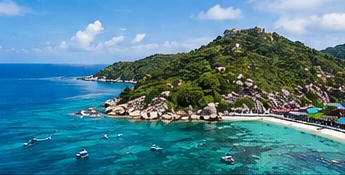
Choose Aow Leuk for a focused bay visit
Look closely instead of swimming further
Aow Leuk, also written Ao Luek, is a southern-east-coast bay known for a sandy centre and reef along its sides. Koh Tao's local guide describes the bay's setting and shore-snorkelling appeal. None of that removes the need to inspect the day's wind, visibility and entry route. [9]
For a useful visit, decide where you will enter and where you will come out before putting on the mask. Keep the first swim short so you can judge comfort and equipment. Afterwards, you can extend the visit without committing the whole group to a distant return swim.
The appeal is not necessarily covering the greatest distance. Watching a small area carefully can reveal more than moving quickly along a coastline. It also makes it easier to keep track of your companion and your position relative to the beach.
Check how the access arrangement works
Different approaches through surrounding businesses may have their own charges or conditions. Ask what payment covers before using facilities, and do not interpret an unlocked gate as an invitation to cross private property. I have not repeated an old admission figure as a guaranteed current price.
Pair Aow Leuk with an easy meal or a nearby southern outing, but avoid an elaborate sequence of paid beach entries. One bay enjoyed properly can be more satisfying than three that become a succession of parking, changing and repacking.
Watch wildlife at Shark Bay without chasing it
Treat sightings as a possibility
Shark Bay, also known as Thian Og, appears in local snorkelling itineraries for the possibility of seeing turtles and blacktip reef sharks. Oxygen's published routes include the bay, but a named stop cannot promise what animals will appear or whether conditions will allow a visit. [2]
A good wildlife experience begins with restraint. Let animals choose their distance, avoid surrounding them and never try to touch, feed or block their movement. Green Fins specifically advises against chasing marine life and feeding fish. [16]
If seeing wildlife is your main reason for entering the water, consider a responsible guide rather than swimming further out because someone points at a dark shape. Explain your confidence level, use appropriate flotation when needed and agree how the group will stay together.
Do not turn a swim into a hunt
The quality of the outing is not measured by how close you get to an animal. A calm view from a respectful distance is enough. Equally, a swim with no turtle sighting can still offer interesting fish, light and coastal scenery.
Check the exact shore access and any current charge through the business you use. Also, leave a straightforward route back to your accommodation. Wildlife-focused outings can absorb more time than expected, so do not place an inflexible transfer immediately after the hour when you hope a turtle might appear.
Climb John-Suwan Viewpoint only when the footing suits
Short does not mean effortless
John-Suwan Viewpoint is at the southern end of Koh Tao, looking back across the island towards neighbouring bays. Local route information describes a short walk with steep sections and rocky ground. That makes it a small hike or scramble, not simply a roadside photo stop. [10]
Wear shoes with grip, carry water and leave your hands free where possible. A compact bag is more useful than loose items that need constant attention. Then keep enough time for the descent; going down wet or awkward ground can be less comfortable than going up.
For a first visit, I would choose a dry daylight window rather than building the day around a sunrise or sunset attempt. The photograph is not worth discovering the route in darkness or rushing back down because a driver is waiting.
Know when to choose another view
Travellers uncomfortable with heights, scrambling or uncertain balance should ask about the actual route before starting. Admission arrangements can also change, so check locally rather than assuming an older quoted fee is still valid.
A southern beach lunch or a comfortable cafe view can be a better alternative without making the day second best. If you do climb, combine it with one nearby stop rather than adding every southern beach afterwards. The viewpoint already gives you a broad sense of the island; you do not need to visit every bay visible from it immediately.
Enjoy Sairee at walking pace
An easy evening can be a highlight
Sairee is one of the island's best-known beach areas, with accommodation and places to eat identified in Tourism Thailand's destination information. It works well as a deliberately low-effort part of a trip otherwise shaped by courses, boats and transfers. [1]
Choose a stretch near where you are staying or being dropped off, then walk only as far as feels enjoyable. Pause for a drink, find somewhere for dinner and let the evening develop without a strict sequence of venues. The western outlook makes it a natural place to look towards the sunset, although cloud decides the display.
For solo travellers, an easy evening among open businesses may be preferable to returning from an isolated viewpoint after dark. Groups should still agree a meeting point and keep track of each other rather than assuming everyone will find the same restaurant eventually.
Separate the view from the swimming decision
A pleasant beach scene does not guarantee a suitable swimming area at that moment. Watch for boats, local activity and changing conditions, and do not enter the water after drinking. The beach remains useful as a place to sit even when swimming is not the right option.
I would keep at least one Sairee evening free of advance reservations. It is a chance to absorb the day rather than move straight to the next scheduled experience. That breathing space becomes particularly valuable during a multi-day diving course.

Try a short kayak or paddleboard session in suitable water
Think small before thinking around-the-island
Paddling offers a different perspective on the coastline, but it is still a water activity rather than a guaranteed easy alternative to swimming. Local Tanote Bay information lists kayak availability; actual rental locations, equipment and conditions should be checked on the day. [8]
For a beginner, the useful version is a short session in an area the provider considers suitable, with a fitted buoyancy aid and clear instruction. Ask about the allowed boundary, wind direction, return time and what to do if you struggle to get back.
Do not treat a destination visible across the water as an appropriate independent route. Wind, boat traffic and fatigue can make the return harder than the outward paddle suggests. A guided session or simply remaining near the agreed launch area may be the better choice.
Keep the outing separate from diving plans
A calm-looking morning is a reason to seek current local advice, not a promise that conditions will remain unchanged. If a provider advises against launching, choose a land activity instead of looking for someone with looser rules.
Bring only belongings you can protect and secure, and avoid letting a phone photograph distract you from your position. My suggested first session is intentionally modest: learn the basics, enjoy the view and return with energy left. An independent coastal expedition belongs in a different category of planning.
See the granite landscape with a climbing instructor
A structured introduction rather than improvised scrambling
Koh Tao's granite is not only a backdrop to beaches. Goodtime Adventures publishes a beginner Discover Rock Climbing experience lasting approximately four hours, with instruction, climbing equipment and transfer from its meeting point to the climbing area. Its advertised starting price was THB 2,600 when checked on 2 October 2026. [11]
This is a useful option for travellers who want an active land-based day. Ask about the approach walk, route choice, group size, equipment fit and the weather policy before booking. A beginner session should be matched to the participants rather than to an impressive photograph on the sales page.
Wear suitable clothing and follow the provider's footwear and water instructions. If you have a relevant injury or limitation, explain it in advance so the operator can assess whether the session is appropriate. Do not rely on a generic statement that an activity suits everyone.
Leave room to enjoy learning
For someone new to climbing, the success of the day may simply be becoming comfortable with the harness, rope and first route. There is no need to reach the hardest line or compete with another participant.
I would avoid booking this immediately after a demanding diving programme or before a rushed ferry departure. Although it is a half-day product, getting ready, reaching the meeting point and recovering afterwards use more time than the headline duration alone.
Take a Thai cooking class with a usable menu
A land-based experience with a clear result
Thai Cooking with Joy publishes a roughly three-hour join-in class teaching three dishes, priced at THB 1,500 per person when checked on 2 October 2026. Its programme page places the school in South Sairee and explains that menu choices depend on the booking arrangement. [12]
Before booking, look for dishes you will realistically cook at home. Ask how to substitute ingredients, control chilli and recognise when a paste or stir-fry is ready. Understanding a handful of decisions makes the lesson more useful than collecting a long recipe booklet.
Let the school know about allergies or dietary requirements early. Also, confirm whether a requested adaptation can be made safely in the same kitchen. A menu description alone cannot establish that a meal is suitable for every participant.
Use it as more than an emergency rain plan
A class can provide a welcome change of pace during a beach-and-diving stay. However, it deserves a place in the itinerary on its own merits rather than only being considered when an excursion is cancelled.
Allow room to enjoy the food and conversation afterwards. Then keep the evening flexible, especially if you normally eat early. Couples or small groups comparing a private class should calculate the actual group total and confirm who participates rather than assuming the per-person price works out the same way.
Choose reef learning over a souvenir wildlife encounter
Ask what useful participation involves
New Heaven's conservation programme combines marine-learning sessions with supervised practical diving. Its current course description runs from three days upwards and states an advanced-level qualification or equivalent as a requirement. It should not be described as a universal drop-in activity for an unqualified holidaymaker. [13]
For an eligible diver, it offers a different reason to spend time underwater: observation, identification and learning how conservation work is organised. Ask which part of the programme will run during your dates, what skills are required and what you will actually do.
A photograph beside a coral project is not the same as useful conservation work. The most responsible contribution may be learning a survey method, following a no-touch approach or supporting an established activity rather than handling coral yourself.
Non-divers still have meaningful choices
Ask local organisations about any supervised public events that genuinely welcome visitors. Do not assume a beach cleanup, talk or volunteer activity is available every day. An enquiry before arrival is better than turning up with expectations a small team cannot meet.
Meanwhile, careful everyday behaviour needs no special booking: avoid litter, leave shells and marine life where they are, and choose operators that explain responsible practices. The value lies in how you behave throughout the trip, not in buying a conservation label for one afternoon. [16]
Build three different itineraries instead of one overloaded list
Three full days without scuba diving
This sample assumes you are already on the island and have three full days before departure. It is an editorial sequence, not a timetable. Move the main water activity to a suitable day and keep a land-based replacement available.
| Day | Main experience | Easy addition | Sensible limit |
|---|---|---|---|
| 1 | Guided snorkelling, with the route chosen carefully | A relaxed meal afterwards | Do not add a distant viewpoint |
| 2 | John-Suwan in suitable conditions and one southern bay | A short cafe or beach pause | Leave the climb optional |
| 3 | Cooking or guided climbing | Sairee towards sunset | Keep an unhurried evening |
If the snorkelling route does not include Nang Yuan and the sandbar is your priority, replace the third day's main activity with that visit. Do not force both into a day that already has a fixed afternoon commitment.
A stay built around learning to dive
Arrive before the course begins, complete the provider's full programme and keep the following day flexible. Add short meals and gentle beach time around training rather than treating the course as something you can fit between tours. A longer stay is useful when you want a separate Nang Yuan visit as well as certification.
Count actual calendar days, not only nights. Arriving at lunchtime on day one and leaving early on day four may not provide the training and onward-travel buffer you imagined from a three-night booking.
A quieter five-day version
Combine one snorkelling outing, one beach day, one land activity and one viewpoint or Nang Yuan visit, leaving another day open. The spare day can absorb a weather change or become a return to your favourite place.
For couples with different interests, schedule separate activities on one day and agree a shared evening. One person can dive while the other cooks or relaxes, without either feeling obliged to buy an activity that does not interest them. That often produces a better holiday than searching endlessly for a single tour both will tolerate.
Understand the price of the experience you are buying
Compare like with like
These operator-published examples were checked on 2 October 2026. They are a planning snapshot, not live quotes or a recommendation based on price alone. Confirm availability and the complete inclusion list directly before booking.
| Published example | Amount | Time or outcome | Important distinction |
|---|---|---|---|
| Koh Nang Yuan admission | THB 250 per person | Access during its visitor window [4] | Boat transport is separate unless included |
| Big Blue introductory scuba | THB 3,800 per person | One-day experience [5] | Not the full Open Water qualification |
| Big Blue SSI Open Water | THB 12,000 per person | Approximately 2.5 days of training [6] | Requires completion of the course |
| Goodtime Discover Rock Climbing | From THB 2,600 per person | Approximately half a day [11] | Ask about approach, transfer and weather |
| Thai Cooking with Joy join-in class | THB 1,500 per person | About three hours and three dishes [12] | Confirm the booked menu and adaptations |
The cooking and introductory climbing examples total THB 4,100 per person using the prices checked on 2 October 2026. That arithmetic excludes accommodation, food outside the class, other transfers and any extras. It is useful as the cost of two selected activities, not as an estimate for an entire island stay.
Where small omissions make a difference
Check whether a snorkelling quote includes Nang Yuan admission, pickup from your actual accommodation and the equipment you need. Likewise, a diving quote should identify the unit: per dive, per outing or per completed course. These are more useful comparisons than assuming every cheaper listing is the same product.
I would pay for clarity where it prevents a missed pickup or unsuitable activity. Elsewhere, save by doing fewer things well. A relaxed beach day does not become inferior simply because it costs less than another organised tour.
Choose a base and transport plan that match your activities
Reduce repeated journeys before arrival
A base near your school or regular meeting point can simplify a diving holiday. For a non-diving stay, consider walkable food, access to your chosen beaches and an easy arrangement for occasional taxis. A remote scenic room may be ideal for staying put but less convenient for several early departures.
Ask each activity provider where you need to be, not just whether pickup is advertised. Some transfers operate from fixed meeting points, and an isolated property's access can change what is possible. Save the details and an offline map before leaving reliable Wi-Fi.
Do not learn to ride on holiday roads
Koh Tao's steep approaches make vehicle choice a meaningful decision. Local bay information notes steep sections, while the FCDO warns about road safety, licensing and insurance in Thailand. Being offered a motorbike by a rental business does not establish that you are qualified or covered to use it. [8] [15]
Use arranged taxis or appropriate boat transfers when those solve the journey more safely for you. For a short stay, the apparent freedom of a rental can be outweighed by parking, difficult access and the worry of returning along an unfamiliar road after dark.
Keep ferry days lighter than sightseeing days
Check the exact route, departure point and conditions with the operator. Lomprayah's booking system covers island services, but a general route description is not a guarantee that every departure fits your date or onward connection. [17]
I would avoid booking an expensive activity shortly after the inbound ferry. Delays, finding your accommodation and simply recovering from the journey can use the time you expected to spend on the beach. On departure day, keep belongings dry, allow the stated check-in time and do not rely on the final possible connection before a flight.
Weather, children and mobility: choose the suitable version
Let the day's conditions change the choice
Tourism Thailand's general destination information favours particular seasonal windows, but a seasonal overview cannot tell you which bay will suit tomorrow. Wind direction, waves and local access matter to the actual activity. [1]
Ask the operator about conditions and accept a cancellation when appropriate. A cooking class or a restful land-based day is a sensible replacement for an unsuitable sea trip. Hiking on wet granite is not automatically a safe fallback simply because you have left the boat behind.
Ask practical access questions
For families, start with session length, shade, toilets, equipment fit and the amount of supervision available. For mobility needs, ask about steps, ladders, wading, the landing surface and the walk from vehicle to activity. A label such as family friendly or easy is not enough detail to make the decision.
Explain what assistance is needed and ask for a description or photograph of the boarding point. Then consider the return as well as the outward journey. Getting onto a boat when fresh and dry can be different from climbing back aboard after time in the sea.
Keep a non-swimming option genuinely enjoyable
Someone who does not wish to swim should not automatically be booked onto an all-day snorkelling boat. Check whether there is a comfortable way to remain aboard and whether that sounds enjoyable to them. A separate cooking class, short local outing or beach-based day may be a better use of their time.
Protect the gap between diving and flying
Calculate from the last dive, not from checkout
DAN's guidance for symptom-free recreational divers recommends a minimum interval of 12 hours after one no-decompression dive and 18 hours after multiple dives in a day or over multiple days. Longer intervals reduce risk further; these minimums do not guarantee safety. Follow your dive professional's advice and any more conservative requirements that apply to your diving. [14]
Count backwards from the actual flight, using the time your final dive ends. A ferry journey does not automatically provide enough buffer just because you have left Koh Tao. Equally, a course timetable and a flight booking need to be checked together before paying for either.
Pros and cons of an activity-led Koh Tao holiday
What makes the choice rewarding
The strongest feature is the range of ways to engage with the sea. A short try-dive, a full qualification, a guided snorkelling day and a careful shore visit can suit different interests without pretending to be the same experience. Land-based cooking and climbing also give the stay a useful change of pace.
A multi-day activity can create structure and a sense of progress. For someone who wants to learn a skill, that may be more satisfying than moving to a new island every other night. Non-divers, meanwhile, can create a varied stay without committing to a course.
What can make it frustrating
The compact appearance of the island can conceal steep journeys, awkward boarding and activities that require more preparation than their photographs suggest. Sea conditions may change plans, and a qualification course is not compatible with treating every day as completely spontaneous.
My judgement is that Koh Tao works best when you choose a clear emphasis and leave some flexibility around it. It is less rewarding when you expect to dive, snorkel, climb, visit every bay and catch a flight within a few tightly packed days.
Common mistakes that make the trip harder
Buying the wrong departure island
Some excursions marketed with Koh Tao in the title start on Koh Samui or Phangan. Read the meeting point and return destination. The attraction name does not tell you where the boat leaves, and discovering the difference on the morning of departure can waste the whole booking.
Assuming every snorkelling trip includes Nang Yuan
Compare the actual route and admission arrangements. A shorter coastal programme can be an excellent product while deliberately leaving out the island. Choose it for that purpose rather than assuming a familiar photograph means the viewpoint is included.
Planning a course around spare fragments of time
Training has required sessions and skills. Do not book sightseeing, a late party or an early ferry that interrupts it. Ask about the complete schedule and the possibility of extra practice before deciding how many nights to stay.
Chasing a wildlife promise
There is no reliable appointment system for turtles or sharks. Pick the quality of the guide, the treatment of animals and the suitability of the water rather than a guarantee that should not have been made in the first place.
Koh Tao activities: detailed FAQs
Is Koh Tao worth visiting if I do not dive?
Yes, particularly if you enjoy beaches, snorkelling, coastal scenery or learning something on land. I would combine one carefully chosen boat trip, one bay, a viewpoint when suitable and a cooking or climbing session. There is no requirement to learn scuba simply because it is prominent on the island. However, be realistic if neither beaches nor water-based activities interest you much.
Should I book a try-dive or an Open Water course?
Choose the introductory experience when you want to discover how diving feels without committing to a qualification programme. Choose Open Water when certification is a genuine goal and you can give it the necessary time and attention. Discuss confidence, swimming ability and the medical questionnaire with the school; price alone is not the right way to decide.
Can I visit Koh Nang Yuan at sunrise?
The island resort's published day-visitor window is 10:00-15:00, checked on 2 October 2026. Overnight guests have different access. A taxi-boat booking does not give an independent visitor permission to arrive outside the stated hours, so confirm the current arrangement rather than relying on sunrise advice written for people staying on the island. [4]
What is the best activity for a nervous swimmer?
That depends on why swimming feels uncomfortable and what support is available. Speak to a qualified activity provider before booking and ask exactly how supervision and flotation work. Do not assume a large snorkelling boat automatically gives individual assistance. A land-based class or a beach visit without entering the water is a valid and enjoyable choice.
How many days should I stay?
For a non-diving first visit, I would allow at least three full days when possible, with five offering more flexibility. A diving course needs its actual schedule, arrival time and onward-flight buffer built into the booking. These are editorial planning suggestions rather than rules: the right length depends on whether you are sampling activities or learning a skill.
Are beach entrances and viewpoints always free?
No single rule covers every access route or facility. Some approaches pass through businesses, and charges or conditions may change. Ask what the current payment covers before using the route, chair or facilities. Do not assume a figure from an older blog remains correct, and do not look for unofficial shortcuts across private property to avoid a charge.
My recommendation: choose one main experience and protect the easy hours
For a non-diving first visit, I would choose a well-matched snorkelling trip, one southern or eastern bay, a suitable viewpoint and a relaxed Sairee evening. Add a cooking class for contrast, or replace a beach block with guided climbing if that interests you more.
For an aspiring diver, make the course the centre of the stay. Choose a school that answers your practical questions, allow the required sessions and keep enough room afterwards for onward-travel advice. An activity that teaches a lasting skill does not need to compete with every attraction in the same few days.
Above all, treat the sea, terrain and wildlife as conditions to respect rather than items a booking must deliver. Koh Tao is easier to enjoy when a changed bay, a missed animal sighting or an extra rest day does not feel like failure. A few well-chosen experiences will give the trip more shape than a crowded list you are constantly trying to catch up with.
Sources and fact-checking notes
Research reviewed on 2 October 2026. Official tourism information and operators’ own pages support destination and booking details; local guides help with coastal context. Published costs are dated examples, not quotes for your travel dates. Suggested day plans and visit lengths are editorial judgement, not claims of a first-hand visit.
- Tourism Authority of Thailand: Ko Tao (Official tourism; reviewed 2 October 2026).
- Oxygen Tour: regular morning snorkelling trip (Direct tour operator; reviewed 2 October 2026).
- Oxygen Tour: early-bird snorkelling trip (Direct tour operator; reviewed 2 October 2026).
- Nangyuan Island Dive Resort: day-visitor information (Direct island operator; reviewed 2 October 2026).
- Big Blue Diving: Basic Scuba Diver experience (Direct dive operator; reviewed 2 October 2026).
- Big Blue Diving: SSI Open Water course (Direct dive operator; reviewed 2 October 2026).
- Big Blue Diving: planned guided-dive schedule (Direct dive operator; reviewed 2 October 2026).
- Koh Tao Complete Guide: Tanote Bay (Local destination guide; reviewed 2 October 2026).
- Koh Tao Complete Guide: Aow Leuk (Local destination guide; reviewed 2 October 2026).
- Koh Tao Complete Guide: viewpoints (Local destination guide; reviewed 2 October 2026).
- Goodtime Adventures: Discover Rock Climbing (Direct activity operator; reviewed 2 October 2026).
- Thai Cooking with Joy: class programme (Direct school; reviewed 2 October 2026).
- New Heaven Reef Conservation: three-day programme (Direct conservation provider; reviewed 2 October 2026).
- Divers Alert Network: flying after diving (Diving safety organisation; reviewed 2 October 2026).
- UK FCDO: Thailand safety and security (Government travel advice; reviewed 2 October 2026).
- Green Fins: snorkellers environmental best practice (Conservation organisation; reviewed 2 October 2026).
- Lomprayah: ferry booking and routes (Direct ferry operator; reviewed 2 October 2026).
Illustrations in this article were created for Taylor’s Trailblazing Travels. Third-party photographs, where used, are credited beside the image or in the source list.