Best Things to Do in Kanchanaburi
Choose a few memorable experiences, understand the distances and leave room to enjoy them.
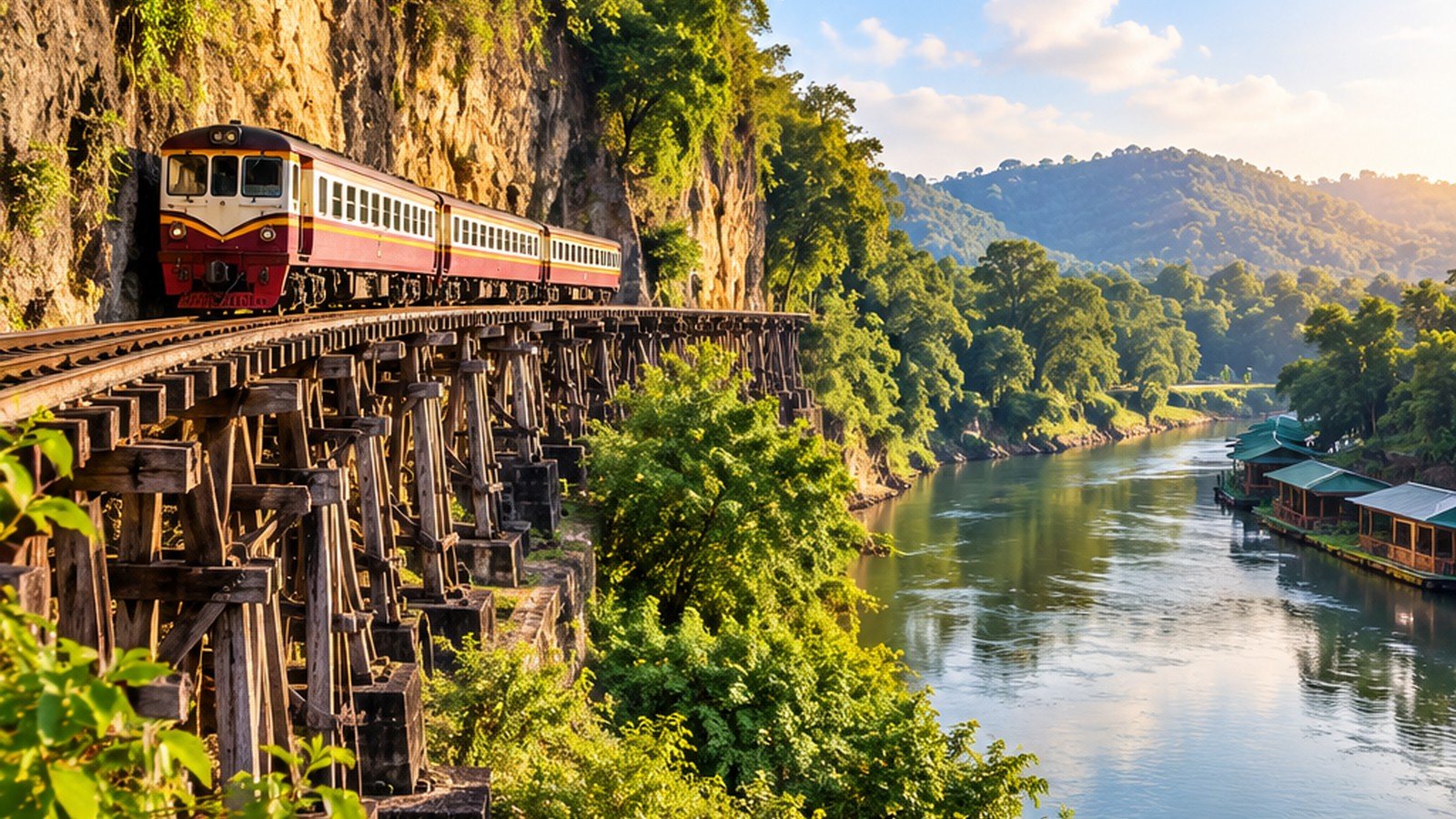
Original illustration inspired by the Tham Krasae railway landscape; not a survey of track or visitor access.
Make the trip work for you
The best things to do in Kanchanaburi are not all variations on the famous bridge. A good visit can combine careful remembrance, a changing view from a train window, older archaeological sites and time beside water. The challenge is choosing experiences that fit together without turning the province into a checklist of long drives. This guide separates the town sights from the larger outings and explains when a place deserves a whole morning, a short stop or another visit.
You will find practical ways to choose between Erawan and a rail-led day, suggestions for adding heritage and quieter scenery, and accommodation experiences that need their own time. The recommendations are based on current source checks and planning judgement, not claimed personal visits. Importantly, a place can be historically significant without being open today: Hellfire Pass remains on the future-interest list while its official closure is in force.
This guide contains affiliate links. If you book through one, Taylor’s Trailblazing Travels may earn a commission at no extra cost to you. Choose the option that suits your trip; paid bookings are not required to use this guide.
Railway Centre + cemetery
Give the subject time before visiting the bridge.
Erawan
Choose a comfortable walking limit, not a compulsory summit.
Tham Krasae rail section
Confirm the precise segment and the return.
A river stay
Treat transfer time as part of the accommodation decision.
Planning note Status check, 4 October 2026: Hellfire Pass Interpretive Centre and walking trail are temporarily closed until further notice. [1]
How to choose the best things to do in Kanchanaburi
Start with the map, not an attraction count
Kanchanaburi rewards a mixed itinerary, but its attractions do not form one walkable sightseeing district. The town, the Khwae Noi railway corridor and the Erawan side of the province create different days. A list that treats them as neighbouring stops can make even a short selection exhausting. The Tourism Authority of Thailand identifies the rivers and the wider province’s varied historical and natural sites; the planning groups here translate that geography into useful choices. [2]
This selection is research-led. Places are included for their historical importance, distinctive landscape, cultural interest or usefulness in building a balanced visit. The order groups related experiences rather than pretending to be a measured popularity ranking. Travel and visit durations below are editorial planning ranges, not precise driving measurements or guaranteed access windows.
| Experience group | Allow initially | Best reason to choose it |
|---|---|---|
| Town history and bridge | Half to one full day | Understand the railway before seeing its best-known structure |
| Erawan forest and falls | Most of a day from town | Walking, scenery and permitted swimming |
| Railway and Mueang Sing corridor | One carefully planned day | A scenic journey with a different layer of history |
| Temple and old-town visits | A flexible half day | Add cultural variety without another major excursion |
| Remote river accommodation | An overnight, preferably longer | Make the setting itself part of the trip |
Balance one demanding outing with something gentler
Choose one major excursion before adding smaller stops. A museum-and-river afternoon can sit comfortably beside a waterfall day, while three lengthy outdoor outings in succession may become repetitive. Also consider the emotional weight of wartime sites: thoughtful visits need more than a few minutes between photographs.
Visit the Thailand-Burma Railway Centre
The most useful starting point for the wartime story
The Thailand-Burma Railway Centre provides context that the bridge alone cannot. Its exhibitions explain the railway and the experiences of the people forced to build and maintain it. Allow roughly 90 minutes if you enjoy reading displays; a rushed half-hour is likely to miss the reason for coming. The operator’s current visitor page lists 09:00-16:00 daily, adult admission THB 160 and admission THB 80 for children aged 7-12, checked 4 October 2026. [3]
Rather than treating the museum as a prelude to the photograph you came for, choose one or two themes to follow: engineering under coercion, medical conditions, camp life or the consequences for families. That gives a large subject a manageable focus. A guided introduction can help, but allow some independent time so everyone can read at their own pace.
Pair it with one nearby stop
The main war cemetery is the natural partner because it is in the same area. After both, leave room for lunch or a quiet break. You do not need to visit every museum bearing railway or war in its name to understand that the subject is complex.
Check the exact establishment when booking transport. Similarly named museums around town are not interchangeable, and a driver may default to the one on a standard tour route. Save the museum’s full name and location rather than asking only for the Death Railway museum.
Pay your respects at Kanchanaburi War Cemetery
A place to slow down
The Commonwealth War Graves Commission’s Kanchanaburi War Cemetery is a memorial landscape rather than an attraction designed around entertainment. It commemorates men who died in connection with the railway, with carefully maintained graves and information that can support a more personal understanding of the wider history. Use the Commission’s records if you are looking for a particular person. [4]
A short, respectful visit can be meaningful. Read individual names and ages rather than trying to absorb the scale only through a panoramic photograph. Keep to paths, allow relatives privacy and avoid using grave markers as places to sit or put bags. Where children are visiting, explain before entering why voices and behaviour should change.
Make a family-history visit different from a general stop
If a relative is commemorated here, research the grave reference beforehand and allow more time than a standard tour might provide. Tell your guide that this is a personal visit, not a quick scheduled stop. A group that leaves after ten minutes may not give you the space you need.
Conversely, travellers without a personal connection need not manufacture one. It is enough to visit with attention and respect. The value lies in recognising the individuals and the circumstances, not in having the most elaborate story to accompany the visit.
See the Bridge over the River Kwai
Understand what you are looking at
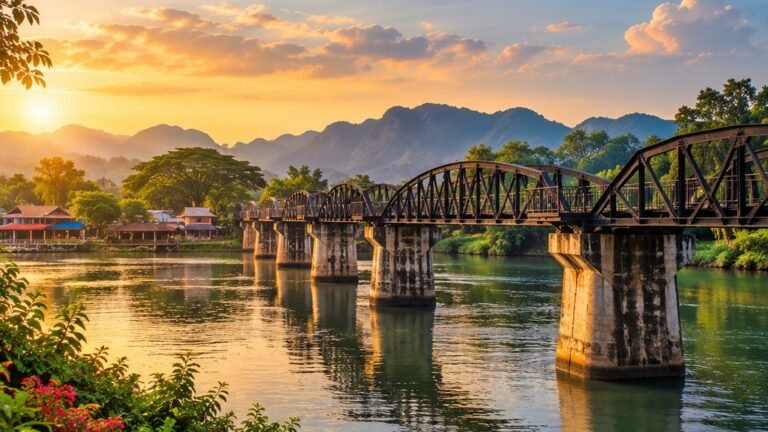
The bridge is the image most visitors associate with Kanchanaburi, but it is best approached after reading about the railway. Seeing the river, the line and the surrounding town helps place the landmark in a landscape rather than leaving it as an isolated film reference. It also makes clear that a bridge visit is not the same as riding the line through the countryside. [2]
Allow approximately 45-60 minutes for an ordinary visit, with longer for a meal nearby. There is no need to force a particular sunset slot into an otherwise awkward day. Cloud cover, water level and the available public viewpoints can matter more than the minute you arrive.
Treat it as a working railway
Follow barriers and instructions, and stay away from the line when trains move through. Do not stand in a position that requires you to calculate whether an approaching train will fit beside you. A photo from a proper public viewpoint is the sensible choice, particularly with children or anyone unsteady on uneven surfaces.
The bridge neighbourhood can be a convenient accommodation base for a short visit. However, proximity to the bridge does not put you within walking distance of every town museum, the bus terminal or the rural attractions. Choose a hotel for the entire trip, not one photograph.
Ride the scenic railway near Tham Krasae
Make the journey the main event
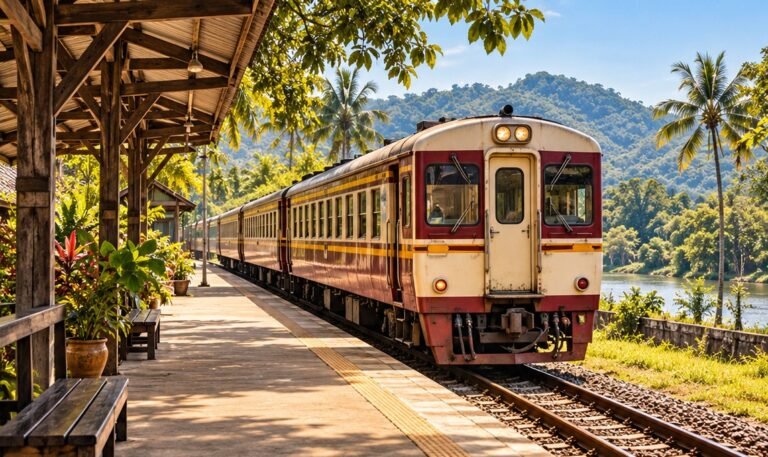
The section around Tham Krasae is valued for the line’s relationship with the cliff and river. The experience is looking out from a working train as the scenery changes, not merely arriving at a named station. Before choosing a trip, establish exactly which section you will ride, how long you will be aboard and how you will leave the final station. [2] [5]
Some itineraries use road transport to reach the scenic section and collect travellers afterwards. Others begin with a much longer train journey from town. Neither is inherently the correct version, but they use time differently. A short segment can suit a mixed sightseeing day; a longer ride is more appropriate when rail travel itself is your priority.
Check the practical details before boarding
Have water, sun protection and a small bag you can keep with you. Use the seat and window safely; do not lean outside to improve a photograph or crowd a doorway. An ordinary service should not be mistaken for an air-conditioned sightseeing coach with guaranteed seating and commentary.
Confirm the current timetable with SRT or the operator rather than designing the return around an old screenshot. Where a driver is meeting you, record the station name and meeting point in writing. A missed connection at a rural stop can be a much larger problem than a short delay in town.
Spend a proper morning at Erawan National Park
Choose the experience, not the summit count
Erawan’s appeal is its layered waterfalls, woodland paths and pools. You can enjoy a shorter lower-tier visit without reaching the highest point. Conversely, a more ambitious walk needs enough time to descend safely and meet your return transport. The park’s official page provides contact and accommodation information; use it to check restrictions rather than assuming that a general opening notice guarantees every activity. [6]
Plan around your group’s slowest comfortable pace. A series of short climbs, wet steps and stops for photographs can take longer than the distance suggests. Start by deciding how long you want to spend in the forest, then work backwards to a suitable departure from town. A midday arrival is less flexible than a morning one.
Admission and access are separate questions
Thai National Parks, an independent licensed tour operator rather than the government park authority, lists foreign adult admission at THB 300 and general hours of 08:00-16:30 in its June 2026 update, checked 4 October 2026. Confirm child concessions and any vehicle or activity charges locally because published summaries are not fully consistent. [7]
Paying admission does not mean every pool is open. Follow current swimming instructions, use required flotation equipment and stay out when water conditions or staff directions rule it out. The attraction is still a forest landscape, not a controlled swimming pool with identical conditions every day.
Explore Mueang Sing Historical Park
Add an earlier layer of history
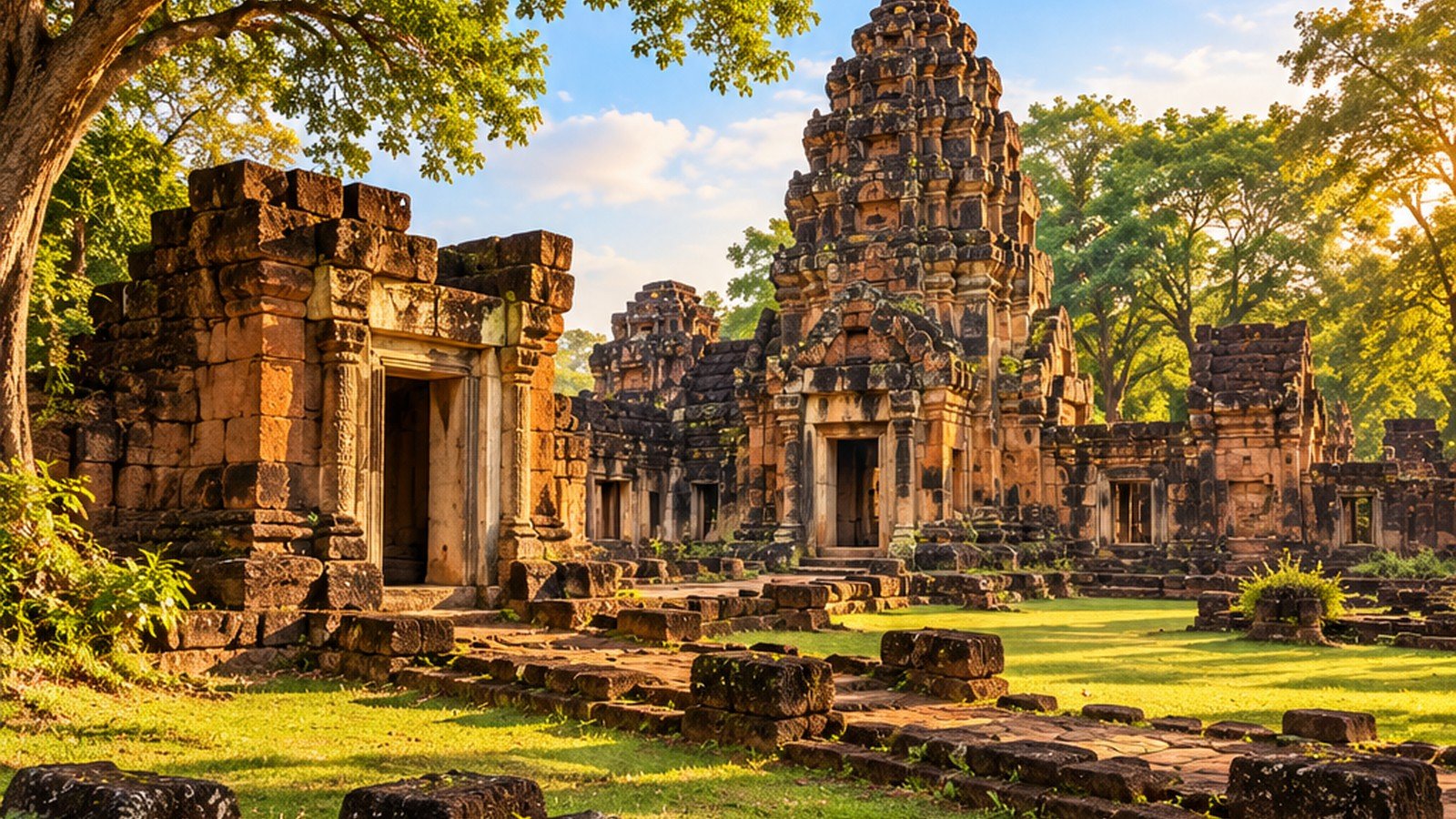
Mueang Sing broadens a visit beyond the twentieth-century railway. The Fine Arts Department describes an archaeological site on the Khwae Noi, including the ancient settlement and its religious architecture. Its laterite structures, open ground and surviving layout offer a different kind of experience from a busy working temple. [8]
Allow roughly 60-90 minutes, longer if you enjoy the explanatory material. Walk slowly enough to notice the relationship between the structures rather than photographing one doorway and leaving. A guide can help distinguish what is surviving fabric, what has been restored and what archaeologists infer from the site.
Combine it geographically, not indiscriminately
This is a more natural partner for a railway-corridor outing than for a tightly timed Erawan visit. Nevertheless, check the actual road route and remaining time rather than assuming two places on the same side of the province are adjacent. Lunch, station waits and walking inside a site are part of the day too.
Tourism Authority of Thailand’s Thai-language entry lists foreign admission at THB 100 and opening from 07:30 to 16:30, checked 4 October 2026. Treat that as a dated visitor listing and reconfirm before a late-afternoon arrival. Avoid touching fragile masonry or climbing where access is not expressly permitted. [9]
Keep Hellfire Pass on the right kind of list
Important, but not currently an open attraction
At the 4 October 2026 review, the Australian Department of Veterans’ Affairs states that Hellfire Pass Interpretive Centre and its walking trail are temporarily closed until further notice because of heavy rain and unsafe conditions. Its importance does not justify presenting it as an available stop while that notice remains in force. [1]
For a future visit after reopening, give the site an appropriately unhurried place in the itinerary. It is outside town and combines interpretation with a memorial landscape. A personal connection, the conditions underfoot and the amount of trail you intend to cover all affect the time required.
Do not use a tour listing as a reopening notice
An old excursion description may continue to advertise a closed site. Ask the provider directly whether the visit is operating and check the official notice yourself. If another attraction replaces it, decide whether that is an acceptable substitution before paying.
During the closure, the centre’s official online material can support your understanding of the railway without requiring a journey to a locked entrance. That is a useful alternative for research, not a claim that a virtual experience is identical to being there. Keep the site on a future-interest list rather than forcing it into today’s route. [10]
Visit Wat Tham Suea with realistic access expectations
A temple outing beyond the town centre
Wat Tham Suea, sometimes written Wat Tham Seua, is in the Tha Muang area outside central Kanchanaburi. It is known for its large Buddha image and elevated setting. The Tourism Authority of Thailand’s Japanese-language listing places it roughly 16 km from Kanchanaburi station; this is an outing requiring transport, not a continuation of a bridge-area stroll. [11]
Wear clothing suitable for a working temple and take shoes that are easy to remove where required. Treat prayer areas as religious spaces even when the view is the reason you came. A quiet visit, with time to sit and observe, often feels more rewarding than rushing between the most photographed angles.
Confirm the climb rather than assuming assistance
The site includes steps. Online references to a lift or cable arrangement should prompt a question about current operation, not an assumption of guaranteed step-free access. Ask what route is available to the exact area you want to reach and whether assistance is suitable for your circumstances.
The same official listing gives 08:00-17:00 hours and free temple admission, checked 4 October 2026. This does not establish that every ancillary service is free or operating. Keep a small amount of cash for genuine optional expenses, and choose how much to climb according to the conditions and your own energy.
Walk Pak Prak's heritage streets
Look beyond the weekend stalls
Pak Prak is worth considering for its streetscape, not only for shopping. Tourism Authority of Thailand material highlights historic buildings with Chinese, European and Thai influences and information panels relating to the area’s past. A slow walk provides a useful contrast to museums because it places local history among buildings still connected with everyday life. [12]
Allow 45-90 minutes depending on the weather and how much you stop. Look for building details and readable information panels rather than wandering into private premises to find an imagined attraction. Where a shop is open, buy something because you want it rather than treating the owner as part of a staged heritage display.
Ask what is happening on your date
A market evening adds food and activity, but it is not interchangeable with an ordinary weekday walk. Confirm the operating day and whether rain has changed arrangements. A quieter visit can be enjoyable, provided that you were not expecting rows of stalls and a full programme.
Choose a meal in the area or return to your accommodation corridor; either can work. What matters is keeping the evening’s transport straightforward. Save your pickup point while it is still familiar, particularly if your hotel is on the other side of the river or outside the centre.
Consider Chungkai War Cemetery for a focused visit
A separate memorial, not a duplicate tick
Chungkai War Cemetery lies outside the immediate town-centre cluster. The Commonwealth War Graves Commission links it with the former camp and hospital, giving it a distinct context from the main cemetery. Choose it because you want that additional understanding or have a personal connection, not because every memorial must be collected on the same morning. [13]
The setting can encourage a quieter visit, but quietness is not a guarantee of privacy. Follow the same standards of respectful conduct as at the main cemetery. Before arrival, check the visitor access information, particularly if you need step-free entry or wish to locate a specific grave.
Give the journey a reason
A short private trip can make sense when paired with another appropriate stop on that side of town. However, ask for the actual road route. Rivers and bridges can turn a seemingly tiny map distance into a longer journey, so do not plan to stroll there solely on the basis of a pin near water.
For a limited first visit, the Railway Centre and main cemetery may be enough. Spending more time understanding those sites is often preferable to adding Chungkai in a hurry. For a family-history visit, reverse that judgement and give the personally relevant cemetery priority.
Make the river part of the trip without overbooking it
A bank-side meal can be enough
You do not have to buy an activity to enjoy the rivers. A room terrace, a public viewpoint or an unhurried restaurant stop may provide the pause the itinerary needs. Kanchanaburi’s two major river corridors shape both the town and the accommodation choices, but they are not one continuous strip of interchangeable hotels. [2]
For a restaurant visit, check where the entrance is, how you will return and whether the menu suits the group. A picture of a table beside water tells you little about steps, shade, music, insects or the route from the car park. Those practical details matter when the meal is meant to be relaxing.
Ask more before booking a boat outing
Confirm the route, boarding point, duration, weather policy and whether life jackets appropriate for everyone are provided. A sightseeing boat, a transfer boat and a water-sport activity are different purchases. Do not book a transfer expecting guided commentary or assume that being comfortable on a large boat means a small craft will feel the same.
In unsettled weather, a riverbank break is the simpler choice. Cancelled boating does not have to leave a gap if the surrounding day already has enough substance. Build flexible time into the plan instead of treating every hour without a booking as a problem to solve.
Stay overnight in a floating or riverside property
Turn accommodation into an experience deliberately
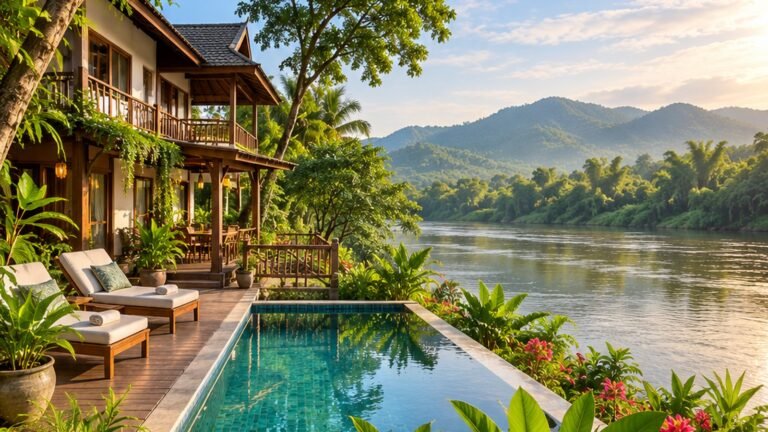
A remote riverside stay can be one of the most distinctive things to do in the province, but it should shape the itinerary. Sai Yok properties requiring a road transfer and boat access are not convenient substitutes for a hotel near the town station. Plan to arrive early enough to enjoy the setting rather than reaching it only for dinner and leaving immediately after breakfast. [14]
The difference between properties can be substantial. River Kwai Jungle Rafts describes a no-electricity model, while other floating accommodation offers a different level of in-room facilities. A floating room is therefore not a single product category with predictable comfort, charging or hot-water arrangements. Read the property’s own description before choosing. [15] [16]
Compare the full stay, not only the room
Ask what the rate includes: meals, shared boat transfer, activities and any extra-person charges. A lower room amount can be misleading when every essential transfer and meal is separate. Equally, an inclusive arrangement may be poor value if you intend to spend nearly the whole day elsewhere.
For families, enquire about deck barriers, water access, room layout and supervision. For anyone who needs regular power, refrigeration or reliable connectivity, obtain explicit confirmation rather than inferring facilities from the word resort. Choosing land-based accommodation is a perfectly sensible alternative.
Visit Ban Kao National Museum for a different time scale
Look beyond the railway era
Ban Kao National Museum focuses on prehistoric archaeological material from the area. The Fine Arts Department’s own history explains the museum’s role in collecting and presenting finds from Ban Kao and other Kanchanaburi sites. It offers a useful contrast to both the wartime museums and Mueang Sing’s surviving architecture. [17]
Choose it when you enjoy objects, evidence and the question of how archaeologists reconstruct everyday life. Pottery and tools can tell a different story from the large monuments that dominate a sightseeing list. You do not need specialist knowledge to find that interesting, but allowing time to read the interpretation makes the visit more worthwhile.
Check the practical visit before driving out
Confirm opening days, the current exhibition areas and admission with the museum before travelling. Do not assume it follows the opening pattern of every other museum in the province. The official contact page is a better starting point than an old itinerary that lists it between two unrelated attractions. [17]
As with Mueang Sing, give the museum a reason to be in the route. It suits a traveller interested in the region’s deeper history, not simply someone looking for another indoor stop to fill a spare hour. A smaller, thoughtful visit here may add more variety than a second museum covering ground you have already explored.
Add a Srinagarindra reservoir viewpoint, not another full excursion
A landscape pause on the Erawan side
The Tourism Authority of Thailand places Srinagarindra Dam in the same broad outing area as Erawan and describes the reservoir setting. This can make it a useful scenic addition when the route and remaining time suit, rather than a separate cross-province detour. [18]
Decide whether you want a brief viewpoint stop or a more substantial lake activity. Those are different time commitments. A driver pausing at an accessible viewpoint is not providing a cruise, and a cruise needs its own boarding, duration and safety checks. Keep the terminology clear when agreeing the itinerary.
Do not sacrifice the main visit for an extra pin
If your Erawan walk has taken longer than expected, omit the viewpoint rather than compressing the return into an anxious drive. Conversely, when someone does not want a long waterfall walk, a gentler landscape stop may improve the day. The value depends on how it fits the group, not whether it appeared in a photograph online.
Use designated public access and obey local barriers. A dam is infrastructure as well as scenery, so not every road, platform or water edge is intended for visitors. In poor weather, an exposed viewpoint may add little; a comfortable meal and an earlier return can be the more enjoyable option.
See the Giant Rain Tree as a short, considerate stop
Enjoy the canopy without making a full day of it
The Giant Rain Tree, also called the Giant Monkey Pod Tree, is a well-known large-canopy landmark in the Ko Samrong area. The national tourism directory identifies the site and its location, although its displayed opening-time fields are inconsistent; confirm access locally rather than relying on those fields. [19]
Treat it as a brief stop when you are already travelling on a sensible route nearby. The experience is the scale and shade of the tree, not a programme of activities requiring hours. A visitor who enjoys trees and photography may linger, while others may be satisfied with a short walk around the designated area.
Keep the living landmark intact
Avoid climbing, hanging from branches or using the roots as a platform for posed photographs. Stay within the areas open to visitors and give other people room to enjoy the view. A quiet, observant visit is more appropriate than treating the tree as equipment for a group photo session.
Check the road route before combining it with another attraction. Broadly being outside Kanchanaburi does not mean two sites are neighbours. It is most useful as a modest addition to a suitable southern-side outing, not as an automatic extra after a long day in the opposite direction.
Photograph the landscape without losing the visit
Separate a picture from a risky position
At the railway, use places intended for visitors and keep away from moving trains. Around waterfalls, prioritise secure footing over an uninterrupted view. At memorials and active temples, consider other people’s privacy and the purpose of the site before setting up a photograph.
A useful approach is to take a few pictures on arrival, then put the camera away for part of the visit. That helps the place become more than a set of images to organise later. A technically imperfect photograph is a better souvenir than an injury, a damaged structure or an intrusion into somebody else’s act of remembrance.
Keep animal encounters out of the impulse-buy category
Judge the activity, not its name
Kanchanaburi-area excursions may include animal interactions, but labels such as sanctuary or rescue do not establish how an experience operates. World Animal Protection recommends observation without riding, bathing or touching elephants. Use that as a concrete screening question rather than relying on attractive photographs or a provider’s adjective. [20]
Ask whether animals can move away, whether close contact is required, and whether the itinerary includes performances or tourist bathing. A vague answer about being ethical is not a substitute for describing the activity. If the provider will not explain the arrangement, choose an outing that does not include it.
Leave room to decline a bundled stop
Some packaged routes combine otherwise appealing history or landscape visits with an unwanted animal activity. Read the detailed schedule before payment and ask whether you can omit that part without being stranded. Do not assume that a guide can redesign the whole excursion after you arrive.
For many travellers, a forest walk, a railway ride and a riverside stay already provide a varied trip. There is no need to add an animal encounter to make the itinerary feel complete. Choosing not to participate is a clear planning decision, not a missed obligation.
Build a one-day, two-day or three-day visit
One day: stay selective
For a single day from Bangkok, choose either the town’s railway history or a nature-led excursion and be honest about the transfer. A tightly packaged trip might include several highlights, but compare the time inside each place with the time in the vehicle. Nevertheless, a fifteen-minute stop and a proper visit can carry the same attraction name in an advertisement.
A town-focused day might combine the Railway Centre, cemetery, lunch and bridge. By contrast, a waterfall-focused day needs an early departure and an acceptable return time. Do not assume there will also be enough energy for a late Bangkok booking afterwards. Starting tired makes the long return feel longer.
Two or three days: use the extra night well
With one night, pair town history with one larger outing. With two nights, a fuller sequence might be town history, Erawan and then a railway-corridor day, subject to transport and conditions. Alternatively, replace one sightseeing day with a remote river stay instead of trying to add it on top.
The extra night is most useful when it removes a rushed transfer or lets you begin outdoors earlier. It is less useful if you fill every added hour with another distant stop. Give each day a clear main purpose, one optional addition and a sensible finish.
Getting around and choosing tours
Distinguish town transport from provincial transport
Short local rides can connect the hotel, museums and bridge, but they do not solve a full day in the countryside. For each outlying destination, establish both the outward and return journey. A cheap ride to the entrance is not a complete transport plan when no suitable service remains later.
On public transport, keep the attraction list shorter and verify the last usable return. With a private driver, agree the route, hours, waiting time and any extra charges beforehand. With a guide, clarify whether interpretation is included or whether the booking is simply a driver and vehicle. The same word tour can conceal very different services.
Read an excursion from the bottom upwards
Start with exclusions, meeting point and return time before admiring the headline itinerary. Check whether admission, rail tickets, meals and pickup at your actual hotel are included. A package advertised from Bangkok may not collect from Kanchanaburi, and the reverse can also be true. Commercial listings are useful for comparison, but their availability and terms are date-specific. [21]
For an itinerary mentioning Hellfire Pass, obtain a current explanation of the closure and any substitution. Also ask how the operator handles heavy rain at Erawan. A clear cancellation or alternative plan is more valuable than a promise that every advertised stop will happen regardless of conditions.
Costs: spend on the part you cannot arrange easily
Keep admissions separate from transport
A useful budgeting method is to price the major transport first, then add the attractions you have genuinely chosen. The known visitor charges in this guide are dated examples, not a combined pass. A tour may already include them, so avoid adding the same admission twice.
As an illustrative exercise dated 4 October 2026, suppose two adults allocate THB 2,400 to a private vehicle for one day and THB 600 to lunch and drinks. Their shared base cost is then THB 1,500 each before admissions or other extras. These are assumed inputs, not market quotes. Replace them with your written offer to see whether a shared tour actually saves money.
Put the saving in the right place
For a solo traveller, a shared outing can spread vehicle costs. For several people, a private vehicle may become more competitive, especially when hotel pickups would otherwise require extra rides. However, do not divide a quote by the number of passengers until you know the vehicle can comfortably carry everyone and their bags.
Accommodation is another place where apparent savings can disappear. A remote bargain that needs several extra taxis may cost more over the whole stay than a room in the area you use most. Compare the combined cost of room, meals and transport rather than treating the room price as the complete decision.
Weather, footwear and current restrictions
Match the day to the forecast
The Thai Meteorological Department’s outlook reviewed on 4 October 2026 includes heavy-rain and flash-flood cautions. The FCDO also carries a severe-flooding notice affecting parts of Thailand, including Bangkok. These are reasons to check your actual route and activities, not to assume that every place in this guide is either open or closed. [22] [23]
Keep a museum or town option available when the main plan is outdoors. Nevertheless, a closed memorial trail is not a wet-weather substitute for a closed waterfall. Use actual opening information and local instructions to choose the replacement, and do not drive through flooded roads to preserve a booking.
Pack for surfaces as well as temperatures
Bring footwear suitable for uneven ground, with enough grip for damp paths. A small towel, dry clothing and a separate bag for wet items are useful for a waterfall day. For temples, carry appropriate covering rather than expecting every entrance to rent clothing in your size.
Save tickets and essential contacts offline. Mobile data helps with messages and pickup coordination, but it should not be the only way to find your hotel or show a reservation. A charged phone, a power bank and a written fallback contact reduce the inconvenience of a poor signal or an unexpectedly long day.
Pros, cons and common mistakes
Why Kanchanaburi can justify several days
The destination’s strength is variety: remembrance, working railway, archaeological remains, active temples and river landscapes can all contribute something different. The slower pace of an overnight stay also lets you visit town without treating it simply as a transfer point between famous attractions.
However, that variety comes with distance. A visitor who dislikes vehicle time may enjoy a carefully chosen town stay more than a provincial checklist. Heat, rain and access requirements also change which activities make sense. Plan for the person travelling, not for the longest list you can publish afterwards.
Avoid the misleading shortcuts
Do not assume all River Kwai accommodation is central, all waterfall tiers are open, or every tour includes the train ride implied by its title. Also avoid confusing similarly named museums and temples. Saving the full attraction name and map pin prevents several of these problems at once.
Another common error is visiting a memorial only because it appears beside a restaurant or photo stop. Give the history its own time and tone. Finally, resist the idea that a trip is incomplete because you left one famous site for another visit. A well-chosen omission often improves everything else.
Frequently asked questions
What are the three essential experiences for a first visit?
A useful starting combination is the Railway Centre and main cemetery as one historical block, the River Kwai bridge, and either Erawan or a scenic railway outing. This is an editorial selection for variety, not a universal ranking. Someone with a family connection to the railway may prioritise additional memorial research, while a nature-focused traveller might spend more time in the forest and less at the bridge.
Can I see Erawan and ride the train in one day?
Some organised itineraries combine them, but examine the detail. The amount of waterfall time, the exact rail segment and the total day length matter more than whether both names appear. A slower visitor or a group with children may prefer to separate them. Confirm which part is shortened if the train runs late or the road takes longer than expected. [21]
Is Hellfire Pass open now?
It was listed as temporarily closed until further notice at the 4 October 2026 editorial check. The closure covers the interpretive centre and walking trail. Consult the official notice again before travel because reopening depends on conditions. Do not rely on an old tour description, an undated recommendation or the presence of ordinary opening hours elsewhere on the same website. [1]
Are the attractions suitable for somebody with limited mobility?
Some visits can be adapted, but accessibility varies within each site. Ask about the route from vehicle to entrance, steps, surfaces, toilets, seating and the exact area you want to see. A temple’s lower area and its high viewpoint may have completely different requirements. Likewise, a floating hotel’s room may be spacious while its boat transfer is unsuitable. Obtain specific answers before booking.
Should I stay in town or on the river outside it?
Choose town when your priorities are museums, restaurants and flexible onward transport. Choose a remote riverside property when you are deliberately giving time to the stay itself and accepting arranged transfers and a narrower dining choice. A split stay can work with enough nights, but moving rooms during a short visit may consume more time than the change of scenery adds.
Is Kanchanaburi mainly a place for history enthusiasts?
No, although the wartime history deserves respectful attention. The rivers, forest walks, temple visits and quieter accommodation experiences give other reasons to visit. The most balanced plan usually acknowledges the history while leaving room for an activity that matches your own interests. You do not need to turn every day into either a museum circuit or an adventure programme.
Final recommendation: choose three anchors, then stop adding
Pick a historical anchor, an outdoor or rail anchor, and a comfortable base. Once those are in place, add only smaller activities that fit the geography and the available energy. That structure is more useful than treating every place in the province as an essential stop.
For most first visits, the best improvement is an extra night rather than an extra attraction. It gives the museums breathing room, makes an early outdoor start realistic and reduces the pressure on the return journey. Check closures, book the difficult transfers, and leave some space for simply being beside the river.
Sources and fact-checking notes
Source checks were completed on 4 October 2026. Official operators and public bodies are prioritised; independent specialists and commercial listings are identified below. Suggested visit lengths, budget exercises and route choices are planning judgements, not live availability or a record of personal visits. Recheck time-sensitive details for your date.
- Australian Department of Veterans' Affairs: Hellfire Pass visitor notice
Official closure notice, updated 29 September 2026: centre and walking trail closed until further notice. Checked 4 October 2026.
- Tourism Authority of Thailand: Kanchanaburi
Geography, rivers and wider provincial attractions. Checked 4 October 2026. Promotional minimum journey times are not used as door-to-door guarantees.
- Thailand-Burma Railway Centre: visitor information
Museum operator lists 09:00-16:00, adult admission THB 160 and children aged 7-12 THB 80. Checked 4 October 2026. Old transport prices elsewhere on this page are not used.
- Commonwealth War Graves Commission: Kanchanaburi War Cemetery
Primary source for the cemetery, commemorative context and visitor access. Checked 4 October 2026.
- State Railway of Thailand: official timetable search
Use exact origin, destination and travel date; includes service notices. Checked 4 October 2026. Live search availability was intermittent.
- Department of National Parks: Erawan park and accommodation
Official park contact and accommodation information. Checked 4 October 2026. Do not infer swimming or upper-trail access from the existence of the booking page.
- Thai National Parks: Erawan visitor guide
Independent licensed tour operator, not the Department of National Parks. June 2026 listing gives foreign adult admission THB 300, child THB 150 and general hours 08:00-16:30. Checked 4 October 2026; confirm concessions and access with the park.
- Fine Arts Department: Mueang Sing Historical Park
Official archaeological context and location on the Khwae Noi. Checked 4 October 2026.
- Tourism Authority of Thailand: Mueang Sing admission
Thai-language visitor entry lists foreign admission THB 100 and 07:30-16:30 hours. Checked 4 October 2026; reconfirm before travelling.
- Hellfire Pass Interpretive Centre: current notices
Official memorial site. The current notice dates the temporary closure from 27 September 2026. Checked 4 October 2026.
- Tourism Authority of Thailand, Japan: Wat Tham Suea
Official destination listing gives 08:00-17:00, free temple admission and a location roughly 16 km from Kanchanaburi station. Checked 4 October 2026; do not assume the lift is operating.
- Tourism Authority of Thailand: Pak Prak heritage road
Heritage context and the old-town street. Published 2020; checked 4 October 2026. Market schedules require local confirmation.
- Commonwealth War Graves Commission: Chungkai War Cemetery
Location and commemorative history from the organisation responsible for the cemetery. Checked 4 October 2026.
- The FloatHouse River Kwai: official arrival questions
Phutakien Pier access, scheduled boat transfers and arrival arrangements. Checked 4 October 2026; request written confirmation for the chosen rate.
- River Kwai Jungle Rafts: official frequently asked questions
Boat access and no-electricity model; package inclusions and current transfer windows require reconfirmation. Checked 4 October 2026.
- The FloatHouse River Kwai: floating-villa description
Hotel operator describes floating accommodation and facilities; not an independent review. Checked 4 October 2026.
- Fine Arts Department: Ban Kao National Museum
Official museum history and prehistoric collection context. Checked 4 October 2026. No unverified admission or opening-day promise is made.
- Tourism Authority of Thailand: Srinagarindra Dam
Reservoir location and relationship to the Erawan area. Checked 4 October 2026; old transport details are not used.
- Thailand Tourism Directory: Giant Monkey Pod Tree
Government-hosted destination directory; the entry itself says its information is not official agency information. Used for the landmark and location only; conflicting time fields are not used. Checked 4 October 2026.
- World Animal Protection: elephant-friendly tourism guide
Animal-welfare organisation advocates observation without riding, bathing or touching. Checked 4 October 2026.
- GetYourGuide: Kanchanaburi waterfall and train itinerary
Example commercial tour structure; availability, pickup zone and inclusions must be confirmed for the selected date. Checked 4 October 2026.
- Thai Meteorological Department: seven-day outlook
Official forecast published 4 October 2026. Weather, water levels and local restrictions must be rechecked for the travel date.
- FCDO: Thailand travel advice
Official advice including the severe-flooding notice. Checked 4 October 2026; a national notice is not evidence that every local attraction is closed.
Illustrations in this article were created for Taylor’s Trailblazing Travels. Third-party photographs, where used, are credited beside the image or in the source list.