Best Areas to Stay in Ayutthaya
Choose between ruins access, river atmosphere, a station-friendly arrival and modern facilities.
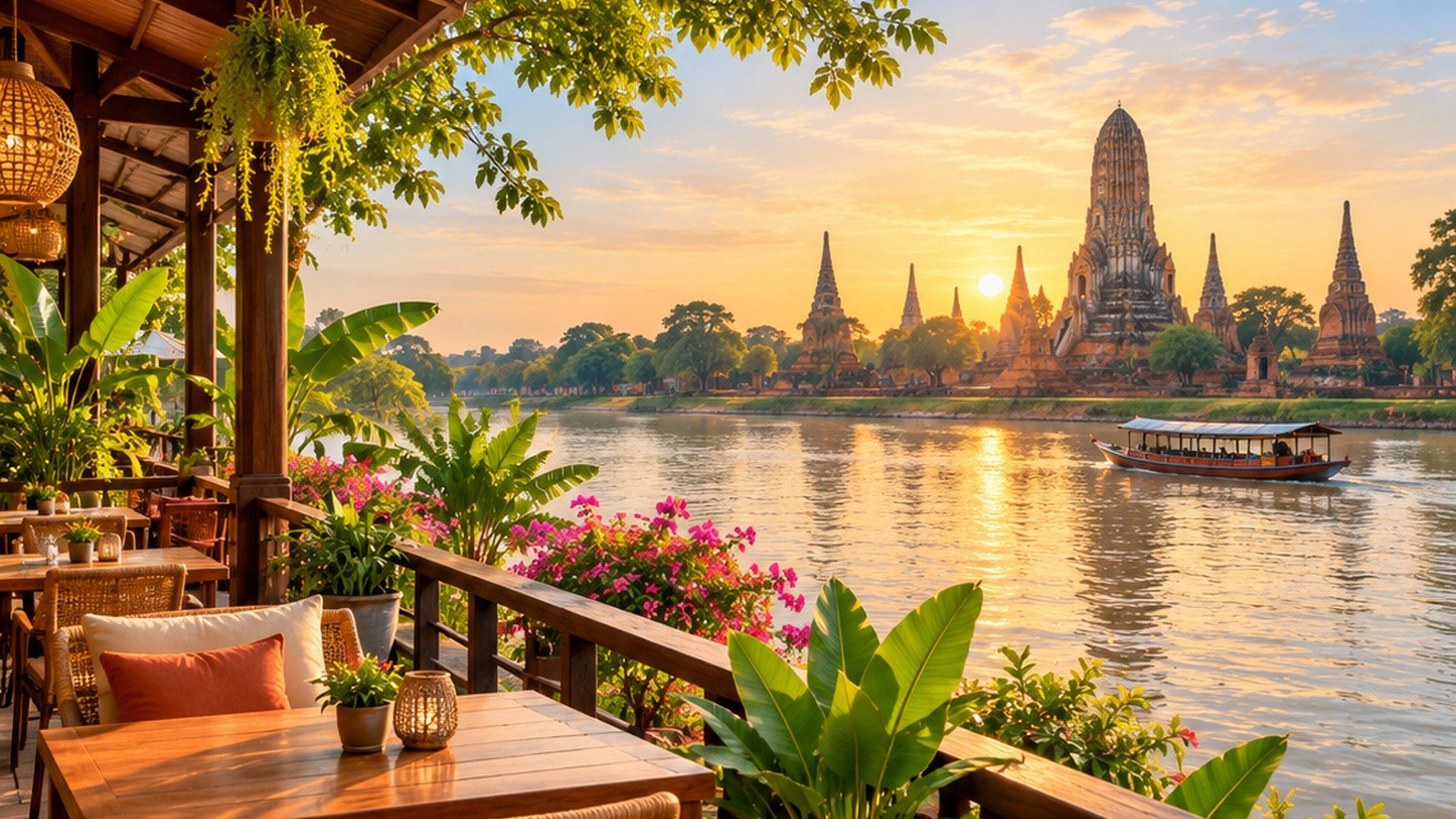
Conceptual Ayutthaya illustration. It does not depict a named hotel, a guaranteed room view or an exact riverbank layout.
Make the trip work for you
The best areas to stay in Ayutthaya depend on how you want to use the hours between checking in and leaving again. A central island guesthouse can make a short ruins visit easier; a southern riverside hotel can turn the evening into part of the holiday; an east-side garden property may suit a train arrival and a slower pace. The same attractive room can be a good choice for one of those plans and an awkward one for another.
This guide compares practical accommodation zones and uses selected hotels as verified location examples, not as personally tested recommendations or a league table. It explains river crossings, arrival arrangements, walking routes and room categories before discussing spending. Live rates vary with dates and occupancy, so the budget examples are clearly marked as calculations rather than offers. The aim is to help you choose an address that gives you more useful time in Ayutthaya.
This guide contains affiliate links. If you book through one, Taylor’s Trailblazing Travels may earn a commission at no extra cost to you. Choose the option that suits your trip; paid bookings are not required to use this guide.
Central historic island
A practical starting point for the main ruins.
Southern riverside
Choose it when you will enjoy the room and evening setting.
Eastern mainland
Confirm the last transfer; station-side does not mean ruins-side.
Southeastern hotel district
Accept road journeys to the historical island.
Planning note Location note: rivers divide the main accommodation zones. Compare a usable road or walking route, not a straight line across the water. [1]
Best areas to stay in Ayutthaya: the useful shortlist
Choose the day you want to wake up to
For a first visit focused on ruins, start with accommodation on the historic island near the central temple area. Alternatively, consider the southern riverside for a more atmospheric evening. For an early train or a late arrival, look east of the island around the station and nearby mainland accommodation. A modern hotel near Central Ayutthaya shopping centre serves a different purpose again: facilities and road access rather than walking straight into the historic park.
These are practical accommodation zones, not official neighbourhood boundaries or a ranking based on hotel review scores. The comparison uses the city’s river-island geography, accommodation addresses, transport needs and likely sightseeing patterns. UNESCO describes the historic city’s island setting; that geography remains fundamental to understanding why a room across the water may require a very different journey. [1]
| Area | Strongest fit | Main compromise |
|---|---|---|
| Central historic island | First-time ruins visits without a car | Not every hotel is quiet or directly beside an entrance |
| Southern U Thong riverside | Couples, river views and slower evenings | Some main temple visits still need a ride |
| Station-side eastern mainland | Train arrivals and garden-style stays | River crossing or road transfer to the central ruins |
| Western island | Quieter lanes and a less hurried stay | Fewer immediately convenient dining choices in some pockets |
| Northern/eastern island lanes | Local atmosphere with a mapped-out route | Property-by-property differences matter more than the area label |
| Southeastern modern-hotel district | Drivers, families wanting facilities, business visits | Not a walkable substitute for the historical park |
Do not begin by filtering for a river view
First decide whether you want to walk, cycle, hire a tuk-tuk or use a driver. Then choose a zone that supports that decision. A beautiful view can be worth paying for, but it should be an informed trade-off rather than the reason you accidentally book far from your intended day.
Central historic island: the simplest first-time base
Best for a ruins-focused short stay
Look around the central temple area associated with Wat Mahathat, Wat Ratchaburana and the roads leading into the historical park. This is the most intuitive starting zone when your main aim is to spend time among the ruins and return easily for a break. However, the historical park is not one building with one door: several separate sites are spread through the island. [1]
A hotel described as central may therefore be near one set of temples without being a short walk from every other stop. Check the actual entrance, not the middle of the shaded park area on a booking map. For a first visit of one or two nights, reducing the number of necessary rides can be more valuable than getting a larger room farther away.
The trade-off is at street level
Guesthouses on busier roads may have traffic or restaurant noise, while a side-lane property can be calmer but less convenient after dark. Read recent comments about the specific room orientation. A rear room can have a very different experience from one facing the street, even inside the same small building.
This is also the zone where bicycles can make a short stay flexible, provided you are comfortable riding in local traffic. Ask where bicycles are collected, whether lights and locks are supplied, and whether the hotel has somewhere appropriate to leave them. A bicycle icon on a booking page does not establish the condition of the available equipment.
Southern riverside: choose it for the evening as well as the view
A different kind of Ayutthaya stay
The southern U Thong Road area appeals when accommodation and dinner beside the water form part of the visit. sala ayutthaya’s official address is in Pratu Chai, and its riverside restaurant looks towards Wat Phutthaisawan. This is a useful example of the area’s appeal, not evidence that every property along the river has the same view or access. [2] [3]
The zone suits couples and travellers who expect to spend a meaningful part of the late afternoon at the hotel. It can also work well with a driver or a planned tuk-tuk circuit. If your plan involves leaving early, sightseeing continuously and returning only to sleep, you may use very little of what makes a premium river location attractive.
Buy the room category you actually need
sala’s official room list distinguishes Superior, River View, Terrace and suite categories. Do not assume the hotel’s headline photography applies to its lowest-priced room. Check whether your chosen category has the view, outdoor space and bed arrangement that motivated the booking. [2]
Riverfront dining may be available even when you stay elsewhere. That creates a useful middle option: book a simpler central room and reserve one meal with a view. Compare the total cost and the return journey rather than assuming an overnight river-view upgrade is the only way to enjoy the setting.
Compare small riverside hotels individually
Similar locations do not mean identical stays
iuDia is another riverside reference point. Its own site describes courtyard and river-oriented accommodation and a pool, illustrating how a small property’s atmosphere can differ from a larger full-service hotel. However, read the exact room details before assuming that every room faces water, has the same light or uses the same access route. [4]
For small hotels, the arrival experience matters. Ask about reception hours, bag handling, parking and steps between the entrance and your room. A welcoming place can still be inconvenient for a traveller carrying heavy luggage or needing step-free access. The word boutique tells you about positioning, not a consistent set of facilities.
Think about the time between sightseeing blocks
A southern riverside base becomes more useful when you deliberately return for the hottest part of the day. That might mean morning ruins, lunch and a rest, followed by a shorter outing or dinner. It is less useful when returning to the room requires an awkward detour you are unwilling to make.
If breakfast, pool time or a quiet terrace is important, ask about those facilities before choosing the rate. A pool photograph does not establish its depth, shade, operating hours or suitability for a child. Likewise, a restaurant on site does not guarantee that it can accommodate every dietary requirement without advance notice.
Station-side mainland: useful for the right arrival pattern
The station is not inside the central temple area
Ayutthaya railway station lies east of the historic island, across the Pa Sak River. That makes station-side accommodation potentially useful for rail arrivals, but it also means your first sightseeing journey needs a crossing or a road transfer. A hotel close to the station is not automatically close to the ruins you most want to see. [5]
This zone can suit an evening arrival, an early departure or a visitor who prefers a quieter garden property to a central guesthouse. Before booking, check whether the hotel is truly near the station entrance or simply on the same side of the city. A short straight-line distance is not a walking route when rail lines, canals or major roads intervene.
Garden accommodation may be the reason to stay here
Baan Thai House’s official site lists its Pai Ling address and a selection of villas, with a pool and cycling among the facilities. It offers a useful example of a stay chosen for space and setting rather than immediate proximity to the central ruins. Do not infer that it is a walk-with-suitcases option solely from a map; check the actual road and entrance. [6]
Ask how you would reach the island in the morning and return after dinner. For a late arrival, arrange the last short transfer beforehand rather than expecting a convenient ferry or waiting vehicle. A station-oriented choice works best when the hotel helps you solve those two local journeys.
Western historic island: quieter, but still map the details
Good for a slower second visit
The western side of the island can appeal to travellers who value lower-key lanes and do not need every meal directly outside the door. It gives another way to experience the historic city without choosing either the busiest central cluster or a modern hotel beyond the island. Nevertheless, quietness is a property-level question, not something guaranteed by a compass direction.
Use the historical sites you actually plan to visit as reference points. Wat Chaiwatthanaram, for example, is beyond the island on the opposite bank, so a hotel that looks close across the river may still need a road transfer. UNESCO’s site description helps establish the larger historic landscape, but your hotel route requires an ordinary street map. [1]
Plan dinner and the last ride home
A peaceful lane can feel less convenient once you are tired or it starts raining. Before paying for a room, identify two or three realistic dining options and check how you would return after an evening outing. Do not assume that a long, dark walk will seem appealing simply because it looked short on a screen.
This zone is more forgiving when you have a bicycle you can use safely or a reliable local transport arrangement. With a car, confirm parking at the actual property rather than looking for space after arrival. The reward is a potentially gentler stay; the cost is a little more planning.
Northern and eastern island lanes: judge the micro-location
A useful middle ground, not a uniform district
Accommodation in the island’s northern and eastern lanes can offer a mixture of local streets, guesthouses and access towards the station side. The appeal is often a less concentrated visitor environment while retaining an island base. However, two hotels in this broad zone can have very different routes to the central temples and evening food.
For that reason, avoid choosing on the neighbourhood name alone. Measure the walk to one temple entrance, one usable food option and one agreed pickup point. If all three work, a less famous address may be more practical than a heavily promoted property whose entrance is awkward to reach.
Look for the small details that affect sleep
Pay attention to room position, road frontage and how sound travels through the building. Older guesthouses can be charming without having modern sound insulation. Recent reviews that describe a specific source of noise are more useful than a general score saying the location is excellent.
A room away from the road, a clear late-check-in procedure and a host who can explain local transport may be the decisive advantages. These are not glamorous filters, but they often determine whether a short visit feels easy. Contact the property with one concise message rather than assuming that a high rating answers every practical question.
Southeastern modern-hotel district: facilities before ruins access
Best when a car or hotel facilities matter
Centara Ayutthaya is beside Central Ayutthaya shopping centre, southeast of the historic island. The operator lists facilities including a rooftop pool, fitness provision, parking and several room types. This location makes sense for a traveller combining sightseeing with modern hotel facilities, shopping or a business visit. It is not the same proposition as a guesthouse near Wat Mahathat. [7]
A larger hotel can be useful for families wanting a predictable room arrangement or drivers preferring easier road access. However, verify the precise family configuration and whether connecting rooms are confirmed rather than merely requested. A room’s maximum occupancy does not tell you how comfortably everyone will sleep.
Budget for the journeys it creates
Expect to use road transport for the historic sights and allow time for entering and leaving the island. An advertised short driving distance should not become a promise of identical travel time at every hour. A central hotel that costs slightly more may still compare well once several daily rides are added.
Conversely, this zone can be entirely sensible when your vehicle is already arranged and you expect to spend afternoons at the hotel. The key is to choose it knowingly. Do not book a modern shopping-centre hotel and then feel disappointed that the ruins are not outside the lobby.
Do not confuse Ayutthaya city with the wider province
A province label can hide a different itinerary
Accommodation platforms can return properties well beyond the city when you search Ayutthaya. A countryside retreat or a stay near Bang Pa-in may be appealing, but it should be judged as a separate base with its own transport requirement. The existence of a famous nearby attraction does not place it beside the historic island.
Read the full address, look at the map scale and calculate the route to your first planned morning stop. If the hotel is the main experience, a remote location can be the correct choice. If your priority is a short ruins visit with no car, the same property may create unnecessary journeys.
Use distance in the way that matters to you
A driver cares about road access and parking. By comparison, a rail passenger with a suitcase cares about the path from platform to vehicle and the final approach to reception. A cyclist cares about traffic, bridges and safe storage. One headline distance cannot represent all those needs.
When a booking page says near the historical park, ask near which entrance and by which route. This simple question helps separate useful location claims from broad marketing language. Keep a screenshot of the address and entrance pin with your reservation so that your driver is not navigating only by an English hotel name.
One night, two nights or a longer stay?
One night needs a particularly easy base
For a single night, minimise check-in friction and repeated crossings. A central island room often works well for a first-time ruins visit; a station-side room can be better for a very early train. Choose between them by looking at the arrival and departure times, not by treating one area as universally superior.
Before booking, ask whether you can leave luggage before check-in and after check-out. Those two services can turn one night into a useful afternoon and a useful morning. Without them, you may spend a disproportionate amount of a short visit working out what to do with bags.
Two nights make atmosphere easier to enjoy
With two nights, a riverside or garden property becomes easier to justify because you have time to return during the day and enjoy the setting. You can split temple visits around heat and meals instead of treating Ayutthaya as one continuous outdoor circuit.
Longer stays benefit from practical facilities: somewhere to wash or dry clothes, a comfortable place to sit and dining choices you will not tire of after the first evening. A spectacular but impractical room can be less appealing on the fourth day than on the first. Ask what your ordinary day will look like once the novelty of the photograph has passed.
Match the area to your travel style
Solo travellers and couples
Solo visitors often benefit from an easy route between accommodation, food and the main sights. That does not mean choosing the busiest road, but it does mean avoiding unnecessary isolated journeys after dark. A small guesthouse with clear transport advice can be more useful than a larger property that assumes every guest has a car.
Couples choosing a special overnight stay may reasonably prioritise a terrace, a view or a memorable dinner. Yet make the comparison between actual rooms, not hotel brands. A river-view room with inconvenient access is not automatically more romantic than a comfortable central room and a well-planned evening meal elsewhere.
Families and travellers needing easier access
For families, compare sleeping arrangements, pool access, breakfast and the journey back for a rest. A central location loses its advantage if the family cannot comfortably use the room. Equally, a spacious outlying hotel creates work if every snack and outing requires another vehicle.
For reduced mobility, ask about the entire access chain: vehicle drop-off, reception, bedroom, bathroom and breakfast area. The presence of a lift in one part of the building does not establish a step-free route through all the others. Request specific answers and, where helpful, photographs of steps or bathroom arrangements before booking.
Room budgets: compare like with like
Use a spending framework rather than invented rates
Hotel prices depend on dates, occupancy, room type and cancellation terms. This guide does not present an undated headline rate as a verified offer. For planning only, you could test room budgets of THB 1,200, THB 2,400 and THB 4,800 per night, with those illustrative thresholds set on 4 October 2026. They are search budgets, not promises that a particular class of hotel will be available at each level.
Compare what those budgets buy on your dates. One rate may include breakfast and cancellation, another may exclude taxes or require full prepayment, and a third may show a different occupancy. The apparently cheapest room is not necessarily the least expensive complete stay.
Put a price on location only after counting the rides
Suppose a central room is THB 500 more per night than an outlying option, but choosing the latter creates two hypothetical THB 250 journeys. The room saving has disappeared before you consider time. This is an arithmetic example dated 4 October 2026, not a local taxi tariff.
Use your own quotes in that calculation. Sometimes the outlying hotel still wins because you have a car or prefer its facilities. Sometimes the central room is clearly more economical. The purpose is to compare the complete day instead of focusing on one number beside the bed photograph.
Arriving by train: solve the final kilometre first
Your train does not arrive at the ruins
The east-side railway station is separated from the central historical area by the river. Local crossing and road options can help, but they should not be treated as universally available at every arrival hour. With heavy luggage, an agreed pickup or a straightforward road transfer may be preferable to a more scenic but awkward approach. [5]
Send the property your train number and expected arrival time. Ask for the meeting point and price of any collection, and find out what happens if the train is delayed. A confirmed arrangement should identify the person or vehicle you are meeting rather than simply promising someone will be there.
Choose the Bangkok departure station separately
Bangkok-Ayutthaya trains use more than one Bangkok terminal. Check the selected service rather than assuming every train leaves Hua Lamphong or every train leaves Krung Thep Aphiwat. SRT’s timetable and booking system are the appropriate final checks for the service you intend to use. [8] [9]
A hotel near the Ayutthaya station does not compensate for going to the wrong station in Bangkok. Keep both ends of the journey in the booking notes, alongside the property’s address. That gives you a simple chain from the first hotel to the next rather than several disconnected reservations.
Walking, cycling and local touring
A walkable base is not a walkable whole city
Staying close to a temple cluster makes short walks easier, but Ayutthaya’s full sightseeing circuit includes separate sites and river crossings. Do not assume that choosing an island hotel removes every need for transport. Decide which places you will visit together and where a midday rest fits between them. [1]
Walking can be pleasant in manageable blocks, but heat and exposed ground make a long continuous route harder than the distance alone suggests. Carry water and avoid treating every detour as compulsory. A short ride back to the hotel can be a sensible choice rather than a failure to travel independently.
Use a bicycle or tuk-tuk for a defined task
For cycling, inspect the bicycle, brakes, tyres, lock and lights, and consider whether you are comfortable with the roads involved. Do not choose a distant hotel merely because it offers free bicycles. A free vehicle that you do not feel safe using provides no real location advantage.
For a tuk-tuk or driver, agree the stops, duration, waiting and final destination. A tour returning you to the station is different from one finishing at your hotel. If you need historical interpretation, confirm that a guide is included; a driver taking you to entrances does not necessarily provide a guided visit.
Test the last walk, not just the map distance
The final five hundred metres can decide the location
When two hotels appear equally close to the ruins, inspect the final approach to each. Look for the entrance position, large road crossings, shade and whether the route is one you would want to repeat after dinner. A short distance along an uncomfortable road can feel less convenient than a slightly longer, simpler route.
Use recent street imagery where available, but remember that it may not show current roadworks or flood conditions. Ask the accommodation to describe the approach from your intended pickup point. A useful answer names the entrance and any steps or obstacles rather than merely saying that the hotel is easy to find.
Match the walk to the person carrying the bag
The same route can be straightforward with a small backpack and awkward with a rolling suitcase, pushchair or mobility aid. Think about the journey under the least convenient likely conditions: rain, heat or darkness, not only the attractive daylight view. If that journey does not work, price a short transfer before deciding the hotel is cheaper.
This check also helps with late checkout. Knowing a clear place for a vehicle to collect you prevents a stressful final walk with all your belongings. A practical entrance and a usable pickup point rarely dominate the hotel photographs, yet they can improve every day of a short stay.
Read reviews for the room you are actually booking
Look for evidence rather than a single score
Read recent reviews that discuss the things you need: noise, stairs, room size, bathrooms, air conditioning and communication about arrival. A high average score is useful context, but it cannot guarantee that a specific room works for your circumstances. Similarly, a complaint about something you do not care about may be less relevant than one clear description of a problem you do.
Distinguish a hotel’s response from a solved issue. An apologetic reply is encouraging, but it does not establish that construction has ended or a faulty facility has been replaced. Where a recent concern affects your decision, ask the property directly and keep the answer with the booking.
Confirm requests that cannot be left to chance
A double bed, a ground-floor room, connecting rooms or a quiet orientation may be requests rather than guaranteed features. Look for them in the room description and confirmation, not only in a free-text request box. If the stay depends on one feature, obtain an explicit answer before the cancellation deadline.
For riverside properties, ask whether river view refers to the bedroom, a shared terrace or only the restaurant. For family rooms, ask what counts as a bed rather than assuming a daybed is prepared for sleeping. These small distinctions are often more consequential than a broad hotel category.
Weather, river levels and booking flexibility
Treat a riverside stay as a dated decision
At the 4 October 2026 review, official forecasts and UK travel advice include heavy-rain and flooding cautions affecting parts of Thailand. That is not proof that a particular Ayutthaya hotel is inaccessible, but it is a reason to ask about its current entrance, local roads and planned activities. [10] [11]
For future dates, check again rather than carrying today’s conditions forward indefinitely. Riverfront accommodation can be appealing in many seasons, but photographs of clear skies do not tell you how a low-lying access lane performs in heavy rain. The property is the first place to ask about immediate local access.
Flexibility matters most when the plan has dependencies
A cancellable room can be especially useful when it depends on a train, an airport arrival or a weather-sensitive activity. Read the deadline and time zone, and distinguish free cancellation from a deposit that is simply paid later. A flexible headline can still contain conditions that matter to your booking.
Save confirmations and contact details offline. Mobile data is helpful for arranging a pickup, but an unlocked, compatible phone and a suitable package are necessary before an eSIM will solve that problem. Keep a second way to show the address if the phone fails or the battery runs out.
Three realistic location choices
A first-time couple without a car
For an afternoon arrival and two nights of ruins visits, start with the central island. It reduces the effort of beginning the first morning and makes a return for a rest more realistic. Add a southern riverside dinner as a separate outing rather than assuming that a river-view hotel is necessary to enjoy an evening by the water.
If the couple’s priority is a special hotel stay, reverse the emphasis: book the southern riverside and arrange sightseeing transport. Neither choice is objectively better; each works because the room and the plan support one another. The mistake would be paying for the view while organising days that leave no time to see it.
A rail passenger and a driving family
A rail passenger arriving late for one night may prefer an east-side property with a confirmed station transfer, especially before another early train. In that case, a shorter temple programme is a sensible trade-off. Do not add a late river crossing merely to say that the room is on the island.
A family arriving by car may reasonably choose a modern southeastern hotel with a confirmed sleeping arrangement and parking. They should then plan a deliberate drive to the ruins rather than expecting an entirely walkable holiday. Count parking, heat and the midday return as part of the day’s organisation, not inconveniences to solve after arrival.
Pros, cons and common mistakes
The main advantages and compromises
Central island accommodation prioritises access to the historical experience. Southern riverside properties prioritise the setting. Mainland garden stays prioritise space and atmosphere, while modern southeastern hotels prioritise facilities and road access. None removes the need to inspect the precise room and the journeys around it.
The most common disappointment is a mismatch between the photograph and the itinerary. A visitor books tranquillity but needs frequent quick outings, or chooses the centre but expects resort-style seclusion. Write down your three non-negotiables before browsing and eliminate properties that cannot meet them, however attractive the images appear.
Avoid three expensive assumptions
Do not assume that across the river means just a short walk, that every room shares the advertised view, or that a family occupancy figure guarantees the beds you need. Also check luggage storage and late arrival rather than treating them as universal hotel services.
Finally, do not change hotels simply to experience another zone during a two-night visit unless the move has a clear purpose. Packing, checkout, transfer and waiting for the next room can consume much of the day. A single well-chosen base and a planned evening outing often provide more enjoyment with less administration.
Frequently asked questions
Where should I stay on my first visit to Ayutthaya?
The central historic island is the most useful starting point for a ruins-led visit without a car. It puts the first sightseeing blocks within easier reach and can make a midday break practical. Choose the southern riverside instead when accommodation atmosphere is a major reason for staying overnight and you are happy to arrange transport. Always check the exact address and room rather than booking solely on the area name.
Is the railway-station area a good place to stay?
It can be, particularly for a late arrival, early departure or a garden property that suits your preferences. However, the station is east of the island, not beside all the central ruins. Check the final transfer and the next morning’s sightseeing journey. A property on the same side of the city may still be an awkward walk with luggage. [5]
Are river-view hotels worth the extra money?
They can be when you will spend time enjoying the view, terrace or dinner setting. Compare the actual room category and total stay cost. A lower-priced room at the same hotel may not face the water, while staying centrally and booking one riverside meal can provide a different balance. There is no universal premium that makes sense for every budget or schedule.
Can I stay near the ruins and walk everywhere?
You can make some sightseeing easier on foot, but the full historical landscape includes separate clusters and sites across rivers. A central address should reduce journeys, not create an expectation that no local transport will ever be useful. Group nearby sites, allow for heat and use a ride when it makes the day more comfortable. [1]
Which area works best with children?
Choose by the family’s room, rest and transport needs rather than a generic family-friendly label. Central accommodation reduces some journeys, a garden property may offer useful downtime, and a modern hotel may provide a more suitable sleeping arrangement. Confirm pools, steps, extra beds and any child seats. A good family base is the one that supports both sightseeing and an easy return for rest.
Should I stay in Ayutthaya or visit from Bangkok?
Stay overnight when you want two cooler sightseeing periods, a slower evening or a hotel experience of its own. A day trip can be enough for a selective introduction, particularly if you prefer not to move luggage. The overnight choice becomes less appealing when arrival and departure leave almost no usable time. Compare the actual hours available, not simply the number of nights on the booking.
Final recommendation: choose the address before the photograph
For an uncomplicated first stay, shortlist central island accommodation and test the route to your first temple, dinner and onward transport. Move towards the southern riverside for a slower, view-led visit, or towards the mainland and modern hotel districts when arrival patterns, space or facilities justify the extra journeys.
Once the area fits, check the exact room, luggage arrangements and cancellation terms. That sequence is more reliable than falling for a picture and trying to make the rest of the holiday adapt to it. Ayutthaya is easier to enjoy when your accommodation gives you useful time rather than another daily transport problem.
Sources and fact-checking notes
Source checks were completed on 4 October 2026. Official operators and public bodies are prioritised; independent specialists and commercial listings are identified below. Suggested visit lengths, budget exercises and route choices are planning judgements, not live availability or a record of personal visits. Recheck time-sensitive details for your date.
- UNESCO: Historic City of Ayutthaya
Primary source for the historic city and river-island setting. Checked 4 October 2026.
- sala ayutthaya: official rooms and location
Hotel operator lists the Pratu Chai address and separate Superior, River View and suite categories. Checked 4 October 2026; no live room rate is asserted.
- sala ayutthaya: riverside restaurant
Official setting opposite Wat Phutthaisawan and dining information. Checked 4 October 2026.
- iuDia: official hotel website
Operator information on riverside rooms, courtyards and pool. Checked 4 October 2026. Historical statements on this hotel page are not used as a history source.
- Thai Train Guide: Ayutthaya railway station
Independent specialist source on station geography and onward access. Checked 4 October 2026.
- Baan Thai House: official accommodation website
Pai Ling address, villa styles and facilities. Checked 4 October 2026; station-to-property access must be checked against the actual entrance.
- Centara Ayutthaya: official hotel facts
Central Ayutthaya shopping-centre location, room types and facilities. Checked 4 October 2026.
- State Railway of Thailand: Hua Lamphong to Ayutthaya
Official route result lists ordinary/suburban services and fares starting at THB 15. Search snapshot checked 4 October 2026; recheck individual trains and operating days.
- State Railway of Thailand: D-Ticket
Official booking system for eligible services. Not every unreserved local service can be booked here. Checked 4 October 2026.
- Thai Meteorological Department: seven-day outlook
Official forecast published 4 October 2026. Weather, water levels and local restrictions must be rechecked for the travel date.
- FCDO: Thailand travel advice
Official advice including the severe-flooding notice. Checked 4 October 2026; a national notice is not evidence that every local attraction is closed.
Illustrations in this article were created for Taylor’s Trailblazing Travels. Third-party photographs, where used, are credited beside the image or in the source list.