Best Areas to Stay in Kanchanaburi
The right riverbank, the right arrival point and a room that supports your kind of trip.
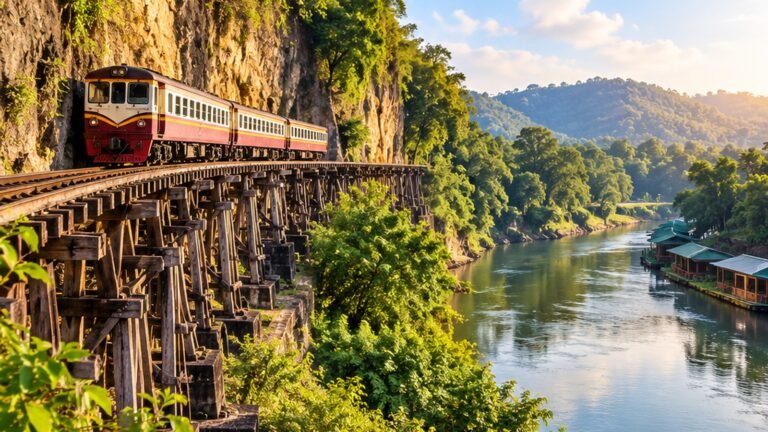
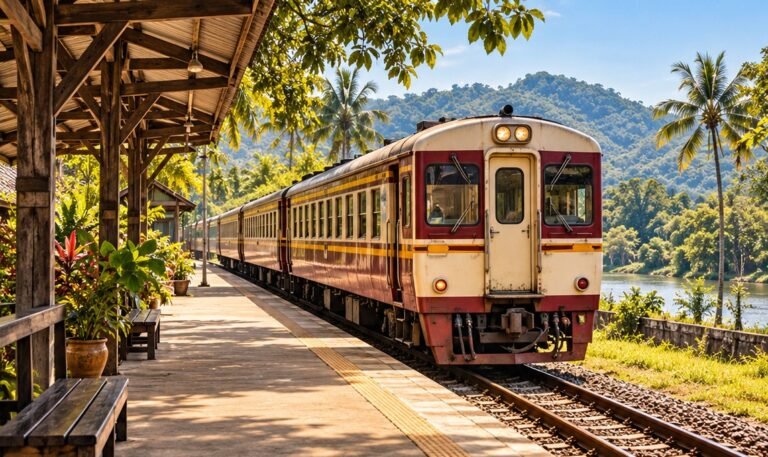
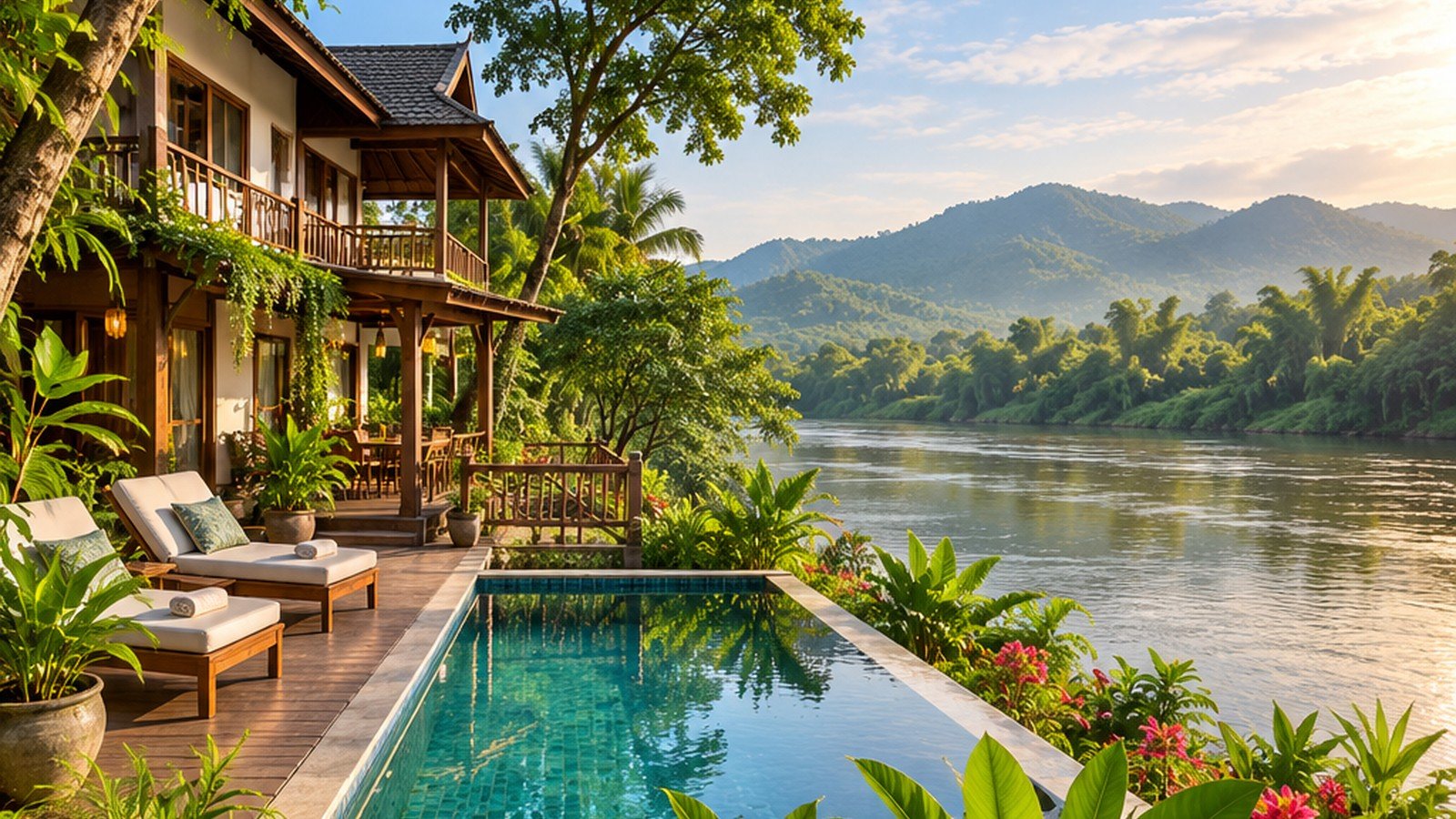
Conceptual riverside accommodation illustration; not a photograph of a named resort or a promise of room facilities.
Make the trip work for you
The best areas to stay in Kanchanaburi range from a practical town corridor to river properties that need a road journey and a boat before you reach reception. Searching only for River Kwai hotels can mix all of them together. That is how a promising room turns into an unexpected series of transfers, or a beautiful remote stay leaves you too little time to enjoy the scenery you paid for.
This guide separates the main zones and explains the daily routine each one creates. Selected properties illustrate verified locations and facilities, rather than serving as a personally tested hotel ranking. You will find advice for short car-free visits, drivers, families and travellers considering floating accommodation, with particular attention to room access and the correct pier. Costs are treated as complete-stay comparisons, while current closures and weather checks remain distinct from the longer-term location advice.
This guide contains affiliate links. If you book through one, Taylor’s Trailblazing Travels may earn a commission at no extra cost to you. Choose the option that suits your trip; paid bookings are not required to use this guide.
Central town corridor
Simpler food, museum access and tour arrangements.
Bridge neighbourhood
Convenient for the bridge, not every town sight.
Sai Yok / Khwae Noi
Allow proper time for both road and boat access.
The actual arrival point
Town station, bridge stop and resort pier are different places.
Planning note Before choosing a hotel for one excursion, check it is operating: Hellfire Pass remains temporarily closed at the 4 October 2026 review. [1]
Best areas to stay in Kanchanaburi: town or countryside first?
The decision that matters more than the hotel name
Decide whether you are booking a base for exploring Kanchanaburi town or a stay in the surrounding river country. Those are different holidays. A central guesthouse lets you move between restaurants, museums and onward transport; a Sai Yok floating resort may require a long road transfer and a boat before you reach the room. Both can be appealing, but they should not appear in one undifferentiated shortlist.
This comparison groups accommodation by practical location and access, not by star rating or an invented score. The selection is based on the province’s geography, published hotel addresses, transport arrangements and the activities most likely to shape a stay. The Tourism Authority of Thailand’s destination information establishes the wider provincial context. [2]
| Zone | Best suited to | What you accept in return |
|---|---|---|
| Central Maenam Kwai corridor | First visits without a car | Check road noise and the final lane to the property |
| Immediate bridge neighbourhood | Short stays centred on the landmark | Other town sights may still need a ride |
| Pak Prak and southern town | Heritage streets and road-transport convenience | Less of a resort-style river atmosphere in some pockets |
| Opposite-bank and outer-town resorts | Drivers and guests prioritising grounds or a pool | Fewer spontaneous walks to town restaurants |
| Sai Yok and Khwae Noi | Floating stays and a countryside-focused break | Longer transfers, meal planning and boat logistics |
| Erawan/Srinakarin side | An early park visit or a nature-led stay | Not a convenient base for repeated town sightseeing |
A river label is not an address
Kanchanaburi’s river names and accommodation branding can make distant places sound close together. Always open the map, check the road route and identify the correct bank. The name River Kwai tells you something about the setting; it does not tell you how long it takes to collect dinner, reach a station or join a tour.
Central Maenam Kwai corridor: the easiest all-round starting point
A useful base without a car
The central Maenam Kwai Road corridor is the first area to inspect for a flexible town stay. It can put accommodation, food and local tour arrangements within a manageable area while keeping the railway-history sights and bridge reachable by short journeys. However, the road is long enough that one end and the other should not be treated as the same location.
Look at the specific stretch surrounding the hotel. A property nearer the central museum and station area may suit a history-focused visit, while one farther towards the bridge may be more convenient for that landmark. Do not select solely by a booking platform’s centre-distance measure, which may use a reference point unrelated to your plans.
Expect variety, not one consistent atmosphere
This corridor includes simpler guesthouses and more developed riverside properties. Some entrances face the road, while others lead down smaller lanes to the water. That last stretch affects luggage handling, evening lighting and noise, so inspect it as carefully as the room photographs.
For a first visit, the strongest advantage is flexibility. You can choose dinner according to how the day went, arrange an excursion and return for a rest without turning every movement into a major transfer. The compromise is that you need to choose the room orientation carefully if quiet sleep is a priority.
Use Good Times Resort as a location reference, not a universal verdict
What an operator’s address can tell you
Good Times Resort describes a riverside position, a pool and access to both the bridge and the town’s transport points. Its published distances illustrate why the central corridor can work well for a short visit. They do not establish an accessible walking route or guarantee that every guest will prefer the same setting. [3]
When comparing it with another property, trace the journeys you will actually make: arrival station to reception, reception to dinner, and hotel pickup to your chosen day trip. A room that looks slightly farther from one attraction may still be better placed for the whole stay.
Ask questions the photograph cannot answer
For a riverside room, clarify whether the view is from the bedroom, terrace or shared restaurant. Ask about steps and the route through the grounds if you have heavy bags or limited mobility. Also find out whether breakfast timing works with an early outing; a breakfast-inclusive rate is less useful when you leave before service.
Small practical advantages can outweigh a larger room. Luggage storage, clear communication about pickups and a sensible late-arrival procedure all matter for a one- or two-night stop. Compare those features alongside the setting rather than relying only on an average review score.
Immediate bridge neighbourhood: convenient for a short, focused visit
Best when the bridge is part of your daily view
The area around the Bridge over the River Kwai works well for visitors who want to see it without arranging a separate major outing. U Inchantree’s official location page places the property close to the bridge, making it a useful example of this micro-area. The hotel’s location is verified; a particular room’s river view or suitability still needs to be checked in its own description. [4]
This zone can suit a couple on a short break or someone arriving with a private vehicle. It is also useful when you value an early or late visit to the riverbank rather than joining the busiest part of a sightseeing day. The advantage is proximity to this landmark, not proximity to everything in the province.
Other town journeys remain separate
The Railway Centre, main cemetery, bus terminal and different railway stations are not all at the bridge. Check those journeys before choosing this area for a car-free stay. A hotel near the bridge-area station is not automatically near Kanchanaburi’s main town station.
When booking a rail arrival, use the exact station name and confirm whether your service stops there. Do not assume a train can leave you at whichever station appears closest to your hotel. A short taxi may still be necessary, and arranging it in advance can make arrival considerably easier.
A bridge-area hotel does not have to be a luxury river resort
Compare the practical alternatives
Kanchanaburi City Hotel’s official contact page places it on Maenam Kwai Road near the bridge. That gives you another type of option in the same general area: a town-style hotel rather than a stay selected primarily for a premium riverside setting. It is a location example, not a claim that its facilities or service are identical to neighbouring properties. [5]
This distinction matters for a traveller who plans to spend most daylight hours elsewhere. A practical room near the intended evening area can be a better use of the budget than paying for extensive grounds you never see. Conversely, a traveller planning a restful afternoon may reasonably value those grounds very highly.
Check sleeping arrangements carefully
For a family or small group, compare the actual beds, not only the maximum occupancy. A room advertised for several people may use floor bedding, a sofa or an extra bed that needs arranging. Ask what is included in the selected rate and whether the sleeping setup is confirmed.
Also check the pool and breakfast independently. A pool can be useful downtime without being suitable for unsupervised children, and breakfast can be convenient without meeting every dietary need. These details decide whether the hotel supports the group; the distance to the bridge is only one part of the decision.
Pak Prak and southern town: heritage and everyday access
An alternative to the visitor corridor
The Pak Prak area offers a stay connected with Kanchanaburi’s older streets and local life. Tourism Authority of Thailand material describes historic buildings and the area’s architectural mixture, with market activity at particular times. A hotel here can appeal when you enjoy a heritage walk and do not need to spend every evening beside the bridge. [6]
Southern town can also be worth examining when bus travel shapes the visit. Nevertheless, verify the distance to the actual terminal or travel office you will use. The words bus station on a map may refer to a different collection point from the one printed on a ticket.
Know what the quieter evening means
An area can be pleasantly low-key on an ordinary evening and lively during a market event. Ask what operates on your dates instead of assuming a permanent night-market atmosphere. Check where you would eat on a wet weekday and how you would return from the bridge area after dark.
This zone is less compelling when your main aim is a resort-style stay with extensive grounds and a water-facing terrace. Choose it for access and local texture rather than expecting the photographs of a remote river retreat. The best room is one that matches the kind of evening you will actually enjoy.
Opposite-bank and outer-town resorts: space with a transport cost
Crossing the river changes the daily routine
Resorts outside the busiest corridor can provide more space, gardens and a stronger sense of separation from town. Dheva Mantra’s official contact page, for example, lists its Tha Makham address and offers SUV or van transfer enquiries. The presence of such arrangements is useful evidence that transport should be part of your booking conversation. [7]
Do not judge the location by drawing a straight line across the water. You need a usable road bridge and an entrance route. A hotel that looks close to the opposite bank may still require a meaningful drive to a restaurant or museum on your list.
Good for drivers and hotel-led breaks
This type of base works best when you have a car, are happy to book rides, or expect to spend substantial time on the property. A pool afternoon followed by dinner on site is a different plan from returning to town repeatedly for small outings. Neither is wrong, but the location should support the one you prefer.
Ask about parking, restaurant hours, transfer notice and the cost of a return journey rather than only the outward trip. If you need collection after dinner, agree the time and place before leaving. An attractive room rate should be compared with the transport and meals it makes necessary.
Sai Yok and the Khwae Noi: a countryside stay, not a town hotel
Give this area its own time
Sai Yok is the choice for travellers who want river scenery and a more secluded stay to be central to the holiday. Many properties sit along the Khwae Noi corridor, well beyond Kanchanaburi town. Reaching them can involve both road travel and a boat, so they should not be treated as a minor variation on a central hotel. [8]
For one night, aim to arrive early enough to enjoy the property rather than paying mainly for the journey to and from it. Two nights are easier when you want both an outing and some time at the accommodation. Check whether your planned tour actually collects from the area; a Kanchanaburi pickup label may refer only to town hotels.
Meals and movement become part of the booking
At a remote property, you may not have a row of restaurants outside the entrance. Compare meal arrangements before choosing a rate, especially for dietary needs or children who need predictable food times. Ask whether lunch is available on arrival and what happens when a delayed transfer misses a meal window.
The same applies to activities. A room beside the river does not automatically include kayaking, a guide or permission to swim. Understand which experiences are available, which cost extra and which depend on conditions. Sometimes the most enjoyable activity is simply allowing enough time to sit on the terrace.
Jungle Rafts and FloatHouse: read the facilities before choosing the mood
Floating accommodation is not one standard product
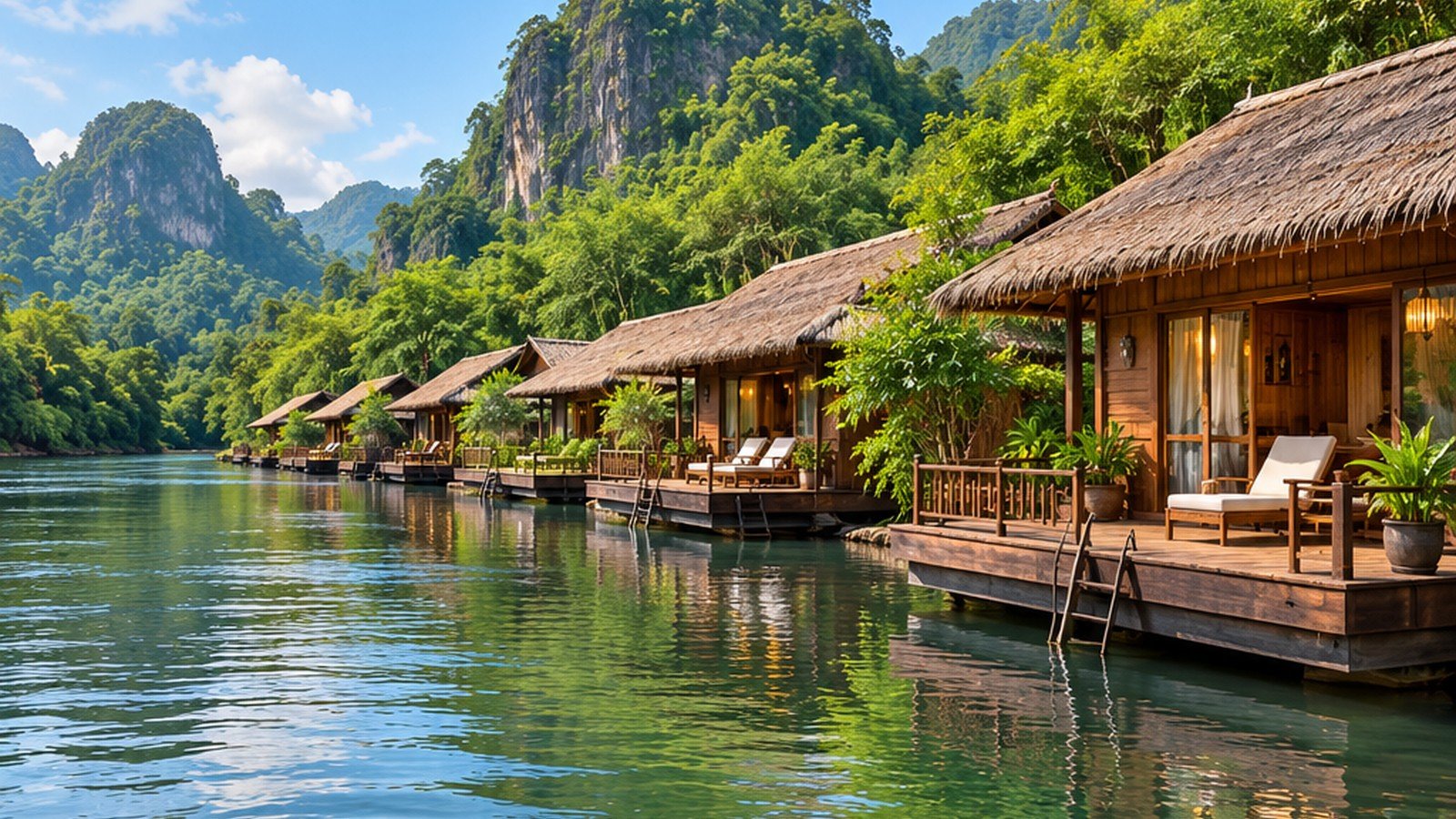
River Kwai Jungle Rafts describes a no-electricity concept, including limitations on internet and hot water. That can be an appealing deliberate escape for some travellers, but it is a poor match for someone who needs regular power or expects the facilities of a conventional air-conditioned hotel. Treat the concept as a practical choice, not only a romantic description. [9]
The FloatHouse River Kwai describes a different floating-villa experience with a different set of in-room facilities. Do not transfer assumptions from one property to the other just because both float on the river. Verify power, cooling, hot water and the exact room arrangement with the operator for your dates. [10]
The boat transfer is part of the room access
FloatHouse’s official arrival information identifies Phutakien Pier and scheduled boat arrangements. Confirm the current times and any charge outside the included service before you book road transport. A car arriving at the resort’s map pin on the opposite side of the river may not deliver you to the correct boarding point. [8]
For children or reduced mobility, ask about the step between pier and boat, assistance with bags, deck barriers and the route to the room. Water level changes can affect the boarding experience. A spacious villa does not by itself establish that the journey into it is suitable.
Erawan and Srinakarin side: choose it for nature access
A useful specialist base
Accommodation towards Erawan or the Srinakarin area can suit a visit organised around the park and surrounding landscape. It is less suitable for someone who expects to return to town for several museums and different restaurants each day. The park’s official information and contact details are the starting point for checking park accommodation and current access. [11]
The benefit of staying nearer is the possibility of an easier early start, but measure the actual road distance to the entrance you need. A property associated with a lake, dam or park region may still be some distance from the waterfall trailhead. Check the map at a scale that shows the whole journey.
Do not confuse scenery with practical flexibility
A beautiful reservoir view can come with a narrow choice of food and transport. Ask how you would leave without your own vehicle, whether transfers can be arranged and what notice is required. For an onward journey to Bangkok, plan the rural leg and intercity leg together rather than assuming they connect automatically.
Rain and park restrictions matter particularly in this area. A room near a waterfall does not guarantee that swimming or upper trails will be open. Choose accommodation you would still enjoy if the activity were shortened, and check the cancellation terms when the whole stay depends on a specific outdoor experience. [12]
Where to stay for a two-night first visit
Keep both nights in town for maximum flexibility
For a first visit involving the Railway Centre, cemetery, bridge and one larger excursion, the central corridor or immediate bridge neighbourhood is usually the most practical starting point. The reason is logistical: you can reach the historical sights, find meals and organise a day out without adding a remote check-in to the same short trip.
Use the first afternoon for town, the next day for Erawan or the scenic railway, and the last morning for a relaxed departure. The precise order depends on arrival time and conditions, but keeping one base avoids spending the best part of a day repacking and waiting for another room.
Split only when the change is the experience
A town night followed by a floating night can work when the river stay is a deliberate highlight and the transfer is arranged as part of the route. It is less successful when you add it merely to sample two hotels. Check-out, road travel, pier waiting and check-in are real time commitments even when each looks manageable in isolation.
With three or four nights, the split becomes more forgiving. You can give town history a proper day and still arrive at the remote property with enough time to enjoy it. The extra night is doing useful work when it removes a rushed transfer, not simply increasing the room count.
Arriving from Bangkok: book the correct destination
Town, bridge and remote pier are different drop-offs
A ticket to Kanchanaburi may finish at a terminal or office rather than your accommodation. Private transfers can often be arranged to a specific address, but the price and travel time depend on that address. Compare bookings only after the destination is clear. Commercial route listings are useful for checking available vehicle types, not for assuming that every fare includes the same final journey. [13]
For a rail journey, distinguish Kanchanaburi town station from a bridge-area stop and from the stations farther along the line. Confirm the service and stopping pattern with SRT before choosing a hotel around a presumed arrival. [14]
Remote accommodation needs a joined-up transfer
For Sai Yok, send the road driver the pier specified by the hotel and coordinate with the boat departure. Ask who should be contacted if you are delayed and whether arrival after dark is accepted. Keep the hotel’s instructions rather than relying on a general navigation app to improvise the final stage.
If travelling directly after a flight, leave a generous margin for immigration, bags and road delays. A missed boat window is not the same as arriving late at a city hotel with a staffed lobby. Where the timing is uncertain, a town night before the remote stay may be the more comfortable arrangement.
Drivers, parking and the road-access test
Check where the car will remain overnight
For a town hotel, ask whether parking is on site, nearby, reserved or subject to availability. A parking symbol on a booking page may not mean a space beside reception. If you are carrying luggage or travelling with someone who cannot walk far, ask for the actual unloading arrangement.
For boat-access accommodation, the car may remain at the pier while you travel onwards by water. Confirm the approved parking location, access hours and what you should take from the vehicle. Do not leave essential medication, documents or charging equipment in a car you cannot conveniently reach again.
A vehicle adds flexibility, not unlimited time
Having a car makes outlying areas more workable, but it does not remove distance or the need to plan an evening return. Long rural outings followed by unfamiliar driving after dark may not be the relaxing break you intended. Pick an accommodation area that reduces the journeys you most often need.
For a hired driver, specify the hotel, all planned stops, waiting time and final drop-off before agreeing the quote. A transfer to Kanchanaburi town is not automatically an all-day vehicle for the wider province. Written details prevent misunderstandings about what the booking covers.
Families, accessibility and rooms beside water
Treat the water edge as a design question
For a family stay, ask how the room opens onto the river or pool and whether there are barriers appropriate for the children travelling. A terrace that looks relaxing for adults may require constant supervision with a young child. Request photographs of the actual room type and outdoor access rather than relying on a wide promotional image.
The same approach applies to sleeping arrangements. Confirm whether children use existing beds, extra beds or a separate room, and whether any connecting-room request is guaranteed. A nominal maximum occupancy does not answer those questions. Meal times and a workable place for a midday rest are also part of a family-friendly stay.
Accessibility begins before reception
List each stage: road drop-off, pier where relevant, boat, path through the grounds, bedroom and bathroom. A property can have a comfortable room but an unsuitable approach. Ask about ramps, steps, handrails, assistance and the surfaces involved, then judge the whole chain rather than one facility.
If a particular need is non-negotiable, seek a clear response before the cancellation deadline. Avoid letting a general assurance such as easy access replace specific information. A land-based town hotel may offer the simpler solution even when a remote room appears more spacious or scenic.
A boat-access arrival checklist that starts in Bangkok
Confirm the handover between road and river
For a floating property, obtain one set of instructions covering the road destination, pier contact and boat arrangement. The driver should receive the pier pin, while you keep the accommodation’s reception number. Confirm whether the boat is a shared scheduled service or a separately arranged transfer attached to your booking. [8]
Before leaving Bangkok or Kanchanaburi town, check whether a delay would change the boat arrangement. Do not expect the road driver to negotiate an unplanned crossing for you at the end of the journey. The useful agreement identifies who will call whom, what waiting is included and how you will be told about a revised arrival.
Keep the first evening’s essentials with you
Pack medication, documents, a change of clothes and anything needed immediately in a small bag you can carry securely. Ask staff to handle larger items where assistance is offered, but do not put fragile or essential belongings somewhere you cannot supervise. Wear footwear that makes stepping between surfaces easier.
Once aboard, follow the crew’s directions and use the provided safety equipment as instructed. The transfer is part of being accommodated on the river, not an incidental inconvenience to rush through. A calm arrival with adequate daylight is generally more comfortable than discovering the boarding arrangement after an uncertain late drive.
Working, charging and longer stays
A restful escape can be a poor work base
A property designed around switching off may not suit someone expecting video calls, constant charging or a desk with dependable connectivity. River Kwai Jungle Rafts’ no-electricity model makes that distinction particularly clear. Elsewhere, ask about the connection available in the actual room and whether power interruptions affect your essential needs. [9]
Do not choose a remote hotel for its silence and then assume all the infrastructure of a city business hotel. A central base may be more appropriate when work cannot move around the holiday. Alternatively, separate a connected town stay from a shorter offline river experience, with no important call scheduled during the transfer.
Check ordinary living details after the first night
For three or more nights, ask about laundry, places to dry clothing and the range of meals available. A wet towel or swimwear is easier to manage when the room has somewhere appropriate to dry it; draping items over furniture may not be acceptable or effective. Clarify any laundry turnaround before relying on it for the next stage of the trip.
A comfortable chair, usable lighting and somewhere to store bags can also matter more over several days than a dramatic entrance. Look for photographs of the practical parts of the room, not only the view. A hotel can be wonderful for one special evening while being less suitable for a longer everyday routine.
Questions to settle before a non-refundable booking
Town and bridge-area properties
Ask whether your chosen room faces the road, what time reception is staffed and whether bags can remain after checkout. Provide your arrival station or terminal and request the simplest route to the entrance. Where quiet sleep matters, ask about nearby music, events or work rather than relying on the word peaceful.
For a group, include the bed configuration and any need for a ground-floor room in the same message. The goal is a short, clear exchange that resolves the features the stay depends on. Keep the response alongside the rate conditions so that a requested feature is not later mistaken for a guaranteed one.
Outer-town and river properties
Ask how you will obtain meals and return transport when you are not joining a package. For boat access, confirm the pier, the included transfer and the consequence of missing it. For a water-facing room, ask about barriers and the route between the room, restaurant and reception.
An unanswered essential question is a reason to keep looking or choose a flexible rate. It is not necessary to ask dozens of questions about every imaginable issue; focus on the few that would make the booking unusable for you. That produces a better decision than assuming the most attractive property will somehow solve everything on arrival.
What the total stay might cost
Compare packages with the same inclusions
Remote accommodation often needs a different cost comparison from a town room. Meals and boat transfers may be included in one offer and extra in another. Check the number of people covered, the room type, transfer windows and any additional-person charge. Only then compare the apparent nightly amounts. [9] [8]
For town accommodation, count the rides the location creates. A higher room price can be offset by easier meals and fewer transfers; an outlying hotel can still be better value when you already have a car or plan to remain on site. The answer depends on your actual pattern, not on a universal premium for being central.
A transparent example, not a hotel quotation
Consider an illustrative two-night comparison for two adults, prepared on 4 October 2026. A town room budget of THB 1,800 per night plus THB 1,000 in local travel totals THB 4,600 before meals. An outlying room budget of THB 1,400 per night plus THB 2,000 in local travel totals THB 4,800. These are invented planning inputs used to show the calculation, not observed hotel or taxi prices.
Replace the amounts with real offers. Add compulsory meals, transfers and taxes where applicable, then compare cancellation terms. A small saving on a non-refundable stay can be poor value when your flight or weather-sensitive plans are uncertain. The useful number is the total cost of the stay you can actually use.
Match excursions to the accommodation zone
Check the pickup boundary before paying
A tour marketed as departing from Kanchanaburi may collect only from a limited town area. It may not include a hotel on the opposite bank, a resort towards Erawan or a Sai Yok pier. Send the full address and obtain confirmation of the pickup point, time and any surcharge before booking. [15]
This is particularly important for a shared excursion. A private driver may be able to alter the route for a price, while a shared group has a fixed collection pattern. A hotel that saves money on the room can become awkward if you need a separate early-morning ride to join the tour.
Check closures before choosing a location for one attraction
At the 4 October 2026 review, Hellfire Pass Interpretive Centre and the walking trail are closed until further notice. Do not choose a remote hotel solely for visiting that site until official information confirms reopening. Its ordinary opening hours elsewhere online do not override the current closure notice. [1]
Likewise, confirm Erawan’s current access when a park visit is the main reason for staying on that side of the province. An accommodation booking is not evidence that the activity is operating. Choose a base with an acceptable alternative day, or retain cancellation flexibility while conditions remain uncertain.
Quiet rooms, views and reliable information
Look for the source of noise, not just the adjective quiet
A river-facing room can hear boats, nearby music or activity in a shared restaurant. A garden room can face a service route, and a central guesthouse can have surprisingly quiet rear rooms. Read recent reviews for specific descriptions of time, place and room orientation instead of assuming one accommodation category is always peaceful.
Ask whether building work or events are planned during your dates where a recent review raises the issue. A general apology in a review response does not establish that the problem has ended. Also remember that a traveller who sleeps early may care about noise that another guest barely notices.
Keep essential communication independent of the view
Download the hotel’s arrival instructions, address and contact details. For remote stays, store the pier pin as well as the property’s pin. Mobile data is useful for coordinating a delayed arrival, but it should not be the only place your instructions exist.
An eSIM can support that communication if your device is compatible and unlocked. Check the Thailand coverage and package validity before buying, and remember that a rural signal is not guaranteed simply because the country is included. Essential arrangements should already be clear before you set off.
Pros, cons and the location mistakes to avoid
What each broad choice does well
Town gives flexibility, food choice and simpler transport. The bridge neighbourhood makes one major landmark especially easy to visit. Outer-town resorts can offer space and grounds, while Sai Yok turns the river setting into the central experience. Erawan-side accommodation can simplify a nature-led visit when the property is genuinely well placed for the route.
The compromise is that no single area does all of those things equally well. A hotel cannot be both secluded and surrounded by spontaneous dining options, nor can a remote pier remove the time needed to return to town. Make those trade-offs explicit before you become attached to a room photograph.
Avoid the wrong bank, station or pier
The most disruptive mistakes are geographical. Confirm the road route, exact railway stop and correct boat pier. Then check the room details: river view, power, cooling, bed layout and access. Those practical checks do more to protect the holiday than another hour comparing broad star ratings.
Finally, avoid treating every night as an opportunity to change properties. Unless the move serves a clear purpose, staying put gives you more time to enjoy the destination. A well-chosen ordinary room can support an excellent trip; an impressive room in the wrong place can make each day unnecessarily complicated.
Frequently asked questions
Where should I stay without a car?
Start with the central Maenam Kwai corridor or a bridge-area property with confirmed local transport. Check the exact stretch of road and nearby food rather than assuming the whole corridor is equally convenient. For rural outings, arrange both directions or choose a tour whose pickup includes your hotel. Car-free travel becomes harder when accommodation is remote but the itinerary repeatedly returns to town.
Is it better to stay near the bridge or the main station?
Choose according to the journeys that matter most. The bridge area suits a landmark-focused stay and an evening by the river. A location closer to the central station and museum area can suit rail arrivals and historical visits. Confirm which station your train actually uses; the closest-looking station on a map is not necessarily a stop on your service. [14]
Are all River Kwai hotels in Kanchanaburi town?
No. The label is used for accommodation across a much wider river landscape, including remote Sai Yok properties. Check the full address and road access before paying. A town bus ticket may leave you with a substantial further journey, and some properties require a boat from a specified pier. [8]
Is one night enough for a floating resort?
One night can be worthwhile if the transfer is efficient and you arrive early enough to enjoy the property. It is less satisfying when most of the stay falls between a late dinner and an early departure. Two nights give more room for a relaxed morning or an excursion, but the correct choice depends on whether the accommodation or wider sightseeing is your priority.
Do floating hotels have electricity and air conditioning?
Some do, while others deliberately do not. River Kwai Jungle Rafts explicitly describes a no-electricity concept; that should not be generalised to every floating property. Read the operator’s facilities for the exact hotel and room type, and ask directly if power, cooling or hot water is essential. [9] [10]
Where should a family with young children stay?
A land-based town or outer-town hotel with a confirmed room arrangement and suitable pool can be simpler than boat-access accommodation. However, the details matter more than the label. Check barriers, steps, sleeping arrangements, food and transport. A river terrace may look ideal while requiring more supervision than the family wants on holiday.
Can I stay near Erawan and still explore town?
Yes, with sufficient transport and time, but repeated journeys reduce the advantage of the location. Choose that side when the park and surrounding landscape are your main priorities. For a first visit split between museums, the bridge and one waterfall day, a town base may be more flexible. Confirm the actual entrance distance rather than assuming every Erawan-area property is nearby. [11]
Final recommendation: make the location do useful work
For a first two-night stay, begin with the central corridor or the immediate bridge area and select the property whose arrival, food and excursion arrangements fit your plans. Choose an outer-town resort when you will use its grounds and have transport. Choose Sai Yok when the river stay itself deserves its own place in the itinerary.
Before payment, confirm the correct bank, station or pier, the actual room facilities and the complete cost with essential transfers. Those details turn a hotel booking into a workable holiday. The most appealing accommodation is the one that gives you the day you wanted, not simply the strongest photograph in the search results.
Sources and fact-checking notes
Source checks were completed on 4 October 2026. Official operators and public bodies are prioritised; independent specialists and commercial listings are identified below. Suggested visit lengths, budget exercises and route choices are planning judgements, not live availability or a record of personal visits. Recheck time-sensitive details for your date.
- Australian Department of Veterans' Affairs: Hellfire Pass visitor notice
Official closure notice, updated 29 September 2026: centre and walking trail closed until further notice. Checked 4 October 2026.
- Tourism Authority of Thailand: Kanchanaburi
Geography, rivers and wider provincial attractions. Checked 4 October 2026. Promotional minimum journey times are not used as door-to-door guarantees.
- Good Times Resort: official location and facilities
River location, town distances, pool and transport enquiries. Checked 4 October 2026. Advertised walk times are not treated as measured accessible routes.
- U Inchantree Kanchanaburi: contact and location
Operator locates the property near the River Kwai bridge. Checked 4 October 2026; verify the booked room rather than assuming every room has a river view.
- Kanchanaburi City Hotel: official contact page
Operator locates the hotel on Maenam Kwai Road near the bridge. Checked 4 October 2026.
- Tourism Authority of Thailand: Pak Prak heritage road
Heritage context and the old-town street. Published 2020; checked 4 October 2026. Market schedules require local confirmation.
- Dheva Mantra Resort: location and transfers
Operator address, road distances and SUV/van transfer enquiries. Checked 4 October 2026.
- The FloatHouse River Kwai: official arrival questions
Phutakien Pier access, scheduled boat transfers and arrival arrangements. Checked 4 October 2026; request written confirmation for the chosen rate.
- River Kwai Jungle Rafts: official frequently asked questions
Boat access and no-electricity model; package inclusions and current transfer windows require reconfirmation. Checked 4 October 2026.
- The FloatHouse River Kwai: floating-villa description
Hotel operator describes floating accommodation and facilities; not an independent review. Checked 4 October 2026.
- Department of National Parks: Erawan park and accommodation
Official park contact and accommodation information. Checked 4 October 2026. Do not infer swimming or upper-trail access from the existence of the booking page.
- Thai Meteorological Department: seven-day outlook
Official forecast published 4 October 2026. Weather, water levels and local restrictions must be rechecked for the travel date.
- 12Go: Bangkok-Kanchanaburi transport listings
Commercial route inventory checked 4 October 2026. Only dated listings can confirm a particular departure, pickup point, baggage policy or fare.
- State Railway of Thailand: official timetable search
Use exact origin, destination and travel date; includes service notices. Checked 4 October 2026. Live search availability was intermittent.
- GetYourGuide: Kanchanaburi waterfall and train itinerary
Example commercial tour structure; availability, pickup zone and inclusions must be confirmed for the selected date. Checked 4 October 2026.
Illustrations in this article were created for Taylor’s Trailblazing Travels. Third-party photographs, where used, are credited beside the image or in the source list.