Chiang Mai food guide
A practical restaurant shortlist for choosing one famous bowl, one northern sharing table, flexible street food and only the tasting menus worth planning around.
A useful Chiang Mai food plan mixes one specialist bowl, one northern sharing meal, one flexible market stop and only the reservations worth building around.
Chiang Mai is one of those cities where a food list can become less useful the longer it gets. A famous noodle shop, a family-run northern restaurant, a riverside music venue and a chef’s counter are solving completely different dining problems. Ranking them as though they were interchangeable misses the point — and often produces an itinerary with too many reservations, too much travelling and no room for a simple bowl when that is what you actually want.
This guide narrows the choice to twelve restaurants that create genuine contrast. It explains which meals deserve an advance booking, which places work best as walk-ins, what a realistic 2026 spend looks like and where the weak points are. Opening hours, direct menus and reservation rules were checked during the final research pass on 6 September 2026. Even so, restaurants change days, prices and set menus quickly, so the guide separates verified facts from editorial planning allowances and tells you what to reconfirm.
The opening days, direct menus, Michelin selections and booking details in this edition were rechecked on 6 September 2026. Restaurant schedules and tasting menus can change quickly, so treat all prices and hours as dated planning information and reconfirm the exact branch, service and final price before travelling.
Best first bowl
Khao Soi Mae Sai is focused, inexpensive and easy to understand. Arrive before the late-lunch rush and carry cash.
Best northern sharing meal
Huen Muan Jai offers range and value; Kiti Panit adds a restored 1888 setting and more polished service.
Best special-occasion choice
Blackitch gives the strongest local-ingredient tasting narrative, while Belén is the high-spend European-format finale.
Most important difference
Format changes everything: a walk-in noodle bowl, shared Lanna dinner and long tasting menu need different appetites, budgets and booking strategies.
A useful list needs contrast, not twelve versions of the same meal
The shortlist starts with visitor intent. A first-time traveller may need one benchmark bowl of khao soi, one broad northern Thai meal, a market-style stop, a comfortable central dinner and perhaps one special-occasion menu. It does not help to fill all twelve places with chef’s counters or to imply that the cheapest shop and the most expensive tasting menu should be judged by the same service standard.
Recognition was one filter, not the only filter. Chiang Mai has 18 Bib Gourmand venues in the 2026 guide, and Thailand’s government summary describes the local Bib benchmark as high-quality food at a reasonable price, under 1,000 THB for a three-course meal. However, a badge cannot tell you whether the music will be too loud, whether a restaurant is forty minutes from the day’s route or whether a tasting menu is sensible after a cooking class.[1][2]
How to read the prices in this guide
A figure labelled as an official menu price comes from a current restaurant or booking page. A figure labelled as a planning allowance is an editorial buffer for food before alcohol, built from the present format, published dish prices where available and recently checked listings. It is deliberately broad because sharing style, drinks, supplements and appetite can change the bill more than the price of one dish.
For fine dining, always ask for the all-in amount. A 5,500-THB menu can become roughly 6,400-6,500 THB before drinks when 10% service and 7% VAT are excluded. Deposits can also be non-refundable. By contrast, casual shops may be cash only, have no formal booking system and sell out even though their published closing time is later.
The practical standard applied to every recommendation
- The restaurant must add a distinct meal type, location or price point to the trip.
- Current 2026 opening information or a clear direct-confirmation route must be available.
- The likely trade-off — queue, journey, noise, limited seating, set-menu rigidity or high total price — must be stated plainly.
- No venue is described as allergy-safe, child-proof or worth a long journey for every reader.
- Personal-style advice is framed as a planning judgement, not a false claim that Karen has eaten every dish at every venue.
| Restaurant | Experience | Area | Planning spend / person | Booking |
|---|---|---|---|---|
| Khao Soi Mae Sai | Khao soi specialist | Chang Phueak | 60-150 THB | Walk in early |
| Sanpakoi Kanomjeen | Curry noodles at a market | Chang Moi | 60-200 THB | Walk-in; cash |
| Roti Pa Day | Evening roti stop | Tha Phae | 30-150 THB | Walk-in; cash |
| Huen Muan Jai | Northern sharing meal | Chang Phueak | 300-700 THB | Reserve at peak times |
| Kiti Panit | Heritage northern dinner | Tha Phae / Chang Khlan | 800-1,500 THB | Reserve |
| Huan Soontaree | Riverside food and music | Pa Tan | 500-1,100 THB | Reserve a suitable table |
| Meena | Green destination lunch | San Kamphaeng | 300-750 THB | Reserve weekends |
| Baan Landai | Polished central Thai meal | Old City | 500-1,200 THB | Direct booking recommended |
| CHAWEE | Tiny seasonal set-menu room | Chang Phueak | About 1,000 THB | Advance phone booking |
| Blackitch | Fermentation-led tasting menu | Nimman | 2,500-3,500+ THB | Essential |
| Cuisine de Garden | Lanna / Nordic tasting menu | Hang Dong | 3,200+ THB | Deposit likely |
| Belén | European-format tasting menu | Chang Khlan | 6,400-6,500+ THB | Essential |
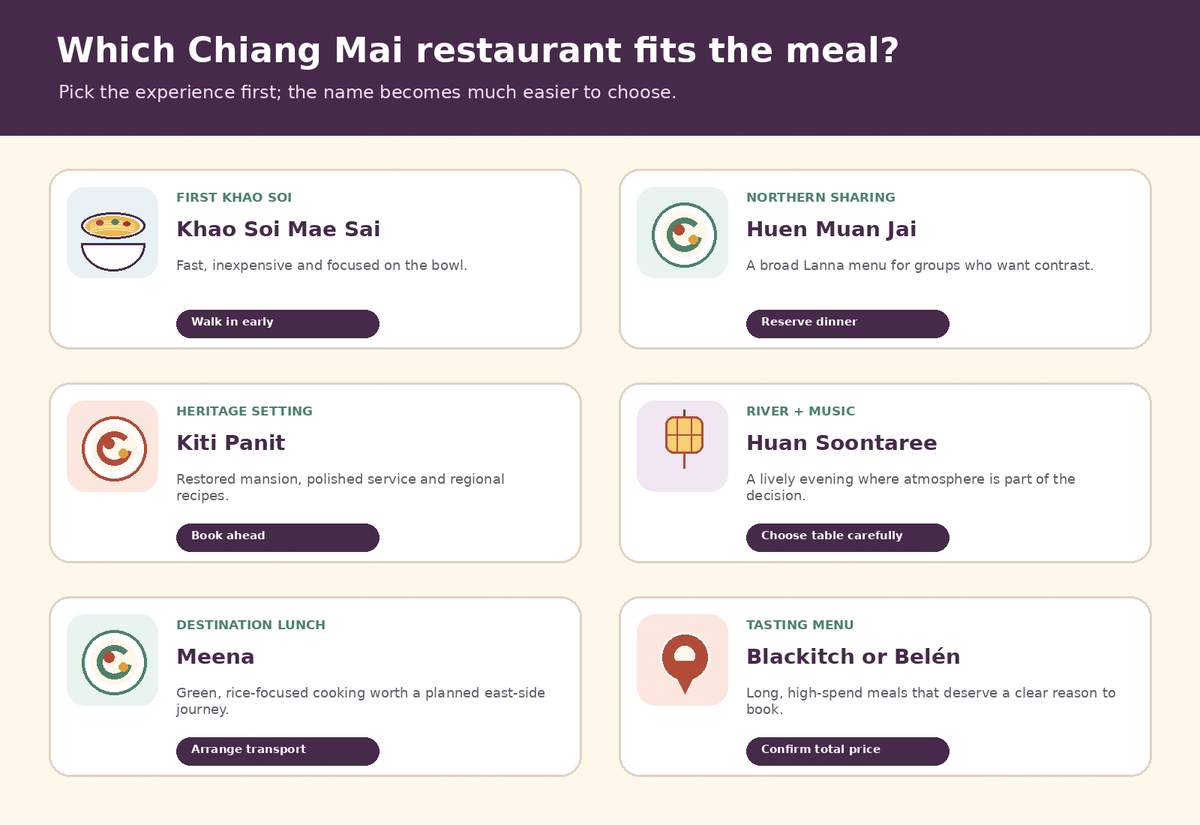
The order below moves from quick local food to destination tasting menus. It is not a claim that number one is universally better than number twelve. Instead, use the shortlist to solve the meal you actually need — then compare the alternatives within that category.
Why it earns a place
Khao Soi Mae Sai earns its place because it does one important job cleanly: it gives a first-time visitor a direct introduction to Chiang Mai’s best-known noodle dish without turning lunch into an event. The current Michelin listing keeps the shop in the 2026 Bib Gourmand selection and publishes its Ratchaphruek Road address, Monday-to-Saturday schedule and cash-only policy.[3]
The practical appeal is speed and focus. Khao soi combines egg noodles, curry broth, a meat topping, crisp noodles and condiments, so one bowl already has plenty happening. I would use this as the benchmark bowl near the start of a trip, then resist the temptation to compare every later meal with it. A second specialist can be interesting; three similar noodle lunches usually crowd out more revealing northern dishes.
What to order and how to use the meal
Choose the protein you genuinely want, then taste the broth before adding lime, pickled mustard greens or chilli oil. Those condiments are there to tune richness, acidity and heat, not to be tipped in automatically. Add a side only when hungry because the bowl is more filling than it looks. Anyone avoiding coconut, gluten, egg, fish sauce or a specific meat should ask directly; a busy specialist shop is not the right place to assume a recipe can be rebuilt safely.
Hours, booking and the main trade-off
Arrive in the morning or around an early lunch rather than treating 16:00 as a promise that every option will remain available. Seating is functional, turnover is quick and a queue may move faster than it first appears. Bring small cash, save the location offline and keep the afternoon flexible. The main reason to skip it is not quality but fit: diners wanting air conditioning, long conversation, formal allergy control or table service will be happier elsewhere.
| Advantages | Limitations |
|---|---|
| Clear benchmark for a first khao soi | Cash only |
| Low-cost and quick | Basic comfort and possible queue |
| Convenient for a flexible daytime plan | Limited flexibility for complex dietary needs |
Why it earns a place
Sanpakoi Kanomjeen broadens the trip beyond khao soi. The restaurant has operated since 1977 inside Thongkam Market, and the current Michelin page highlights nam lo, a northern curry served with rice noodles, as the signature direction. It is listed as cash only and currently opens from late morning into the evening from Monday to Saturday.[4]
This is the kind of place that works when travellers want to point, ask and assemble a meal rather than follow a formal course sequence. Kanom jeen noodles are a base for different curries and vegetables, so two diners can sample more than one flavour without ordering a large banquet. Meanwhile, the market setting gives the meal useful context: it feels like part of daily city life rather than a themed version of it.
What to order and how to use the meal
Start with one curry each or share two smaller combinations, then add the vegetables and accompaniments that make sense at the counter. Ask which curry is mildest only when that is actually the priority; sweetness, fermentation and herbal intensity can matter as much as chilli. Nam lo is the place-specific choice, while a familiar-looking curry gives cautious diners a useful comparison. Because sauces may contain fish sauce, shrimp paste, meat stock or shared utensils, a visual inspection is not enough for an allergy decision.
Hours, booking and the main trade-off
The long opening window makes Sanpakoi easier to fit than many specialist shops, although Sunday closure still matters. Go earlier for the widest choice and later for a more evening-market feel. Bring cash, expect straightforward seating and keep expectations centred on food rather than service theatre. It can pair with a separate dessert stop, but do not call it a pre-dinner snack when everyone orders a full bowl and several sides.
| Advantages | Limitations |
|---|---|
| Different northern noodle experience | Cash only |
| Long service window | Market comfort rather than restaurant polish |
| Excellent value for sampling | Ingredient communication can be difficult at busy periods |
Why it earns a place
Roti Pa Day belongs here because it adds a compact Muslim-Thai street-food experience without pretending to be a full restaurant dinner. The current Michelin listing places the stall in front of Wat Mahawan, describes an egg-free dough cooked in coconut oil and notes a wide choice of toppings. Most importantly, its published hours are 18:00 to midnight. That corrects the common mistake of treating it as a breakfast recommendation.[5]
Use it after an early dinner, during an evening walk or as one small part of a casual food night. Plain crisp roti gives the clearest sense of texture; condensed milk, banana, egg or other toppings turn it into a heavier dessert or snack. The planning test is simple: if the group has just finished a large northern sharing meal, order one to split rather than proving enthusiasm through quantity.
What to order and how to use the meal
Begin with a plain or lightly sweetened roti, then add one more adventurous topping only if the first is enjoyed. Ask before assuming that every version is vegan simply because the base dough is described as egg-free; toppings, condensed milk, butter substitutes and shared preparation may change the answer. Likewise, Muslim ownership or style should not be converted into an unsupported claim that every ingredient or preparation process meets a particular halal certification standard.
Hours, booking and the main trade-off
Expect roadside seating, an evening queue and fast production. Tha Phae is convenient for many Old City and Night Bazaar routes, so a special taxi journey is rarely necessary. Rain changes the experience more than it would at an indoor restaurant, and rich toppings can feel excessive in humid weather. Keep small notes, watch the queue before committing and save another dessert option nearby in case the stall is unexpectedly closed.
| Advantages | Limitations |
|---|---|
| Distinctive evening stop | Street-side comfort |
| Easy to share and inexpensive | Shared preparation limits allergy certainty |
| Convenient for central night walks | Not a substitute for a balanced dinner |
Why it earns a place
Huen Muan Jai is the most straightforward choice for travellers who want a proper northern Thai sharing table without committing to tasting-menu prices. Michelin retains it as a 2026 Bib Gourmand and lists a split lunch-and-dinner schedule with Wednesday closed. The Lanna-style wooden setting adds atmosphere, but the broad regional menu is the real reason to book.[6]
A successful first northern meal needs contrast. One curry, one chilli dip with vegetables, sausage or grilled meat, a greener dish and sticky rice will usually teach the table more than four pork-heavy signatures. I would choose Huen Muan Jai for a mixed group because people can try a little of several flavours, yet nobody has to sit through a long fixed menu.
What to order and how to use the meal
Gaeng hung lay is a useful reference point for rich, gently spiced northern curry, while sai ua brings herbs and smoke. Add a nam prik only after asking how hot or fermented it is, and request portion guidance before ordering for two. Northern dishes can include pork, offal, shrimp paste, fish sauce and shared stocks, so vegetarian or allergy requirements need ingredient-level discussion rather than a broad phrase such as ‘no seafood’.
Hours, booking and the main trade-off
The split service creates a real gap in the afternoon, and Wednesday closure catches travellers who rely on old listicles. Reserve dinner during weekends, holidays and the coolest months, then reconfirm the same day when the meal anchors the evening. Families and groups generally have more room here than at a counter restaurant. However, anyone wanting a quiet modern room or a fast single-plate meal may find the format more involved than necessary.
| Advantages | Limitations |
|---|---|
| Wide northern Thai range | Easy to over-order rich food |
| Good value when shared | Split hours and Wednesday closure |
| Comfortable for groups and first-timers | Popular periods can feel busy |
Why it earns a place
Kiti Panit is the occasion version of a northern Thai sharing meal. Its official history places the restored mansion in 1888, when the building opened as Chiang Mai’s first general store. The restaurant currently publishes lunch and dinner services from Wednesday to Monday, while its menu gives unusually useful price transparency for planning.[7][8]
Choose it when the building and paced service genuinely add value, not simply because the group wants northern food. Current menu examples include chicken khao soi at 260 THB, beef khao soi at 360 THB, nam prik at 190 THB, sai oua at 220 THB and gaeng hung lay at 390 THB. Prices exclude 10% service and 7% VAT, so the table total rises noticeably beyond the printed dish sum.[8]
What to order and how to use the meal
For two people, one curry, one dip or salad, one grilled or sausage dish and rice will often be enough. Add khao soi only when it solves a comparison or someone particularly wants it; ordering noodles plus several rich sharing plates can flatten the meal. Ask staff to build contrast and mention spice tolerance, offal, seafood ingredients and allergies before the kitchen begins. A polished room improves communication, but it does not remove the need for precise questions.
Hours, booking and the main trade-off
Reserve an evening slot, allow time to look at the building and avoid squeezing dinner between late sightseeing and a market. The central location is convenient, although traffic around Tha Phae can still slow a car. This is also a sensible choice for travellers who feel uncomfortable in a basic market setting. By contrast, budget diners or anyone prioritising the deepest possible food value should spend less at Huen Muan Jai and use the saving elsewhere.
| Advantages | Limitations |
|---|---|
| Memorable 1888 heritage setting | Service and VAT added |
| Current menu prices available | Higher cost than casual northern restaurants |
| Polished service for a regional meal | Rich menu needs disciplined ordering |
Why it earns a place
Huan Soontaree combines northern Thai food, a Ping River setting and live music, which makes it one of the clearest atmosphere-led choices on this list. Michelin’s current page highlights the performance element and a boneless fish stuffed with pork, while publishing evening hours from Monday to Saturday and a Sunday closure.[9]
The same features create the main warning. A table close to the stage can be a highlight for one group and an obstacle to conversation for another. Therefore, book Huan Soontaree when the music is part of the reason for going. Travellers seeking a romantic whisper-quiet dinner should choose a calmer riverside venue rather than hoping the speakers will somehow disappear.
What to order and how to use the meal
Share several dishes and ask which house specialities work together. The stuffed fish is an unusual talking point, although pork inside fish makes it unsuitable for diners who avoid either ingredient. Balance fried or rich dishes with vegetables, herbs and rice. Since live entertainment can distract the table, agree on an order before the performance becomes busy and confirm whether drinks, service or special menu items alter the expected spend.
Hours, booking and the main trade-off
Reserve a covered or river-facing table according to the season, ask when the main music begins and arrange the return journey before arriving. The Pa Tan location is not a comfortable walk from every hotel. Families should discuss volume, seating and timing rather than relying on a generic ‘family-friendly’ label. Rain may move tables or change the atmosphere, so a flexible booking matters during wetter months.
| Advantages | Limitations |
|---|---|
| Food, river and music in one evening | Noise can dominate |
| Good for sociable groups | Table position matters |
| Distinct from a standard central dinner | Needs planned transport |
Why it earns a place
Meena is a destination meal east of central Chiang Mai, not a restaurant to squeeze into a spare hour. Michelin keeps it in the 2026 Bib Gourmand selection and highlights its five-coloured rice, pork-rib curry with longan and calm setting in the Lhong Him Kaw community. The current published schedule runs from 10:00 to 20:00 every day.[10]
The journey earns its place when paired with a slower San Kamphaeng day, craft stops or a hired car. It makes less sense between Doi Suthep and an Old City evening booking. I would treat lunch as the anchor, arrive without a deadline and leave enough daylight to solve the return journey comfortably. That turns distance into part of the day rather than a source of stress.
What to order and how to use the meal
Use the coloured rice as the visual centre, then add a curry, vegetables and one contrasting dish. The longan curry is distinctive but may feel sweet and rich to diners expecting a sharp curry. Ask staff which portions suit the table and whether particular rice colours or dishes are available that day. As elsewhere, attractive plant ingredients do not guarantee a vegan recipe; stocks, sauces and shared cooking still need checking.
Hours, booking and the main trade-off
Book at weekends or for a large group, and arrange a driver, ride app or car with a clear collection plan. Open-air greenery is part of the appeal, but heat, mosquitoes and rain can alter comfort. A compact umbrella and repellent may be more useful than smart clothes. Skip Meena when the trip has only two full days or when someone dislikes spending travel time on a restaurant; choose Baan Landai or Kiti Panit centrally instead.
| Advantages | Limitations |
|---|---|
| Distinctive green setting | Journey from central Chiang Mai |
| Rice-led menu beyond standard tourist choices | Weather affects comfort |
| Good value for a destination meal | Poor fit for a rushed itinerary |
Why it earns a place
Baan Landai is the useful bridge between street food and a tasting menu. The Old Town branch publishes unusually detailed practical information: lunch last orders at 14:30, dinner last orders at 20:30, Monday closure, limited tables and a direct-reservation policy rather than third-party booking. It also accepts Visa and Mastercard according to the current FAQ.[11]
Choose it for a polished, central Thai meal where conversation, comfort and a varied menu matter. It is not exclusively northern, which is a limitation only when the trip has room for one regional dinner. For mixed-confidence diners, that breadth can be an advantage because the table can pair unfamiliar flavours with dishes that feel easier to understand.
What to order and how to use the meal
Ask for portion guidance and build a balanced sharing order. Two people rarely need every famous dish seen online. Start with one aromatic or spicy plate, one slower curry or braise, a vegetable dish and rice, then add only after seeing the portions. The restaurant publishes a vegetarian menu, but its allergy FAQ asks diners to contact the team in advance and explains that some severe requests may be declined depending on kitchen capability.[11]
Hours, booking and the main trade-off
Book through the restaurant’s stated direct channels and confirm whether the table is indoors or outside. Its FAQ warns that outdoor seating can be affected by rain and mosquitoes, which is useful honesty. Families are accepted, but a small room still needs realistic behaviour and table planning. When a serious allergy is involved, obtain a direct written answer before the day; a reservation confirmation alone is not an ingredient guarantee.
| Advantages | Limitations |
|---|---|
| Central and comfortable | Limited tables |
| Transparent reservation and allergy information | Monday closure |
| Good bridge between casual and formal dining | Not a purely northern Thai experience |
Why it earns a place
CHAWEE is one of Chiang Mai’s three new Bib Gourmand entries for 2026. Michelin describes a monthly changing menu rooted in childhood memories and older recipes, which gives the restaurant a clear identity beyond ‘modern Thai’. The current guide also publishes a direct phone number, an important detail for such a small room.[1][12]
This is the choice for diners who want a chef-led sequence but do not want to jump straight from a 100-THB bowl to a 3,000-THB tasting menu. A July 2026 secondary planning check described only three or four tables, advance phone reservations and a set of roughly seven courses near 1,000 THB. Because that information is not the restaurant’s own live booking page, treat every exact price, time and course count as provisional.[13]
What to order and how to use the meal
The attraction is the menu the kitchen is serving, so there may be little value in arriving with a list of must-order dishes. Ask what the current set includes, whether it can accommodate the party’s restrictions and how long to allow. Seasonal variation is a strength for flexible diners and a weakness for anyone who needs certainty. Confirm chilli, shellfish, fish sauce, offal and meat ingredients before paying or travelling.
Hours, booking and the main trade-off
Telephone booking may require help from hotel staff, a local SIM or a messaging follow-up. Reconfirm the date, service, price, deposit, payment method and location in writing where possible. Do not plan CHAWEE immediately after a cooking class. The room is too limited to absorb late arrivals casually, and a set menu is more enjoyable when the day has left some appetite.
| Advantages | Limitations |
|---|---|
| Current 2026 Bib newcomer | Exact menu changes monthly |
| Small and personal format | Very limited seating |
| Middle ground between casual food and costly fine dining | Current hours and price need direct confirmation |
Why it earns a place
Blackitch is the most locally grounded tasting-menu choice on this shortlist. Michelin describes a 16-seat room, a seasonal menu of more than ten courses and a strong focus on Thai ingredients, fermentation and preservation. The current listing publishes lunch and dinner services on Monday, Tuesday and Thursday through Sunday, with Wednesday closed.[14]
Book it when the technique and ingredient story genuinely interest the table. It is not a better version of Huen Muan Jai; it is a different format with smaller courses, less choice and more explanation. That distinction matters because travellers sometimes pay tasting-menu prices while secretly wanting a relaxed curry and rice dinner. A planning allowance of 2,500-3,500 THB before drinks is sensible, but the direct quote should always win.
What to order and how to use the meal
Expect the current sequence rather than a conventional a la carte order. Ask about menu length, pairings, substitutions and the point at which dietary changes become impossible. Fermented sauces, seafood products and preserved ingredients can be central rather than incidental, so serious restrictions need early discussion. Keep lunch light, avoid a food tour that afternoon and give the kitchen enough time to explain the meal without watching the clock.
Hours, booking and the main trade-off
Reserve well ahead for only 16 seats and reconfirm the final total, deposit and cancellation terms. Nimman is convenient from many west-side hotels, although evening traffic still affects arrival. A counter or intimate room may not suit young children or a group that wants private conversation. The reason to skip Blackitch is not simply price: fixed pacing, experimental flavours and a long commitment need to match the diners.
| Advantages | Limitations |
|---|---|
| Strong Chiang Mai ingredient narrative | Fixed-menu rigidity |
| Intimate 16-seat format | High spend and long meal |
| Clear contrast with classic northern restaurants | Dietary substitutions may be limited |
Why it earns a place
Cuisine de Garden offers a different creative direction: its official site describes a Lanna and New Nordic approach built around local Thai ingredients and a nature-led presentation style. The restaurant sits in Hang Dong, so the setting and journey are part of the commitment rather than an incidental taxi ride.[15]
Cuisine de Garden’s current direct menu lists a 12-course “Cast Off Rain” sequence at 3,200 THB net per person, including mineral water. Its own home page currently describes lunch and dinner service daily, while the 2026 Michelin listing shows a more limited Wednesday-to-Sunday pattern. Because those published schedules do not align, confirm the exact sitting directly before arranging transport.[15][16]
What to order and how to use the meal
Read the current concept before booking and ask which courses rely on seafood, meat, dairy or fermentation. Presentation is a major part of the experience, which suits diners who enjoy surprise and visual storytelling. Travellers primarily seeking recognisable northern classics should choose Kiti Panit or Huen Muan Jai instead. Likewise, a child or adult who dislikes long structured meals may enjoy the setting less than the person making the reservation expects.
Hours, booking and the main trade-off
Build a return driver into the cost, record the deposit rules and allow a generous evening. Do not depend on finding a car instantly after a late rural dinner. Deposit, rescheduling and cancellation terms can change with the booking channel, so read the direct confirmation rather than relying on an old marketplace summary. The all-in bill should be checked for drinks, service, tax and supplements before the cancellation window closes.
| Advantages | Limitations |
|---|---|
| Distinctive visual experience | Hang Dong transport commitment |
| Local-ingredient creative approach | Deposit and cancellation exposure |
| Strong special-occasion contrast | Not the best introduction to traditional northern food |
Why it earns a place
Belén is the most expensive and least traditionally northern choice here, which is exactly why its role must be stated clearly. The official site currently offers one seasonal tasting menu at 5,500 THB, excludes 10% service and 7% VAT, and asks guests to allow at least 90 minutes. The published dinner schedule closes on Wednesday, with the restaurant FAQ listing a 20:00 last seating.[17]
After service and VAT, the menu alone is roughly 6,400-6,500 THB before drinks, depending on how charges are applied. Book it only when the group wants a European-format fine-dining finale and accepts that this spend could fund many excellent local meals. It should not displace the trip’s only northern Thai dinner. Instead, use it as an extra layer for travellers whose interest genuinely includes luxury tasting menus.
What to order and how to use the meal
The restaurant serves a single menu, so the real decision happens before arrival. Request the latest menu structure, pairing prices, dress expectation, accessibility information and written confirmation of any dietary adaptation. A willingness to note an allergy is not the same as a guarantee that the kitchen can remove cross-contact. Because the meal is inside a major hotel, communication may be smoother, but the medical standard should remain unchanged.
Hours, booking and the main trade-off
Reserve well ahead, check deposit and cancellation rules, and arrive early enough that traffic does not compress the sitting. The InterContinental location near the Night Bazaar makes the return easier than Hang Dong, although the experience still deserves an unhurried night. Skip Belén when price anxiety will dominate the table or when someone expects recognisable Thai classics. A costly menu is worthwhile only when its style matches the diners.
| Advantages | Limitations |
|---|---|
| Most polished luxury finale | Highest cost in the guide |
| Central hotel setting | Not a northern Thai primer |
| Clear published base price and time allowance | Single menu limits flexibility |
A restaurant’s area changes more than the taxi fare. It determines whether a meal can follow sightseeing naturally, whether the group can walk home, and how much delay should be built around rain or traffic. The strongest food itinerary clusters at least some meals around the day’s location instead of crossing the city because a saved map pin looks tempting.
| Area | Best for | Useful restaurants in this guide | Main caution |
|---|---|---|---|
| Old City / Tha Phae | Easy central evenings and mixed-confidence diners | Roti Pa Day, Baan Landai, Kiti Panit | Traffic and tourist crowds around major gates |
| Chang Phueak / Santitham | Noodles, northern food and small chef-led rooms | Khao Soi Mae Sai, Huen Muan Jai, CHAWEE | Separate pins may still require a short ride |
| Chang Moi / riverside approach | Market food and casual local meals | Sanpakoi Kanomjeen | Market seating and cash are common |
| Pa Tan / Ping River | Atmosphere-led group evenings | Huan Soontaree | Return transport and music volume |
| Nimman | Contemporary dining and west-side hotel convenience | Blackitch | Traffic can erase the apparent short distance |
| San Kamphaeng / Hang Dong | Destination lunch or tasting-menu outing | Meena, Cuisine de Garden | The journey must be designed, not improvised |
| Chang Khlan / Night Bazaar | Hotel-based splurge and central nightlife | Belén, near Kiti Panit | Tourist-zone prices vary widely |
Where I would base a food-focused first visit
For a first trip, the Old City edge, Chang Khlan or the space between the Old City and Nimman gives the best compromise. None puts every restaurant on foot, but each keeps many daytime sights, markets and evening options within a manageable ride. Read the detailed best areas to stay in Chiang Mai guide before choosing a hotel solely from a restaurant map.
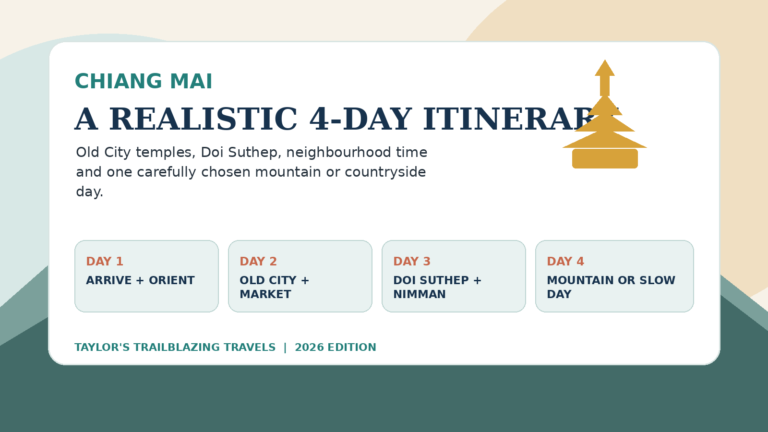
Four nights are enough for contrast but not for every famous address. One priority meal each day protects the trip from heat, sightseeing delays and simple loss of appetite. The plan below is deliberately incomplete: breakfast can be spontaneous, and at least one evening remains movable.
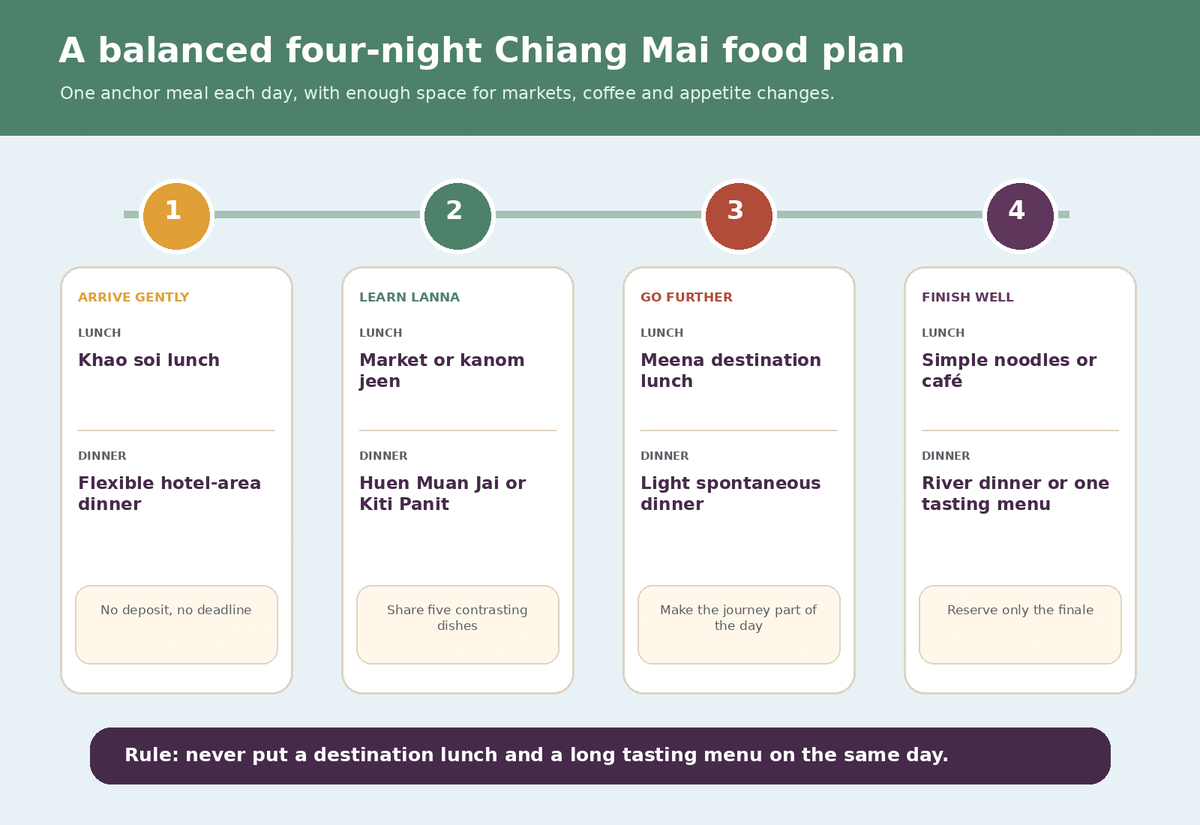
| Day | Main food decision | Flexible space | Why it works |
|---|---|---|---|
| Arrival day | Sanpakoi Kanomjeen or a simple neighbourhood meal | Roti Pa Day only if hungry later | No expensive reservation depends on an on-time flight or train |
| Full day 1 | Khao Soi Mae Sai before or after a north-side route | Unbooked evening | The benchmark bowl comes early without consuming the whole day |
| Full day 2 | Huen Muan Jai or Kiti Panit | Light lunch and cafe stop | One broad northern sharing meal gets proper appetite and attention |
| Full day 3 | Meena as a destination lunch | Easy central dinner | The east-side journey has room rather than fighting another booking |
| Final night | CHAWEE, Blackitch, Cuisine de Garden or Belén | Very light daytime food | Only one long or expensive set menu is needed |
The two-night version
With two nights, choose one casual daytime speciality and one northern sharing dinner. Khao Soi Mae Sai plus Huen Muan Jai gives the clearest value-led contrast. Alternatively, Kiti Panit replaces Huen Muan Jai when the heritage room matters. Do not spend half of a short visit travelling to both Meena and Hang Dong unless food is the principal purpose of the trip.
The seven-night version
A week allows one market meal, two different northern restaurants, a destination lunch, a food tour or class and one set menu without overloading the schedule. Add Sanae, Aeeen, Rasik or Busarin according to dietary needs and interest rather than adding a second tasting menu automatically. The wider Chiang Mai itinerary helps place meals around temples, markets and day trips.
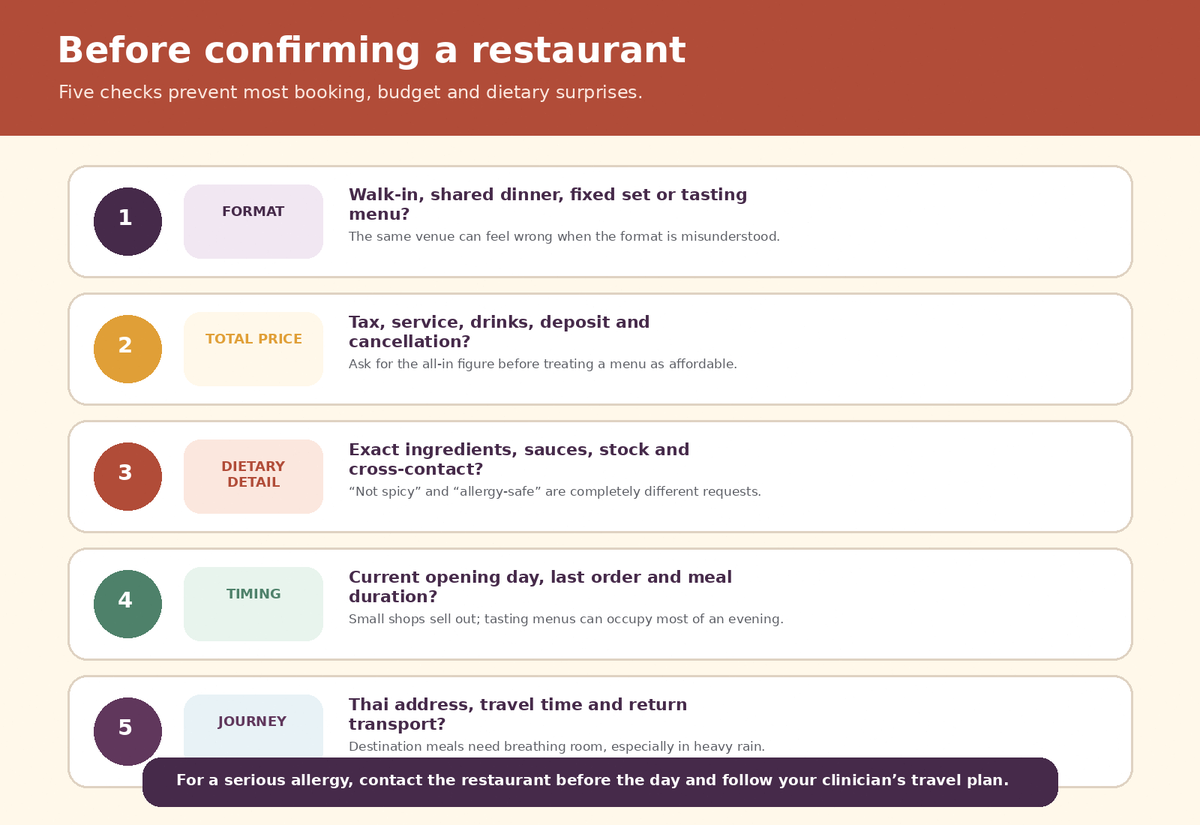
Book the seats that can genuinely disappear
CHAWEE, Blackitch, Cuisine de Garden and Belén have limited seats, fixed formats or deposit exposure, so they deserve advance action. Kiti Panit, Huan Soontaree and Baan Landai also benefit from reservations when the exact evening matters. Casual noodle and roti stops should remain flexible unless travelling with a large party. This approach protects both access and freedom.
Record the complete agreement
- Restaurant name, branch and map pin.
- Date, arrival time, last seating and estimated duration.
- Number of adults and children, plus high-chair or accessibility requests.
- Current menu price, currency, VAT, service, drinks and supplements.
- Deposit amount, payment channel, refund and rescheduling rules.
- Dietary request and the restaurant’s exact reply.
- Indoor, outdoor, river, stage or counter seating when that changes the experience.
- Telephone, messaging account and a screenshot available offline.
Do not confuse a closing time with a last-order promise
A listing that says 22:00 may stop accepting food much earlier, while a specialist shop can sell out before its published close. Baan Landai’s direct FAQ is a good model because it publishes separate last-order times. Elsewhere, ask the question directly. Arriving forty minutes before closing is not a neutral choice when the meal is meant to be slow or multi-course.
Taste preference and medical risk are different conversations
Asking for less chilli is a flavour request. A serious allergy is a health-critical request involving ingredients, stocks, sauces, utensils, oil and cross-contact. Do not merge the two into one vague message. The NHS advises people with food allergy to check ingredients, tell restaurant staff, carry prescribed adrenaline auto-injectors where applicable and seek urgent help for a severe reaction.[26]
Vegetable-looking dishes may still contain animal ingredients
Fish sauce, shrimp paste, oyster sauce, meat stock, dried seafood and shared cooking can appear in dishes that look vegetarian. Use ingredient names, not only the word vegetarian. Baan Landai publishes a vegetarian menu but still asks allergy guests to contact the restaurant in advance, which is the right distinction. Aeeen is the strongest alternative in this guide for travellers deliberately seeking a plant-based restaurant, yet individual allergies still need confirmation.[11][20]
A translation card is support, not certification
A professionally prepared card can make a restriction clearer, especially when it lists the exact ingredient and the consequences of cross-contact. Nevertheless, a card cannot prove that a small kitchen has separate equipment or safe processes. Travellers with a serious condition should follow their clinician’s plan, carry medication in hand luggage, maintain insurance and identify nearby medical care before eating.
General food-safety cues
The World Health Organization’s Five Keys focus on cleanliness, separating raw and cooked food, thorough cooking, safe temperatures and safe water or raw materials. A busy stall is not automatically safe, and a polished dining room is not automatically risk-free. Look for active turnover, food cooked thoroughly, clean handling and sensible storage, then use personal judgement rather than a blanket rule about street food.[25]
Choose a food tour when ordering and navigation are the problem
A guided evening can be valuable during the first 24 hours because the guide handles market navigation, ordering and context. The current GetYourGuide evening market option advertises about 2.5 hours, at least eight dishes, hotel pickup and a group cap of ten. A Viator small-group option uses a market route and songthaew transport while teaching ordering language. These are examples to compare, not claims that every departure or tasting remains identical.[22][23]
Choose a cooking class when technique matters
A cooking class is more useful than another restaurant booking when travellers want to understand curry paste, herbs, market ingredients or the structure of a Thai meal. One current GetYourGuide option combines a market visit, herb garden and practical cooking. However, a class can supply enough food for most of the day, so remove a major lunch or dinner rather than stacking experiences.[24]
Choose an independent route when flexibility matters most
Independent eating works best for confident diners who can use maps, queue patiently and accept that a saved stall may be closed. It is cheaper and more adaptable, although context and dietary communication are weaker. A good compromise is one guided experience early in the trip, followed by independent choices informed by what the guide explained. Do not book a tour merely because an affiliate link exists; it should solve a real problem.
The figures below are planning allowances in Thai baht before alcohol. They are intentionally broad and should not be treated as live quotations. Sharing style, service charges, imported drinks, supplements, transport and appetite can move the total quickly. The separate Thailand travel budget guide helps place meals inside the full trip cost.
| Meal type | Food allowance / person | Typical extras | Best use |
|---|---|---|---|
| Specialist bowl or market plate | 60-200 THB | Drinks, second dish, cash | Flexible breakfast, lunch or casual evening |
| Northern sharing restaurant | 300-900 THB | Rice, drinks, larger group order | One substantial regional meal |
| Heritage or polished central restaurant | 700-1,500 THB | VAT, service, cocktails | Comfort or occasion without a fixed menu |
| Small seasonal set menu | About 1,000-1,500 THB | Deposit, drinks, taxi | Chef-led middle ground |
| Creative tasting menu | 2,500-3,500+ THB | Pairing, service, tax, transport | One special evening |
| Luxury international tasting menu | 6,400-6,500+ THB | Drinks, supplements | Fine-dining travellers only |
Daily food-budget examples
| Style | Daily food allowance | What it could cover | Main compromise |
|---|---|---|---|
| Value-led | 500-900 THB | Simple breakfast, specialist lunch, casual dinner and drinks | Limited alcohol and fewer polished settings |
| Comfortable mixed | 1,200-2,200 THB | Cafe breakfast, local lunch, northern sharing dinner and drinks | One costly tasting menu still sits outside the day |
| Food-focused | 2,500-4,500 THB average | Guided experience or polished dinner plus lighter meals | Requires deliberate appetite and schedule management |
| Luxury tasting day | 7,000+ THB | Light daytime food and Belén-level dinner | Most of the budget goes to one meal |
Where travellers most often underestimate cost
- 10% service and 7% VAT added to menu prices.
- Wine, cocktails and imported sparkling water.
- Taxi waiting time or a private driver for Hang Dong and San Kamphaeng.
- Deposits that cannot be refunded after the deadline.
- Ordering too many sharing dishes for two people.
- A cooking class followed by a full reserved dinner that nobody needs.
- Hotel breakfast included in the room rate but ignored when building the food plan.
Choose accommodation for the whole itinerary
A food map should influence but not control the hotel choice. Old City and Tha Phae bases favour central meals and sightseeing; Nimman favours west-side cafes and Blackitch; Chang Khlan suits the Night Bazaar and Belén. A remote resort can be pleasant, yet every dinner becomes a transport project. Compare room cancellation, breakfast, road noise and walking conditions alongside restaurant distance.
Arriving from Bangkok
Flights are fastest, while overnight trains and daytime rail journeys turn transport into part of the trip. The Bangkok to Chiang Mai transport guide compares the main choices. Build the first important dinner after a buffer, not immediately after the scheduled arrival. Delays, luggage and hotel check-in can consume more time than a map suggests.
Mobile data is a dining tool
Restaurant pins, ride apps, translated messages and last-minute closure checks all depend on a working connection. Download offline maps as backup and save reservation screenshots before leaving Wi-Fi. The full Thailand SIM card and eSIM guide explains the main options.
Build the return journey before the meal
For Meena, Huan Soontaree and Cuisine de Garden, decide who is driving or which app will be used before sitting down. Save the address in Thai, ask the restaurant about pickup access and keep enough battery. When alcohol is involved, a booked car is part of the meal cost. Scooter rental is not a sensible answer for an inexperienced rider returning after dinner or in rain.
Food travel needs less equipment than product lists imply. A phone with data, a payment backup and weather protection solve more problems than specialist cutlery or containers. Buy only when an item addresses a real health, communication or weather need.
| Item | Useful when | Advantages | Limitations |
|---|---|---|---|
| Professionally translated allergy card | A diagnosed allergy requires exact ingredient communication | Clearer than improvising under pressure | Cannot guarantee kitchen controls or replace medical advice |
| Thai phrasebook | Travellers want broader ordering and courtesy language | Works offline and supports local interaction | Generic phrases are insufficient for severe allergies |
| Compact umbrella | Rainy-season markets, open-air seating and pickup waits | Small and useful beyond restaurants | Cheap models can fail in wind |
| Power bank | Maps, ride apps and translated messages run all day | Protects the return journey | Must meet airline battery rules |
| Small cash wallet | Cash-only shops and market stalls | Speeds simple payments | Split cash and cards rather than carrying everything together |
See the full Thailand packing list and best time to visit Thailand guide before buying weather-specific gear.
Twelve main entries keep the guide usable, but several excellent alternatives solve needs the core list cannot cover perfectly. These are replacements, not automatic additions.
| Alternative | Choose it for | Current planning note | What it can replace |
|---|---|---|---|
| Aeeen | Plant-based Neo Shojin Ryori and seasonal ingredients | Current Michelin listing shows Thursday-Sunday 11:00-17:00, Monday-Wednesday closed and cash only | A destination lunch when vegetarian food is the priority[20] |
| Sanae | A halal kitchen and creative beef-focused Thai cooking | Confirm certification expectations, current menu and reservation details directly | Baan Landai or a northern dinner for halal-seeking diners[19] |
| Rasik Local Kitchen | A tiny booked regional experience | Current listing describes 14-16 seats per service, three menu formats and booking required | CHAWEE or Blackitch, depending on the chosen format[18] |
| Busarin Cuisine | Family recipes and a daytime northern meal | Current listing publishes Monday-Saturday 11:00-16:00 and Sunday closure | Huen Muan Jai when lunch fits better than dinner[21] |
How to decide between the alternatives
Start with the constraint that matters most. Aeeen addresses plant-based intent; Sanae addresses halal kitchen needs; Rasik offers an intimate booked format; Busarin suits a daytime northern meal. Replacing by need creates a stronger itinerary than adding every recognised restaurant. It also keeps space for unplanned neighbourhood food, which is often where a trip becomes personal.
Why Chiang Mai is unusually good for food travellers
| Advantages | Limitations |
|---|---|
| Exceptional contrast from low-cost specialists to ambitious tasting rooms | Opening days, last orders and temporary closures can change quickly |
| Northern dishes explain a regional identity distinct from central Thai staples | Fish sauce, shrimp paste, meat stock and shared preparation complicate dietary assumptions |
| Many recognised restaurants remain accessible at moderate prices | Popular rooms and tiny chef-led venues need advance booking |
| Compact central districts support flexible eating | Destination venues east and south require deliberate transport |
| Markets, tours and classes add context beyond restaurant reviews | Too many food activities can overwhelm appetite and itinerary |
Ten mistakes that weaken an otherwise good food plan
Booking every dinner
Heat, tours and delayed transport make a fully reserved week fragile. Protect at least one free evening.
Treating Roti Pa Day as breakfast
Its current published service is evening to midnight. Use it as a dessert or casual night stop.
Ordering every signature
Rich curries, sausage, dips and noodles can overwhelm two diners. Ask for portion and balance advice.
Ignoring tax and service
A tasting menu or heritage restaurant may add 10% service and 7% VAT to the printed price.
Assuming Michelin means expensive
Bib Gourmand recognition in Thailand specifically includes a value benchmark under 1,000 THB for three courses.
Assuming vegetable means vegan
Sauces, stocks and shared preparation may contain animal ingredients even when the visible dish is plant-heavy.
Scheduling two food events in one day
A cooking class plus a large booked dinner often wastes money and reduces enjoyment.
Leaving the return ride unresolved
San Kamphaeng and Hang Dong meals need a clear collection plan, especially after dark or in rain.
Using one old screenshot as truth
Confirm the current branch, day, last order, menu, deposit and dietary answer directly.
Forgetting cash and a backup
Several specialist shops are cash only. Split cash and cards, then keep enough baht for the return journey.
What are the best restaurants in Chiang Mai for a first visit?
A balanced first shortlist is Khao Soi Mae Sai for a specialist bowl, Huen Muan Jai or Kiti Panit for northern sharing food, Sanpakoi Kanomjeen for a casual market meal and one optional set menu such as CHAWEE or Blackitch. Add Roti Pa Day as an evening snack, not breakfast. Choose by meal type and location rather than trying to visit every famous address.
How much should I budget for restaurants in Chiang Mai?
A specialist bowl or market plate may cost roughly 60-200 THB per person, a northern sharing meal about 300-900 THB, and a polished heritage dinner around 700-1,500 THB before drinks. Creative tasting menus can start near 2,500-3,500 THB, while the current Belén menu reaches roughly 6,400-6,500 THB after published service and VAT but before drinks. Reconfirm all live prices.
Do I need restaurant reservations in Chiang Mai?
Reserve limited-seat or fixed-menu restaurants such as CHAWEE, Blackitch, Cuisine de Garden and Belén. Kiti Panit, Huan Soontaree and Baan Landai also merit booking when a precise evening matters. Keep noodle shops, markets and roti stops flexible because queues, sell-outs and appetite are easier to manage without a reservation.
Which Chiang Mai restaurant is best for northern Thai food?
Huen Muan Jai is the most flexible first choice for a relaxed shared introduction. Kiti Panit adds a restored 1888 heritage setting and more polished service. Busarin is a useful daytime alternative, while Meena adds a destination setting and rice-led menu east of the city. The best option depends on whether value, atmosphere, location or meal time matters most.
Where should I try khao soi in Chiang Mai?
Khao Soi Mae Sai is the focused recommendation in this guide because it is inexpensive, current, easy to understand and recognised as a 2026 Bib Gourmand. Arrive earlier than the published closing time, bring cash and taste the broth before adding condiments. One benchmark bowl is enough to start; use later meals to explore other northern dishes.
Is Roti Pa Day open for breakfast?
No. Its current Michelin listing publishes daily hours from 18:00 to midnight. Treat it as an evening street-food or dessert stop near Wat Mahawan and Tha Phae. Opening patterns can still change, so keep a nearby alternative and avoid making a special journey without checking on the day.
What is the best Chiang Mai restaurant for a special occasion?
Kiti Panit suits travellers who want a beautiful historic room without a fixed tasting menu. Blackitch is the strongest local-ingredient tasting narrative; Cuisine de Garden suits diners who enjoy theatrical nature-led presentation; Belén is the luxury international finale. Choose the culinary format the group actually enjoys, then check the all-in price and cancellation terms.
Are Chiang Mai restaurants suitable for vegetarians and vegans?
Many restaurants can offer vegetable dishes, but fish sauce, shrimp paste, oyster sauce, meat stock and shared cooking are common concerns. Ask by ingredient rather than relying on a broad vegetarian label. Aeeen is a useful plant-based alternative, while Baan Landai publishes a vegetarian menu. Serious allergies still require direct discussion about cross-contact and kitchen capability.
Is Chiang Mai street food safe?
No venue type is automatically safe or unsafe. Use the WHO principles: look for cleanliness, separation of raw and cooked food, thorough cooking, safe temperature control and safer water or ingredients. Active turnover can be a useful clue, but it is not a guarantee. Travellers with medical vulnerabilities should follow their clinician’s advice and avoid relying on a blog assessment.
Should I book a Chiang Mai food tour?
A tour is worthwhile when ordering, market navigation and cultural context are the main barriers. It can be especially useful near the start of a trip. Compare the live duration, walking level, transport, tasting count, dietary limitations and cancellation rules. Confident travellers may prefer an independent route, while one tour followed by flexible eating often gives the best balance.
Is a Chiang Mai cooking class worth it?
Yes, when learning technique and ingredients matters more than adding another restaurant. A market visit and herb-garden component can explain curry pastes and produce in a way dinner cannot. However, classes often provide a large amount of food. Remove a major meal that day, and confirm dietary arrangements and cross-contact limitations directly with the operator.
Which area is best to stay in for Chiang Mai restaurants?
The Old City edge, Tha Phae, Chang Khlan and the corridor towards Nimman are the most versatile first-visit bases. They will not put every restaurant on foot, but they reduce travel for central meals and sights. Choose the hotel for the whole itinerary, including noise, breakfast, cancellation and transport, rather than for one reservation.
Can I use cards at Chiang Mai restaurants?
Card acceptance varies. Khao Soi Mae Sai, Sanpakoi Kanomjeen and Roti Pa Day are currently listed as cash-only, while Baan Landai states that Visa and Mastercard are accepted. Keep small baht notes, a second payment method and enough cash for a ride home. Ask before ordering at any place where payment information is unclear.
How many food-focused days do I need in Chiang Mai?
Three or four full days allow one khao soi stop, one market meal, one northern sharing dinner, a destination lunch or guided activity and one optional set menu without forcing the schedule. With only two nights, choose one casual speciality and one northern dinner. A week creates room for alternatives such as Aeeen, Sanae, Rasik or Busarin.
The strongest first-timer combination
For most first visits, I would choose Khao Soi Mae Sai, one meal at Huen Muan Jai or Kiti Panit, one flexible market or roti stop and only one chef-led set menu. Meena becomes the destination lunch when the itinerary has time east of the city. Huan Soontaree replaces a quiet dinner only when live music is genuinely welcome. This creates contrast without letting restaurants consume the trip.
What to check during the final 48 hours
- Opening day, branch, last order and map pin.
- Current menu, all-in price, deposit and cancellation deadline.
- The restaurant’s written reply to any dietary or accessibility request.
- Weather and indoor or outdoor seating.
- Arrival buffer and a safe return journey.
- Enough unbooked space for appetite, delays and spontaneous finds.
- Current Thailand entry, health, insurance and travel advice.[27]
Restaurant hours, prices, menu formats and booking details were checked on 6 September 2026 against direct restaurant pages, the 2026 Michelin Guide, Thai government reporting, current reservation marketplaces, WHO, NHS and UK government advice. Because operations can change after publication, direct confirmation from the venue should outrank this article for a live reservation.
Core selection and restaurant sources
- Thailand Government Public Relations Department – 2026 Bib Gourmand selection. Official summary of 137 Thailand Bib Gourmand venues, including 18 in Chiang Mai and the under-1,000-THB Thailand benchmark for a three-course meal.
- MICHELIN Guide – Chiang Mai Bib Gourmand restaurants. Current 2026 list of 18 Chiang Mai Bib Gourmand venues and its cuisine, price and facilities filters.
- MICHELIN Guide – Khao Soi Mae Sai. 2026 Bib Gourmand status, address, current hours, contact details, cash-only note and inspector description.
- MICHELIN Guide – Sanpakoi Kanomjeen. 2026 Bib Gourmand status, Thongkam Market location, current hours, cash-only note and nam lo recommendation.
- MICHELIN Guide – Roti Pa Day. 2026 Bib Gourmand status, evening opening hours, location in front of Wat Mahawan and plain-roti recommendation.
- MICHELIN Guide – Huen Muan Jai. 2026 Bib Gourmand status, northern Thai focus, opening days, setting and facilities.
- Kiti Panit – official website. Direct 2026 opening schedule, address, contact information and the history of the restored 1888 general-store mansion.
- Kiti Panit – official menu. Current dish prices and the statement that prices exclude 10% service charge and 7% VAT.
- MICHELIN Guide – Huan Soontaree. 2026 Bib Gourmand status, riverside setting, live-music context, current opening schedule and signature stuffed fish.
- MICHELIN Guide – Meena. 2026 Bib Gourmand status, San Kamphaeng location, current hours, five-coloured rice and pork-rib longan curry.
Menus, alternatives and specialist restaurants
- Baan Landai – official Old Town FAQ. July 2026 opening hours, last-order times, direct-reservation policy, payment, family, weather and allergy information.
- MICHELIN Guide – CHAWEE. 2026 Bib Gourmand status, monthly seasonal menu, intimate format and current contact number.
- ThailandAddict – CHAWEE July 2026 planning snapshot. Secondary current check of advance-only reservations, tiny table count, approximate 1,000-THB set and reported service windows; all details require direct reconfirmation.
- MICHELIN Guide – Blackitch. 2026 selection, 16-seat format, seasonal menu of more than ten courses, current opening schedule and contact number.
- Cuisine de Garden – official website. Direct description of the Lanna/New Nordic approach, local ingredients, address, contact information and published service hours.
- Cuisine de Garden – current tasting menu. Direct menu checked for the current 12-course, 3,200-THB-net format and included mineral water.
- Belén by Paulo Airaudo – official website. Current single-menu format, 5,500-THB base price, excluded VAT and service, minimum time allowance, address, phone and opening schedule.
- MICHELIN Guide – Rasik Local Kitchen. 2026 Bib Gourmand status, 14-16 seats per service, booking requirement, menu formats and current opening schedule.
- MICHELIN Guide – Sanae. 2026 Bib Gourmand listing and its description as a halal kitchen focused on creative beef dishes.
- MICHELIN Guide – Aeeen. 2026 selected plant-based restaurant, Neo Shojin Ryori concept, seasonal ingredients and limited Thursday-Sunday schedule.
- MICHELIN Guide – Busarin Cuisine. 2026 selected northern Thai restaurant, family-recipe focus, current daytime hours and Sunday closure.
Tours, health and travel-advice sources
- GetYourGuide – Chiang Mai evening street-food market tour. Current operator-published 2.5-hour format, small-group limit, hotel pickup and minimum tasting information checked before inclusion.
- Viator – Chiang Mai small-group evening street-food tour. Current market route, small-group format, songthaew transport and ordering-language context checked before inclusion.
- GetYourGuide – Chiang Mai cooking class, market and herb garden. Current operator-published market, garden and cooking format checked before inclusion; dietary needs still require direct confirmation.
- World Health Organization – Five Keys to Safer Food. International food-safety principles covering cleanliness, separation, thorough cooking, safe temperatures and safe water or raw materials.
- NHS – Food allergy. UK clinical guidance on symptoms, restaurant communication, prescribed adrenaline and urgent response to severe allergic reactions.
- UK Foreign, Commonwealth & Development Office – Thailand travel advice. Current UK government destination advice to consult alongside insurance, health and local emergency preparation.
Illustrations in this article were created for Taylor’s Trailblazing Travels. Third-party photographs, where used, are credited beside the image or in the source list.
About Karen Taylor
Karen Taylor created Taylor’s Trailblazing Travels to turn complicated Thailand research into practical, realistic trip plans. Her guides compare timings, costs, booking choices and likely trade-offs using current official information, direct venue sources and clearly labelled planning estimates. She does not claim to have personally visited every place covered; recommendations are based on careful research, cross-checking and traveller-focused analysis.