
Thailand transport • 2026
A practical hotel-to-hotel guide to direct flights, overnight coaches, the sleeper route through Surat Thani and long-distance road travel.
The rail option ends at Surat Thani and continues by road; compare every route from the Bangkok hotel to the final Phuket accommodation.
Bangkok to Phuket transport looks simple on a booking screen, yet the fastest ticket can still create a slow day when the wrong Bangkok airport, checked luggage and a long Phuket hotel transfer are added.
For most short holidays, flying protects the greatest amount of usable time. However, a direct overnight coach can be a reasonable budget choice, while a sleeper train through Surat Thani has genuine appeal when the railway journey is part of the experience rather than merely a way to reach the beach.
This guide compares realistic hotel-to-hotel time, complete cost, luggage, sleep, connection risk and arrival transport for Patong, Phuket Town, Kata, Karon, Rawai and other hotel areas. Prices and schedules are dated planning ranges, so the live operator page remains the final check before payment.
Best overall
Direct flight
Usually the strongest choice for short holidays, families and travellers who want a useful Phuket arrival day.
Best budget overnight
Direct coach
Often the lowest straightforward fare, provided you sleep reasonably well in a reclining seat and keep arrival morning light.
Best for the journey
Sleeper plus road
Choose it for the rail experience and a flexible schedule, not because it is the fastest route.
Critical difference
The final Phuket area
Phuket Airport, Phuket Town, Patong, Kata, Rawai and the piers create very different transfer times and costs.
This guide was rechecked on 6 September 2026. The most useful update is not a single cheapest fare; it is that both Bangkok airports remain active on the route, direct overnight coaches leave from more than one terminal, and the State Railway of Thailand now uses a shorter advance-sales window than older guides may quote.
| Planning point | What current sources show | How to use it |
|---|---|---|
| Direct flights | Current route results show nonstop journeys from both BKK and DMK, commonly scheduled at about 1 hour 25 to 1 hour 35 minutes.[5] | Search both airports, then choose by total cost and access from the Bangkok hotel rather than airfare alone. |
| Direct buses | September examples included an approximately 14-hour Transport Co service from Mochit and a 12-hour-10-minute VIP24 service from the Southern Terminal.[5] | Check the exact terminal, seat layout and Phuket finish; “Bangkok” and “Phuket” are not precise enough. |
| Train connection | SRT’s 2026 timetable shows several daily Bangkok–Surat Thani patterns, but Phuket has no railway station.[16] | Choose the train for the sleeper experience and protect the onward road connection from Phun Phin. |
| Rail booking window | An SRT notice dated 24 April 2026 reduced the maximum advance-sales period for reservable trains from 180 days to 90 days, subject to distance rules.[7] | Search D-Ticket as soon as the eligible window opens for useful lower berths on peak dates. |
| Phuket public buses | AOT lists the Smart Bus at 100 baht through west-coast resort areas to Rawai, plus Route 8411 towards Phuket Town.[1][2] | Match the service to the hotel area and arrival time; a private transfer is often better after a late landing. |
| Power banks | CAAT’s 2026 rule keeps power banks in carry-on baggage, limits most passengers to two and prohibits using or charging them during the flight.[12] | Carry a clearly labelled unit within the permitted Wh limit and check the operating airline’s additional rules. |
Bangkok and Phuket are separated by a long overland journey, yet the route feels deceptively simple because nonstop flights are frequent. The right choice depends less on the ticket headline and more on where you start in Bangkok, where you stay in Phuket, how much luggage you carry and what you need to do after arrival. Readers still shaping the wider holiday can pair this comparison with the two-week Thailand itinerary and the broader Thailand transport guide.
At-a-glance comparison
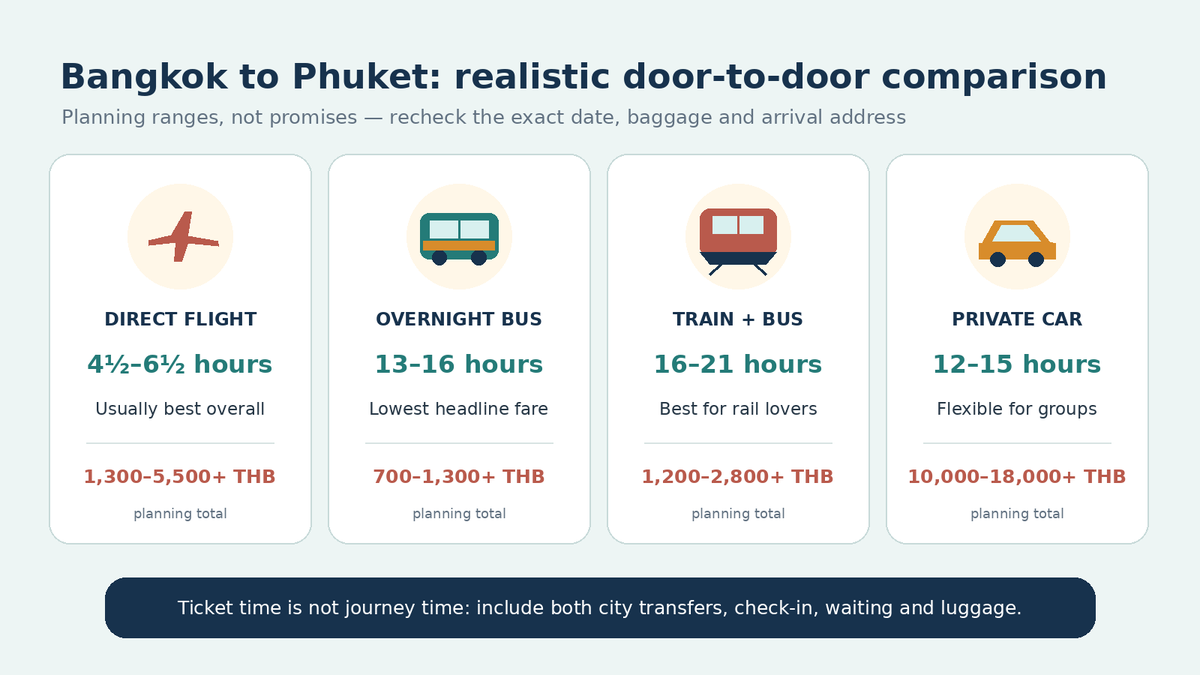
| Option | Realistic total time | Planning cost per adult | Best for | Main drawback |
|---|---|---|---|---|
| Direct flight | 4½–6½ hours hotel to hotel | About 1,300–4,500+ baht before some bags and transfers | Short trips, families, most first-time visitors | Airports, baggage rules and Phuket’s long final transfer |
| Direct overnight bus | 13–16 hours including terminals | About 700–1,200+ baht | Low budgets and travellers who sleep well on coaches | A poor night can damage the first Phuket day |
| Train plus bus | 16–20 hours | About 1,100–2,200+ baht depending on berth and connection | Rail enthusiasts and slower itineraries | No railway station in Phuket; at least one transfer is unavoidable |
| Private car with driver | 12–14+ driving hours | Often 10,000–18,000+ baht per vehicle | Groups, door-to-door needs and custom stops | Long road exposure and high cost |
| Self-drive | 12–14+ driving hours; safer over two days | Rental, fuel, tolls, insurance and hotel | Experienced drivers building a southern road trip | Fatigue, unfamiliar roads and documentation requirements |
A route search rechecked on 6 September 2026 showed nonstop flights commonly scheduled for about 1 hour 25 to 1 hour 35 minutes. Direct-bus examples included a roughly 14-hour Transport Co service from Mochit and a 12-hour-10-minute VIP24 service from Bangkok’s Southern Terminal. [5] The cheapest visible ticket is not a complete cost: add baggage, Bangkok airport or terminal access, and the final transfer from Phuket Airport or Phuket Bus Terminal 2.
Karen’s route rule
When I compare this journey, I price the whole chain from one hotel door to the next. A 1,500-baht flight can become a 3,500-baht travel day after checked luggage, two airport transfers and food. Conversely, a 750-baht bus can cost more in practical terms when it leaves you exhausted and you lose a prepaid morning tour.
Compare the route before choosing a mode
Use a route comparison only after deciding your acceptable travel time, Bangkok departure point, Phuket arrival area and luggage needs. Then compare the actual operators and conditions for your date rather than choosing the first low headline price.
Fly when the Phuket stay is five nights or shorter
A short beach holiday cannot absorb an avoidable 13- to 20-hour transfer. A midday flight normally gives enough margin to leave a Bangkok hotel without a dawn start and reach a Phuket hotel before evening. This is the default choice for most first-time visitors.
Take the bus only when the savings are meaningful
The direct bus earns its place when the fare difference remains large after airport transfers and baggage are added. Choose a licensed, clearly identified operator and a class you understand. A cheap seat is not a bargain when it is actually a narrow overnight seat, the arrival point is far from your hotel or the booking hides vehicle changes.
Choose train plus bus for the journey, not for speed
The rail route can be enjoyable because a proper sleeper offers more room to move than a coach. However, it is not a direct train to Phuket. You travel from Bangkok to Surat Thani Train Station at Phun Phin, then continue by bus, van or private transfer across the mainland and bridge to Phuket.
Use a private car when the group or itinerary justifies it
A door-to-door car can work for four or more people, unusual luggage, a stop in Hua Hin or Chumphon, or a traveller who cannot manage terminals. For a simple point-to-point journey, flying is usually faster, cheaper and less tiring.
Do not compare only the departure and arrival times
Add check-in, security, terminal access, waiting, baggage collection and the final Phuket transfer. On the road options, add hotel-to-terminal travel and a recovery allowance after an overnight journey.
How long does flying really take?
The airborne time is commonly around 1 hour 30 minutes. A sensible door-to-door plan is longer: 45–90 minutes from a central Bangkok hotel to the airport, 90 minutes at the terminal for a domestic flight, the flight itself, 20–45 minutes to leave Phuket Airport and 45–120 minutes to reach the hotel. Traffic, rain and the location of your resort make the final leg unpredictable.
What live 2026 results look like
The route search rechecked on 6 September 2026 showed direct flights from both Suvarnabhumi and Don Mueang, with scheduled airborne times around 1 hour 25 to 1 hour 35 minutes. [5] Fares moved substantially by departure time and baggage bundle, so use these timings as a current route signal rather than a fare promise.
The real cost of a low-cost flight
| Cost item | What to check | Why it changes the comparison |
|---|---|---|
| Base fare | Date, departure time, airport and fare family | The cheapest time may create an expensive taxi or lost hotel night |
| Checked baggage | Weight allowance and whether it is prepaid | Airport baggage can cost much more than adding it during booking |
| Seat selection | Whether sitting together matters | Families may need to add seats to compare fairly |
| Bangkok transfer | BKK or DMK and hotel location | Crossing Bangkok can erase a small fare saving |
| Phuket transfer | Hotel area and arrival time | The airport is in the north; southern beaches are not close |
| Food and buffer | Meal timing and delay resilience | A very early or late flight can add practical costs |
Best flight timing
For most visitors, a departure between roughly 10:00 and 15:00 is easier than the first or last flight. It avoids a pre-dawn Bangkok transfer, leaves room for ordinary hotel breakfast and gives more recovery options if the airline changes the schedule. An early flight is sensible when you have only one Phuket day to protect; a late flight works when you deliberately want a full final day in Bangkok and have arranged a late Phuket check-in.
Who should fly?
- Travellers with fewer than six nights in Phuket.
- Families with children, several cases or a pram.
- Anyone who sleeps badly on buses or trains.
- Visitors arriving from an international flight who can connect at the same Bangkok airport with a safe buffer.
- Travellers with a fixed Phuket activity the following morning.
When flying is not automatically best
A flight becomes less attractive when you must switch Bangkok airports, pay for multiple heavy bags, land after public transport stops or arrive too late for an onward boat. In those cases, compare a later same-airport flight, one additional Bangkok night or a through road ticket rather than forcing the cheapest air fare to fit.
Suvarnabhumi Airport (BKK)
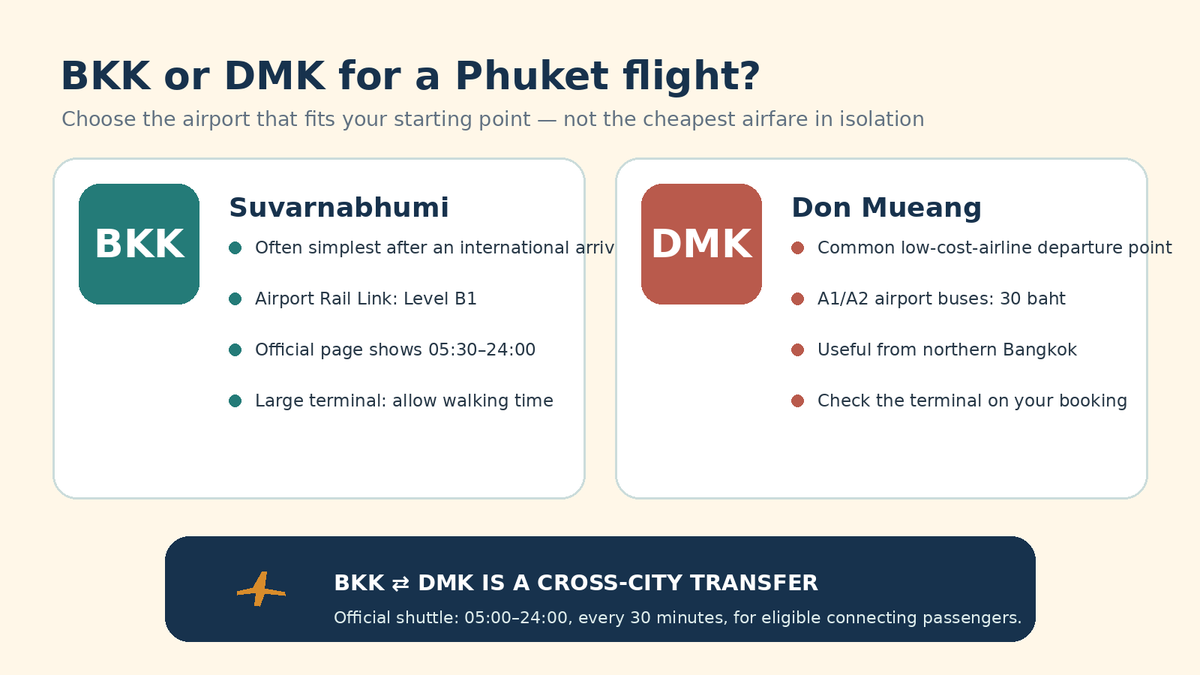
BKK is usually the simplest choice when you arrive internationally at Suvarnabhumi, stay near the Airport Rail Link or find a full-service fare with suitable baggage. The terminal is large, so allow time for the walk, security and gate change. A slightly higher same-airport fare can be better value than transferring across Bangkok to Don Mueang.
Don Mueang Airport (DMK)
DMK is often useful for low-cost domestic services and travellers staying in northern Bangkok. It can also be practical from areas connected to the Red Line. However, it is not beside Suvarnabhumi. Treat BKK and DMK as separate airports, not two terminals of the same airport.
Switching between BKK and DMK
Airports of Thailand’s shuttle summary states 05:00 to midnight with departures every 30 minutes, while the same page’s opening-hours panel displayed a shorter window when rechecked. [3] The service is intended for eligible transferring passengers, so carry onward-flight evidence and verify the current boarding point and hours. Even when traffic is light, this is a cross-city transfer followed by fresh check-in and security.
Connection rule
Do not book a self-made BKK-to-DMK connection as though it were a normal terminal change. A conservative daytime buffer is often five to six hours; longer is sensible during peak traffic, heavy rain, immigration queues or separate-ticket travel.
A simple airport decision
- Start with the airport where you already are or the one easiest from your Bangkok hotel.
- Compare the complete fare with baggage and seats.
- Add the cost and time of reaching that airport.
- Reject any option that depends on a tight cross-airport transfer.
- Choose the schedule that protects your first Phuket evening or next-day plans.
Price the same baggage on every airline
A fair comparison uses the same luggage assumption. Check cabin dimensions, personal-item rules, checked-bag weight and sports-equipment charges. When the booking page offers a bundle with baggage, seat and change flexibility, compare it with adding each item separately.
Protect separate tickets
An international ticket and a separately purchased domestic flight are usually separate contracts. If the first flight is late, the domestic airline may treat you as a no-show. Keep a generous buffer, remain at the same airport where possible and consider an overnight Bangkok stop after a long-haul arrival.
Avoid the false saving of the first flight
A 06:00 departure can require leaving the hotel before public rail services are useful. Add the taxi, missed breakfast, short night and the chance that your Phuket room will not be ready. A 10:30 flight may cost more on screen yet create a much better day.
Check the Phuket arrival before paying
Landing at 22:30 is not the same as reaching Patong, Kata or Rawai at 22:30. Confirm the hotel’s late-arrival procedure and estimate the transfer. If the next step is a ferry, never assume a late flight will connect to the final sailing. Stay near Phuket or the relevant pier and travel onward the following day.
Families should compare a complete basket
Four low-cost fares can accumulate baggage, seat and transfer charges quickly. A full-service fare with checked baggage or a private airport transfer may narrow the gap. Use one spreadsheet line per cost so the family decision is based on the final total, not four attractive base fares.
Airport access is part of the Bangkok-to-Phuket journey, not a small detail tacked onto the airfare. Use the Bangkok travel guide to match your hotel area to the city’s rail and road network, then work backwards from the airline’s check-in deadline.
Central Bangkok to Suvarnabhumi Airport (BKK)
Suvarnabhumi’s official transport page places the Airport Rail Link on Level B1 and displays operating hours of 05:30–24:00. [13] It is especially useful from Phaya Thai or Makkasan when luggage is manageable. A metered taxi or app ride can be more direct for a couple or family with several bags, although rain and weekday peaks can stretch the road journey.
Central Bangkok to Don Mueang Airport (DMK)
Don Mueang’s official BMTA page lists the A1 and A2 buses at 30 baht, with A1 serving Mo Chit 2 and BTS Mo Chit and A2 continuing towards Victory Monument. It displays 15-minute intervals for much of the day, while A3 and A4 cost 50 baht and serve other central corridors. [14] The Red Line is another useful option from Krung Thep Aphiwat, particularly when road traffic is heavy.
Which Bangkok neighbourhood favours which airport?
| Starting point | Usually easier first check | Why |
|---|---|---|
| Near Phaya Thai or Makkasan | BKK | Direct access to the Airport Rail Link |
| Near Ari, Chatuchak or Mo Chit | DMK | Shorter northern-Bangkok access and useful bus or rail links |
| Arriving internationally at BKK | BKK | Avoids a cross-city airport transfer when a suitable through or same-airport flight exists |
| Riverside or old city | Compare both | Road time varies; the better departure may depend on time of day and baggage-inclusive fare |
Use a departure buffer, not a best-case map estimate
| Situation | Planning approach | Reason |
|---|---|---|
| Normal domestic departure | Aim to be inside the terminal about 90 minutes before departure, or earlier if the airline specifies | Allows bag drop, security and a gate change |
| Taxi in peak traffic or heavy rain | Add at least 30–60 minutes to an ordinary road estimate | Bangkok journey times can expand quickly |
| Separate international and domestic tickets | Use a large buffer or an airport hotel | The second airline may not protect a missed connection |
| BKK–DMK transfer | Treat it as a separate cross-city journey | Shuttle eligibility, waiting, traffic and fresh check-in all consume time |
Phuket International Airport sits in the north of the island. Phuket Town, Patong, Kata, Karon, Rawai and Nai Harn are different transfer problems, not one generic “Phuket hotel” journey. Check the best areas to stay in Phuket before booking transport, because the cheapest airport option may be excellent for a daytime solo arrival and poor for a family landing late with four cases.
Phuket Smart Bus for the west coast
Airports of Thailand currently lists the Phuket Smart Bus at 100 baht from the domestic-terminal Exit 3 public-transport area. The route runs through Ban Khian, Cherngtalay, Surin, Kamala, Patong, Karon and Kata to Rawai. [1] It is particularly useful for light-luggage travellers staying near a listed west-coast stop; recheck the timetable before travel.
Airport bus towards Phuket Town
Airports of Thailand currently lists the orange Airport Bus Route 8411 towards Phuket Town. The official page says passengers can buy on board or online, pay by cash or QR code, and find the vehicle in the public-transport parking area after Exit 3. It displays daily service from 08:00 to 21:00, with a distance-based fare. [2] Recheck the live timetable because operating details can change.
Shared van
A shared van can be faster than the bus and cheaper than a private car, but it may wait for passengers and make several hotel stops. Confirm the exact destination, whether there is a vehicle change and whether the quoted fare includes delivery to your accommodation rather than a central drop-off.
Private transfer or taxi
A private transfer is useful for late arrivals, groups, families, large luggage, villas away from main roads or travellers who want a named meeting point. Before paying, compare the vehicle capacity, included waiting time, flight-delay handling, child-seat availability, cancellation terms and the exact hotel zone. A cheap sedan is not a genuine match for four adults and four large suitcases.
Planning times by hotel area
| Area | Typical road-time range | Public-transport fit | Practical note |
|---|---|---|---|
| Phuket Old Town | About 45–70 minutes | Airport city bus can fit | Useful for one-night stays and ferries from eastern Phuket |
| Bang Tao / Surin | About 30–60 minutes | Smart Bus can fit | Often the shortest major resort transfer |
| Kamala | About 45–75 minutes | Smart Bus can fit | Road congestion can build along the coast |
| Patong | About 60–90 minutes | Smart Bus or express options | Allow more time at busy evening periods |
| Karon / Kata | About 75–105 minutes | Smart Bus can fit | Longer after a late flight or with many stops |
| Rawai / Nai Harn | About 90–120 minutes | Smart Bus reaches Rawai | A private transfer may be better with luggage |
| Khao Lak | About 60–100 minutes north | Private/shared transfer usually easier | Khao Lak is not on Phuket island |
Rassada Pier and onward islands
A flight arrival and island boat should rarely be connected tightly. Baggage delivery, road traffic and weather all matter. If the last ferry is important, book a morning flight with a large margin or stay overnight near Phuket Town and continue the next day.
When a pre-booked Phuket Airport transfer adds value
A reserved transfer is most useful when the arrival is late, the hotel is far south, the party has several cases, the destination is Khao Lak or the traveller wants a clearly documented meeting point. Compare the vehicle size, waiting policy, cancellation terms and precise destination before paying.
An extra hotel night can look inefficient on paper, yet it often protects the expensive part of the trip. Consider one when an international flight reaches BKK late, a Phuket departure is very early, separate tickets are involved, or the last island ferry would otherwise depend on a flawless connection.
Stay near the airport when the connection is fragile
- Use a BKK-area hotel when immigration, baggage reclaim and a separate domestic ticket leave too little safe margin.
- Choose a DMK-area hotel rather than crossing Bangkok before dawn for a low-cost departure.
- Stay near Phuket Airport after a late arrival if the hotel is in Rawai, Nai Harn or Khao Lak and the transfer would finish deep into the night.
- Use Phuket Town as a practical buffer before a morning Rassada Pier departure.
What to check before booking
Look for a genuinely available airport shuttle, late reception, the correct terminal distance, breakfast hours and a room rate that can be cancelled. “Near the airport” can still mean a taxi ride, so open the map rather than relying on the property name.
Compare buffer-night accommodation only when it reduces risk
Agoda and Booking.com can be useful for mapping airport-area or Phuket Town availability. Set the correct date, read the most recent access reviews and confirm the transfer directly with the property; do not book an extra night merely because it appears in this guide.
How long does the direct bus take?
Current direct-bus examples rechecked on 6 September 2026 ranged from about 12 hours 10 minutes to 14 hours, depending on operator and terminal. [5] Add the journey to the Bangkok departure point, check-in and waiting, then the local transfer from Phuket Bus Terminal 2. A practical hotel-to-hotel allowance is usually 13 to 16 hours.
Where do buses leave Bangkok?
Many services use Bangkok’s Southern Bus Terminal, commonly called Sai Tai Mai, although some operators and combined products use other pickup points. The terminal is west of the central tourist areas and not directly beside a major central rail station. Read the exact voucher rather than assuming every Phuket bus leaves the same place.
Express, VIP and VIP24 are not interchangeable
Class names vary by operator. A VIP24 coach normally has three seats across rather than four, creating more width. However, the word “VIP” alone does not guarantee the same layout, toilet, meal, blanket or luggage policy. Look for a seat map, operator name and recent reviews.
September 2026 listings showed bus prices beginning around the high hundreds of baht, while premium seat layouts cost more. [5] Treat every figure as a snapshot and let the final checkout, operator, seat map, terminal and refund conditions control the decision.
Arrival in Phuket
Long-distance coaches commonly arrive at Phuket Bus Terminal 2, north of Phuket Town. That is not Patong, Kata, Karon or Rawai. Price the final transfer before selecting the bus, and verify whether any product promising a beach destination genuinely includes a through transfer.
What the 2026 traveller reviews reveal
Recent route reviews show why operator details matter: some passengers praised comfortable reclining seats and straightforward terminal check-in, while others reported very cold cabins, short seats, unclear vehicle changes or a drop at the bus station rather than the beach. Reviews are subjective, but recurring themes help identify what to ask before booking.
Who should take the bus?
- A solo traveller with a genuinely large fare saving and no fixed morning plan.
- Someone who sleeps reasonably well in a reclining coach.
- A traveller comfortable managing a large terminal and the final Phuket transfer.
- A flexible itinerary that can absorb a late arrival or a poor night’s sleep.
What to pack for the coach
- A warm layer because air-conditioning can be intense.
- Water and a small meal or snacks bought before boarding.
- Earplugs, eye mask, power bank and offline hotel address.
- Medication and valuables in the personal bag, never the luggage hold.
- A screenshot of the operator, terminal, platform instructions and final drop-off.
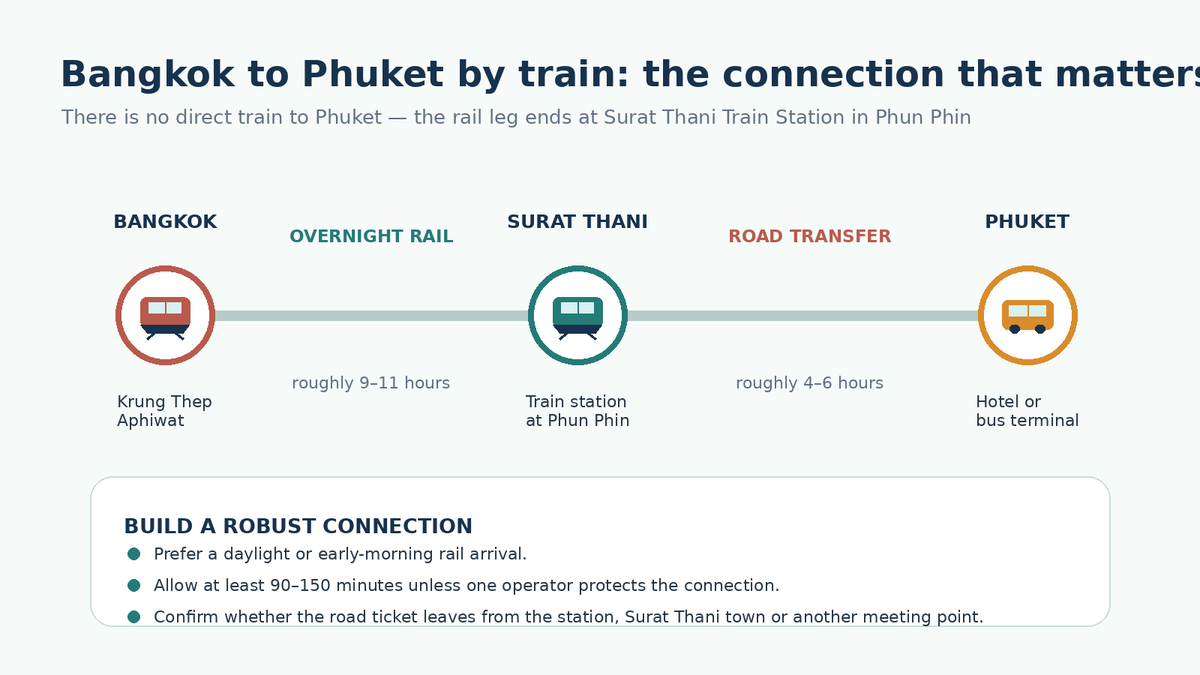
There is no direct train to Phuket
Phuket has no railway station. The normal rail plan is Bangkok to Surat Thani Train Station in Phun Phin, followed by a bus, van or private transfer to Phuket. From there, the road leg still takes several hours, so the train is an experience-led option rather than a shortcut.
Current 2026 train examples
The official 2026 timetable and a route search rechecked on 6 September show several daily departures from Krung Thep Aphiwat towards Surat Thani, including daytime and overnight patterns. Typical listed departures include around 07:30, 15:10, 16:10, 16:50, 17:30, 18:50, 19:50, 20:30 and 22:50, but class, running status and arrival time vary by service. [16][6] Search the exact date and avoid building a tight road connection around a scheduled arrival.
| Sample departure | Sample arrival | What the timing means | Connection approach |
|---|---|---|---|
| 15:10 | 01:11 | Very early arrival in Phun Phin | Confirm waiting facilities and a protected onward service |
| 16:10 | 01:49 | Still deep night | Avoid an unverified roadside transfer |
| 16:50 | 02:20 | Useful train, awkward arrival hour | Joint ticket or pre-arranged pickup adds value |
| 17:30 | 04:06 | More manageable but still early | Allow breakfast and a generous bus buffer |
| 18:50 | 04:58 | Reasonable onward connection window | Do not book a bus that assumes perfect rail punctuality |
| 19:50 | 06:23 | Good daylight arrival for many travellers | Often the easiest independent-transfer timing |
| 20:30 | 07:16 | Latest visible sleeper example | Comfortable morning connection if available |
Which rail class makes sense?
| Class | Best feature | Main limitation | Best for |
|---|---|---|---|
| Second-class AC lower berth | Wider bed and easy access | Usually costs more and sells first | Most adults choosing the rail experience |
| Second-class AC upper berth | Lower price | Narrower, cooler and requires a ladder | Light travellers comfortable climbing |
| First-class cabin | Private compartment where available | High fare and limited inventory | Couples or travellers prioritising privacy |
| Second-class seat | Cheaper than a berth | Poor choice for a full overnight journey | Daytime services or strong budget constraints |
| Third-class fan seat | Very low headline fare | Long, hot and tiring for this distance | Experienced budget travellers only |
Book the berth before building the rest of the plan
SRT reduced advance sales for reservable trains from 180 days to a maximum of 90 days from 30 April 2026, with the exact window governed by the journey’s share of the train’s full route. [7] Bangkok–Surat Thani journeys on long-distance services can fall within that maximum, but D-Ticket remains the final check. Passenger names and passport or ID details must match the actual travellers. [4] Useful lower berths can sell out well before ordinary seats.
Phun Phin is not central Surat Thani
Surat Thani Train Station is in Phun Phin, outside central Surat Thani. A through product may meet the train and move passengers to a bus or van. On separate tickets, confirm the pickup point, operator desk, latest check-in and what happens when the train is late.
Joint ticket versus separate bookings
A joint train-and-bus product is easier when the provider coordinates the connection and clearly states the meeting process. Separate tickets offer more control but require a generous buffer. Do not book the cheapest onward van ten minutes after the scheduled train arrival and expect the two companies to protect each other.
How much buffer should you allow?
For an ordinary separate booking, 90 minutes to two hours is more comfortable than a tight connection, especially before a long road leg. A longer gap may be sensible in wet weather or when the onward operator has only one departure you can use. If the connection is sold as a coordinated through ticket, read the missed-connection policy rather than assuming protection.
The rail option works best when the sleeper is part of the holiday
Choose it because you enjoy overnight trains, want a lower berth and have time for the transfer. Do not choose it because the map appears to show a railway reaching Phuket; it does not.
Compare the rail leg and onward transfer separately
Search Bangkok–Surat Thani first, then check the road departure point and buffer before paying. A combined product can simplify the handover, but only when the meeting instructions and missed-connection policy are clear.
Private car with driver
A driver can collect a group from a Bangkok hotel and deliver it to a Phuket address, avoiding terminals and baggage limits. This can suit four or more travellers, film or sports equipment, older relatives or a planned stop. Confirm the vehicle, seat belts, licensed operator, driver-rest approach, tolls, fuel, luggage capacity and whether the quoted journey is intended to run overnight.
Self-driving in one day is demanding
The route is long enough that a one-day drive can become a fatigue problem rather than a scenic road trip. Traffic leaving Bangkok, roadworks, rain and rest stops add time. A safer holiday plan is often to split the drive around Hua Hin, Prachuap Khiri Khan or Chumphon and continue rested.
Documents and road risk
UK government travel advice says British drivers need the 1968 version of the International Driving Permit together with their UK licence, and it highlights Thailand’s high number of road accidents, particularly involving motorcycles. [8] WHO Thailand also identifies speeding, drink driving and helmet non-use among priority risk factors. [9]
When a road trip makes sense
- Phuket is one stop in a longer southern Thailand itinerary.
- The group wants Hua Hin, Prachuap, Chumphon, Khao Sok or Phang Nga stops.
- A suitable driver can be shared across several passengers.
- The itinerary allows an overnight stop rather than a forced marathon drive.
- The traveller is licensed, insured and comfortable with Thai road conditions.
When it does not
Do not rent a car simply to avoid flying when you have no interest in the route, little driving experience in Thailand or a fixed Phuket check-in. The cumulative road exposure, parking, fuel and fatigue usually outweigh the flexibility.
The table below is a planning model, not a quote. It uses reasonable 2026-style ranges so you can compare like with like. Replace every line with the actual date, baggage and hotel locations before booking.
A useful sterling planning conversion
The Bank of Thailand’s 31 August 2026 commercial-bank mid-rate was 44.8744 baht to £1. That makes 1,000 baht roughly £22.30 for quick mental planning. [15] Your card issuer, cash exchange desk or ATM will use a different rate and may add fees, so this is not a spending guarantee.
| Traveller | Flight total | Direct bus total | Train + bus total | Best-value interpretation |
|---|---|---|---|---|
| Solo, cabin bag | About 2,300–5,500 baht | About 1,100–2,200 baht | About 1,600–3,000 baht | Bus can save cash; flight usually saves most of a day |
| Solo, checked bag | About 3,000–6,500 baht | About 1,100–2,300 baht | About 1,700–3,200 baht | Price the bag before comparing |
| Couple, two cases | About 5,500–11,000 baht | About 2,200–4,000 baht | About 3,200–6,000 baht | Flight remains strong unless fares are high |
| Family of four | About 10,000–22,000 baht | About 4,500–8,000 baht | About 6,500–12,000 baht | A private Phuket transfer often improves the flight day |
| Group of five or six | About 14,000–30,000 baht | About 6,000–12,000 baht | About 8,000–18,000 baht | A private car quote becomes worth comparing |
Value the first Phuket day
A traveller earning a full beach afternoon after a midday flight receives something the overnight bus cannot provide. Conversely, a person with a flexible month-long trip may reasonably trade comfort for a lower fare. The “best value” answer changes with the number of usable holiday hours.
Do not double-count a hotel saving
An overnight bus or train may replace one hotel night only when you would otherwise have paid for that exact night. If you keep the Bangkok room for luggage and showering until late, or book Phuket from the previous night for immediate check-in, the saving disappears.
Groups should compare per vehicle, not per person
A private airport transfer or long-distance car often looks expensive per booking and reasonable per traveller. Divide the correct vehicle price by the real number of passengers and confirm that the luggage will fit.
Example 1: first-time couple with five Phuket nights
They leave a Sukhumvit hotel at 09:00, fly from BKK around midday and pre-arrange a transfer to Kata. Even with a 90-minute road journey from HKT, they are likely to reach the hotel in time for dinner. The flight protects four full Phuket days.
Example 2: solo backpacker with a flexible month
The traveller chooses a reputable evening VIP24 bus, brings a warm layer and has no paid activity on arrival day. A low fare is meaningful because time is abundant. They verify that the ticket ends at Phuket Bus Terminal 2 and budget the onward local transfer.
Example 3: rail enthusiast with a lower berth
The traveller books a lower sleeper that reaches Phun Phin after 06:00, adds a two-hour connection buffer and uses a clearly identified onward bus. The journey takes most of the following day, but the sleeper itself is a deliberate experience rather than a compromise.
Example 4: family road trip through southern Thailand
A family rents an insured car, stays overnight in Chumphon and continues to Phuket after breakfast. They stop in Phang Nga before checking in. The car makes sense because Phuket is part of a longer route and the driving is split, not because it beats the flight on speed.
Short holiday
Fly. The time saved is usually worth more than the fare difference, especially when you have a fixed return date.
Family with children
A daytime flight plus a private transfer is usually the least fragile plan. Avoid a late landing when children will still face a 60- to 120-minute road transfer.
Solo budget traveller
Compare an express or VIP bus with a light-baggage flight. The cheapest flight can win when the airport transfers are simple, while the bus wins when airfares and bags are high.
Older traveller or limited mobility
Flying reduces the time in a moving vehicle, but airport walking can be substantial. Request airline assistance in advance and arrange a Phuket pickup that matches the mobility need. A first-class sleeper can offer privacy, yet the train-to-bus transfer adds complexity.
Remote worker
Fly unless the journey day is intentionally offline. Bus and train connectivity can be inconsistent, power sockets may not work and a poor night affects the next workday. Keep essential files offline and carry a power bank.
Nervous flyer
A lower sleeper berth can be the most comfortable non-flight option when paired with a generous onward connection. A direct premium bus is simpler but provides less freedom to move and a longer continuous road journey.
Traveller going directly to Khao Lak
A flight to HKT plus a northbound transfer is usually efficient. Do not travel south into central Phuket before going back north. For overland travel, compare whether a service can stop in Phang Nga or Khao Lak rather than continuing to Phuket Town.
Checked baggage can change the flight winner
Prepay the correct bag weight and keep the confirmation. Weigh cases before leaving the Bangkok hotel. If two passengers can share one larger allowance within the airline rules, compare that with two separate bags.
Bus luggage goes out of sight
Put clothing and ordinary items in the hold. Keep passports, money, medication, electronics, tickets and one warm layer with you. Photograph the bag and any luggage tag.
Train storage is shared space
Second-class sleeper luggage normally remains near the berth rather than in a private locked compartment. A cable lock can discourage casual movement, but valuables still belong in a small bag kept with you.
Prams, surfboards and dive equipment
Ask before booking. Airlines may classify equipment separately, vans may lack room and a private transfer may require a larger vehicle. An equipment-friendly fare can be cheaper than paying oversize charges at the airport.
Keep the first-night kit accessible
Pack medication, swimwear, basic toiletries, chargers and one change of clothes in the personal bag. A delayed checked case then becomes an inconvenience rather than a ruined first day.
Most people do not need to buy specialist gear for this route. However, a few compact items can solve predictable problems on an overnight coach, sleeper train or baggage-heavy flight. The Thailand packing list covers the wider trip; the table below focuses only on this transfer.
| Item | Best for | Useful feature | Main drawback |
|---|---|---|---|
| Compressible neck pillow | Overnight coach or upright airport wait | Packs smaller than a rigid memory-foam model | Still occupies space and may not suit every sleeping position |
| Eye mask and reusable earplugs | Sleeper train, cold bright coach or early airport hotel | Low weight; addresses the most common sleep disruptions | Earplugs need a comfortable fit and should not block important announcements |
| Clearly labelled power bank | Long travel day with maps, tickets and driver messages | Visible watt-hour rating and protected terminals | Airline and national safety rules apply |
| Luggage tracker | Checked luggage or coach-hold baggage | Can show a bag’s last known location | It does not prevent loss and network coverage varies |
Thailand’s 2026 power-bank rules change the buying advice
Thailand’s Civil Aviation Authority says power banks must stay in carry-on baggage, never checked baggage. The new rule permits units up to 100Wh, allows 100–160Wh only with airline approval, and limits passengers to two. It also prohibits charging or using a power bank during the flight and says it must remain accessible rather than in an overhead locker. Unlabelled units can be refused. [12] Therefore, buy by a visible watt-hour rating and confirm the operating airline’s rules before departure.
Optional travel-kit searches
These links open broad Amazon UK searches rather than a claim that one model fits everyone. Compare dimensions, weight, reviews and return terms. For a power bank, check the printed Wh rating on the product itself, not only the marketing description.
Wet-season travel needs more road margin
Tourism Authority of Thailand explains that the country is affected by monsoons and has an extended wet season. [11] Heavy rain can slow airport roads, coastal roads and the long overland route. A 60-minute map estimate can become a poor connection plan during a storm. The best time to visit Thailand guide gives a broader seasonal overview.
Flights can be delayed even when the route is short
A late inbound aircraft, thunderstorms or congestion can move the schedule. Avoid a same-day non-refundable boat or long-distance pickup immediately after arrival. Build recoverable connections.
Road services can arrive late
A direct bus or private car crosses a large section of southern Thailand. Roadworks, checkpoints, weather and rest stops all affect timing. Do not schedule a prepaid morning dive, ferry or airport departure immediately after the published arrival.
The train connection needs protection
Rail delays become more important when the next ticket is a separate van or bus. A joint ticket may coordinate the transfer, but only the written conditions tell you what protection exists.
Use a recovery night before expensive plans
For a wedding, liveaboard, long-haul departure or non-refundable island resort, arrive in the relevant area at least one night earlier. The extra hotel is often cheaper than repairing a missed connection.
- Confirm the Phuket hotel area and check-in time.
- Choose the transport mode using complete door-to-door time and cost.
- Book the scarce element first: flight at the right time or lower sleeper berth.
- Add checked baggage, seats and any assistance requirements immediately.
- Book the Phuket arrival transfer or identify the exact public route.
- Save every ticket, address and pickup instruction offline.
- Recheck the schedule 72 hours before travel and again on the day.
- Keep a backup route and enough money for a taxi or hotel when disruption occurs.
Why the hotel area comes first
Patong, Phuket Town and Rawai create very different arrival days. The hotel address determines whether the Smart Bus fits, how long a private transfer takes and whether a late flight remains sensible.
Why the final transfer should not be an afterthought
A tired traveller landing after dark is vulnerable to confusion. A saved transfer plan, correct meeting point and offline address remove much of that stress.
Use a sensible fallback order
- Check the same airport at a less popular time.
- Check the other Bangkok airport only after pricing the transfer.
- Move the journey by one day if the itinerary allows.
- Compare a reputable premium bus.
- Look for a lower sleeper on another train and rebuild the Surat Thani connection.
- Use a private car only when the group and road plan justify it.
Do not buy an overnight seat by accident
Train search pages can show both sleepers and upright seats. Read the class name, carriage and berth type before paying. A low price may represent a seat that is unsuitable for a full overnight journey.
Peak periods require earlier action
Thai public holidays, year-end travel, school breaks and major events can compress availability. A flexible fare or one additional hotel night may be better than a fragile chain of separate tickets.
Avoid unknown pickup promises
When a product says “Bangkok hotel pickup” or “Patong drop-off,” inspect the operator, vehicle changes, pickup window and exact final stop. A vague door-to-door promise is not the same as a confirmed private transfer.
What mobile data helps with
- Airline schedule changes and mobile boarding passes.
- Live maps between Bangkok hotels, airports and terminals.
- Messages from the Phuket driver or accommodation.
- Translation, emergency calls and cashless booking confirmation.
- Finding the correct bus desk or train meeting point after a delay.
Download the essentials as well
Mobile data can fail, batteries run down and apps log out. Save PDFs, screenshots, the hotel name in Thai, the full address, booking references and emergency numbers offline. Carry a power bank in cabin or personal luggage, not checked baggage where airline rules prohibit it.
Optional arrival-day eSIM
An eSIM can be useful when you want data before reaching an airport SIM desk or when retaining your home SIM for messages. The supplied Airalo destination is a broader offer page, so select Thailand and verify the live data allowance, validity, network, hotspot rules and device compatibility before purchase.
Use identifiable operators
Book through the operator, official platform or a reputable comparison service. Match the company, vehicle and pickup point to the voucher. Be cautious when someone at a terminal tries to redirect you to a different vehicle without a clear explanation.
Wear the seat belt
Road travel is the highest-risk part of this route. UK travel advice highlights Thailand’s high number of road accidents, particularly involving motorcycles. [8] Choose a seat with a working belt and use it, including in vans and private transfers.
Protect passports and valuables
Keep the passport with you unless an authorised process genuinely requires inspection. Do not place it in the coach hold. Store backup copies securely and keep emergency cash separate from the main wallet.
Save official numbers
Thailand Tourist Police lists hotline 1155. [10] General police is 191 and emergency medical assistance is 1669. Save the hotel, operator and insurer contacts as well.
Travel insurance must fit the itinerary
Check missed-departure, baggage, medical and road-vehicle exclusions. A policy may require a valid licence and suitable International Driving Permit for driving or scooter use.
- Choosing the cheapest flight before adding baggage and two airport transfers.
- Booking DMK after arriving at BKK without a realistic cross-airport buffer.
- Treating the 1½-hour flight as the complete travel time.
- Assuming Phuket Airport is close to every beach.
- Expecting a direct train to Phuket.
- Booking a separate Surat Thani bus too close to the scheduled train arrival.
- Buying an upright overnight train seat because it appears first or cheapest.
- Assuming every “VIP” coach has the same seat layout and service.
- Forgetting that the long-distance bus may end at Phuket Bus Terminal 2.
- Scheduling a ferry, dive trip or wedding immediately after a long transfer.
- Putting passports, medication or electronics in the bus luggage hold.
- Driving the full route after a long-haul flight or poor night’s sleep.
The most expensive mistake is usually a fragile connection
A missed boat, hotel night or new flight can cost far more than the original saving. Build the route so one ordinary delay does not collapse the rest of the itinerary.
Direct flight
| Pros | Cons |
|---|---|
| Fastest complete option for most travellers; frequent departures; straightforward for short trips | Baggage and transfers can raise the cost; airport walking and check-in; HKT is far from southern beaches |
Direct overnight bus
| Pros | Cons |
|---|---|
| Low fare; no airport security; one through road journey; may replace a hotel night | Long continuous journey; sleep quality varies; terminal-to-hotel transfer remains; road risk |
Train plus bus
| Pros | Cons |
|---|---|
| Sleeper experience; more freedom to move; lower berth can be comfortable | No direct rail to Phuket; connection risk; longest practical option; berth availability |
Private car with driver
| Pros | Cons |
|---|---|
| Door to door; flexible stops; useful for groups and unusual luggage | Expensive; long road exposure; driver-rest and vehicle quality require checking |
Self-drive
| Pros | Cons |
|---|---|
| Maximum route flexibility; useful for a multi-stop southern road trip | Fatigue, unfamiliar roads, documentation, insurance, parking and a very long day |
What is the best way to get from Bangkok to Phuket?
A direct flight is best for most short and first-time trips. A premium bus is the main budget alternative, while train plus bus suits travellers who deliberately want the sleeper experience.
How long is the flight from Bangkok to Phuket?
Nonstop flights are commonly scheduled for about 1 hour 30 minutes. Allow roughly 4½ to 6½ hours hotel to hotel after Bangkok access, check-in, baggage and the Phuket transfer.
Is there a direct train from Bangkok to Phuket?
No. Travel by train to Surat Thani Train Station in Phun Phin, then continue to Phuket by bus, van or private transfer.
How long is the direct bus?
Most planning guidance is around 12 to 14 hours on the road. Add Bangkok terminal access and the transfer from Phuket Bus Terminal 2, creating a hotel-to-hotel day of roughly 13 to 16 hours.
Is the overnight bus worth it?
It can be worth it for a flexible solo traveller when the fare saving is large and the operator and class are clear. It is a poor fit for light sleepers or anyone with a fixed morning plan.
Which Bangkok airport is better for Phuket?
Use the airport that fits your existing location and complete cost. BKK often suits an international connection at Suvarnabhumi; DMK often has low-cost choices and can suit northern Bangkok.
Can I transfer between BKK and DMK?
Yes, but it is a journey across Bangkok. AOT lists a shuttle from 05:00 to midnight every 30 minutes, subject to current eligibility and boarding requirements. Keep a large connection buffer.
How early should I arrive for a domestic flight?
Airline rules control, but arriving around 90 minutes before departure is a practical starting point for many domestic flights. Add more time for baggage, unfamiliar terminals or peak periods.
How much is the Phuket Smart Bus?
Airports of Thailand currently lists a 100-baht fare and a route from HKT through west-coast resort areas to Rawai. Verify the current timetable and stop before travel.
How do I get from Phuket Airport to Patong?
The Smart Bus can suit daytime travellers with manageable luggage, while shared vans, taxis and private transfers offer more direct service. Road time is commonly around 60 to 90 minutes but can be longer.
How do I get from Phuket Airport to Kata or Karon?
Use the Smart Bus, shared van, taxi or private transfer. Kata and Karon are farther from HKT than many first-time visitors expect, so allow roughly 75 to 105 minutes in ordinary conditions.
Which train should I choose to Surat Thani?
Choose a service that offers the class you want and arrives at an hour compatible with a safe onward connection. A sleeper arriving after about 06:00 is often easier than one arriving around 01:00 or 02:00.
How far ahead can I book the train?
SRT reduced advance sales for reservable trains to a maximum of 90 days from 30 April 2026, subject to route-distance rules. Check D-Ticket for your exact service and book useful lower berths early for peak dates.
Should I book a joint train-and-bus ticket?
A coordinated product can simplify the transfer when the meeting process and missed-connection policy are clear. Separate tickets offer flexibility but need a generous buffer.
Is driving from Bangkok to Phuket safe?
It is a long and demanding drive. Use valid documents and insurance, avoid driving fatigued and consider an overnight stop. Thailand has significant road-safety risks, so this is not a casual alternative to flying.
Can I travel with large luggage?
Usually, but limits differ. Prepay airline baggage, confirm coach hold allowances and reserve a large enough transfer vehicle. Keep valuables, medication and documents with you.
Can I connect straight to a ferry after landing?
Only with a very large margin and a flexible ticket. A safer plan is a morning flight or an overnight stay near Phuket Town or the relevant pier.
What should I book first?
Book the scarce or schedule-critical element first: a well-timed flight or sleeper berth. Then secure baggage, seats and the Phuket transfer.
For a normal two-week Thailand holiday, I would choose a direct daytime flight and protect the arrival with a clear Phuket transfer. The departure should suit the Bangkok hotel or international connection, even when another airport shows a slightly lower fare. Once the transfer is fixed, the Phuket itinerary and best Phuket day trips guide can shape the days that follow.
I would choose the direct bus only when the saving remains substantial after all transfers and I have no important plan on arrival morning. I would choose the sleeper route when the train itself is something I want to experience, then deliberately allow time at Surat Thani rather than engineering a tight connection.
For a family or group, I would compare one complete flight basket against a private vehicle quote. For a self-drive trip, I would build a southern road itinerary and stop overnight. The central decision is not “Which ticket is cheapest?” It is “Which complete journey preserves the holiday I actually want?”
- Airports of Thailand: Phuket Smart Bus. Official 100-baht service linking Phuket Airport with west-coast resort areas and Rawai; timetable details remain changeable.
- Airports of Thailand: Airport Bus Route 8411. Official Phuket Town airport-bus pickup, payment and operating guidance.
- Airports of Thailand: BKK–DMK airport shuttle. Official inter-airport shuttle summary and timetable panel; the page displayed inconsistent hours when checked, so same-day verification is advised.
- State Railway of Thailand D-Ticket. Official train search and reservation system.
- 12Go: Bangkok to Phuket route results. Dated September 2026 market snapshot for flights, buses, vans and road transfers; prices and schedules change.
- 12Go: Bangkok to Surat Thani train results. Dated September 2026 train timing, class and fare examples.
- State Railway of Thailand: 90-day advance-sales notice. Official notice dated 24 April 2026 reducing the reservable-train advance-sales window from 180 days to 90 days, subject to distance rules.
- UK Foreign, Commonwealth & Development Office: Thailand safety and security. Current road-safety, driving-document and personal-security guidance for British travellers.
- World Health Organization Thailand: road safety. National road-risk context and priority safety factors.
- Thailand Tourist Police. Official Tourist Police information and hotline 1155.
- Tourism Authority of Thailand: weather. Official seasonal and monsoon planning context.
- Civil Aviation Authority of Thailand: 2026 power-bank rules. Official carry-on-only rules, power limits, two-unit maximum, accessible storage and in-flight use restrictions.
- Airports of Thailand: Suvarnabhumi transport. Official Airport Rail Link, taxi and airport-access guidance.
- Airports of Thailand: Don Mueang BMTA buses. Official A1–A4 route, fare, interval and operating-hour guidance.
- Bank of Thailand: commercial-bank exchange rates. Official exchange-rate data used only for clearly dated conversion examples.
- State Railway of Thailand: 2026 timetable. Official service lookup for Bangkok and Surat Thani; travellers should search their exact date.
- Thai Meteorological Department. Official current forecasts and severe-weather warnings.
- Thai Airways: restricted baggage. Airline policy example for batteries and restricted baggage; the operating airline’s own rules control.
Illustrations in this article were created for Taylor’s Trailblazing Travels. Third-party photographs, where used, are credited beside the image or in the source list.