
A practical comparison of Krabi’s best accommodation areas, including transfers, beach access, evening convenience and hotel-location advice for first-time visitors, couples, families and quieter trips.
Choosing a hotel in Krabi is not simply a matter of finding a room with a good review score. The province is spread across road-connected beach towns, a boat-access peninsula, a practical inland town and quieter resort pockets where a short distance on a map can still mean an expensive taxi. Two hotels carrying the word “Krabi” can produce completely different holidays.
For most first-time visitors, Ao Nang is the safest all-round choice. It has the broadest mix of restaurants, tour desks, shops, road transfers and frequent long-tail boats to Railay. However, it is not the best answer for everyone. Railay feels far more dramatic after the day-trippers leave. Klong Muang gives families and couples a quieter mainland beach without surrendering road access. Tubkaek suits travellers who genuinely want resort time, while Krabi Town works for food, value and onward transport rather than a classic beach break.
This guide compares the areas honestly, including what happens after dark, how awkward luggage can become, where an early flight changes the decision and why “beachfront” does not always mean a swimmable beach outside the hotel. Prices are planning ranges rather than promises, because live rates change sharply by date, room type, cancellation terms and the late-December holiday peak.
Ao Nang is the best area to stay in Krabi for most first-time visitors because it combines road access, restaurants, tour departures and frequent boats to Railay. Choose Railay for scenery, Klong Muang for quiet comfort, Tubkaek for secluded luxury, Krabi Town for value and local food, or Ao Nam Mao for a peaceful mainland base.
Quick answers
Best for a first trip
Ao Nang, especially within an easy walk of the beach road and evening restaurants.
Best for scenery
Railay West or a well-located Railay East property within a short walk of the west beach.
Best for families
Nopparat Thara for space and convenience, or Klong Muang for a calmer resort-style stay.
Best for couples
Tubkaek for seclusion, Railay for atmosphere or Klong Muang for quiet without boat-only access.
Best for value and food
Krabi Town, provided beach time is not the main purpose of the stay.
Best quiet mainland base
Ao Nam Mao for road access, slower evenings and convenient reach toward Railay-area piers.
Useful trip length
Four to six nights gives enough time for one island day, Railay, one inland day and weather flexibility.
Book first
The exact room category and transfer plan, not merely the hotel name or a vague “Krabi” location.
In this guide
Krabi is not one resort: understand the map before you book
The Tourism Authority of Thailand describes Ao Nang as the visitor-facing seaside town and a major launching point for boats to the nearby islands and the isolated beaches of Phra Nang Cape, including Railay. It also distinguishes Nopparat Thara as a quieter, shaded beach area connected with the national park landscape. That short official description explains why the accommodation decision matters so much: some bases are road hubs, some are beach resorts and one of the most famous areas has no road access at all.[1]
The three journeys that decide whether a hotel feels convenient
Before comparing swimming pools, test three ordinary journeys. First, how will you reach the hotel from Krabi Airport with luggage? Second, how will you get to the activity or boat departure you care about most? Third, where will you eat after 8pm if you do not want the hotel restaurant? A property can look central on a province-wide map yet still require a taxi for every dinner.
Ao Nang scores well because those three journeys are usually simple. Railay makes the middle of the trip memorable but adds a boat transfer at the beginning and end. Tubkaek can offer an exceptional view while making spontaneous evenings elsewhere impractical. Krabi Town is convenient for markets and road transport, although reaching a beach becomes the journey.
Count transfer stages, not map kilometres
A short straight-line distance can conceal a road transfer, pier check-in, luggage handling and a weather-dependent boat. For example, Rayavadee’s official transfer information describes roughly 20 minutes by road from Krabi Airport to its pier and another 20 minutes by boat to the resort. Waiting, loading and sea conditions can lengthen the door-to-door journey, so a Railay hotel should not be treated like an ordinary airport-to-resort taxi ride.[14]
Meanwhile, an Ao Nang beachfront property may be around 40 minutes by road from the airport according to Centara’s current location information, with no boat stage required. That difference matters most for late arrivals, early departures, young children, reduced mobility and large suitcases.[12]
Karen’s planning perspective
Choose the base for the ordinary hours
It is easy to choose accommodation for one postcard moment. Instead, picture 7am with luggage, 2pm after a full boat day and 9pm when everyone wants an easy dinner. The area that works in those ordinary hours is normally the one that produces the better holiday.
Krabi area comparison at a glance
The room ranges below are broad planning figures in Thai baht for a double or twin room outside the most expensive holiday dates. They are not live quotes. A refundable room with breakfast, a family room or a genuine beachfront category may cost substantially more.
| Area | Best for | Typical airport journey | Evening convenience | Planning room range | Main compromise |
|---|---|---|---|---|---|
| Ao Nang | First trips, tours, restaurants, mixed groups | About 30–45 minutes by road | Excellent in the central zone | THB 1,200–7,000+ | Busy and tourist-facing; the town beach is not Krabi’s prettiest swimming beach |
| Nopparat Thara | Families, longer stays, quieter evenings near Ao Nang | About 35–50 minutes by road | Good near the Ao Nang end; patchier farther north | THB 1,300–6,500+ | The northern end may require short rides for dinner and departures |
| Railay and Tonsai | Scenery, climbing, couples, short special stays | Road transfer plus boat; often 45–75 minutes door to door | Compact but limited and generally pricier | THB 2,000–14,000+ | Boat-only access, luggage handling and weather dependence |
| Klong Muang | Quiet comfort, families, couples, resort facilities | About 45–60 minutes by road | Moderate around hotel clusters | THB 2,200–11,000+ | Not a walkable substitute for central Ao Nang |
| Tubkaek | Secluded luxury, honeymoons, resort time, sunsets | About 50–70 minutes by road | Low outside the resorts | THB 4,500–22,000+ | Isolation is the attraction and the drawback |
| Krabi Town | Value, local food, markets, short transit stays | About 20–30 minutes by road | Very good for local dining | THB 800–3,500+ | No classic beach holiday outside the door |
| Ao Nam Mao | Quiet mainland stays, villas, road access toward Railay piers | About 25–40 minutes by road | Limited; hotel dining or transport may be needed | THB 1,500–8,000+ | Scattered development and little nightlife |
How to use this table
Do not pick the lowest room range first. Add likely taxis, breakfast, boat transfers and the cost of changing a non-refundable booking. A central room that costs THB 500 more can be cheaper overall than an isolated bargain requiring two paid rides each day.
Best area to stay in Krabi by traveller type
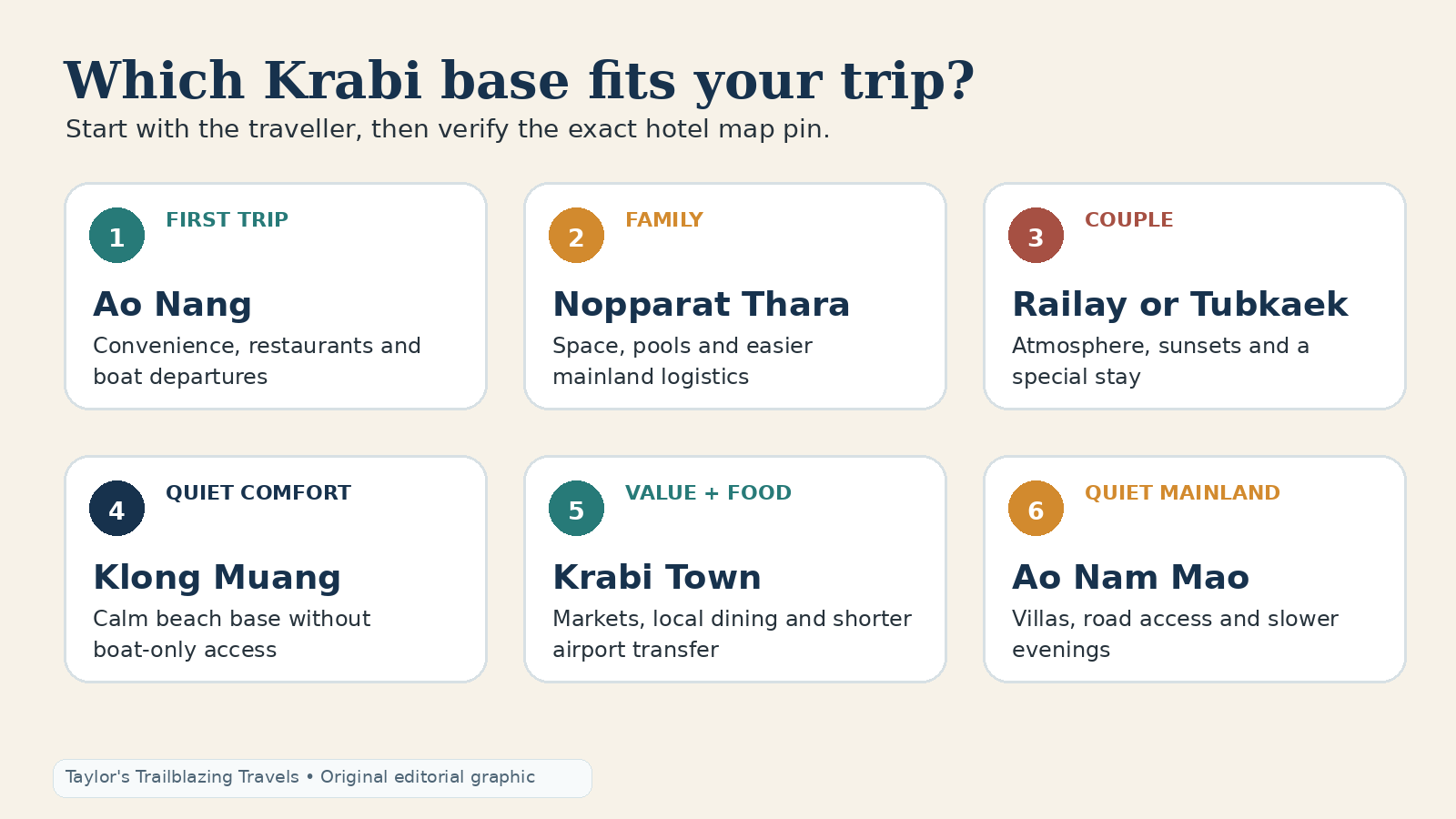
| Traveller | First choice | Strong alternative | Why |
|---|---|---|---|
| First-time visitor | Ao Nang | Nopparat Thara | The simplest combination of road access, food, boats and tour pickups |
| Couple seeking atmosphere | Railay | Tubkaek | Railay feels special after day visitors leave; Tubkaek offers privacy and sunsets |
| Family with young children | Nopparat Thara | Klong Muang | More space, family-oriented resorts and no compulsory boat transfer |
| Traveller with reduced mobility | Central Ao Nang | Klong Muang resort | Road access and a carefully checked accessible hotel are easier than beach boat landings |
| Solo traveller | Ao Nang | Krabi Town | Ao Nang is social and convenient; Krabi Town is cheaper and locally focused |
| Luxury resort holiday | Tubkaek | Klong Muang | High-end properties, quiet beaches and facilities designed for staying on site |
| Committed climber | Railay East or Tonsai | Ao Nang | Immediate climbing access versus better mainland food and logistics |
| Early flight or one-night transit | Krabi Town | Ao Nang | Road-only transfer and fewer weather-sensitive stages |
| Remote worker | Ao Nang | Krabi Town | Broader café, dining and service choice; verify room Wi-Fi before booking |
| Quiet stay without total isolation | Klong Muang | Ao Nam Mao | Both remain road-connected while feeling calmer than central Ao Nang |
These are starting points rather than rules. A family that plans to spend every day at a large resort may prefer Tubkaek, while an active couple who wants a new restaurant every evening may be happier in Ao Nang. Therefore, match the base to the daily pattern rather than the label attached to the trip.
Ao Nang: the best all-round base for most first-time visitors
Ao Nang is the practical centre of Krabi’s visitor economy. The Tourism Authority of Thailand identifies it as the seaside strip most visitors treat as “town” and as the principal launch point for boats to nearby islands and the Phra Nang peninsula. That concentration of transport, restaurants, pharmacies, convenience stores and tour operators is exactly why Ao Nang wins the first-trip recommendation.[1]
Convenience does not mean every Ao Nang hotel has the same location. The area stretches inland and north toward Nopparat Thara. A property advertised as “Ao Nang” can be beside the beach road, up a steep side street, beyond easy evening walking distance or close enough to the main strip to hear late-night traffic. Always check the map pin and the walking route, not just the straight-line distance.
Choose the right part of Ao Nang
The western beach end is useful for long-tail boats to Railay and sunset walks. Central Ao Nang Road gives the strongest restaurant and shop choice, although it can feel busy. The inland upper road usually offers better-value rooms and larger pools, but walking back uphill in heat or rain is less appealing than it looks on a map. The northern side toward Nopparat Thara is calmer and often better for families, provided the exact hotel remains close enough to the places you will use.
Panan Krabi Resort’s official site describes a central Ao Nang location within walking distance of the beach, restaurants, cafés, shops and tour operators. Centara Ao Nang Beach Resort describes an absolute beachfront position at the quieter end of Ao Nang, family suites and a drive of roughly 40 minutes from Krabi Airport. Those two examples show the main location choice: central walkability or a more resort-led beachfront edge.[13][12]
Ao Nang hotel shortlist by stay style
| Stay style | Useful example | Why it may work | What to verify |
|---|---|---|---|
| Central mid-range | Panan Krabi Resort | Walkable access to the beach road, dining and tour services | Room outlook, evening noise, breakfast terms and exact cancellation policy |
| Beachfront family resort | Centara Ao Nang Beach Resort & Spa Krabi | Direct beach access, family room options and a quieter edge-of-centre setting | Room category, pool view versus sea view and transfer inclusion |
| Budget guesthouse | Side streets behind central Ao Nang | Lower prices while retaining restaurant and transport access | Hill gradient, lift, road noise, safe walking route and distance in real minutes |
| Apartment-style stay | Inland Ao Nang | More space for longer stays and families | Kitchen equipment, cleaning schedule, transport costs and nearby food choice |
Advantages of Ao Nang
- Road transfer from the airport with no compulsory boat stage.
- The widest choice of restaurants, pharmacies, shops and tour desks.
- Simple access to Railay and common island-tour departure arrangements.
- Accommodation across budget, family, boutique and higher-end categories.
- A forgiving base when weather cancels a boat day.
Disadvantages of Ao Nang
- The busiest and most tourist-facing base in this comparison.
- The main beach is attractive at sunset but is not the province’s clearest swimming beach.
- Traffic, nightlife and construction noise vary sharply by street.
- Hotels using “Ao Nang” can sit farther inland than expected.
- Beachfront and central rooms can rise steeply in peak season.
Useful booking step for Ao Nang
Compare the map position before comparing the room decoration. A central room can save repeated transport costs, while an airport transfer booked in advance can be worthwhile for a late arrival or family group.
Nopparat Thara: the best family-friendly compromise near Ao Nang
Nopparat Thara sits immediately north of central Ao Nang but feels different once you move away from the junction between the two. The Tourism Authority of Thailand describes it as a quieter, shady beach within the wider national park setting. The southern end remains close enough to Ao Nang for easy dinners, while the northern stretch becomes more residential and resort-like.[1]
This area often suits families because hotels tend to have more land, larger pools and less doorstep nightlife than the central strip. It can also work well for travellers staying a week who want access to Ao Nang without living inside its busiest zone. Nevertheless, Nopparat Thara is long. A hotel close to the Ao Nang end and one beyond the bridge can create very different evenings.
Southern versus northern Nopparat Thara
The southern side is the practical choice when you want to walk into Ao Nang. Restaurants, convenience stores and transport are more frequent, although the atmosphere is less secluded. Farther north, the roads become quieter and some properties feel more like self-contained resorts. That calm is appealing, but it increases reliance on taxis, ride-hailing or hotel shuttles.
Families should also check the exact beach conditions they expect to use. Tides can change the look and depth of the shore, and the best family hotel may be the one with a reliable pool, shaded grounds and a convenient room layout rather than the one with the shortest marketing distance to the sand.
What to check before booking with children
- Whether family rooms use proper beds or a sofa bed with a limited weight or age range.
- Whether connecting rooms are guaranteed or only requested.
- The walking route to restaurants, including road crossings and pavement gaps.
- Pool depth, shade and supervised children’s facilities.
- Breakfast charges for children and any compulsory festive dinner.
- Whether the tour pickup covers the hotel without an extra meeting-point transfer.
Advantages of Nopparat Thara
- Quieter than central Ao Nang while remaining close to its services.
- Good supply of family-oriented and pool-focused hotels.
- Road access from the airport.
- More breathing room for longer stays.
- A useful compromise for mixed-age groups.
Disadvantages of Nopparat Thara
- The area stretches farther than many visitors expect.
- The northern end is not reliably walkable to central Ao Nang.
- Beach conditions vary with tide and season.
- Tour pickup arrangements differ by operator.
- Some hotels sit behind the beach rather than directly on it.
Useful booking step for Nopparat Thara
Use the hotel map and switch to walking view before booking. A property near the Ao Nang end suits restaurant-led evenings, while a farther-north resort should be chosen because you are happy to spend more time on site.
Railay and Tonsai: the best area for scenery and a short special stay
Railay is attached to the mainland, yet limestone cliffs make it function like an island. There is no ordinary road arrival. Guests reach the peninsula by boat, which is part of the appeal and the main logistical weakness. The scenery is immediate, the beaches feel more atmospheric after day visitors leave and climbing is woven into the character of the place. However, the same geography complicates suitcases, early flights and rough-sea days.
Railay West, Railay East and Tonsai are not interchangeable
Railay West is the classic sunset beach and generally commands the highest prices. Railay East faces the mangrove side, so it is not the swimming beach many first-time visitors imagine; nevertheless, it contains restaurants, bars, climbing businesses and often better-value rooms. The walk between east and west is short, which makes a well-positioned Railay East hotel a sensible compromise. Phra Nang is the standout beach area but has very limited accommodation immediately beside it. Tonsai, around the headland, remains more rustic and climbing-focused, with a looser backpacker feel and more awkward access.
Railay Village Resort describes its property as being on Railay West, directly on the beachfront and aimed at families and couples. Rayavadee occupies a very different luxury category on the Phra Nang peninsula, with its own resort transfer process and extensive grounds. These examples underline why the name “Railay” is not enough: the exact shoreline, walking route and arrival arrangement matter.[15][14]
The luggage and departure rule
Assume you may need to step through shallow water, cross sand or hand a suitcase between staff and a long-tail boat. Conditions and landing points vary. Therefore, large hard-shell cases, pushchairs, mobility aids and fragile electronics require more planning than they would at a road-access hotel. Ask the property exactly which pier it uses, whether staff meet the boat, what happens after dark and whether the quoted transfer includes every stage.
Avoid making Railay your final night before a very early flight unless the hotel confirms a reliable private transfer and you accept the weather risk. For most travellers, the safer sequence is to place Railay in the middle of the trip or finish with a mainland night.
How long should you stay in Railay?
Two nights is the practical sweet spot for many first visits. It provides one quiet evening, one full day and a second morning without creating excessive packing. One night can work when the hotel manages luggage well and the wider itinerary is short. Four or more nights suits climbers, beach-focused couples and travellers comfortable with a smaller dining and service choice.
Advantages of Railay
- Krabi’s most dramatic accommodation setting.
- Quiet mornings and evenings after many day visitors leave.
- Immediate access to beaches, cliff scenery and climbing.
- A compact peninsula that reduces daily road travel.
- Memorable choice for an anniversary or two-night split stay.
Disadvantages of Railay
- Boat-only arrival and departure.
- More complicated luggage and reduced-mobility access.
- Generally higher food and room prices.
- Smaller range of shops, pharmacies and services.
- Sea and weather conditions can affect transfers.
Useful booking step for Railay
Confirm the beach side, transfer method and walking route before paying. Travellers staying mainly for climbing should also compare the activity meeting point with the hotel location.
Klong Muang: the best quiet mainland base without complete isolation
Klong Muang sits north of Ao Nang in the Nong Thale area. It is quieter, more spread out and more resort-led, yet it remains connected by road. That combination makes it one of the strongest choices for couples and families who want a calmer beach holiday but do not want every arrival and departure to depend on a boat.
Dusit Thani Krabi Beach Resort’s official information places the resort on Klong Muang Beach and highlights a large beachfront property with two pools, family facilities, restaurants and activities. It also notes that some local restaurants sit within a few minutes of the hotel. That pattern is typical of the better-situated Klong Muang stays: enough nearby choice for a few evenings, although nowhere near Ao Nang’s density.[16]
Who Klong Muang suits
Families benefit from resort facilities, larger grounds and the absence of a compulsory boat transfer. Couples gain quieter sunsets and more space. Travellers who plan only one or two excursions during a five-night stay may prefer Klong Muang to central Ao Nang. Conversely, someone who expects to browse restaurants, bars and shops every evening may find the area too dispersed.
Location still matters within Klong Muang
Check whether the hotel sits near a usable cluster of restaurants and shops or on a more isolated stretch. A road may appear walkable during daylight yet feel uncomfortable after dark because of traffic, limited pavement or poor lighting. Ask about hotel shuttles, ride-hailing availability and the real taxi cost to Ao Nang before deciding that the lower room rate is a bargain.
Hotel style in Klong Muang
The area is strongest in mid-range and upscale resorts, including properties with pools, gardens, children’s facilities and on-site dining. Smaller guesthouses exist, but a very cheap room can undermine the reason for staying here if it lacks easy beach access or requires daily transport. In Klong Muang, paying for the right grounds and location often adds more value than paying for a decorative sea-view upgrade.
Advantages of Klong Muang
- Quiet mainland beach atmosphere with road access.
- Strong family and resort facilities.
- Less hectic than Ao Nang.
- Good base for couples who still want some nearby dining.
- Useful access toward Hong Islands departures, depending on operator.
Disadvantages of Klong Muang
- Restaurant choice varies sharply by exact hotel location.
- Repeated trips to Ao Nang add time and cost.
- Tour pickup coverage must be checked.
- Lower-density streets may be awkward on foot after dark.
- Budget accommodation is less compelling than in Ao Nang or Krabi Town.
Useful booking step for Klong Muang
Compare the hotel against the nearest restaurant cluster and confirm whether a Hong Islands pickup is included. Klong Muang works best when you genuinely value quiet time at the property.
Tubkaek: the best area for secluded luxury and resort time
Tubkaek is the choice for travellers who want the hotel to be a major part of the holiday. The beach faces a striking Andaman island panorama, the atmosphere is quieter than Klong Muang and several properties are designed around privacy, wellness, dining and sunset views. It can feel exceptional when that is the intention. It can feel inconvenient when a guest books it as though it were a quiet corner of Ao Nang.
The Tubkaak Krabi Boutique Resort describes a secluded setting between Hang Nak mountain and the beach, with views toward a 13-island archipelago and a strong romance and nature focus. Banyan Tree Krabi likewise describes an all-pool-suite-and-villa resort on Tubkaek Beach, with a secluded beach, spa, children’s facilities and on-site experiences. Those official descriptions are useful because they show the destination logic: stay here to use the resort, not simply to sleep before spending every day elsewhere.[17][18]
What a Tubkaek room price should include
At this level, compare the whole stay rather than the cheapest rate. Breakfast, airport transfer, room view, pool privacy, children’s access, half-board, cancellation terms and resort activities can change the real value by thousands of baht. A lower headline price may exclude the very features that make the location worthwhile.
Who should avoid Tubkaek?
Avoid it when the plan involves nightly restaurant-hopping, frequent budget tours from central Ao Nang or a strict low-cost itinerary. It may also frustrate solo travellers who want an easy social scene. However, couples, honeymooners and families happy with a high-quality resort can use the isolation as a feature rather than a problem.
Tubkaek versus Klong Muang
Klong Muang is the more flexible choice. It offers a broader mix of properties and a better chance of nearby independent dining. Tubkaek feels more secluded and generally more expensive, with a stronger emphasis on resort facilities and views. Choose Tubkaek when the hotel experience matters more than external convenience; choose Klong Muang when you still want a quiet beach but prefer a little more independence.
Advantages of Tubkaek
- Exceptional sunset and island views.
- High-quality luxury and boutique resorts.
- Quiet beach atmosphere.
- Strong romance, wellness and resort-dining options.
- Good fit for travellers building rest into a wider Thailand itinerary.
Disadvantages of Tubkaek
- Limited independent evening choice.
- Longer and more expensive road transfers.
- High room prices during popular dates.
- Not ideal for daily trips into Ao Nang.
- Isolation can feel restrictive without advance planning.
Useful booking step for Tubkaek
Compare packages, not room-only headlines. A private or small-group boat day can also make more sense from the northern beaches than repeatedly travelling into central Ao Nang.
Krabi Town: the best area for value, local food and transit
Krabi Town is the provincial centre rather than a beach resort. It offers local restaurants, markets, cafés, riverside walks and generally lower room rates. The Tourism Authority of Thailand lists Maharaj Walking Street on Friday to Sunday evenings and Chao Fah Pier Night Market daily, which illustrates the town’s strongest appeal: food and ordinary local life rather than a resort strip.[1]
The town is useful for a late arrival, an early flight, a one-night stop before an onward route or a traveller prioritising food and budget. It can also suit a remote worker who values cafés and services more than immediate beach access. However, anyone imagining that “Krabi Town” means walking out of the hotel onto a classic Andaman beach will be disappointed.
Where to stay inside Krabi Town
Look around the Maharaj Road and Walking Street area for easy food and market access, or choose the riverside for a quieter outlook. Check whether the hotel has a lift, because small boutique properties may occupy narrow buildings. A room facing the street can be lively on market nights, while a rear room may sacrifice the view but improve sleep.
Using Krabi Town as a base for day trips
Inland attractions are often straightforward from town, and some tours include central pickups. Boat trips require more care because departure points and pickup zones vary. Ao Nang remains the easier base for frequent island days. Therefore, Krabi Town works best when beach trips are occasional rather than the main daily activity.
How many nights make sense?
One or two nights is enough for most beach-focused itineraries. Three or more nights can work for food-led travellers, a lower-budget trip or a mixed route using local transport. A split stay of one town night followed by several coastal nights can reduce stress after a late flight without sacrificing the beach portion of the holiday.
Advantages of Krabi Town
- Lower accommodation prices.
- Strong local food and market access.
- Shorter road transfer from the airport.
- Useful for transit and inland trips.
- Less resort-oriented atmosphere.
Disadvantages of Krabi Town
- No classic beach outside the hotel.
- Less convenient for repeated island tours.
- Evening atmosphere is local rather than beach-holiday focused.
- Tour pickups may require a meeting point.
- A long stay can feel disconnected from the coast.
Useful booking step for Krabi Town
Choose the exact town zone according to food, market and transport priorities. A one-night town stay can also protect an itinerary when an evening flight lands too late for a comfortable boat transfer.
Ao Nam Mao: the best quiet mainland base near the Railay side of Krabi
Ao Nam Mao lies south-east of Ao Nang and gives travellers a quieter mainland address with road access. Development is scattered, so the experience depends heavily on the exact property. Some hotels sit in peaceful grounds with their own pools and dining; others are better treated as villa bases for guests using a driver or rental car.
The ShellSea Krabi describes a secluded beachfront and pool-villa setting near Fossil Shell Beach, with Ao Nang around ten minutes away by car according to its official site. That positioning captures Ao Nam Mao’s appeal: close enough to reach the better-known areas, yet far enough away to feel removed from central Ao Nang.[19]
Who should choose Ao Nam Mao?
Couples and families who want a quiet hotel, a private-pool option or a slower evening rhythm may enjoy it. It can also suit travellers planning Railay access through the relevant pier arrangement, although boat routes and schedules must be checked for the exact date and hotel. Guests who expect a long, lively promenade should choose Ao Nang instead.
The transport question
Road access is a major advantage over Railay, but public transport and ride-hailing can be less immediate than in central Ao Nang. Ask the hotel for a current taxi price, shuttle timetable and late-evening procedure. A free daytime shuttle is helpful, yet it does not solve dinner transport if the final return leaves at 6pm.
Ao Nam Mao versus Klong Muang
Both are quieter mainland alternatives. Klong Muang has a more established resort beach identity and stronger northern-coast hotel clusters. Ao Nam Mao feels more dispersed and can offer better access toward Krabi Town, Fossil Shell Beach and southern-side piers. Choose according to the activities and restaurants you will actually use.
Advantages of Ao Nam Mao
- Quiet atmosphere with road access.
- Useful villa and resort-style properties.
- Closer to Krabi Town than the northern beaches.
- Potentially convenient for the Railay side, depending on current pier service.
- Good fit for travellers using a driver or hotel shuttle.
Disadvantages of Ao Nam Mao
- Limited walkable nightlife and dining.
- Scattered development makes the exact map pin critical.
- Transport options may thin out at night.
- The immediate beach may not match Railay or the offshore islands.
- Some tour pickups require an extra arrangement.
Useful booking step for Ao Nam Mao
Ask the hotel to describe the evening transport plan in writing. A quiet property is far more enjoyable when you know the shuttle times, taxi cost and nearest reliable restaurant before arrival.
Should you split your Krabi stay between two areas?
A split stay can combine convenience with atmosphere, but moving hotels consumes more time than the booking calendar suggests. Checkout, luggage storage, transfer waiting and a second check-in can remove half a day. Therefore, a split works best when each base delivers a clearly different experience and the total trip is at least five nights.
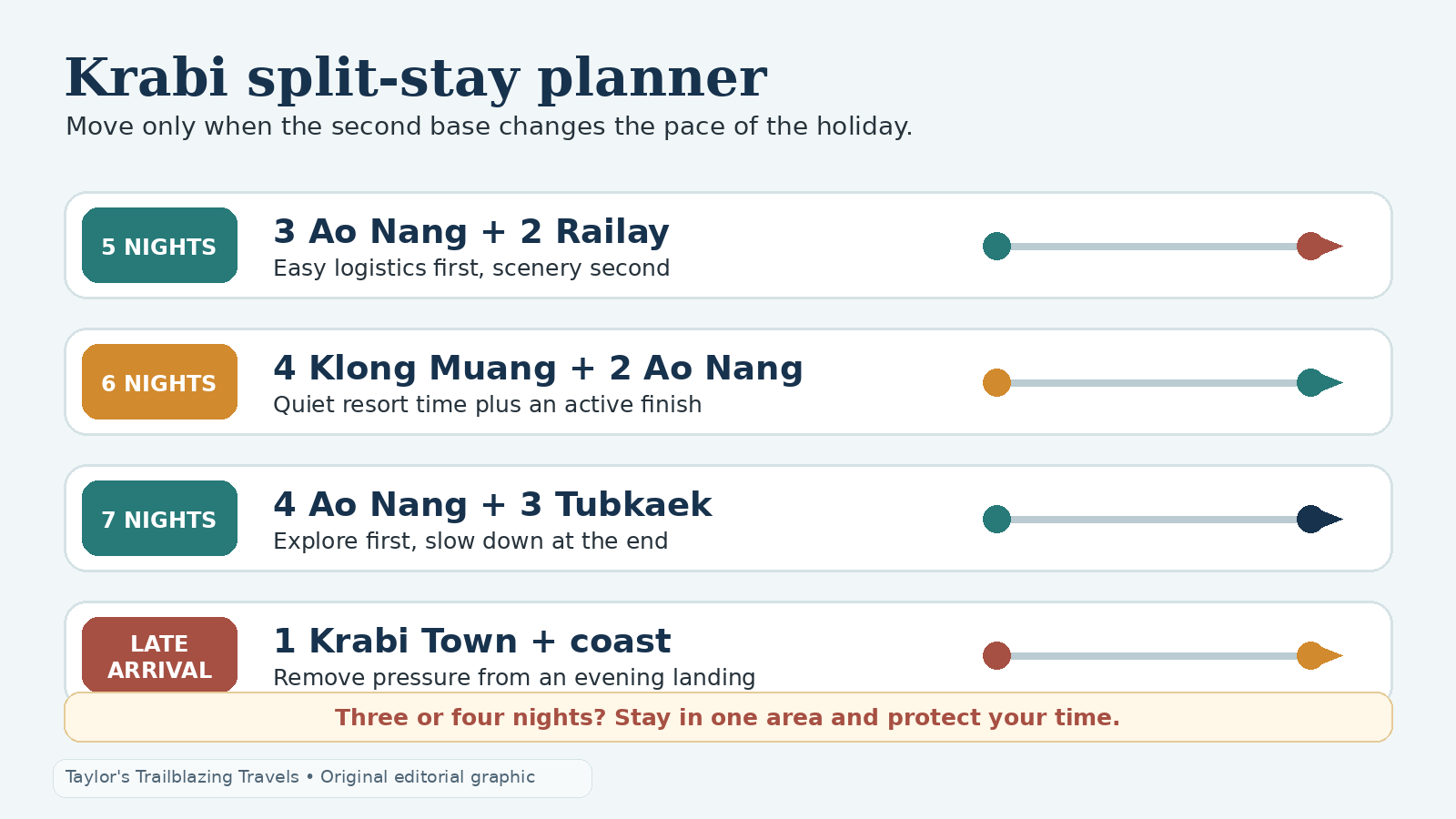
| Trip length | Suggested split | Why it works | Watch-out |
|---|---|---|---|
| Four nights | Stay in one area, usually Ao Nang | Protects limited time and leaves room for weather changes | A one-night move rarely repays the packing time |
| Five nights | Three Ao Nang + two Railay | Easy tour logistics followed by quiet scenery | Keep Railay away from an early-flight final morning |
| Six nights | Four Klong Muang + two Ao Nang | Resort time plus a convenient activity-and-food base | Book the transfer rather than assuming taxis are instant |
| Seven nights | Four Ao Nang + three Railay or Tubkaek | Balances exploration with a slower second phase | Choose only one quiet luxury base |
| Late arrival | One Krabi Town + remaining nights on the coast | Removes pressure to make a late boat or long resort transfer | Confirm next-day luggage and pickup arrangements |
| Longer southern trip | Four Krabi mainland + three or more Koh Lanta | Adds a genuinely different island stay | Check seasonal transfer availability and pier details |
When not to split
Do not split a three- or four-night trip merely because two hotels look appealing. Avoid it when travelling with several young children, mobility equipment or many cases unless the hotels manage the transfer. A single central base plus one Railay day trip is often easier than moving everyone for one night.
When a split adds real value
Move when the second area changes the pace. Ao Nang plus Railay changes road-hub convenience into boat-access atmosphere. Klong Muang plus Krabi Town adds local food and market time. Ao Nang plus Tubkaek creates an active first half and a resort-led finish. In each case, the move has a purpose that can justify the lost hours.
How much should you budget for accommodation in Krabi?
Krabi pricing is highly seasonal. The Tourism Authority of Thailand advises early reservations for the late-December to early-January peak, when popular accommodation can fill far in advance. At other times, the same room category may be substantially cheaper, particularly during the wetter Andaman season.[1]
| Budget level | Planning range per room | What it commonly buys | Likely compromise |
|---|---|---|---|
| Low-cost | THB 800–1,600 | Simple guesthouse or small hotel, strongest in Krabi Town and inland Ao Nang | Distance, basic facilities, no lift or non-refundable terms |
| Comfortable mid-range | THB 1,600–4,500 | Pool hotel, better location or larger room in Ao Nang, Nopparat or town | True beachfront rooms cost more |
| Upper mid-range | THB 4,500–8,500 | Strong resort facilities, family room or better Railay/Klong Muang position | Breakfast and transfers may still be extra |
| Luxury | THB 8,500–20,000+ | High-end Railay, Tubkaek or premium beachfront resort category | Price can rise sharply at holidays and for private pools |
Five costs hidden by the nightly rate
- Airport or pier transfer, especially for Railay and the northern beaches.
- Breakfast, children’s meals and compulsory festive dinners.
- Extra beds or occupancy charges that appear after guest ages are entered.
- Daily taxis when the hotel is not near restaurants or pickup zones.
- Non-refundable risk when weather, flights or family plans change.
How far ahead should you book?
For Christmas, New Year and scarce family-room categories, book as soon as dates are firm and prefer a sensible cancellation window. For ordinary high-season weeks, several months is prudent for Railay and top northern-beach resorts. During green season, flexibility often matters more than locking in the absolute lowest price. Always compare the final total after taxes, breakfast and transfer extras.
Price-check rule
Compare one refundable rate, one breakfast-included rate and one room-only rate. Then add the likely transfer and meal costs. The cheapest line on the first screen is not always the cheapest stay.
Krabi Airport and last-mile transfer planning
The Department of Airports operates Krabi International Airport and publishes current airport information through its official minisite. Transfer products and counters can change, so verify the live arrangement close to travel rather than relying on an old screenshot.[7]
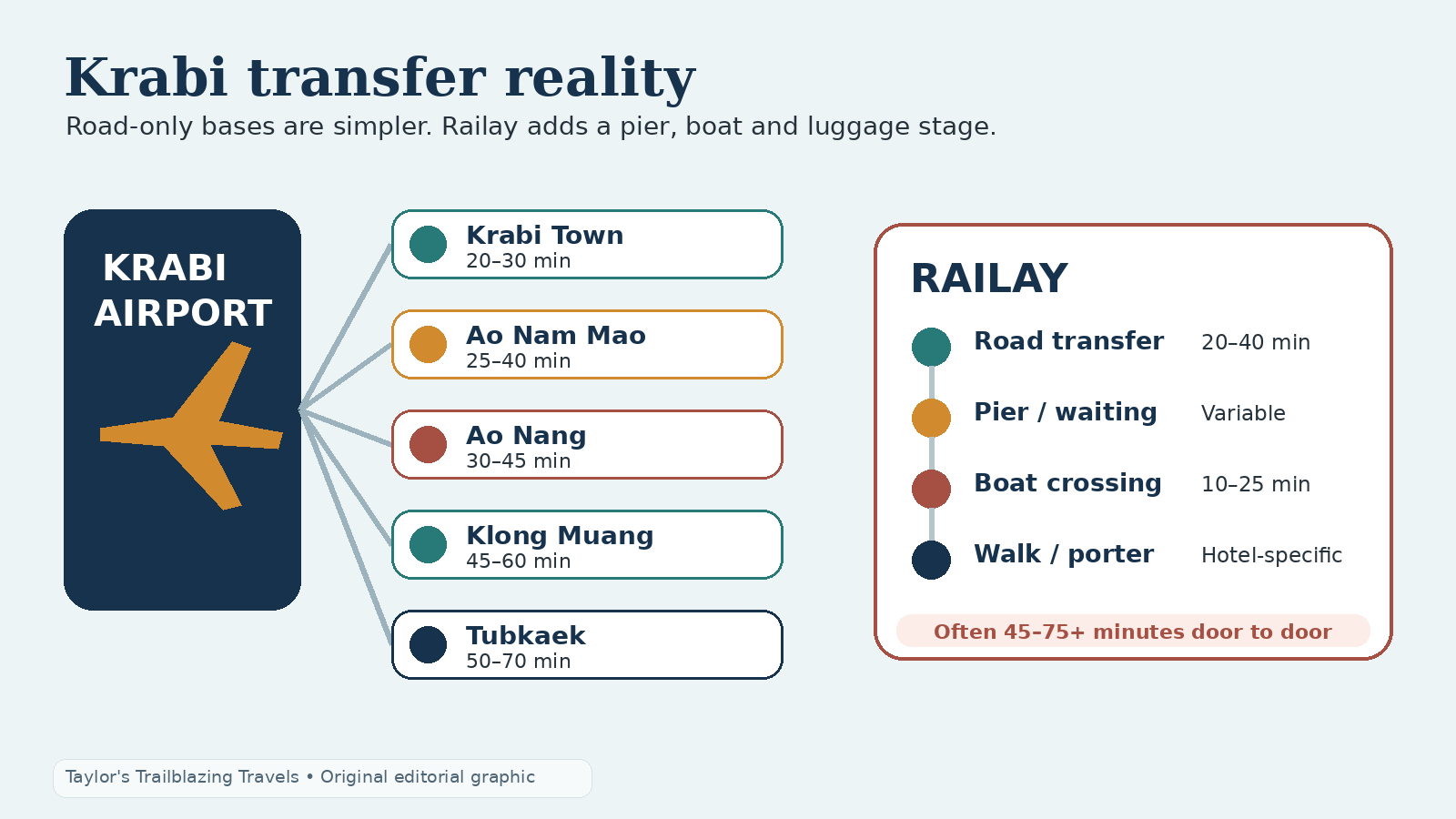
| Destination | Planning journey | Transfer type | Important question |
|---|---|---|---|
| Krabi Town | About 20–30 minutes | Road only | Does the hotel provide a late-arrival desk or lockbox? |
| Ao Nam Mao | About 25–40 minutes | Road only | Is the property near the pier, beach or an isolated road? |
| Ao Nang | About 30–45 minutes | Road only | Will the vehicle drop directly at the hotel? |
| Nopparat Thara | About 35–50 minutes | Road only | Which end of the long beach area is the hotel? |
| Klong Muang | About 45–60 minutes | Road only | Is a private transfer better value for the group? |
| Tubkaek | About 50–70 minutes | Road only | Does the room package include airport transfer? |
| Railay | Often 45–75 minutes or more | Road, pier, boat and walking/porter stage | Which pier, boat type and late-arrival procedure apply? |
These are planning estimates, not schedules. Traffic, rain, waiting time, pier choice, shared-vehicle stops and sea conditions can change them. For Railay, request a written stage-by-stage transfer from the hotel. Once a group reaches three or four people, compare the shared price with a private vehicle for Tubkaek or Klong Muang.
Early-flight rule
With a very early departure, a road-connected final night is usually safer. Krabi Town gives the shortest planning journey, while Ao Nang remains workable with a pre-booked vehicle. Railay should be used only when the property confirms an appropriate private transfer and the traveller accepts the extra sea-condition risk.
Compare the full route
Check whether the ticket covers airport-to-hotel travel or only a terminal-to-terminal segment. A low fare that ends at Krabi Bus Terminal can be poor value when the final taxi is added.
The 12-question Krabi hotel booking checklist
A polished hotel photograph cannot answer the practical questions that shape the stay. Before paying, work through this list and save the answers with the booking confirmation.
- What is the exact map pin, and what does the walking route look like rather than the straight-line distance?
- Is the hotel on a hill, and can every guest manage the slope in heat or rain?
- Does “beachfront” mean direct sand access, a road between the hotel and beach, or only a sea view?
- Which beach section is nearest, and is it suitable for swimming at the likely tide and season?
- Are breakfast, taxes, service charges and any festive dinner included?
- Is the selected room category renovated, accessible by lift and suitable for the stated occupancy?
- Are connecting rooms guaranteed in writing?
- Does the hotel have current construction or renovation work?
- Which tours collect from the lobby, and which require a meeting-point transfer?
- What is the airport-transfer price and late-arrival procedure?
- For Railay, which pier, boat and luggage-assistance arrangement applies?
- What are the cancellation deadline, no-show charge and date-change rules?
Read the room name literally
“Deluxe sea view” can mean a partial view over a roof. “Pool access” may open onto a shared channel rather than a private pool. “Family room” can be a standard room with a sofa bed. Therefore, open the room-category photographs, floor area, bed description and occupancy rules instead of assuming the label has a universal meaning.
Check the most recent operational reviews, not only the score
Use reviews to detect repeated issues such as road noise, poor lift access, breakfast queues, renovation work or unreliable hot water. Avoid treating a single angry comment as decisive. A pattern across recent stays is more useful than a ten-year average score.
Make screenshots part of the booking record
Save the room description, included benefits, cancellation policy and transfer promise. That record helps when a listing changes or a benefit is disputed. It is particularly useful for family occupancy, airport collection and paid room upgrades.
Best season, sea conditions and flexible booking
Krabi lies on Thailand’s Andaman side. Calm, dry-season conditions are generally most reliable from roughly November into April, while the wetter south-west monsoon period brings more rain, wind and variable sea conditions. However, weather does not follow a perfect monthly boundary. A dry-season week can still be wet, and a green-season trip can include long sunny periods.
The Thai Meteorological Department publishes the current Krabi forecast, warnings, shipping forecast and ocean-wave information. Check those sources close to a boat transfer or island trip instead of relying only on a generic phone icon.[5][6]
How weather changes the best area
Ao Nang becomes more useful when boat plans change because restaurants, cafés, shops and road-based alternatives remain available. Railay remains beautiful in rain but can feel confined if sea travel is disrupted. Klong Muang and Tubkaek work well when the resort has enough facilities to occupy a wet afternoon. Krabi Town is the strongest food-and-café fallback, although it does not replace a beach holiday.
Green-season booking strategy
Choose a refundable or flexible rate when practical, avoid stacking two non-refundable boat-dependent bookings and leave one movable day. A hotel with a good pool, covered public areas and reliable dining becomes more valuable than a purely photogenic room. Meanwhile, travellers staying on Railay should ask how the hotel handles delayed or cancelled transfers.
Never pressure a captain to sail
A cancelled or delayed boat is frustrating, but the operator is assessing conditions the traveller cannot judge from the beach. Accept the safety decision, document any refund or rebooking and switch to a road-based plan.
Useful products for a Krabi hotel-and-island stay
Accommodation choice matters far more than buying extra equipment. Nevertheless, a few small items can reduce friction when luggage, wet boat landings and changing hotel locations are part of the route.
| Item | Useful when | Advantages | Limitations |
|---|---|---|---|
| Thailand eSIM | Checking transfers, maps and hotel messages on arrival | Can provide data before reaching a local shop | Phone must support eSIM; compare data allowance and network terms |
| Packing cubes | Using two Krabi hotels or combining Krabi with another island | Reduces full unpacking during a short split stay | Does not reduce baggage weight and can encourage overpacking |
| Compact luggage scale | Using low-cost domestic flights | Helps avoid airport repacking and excess surprises | Check the battery and accuracy before travel |
| Small dry bag | Railay transfers and island days | Keeps documents and clothing together above splashes | Not every bag is certified for full submersion |
| Waterproof phone pouch | Wet long-tail landings and beach transfers | Simple splash protection while keeping the phone accessible | Test the seal and follow the manufacturer’s depth rating |
Helpful, not compulsory
Buy only what solves a real problem in the itinerary. A tested dry bag can be more useful than extra clothing for a Railay split, while packing cubes matter mainly when changing hotels.
For a wider clothing and weather checklist, use the Thailand packing list.
Common mistakes when choosing where to stay in Krabi
Booking a “Krabi” hotel without checking the map
The province name appears on properties from Krabi Town to remote beaches. Open the map pin, calculate the daily journey and read the address. A bargain loses its value when every dinner needs a THB 600 return taxi.
Choosing Railay for the final night before an early flight
The boat transfer adds a weather-sensitive stage. Unless the hotel provides a suitable private arrangement, finish on the mainland and use Railay earlier in the trip.
Assuming Ao Nang Beach is the trip’s best swimming beach
Ao Nang is the best logistical base, not automatically the most beautiful swimming location. Use it for convenience and reach Railay or the islands for the classic scenery.
Expecting Tubkaek to have Ao Nang nightlife
Tubkaek is chosen for quiet resort time. If independent restaurants and evening browsing are priorities, stay in Ao Nang or carefully positioned Klong Muang.
Ignoring the exact part of Nopparat Thara
The southern end can feel connected to Ao Nang; the northern end can require transport. Treat it as a long district rather than a single point.
Paying for a sea view but not the useful room
A larger family room, quieter rear location, lift access or flexible cancellation may improve the stay more than a partial sea view. Compare functional benefits before decorative ones.
Relying on a scooter as the transport plan
Do not book an isolated hotel on the assumption that everyone can rent a scooter. Licence, insurance, helmet, road and weather issues must all be suitable. Pre-price legitimate taxis or drivers instead.
Making every night non-refundable
Flight disruption, illness and rough sea conditions can alter the route. A small saving across several non-refundable bookings can create a much larger loss when one stage changes.
Frequently asked questions about the best areas to stay in Krabi
What is the best area to stay in Krabi for the first time?
Ao Nang is the strongest first-time choice because it combines road access, restaurant choice, tour pickups and frequent boats to Railay. Stay within a genuine walking distance of the beach road rather than relying only on an “Ao Nang” address.
Is Ao Nang or Railay better?
Ao Nang is better for logistics, dining variety and airport transfers. Railay is better for scenery, beach atmosphere and climbing. A five-night trip can combine three nights in Ao Nang with two in Railay.
Is Railay an island?
No. Railay is a mainland peninsula cut off from road access by limestone cliffs, so visitors arrive by boat. It behaves like an island from a transport perspective.
Where should families stay in Krabi?
Nopparat Thara and Klong Muang are the most balanced family choices. Both offer road access and family-oriented resorts. Central Ao Nang also works when convenience is more important than quiet.
Where should couples stay in Krabi?
Railay suits couples seeking atmosphere and dramatic scenery. Tubkaek is stronger for secluded luxury, while Klong Muang gives quiet comfort with more mainland flexibility.
Is Krabi Town a good place to stay?
Yes for value, local food, markets, a late arrival or a short transit stay. It is not the best base when the main goal is walking directly onto a beach or taking island tours every day.
Is Klong Muang too quiet?
It can be too quiet for travellers who want a broad restaurant and nightlife choice. However, a well-positioned resort near a small dining cluster gives enough independence for many couples and families.
Is Tubkaek worth the extra cost?
It can be when the resort, view, privacy and quiet beach time are central to the holiday. It is poor value when you plan to spend every day and evening in Ao Nang.
How many nights should I spend in Krabi?
Four to six nights suits most first visits. Three nights can cover Railay and one island day but leaves little weather flexibility. Seven nights allows a slower pace or a meaningful split stay.
Can I stay in Railay with large luggage?
Yes, but confirm the hotel transfer and porter arrangements. Expect a boat stage and possible contact with sand or shallow water. Pack essential electronics and documents in reliable splash protection.
Which area is closest to Krabi Airport?
Krabi Town is generally the shortest road transfer among the principal bases. Ao Nam Mao is also relatively convenient. Railay may look close but requires a pier and boat stage.
Do I need a scooter in Krabi?
No. Ao Nang, central Nopparat Thara and compact Railay can work without one. Quieter mainland areas require more taxis or hotel shuttles. Only rent a scooter when licence, experience and insurance requirements are fully satisfied.
Where is the best nightlife in Krabi?
Ao Nang has the broadest visitor nightlife and late restaurant choice. Krabi Town offers local markets and bars rather than a beach-resort scene. Railay has compact bars but fewer options.
Where should I stay for an early flight?
Krabi Town is the lowest-stress choice, followed by Ao Nang with a pre-booked road transfer. Avoid a boat-only final night unless the hotel provides a reliable early private transfer.
What is the best area in the rainy season?
Ao Nang is the most flexible because it retains cafés, restaurants, shopping and road-based alternatives when boats are cancelled. A full-service Klong Muang or Tubkaek resort can also work well for a wet afternoon.
Should I book a beachfront hotel?
Only when direct beach access matters more than central convenience. Verify whether a road sits between the hotel and sand, whether the beach is swimmable at the expected tide and whether the selected room actually faces the sea.
How do I choose between Ao Nam Mao and Klong Muang?
Choose Klong Muang for an established quiet resort beach north of Ao Nang. Choose Ao Nam Mao for a quieter southern-side base with easier reach toward Krabi Town and selected Railay-side piers.
What should British travellers check before Thailand?
Check the current FCDO Thailand advice, passport validity, visa rules, insurance and the Thailand Digital Arrival Card. Current UK guidance says foreign nationals must complete the digital arrival card and can register within the three days before arrival.[9][11]
Which Krabi area should you choose?
Choose Ao Nang when you want the most forgiving base. It is the best answer for a first visit, a short trip, mixed interests and travellers who value easy dinners as much as dramatic day trips. Choose Railay for two memorable nights when scenery and atmosphere justify the boat transfer. Choose Nopparat Thara or Klong Muang when family space and quieter evenings matter more than being in the centre.
Tubkaek should be a deliberate resort decision, not an accidental bargain. Krabi Town is an excellent value and food base when the beach is not the daily priority. Ao Nam Mao works for travellers who like quiet, road access and a hotel-led stay south of Ao Nang.
The best area is the one that reduces the journeys you will repeat. Start with the airport arrival, the activity you care about most and the dinner plan. Once those three work, the pool and room view can make a good choice even better.
Final planning checklist
- Confirm the exact map pin and walking route.
- Price the complete airport or boat transfer.
- Check room occupancy, breakfast and cancellation terms.
- Verify the nearest reliable restaurant and late-evening transport.
- Keep one day flexible for weather.
- Save screenshots of the room category and included benefits.
- Recheck current official travel and entry advice before departure.
Sources and verification notes
Research reviewed on 26 August 2026. Hotel rates, transfers, schedules, sea conditions, room features and entry rules can change. Recheck live information before booking and before travel.
- Tourism Authority of Thailand – Krabi destination guide – Ao Nang, Nopparat Thara, Railay, markets and peak-season booking context.
- Tourism Authority of Thailand – 10 things to do in Krabi – Destination and attraction context.
- Tourism Authority of Thailand – Krabi trip planner – Railay, Phra Nang and route context.
- Tourism Authority of Thailand – Krabi nature guide – Krabi Town and wider provincial context.
- Thai Meteorological Department – Krabi forecast – Current observations and seven-day forecast.
- Thai Meteorological Department – Southern West Coast forecast – Andaman weather and sea-condition context.
- Department of Airports – Krabi International Airport – Official airport information and notices.
- UK Foreign, Commonwealth and Development Office – Thailand travel advice – Current warnings, insurance and safety advice.
- UK Foreign, Commonwealth and Development Office – Thailand entry requirements – Passport, visa and digital-arrival-card guidance for British travellers.
- Thailand Tourist Police – contact information – Tourist Police hotline 1155.
- Thailand Immigration Bureau – Thailand Digital Arrival Card – Official arrival-card portal.
- Centara Ao Nang Beach Resort & Spa Krabi – official site – Ao Nang beachfront location, family facilities and airport-distance context.
- Panan Krabi Resort – official site – Central Ao Nang location and walkability context.
- Rayavadee – official site – Phra Nang peninsula location and road-plus-boat transfer information.
- Railay Village Resort – official site – Railay West beachfront and stay-style context.
- Dusit Thani Krabi Beach Resort – official site – Klong Muang location and family-resort facilities.
- The Tubkaak Krabi Boutique Resort – official site – Tubkaek location, beach and resort-focus context.
- Banyan Tree Krabi – official site – Tubkaek luxury, accommodation and facility context.
- The ShellSea Krabi – official site – Ao Nam Mao/Fossil Shell Beach positioning and access to Ao Nang.
- GetYourGuide – Hong Islands example – Current activity comparison example.
- GetYourGuide – Four Islands example – Current activity comparison example.
- GetYourGuide – Railay climbing example – Current activity comparison example.
- Viator – private Hong Islands long-tail example – Private-boat comparison example.
- Viator – inland Krabi tour example – Current inland-trip comparison example.
- 12Go Asia – Krabi Airport to Ao Nang route comparison – Current transport comparison example.
- Agoda – Krabi accommodation search – Live hotel availability and map comparison.
Image credits
- krabi-best-areas-2026-hero.png: Original editorial illustration created for Karen Taylor and Taylor’s Trailblazing Travels.
- krabi-area-matcher-2026.png: Original traveller-to-area decision graphic created for this article.
- krabi-split-stay-planner-2026.png: Original split-stay planning graphic created for this article.
- krabi-transfer-reality-2026.png: Original road-and-boat transfer graphic created for this article.
All four graphics are original editorial artwork created for this package. No third-party stock photograph or photographer attribution is required.