
Da Nang Travel Guide: Beaches, City Sights and Central Vietnam Bases
Build a city-and-beach stay around the Han River and My Khe, then choose the regional trips that earn their time.
AI-generated editorial illustration inspired by Da Nang’s My Khe coastline.
This Da Nang travel guide treats the city as a place to spend time: a riverfront centre, an urban beach, Cham sculpture, local food and a mountainous headland. Its airport and rail connections also make it a practical arrival point for central Vietnam. [1]
The main planning mistake is to book several nights here and then spend every full day elsewhere. First decide whether you want a city break, a beach holiday or a convenient base for selected excursions. Each version can work, but it changes the right hotel location and the amount of travel that feels worthwhile.
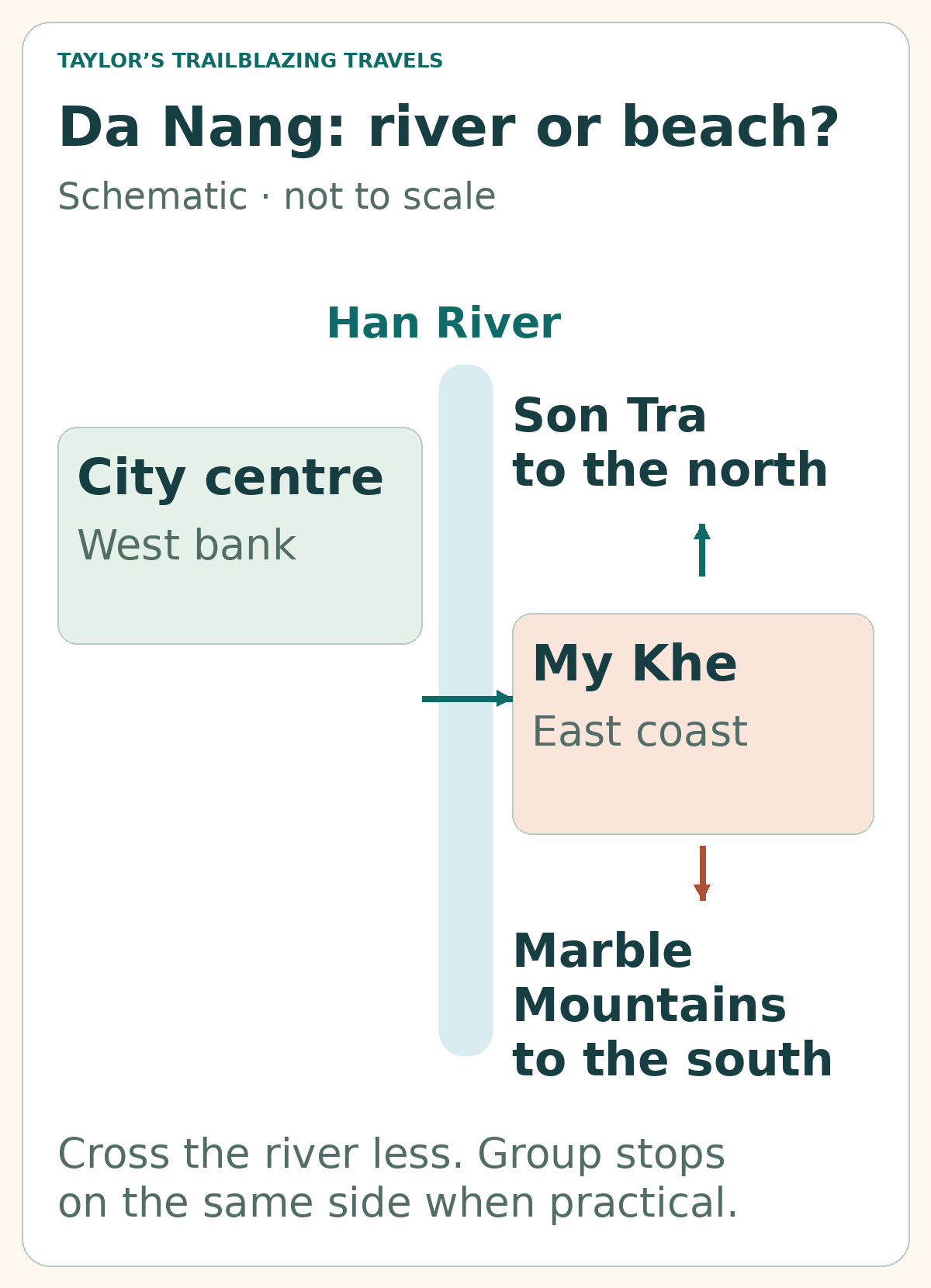
My Khe and nearby An Thuong suit a stay built around the coast.
The central west bank of the Han River puts the urban side first.
Reserve a full day for Da Nang before adding a regional excursion.
Treat Son Tra to the north-east and Marble Mountains to the south as separate outings.
Da Nang travel guide: choose the right city base
Think of the urban centre around the Han River and the beach districts east of it as two useful anchors. My Khe continues along the eastern coast, Son Tra rises to the north-east, and Marble Mountains lies to the south. [1] The local accommodation overview distinguishes urban riverfront hotels, coastal resorts and more secluded Son Tra settings. [22] The hotel pin matters more than a broad district name.
| Area | Choose it for | Check before booking |
|---|---|---|
| Central Han River, west bank | Museum visits, market browsing and riverside evenings | The exact stretch of river, traffic noise and the journey to the beach. |
| My Khe and An Thuong | Beach walks with cafés and evening food nearby | Road crossings, actual beach access and noise around your room. |
| Non Nuoc resort stretch | A holiday centred on a particular resort and its facilities | Restaurant choice outside the property and the cost of trips into the centre. |
| Son Tra-side resort setting | A specific quieter property whose setting is the attraction | Transport dependence, pickup coverage and how often you expect to leave. |
An Thuong has a visitor-oriented pedestrian and night-market area, which can suit travellers wanting food and activity near a beach base. [2] For light sleepers, “close to everything” is a reason to inspect recent room-specific comments, especially for evening noise.
A useful decision rule is to locate your repeated activity. Three beach mornings make a beach base valuable; repeated museum, market and riverfront outings favour the centre. A resort farther out makes sense when its pool, grounds and room are part of the planned experience, rather than a place used only for sleeping.
Compare Da Nang stays on Booking.com for a city-wide search, or search Agoda stays near My Khe Beach. Compare the same dates, room type, breakfast and cancellation terms.
After the 2025 administrative merger, the wider Da Nang municipality also includes Hoi An. Check the map pin rather than assuming every hotel labelled Da Nang is in the urban area described here. [3]
Give the city centre a day of its own
Start with Cham sculpture
The Museum of Cham Sculpture holds sandstone and terracotta works associated with Champa, including material from sites such as My Son and Tra Kieu. [4] It is a useful cultural anchor before the holiday becomes a sequence of viewpoints and beaches.
Allow around ninety minutes as an editorial starting point, longer if you read closely. Choose a few groups of objects and use the labels to understand their original setting. Check the museum’s current opening arrangements for your date; older published timetables are not consistent enough to build a tightly timed visit around.
Pair the museum with the riverfront
Use the rest of the day for a market browse, a local lunch and a riverside walk, with a break when heat or rain makes outdoor time less appealing. Han Market and the Bach Dang riverfront provide a practical central pairing. [5] Shopping need not fill the whole afternoon: give yourself time to return to the river after dark.
The tourism authority advertises the Dragon Bridge fire-and-water show at 21:00 on Fridays, Saturdays, Sundays and major holidays. [6] If it falls within your stay, choose a viewing position with a clear way out, expect crowds and keep some distance from the spray. Recheck local notices for changes.
Dragon Bridge schedule checked 23 October 2026. It is an advertised programme, not a guarantee that weather or an event restriction will permit a particular performance.
Back to top ↑Use My Khe for beach time, then eat beyond the hotel
My Khe’s urban setting lets you combine coast time with ordinary city meals and short excursions. Morning walks are a useful way to enjoy the beach before the rest of the day fills up; the local tourism portal describes exercise and sunrise activity along the shore. [7]
Separate enjoying the beach from swimming. The beach-management guidance reported in October 2026 says to use designated bathing areas, follow the flags and lifeguards, and swim while supervision is operating. Avoid rough conditions and prohibited areas; children need active adult supervision. Check the instructions at your actual beach access. [8]
For families, a pool can make a beach hotel more useful when the sea is unsuitable. For anyone booking a coastal room, check the walk from lobby to sand: a busy road, steps or a long detour can change the value of the location. A sea-view photograph alone does not answer that question.
Order a few regional dishes
Mi Quang combines noodles with a small amount of broth, herbs and toppings that vary by version. Bun cha ca is a fish-cake noodle soup; banh xeo is a crisp filled pancake commonly served with greens and dipping sauce. [9] Trying two or three dishes across different meals gives more variety than ordering a large unfamiliar spread once.
At a seafood restaurant, ask whether the displayed amount is per dish, per kilogram or for a smaller unit; the national tourism food guide describes seafood priced by weight. [9] Confirm the selected quantity, cooking charge and total before ordering. Mention dietary restrictions clearly rather than relying on the name of the main ingredient.
Back to top ↑Choose north or south for the next half-day
South: Marble Mountains
Marble Mountains combines caves, pagodas and viewpoints; Thuy Son is the main visitor mountain. [10] Give it an early part of the day and allow time for the surfaces and steps rather than treating it as a quick roadside photograph.
The tourism authority lists adult Thuy Son admission at VND 40,000, a lift at VND 15,000 each way and separate Am Phu Cave admission at VND 20,000. [10] Thus the main admission plus a return lift is VND 70,000; adding Am Phu makes VND 90,000 before transport. These are published components, not an all-inclusive tour price.
The lift does not mean the whole cave-and-pagoda route is step-free. Ask which parts fit your mobility needs, and wear shoes suited to uneven surfaces. A shorter route can be more rewarding than reaching every viewpoint.
Compare Marble Mountains tours on GetYourGuide if you want interpretation and pickup. Check whether admission, lift use, Am Phu and return transport are included; combining several attractions is only useful if the pace suits you.
North-east: Linh Ung and Son Tra
Linh Ung Pagoda at Bai But provides a focused Son Tra outing. The wider peninsula includes forest and protected wildlife habitat, while higher routes have access controls, including restrictions on automatic scooters and certain larger vehicles. [11] Ask a local operator which roads are open rather than planning an unrestricted mountain loop.
Choose a defined temple-and-coast visit if you want a manageable half-day. Wildlife watching needs a suitable guide and realistic expectations; sightings should never be a promised part of a casual drive. Keep away from animals and do not feed them.
Marble Mountains prices and Son Tra access guidance checked 23 October 2026 against the tourism authority’s published information. Confirm the relevant route and charges locally before setting out.
Back to top ↑Choose dates and nights for the holiday you want
For a mixed city-and-coast visit, March and April are sensible starting points. Local tourism guidance describes a generally drier January-to-August period, early-year drizzle, summer heat and a wetter September-to-December period. [12] Choose summer if you tolerate heat and can keep sightseeing away from the hottest hours; retain indoor options in the wetter months.
Storms and heavy rain can disrupt regional travel. Check current forecasts and operator notices before a mountain excursion or a tight onward connection, particularly during the storm season. [13]
Two nights provide a brief introduction, usually with one full day. Three nights allow a city day and a beach-plus-sight day. Four nights give one regional excursion its own space. Five or more can work for a resort holiday or several excursions, but ask whether moving to the place you want to explore would save repeated travel.
Count full days rather than hotel nights when comparing plans. An evening arrival and a morning flight can turn three nights into only two useful sightseeing days. A hotel change and a day trip also consume different kinds of time: the former interrupts one day, while the latter may create two long journeys for every excursion.
Back to top ↑Airport arrivals, rail connections and local journeys
Da Nang has an airport serving domestic and international travel, plus a railway station on Vietnam’s north–south network. [14] Check the arrival point on the actual ticket: an airport transfer, a railway pickup and a coach-company drop-off are different bookings.
For an airport pickup, send the flight number, date, terminal shown by the airline, passenger count and luggage details. Confirm where the driver will wait and how a delay affects the booking. If heading straight to Hoi An, book that destination explicitly rather than an urban Da Nang transfer.
Use a reputable taxi or genuine ride-booking app, and match the vehicle and driver to the booking before getting in. FCDO guidance cautions about transport scams and app impersonation. [15] Save the hotel pin and a local contact number so a spelling difference does not derail the last part of the journey.
For sightseeing, group nearby stops and use a car between the river, coast and more distant sights when walking is impractical. A motorbike is not necessary for this guide’s plan. For a car with a driver, agree waiting time, included stops, parking charges and the finish point in advance.
Save your hotel pin offline. If you need data, browse Airalo eSIMs, then select Vietnam. Check device compatibility, activation timing and plan inclusions. The link opens Airalo’s general catalogue. [16]
Back to top ↑Is Da Nang the right base for Hoi An, Ba Na Hills or Hue?
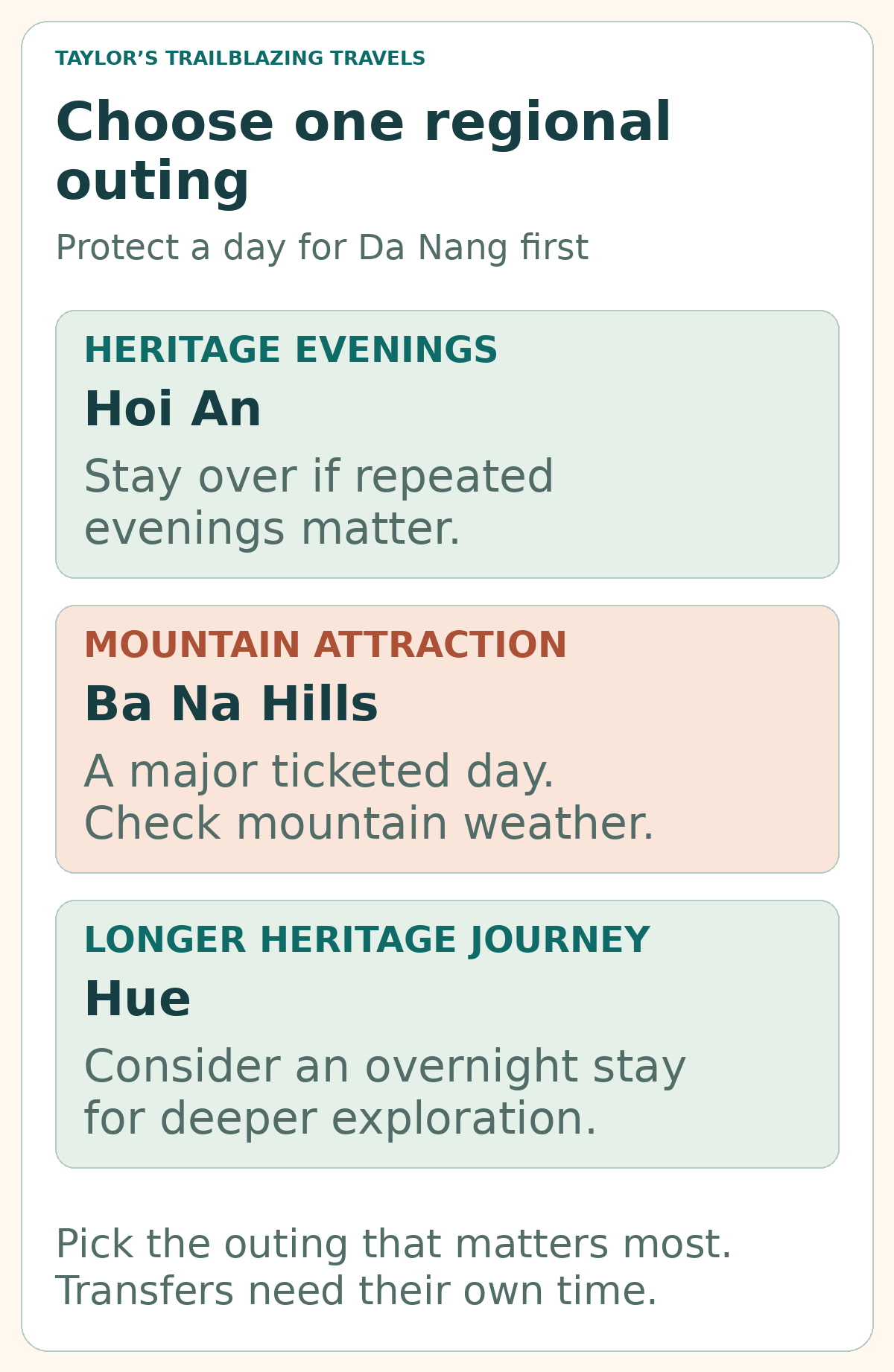
Start with the reason for each trip. Hoi An offers a historic trading-town setting; Ba Na Hills is a mountain leisure complex; Hue centres on imperial history. Their names should not become a compulsory list attached to every Da Nang booking. [17] [18] [19]
| Destination | Day trip makes sense when… | Consider another approach when… |
|---|---|---|
| Hoi An | You want a single introduction to heritage streets and can arrange the return journey. | You want both quieter mornings and leisurely evenings; an overnight stay adds useful time. |
| Ba Na Hills | You specifically want the cable car, Golden Bridge and leisure attractions. | Your interests are everyday city life or historic architecture; keep the city day instead. |
| Hue | One carefully selected historic visit justifies a long day for you. | You want several monuments and relaxed meals; an overnight stop gives more room. |
The Golden Bridge is within Sun World Ba Na Hills, reached as part of the mountain complex; it is separate from the city’s Dragon Bridge. [18] Allow a full day as a planning choice, including road travel, cable-car access and queues. Compare Ba Na Hills tickets and tours on GetYourGuide, checking transport, admission, meals and the cancellation policy separately. Mountain visibility can change what the day looks like.
For Hue, rail can form part of the experience: the tourism authority describes the coastal heritage train route via Hai Van. [20] Compare Da Nang–Hue rail and road options on 12Go, then verify the station, departure, seat and total journey for your date. A one-way rail trip followed by an overnight stay is often a better fit than using most of a day to return immediately.
For a lower-cost Hoi An outing, DanaBus’s route 02 currently links Da Nang Central Bus Station with Hai Ba Trung parking in Hoi An. Confirm the nearest stop and final return; neither endpoint is automatically your hotel. [21]
A city-first plan for three nights
This original grouping assumes arrival on the first afternoon or evening, two full days and departure on the fourth day. It keeps the river, coast and one nearby sight in the plan without turning the visit into a race across central Vietnam.
| Day | Suggested grouping | Reason |
|---|---|---|
| Arrival | Settle into your chosen base; take a short local walk and eat nearby. | Leave room for flight delays and avoid making the first evening depend on a performance. |
| First full day | Cham Sculpture Museum, central lunch and market browsing; riverfront later. | Give the urban side a coherent day, with a break between indoor and evening plans. |
| Second full day | Beach time and either Marble Mountains or Linh Ung. | Choose one direction and leave a relaxed block at the hotel or shore. |
| Departure | Breakfast and a short activity only if the transfer buffer permits. | Do not make a distant excursion responsible for catching your onward transport. |
With a fourth night, add the regional trip that best matches your interests. With only one full day, select the museum-and-river combination or the beach-and-nearby-sight combination. A shorter list is preferable to spending the whole visit moving between distant photo stops.
Back to top ↑Compare the whole stay, not just the room rate
Use three spending groups: the room, everyday meals and local journeys, and larger paid outings. Price the final group separately. A Ba Na Hills day, a private regional driver and a resort dinner are different purchases, so an undifferentiated daily budget can hide the choice that changes the total.
The Marble Mountains example above gives one transparent fixed-cost comparison: published main admission plus return lift totals VND 70,000 per adult, before transport or extra cave admission. [10] For hotels and excursions, use actual quotes for your dates rather than treating a generic guide’s price band as live inventory.
When comparing two bases, calculate: room-total difference, plus the extra trips each location creates, plus any meals you expect to buy at the property. If a room saves VND 300,000 per night over three nights, the total saving is VND 900,000 per room. Compare that saving with the transfers and inconvenience it creates; those figures are an arithmetic example, not researched room or taxi rates.
Book accommodation after choosing the base, then the arrival transfer if needed, then the major excursion. Keep ordinary city time flexible. For families or travellers with mobility needs, confirm the lift, room access, beach route, child seating and pickup arrangements directly, rather than relying on a broad filter.
Before paying for any tour, read the finish time as carefully as the pickup. A programme can include the attraction you want yet leave too little free time there, or return too late for an onward flight. The useful booking is the one that fits the rest of the stay.
Back to top ↑Frequently asked questions
Is Da Nang worthwhile if I am also visiting Hoi An?
Yes, if you want an urban beach, the riverfront, Cham sculpture and a different style of stay. Allocate time to those experiences. If your only objective is Hoi An’s heritage streets and countryside, using Da Nang purely as the arrival point may be the cleaner plan.
Is one Da Nang hotel a good base for a whole central Vietnam trip?
It works for a beach-led stay with selected outings. It is less effective when most days begin with a long departure and end with the same return journey. Once Hoi An or Hue becomes a main interest, compare an overnight stop there with the repeated travel from Da Nang.
Can I enjoy the city without riding a motorbike?
Yes. The suggested plan combines walking within each area with car journeys between them. For a driver booking, agree the stops, waiting time and return arrangement. Choose a hotel near the activity you expect to repeat so that transport does not organise every part of the day.
Which location works better for a very early flight?
Check the actual driving route and your hotel’s ability to arrange a reliable departure at the required time. On a short stay, a central base may simplify the decision, but proximity alone does not establish transfer time. Confirm pickup the day before and keep the airline’s check-in requirements separate from the road journey.
Should I stay here if swimming is essential?
Choose dates with the seasonal pattern in mind, then assess conditions each day. No city beach can promise safe swimming throughout a stay. If swimming is the holiday’s main purpose, a suitable pool and flexible plans give the booking more value when the sea cannot be used.
Choose the plan that suits your visit
Choose My Khe or An Thuong when beach mornings and nearby food define the holiday; choose the central Han River when the city’s museums, markets and evenings come first. Give Da Nang two full days before adding a regional excursion. Then choose Hoi An for merchant-town heritage, Ba Na Hills for its mountain attractions or Hue for imperial history, allowing an overnight elsewhere when that destination deserves more of the trip.
Back to top ↑Sources and methodology
Researched and editorially reviewed on 23 October 2026. Official tourism, attraction and transport sources support the destination facts. Suggested bases, day groupings and budget examples are editorial planning models; they are not reports of personal visits or live booking quotes. Recheck dated prices, access and operating details before travelling.
- Vietnam Tourism — Da Nang
- Da Nang Tourism Promotion Centre — An Thuong Night Market
- Da Nang Tourism Promotion Centre — About Da Nang City
- Da Nang Tourism Promotion Centre — Museum of Cham Sculpture
- Vietnam Tourism — A perfect three-day itinerary in Da Nang
- Da Nang Tourism Promotion Centre — The Dragon Show
- Da Nang Tourism Promotion Centre — Enjoy Da Nang at two beaches
- Báo Văn Hóa — Da Nang beach-safety advice for the low season
- Vietnam Tourism — A foodie guide to Da Nang
- Da Nang Tourism Promotion Centre — The Marble Mountains
- Da Nang Tourism Promotion Centre — The Son Tra Peninsula
- Da Nang Tourism Promotion Centre — Weather Da Nang
- Smartraveller — Vietnam
- Da Nang Tourism Promotion Centre — Go to Da Nang
- FCDO — Vietnam: safety and security
- Airalo — Vietnam eSIM catalogue
- UNESCO World Heritage Centre — Hoi An Ancient Town
- Sun World Ba Na Hills — Location and access
- UNESCO World Heritage Centre — Complex of Hue Monuments
- Da Nang Tourism Promotion Centre — Connecting Central Heritage train
- DanaBus — Electric operation on routes 02, 13 and 21
- Da Nang Tourism Promotion Centre — Accommodation geography
Illustrations in this article were created for Taylor’s Trailblazing Travels. Third-party photographs, where used, are credited beside the image or in the source list.